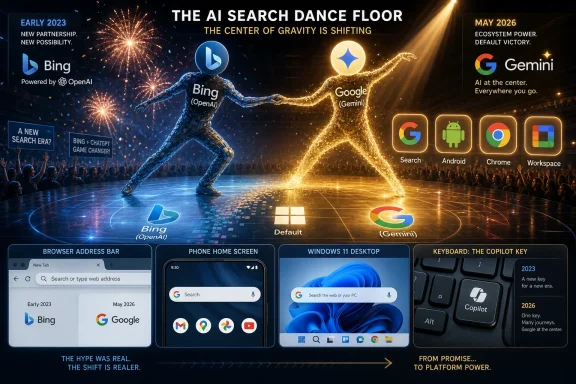
Microsoft put an OpenAI-powered Bing and Edge in front of the public in February 2023, built around a proprietary orchestration layer called Prometheus, but by May 2026 the search-AI momentum has reportedly swung toward Google’s Gemini because Google has embedded AI more deeply into Search, Chrome, and Android. That reversal is not a simple tale of one model beating another in a lab. It is a reminder that search is not won by the smartest demo alone. It is won by the company that can put the assistant where the user already is, at the moment the user is about to ask.
Microsoft’s early advantage was real. The company moved first, moved loudly, and did something rare in consumer search: it made Bing interesting. Satya Nadella’s famous “made them dance” line captured a moment when Microsoft looked less like the enterprise incumbent and more like the insurgent forcing Google to defend its home turf.
But the longer arc of the story is less flattering to Redmond. Microsoft treated AI search as a chance to reintroduce Bing and Edge to users who had already made different choices. Google treated AI search as a renovation of the surfaces users were already touching hundreds of times a week.
The February 2023 Bing launch was the kind of event Microsoft had spent years trying to create. Search had been a sleepy duopoly in practice, with Google commanding the verb and Bing occupying the browser-default trenches of Windows, enterprise policy, and rewards programs. Then generative AI arrived, and suddenly Bing had a story that did not begin with “it is the default in Edge.”
Prometheus mattered because it was not just a chatbot bolted onto a search box. Microsoft described it as a set of techniques that connected OpenAI’s model capabilities with Bing’s index, query interpretation, ranking systems, and citation machinery. In plain English, Microsoft was trying to solve the central weakness of standalone chatbots: they sound confident even when they do not know what happened yesterday.
That was a credible technical bet. Search needs freshness, provenance, ranking, safety filters, and query reformulation. A language model alone is not a search engine, and Microsoft understood that before much of the market did.
The problem was not that Microsoft misunderstood the architecture. The problem was that it overestimated how much architecture can compensate for habit. Users did not wake up in 2023 looking for a new search engine. They woke up looking for answers, usually through the same browser, phone, widget, address bar, and default search provider they had used the day before.
Google’s great advantage was not that it had no panic. It clearly did. The early Bard era looked defensive, rushed, and occasionally clumsy. But Google had time, money, distribution, and the most valuable search muscle memory on Earth. Microsoft had the spark. Google had the room, the wiring, and the light switches.
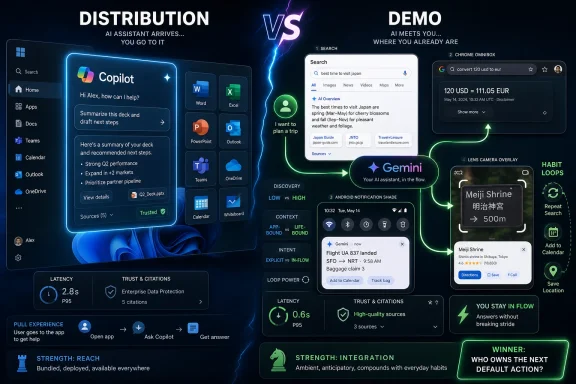
Microsoft’s Copilot strategy has often asked users to go somewhere: click the Copilot icon, open the sidebar, visit the Copilot site, use Edge, or tolerate a panel appearing in Windows. Google’s Gemini strategy has increasingly asked users to do what they already do: search in Google, browse in Chrome, speak to Android, use Lens, summarize a page, or continue a task across Google’s own surfaces.
That difference sounds small until you scale it across billions of daily actions. A feature that appears naturally inside a search result, browser omnibox, phone assistant, or mobile intent surface can become part of user behavior without the user deciding to “adopt AI.” A feature that lives behind a separate brand must win a conscious choice.
This is why the WindowsLatest framing, as summarized by Let’s Data Science, lands with force. Microsoft may have made Google dance in 2023, but Google appears to have learned the choreography and moved it into the house system. Gemini is no longer merely a chatbot competitor. It is becoming the connective tissue between search, browser, mobile operating system, productivity software, and multimodal input.
Copilot, by contrast, has suffered from a kind of identity sprawl. It is in Windows, Edge, Bing, Microsoft 365, GitHub, Security, Azure, and enterprise workflows. Some of those versions are powerful and genuinely useful. But the consumer search story has not achieved the same inevitability as Google’s “AI appears where Google Search already lives” approach.
Microsoft put Copilot everywhere in a branding sense. Google is putting Gemini everywhere in a behavioral sense. Those are not the same thing.
That is why Google’s Chrome and Android distribution matters so much. Chrome is not just a browser; it is a daily interface for work, shopping, entertainment, documentation, troubleshooting, and identity. Android is not just a mobile OS; it is a permissioned layer over notifications, camera input, voice, location, app intents, and on-device context.
If Gemini can sit across those layers with acceptable latency and tolerable privacy controls, Google does not need to convince users to switch to an “AI search engine.” It can convert existing searches into AI-mediated searches one rollout at a time.
Microsoft has Windows, of course, and Windows remains enormously important. But Windows is no longer the primary search surface for many consumer moments. The phone captured much of that territory years ago. Even on PCs, Chrome’s dominance means Windows ownership does not automatically translate into browser ownership, and browser ownership does not automatically translate into search loyalty if users actively install what they prefer.
Edge has improved substantially, and Bing is better than its reputation in many categories. But “better than people think” is not a distribution strategy. Google’s advantage is that people do not have to think about it at all.
That threat was existential enough to rattle Google’s narrative. For two decades, Google had been the company that organized the world’s information. Suddenly, Microsoft was arguing that organization was no longer enough. Users wanted synthesis, conversation, task completion, and a browser that understood the page in front of them.
But forcing a giant to move is not the same as defeating it. In hindsight, the dance metaphor cuts both ways. Microsoft did make Google dance. Google then used the dance floor it already owned.
The market has seen this pattern before. A challenger introduces a new interaction model, the incumbent looks slow, and the first round of commentary declares the platform shift underway. Then the incumbent integrates the new model into its distribution channels, sands off the rough edges, and turns the challenger’s wedge into a feature.
That does not mean Microsoft’s move failed. It accelerated the entire industry. It gave Bing relevance, pushed Google to ship faster, and established the expectation that search should be conversational and assistive. But it did not break Google’s search habit loop.
The harsher reading is that Microsoft spent its surprise advantage waking the sleeping incumbent. The more generous reading is that Microsoft changed the product category even if it did not change the leaderboard. Both can be true.
Microsoft has tried to make Windows feel like an AI-native environment. The Copilot key, the taskbar button, the sidebar experiments, Recall-adjacent concepts, semantic search, and on-device model work all point in the same direction. Microsoft wants Windows to become an operating system that understands user intent rather than simply launching applications and managing files.
That ambition is logical. Windows still has unmatched reach in commercial desktops, gaming PCs, education labs, engineering workstations, and managed enterprise fleets. If Microsoft can make Copilot genuinely useful inside that environment, especially for local search, settings, files, app actions, and administrative workflows, it has an advantage Google cannot easily replicate.
But consumer search does not begin and end at the desktop anymore. The “where should we eat,” “what is this plant,” “summarize this page,” “compare these products,” “translate this sign,” and “what does this error mean” moments often start on mobile. Even when they start on a PC, they often start in Chrome rather than the Windows shell.
That is why Google’s Android and Chrome integration matters more than any single Gemini model score. The AI assistant that sees the page, the tab, the camera, the selected text, and the search query has more context than an assistant waiting behind a generic button. Context is the new default setting.
Microsoft can still make Windows a powerful Copilot surface, but it has to solve a harder problem than Google. It must persuade users that the operating system assistant is the right place to ask questions that the browser and phone already answer.
Microsoft 365 Copilot, GitHub Copilot, Security Copilot, Azure AI services, and the broader OpenAI partnership give Microsoft deep access to business workflows. In many companies, the valuable AI question is not “which assistant searches the public web better?” but “which assistant can summarize a Teams meeting, draft a PowerPoint, query internal documents, triage an incident, or help a developer inside an approved toolchain?”
That is Microsoft’s home ground. It owns the productivity layer for huge swaths of enterprise work. It owns identity, compliance, management, endpoint tooling, and many of the admin consoles where AI assistance can save measurable time.
Google Workspace and Gemini for Workspace are credible competitors, but Microsoft’s enterprise lock-in is real. The company does not need Copilot to become the dominant consumer search assistant for Copilot to matter commercially. A sysadmin using Copilot to reason over logs, a developer using GitHub Copilot to refactor code, or a compliance team using AI to classify documents may never care whether Bing gained two points of consumer search share.
Still, search has symbolic and strategic weight. Search is where user intent becomes monetizable. It is where ads, answers, shopping, local discovery, and web traffic converge. If Google succeeds in transforming search without losing the user, it protects one of the most profitable businesses in technology while redefining the interface around Gemini.
Microsoft can win many AI markets and still lose the AI-search narrative. That is the nuance. It is also the discomfort.
Google’s Gemini push in search benefits from tight integration with ranking infrastructure and user behavior data. Microsoft’s Prometheus concept recognized the same need: language models must be grounded in the index and wrapped in search-specific orchestration. The technical philosophies are closer than the brand war suggests.
Where they differ is in the maturity of the surrounding ecosystem. Google can test AI answers against search behavior at enormous scale. It can tune when AI should appear, when it should stay out of the way, and how to balance generated summaries against traditional links. It can use Chrome and Android to extend the assistant beyond the results page.
Microsoft can test at scale too, but not with the same default consumer search surface. It can use Windows and Edge, but both come with baggage. Windows users have grown wary of prompts, nudges, ads, and settings that appear to privilege Microsoft services. Edge has passionate defenders, but its aggressive promotion inside Windows has also created resentment.
Trust is not only about whether the model lies. It is about whether the product respects the user’s intent. If AI search feels like help, it gets adopted. If it feels like a funnel, it gets closed.
Microsoft’s Bing Copilot raised similar questions, but Google’s scale makes them harder to dismiss. When Google changes search presentation, entire industries feel it. SEO teams, newsrooms, review sites, forums, and documentation publishers all have to adapt to a world where ranking first may matter less if the answer box absorbs the query.
For power users, the picture is mixed. AI search can be excellent for synthesis, troubleshooting, comparison, and unfamiliar domains. It can also flatten nuance, hide sources behind polished prose, and make it harder to inspect the path from query to answer.
For sysadmins and IT pros, the practical concerns are sharper. Browser-level and OS-level AI features create new questions about data handling, account boundaries, logging, tenant controls, extension policy, local model downloads, and whether sensitive page content is being summarized by systems outside the organization’s preferred compliance perimeter.
That is where the Gemini-versus-Copilot contest becomes more than consumer theater. If Chrome, Edge, Windows, Android, and productivity suites all become AI surfaces, administrators will need to manage assistants the way they manage browsers, password managers, sync, telemetry, and cloud storage. The assistant is becoming part of the endpoint.
That would be the wrong lesson. Microsoft does not need more Copilot-shaped furniture. It needs Copilot to solve problems that Windows users already have, in places where Microsoft has legitimate context and permission.
Local file search is one such battleground. Windows search has long been a punchline among power users, especially compared with third-party launchers and indexing tools. If Copilot can safely and privately reason over local files, settings, installed apps, logs, screenshots, and user workflows, it could make Windows feel meaningfully smarter.
System troubleshooting is another. A Windows-native assistant that can diagnose driver conflicts, explain Event Viewer entries, suggest Group Policy settings, identify update failures, and produce PowerShell commands with clear rollback steps would be more valuable to this audience than another generic web chatbot.
Enterprise administration is even more promising. Copilot inside Intune, Defender, Entra, Purview, and Windows Autopatch could become a real operational layer if it reduces toil without inventing confident nonsense. Microsoft should lean into the workflows where it owns the data model and the user has a job to do.
The consumer search war may favor Google’s distribution, but the Windows intelligence war is still Microsoft’s to lose. The difference is that it will be won by usefulness, not ubiquity theater.
For Windows users and IT pros, the concrete implications are already visible:
Microsoft’s early advantage was real. The company moved first, moved loudly, and did something rare in consumer search: it made Bing interesting. Satya Nadella’s famous “made them dance” line captured a moment when Microsoft looked less like the enterprise incumbent and more like the insurgent forcing Google to defend its home turf.
But the longer arc of the story is less flattering to Redmond. Microsoft treated AI search as a chance to reintroduce Bing and Edge to users who had already made different choices. Google treated AI search as a renovation of the surfaces users were already touching hundreds of times a week.
 Microsoft Won the Opening Scene, Not the Distribution War
The February 2023 Bing launch was the kind of event Microsoft had spent years trying to create. Search had been a sleepy duopoly in practice, with Google commanding the verb and Bing occupying the browser-default trenches of Windows, enterprise policy, and rewards programs. Then generative AI arrived, and suddenly Bing had a story that did not begin with “it is the default in Edge.”Prometheus mattered because it was not just a chatbot bolted onto a search box. Microsoft described it as a set of techniques that connected OpenAI’s model capabilities with Bing’s index, query interpretation, ranking systems, and citation machinery. In plain English, Microsoft was trying to solve the central weakness of standalone chatbots: they sound confident even when they do not know what happened yesterday.
That was a credible technical bet. Search needs freshness, provenance, ranking, safety filters, and query reformulation. A language model alone is not a search engine, and Microsoft understood that before much of the market did.
The problem was not that Microsoft misunderstood the architecture. The problem was that it overestimated how much architecture can compensate for habit. Users did not wake up in 2023 looking for a new search engine. They woke up looking for answers, usually through the same browser, phone, widget, address bar, and default search provider they had used the day before.
Google’s great advantage was not that it had no panic. It clearly did. The early Bard era looked defensive, rushed, and occasionally clumsy. But Google had time, money, distribution, and the most valuable search muscle memory on Earth. Microsoft had the spark. Google had the room, the wiring, and the light switches.
Gemini Became a Layer While Copilot Remained a Destination
The most important distinction between Gemini and Copilot in search is not branding. It is placement.Microsoft’s Copilot strategy has often asked users to go somewhere: click the Copilot icon, open the sidebar, visit the Copilot site, use Edge, or tolerate a panel appearing in Windows. Google’s Gemini strategy has increasingly asked users to do what they already do: search in Google, browse in Chrome, speak to Android, use Lens, summarize a page, or continue a task across Google’s own surfaces.
That difference sounds small until you scale it across billions of daily actions. A feature that appears naturally inside a search result, browser omnibox, phone assistant, or mobile intent surface can become part of user behavior without the user deciding to “adopt AI.” A feature that lives behind a separate brand must win a conscious choice.
This is why the WindowsLatest framing, as summarized by Let’s Data Science, lands with force. Microsoft may have made Google dance in 2023, but Google appears to have learned the choreography and moved it into the house system. Gemini is no longer merely a chatbot competitor. It is becoming the connective tissue between search, browser, mobile operating system, productivity software, and multimodal input.
Copilot, by contrast, has suffered from a kind of identity sprawl. It is in Windows, Edge, Bing, Microsoft 365, GitHub, Security, Azure, and enterprise workflows. Some of those versions are powerful and genuinely useful. But the consumer search story has not achieved the same inevitability as Google’s “AI appears where Google Search already lives” approach.
Microsoft put Copilot everywhere in a branding sense. Google is putting Gemini everywhere in a behavioral sense. Those are not the same thing.
Search Is a Habit Machine, and Google Owns the Habit
Search market share is sticky because users rarely evaluate search engines abstractly. They do not run benchmark suites before asking how to fix a printer driver, compare airfares, decode an error message, or check whether a medication interacts with grapefruit. They type into the box that is already there.That is why Google’s Chrome and Android distribution matters so much. Chrome is not just a browser; it is a daily interface for work, shopping, entertainment, documentation, troubleshooting, and identity. Android is not just a mobile OS; it is a permissioned layer over notifications, camera input, voice, location, app intents, and on-device context.
If Gemini can sit across those layers with acceptable latency and tolerable privacy controls, Google does not need to convince users to switch to an “AI search engine.” It can convert existing searches into AI-mediated searches one rollout at a time.
Microsoft has Windows, of course, and Windows remains enormously important. But Windows is no longer the primary search surface for many consumer moments. The phone captured much of that territory years ago. Even on PCs, Chrome’s dominance means Windows ownership does not automatically translate into browser ownership, and browser ownership does not automatically translate into search loyalty if users actively install what they prefer.
Edge has improved substantially, and Bing is better than its reputation in many categories. But “better than people think” is not a distribution strategy. Google’s advantage is that people do not have to think about it at all.
Nadella’s Dance Line Looks Different Three Years Later
Nadella’s “made them dance” line was effective because it was not empty swagger. Microsoft really did force Google into motion. The sudden popularity of ChatGPT and Microsoft’s partnership with OpenAI exposed a vulnerability in Google’s search franchise: if answers could be synthesized conversationally, the classic list of blue links might look old overnight.That threat was existential enough to rattle Google’s narrative. For two decades, Google had been the company that organized the world’s information. Suddenly, Microsoft was arguing that organization was no longer enough. Users wanted synthesis, conversation, task completion, and a browser that understood the page in front of them.
But forcing a giant to move is not the same as defeating it. In hindsight, the dance metaphor cuts both ways. Microsoft did make Google dance. Google then used the dance floor it already owned.
The market has seen this pattern before. A challenger introduces a new interaction model, the incumbent looks slow, and the first round of commentary declares the platform shift underway. Then the incumbent integrates the new model into its distribution channels, sands off the rough edges, and turns the challenger’s wedge into a feature.
That does not mean Microsoft’s move failed. It accelerated the entire industry. It gave Bing relevance, pushed Google to ship faster, and established the expectation that search should be conversational and assistive. But it did not break Google’s search habit loop.
The harsher reading is that Microsoft spent its surprise advantage waking the sleeping incumbent. The more generous reading is that Microsoft changed the product category even if it did not change the leaderboard. Both can be true.
Copilot’s Windows Problem Is That Windows Is Not the Web
For WindowsForum readers, the most interesting part of this contest is not which chatbot gives the better dinner recommendation. It is what this says about Windows as an AI distribution platform.Microsoft has tried to make Windows feel like an AI-native environment. The Copilot key, the taskbar button, the sidebar experiments, Recall-adjacent concepts, semantic search, and on-device model work all point in the same direction. Microsoft wants Windows to become an operating system that understands user intent rather than simply launching applications and managing files.
That ambition is logical. Windows still has unmatched reach in commercial desktops, gaming PCs, education labs, engineering workstations, and managed enterprise fleets. If Microsoft can make Copilot genuinely useful inside that environment, especially for local search, settings, files, app actions, and administrative workflows, it has an advantage Google cannot easily replicate.
But consumer search does not begin and end at the desktop anymore. The “where should we eat,” “what is this plant,” “summarize this page,” “compare these products,” “translate this sign,” and “what does this error mean” moments often start on mobile. Even when they start on a PC, they often start in Chrome rather than the Windows shell.
That is why Google’s Android and Chrome integration matters more than any single Gemini model score. The AI assistant that sees the page, the tab, the camera, the selected text, and the search query has more context than an assistant waiting behind a generic button. Context is the new default setting.
Microsoft can still make Windows a powerful Copilot surface, but it has to solve a harder problem than Google. It must persuade users that the operating system assistant is the right place to ask questions that the browser and phone already answer.
The Enterprise Story Is Less One-Sided Than the Search Story
It would be a mistake to treat “Gemini beats Copilot in search” as “Google beats Microsoft in AI.” The enterprise market is more complicated, and Microsoft’s position there remains formidable.Microsoft 365 Copilot, GitHub Copilot, Security Copilot, Azure AI services, and the broader OpenAI partnership give Microsoft deep access to business workflows. In many companies, the valuable AI question is not “which assistant searches the public web better?” but “which assistant can summarize a Teams meeting, draft a PowerPoint, query internal documents, triage an incident, or help a developer inside an approved toolchain?”
That is Microsoft’s home ground. It owns the productivity layer for huge swaths of enterprise work. It owns identity, compliance, management, endpoint tooling, and many of the admin consoles where AI assistance can save measurable time.
Google Workspace and Gemini for Workspace are credible competitors, but Microsoft’s enterprise lock-in is real. The company does not need Copilot to become the dominant consumer search assistant for Copilot to matter commercially. A sysadmin using Copilot to reason over logs, a developer using GitHub Copilot to refactor code, or a compliance team using AI to classify documents may never care whether Bing gained two points of consumer search share.
Still, search has symbolic and strategic weight. Search is where user intent becomes monetizable. It is where ads, answers, shopping, local discovery, and web traffic converge. If Google succeeds in transforming search without losing the user, it protects one of the most profitable businesses in technology while redefining the interface around Gemini.
Microsoft can win many AI markets and still lose the AI-search narrative. That is the nuance. It is also the discomfort.
The Real Benchmark Is Latency, Trust, and Placement
Model comparisons make good headlines because they compress a messy product reality into a scoreboard. But search assistants are not judged like chess engines. They are judged in milliseconds, defaults, citations, summaries, page layout, privacy prompts, hallucination rates, and whether the answer arrives before the user gives up.Google’s Gemini push in search benefits from tight integration with ranking infrastructure and user behavior data. Microsoft’s Prometheus concept recognized the same need: language models must be grounded in the index and wrapped in search-specific orchestration. The technical philosophies are closer than the brand war suggests.
Where they differ is in the maturity of the surrounding ecosystem. Google can test AI answers against search behavior at enormous scale. It can tune when AI should appear, when it should stay out of the way, and how to balance generated summaries against traditional links. It can use Chrome and Android to extend the assistant beyond the results page.
Microsoft can test at scale too, but not with the same default consumer search surface. It can use Windows and Edge, but both come with baggage. Windows users have grown wary of prompts, nudges, ads, and settings that appear to privilege Microsoft services. Edge has passionate defenders, but its aggressive promotion inside Windows has also created resentment.
Trust is not only about whether the model lies. It is about whether the product respects the user’s intent. If AI search feels like help, it gets adopted. If it feels like a funnel, it gets closed.
Publishers, Power Users, and Admins Are All Staring at the Same Shift
For publishers, AI search changes the economics of being found. A generated answer can satisfy the user before a click happens. Google’s AI Overviews and AI Mode-style experiences raise familiar questions about attribution, referral traffic, and whether the open web becomes raw material for answer engines.Microsoft’s Bing Copilot raised similar questions, but Google’s scale makes them harder to dismiss. When Google changes search presentation, entire industries feel it. SEO teams, newsrooms, review sites, forums, and documentation publishers all have to adapt to a world where ranking first may matter less if the answer box absorbs the query.
For power users, the picture is mixed. AI search can be excellent for synthesis, troubleshooting, comparison, and unfamiliar domains. It can also flatten nuance, hide sources behind polished prose, and make it harder to inspect the path from query to answer.
For sysadmins and IT pros, the practical concerns are sharper. Browser-level and OS-level AI features create new questions about data handling, account boundaries, logging, tenant controls, extension policy, local model downloads, and whether sensitive page content is being summarized by systems outside the organization’s preferred compliance perimeter.
That is where the Gemini-versus-Copilot contest becomes more than consumer theater. If Chrome, Edge, Windows, Android, and productivity suites all become AI surfaces, administrators will need to manage assistants the way they manage browsers, password managers, sync, telemetry, and cloud storage. The assistant is becoming part of the endpoint.
Microsoft’s Best Response Is Not Another Button
The temptation for Microsoft is obvious: add more Copilot entry points. Put it in more corners of Windows. Promote it harder in Bing. Make Edge more assertive. Remind users that Copilot exists until the reminder becomes impossible to ignore.That would be the wrong lesson. Microsoft does not need more Copilot-shaped furniture. It needs Copilot to solve problems that Windows users already have, in places where Microsoft has legitimate context and permission.
Local file search is one such battleground. Windows search has long been a punchline among power users, especially compared with third-party launchers and indexing tools. If Copilot can safely and privately reason over local files, settings, installed apps, logs, screenshots, and user workflows, it could make Windows feel meaningfully smarter.
System troubleshooting is another. A Windows-native assistant that can diagnose driver conflicts, explain Event Viewer entries, suggest Group Policy settings, identify update failures, and produce PowerShell commands with clear rollback steps would be more valuable to this audience than another generic web chatbot.
Enterprise administration is even more promising. Copilot inside Intune, Defender, Entra, Purview, and Windows Autopatch could become a real operational layer if it reduces toil without inventing confident nonsense. Microsoft should lean into the workflows where it owns the data model and the user has a job to do.
The consumer search war may favor Google’s distribution, but the Windows intelligence war is still Microsoft’s to lose. The difference is that it will be won by usefulness, not ubiquity theater.
The Lesson From Gemini’s Surge Is Brutally Practical
The story is not that Microsoft was foolish to bet on OpenAI, or that Bing’s AI launch was fake momentum. The story is that search is a distribution business wearing a technology costume. The model matters, but the route to the user matters more.For Windows users and IT pros, the concrete implications are already visible:
- Google’s advantage in AI search comes from putting Gemini into existing Search, Chrome, and Android workflows rather than asking users to adopt a separate destination.
- Microsoft’s Prometheus-era Bing launch was technically important, but it did not overcome entrenched search habits or Google’s control of default consumer surfaces.
- Copilot remains strategically strong in Microsoft’s enterprise ecosystem, especially where it can operate inside Microsoft 365, GitHub, Azure, Security, and device-management workflows.
- Browser and operating-system AI features will increasingly become policy issues for administrators, not just convenience features for users.
- Microsoft’s best Windows play is to make Copilot excellent at local, contextual, permission-aware tasks that Google cannot perform from the search page alone.
References
- Primary source: Let's Data Science
Published: Sun, 24 May 2026 20:48:32 GMT
Gemini Outperforms Microsoft's Copilot in Search | Let's Data Science
WindowsLatest reports that in 2023 Microsoft integrated a custom OpenAI model, internally dubbed `Prometheus`, into Edge and Bing, and quotes CEO Satya Nadella saying, "Google is the 800-pound gorilla in search... I want people to know that we made them dance," per WindowsLatest... letsdatascience.com
- Related coverage: androidcentral.com
Google thinks Gemini 3.5 Flash can finally make AI agents more useful | Android Central
Google just supercharged AI speed with Gemini 3.5 Flash, but the Pro model is still weeks away.www.androidcentral.com - Related coverage: pcgamer.com
'AI Mode has been a revelation, our biggest upgrade to Search ever. People love it,' says Google CEO | PC Gamer
But I still think there's an AI industry bubble that could burst.www.pcgamer.com - Related coverage: axios.com
Google unveils broad new push to put AI everywhere
The search giant showcased a range of AI initiatives.www.axios.com
- Related coverage: techradar.com
Gemini Intelligence hardware requirements revealed — here's which Samsung, Google, and other Android phones can run Create My Widget, Rambler, and more | TechRadar
The Pixel 9 series, Galaxy S25 line, and more probably won't get itwww.techradar.com - Related coverage: windowslatest.com
Microsoft Bing is aggressively pushing Copilot when people search for ChatGPT or Gemini, and it's embarrassing
In our tests, Windows Latest observed that Bing now shows an interactive Copilot widget when you search for ChatGPT and Gemini. www.windowslatest.com
- Related coverage: techcrunch.com
Google brings Gemini in Chrome to US users, unveils agentic browsing capabilities, and more | TechCrunch
Google says the AI assistant will be able to complete tedious tasks for users, like booking a haircut or ordering weekly groceries.techcrunch.com - Related coverage: winbuzzer.com
Google Rolls Android AI Into Gemini Intelligence Push
Google has launched Gemini Intelligence for Android, bundling Chrome, Autofill, and task automation with new privacy controls and a wider 2026 rollout. winbuzzer.com
- Related coverage: android.gadgethacks.com
How Gemini in Chrome on Android Works: Features, Access, and Privacy << Android :: Gadget Hacks
Google last week announced a feature that changes what happens after you open a link on your phone. Starting late June, Gemini in Chrome on Android will... android.gadgethacks.com
- Related coverage: fortune.com
Microsoft CEO says he hopes Google is ready to compete on A.I. search and ‘show that they can dance’ | Fortune
He added that Google is the “800-pound gorilla in this.”fortune.com
- Related coverage: gadgets.beebom.com
Chrome on Android Is Getting Gemini AI Features That Can Auto Browse and Complete Tasks for You | Beebom Gadgets
Google has announced a slew of new Gemini features that are coming to Chrome on Android, including Personal Intelligence.gadgets.beebom.com - Official source: news.microsoft.com