

CVE-2026-34182 is an OpenSSL vulnerability published on June 9, 2026, in which CMS AuthEnvelopedData handling may accept forged messages because OpenSSL does not sufficiently validate cipher choices and authentication tag lengths. The MSRC link circulating with the CVE currently resolves to a failed “not found” page, which matters because this is not, on the available evidence, a normal Microsoft Security Update Guide entry. The bug is still relevant to Windows shops, but the work begins with OpenSSL inventory, not with waiting for Windows Update to save the day.
A failed Microsoft Security Response Center page can make a vulnerability feel more mysterious than it is. In this case, the page text says the Security Update Guide entry was not found and the request failed, while the CVE itself is visible in third-party vulnerability feeds and is assigned to OpenSSL. That mismatch should push administrators away from treating this as a missing Patch Tuesday item and toward the less comfortable reality: many Windows environments carry OpenSSL inside applications Microsoft does not patch.
That is the recurring problem with cryptographic library flaws on Windows. The operating system has its own cryptographic stack, but the Windows software ecosystem is full of products that embed OpenSSL for TLS, S/MIME, PKCS#7/CMS workflows, update clients, VPN tooling, developer runtimes, backup agents, and appliances with Windows management components. If a scanner reports “OpenSSL” on a Windows endpoint, it may be pointing at a bundled DLL in an application folder rather than a Microsoft-owned component.
The MSRC dead end therefore should not be read as proof that the issue is irrelevant to Windows. It is proof that the ownership boundary is elsewhere. Microsoft may eventually document exposure for a product that ships a vulnerable OpenSSL build, but CVE-2026-34182 is, at its core, an upstream OpenSSL issue.
The public description identifies two broad failure modes. In one, an attacker can reportedly take a legitimate AuthEnvelopedData message for a recipient and rewrite the inner content-encryption algorithm from an authenticated encryption mode such as AES-GCM to a non-AEAD mode such as AES-OFB. OpenSSL may then proceed as if this were an acceptable message, using the real content-encryption key but bypassing the integrity property the sender and application expected.
The second failure mode is more compact but just as serious in the right application. If the authentication tag length can be reduced to a trivially small value, the attacker’s brute-force problem changes dramatically. A tag that is supposed to make modification infeasible becomes short enough that repeated attempts may become practical, depending on how the application behaves.
This is why the phrase “may accept forged messages” undersells the issue. The frightening part is not merely that malformed CMS data is accepted. It is that an application may receive a clean success result from a library call and then make a security decision on the assumption that authenticity has been verified.
The attack also depends on application behavior. If a product never processes attacker-supplied CMS AuthEnvelopedData, it is unlikely to be directly exposed. If it does process that data but treats all failure and success paths identically, some oracle-style risks may be blunted. But if it decrypts CMS objects from untrusted sources and leaks success, failure, timing, workflow state, or downstream processing differences, the bug becomes much more interesting.
That last sentence describes more software than many vendors would like to admit. Security boundaries often emerge accidentally from business logic: a helpdesk ticket parser, a secure message gateway, a document ingestion service, an IoT provisioning tool, or an internal automation job that trusts CMS_decrypt() as the gatekeeper. The bug lives in OpenSSL, but the exploitability lives in the application’s assumptions.
For Windows administrators, that makes the investigation awkward. You cannot answer exposure merely by asking whether the host has OpenSSL. You need to know which executable loads it, what version it is, and whether the relevant CMS APIs are reachable from untrusted input.
The OpenSSL project also states that its FIPS modules are not affected. That is useful but should not become a lazy exemption. A product can include a FIPS-validated module and still ship non-FIPS OpenSSL code paths, helper binaries, or legacy libraries elsewhere in the installation directory. Compliance labels are not a substitute for version and load-path evidence.
The practical remediation path is branch-specific updating. Teams should look for vendor updates that move OpenSSL to fixed releases or backport the relevant patches. In enterprise environments, the most reliable answer is often not replacing DLLs by hand but applying the application vendor’s update, because OpenSSL ABI compatibility and provider configuration can turn a “quick file swap” into an outage.
The unpleasant truth is that vulnerability scanners will probably find this issue faster than vendors publish Windows-specific remediation notes. That creates a familiar gap: the security team sees CVE-2026-34182, the desktop or server team sees no Microsoft patch, and the application owner says the product is “up to date.” The only way out is inventory tied to application ownership.
That software supply chain is where OpenSSL bugs become Windows operational problems. A single workstation can contain multiple OpenSSL copies under different directories, each with a different patch cadence. A developer machine might have OpenSSL under Git, Python, Node-adjacent tooling, container images, WSL distributions, package caches, and vendor SDKs. A server might have one copy used by a business-critical service and four others that only exist because an installer never cleaned them up.
Defender Vulnerability Management, Intune, third-party scanners, and EDR inventory tools are increasingly good at spotting library versions. They are less good at telling you whether a particular DLL is loadable, reachable, or used for CMS AuthEnvelopedData. That gap is where remediation fatigue sets in: every OpenSSL CVE becomes a spreadsheet fight over “real” versus “detected” risk.
CVE-2026-34182 is a useful forcing function because it is not enough to know that OpenSSL exists. The business question is whether a reachable workflow processes CMS AuthEnvelopedData from untrusted or semi-trusted sources. Security teams should press vendors for that answer rather than accepting generic statements about TLS exposure.
That invisibility is part of the risk. Developers may call high-level OpenSSL CMS routines without deeply understanding every algorithm constraint inside the standard. Administrators may not know that a business process depends on CMS at all. Security reviewers may test the happy path of decryption and signature handling without attempting algorithm-substitution or tag-length abuse.
The reported bug is a reminder that cryptographic APIs are contracts. If an API says decryption succeeded, application code often treats that as an authorization event, not merely a parsing event. When the contract is too permissive, the application inherits a security failure it did not explicitly code.
This is also why “no public exploitation observed” would not be a reason for complacency. Bugs in cryptographic message validation often age badly. They may be hard to exploit generically, but once researchers or attackers find a product that exposes the right oracle, the vulnerability moves from theoretical to highly specific.
On Windows, the investigation should include file-system searches for common OpenSSL library names, application manifests, EDR software inventory, vulnerability-management detections, and vendor SBOMs where available. But file presence alone is noisy. The higher-value work is correlating a vulnerable OpenSSL copy with a running service, an exposed network path, a message ingestion function, or a user-facing application that handles encrypted content.
Application vendors should be asked three specific things in plain language. Do you ship an affected OpenSSL version? Do you invoke CMS AuthEnvelopedData processing on untrusted input? If yes, what fixed build or mitigation should customers deploy? Anything less precise will turn into weeks of circular ticket updates.
There is also a container and WSL angle for Windows-heavy shops. A vulnerability may not sit in a Windows directory at all; it may live in a Linux container image deployed from a Windows developer workstation or built by a Windows-hosted CI runner. The operating system label on the asset is less important than the library version in the execution environment.
That variability frustrates executives and auditors because it resists a clean “critical/high/medium” narrative. But it is the honest narrative. The OpenSSL bug creates a class of possible failures; the application decides whether the class is reachable.
Security teams should avoid two equally bad responses. One is minimizing the bug because it is not a TLS remote-code-execution disaster. The other is declaring an emergency across every Windows endpoint merely because a scanner found a vulnerable OpenSSL string. Both reactions waste time and reduce trust.
The better message is narrower and stronger: systems that process CMS AuthEnvelopedData with affected OpenSSL builds need prompt vendor updates or compensating controls, especially where attackers can submit messages repeatedly and observe success or failure. That is a defensible statement an application owner can act on.
The best vendors will publish precise advisories. They will name affected product versions, fixed versions, whether the vulnerable code path is reachable, and whether the product uses OpenSSL FIPS modules in a way that changes exposure. They will not hide behind vague statements that “OpenSSL is included but not believed to be exploitable” without explaining why.
The weakest vendors will let scanners do their customer communications for them. Their software will light up dashboards, support will initially deny exposure, and customers will spend days proving that a DLL shipped inside the vendor’s own installer. That pattern is not unique to this CVE, but this CVE is a clean example of why dependency transparency matters.
For WindowsForum readers, the lesson is practical. If your fleet has recurring OpenSSL findings in Microsoft Defender, Intune, or another vulnerability platform, build the ownership map now. The next OpenSSL issue will not wait for you to decide which team owns a copy buried under Program Files.
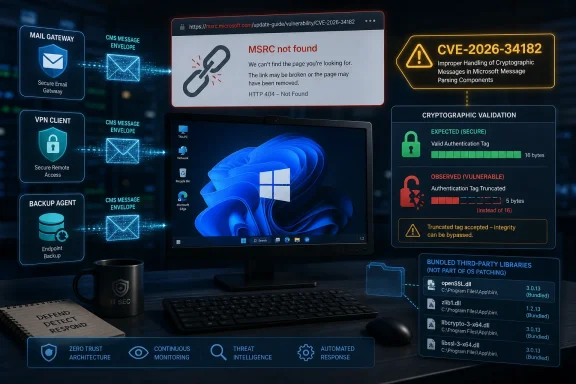 The Broken MSRC Link Is the First Clue, Not the Story
A failed Microsoft Security Response Center page can make a vulnerability feel more mysterious than it is. In this case, the page text says the Security Update Guide entry was not found and the request failed, while the CVE itself is visible in third-party vulnerability feeds and is assigned to OpenSSL. That mismatch should push administrators away from treating this as a missing Patch Tuesday item and toward the less comfortable reality: many Windows environments carry OpenSSL inside applications Microsoft does not patch.That is the recurring problem with cryptographic library flaws on Windows. The operating system has its own cryptographic stack, but the Windows software ecosystem is full of products that embed OpenSSL for TLS, S/MIME, PKCS#7/CMS workflows, update clients, VPN tooling, developer runtimes, backup agents, and appliances with Windows management components. If a scanner reports “OpenSSL” on a Windows endpoint, it may be pointing at a bundled DLL in an application folder rather than a Microsoft-owned component.
The MSRC dead end therefore should not be read as proof that the issue is irrelevant to Windows. It is proof that the ownership boundary is elsewhere. Microsoft may eventually document exposure for a product that ships a vulnerable OpenSSL build, but CVE-2026-34182 is, at its core, an upstream OpenSSL issue.
This Is a Message-Authenticity Bug, Not Another Generic Crypto Panic
The affected feature is CMS, short for Cryptographic Message Syntax, a standard used to wrap encrypted, signed, or authenticated data. AuthEnvelopedData is the CMS structure meant to provide authenticated encryption: the recipient should be able to decrypt the message and trust that the protected content was not silently altered. That promise collapses if the library accepts combinations of algorithms or tag lengths that should never have passed validation.The public description identifies two broad failure modes. In one, an attacker can reportedly take a legitimate AuthEnvelopedData message for a recipient and rewrite the inner content-encryption algorithm from an authenticated encryption mode such as AES-GCM to a non-AEAD mode such as AES-OFB. OpenSSL may then proceed as if this were an acceptable message, using the real content-encryption key but bypassing the integrity property the sender and application expected.
The second failure mode is more compact but just as serious in the right application. If the authentication tag length can be reduced to a trivially small value, the attacker’s brute-force problem changes dramatically. A tag that is supposed to make modification infeasible becomes short enough that repeated attempts may become practical, depending on how the application behaves.
This is why the phrase “may accept forged messages” undersells the issue. The frightening part is not merely that malformed CMS data is accepted. It is that an application may receive a clean success result from a library call and then make a security decision on the assumption that authenticity has been verified.
The Attack Requires a Particular Shape, Which Is Both Reassuring and Dangerous
CVE-2026-34182 is not the kind of OpenSSL flaw that instantly maps to “any HTTPS server can be remotely owned.” The advisory language points to CMS AuthEnvelopedData processing, not the mainstream TLS handshake path that most people associate with OpenSSL. That distinction matters because panic patching without exposure analysis is how teams miss the actual vulnerable system while celebrating the wrong green checkmark.The attack also depends on application behavior. If a product never processes attacker-supplied CMS AuthEnvelopedData, it is unlikely to be directly exposed. If it does process that data but treats all failure and success paths identically, some oracle-style risks may be blunted. But if it decrypts CMS objects from untrusted sources and leaks success, failure, timing, workflow state, or downstream processing differences, the bug becomes much more interesting.
That last sentence describes more software than many vendors would like to admit. Security boundaries often emerge accidentally from business logic: a helpdesk ticket parser, a secure message gateway, a document ingestion service, an IoT provisioning tool, or an internal automation job that trusts CMS_decrypt() as the gatekeeper. The bug lives in OpenSSL, but the exploitability lives in the application’s assumptions.
For Windows administrators, that makes the investigation awkward. You cannot answer exposure merely by asking whether the host has OpenSSL. You need to know which executable loads it, what version it is, and whether the relevant CMS APIs are reachable from untrusted input.
The Version Ranges Are Broad Enough to Matter
The affected OpenSSL ranges reported for CVE-2026-34182 cover multiple maintained branches: 4.0.0 through early 4.0 releases, 3.6.x, 3.5.x, 3.4.x, and the long-lived 3.0.x line through 3.0.21. That breadth matters because OpenSSL 3.0 remains common in enterprise packaging, container images, appliances, and vendor software. Even if the newest OpenSSL 4.0 line is not widely deployed in Windows fleets, the older affected branches almost certainly are.The OpenSSL project also states that its FIPS modules are not affected. That is useful but should not become a lazy exemption. A product can include a FIPS-validated module and still ship non-FIPS OpenSSL code paths, helper binaries, or legacy libraries elsewhere in the installation directory. Compliance labels are not a substitute for version and load-path evidence.
The practical remediation path is branch-specific updating. Teams should look for vendor updates that move OpenSSL to fixed releases or backport the relevant patches. In enterprise environments, the most reliable answer is often not replacing DLLs by hand but applying the application vendor’s update, because OpenSSL ABI compatibility and provider configuration can turn a “quick file swap” into an outage.
The unpleasant truth is that vulnerability scanners will probably find this issue faster than vendors publish Windows-specific remediation notes. That creates a familiar gap: the security team sees CVE-2026-34182, the desktop or server team sees no Microsoft patch, and the application owner says the product is “up to date.” The only way out is inventory tied to application ownership.
Windows Is Exposed Through Its Software Supply Chain
Windows itself is not synonymous with OpenSSL. Microsoft’s platform crypto story runs through Schannel, CNG, CryptoAPI, and product-specific libraries. But Windows endpoints are not sterile Microsoft-only systems; they are crowded with browsers, agents, runtimes, Git tooling, language package managers, database clients, VPN clients, observability collectors, backup software, and line-of-business applications.That software supply chain is where OpenSSL bugs become Windows operational problems. A single workstation can contain multiple OpenSSL copies under different directories, each with a different patch cadence. A developer machine might have OpenSSL under Git, Python, Node-adjacent tooling, container images, WSL distributions, package caches, and vendor SDKs. A server might have one copy used by a business-critical service and four others that only exist because an installer never cleaned them up.
Defender Vulnerability Management, Intune, third-party scanners, and EDR inventory tools are increasingly good at spotting library versions. They are less good at telling you whether a particular DLL is loadable, reachable, or used for CMS AuthEnvelopedData. That gap is where remediation fatigue sets in: every OpenSSL CVE becomes a spreadsheet fight over “real” versus “detected” risk.
CVE-2026-34182 is a useful forcing function because it is not enough to know that OpenSSL exists. The business question is whether a reachable workflow processes CMS AuthEnvelopedData from untrusted or semi-trusted sources. Security teams should press vendors for that answer rather than accepting generic statements about TLS exposure.
The CMS Corner Case Is Exactly Where Enterprises Hide Critical Workflows
CMS sounds niche until you list where it appears. It underpins formats and workflows related to signed and encrypted messages, certificate-heavy enterprise systems, secure content exchange, firmware and package-style envelopes, and legacy integrations that predate the current fashion for JSON Web Tokens. It is the kind of plumbing that disappears from architecture diagrams because it has “just worked” for years.That invisibility is part of the risk. Developers may call high-level OpenSSL CMS routines without deeply understanding every algorithm constraint inside the standard. Administrators may not know that a business process depends on CMS at all. Security reviewers may test the happy path of decryption and signature handling without attempting algorithm-substitution or tag-length abuse.
The reported bug is a reminder that cryptographic APIs are contracts. If an API says decryption succeeded, application code often treats that as an authorization event, not merely a parsing event. When the contract is too permissive, the application inherits a security failure it did not explicitly code.
This is also why “no public exploitation observed” would not be a reason for complacency. Bugs in cryptographic message validation often age badly. They may be hard to exploit generically, but once researchers or attackers find a product that exposes the right oracle, the vulnerability moves from theoretical to highly specific.
Patch Management Has to Follow the DLL, Not the CVE Page
The failed MSRC page is a bad starting point for remediation because it encourages the wrong workflow: search Microsoft, wait for Microsoft, close ticket when Microsoft has nothing. For this CVE, the workflow should start with software composition and runtime evidence. Find OpenSSL, map it to products, identify whether CMS APIs are used, and update through the responsible vendor.On Windows, the investigation should include file-system searches for common OpenSSL library names, application manifests, EDR software inventory, vulnerability-management detections, and vendor SBOMs where available. But file presence alone is noisy. The higher-value work is correlating a vulnerable OpenSSL copy with a running service, an exposed network path, a message ingestion function, or a user-facing application that handles encrypted content.
Application vendors should be asked three specific things in plain language. Do you ship an affected OpenSSL version? Do you invoke CMS AuthEnvelopedData processing on untrusted input? If yes, what fixed build or mitigation should customers deploy? Anything less precise will turn into weeks of circular ticket updates.
There is also a container and WSL angle for Windows-heavy shops. A vulnerability may not sit in a Windows directory at all; it may live in a Linux container image deployed from a Windows developer workstation or built by a Windows-hosted CI runner. The operating system label on the asset is less important than the library version in the execution environment.
The Severity Depends on the Product, Which Makes Communication Harder
Cryptographic library vulnerabilities are often assigned a single CVE identity but have many severities in practice. In a mail gateway that processes attacker-supplied encrypted CMS messages and reveals parsing outcomes, CVE-2026-34182 could be a serious authenticity and confidentiality concern. In a desktop application that bundles OpenSSL but never touches CMS, the same CVE may be operational noise.That variability frustrates executives and auditors because it resists a clean “critical/high/medium” narrative. But it is the honest narrative. The OpenSSL bug creates a class of possible failures; the application decides whether the class is reachable.
Security teams should avoid two equally bad responses. One is minimizing the bug because it is not a TLS remote-code-execution disaster. The other is declaring an emergency across every Windows endpoint merely because a scanner found a vulnerable OpenSSL string. Both reactions waste time and reduce trust.
The better message is narrower and stronger: systems that process CMS AuthEnvelopedData with affected OpenSSL builds need prompt vendor updates or compensating controls, especially where attackers can submit messages repeatedly and observe success or failure. That is a defensible statement an application owner can act on.
The Real Test Is Whether Vendors Can Explain Their Own Crypto
CVE-2026-34182 arrives in a software ecosystem that has spent years talking about SBOMs, dependency governance, and supply-chain visibility. This is where those promises become measurable. A vendor that cannot quickly say whether it uses affected OpenSSL CMS code is telling customers something important about its internal inventory.The best vendors will publish precise advisories. They will name affected product versions, fixed versions, whether the vulnerable code path is reachable, and whether the product uses OpenSSL FIPS modules in a way that changes exposure. They will not hide behind vague statements that “OpenSSL is included but not believed to be exploitable” without explaining why.
The weakest vendors will let scanners do their customer communications for them. Their software will light up dashboards, support will initially deny exposure, and customers will spend days proving that a DLL shipped inside the vendor’s own installer. That pattern is not unique to this CVE, but this CVE is a clean example of why dependency transparency matters.
For WindowsForum readers, the lesson is practical. If your fleet has recurring OpenSSL findings in Microsoft Defender, Intune, or another vulnerability platform, build the ownership map now. The next OpenSSL issue will not wait for you to decide which team owns a copy buried under Program Files.
The Useful Work Starts After the Scanner Alert
The immediate response should be disciplined rather than theatrical. CVE-2026-34182 deserves attention, but its risk is concentrated in applications that process CMS AuthEnvelopedData from untrusted sources using affected OpenSSL versions. That makes triage more important than blanket panic.- Treat the MSRC “not found” result as a sign that this is not currently documented as a standard Microsoft Security Update Guide vulnerability.
- Inventory OpenSSL copies on Windows endpoints and servers, including application directories, developer tooling, agents, WSL distributions, and container images.
- Prioritize systems that parse encrypted or authenticated CMS, S/MIME-like content, certificate-heavy messages, secure envelopes, or vendor-specific encrypted payloads.
- Ask vendors whether their products use OpenSSL CMS AuthEnvelopedData processing and whether fixed builds or backported patches are available.
- Avoid unsupported DLL replacement unless the vendor explicitly approves it, because cryptographic library swaps can break providers, ABI expectations, and product validation.
- Track scanner detections to application owners, not merely to hostnames, because the remediation path usually belongs to the product that bundled OpenSSL.
References
- Primary source: MSRC
Published: 2026-06-13T01:03:18-07:00

Security Update Guide - Microsoft Security Response Center
 msrc.microsoft.com
- Official source: microsoft.com
MSRC - Microsoft Security Response Center
The Microsoft Security Response Center is part of the defender community and on the front line of security response evolution. For over twenty years, we have been engaged with security researchers working to protect customers and the broader ecosystem.www.microsoft.com
- Related coverage: test.osv.dev

OSV - Open Source Vulnerabilities
Comprehensive vulnerability database for your open source projects and dependencies.
test.osv.dev
- Related coverage: sra.io
