

Move most managed users to Extended Stable by default in 2026, while keeping Edge Stable for pilot rings, developer-heavy groups, and teams that can validate browser changes every two weeks before Edge 152 starts Stable’s new cadence on August 27, 2026. The decision is not about whether Edge is “better” on one channel. It is about whether your organization can absorb twice as many major-version events without turning browser updates into a permanent emergency lane.
Microsoft’s change gives IT departments a cleaner choice than they had before. Stable becomes the faster-moving security and feature lane; Extended Stable remains the slower enterprise lane. The trap is pretending that one of those is universally safer. In 2026, safety depends on whether your controls, app owners, help desk, extension inventory, and change calendar can keep up.
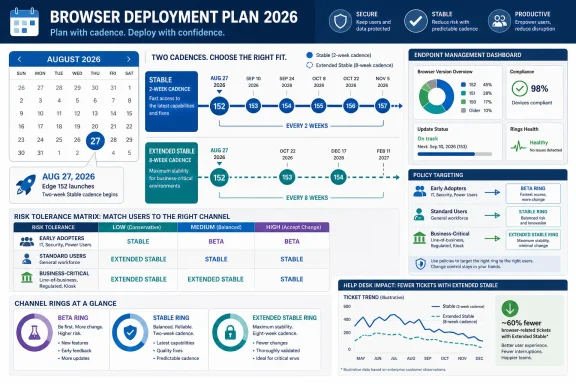
Microsoft Edge Stable moves to a two-week major-version release cycle starting with Edge 152, scheduled for August 27, 2026. Extended Stable remains available for managed enterprise environments and continues on an eight-week cadence. That means the practical fork is simple: Stable gives you faster feature and security delivery, while Extended Stable gives you fewer moments when something new can surprise users.
For small shops, enthusiasts, and modern cloud-first organizations, Stable may be the obvious answer. If your browser stack is mostly Microsoft 365, SaaS, and lightly managed extensions, faster Edge updates are more likely to be background noise than business disruption. The two-week rhythm may even reduce the shock of individual releases because changes arrive in smaller, more frequent packages.
For larger organizations, Extended Stable should be treated as the new default unless there is a specific reason to move faster. Hospitals, banks, manufacturers, schools, government agencies, and regulated businesses rarely measure browser success by novelty. They measure it by whether line-of-business portals, identity flows, printing workflows, device redirection, accessibility tooling, and security extensions behave exactly the same on Monday as they did on Friday.
That does not mean hiding from Stable. It means using Stable deliberately. The clean 2026 model is to run Beta for early warning, Stable for pilots and fast-moving cohorts, and Extended Stable for the broad managed estate.
The mapping is not complicated, but it matters. Before Edge 152, organizations still have time to decide which populations belong on Stable and which should remain on Extended Stable. From Edge 152 onward, Stable users should be expected to see major-version movement every two weeks. Extended Stable users should continue to receive major feature movement on the eight-week enterprise rhythm.
The consequence is that “we’ll test it when it ships” becomes a weaker answer. Microsoft recommends putting a pilot group on Beta and testing from day one to maximize validation time. That recommendation is not decorative. Under a two-week Stable cadence, late testing compresses into a scramble; early testing becomes the only way to preserve calm.
A workable August plan looks like this in prose rather than policy theater: identify your critical browser-dependent workflows now, move a representative pilot population to Beta, assign business owners to validate those workflows, keep a smaller production pilot on Stable, and hold the broad managed estate on Extended Stable until your evidence says otherwise. The organizations that do this before August will treat Edge 152 as a scheduled transition. The organizations that wait will experience it as a recurring interruption.
Stable also makes sense when the organization has a mature ring strategy. If devices are already grouped by risk, if app owners know when they are expected to test, if the help desk has a known escalation path for browser regressions, and if endpoint management can target policies cleanly, the two-week cadence is manageable. In that world, Stable is not chaos; it is just a shorter sprint.
There is also a security argument for staying closer to Stable. Microsoft says security and servicing updates are available only on the latest Stable and Beta releases, which raises the operational cost of lagging behind. A browser is an internet-facing application platform, not a static utility. The longer an organization treats browser updates as optional, the more it must justify that delay against the realities of web security.
But Stable’s security advantage is not free. Faster delivery means more validation events, more release-note review, more pilot feedback, and more coordination with teams that own authentication, extensions, proxy behavior, data-loss prevention, and web apps. If an IT department cannot name who tests those areas, it is not ready to put everyone on the faster channel.
The eight-week cadence gives IT a wider validation window and a quieter user experience. It reduces the number of times help desk teams must ask, “Did Edge just update?” It gives app owners a more realistic chance to test before broad deployment. It also makes it easier to align browser change with existing change-advisory boards, maintenance windows, and business blackout periods.
Extended Stable is not a license to ignore updates. It remains an enterprise option for managed environments, not a museum mode. Security and servicing expectations still matter, and organizations must stay current within the supported model. The value of Extended Stable is controlled pacing, not indefinite delay.
This distinction matters because some admins will hear “two-week Stable” and assume Extended Stable is the bunker. It is better understood as the main road for organizations with high change sensitivity. The bunker is being out of date; Extended Stable is Microsoft’s sanctioned slower lane.
Start with authentication. Edge changes can surface in single sign-on behavior, conditional access prompts, certificate handling, third-party identity flows, profile switching, and session persistence. Even when the browser is not the root cause, it is often the first thing users blame when sign-in changes.
Then look at extensions. Password managers, endpoint security add-ons, compliance capture tools, DLP extensions, accessibility aids, web conferencing helpers, and legacy workflow plugins can all turn a routine browser update into a support ticket. The more business logic you have embedded in extensions, the stronger the case for a staged Stable population and a broad Extended Stable base.
Finally, audit the weird stuff. Printing from web apps, file uploads, camera and microphone permissions, kiosk workflows, PDF handling, protocol links, embedded WebView2 scenarios, and old intranet sites are exactly where “minor browser change” becomes “department cannot work.” Those are the workflows that belong in the pilot plan before August, not after the first angry ticket.
The first practical step is to separate populations. Do not think in terms of “the company uses Stable” or “the company uses Extended Stable.” Think in rings: Beta for early validation, Stable for production pilots and change-tolerant users, Extended Stable for the broad managed estate. The channel decision should be assigned through your normal endpoint-management tooling, not left to whoever installed Edge first.
The second step is to document ownership. Browser validation is not solely an endpoint team job. Identity teams own sign-in flows. Security teams own extensions and inspection behavior. App owners own business workflows. Help desk owns early symptom detection. Without named owners, the two-week cadence will expose the gaps in your operating model.
The third step is to make rollback expectations realistic. Moving channels is not the same as undoing every effect of a browser update, and organizations should be cautious about treating channel switching as an instant fix. The better plan is to catch issues earlier through Beta and Stable pilots, then control broad deployment through Extended Stable where the business requires more predictability.
Low-risk groups are easy to identify. They use common SaaS apps, have modern authentication, rarely depend on fragile extensions, and can tolerate interface or behavior changes. These users can stay on Stable, especially if they include people who will report problems clearly.
Medium-risk groups need more thought. They may use a mix of SaaS and internal portals, rely on a handful of extensions, or work in departments where temporary disruption is annoying but not catastrophic. These users are good candidates for staged Stable deployment, but not necessarily first-wave adoption.
High-risk groups belong on Extended Stable unless there is a strong counterargument. These are users in regulated workflows, customer-facing operations, clinical settings, manufacturing floors, finance close processes, legal discovery, call centers, and environments with specialized hardware or browser-mediated peripherals. For them, the cost of change is measured in operational interruption, not curiosity.
The mistake is treating “security” and “stability” as opposites. They are in tension, but they are not enemies. The right channel is the one that lets an organization remain current without losing control of its working environment.
A good Beta pilot is not just IT volunteers running a browser and hoping to notice something. It should include users from departments with different workflows, device types, extensions, and identity paths. The pilot should include people who can describe what failed, when it failed, and whether the same workflow still works on the broader production channel.
The Beta group should also be visible to the help desk. If pilot users report a broken workflow, that signal should become a validation task before Stable hits the wider population. This is where many enterprises fail: they have pilots, but the feedback disappears into chat threads, ticket comments, or one engineer’s memory.
Beta does not eliminate risk. It turns surprise into a scheduled conversation. In a two-week world, that is often the difference between a manageable release and a noisy incident.
WebView2 is especially important because many desktop applications now rely on web-rendered components without users thinking of them as “the browser.” A faster Edge cadence can therefore matter even when the user is not consciously opening Edge. The app may still depend on Microsoft’s web platform plumbing.
That does not mean every WebView2 app is suddenly fragile. It means admins should include WebView2-dependent applications in the same validation thinking. If a business app embeds web content, authentication, document previews, or cloud workflows through Microsoft’s runtime, it belongs in the test plan.
The broader lesson is that Edge is no longer just a browser shortcut on the taskbar. It is part of the Windows application substrate. Channel strategy should be written with that reality in mind.
Enthusiasts are also better positioned to tolerate small shifts. They can troubleshoot extensions, reset flags, test profiles, and distinguish between a website issue and a browser issue. They may even prefer faster alignment with Chromium-era web development, where browsers compete on rapid iteration.
The caution is that “faster” does not always mean “better.” Edge has accumulated enough features, integrations, shopping tools, AI surfaces, and UI experiments that some users already view browser updates with suspicion. A faster cadence gives Microsoft more chances to improve Edge, but also more chances to irritate users who want the browser to get out of the way.
For unmanaged users, though, Extended Stable is not the central answer because it is an enterprise-oriented option for managed environments. The real consumer choice is whether to stay on Edge Stable, use another browser, or run preview channels knowingly. For most WindowsForum readers outside managed IT, Stable remains the sensible lane.
First, define the default channel for managed users. If the organization has high change sensitivity, make Extended Stable the broad default and carve out Stable exceptions. If the organization has strong validation and low app fragility, keep Stable as the broad default but formalize pilot rings.
Second, create a Beta pilot and give it a job. Its purpose is not to make IT look modern. Its purpose is to validate authentication, extensions, business apps, printing, file handling, policy behavior, and user experience before Stable moves.
Third, map departments to risk. Do not let the loudest team determine the channel for everyone. Developers and IT may belong on Stable; finance close teams, clinical users, factory-floor operators, and call centers may not.
Fourth, review management policies and update workflows. Make sure the channel assignment is intentional, documented, and enforceable through your management stack. If your organization cannot quickly tell which devices are on which Edge channel, that is the first problem to fix.
Fifth, write a support script for the help desk. When users report browser behavior changes, the first-line team should know how to identify the channel, confirm the version, check whether the user is in a pilot ring, and escalate to the right owner. Two-week releases punish vague support processes.
That puts pressure on IT departments that still run browser governance as an occasional task. If Edge touches identity, compliance, apps, data, and user experience, it needs a release process that reflects that importance. The organizations that already operate cross-functional validation will find the new cadence annoying but manageable.
The organizations that rely on heroic troubleshooting after deployment will feel the pain. A two-week cycle leaves less room for informal testing, hallway conversations, and “we’ll see what happens.” It demands instrumentation, ownership, and a clearer contract between IT and business units.
This is why Extended Stable remains strategically important. It gives traditional enterprises a way to stay inside Microsoft’s supported servicing model while acknowledging that not every business process can move at browser-vendor speed. That is not resistance to change. It is change management.
That split model will feel messy to teams that want one standard image and one browser answer. But modern endpoint management is already full of rings, cohorts, exceptions, and staged deployment. Edge now deserves the same treatment as Windows updates, Microsoft 365 Apps updates, security-agent changes, and identity-policy rollouts.
The deciding factor is organizational maturity. If you can test continuously, communicate clearly, and target deployments precisely, Stable is a reasonable default for more users. If you cannot, Extended Stable is not merely safer; it is more honest.
The worst answer is drifting into Stable for everyone because that is where the default energy goes. The second-worst answer is putting everyone on Extended Stable and forgetting why. Either channel can be responsible. Neither channel saves you from doing the work.
Microsoft’s change gives IT departments a cleaner choice than they had before. Stable becomes the faster-moving security and feature lane; Extended Stable remains the slower enterprise lane. The trap is pretending that one of those is universally safer. In 2026, safety depends on whether your controls, app owners, help desk, extension inventory, and change calendar can keep up.
 The Browser Channel Is Now a Change-Management Decision
Microsoft Edge Stable moves to a two-week major-version release cycle starting with Edge 152, scheduled for August 27, 2026. Extended Stable remains available for managed enterprise environments and continues on an eight-week cadence. That means the practical fork is simple: Stable gives you faster feature and security delivery, while Extended Stable gives you fewer moments when something new can surprise users.For small shops, enthusiasts, and modern cloud-first organizations, Stable may be the obvious answer. If your browser stack is mostly Microsoft 365, SaaS, and lightly managed extensions, faster Edge updates are more likely to be background noise than business disruption. The two-week rhythm may even reduce the shock of individual releases because changes arrive in smaller, more frequent packages.
For larger organizations, Extended Stable should be treated as the new default unless there is a specific reason to move faster. Hospitals, banks, manufacturers, schools, government agencies, and regulated businesses rarely measure browser success by novelty. They measure it by whether line-of-business portals, identity flows, printing workflows, device redirection, accessibility tooling, and security extensions behave exactly the same on Monday as they did on Friday.
That does not mean hiding from Stable. It means using Stable deliberately. The clean 2026 model is to run Beta for early warning, Stable for pilots and fast-moving cohorts, and Extended Stable for the broad managed estate.
August 27 Is the Date to Build Around
The important date is August 27, 2026, when Edge 152 is scheduled to bring the new two-week Stable cadence into production. That date should sit on the same calendar as Windows patch cycles, Microsoft 365 change windows, identity-provider maintenance, endpoint-security rollouts, and any internal app freeze periods. Browser changes are no longer a monthly assumption; they become a recurring two-week operational event.The mapping is not complicated, but it matters. Before Edge 152, organizations still have time to decide which populations belong on Stable and which should remain on Extended Stable. From Edge 152 onward, Stable users should be expected to see major-version movement every two weeks. Extended Stable users should continue to receive major feature movement on the eight-week enterprise rhythm.
The consequence is that “we’ll test it when it ships” becomes a weaker answer. Microsoft recommends putting a pilot group on Beta and testing from day one to maximize validation time. That recommendation is not decorative. Under a two-week Stable cadence, late testing compresses into a scramble; early testing becomes the only way to preserve calm.
A workable August plan looks like this in prose rather than policy theater: identify your critical browser-dependent workflows now, move a representative pilot population to Beta, assign business owners to validate those workflows, keep a smaller production pilot on Stable, and hold the broad managed estate on Extended Stable until your evidence says otherwise. The organizations that do this before August will treat Edge 152 as a scheduled transition. The organizations that wait will experience it as a recurring interruption.
Stable Is the Right Choice When Your Validation Muscle Is Already Built
Edge Stable should be the default for users who benefit from faster browser change and whose work is not pinned to brittle internal systems. Developers, web teams, security engineers, IT staff, digital workplace teams, and power users often belong here. They are the people most likely to notice regressions early, distinguish a browser problem from an application problem, and file useful reports before the rest of the company is affected.Stable also makes sense when the organization has a mature ring strategy. If devices are already grouped by risk, if app owners know when they are expected to test, if the help desk has a known escalation path for browser regressions, and if endpoint management can target policies cleanly, the two-week cadence is manageable. In that world, Stable is not chaos; it is just a shorter sprint.
There is also a security argument for staying closer to Stable. Microsoft says security and servicing updates are available only on the latest Stable and Beta releases, which raises the operational cost of lagging behind. A browser is an internet-facing application platform, not a static utility. The longer an organization treats browser updates as optional, the more it must justify that delay against the realities of web security.
But Stable’s security advantage is not free. Faster delivery means more validation events, more release-note review, more pilot feedback, and more coordination with teams that own authentication, extensions, proxy behavior, data-loss prevention, and web apps. If an IT department cannot name who tests those areas, it is not ready to put everyone on the faster channel.
Extended Stable Is the Safer Default When the Browser Is Infrastructure
Extended Stable exists because, in many enterprises, the browser is not merely a browser. It is the runtime for expense systems, HR portals, virtual desktop access, ERP dashboards, document management, privileged admin consoles, and customer-service tools that were not all designed with modern release velocity in mind. When the browser becomes infrastructure, fewer major-version events are a feature.The eight-week cadence gives IT a wider validation window and a quieter user experience. It reduces the number of times help desk teams must ask, “Did Edge just update?” It gives app owners a more realistic chance to test before broad deployment. It also makes it easier to align browser change with existing change-advisory boards, maintenance windows, and business blackout periods.
Extended Stable is not a license to ignore updates. It remains an enterprise option for managed environments, not a museum mode. Security and servicing expectations still matter, and organizations must stay current within the supported model. The value of Extended Stable is controlled pacing, not indefinite delay.
This distinction matters because some admins will hear “two-week Stable” and assume Extended Stable is the bunker. It is better understood as the main road for organizations with high change sensitivity. The bunker is being out of date; Extended Stable is Microsoft’s sanctioned slower lane.
The Real Test Is Your App Portfolio, Not Microsoft’s Release Notes
The first question for IT is not “Which channel is better?” It is “Which applications break when the browser changes?” That inventory decides the channel strategy more than any marketing language about innovation. If your organization cannot answer that question, it should not move everyone to the fastest lane.Start with authentication. Edge changes can surface in single sign-on behavior, conditional access prompts, certificate handling, third-party identity flows, profile switching, and session persistence. Even when the browser is not the root cause, it is often the first thing users blame when sign-in changes.
Then look at extensions. Password managers, endpoint security add-ons, compliance capture tools, DLP extensions, accessibility aids, web conferencing helpers, and legacy workflow plugins can all turn a routine browser update into a support ticket. The more business logic you have embedded in extensions, the stronger the case for a staged Stable population and a broad Extended Stable base.
Finally, audit the weird stuff. Printing from web apps, file uploads, camera and microphone permissions, kiosk workflows, PDF handling, protocol links, embedded WebView2 scenarios, and old intranet sites are exactly where “minor browser change” becomes “department cannot work.” Those are the workflows that belong in the pilot plan before August, not after the first angry ticket.
Policy and Management Tools Become the Difference Between Strategy and Hope
The faster cadence makes management discipline more important than the channel name. An organization that can target Edge policies precisely can run a hybrid model with confidence. An organization that manages browsers by habit and folklore will struggle on either channel.The first practical step is to separate populations. Do not think in terms of “the company uses Stable” or “the company uses Extended Stable.” Think in rings: Beta for early validation, Stable for production pilots and change-tolerant users, Extended Stable for the broad managed estate. The channel decision should be assigned through your normal endpoint-management tooling, not left to whoever installed Edge first.
The second step is to document ownership. Browser validation is not solely an endpoint team job. Identity teams own sign-in flows. Security teams own extensions and inspection behavior. App owners own business workflows. Help desk owns early symptom detection. Without named owners, the two-week cadence will expose the gaps in your operating model.
The third step is to make rollback expectations realistic. Moving channels is not the same as undoing every effect of a browser update, and organizations should be cautious about treating channel switching as an instant fix. The better plan is to catch issues earlier through Beta and Stable pilots, then control broad deployment through Extended Stable where the business requires more predictability.
The Risk Matrix Is Really a Tolerance Matrix
The new Edge cadence changes the risk equation because it increases the frequency of change events. That does not automatically increase total risk, but it changes where the burden lands. Instead of one larger monthly validation cycle, Stable asks IT to operate a smaller cycle twice as often.Low-risk groups are easy to identify. They use common SaaS apps, have modern authentication, rarely depend on fragile extensions, and can tolerate interface or behavior changes. These users can stay on Stable, especially if they include people who will report problems clearly.
Medium-risk groups need more thought. They may use a mix of SaaS and internal portals, rely on a handful of extensions, or work in departments where temporary disruption is annoying but not catastrophic. These users are good candidates for staged Stable deployment, but not necessarily first-wave adoption.
High-risk groups belong on Extended Stable unless there is a strong counterargument. These are users in regulated workflows, customer-facing operations, clinical settings, manufacturing floors, finance close processes, legal discovery, call centers, and environments with specialized hardware or browser-mediated peripherals. For them, the cost of change is measured in operational interruption, not curiosity.
The mistake is treating “security” and “stability” as opposites. They are in tension, but they are not enemies. The right channel is the one that lets an organization remain current without losing control of its working environment.
Microsoft’s Faster Cadence Makes Beta More Important Than Stable
Microsoft’s recommendation to add a pilot group to Beta deserves more attention than the release-cycle headline. Beta is where organizations buy time. If Stable is moving every two weeks, the only way to avoid reactive testing is to shift discovery earlier.A good Beta pilot is not just IT volunteers running a browser and hoping to notice something. It should include users from departments with different workflows, device types, extensions, and identity paths. The pilot should include people who can describe what failed, when it failed, and whether the same workflow still works on the broader production channel.
The Beta group should also be visible to the help desk. If pilot users report a broken workflow, that signal should become a validation task before Stable hits the wider population. This is where many enterprises fail: they have pilots, but the feedback disappears into chat threads, ticket comments, or one engineer’s memory.
Beta does not eliminate risk. It turns surprise into a scheduled conversation. In a two-week world, that is often the difference between a manageable release and a noisy incident.
Windows 10 and WebView2 Keep the Browser Story Wider Than Edge Alone
The Edge channel decision also intersects with Windows 10 and WebView2 planning. WindowsForum readers have already been tracking the way Edge and WebView2 support affects machines that remain on Windows 10 22H2, and that context matters because many organizations will still be managing mixed Windows estates in 2026. Browser cadence is not isolated from OS lifecycle, embedded web runtimes, or application modernization work.WebView2 is especially important because many desktop applications now rely on web-rendered components without users thinking of them as “the browser.” A faster Edge cadence can therefore matter even when the user is not consciously opening Edge. The app may still depend on Microsoft’s web platform plumbing.
That does not mean every WebView2 app is suddenly fragile. It means admins should include WebView2-dependent applications in the same validation thinking. If a business app embeds web content, authentication, document previews, or cloud workflows through Microsoft’s runtime, it belongs in the test plan.
The broader lesson is that Edge is no longer just a browser shortcut on the taskbar. It is part of the Windows application substrate. Channel strategy should be written with that reality in mind.
The Enthusiast Case for Stable Is Stronger Than the Enterprise Case
For Windows enthusiasts and unmanaged users, the recommendation tilts differently. Stay on Stable unless you have a specific reason not to. The two-week cadence should bring faster access to fixes and browser changes without requiring the bureaucracy that enterprises need.Enthusiasts are also better positioned to tolerate small shifts. They can troubleshoot extensions, reset flags, test profiles, and distinguish between a website issue and a browser issue. They may even prefer faster alignment with Chromium-era web development, where browsers compete on rapid iteration.
The caution is that “faster” does not always mean “better.” Edge has accumulated enough features, integrations, shopping tools, AI surfaces, and UI experiments that some users already view browser updates with suspicion. A faster cadence gives Microsoft more chances to improve Edge, but also more chances to irritate users who want the browser to get out of the way.
For unmanaged users, though, Extended Stable is not the central answer because it is an enterprise-oriented option for managed environments. The real consumer choice is whether to stay on Edge Stable, use another browser, or run preview channels knowingly. For most WindowsForum readers outside managed IT, Stable remains the sensible lane.
The Admin Playbook Before Edge 152 Lands
The practical work should start before August 27. Treat the date as the beginning of a new operating model, not a trivia item from a release schedule. If Edge is business-critical in your environment, your decision should be documented before the new cadence begins.First, define the default channel for managed users. If the organization has high change sensitivity, make Extended Stable the broad default and carve out Stable exceptions. If the organization has strong validation and low app fragility, keep Stable as the broad default but formalize pilot rings.
Second, create a Beta pilot and give it a job. Its purpose is not to make IT look modern. Its purpose is to validate authentication, extensions, business apps, printing, file handling, policy behavior, and user experience before Stable moves.
Third, map departments to risk. Do not let the loudest team determine the channel for everyone. Developers and IT may belong on Stable; finance close teams, clinical users, factory-floor operators, and call centers may not.
Fourth, review management policies and update workflows. Make sure the channel assignment is intentional, documented, and enforceable through your management stack. If your organization cannot quickly tell which devices are on which Edge channel, that is the first problem to fix.
Fifth, write a support script for the help desk. When users report browser behavior changes, the first-line team should know how to identify the channel, confirm the version, check whether the user is in a pilot ring, and escalate to the right owner. Two-week releases punish vague support processes.
The Faster Channel Rewards the Organizations That Already Act Like Software Teams
Microsoft’s move is part of a broader reality: browsers have become evergreen software platforms, and the old enterprise instinct to freeze them indefinitely no longer fits the threat model or the web. The internet changes too quickly, and browser vendors increasingly treat version numbers as delivery markers rather than milestone events. Edge 152 is less a one-time release than a signal that the browser is adopting a faster drumbeat.That puts pressure on IT departments that still run browser governance as an occasional task. If Edge touches identity, compliance, apps, data, and user experience, it needs a release process that reflects that importance. The organizations that already operate cross-functional validation will find the new cadence annoying but manageable.
The organizations that rely on heroic troubleshooting after deployment will feel the pain. A two-week cycle leaves less room for informal testing, hallway conversations, and “we’ll see what happens.” It demands instrumentation, ownership, and a clearer contract between IT and business units.
This is why Extended Stable remains strategically important. It gives traditional enterprises a way to stay inside Microsoft’s supported servicing model while acknowledging that not every business process can move at browser-vendor speed. That is not resistance to change. It is change management.
The Sensible 2026 Answer Is a Split Estate, Not a Winner-Take-All Vote
The most concrete answer is also the least ideological: use both channels. Stable should be your discovery and fast-adoption lane. Extended Stable should be your predictability lane. Beta should be the early-warning system that prevents both from becoming guesswork.That split model will feel messy to teams that want one standard image and one browser answer. But modern endpoint management is already full of rings, cohorts, exceptions, and staged deployment. Edge now deserves the same treatment as Windows updates, Microsoft 365 Apps updates, security-agent changes, and identity-policy rollouts.
The deciding factor is organizational maturity. If you can test continuously, communicate clearly, and target deployments precisely, Stable is a reasonable default for more users. If you cannot, Extended Stable is not merely safer; it is more honest.
The worst answer is drifting into Stable for everyone because that is where the default energy goes. The second-worst answer is putting everyone on Extended Stable and forgetting why. Either channel can be responsible. Neither channel saves you from doing the work.
The August Decision Tree Belongs on Every Edge Admin’s Desk
By the time Edge 152 arrives, admins should know which users move fast, which users move slowly, and which workflows decide the difference. This is the short version of the decision guide.- Choose Extended Stable as the broad default when the organization depends on fragile internal apps, regulated workflows, specialized extensions, or strict change windows.
- Keep Edge Stable for users who can tolerate faster feature movement, especially IT, developers, web teams, security staff, and well-supported pilot groups.
- Add a Beta pilot before the August 27, 2026 change so validation starts before Stable receives each new two-week release.
- Treat security and servicing currency as a hard requirement, because Microsoft limits those updates to the latest Stable and Beta releases.
- Map browser channel decisions to real business risk rather than preference, habit, or a generic desire to be “current.”
- Review policy targeting, help-desk scripts, extension inventories, and app-owner responsibilities before the new cadence begins.
References
- Primary source: learn.microsoft.com

Microsoft Edge release schedule | Microsoft Learn
Microsoft Edge release schedulelearn.microsoft.com - Independent coverage: blogs.windows.com

Faster updates, enterprise-friendly schedule: the new Microsoft Edge release cycle
Microsoft Edge is moving to a two-week release cycle, bringing new features and improvements to users and organizations faster than ever. This is great news for teams that thrive on innovation: instead of waiting a full month for the next update, youblogs.windows.com - Primary source: WindowsForum

Microsoft Edge Stable Moves to 2-Week Releases: What IT, Users, and Devs Should Do | Windows Forum
Microsoft will move Microsoft Edge Stable to a two-week major-version release cycle across supported platforms beginning with Edge 152, currently expected...windowsforum.com