

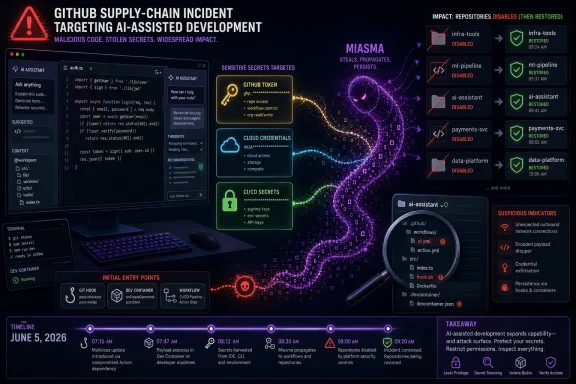
On June 5, 2026, GitHub disabled 73 Microsoft-owned repositories across Azure, Azure-Samples, Microsoft, and MicrosoftDocs after researchers found Miasma malware planted in projects that could steal developer credentials when opened in AI-assisted coding tools and modern IDEs. The breach was not a smash-and-grab against a forgotten corner of Microsoft’s open-source estate. It was a warning shot at the new center of gravity in software development: the workstation where human developers, cloud credentials, CI/CD tokens, and AI agents now meet. Microsoft’s repos were cleaned and restored, but the security model around AI coding tools looks less settled than it did a week ago.
The important fact is not merely that Microsoft repositories were touched. Microsoft owns a lot of GitHub real estate, and much of it is cloned casually by developers, students, consultants, enterprise teams, and cloud architects trying to get a proof of concept working before lunch. That makes its public repos unusually useful terrain for attackers who want scale without negotiating every victim one by one.
A compromised Microsoft repo carries a kind of ambient trust. Developers do not treat it like a random pastebin script or an abandoned npm package with three weekly downloads. They clone it, open it in VS Code, hand it to an AI coding assistant, and assume that the risk begins only when they intentionally run something.
Miasma attacked that assumption. The campaign reportedly planted configuration and workflow material designed to execute when a repository was opened in certain development environments or AI coding tools. That is a subtle but profound shift from the old mental model of “don’t run strange code” to a messier reality where opening a project may be operationally closer to running it than developers want to admit.
The result is a supply-chain incident that feels less like a traditional breach of Microsoft and more like a breach of developer muscle memory. Microsoft’s brand gave the trap credibility. GitHub gave it distribution. AI coding tools gave it a new execution path.
Tools such as Claude Code, Gemini CLI, Cursor, and VS Code sit close to source code, shell access, environment variables, SSH material, cloud credentials, package managers, and repo configuration. That is exactly where an attacker wants to be. A coding assistant that can inspect and modify a project can also become a useful trigger point if its configuration model is abused.
This is why the phrase “AI developer passwords” undersells the story even as it captures the alarm. The prize is broader than passwords. Developer machines often hold GitHub tokens, npm tokens, cloud keys, Azure credentials, OpenAI or Anthropic API keys, database connection strings, signing material, and access to internal systems through VPNs or single sign-on sessions.
That mix is more dangerous than any one secret. A stolen token may open a package registry. A cloud key may expose storage or compute. A GitHub credential may permit code changes. A CI/CD secret may let an attacker mint artifacts that look legitimate. Miasma’s significance lies in aiming at the developer workstation as the place where all those privileges converge.
But the Microsoft repo incident shows a campaign willing to move up and down the chain. It did not merely wait for developers to install a package. It reportedly pushed malicious commits or configuration into repositories that developers might clone directly. That route bypasses some of the defenses built around package registries and dependency manifests.
The campaign’s lineage matters here. Miasma has been described by researchers as related to Mini Shai-Hulud, itself part of a broader family of self-spreading supply-chain malware that has targeted developer ecosystems. The details vary by wave, but the strategy is consistent: steal credentials, use those credentials to reach more trusted places, and then use those places to steal more credentials.
That recursive pattern is what makes these incidents so difficult to reason about. The initial compromised account is rarely the whole story. The poisoned package is not necessarily the final payload. The public repo disabled by GitHub may be a symptom of an earlier credential theft that was never fully remediated.
But fast takedown is not the same as clean impact. A repository that is disabled after compromise may still have been cloned. A credential stealer that runs once on a developer machine may already have done the damage. Restoring a repo after review tells the public that the current code is safe; it cannot prove that every workstation that touched the bad state remained untouched.
This is the uncomfortable arithmetic of modern development. The blast radius is not defined only by the number of affected repositories. It is defined by who cloned them, which tools opened them, what credentials were present locally, which CI/CD environments trusted those credentials, and how quickly teams rotated secrets after the window of exposure.
Microsoft said it temporarily removed repositories while investigating malicious content and notified a small number of customers who may have pulled affected material. That is the right shape of response, but it leaves the inevitable unknowns. Public repos serve anonymous users. Not every clone is visible to Microsoft. Not every exposed credential announces itself by being used immediately.
Reports tied Miasma’s June activity to earlier May incidents involving the durabletask Python package and other developer-focused compromises. If that connection holds, the June 5 repo takedowns look less like an isolated event and more like a second act. That distinction matters for defenders because repeated compromise usually means either incomplete credential rotation, reused access paths, or adversaries actively probing for the next weak link.
The lesson is blunt: after a supply-chain compromise, “remove the malicious version” is not enough. Teams must assume credentials have been copied, automation tokens have been harvested, and CI/CD systems may have been used to produce apparently legitimate artifacts. The attacker’s best move is to leave behind something that looks normal.
This is where provenance and attestations become complicated. The industry has pushed hard toward signed builds, trusted publishing, and verifiable supply chains. Those are good defenses. But when attackers obtain legitimate tokens or abuse legitimate workflows, malicious artifacts can inherit the clothing of trust. Miasma’s reported use of trusted channels is a reminder that provenance tells you where something came from; it does not automatically prove that the source was uncompromised.
That distinction is increasingly fictional. The developer workstation is where cloud environments are administered, infrastructure-as-code is authored, production incidents are debugged, container images are built, and AI agents are granted broad context. In many organizations, a senior developer’s laptop is not adjacent to production; it is a control plane for production.
Miasma exploited that reality. The campaign did not need to breach a hardened Azure tenant if it could steal a developer’s token and ride existing trust relationships. It did not need to defeat every scanner if it could execute through repo configuration or AI tool startup behavior before conventional checks fired.
This also complicates the advice to “just rotate keys.” Rotation is necessary, but it is a cleanup action, not a root-cause fix. If developer machines continue to store long-lived credentials, if AI tools can automatically trigger project-supplied hooks, and if CI/CD workflows accept broad tokens without tight scoping, the same pattern will recur under another name.
Most developers want these tools to be powerful. They want the agent to read the repo, run tests, install dependencies, inspect errors, call CLIs, and modify files. The more capable the agent becomes, the more it resembles an automated junior engineer with shell access and no instinct for suspicion. That is useful. It is also dangerous.
The security question is not whether AI coding tools are uniquely reckless. Traditional IDEs and build tools have long supported extensions, tasks, hooks, and project settings that can be abused. The difference is that agentic coding tools normalize broad automation and encourage developers to open unfamiliar projects precisely so the tool can understand and act on them.
A secure default for that world probably looks more annoying than today’s developer experience. Project-supplied hooks should be treated like macros in an Office document, not like harmless metadata. First-run behavior should be explicit. Tools should display what will execute, which files requested it, and what permissions the action will receive. The cost will be friction, but the alternative is pretending that repo open events are passive.
That is especially true for Azure samples and documentation-adjacent repositories. These repos are built to be copied. Their purpose is to help developers get started quickly, which means they often enter environments during moments of experimentation rather than formal procurement. A developer following a sample may be moving fast, authenticated to cloud services, and less likely to pause over project metadata.
The same dynamic applies across the industry. Google, Red Hat, AWS, HashiCorp, Docker, Microsoft, and popular open-source maintainers all occupy trusted positions in developer workflows. Attackers do not need to compromise the most sensitive internal system if they can compromise something public that thousands of engineers pull into sensitive environments.
That is the uncomfortable reputational dimension for Microsoft. The company appears to have contained the incident, and GitHub’s takedown speed was meaningful. But every high-profile repo compromise trains developers to wonder whether trust should be local, temporary, and verified every time. That is healthy for security and corrosive for the smooth developer experience vendors spend billions trying to create.
Miasma’s reported behavior included harvesting secrets from developer environments and attacking CI/CD contexts. That is the right target if the goal is propagation. Software supply-chain attackers do not simply want data; they want the ability to become part of the build process.
This is why defenders should resist the temptation to classify the incident as “only” an open-source repo problem. A public repo can be the lure, but the victim environment may be private. The meaningful question is not whether Microsoft’s restored repositories are now clean. It is whether downstream users who opened affected repos reviewed their local machines, rotated credentials, checked GitHub audit logs, and examined CI/CD activity during and after the exposure window.
For enterprise teams, the hard part is reconstructing developer behavior. Who cloned the repo? Who opened it in Cursor? Who had Claude Code configured? Who ran tests? Which environment variables were present? Which tokens had write access? Few organizations can answer those questions quickly without a mix of endpoint telemetry, GitHub audit data, secrets inventory, and developer self-reporting.
Developers should start with GitHub tokens, npm or PyPI tokens, cloud provider keys, API keys for AI services, SSH keys, and any secrets stored in environment files or shell profiles. Organizations should prioritize credentials with write permissions, publishing rights, cloud admin scope, or CI/CD access. Read-only keys matter, but keys that can alter code or ship artifacts matter more.
Teams should also review repository activity for unexpected commits, workflow changes, new deploy keys, altered GitHub Actions, unfamiliar OAuth applications, and suspicious package publications. The attacker’s goal may not be immediate monetization. It may be persistence in the software delivery chain.
There is a cultural challenge here. Developers often treat secret rotation as punishment for a mistake. In incidents like this, it should be treated as hygiene after exposure to a contaminated environment. No one needs to have done anything foolish for the right answer to be rotation, revocation, and review.
But Miasma’s more interesting move was not just package poisoning. It was the exploitation of development workflows around project opening, AI agent initialization, and repo configuration. A scanner that looks only at package manifests may miss a malicious settings file. A registry policy may not notice a repo-level hook. An endpoint product may see a legitimate tool executing a legitimate shell command from a trusted workspace.
The defensive answer has to be layered. IDEs and AI coding tools need stronger prompts and sandboxing. GitHub and other platforms need rapid anomaly detection for suspicious cross-repo commits. Enterprises need short-lived credentials and least privilege for developers and automation. Security teams need visibility into AI tool usage without turning every local experiment into a compliance interrogation.
The deeper point is that AI-assisted development collapses boundaries. The assistant reads code, suggests changes, runs commands, and sometimes touches external services. Security controls built for a world of discrete human actions will miss risks created by semi-autonomous tooling that acts inside a developer’s trusted session.
Yet Miasma shows why trust machinery must be paired with behavioral skepticism. If attackers use a legitimate account, a legitimate workflow, or a legitimate token, many downstream systems will see exactly what they were designed to see: an authorized change. Security tools can validate the chain of custody while missing that the custodian was compromised.
That does not mean provenance is useless. It means provenance is not a morality detector. It can help answer whether an artifact came from a claimed source, but defenders still need anomaly detection, peer review, scope controls, and emergency revocation when the claimed source starts behaving strangely.
Microsoft, GitHub, and the broader ecosystem will likely respond with sharper detection for repo-level worm behavior, suspicious AI tool configuration files, and mass credential exfiltration patterns. But attackers adapt to the seams between products. The next campaign may not look like Miasma. It may abuse a different assistant, extension marketplace, package lifecycle hook, container dev environment, or remote workspace feature.
The better lesson is that developers can no longer treat trusted repos as inert text. A cloned project can carry executable expectations in hidden directories, IDE settings, package scripts, devcontainer files, GitHub workflows, and AI assistant configuration. The visible source code may be the least interesting part of the trap.
Security teams also need to update their mental inventory. “Which AI coding tools are allowed?” is no longer only a licensing or data leakage question. It is a question about local execution, project trust, sandboxing, credential access, and auditability. If an AI agent can run commands, it belongs in the threat model.
Microsoft’s 73 restored repos may soon become a historical footnote. The pattern will not. Attackers have discovered that AI development environments are rich, trusted, and still sorting out their default security posture. That is enough to guarantee imitation.
 The Target Was Not Microsoft’s Code, but Microsoft’s Reach
The important fact is not merely that Microsoft repositories were touched. Microsoft owns a lot of GitHub real estate, and much of it is cloned casually by developers, students, consultants, enterprise teams, and cloud architects trying to get a proof of concept working before lunch. That makes its public repos unusually useful terrain for attackers who want scale without negotiating every victim one by one.A compromised Microsoft repo carries a kind of ambient trust. Developers do not treat it like a random pastebin script or an abandoned npm package with three weekly downloads. They clone it, open it in VS Code, hand it to an AI coding assistant, and assume that the risk begins only when they intentionally run something.
Miasma attacked that assumption. The campaign reportedly planted configuration and workflow material designed to execute when a repository was opened in certain development environments or AI coding tools. That is a subtle but profound shift from the old mental model of “don’t run strange code” to a messier reality where opening a project may be operationally closer to running it than developers want to admit.
The result is a supply-chain incident that feels less like a traditional breach of Microsoft and more like a breach of developer muscle memory. Microsoft’s brand gave the trap credibility. GitHub gave it distribution. AI coding tools gave it a new execution path.
AI Coding Assistants Have Become Part of the Attack Surface
The security industry has spent years warning that package install scripts, build steps, and CI/CD workflows can become malware launchers. Miasma does not discard that lesson, but it adds a more contemporary one: AI coding assistants are no longer just productivity features. They are privileged software components with deep access to the developer’s local environment.Tools such as Claude Code, Gemini CLI, Cursor, and VS Code sit close to source code, shell access, environment variables, SSH material, cloud credentials, package managers, and repo configuration. That is exactly where an attacker wants to be. A coding assistant that can inspect and modify a project can also become a useful trigger point if its configuration model is abused.
This is why the phrase “AI developer passwords” undersells the story even as it captures the alarm. The prize is broader than passwords. Developer machines often hold GitHub tokens, npm tokens, cloud keys, Azure credentials, OpenAI or Anthropic API keys, database connection strings, signing material, and access to internal systems through VPNs or single sign-on sessions.
That mix is more dangerous than any one secret. A stolen token may open a package registry. A cloud key may expose storage or compute. A GitHub credential may permit code changes. A CI/CD secret may let an attacker mint artifacts that look legitimate. Miasma’s significance lies in aiming at the developer workstation as the place where all those privileges converge.
The Old Supply-Chain Playbook Has Mutated
Classic software supply-chain attacks often relied on dependency confusion, typosquatting, poisoned packages, or compromised maintainers. Those techniques are still very much alive. The reported Miasma activity included malicious or suspicious packages with names designed to resemble popular libraries, alongside AI-themed packages that would naturally attract developers experimenting with model-connected applications.But the Microsoft repo incident shows a campaign willing to move up and down the chain. It did not merely wait for developers to install a package. It reportedly pushed malicious commits or configuration into repositories that developers might clone directly. That route bypasses some of the defenses built around package registries and dependency manifests.
The campaign’s lineage matters here. Miasma has been described by researchers as related to Mini Shai-Hulud, itself part of a broader family of self-spreading supply-chain malware that has targeted developer ecosystems. The details vary by wave, but the strategy is consistent: steal credentials, use those credentials to reach more trusted places, and then use those places to steal more credentials.
That recursive pattern is what makes these incidents so difficult to reason about. The initial compromised account is rarely the whole story. The poisoned package is not necessarily the final payload. The public repo disabled by GitHub may be a symptom of an earlier credential theft that was never fully remediated.
GitHub’s Fast Takedown Was Necessary, but It Was Not the Victory Lap
GitHub reportedly disabled the 73 Microsoft repositories rapidly once alarms tripped on June 5. That speed matters. In an ecosystem where malicious packages can be downloaded thousands of times before a maintainer wakes up, shaving detection and containment down to minutes is a real defensive achievement.But fast takedown is not the same as clean impact. A repository that is disabled after compromise may still have been cloned. A credential stealer that runs once on a developer machine may already have done the damage. Restoring a repo after review tells the public that the current code is safe; it cannot prove that every workstation that touched the bad state remained untouched.
This is the uncomfortable arithmetic of modern development. The blast radius is not defined only by the number of affected repositories. It is defined by who cloned them, which tools opened them, what credentials were present locally, which CI/CD environments trusted those credentials, and how quickly teams rotated secrets after the window of exposure.
Microsoft said it temporarily removed repositories while investigating malicious content and notified a small number of customers who may have pulled affected material. That is the right shape of response, but it leaves the inevitable unknowns. Public repos serve anonymous users. Not every clone is visible to Microsoft. Not every exposed credential announces itself by being used immediately.
The Durable Task Thread Makes This More Than a One-Day Scare
One reason this incident has drawn attention is the apparent connection to earlier compromises involving Microsoft’s Durable Task ecosystem. Durable Task is not celebrity software, but it is exactly the kind of infrastructure-adjacent project that serious attackers like: boring enough to be trusted, useful enough to be present in real systems, and close enough to cloud workflows to matter.Reports tied Miasma’s June activity to earlier May incidents involving the durabletask Python package and other developer-focused compromises. If that connection holds, the June 5 repo takedowns look less like an isolated event and more like a second act. That distinction matters for defenders because repeated compromise usually means either incomplete credential rotation, reused access paths, or adversaries actively probing for the next weak link.
The lesson is blunt: after a supply-chain compromise, “remove the malicious version” is not enough. Teams must assume credentials have been copied, automation tokens have been harvested, and CI/CD systems may have been used to produce apparently legitimate artifacts. The attacker’s best move is to leave behind something that looks normal.
This is where provenance and attestations become complicated. The industry has pushed hard toward signed builds, trusted publishing, and verifiable supply chains. Those are good defenses. But when attackers obtain legitimate tokens or abuse legitimate workflows, malicious artifacts can inherit the clothing of trust. Miasma’s reported use of trusted channels is a reminder that provenance tells you where something came from; it does not automatically prove that the source was uncompromised.
The Developer Workstation Is Now a Production System in Disguise
Enterprise security programs have long separated production from development. Production gets hardened controls, logging, privileged access reviews, and emergency runbooks. Developer laptops get endpoint protection, device management, and a hope that no one keeps too many secrets in a dotfile.That distinction is increasingly fictional. The developer workstation is where cloud environments are administered, infrastructure-as-code is authored, production incidents are debugged, container images are built, and AI agents are granted broad context. In many organizations, a senior developer’s laptop is not adjacent to production; it is a control plane for production.
Miasma exploited that reality. The campaign did not need to breach a hardened Azure tenant if it could steal a developer’s token and ride existing trust relationships. It did not need to defeat every scanner if it could execute through repo configuration or AI tool startup behavior before conventional checks fired.
This also complicates the advice to “just rotate keys.” Rotation is necessary, but it is a cleanup action, not a root-cause fix. If developer machines continue to store long-lived credentials, if AI tools can automatically trigger project-supplied hooks, and if CI/CD workflows accept broad tokens without tight scoping, the same pattern will recur under another name.
AI Tooling Has Outrun Its Security Defaults
AI coding tools became mainstream with extraordinary speed. In two years, they moved from novelty to routine practice inside professional engineering teams. That adoption curve has been driven by productivity, not by a slow reconsideration of local trust boundaries.Most developers want these tools to be powerful. They want the agent to read the repo, run tests, install dependencies, inspect errors, call CLIs, and modify files. The more capable the agent becomes, the more it resembles an automated junior engineer with shell access and no instinct for suspicion. That is useful. It is also dangerous.
The security question is not whether AI coding tools are uniquely reckless. Traditional IDEs and build tools have long supported extensions, tasks, hooks, and project settings that can be abused. The difference is that agentic coding tools normalize broad automation and encourage developers to open unfamiliar projects precisely so the tool can understand and act on them.
A secure default for that world probably looks more annoying than today’s developer experience. Project-supplied hooks should be treated like macros in an Office document, not like harmless metadata. First-run behavior should be explicit. Tools should display what will execute, which files requested it, and what permissions the action will receive. The cost will be friction, but the alternative is pretending that repo open events are passive.
Microsoft’s Brand Became Part of the Payload
There is a reason attackers prize trusted ecosystems. A malicious file in a throwaway GitHub account must overcome skepticism. A malicious configuration file in a Microsoft-owned repo inherits trust before the developer reads a byte. The brand does not execute the malware, but it lowers the guard that would otherwise stop the interaction.That is especially true for Azure samples and documentation-adjacent repositories. These repos are built to be copied. Their purpose is to help developers get started quickly, which means they often enter environments during moments of experimentation rather than formal procurement. A developer following a sample may be moving fast, authenticated to cloud services, and less likely to pause over project metadata.
The same dynamic applies across the industry. Google, Red Hat, AWS, HashiCorp, Docker, Microsoft, and popular open-source maintainers all occupy trusted positions in developer workflows. Attackers do not need to compromise the most sensitive internal system if they can compromise something public that thousands of engineers pull into sensitive environments.
That is the uncomfortable reputational dimension for Microsoft. The company appears to have contained the incident, and GitHub’s takedown speed was meaningful. But every high-profile repo compromise trains developers to wonder whether trust should be local, temporary, and verified every time. That is healthy for security and corrosive for the smooth developer experience vendors spend billions trying to create.
The CI/CD Angle Is Where the Damage Can Compound
Credential theft from a laptop is bad. Credential theft that reaches CI/CD is worse because pipelines can turn stolen access into distributed compromise. A developer’s local secret may open one door; a pipeline token can publish packages, build containers, deploy infrastructure, or stamp artifacts with organizational legitimacy.Miasma’s reported behavior included harvesting secrets from developer environments and attacking CI/CD contexts. That is the right target if the goal is propagation. Software supply-chain attackers do not simply want data; they want the ability to become part of the build process.
This is why defenders should resist the temptation to classify the incident as “only” an open-source repo problem. A public repo can be the lure, but the victim environment may be private. The meaningful question is not whether Microsoft’s restored repositories are now clean. It is whether downstream users who opened affected repos reviewed their local machines, rotated credentials, checked GitHub audit logs, and examined CI/CD activity during and after the exposure window.
For enterprise teams, the hard part is reconstructing developer behavior. Who cloned the repo? Who opened it in Cursor? Who had Claude Code configured? Who ran tests? Which environment variables were present? Which tokens had write access? Few organizations can answer those questions quickly without a mix of endpoint telemetry, GitHub audit data, secrets inventory, and developer self-reporting.
The Response Playbook Should Start With Assumed Secret Exposure
For anyone who cloned or opened affected Microsoft repositories around June 1 through June 5, the safest posture is not to wait for proof of compromise. Credential stealers are designed to make proof scarce. If a tool ran in a context where secrets were present, rotation is the cheaper assumption.Developers should start with GitHub tokens, npm or PyPI tokens, cloud provider keys, API keys for AI services, SSH keys, and any secrets stored in environment files or shell profiles. Organizations should prioritize credentials with write permissions, publishing rights, cloud admin scope, or CI/CD access. Read-only keys matter, but keys that can alter code or ship artifacts matter more.
Teams should also review repository activity for unexpected commits, workflow changes, new deploy keys, altered GitHub Actions, unfamiliar OAuth applications, and suspicious package publications. The attacker’s goal may not be immediate monetization. It may be persistence in the software delivery chain.
There is a cultural challenge here. Developers often treat secret rotation as punishment for a mistake. In incidents like this, it should be treated as hygiene after exposure to a contaminated environment. No one needs to have done anything foolish for the right answer to be rotation, revocation, and review.
Dependency Scanning Alone Will Not Save the Agentic Workflow
Many organizations will respond to Miasma by turning up dependency scanning, and that is good as far as it goes. Typosquats, malicious package versions, and compromised registries remain major risks. Automated alerts can shorten the time between compromise and containment.But Miasma’s more interesting move was not just package poisoning. It was the exploitation of development workflows around project opening, AI agent initialization, and repo configuration. A scanner that looks only at package manifests may miss a malicious settings file. A registry policy may not notice a repo-level hook. An endpoint product may see a legitimate tool executing a legitimate shell command from a trusted workspace.
The defensive answer has to be layered. IDEs and AI coding tools need stronger prompts and sandboxing. GitHub and other platforms need rapid anomaly detection for suspicious cross-repo commits. Enterprises need short-lived credentials and least privilege for developers and automation. Security teams need visibility into AI tool usage without turning every local experiment into a compliance interrogation.
The deeper point is that AI-assisted development collapses boundaries. The assistant reads code, suggests changes, runs commands, and sometimes touches external services. Security controls built for a world of discrete human actions will miss risks created by semi-autonomous tooling that acts inside a developer’s trusted session.
The Industry’s Trust Machinery Is Showing Its Age
The last decade of software security has been an effort to make trust more mechanical. Sign the commits. Verify the builds. Produce attestations. Scan the dependencies. Pin the versions. Require MFA. Use OIDC. Avoid long-lived secrets. These moves have made the ecosystem better.Yet Miasma shows why trust machinery must be paired with behavioral skepticism. If attackers use a legitimate account, a legitimate workflow, or a legitimate token, many downstream systems will see exactly what they were designed to see: an authorized change. Security tools can validate the chain of custody while missing that the custodian was compromised.
That does not mean provenance is useless. It means provenance is not a morality detector. It can help answer whether an artifact came from a claimed source, but defenders still need anomaly detection, peer review, scope controls, and emergency revocation when the claimed source starts behaving strangely.
Microsoft, GitHub, and the broader ecosystem will likely respond with sharper detection for repo-level worm behavior, suspicious AI tool configuration files, and mass credential exfiltration patterns. But attackers adapt to the seams between products. The next campaign may not look like Miasma. It may abuse a different assistant, extension marketplace, package lifecycle hook, container dev environment, or remote workspace feature.
The Practical Lesson Is Smaller, Meaner, and More Useful
The temptation after a high-profile Microsoft incident is to turn it into a referendum on Microsoft security. That is too easy and not especially useful. Large vendors are attractive targets precisely because their code, samples, packages, and documentation sit inside countless downstream workflows.The better lesson is that developers can no longer treat trusted repos as inert text. A cloned project can carry executable expectations in hidden directories, IDE settings, package scripts, devcontainer files, GitHub workflows, and AI assistant configuration. The visible source code may be the least interesting part of the trap.
Security teams also need to update their mental inventory. “Which AI coding tools are allowed?” is no longer only a licensing or data leakage question. It is a question about local execution, project trust, sandboxing, credential access, and auditability. If an AI agent can run commands, it belongs in the threat model.
Microsoft’s 73 restored repos may soon become a historical footnote. The pattern will not. Attackers have discovered that AI development environments are rich, trusted, and still sorting out their default security posture. That is enough to guarantee imitation.
The June 5 GitHub Sweep Leaves a Short List of Uncomfortable Jobs
The immediate cleanup is not glamorous, but it is concrete. Developers and administrators should treat this incident as a drill for the next one, because the next one will probably arrive through a tool that currently feels like part of the furniture.- Developers who cloned or opened affected Microsoft repositories between June 1 and June 5, 2026 should rotate any credentials that were available in their shell, IDE, AI coding tool, or local environment.
- Teams should review GitHub audit logs, workflow changes, deploy keys, OAuth application grants, package publishing events, and unexpected CI/CD runs from the exposure window.
- Organizations should reduce reliance on long-lived developer and automation secrets in favor of short-lived, tightly scoped credentials that can be revoked without paralyzing the business.
- AI coding tools and IDEs should be configured to require explicit approval before executing project-supplied hooks, startup commands, or repository-local automation.
- Security teams should inventory approved AI development tools with the same seriousness they apply to package registries, build systems, and privileged cloud consoles.
- Maintainers should assume that cleaning a repository is only the first half of incident response; the second half is investigating whether stolen credentials were used elsewhere.
References
- Primary source: Memeburn
Published: 2026-06-14T02:52:19.467745
Loading…
memeburn.com - Related coverage: techradar.com
Microsoft disables over 70 GitHub repos after hackers compromised them with dangerous malware | TechRadar
Someone forgot to change compromised credentialswww.techradar.com - Related coverage: itpro.com
Loading…
www.itpro.com - Related coverage: rescana.com
Miasma Worm Supply Chain Attack: 73 Microsoft GitHub Repositories Compromised via AI Coding Tools – Rescana
Executive SummaryOn June 5, 2026, the Miasma worm, a self-replicating supply chain malware, compromised 73 Microsoft GitHub repositories across four major organizations: Azure, Azure-Samples, Microsofwww.rescana.com - Related coverage: redmondmag.com
Supply Chain Attack Hits Microsoft GitHub Repos, AI Coding Tools -- Redmondmag.com
GitHub disabled 73 Microsoft repositories on June 5 after a malicious commit landed in an Azure project, in what researchers described as a supply chain attack aimed at developer workstations and AI coding environments.redmondmag.com - Related coverage: gigazine.net
Loading…
gigazine.net
- Related coverage: perplexityaimagazine.com
Miasma Worm GitHub Attack 2026: 73 Microsoft Repos
Miasma worm GitHub attack 2026 disables 73 Microsoft repos by targeting Claude Code and VS Code developer environments worldwide.perplexityaimagazine.com - Related coverage: devops.com
GitHub Takes Down 73 Microsoft Repos After Miasma Worm Attack - DevOps.com
GitHub disabled 73 Microsoft repos after the Miasma worm used compromised credentials to target AI coding tools and developer environments.devops.com - Related coverage: gearbriefly.com
Loading…
gearbriefly.com - Related coverage: awesomeagents.ai
Miasma Worm Compromises 73 Microsoft GitHub Repos | Awesome Agents
Miasma worm planted config files that auto-execute credential theft when developers open Microsoft Azure repos in Claude Code, Gemini CLI, Cursor, or VS Code.awesomeagents.ai - Related coverage: theregister.com

GitHub nukes 70+ Microsoft repos, breaks CI/CD pipelines, following suspected worm infections
Miasma worm shapeshifts, but cloud secret-scouting remains the goalwww.theregister.com
- Related coverage: expertinsights.com
Loading…
expertinsights.com - Related coverage: iamtzar.com
Miasma Worm Hits 73 Microsoft GitHub Repositories in Major Supply Chain Attack
In what marks the most significant escalation of an ongoing supply chain campaign, the self-replicating Miasma worm compromised 73 Microsoft GitHub repositoriesiamtzar.com - Related coverage: data-today.net
Miasma worm turns AI coding agents into repo traps | Data Today
Miasma worm is a credential stealer that hit 73 Microsoft GitHub repos. Treat agent-opened clones as compromised, not suspicious.data-today.net - Related coverage: techcrunch.com

Microsoft's open source tools were hacked to steal passwords of AI developers | TechCrunch
Microsoft shut down dozens of GitHub code repositories for Azure and AI coding tools after a reported hack. techcrunch.com
- Related coverage: tomshardware.com

Compromised Mistral AI and TanStack packages may have exposed GitHub, cloud and CI/CD credentials in 'mini Shai Hulud' malware infection — supply-chain campaign spreads across npm and AI developer ecosystems like wildfire
The malware reportedly refused to run on Russian-language systems but could execute a destructive payload under certain geographic conditions.www.tomshardware.com
- Related coverage: assets.kpmg.com
Loading…
assets.kpmg.com
