

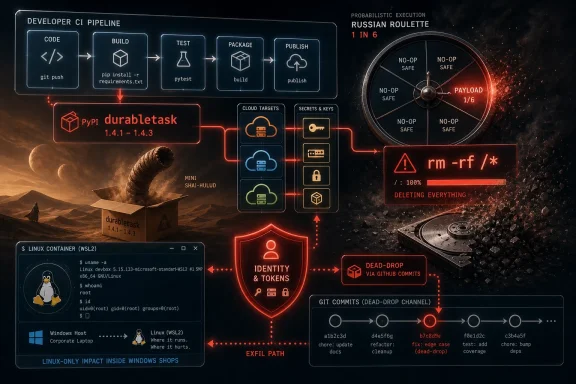
durabletask package on PyPI — versions 1.4.1, 1.4.2, and 1.4.3 — carried a Linux-focused Mini Shai-Hulud payload capable of stealing cloud credentials and, under certain conditions, wiping disks. The compromise is not merely another poisoned package in a crowded registry. It is a reminder that modern developer machines and CI runners are now rich targets precisely because they sit at the crossroads of source code, cloud identity, deployment keys, and automation. The worm’s Dune-themed branding may be theatrical, but the operational lesson is blunt: the open-source supply chain is no longer being abused only for stealthy credential theft; it is being weaponized for coercion, persistence, and sabotage.
The Microsoft Name Made This More Than Another PyPI Scare
The affected package, durabletask, is tied to Microsoft’s Durable Task Framework, a workflow orchestration library used in the Azure ecosystem. That association matters because package trust is not formed only by code review or cryptographic provenance; it is also formed by brand familiarity. Developers see a Microsoft-adjacent package in a routine dependency path and, quite reasonably, treat it differently from a newly created typosquat with a suspicious name and no history.
That is exactly what makes this campaign so uncomfortable. The attack did not need to invent a plausible dependency from scratch. It landed inside a package that already had a legitimate reason to exist, a legitimate audience, and legitimate cloud-adjacent use cases.
For WindowsForum readers, the immediate twist is that the destructive payload described by researchers is Linux-only. That might sound like a reprieve for desktop Windows users, but it is a narrow one. In 2026, a “Windows shop” often runs Linux containers, Linux CI agents, WSL-based developer workflows, Kubernetes nodes, and cloud build systems that are nowhere near a traditional Windows desktop but are very much inside the organization’s Microsoft-centered estate.
The bigger story, then, is not that Microsoft’s name appeared next to a malicious PyPI release. It is that the boundary between “developer dependency” and “production infrastructure” has almost disappeared. A Python package installed in a build job can become a cloud credential incident, a Kubernetes incident, and a data-loss incident in the same breath.
Mini Shai-Hulud Turns Credential Theft Into an Extortion-Like Pressure System
The Mini Shai-Hulud payload described by Aikido and other researchers follows a pattern that has become grimly familiar: steal first, spread next, punish resistance if the operator chooses. The malware attempts to harvest secrets from password managers, cloud SDK configuration, Docker, Kubernetes, Vault, and AI tooling. Those are not random trophies. They are the connective tissue of modern infrastructure.
The campaign’s reported targeting of 1Password, Bitwarden, AWS, Azure, Google Cloud Platform, Docker, Kubernetes, and HashiCorp Vault makes clear that the victim is not just the endpoint. The endpoint is a staging area. The real prize is the set of identities and tokens that allow a developer workstation or CI runner to act on behalf of the organization.
That is why the disk-wiping module is so significant. In older commodity infostealer campaigns, destruction was often bad business because it removed the attacker’s foothold. Here, the destructive function reads more like leverage, chaos engineering by an adversary, or a crude anti-response mechanism. If defenders rotate tokens, shut down infrastructure, or sever command-and-control paths, the attacker may still have left behind enough tripwires to turn incident response into a data-loss exercise.
The TanStack compromise reported before this incident carried a similar warning. Researchers said users needed to disable a dead-man’s-switch mechanism before revoking compromised tokens, because revocation itself could trigger destructive behavior. That design choice is the important part. It turns the routine first step of a secrets incident — revoke the token — into a potentially dangerous move unless responders understand the malware’s logic first.
This is the next stage of supply-chain malware maturity. It does not simply steal credentials and hope no one notices. It anticipates the cleanup playbook and tries to make that playbook risky.
The Wiper’s Theatrics Should Not Distract From Its Engineering
The most lurid detail in the durabletask reports is the “Russian Roulette” behavior. According to Aikido, the wiper checks for Israeli or Iranian locale indicators, spins a one-in-six chance, plays an audio file, forces the system volume upward, and then may execute a broad rm -rf /* deletion command. It is bizarre, theatrical, and almost designed to be quoted.
But theatrics are often camouflage for operational intent. The presence of a probabilistic wiper does not make the campaign unserious. It makes impact less predictable, complicates forensic reconstruction, and ensures that victims may experience different outcomes from the same package version depending on environment, connectivity, locale, and timing.
The locale checks also show that the malware is not simply a generic smash-and-grab script. Whether those checks reflect targeting, misdirection, ideological signaling, or an attempt to manipulate attribution is not settled by the public reporting. In supply-chain campaigns, especially ones with pop-culture branding and folklore references, defenders should be wary of taking cultural artifacts at face value.
The same caution applies to the “TeamPCP” thread running through the reporting. Aikido said the durabletask incident smelled like more TeamPCP activity but stopped short of firm attribution. Wiz and others have compared the payload architecture and infrastructure to earlier campaigns. That is useful, but not the same thing as courtroom-grade certainty.
Attribution is seductive because it gives a messy event a villain and a narrative. For defenders, the higher-value conclusion is more mechanical: the operators are iterating quickly, reusing successful patterns, and moving across ecosystems and packages with enough speed that package-specific trust is no longer sufficient.
The Dead-Drop Channel Is the Clever Part
The most technically interesting detail in this campaign is not the wiper, the audio file, or the Dune branding. It is the fallback command-and-control strategy. Researchers said the malware can search GitHub commits for a marker string, inspect signed commits, and extract Base64-encoded links that point to updated infrastructure.
That matters because defenders are used to thinking about command-and-control as a domain problem. Seize the domain, sinkhole the server, block the known host, and the malware becomes less useful. A GitHub-based dead drop changes that rhythm. The attacker does not need to keep one brittle endpoint alive if the malware can discover a new one through a public platform’s normal search interface.
The reported use of signed commits adds another layer. The goal is not merely to hide a URL in public noise. It is to give the malware a way to distinguish attacker-published instructions from random matching text. That is a resilience pattern, and it belongs in the same mental category as domain generation algorithms and social-media command channels, except it is tailored to the developer ecosystem itself.
This is where the open-source world’s strengths become exploitable surfaces. Public commits, searchable metadata, package registries, automation hooks, and reproducible builds are all features that make software collaboration work. A capable attacker does not need to break those systems in the cinematic sense. They can use them as designed, but toward an adversarial end.
For enterprise security teams, this means blocking a package hash is not enough. If the malware has already run, responders must assume that command paths may shift, secrets may have been staged, and cleanup may require understanding not just the initial package but the payloads it fetched afterward.
The PyPI Problem Is Really an Identity Problem
It is tempting to frame this incident as another PyPI moderation failure. That would be too easy. Public package repositories operate at enormous scale, and malicious uploads are a constant pressure across PyPI, npm, RubyGems, NuGet, and container registries. Registry operators can and should improve detection, but no registry can fully compensate for weak release identity, weak consumer verification, and build systems that automatically trust the newest compatible version.
The durabletask incident hits harder because it allegedly involved consecutive malicious versions of a package that developers had reason to trust. That shifts the focus from name confusion to release integrity. The uncomfortable question is not “why did someone install a sketchy package?” It is “what would have stopped an approved workflow from ingesting a bad release of a package it already trusted?”
For many organizations, the answer is: not much. Dependency update bots open pull requests. CI systems run tests. Build containers install packages. Developers rely on version constraints that may allow patch or minor updates. If tests pass and the application still starts, the pipeline may treat the dependency as acceptable.
That model assumes malicious behavior will be visible as broken functionality. Modern supply-chain malware is built to avoid that. Endor Labs reported that the malicious code could run when the package was imported, without obvious user-facing errors. That is exactly the kind of compromise that can slip through quality gates because quality gates are not threat-modeling gates.
The enterprise control plane must therefore move closer to the moment of dependency selection. Lockfiles, internal mirrors, package allowlists, artifact signing, reproducible build checks, and egress controls are not glamorous. They are the difference between “a malicious package existed” and “a malicious package executed inside a machine that had cloud-wide credentials.”
Windows Shops Are Exposed Through Their Linux Edges
The Linux-only nature of the payload will lead some readers to mentally file this as a non-Windows incident. That would be a mistake. Windows environments have grown Linux appendages everywhere: WSL on developer laptops, Ubuntu images in GitHub Actions, Debian-based containers in Azure Kubernetes Service, Linux runners in self-hosted CI, and appliance-like build boxes that nobody thinks about until they fail.
This is especially true in Azure-heavy organizations. The control plane may be Microsoft. The identity provider may be Entra ID. The developers may use Windows laptops. But the build step that installs a Python package may run in a Linux container with access to Azure credentials, container registry tokens, deployment secrets, and Kubernetes configuration.
That is the danger zone. Malware does not need to wipe a user’s Windows desktop if it can steal the credentials that deploy production services. It does not need to persist in a conventional endpoint-detection sense if it can turn a CI runner into a cloud credential vending machine.
For administrators, the practical implication is that inventory must include build environments and ephemeral runners, not just managed endpoints. If an organization cannot answer where durabletask versions 1.4.1 through 1.4.3 were installed or imported, it does not have a dependency problem. It has an asset-visibility problem.
The incident also underscores why WSL deserves more serious security treatment in enterprise Windows environments. WSL is convenient because it lets developers work in Linux from a Windows machine. That convenience can blur monitoring boundaries, especially when Linux-side tooling stores credentials outside the places Windows-centric security teams normally inspect.
AI Tooling Has Joined the Secrets Sprawl
One detail in the reporting deserves more attention than it will probably get: the worm reportedly looked for AI tooling configuration. That is a sign of the times. AI developer tools, model APIs, vector databases, agent frameworks, and local orchestration utilities have created a new layer of credentials that often sits outside mature secrets-management practice.
A few years ago, an infostealer hunting for cloud keys, SSH keys, Docker credentials, and Kubernetes configs already had enough to cause serious harm. Today, the same machine may also hold API keys for model providers, internal retrieval systems, data-labeling platforms, and automation agents that can read or write sensitive business data. The attack surface has expanded faster than the governance model.
The danger is not only that an attacker can run up an API bill. In some organizations, AI tooling has become a bridge into source code, documents, tickets, customer data, and internal knowledge bases. A stolen AI key may not look as obviously catastrophic as a cloud administrator credential, but it can still expose sensitive context at scale.
Mini Shai-Hulud’s credential shopping list is therefore a useful map of where attackers think value now lives. They are not only looking for yesterday’s secrets. They are tracking the developer stack as it changes.
The Right First Move Is Not Always Token Revocation
The TanStack reporting created a chilling operational lesson: revoking a compromised token can be the wrong first move if malware has installed a destructive dead-man’s switch that watches for revocation. The durabletask reporting describes destructive capabilities under different conditions, but the broader lesson carries over. Incident response cannot be reduced to muscle memory.
In a conventional credentials incident, the response sequence is often straightforward. Revoke keys, rotate secrets, disable sessions, rebuild hosts, and audit logs. In a booby-trapped supply-chain incident, responders need to identify whether malware is polling token status, maintaining persistence, or staging destructive actions before pulling the obvious levers.
That does not mean defenders should leave stolen credentials alive indefinitely. It means the order of operations matters. Isolate the host. Preserve evidence. Stop the malicious process. Disable persistence. Snapshot where appropriate. Then rotate credentials from a clean environment and monitor for attempted reuse.
This is the kind of nuance that gets lost when supply-chain alerts are treated as package advisories rather than live compromises. If a vulnerable library has a bug, upgrading may be enough. If a malicious library ran arbitrary code, the machine is not merely “affected.” It is potentially owned.
Security teams should make that distinction explicit in internal language. “Installed a malicious package” should trigger a different response path from “uses a package with a vulnerability.” The former is closer to endpoint compromise; the latter may be a patch-management event.
Microsoft’s Ecosystem Trust Now Depends on More Than Microsoft
Microsoft is central to this story, but not necessarily in the simplistic way. The package is associated with Microsoft’s Azure ecosystem, and the reputational blast radius reaches Redmond because developers attach Microsoft’s name to the trust decision. But the mechanics of the compromise sit inside the wider open-source distribution system, where Microsoft is one actor among many.
That is the awkward bargain of modern platform strategy. Microsoft has spent years meeting developers where they are: GitHub, Python, Linux, containers, Kubernetes, open-source SDKs, and cross-platform tooling. That has been good for Azure and good for developers. It also means Microsoft’s trust surface now extends into ecosystems it does not fully control.
The company can harden its own publishing processes, monitor official packages, sign artifacts, tighten maintainer access, and respond quickly to malicious releases. Those are necessary steps. But the consumer side still matters: enterprises cannot outsource dependency governance to the vendor whose package name appears in requirements.txt.
This is particularly true for cloud SDKs. A compromised SDK is dangerous not because the SDK itself is magical, but because it is installed in places where credentials are already present. The more useful a package is for automation, the more valuable it becomes as a delivery vehicle for malware.
The lesson for Microsoft customers is therefore not “avoid Microsoft packages.” That would be absurd. The lesson is that official or official-adjacent packages deserve stronger verification precisely because they are more likely to appear in privileged automation paths.
Package Managers Made Software Fast; Attackers Learned the Schedule
The open-source ecosystem was optimized for speed, reuse, and low-friction updates. That bargain produced extraordinary productivity. It also created an environment where code written by strangers can move from a public registry to an internal build system in minutes.
Attackers have learned the cadence. They understand that maintainers publish updates, bots notice, CI installs, tests execute, and secrets are available during the run. They understand that many organizations permit outbound internet access from build environments because package installation and deployment workflows require it. They understand that incident responders are trained to revoke tokens quickly, and they are beginning to design around that reflex.
The durabletask compromise is therefore part of a larger shift from opportunistic package poisoning to workflow-aware intrusion. The attacker is not merely asking, “Can I get code onto a machine?” The attacker is asking, “What will this machine be allowed to do after my code runs?”
That question should haunt every CI/CD architecture review. Build systems often have broader access than production services because they need to assemble, sign, push, deploy, and test. If compromised, they can become privileged cross-environment actors. The fact that they are ephemeral does not make them safe; it can make them harder to investigate.
The answer is not to slow software delivery back to a pre-cloud crawl. It is to make speed conditional on stronger guardrails. Pin dependencies. Separate build and deploy credentials. Prevent package-install steps from accessing production secrets. Restrict egress. Use short-lived tokens scoped to the narrowest possible job. Treat dependency updates as code changes with security impact, not as housekeeping.
The Concrete Work Starts With Boring Controls
For organizations that may have touched the malicious durabletask versions, the response should begin with scoping. Search dependency manifests, lockfiles, build logs, package caches, container layers, developer workstations, WSL environments, and CI job histories for durabletask versions 1.4.1, 1.4.2, and 1.4.3. The key question is not only whether the package was present, but whether it was imported or executed in an environment with useful credentials.
From there, defenders should assume that exposed secrets may include more than cloud keys. Password-manager artifacts, Docker credentials, Kubernetes configs, Vault tokens, AI tool keys, SSH material, and service-specific configuration files all belong in the review. A narrow AWS-only or Azure-only rotation may miss the attacker’s actual haul.
The hardest part is balancing urgency with safety. If a dead-man’s switch or wiper is present, response actions can have side effects. That makes host isolation and process investigation important before bulk revocation from a compromised machine. Credential rotation should happen from trusted systems, not from the infected environment.
Administrators should also review outbound connections from build systems and developer endpoints around the suspected installation window. A package that fetches second-stage code is not fully described by the wheel on PyPI. The network path is part of the payload.
The long-term remediation is less dramatic but more valuable. Organizations need internal package provenance rules, especially for automation environments. A build job should not be able to silently pull a newly published package version from the public internet and execute it with access to sensitive secrets simply because a semantic version range allowed it.
The Worm’s Calling Card Leaves a Checklist in the Sand
The durabletask incident is still fresh enough that defenders should expect details to evolve, but the operational lessons are already clear. The useful response is not panic; it is disciplined scoping, careful cleanup, and a more skeptical model of package trust.
- Organizations should block and remove
durabletaskversions 1.4.1, 1.4.2, and 1.4.3 from developer machines, CI runners, internal mirrors, and container images. - Security teams should treat execution of the malicious package as a possible host compromise, not merely as a dependency advisory.
- Credential rotation should be planned from clean systems after checking for persistence, polling behavior, and destructive triggers.
- Windows-centric environments should inspect Linux build hosts, WSL instances, containers, and Kubernetes-adjacent automation rather than assuming the payload missed them.
- Dependency governance should favor pinned versions, reviewed updates, internal package caches, restricted build egress, and narrowly scoped short-lived credentials.
- AI tooling credentials should be included in secrets inventories and incident-response playbooks because attackers are now looking for them alongside cloud and container credentials.
The Dune branding will eventually fade into the long catalog of malware names, but the pattern it represents will not. The durabletask compromise shows attackers converging on the places where trust, automation, and privilege overlap, and those places are increasingly the same machines that build and deploy everything else. The next defensive leap will not come from treating every poisoned package as an isolated scare; it will come from redesigning developer and CI environments so that a single dependency update cannot become a cloud-wide credential event with a wiper waiting in reserve.