

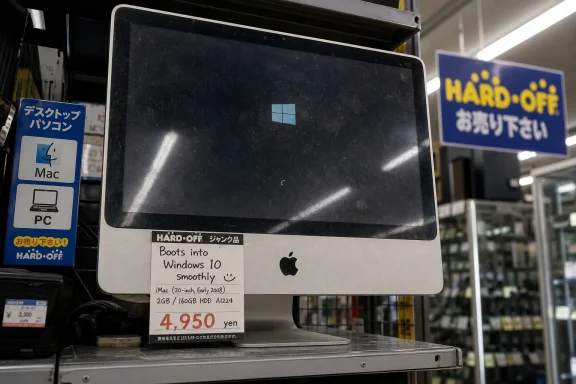
A second-hand iMac spotted at Japan’s HARD OFF resale chain recently went viral after its product tag reportedly advertised an old Apple all-in-one for 4,950 yen as a machine that “boots into Windows 10 smoothly,” despite the system’s antique-era 2GB memory configuration. The joke landed because it was not really a joke. It was a tiny museum piece from the Intel Mac era, sitting under fluorescent retail lighting, accidentally explaining twenty years of platform identity in one handwritten note.
The image amused Japanese social media because it inverted the usual mythology. Macs are supposed to be the polished, self-contained alternative to the PC sprawl; Windows machines are supposed to be the practical workhorses that survive indignity. Here was an iMac wearing Apple’s aluminum-and-glass uniform while apparently living a second life as a low-end Windows 10 box, and the store tag’s cheery confidence made the mismatch funnier than any deliberate meme could have been.
The bigger story is not that someone installed Windows on a Mac. Apple itself made that respectable during the Intel years. The bigger story is that this battered second-hand iMac has become a perfect physical joke about the afterlife of personal computers: when the vendor story ends, the hardware story keeps going, often in ways neither Cupertino nor Redmond would prefer to advertise.
The reported HARD OFF tag works because it sounds like plain retail language. It does not announce a hack, a mod, or a stunt. It simply tells the next buyer what happens when the machine powers on: Windows 10 comes up, and apparently it does so without drama.
That deadpan phrasing is why the internet did the rest. Commenters riffed on the machine as a Mac “cosplaying” as a PC, a reverse Hackintosh, or a computer with an identity crisis. The humor comes from the old distinction between hardware as costume and software as soul, a distinction Apple spent decades trying to collapse into a single brand experience.
In a second-hand shop, though, brand identity has less authority. Machines are judged by what they still do, not by what launch keynote introduced them. The tag was funny because it treated a once-premium iMac as exactly what it had become: a cheap, strange, usable-enough computer with a confusing biography.
HARD OFF is the right stage for that kind of absurdity. Japanese second-hand electronics shops often preserve the weird middle layer of computing history: not pristine collectibles, not e-waste yet, but machines that still have just enough utility to tempt a tinkerer. A 4,950-yen iMac running Windows 10 is not a rational primary computer in 2026. It is a dare with a power cable.
That transition was one of the great paradoxes of modern Apple. The Mac looked less like a generic PC than ever, but architecturally it had moved closer to the Windows world. Boot Camp gave users a sanctioned bridge, letting them install Windows on Intel-based Macs and choose between operating systems at startup.
For students, developers, gamers, and business users, this mattered. A MacBook or iMac could run macOS for daily work and Windows for the one application, game, driver package, accounting tool, or enterprise platform that refused to cross the aisle. The appeal was not ideological purity. It was having one nice machine that could survive a messy software world.
That context makes the HARD OFF iMac less of a freak than it first appears. It belongs to a generation when the Mac’s identity was unusually flexible. Apple sold the experience as integrated and controlled, but the Intel foundation made it porous. Windows on a Mac was not a contradiction; it was a supported compromise.
The difference is that Boot Camp was meant to expand a Mac’s usefulness while the machine was still current. On a thrift-shop iMac with 2GB of RAM, Windows is no longer a convenience feature. It is a second life, and possibly a punishment.
This is where the staff note becomes brilliant. “Boots into Windows 10 smoothly” is a narrow claim masquerading as reassurance. It does not promise that the iMac browses the modern web smoothly, installs updates smoothly, launches Office smoothly, or tolerates a dozen Chromium tabs smoothly. It says the system reaches the operating system without collapsing, which may be the most honest sales pitch in used computing.
Anyone who has worked with old hardware recognizes the genre. A machine can “work” in the technical sense while being functionally hostile. It can pass the power-on test, display a desktop, and still make every click feel like a negotiation with history.
That distinction matters because old computers often become romantic objects online. We like the idea of saving hardware from the scrap pile, and we like the elegance of a machine continuing to serve after its official support window closes. But the lived experience of a 2GB Windows 10 box is less romantic: background services, driver oddities, spinning disks, tired fans, and a web that has become heavier than many operating systems used to be.
The iMac’s Apple shell intensifies the absurdity. Apple’s all-in-one design language suggests polish and intentionality, while the spec sheet suggests survival mode. The visual promise says “premium desktop.” The operating reality says “please wait.”
That changes the meaning of the HARD OFF iMac. It is not only old Apple hardware running Microsoft software. It is old Apple hardware running an operating system that has crossed into its own post-mainstream phase. The machine is doubly displaced: no longer a supported Mac in any practical modern sense, and no longer a clean Windows recommendation either.
For enthusiasts, that makes it more interesting. For ordinary buyers, it makes it more questionable. A cheap computer that boots is not necessarily a safe computer to put on a home network, hand to a child, or use for banking. The second-hand shelf compresses all of those distinctions into one small price tag.
Microsoft’s Windows 11 hardware requirements sharpen the contrast. Many machines that ran Windows 10 acceptably cannot officially move to Windows 11, particularly because of TPM, CPU generation, and security-baseline requirements. A 2007-era iMac is not merely below the line; it belongs to an earlier map.
That is why this little joke travels so well among Windows users. It captures the awkward inheritance of the Windows 10 era. Microsoft built an operating system that ran on an enormous installed base, then eventually drew a harder line for the next platform. The result is a global population of machines that still power on, still feel too useful to discard, and still fall outside the modern support story.
But jokes do not need clean taxonomy. The phrase works because it points to a boundary being crossed. Apple hardware carries cultural meaning, and Windows carries another. Put one inside the other and people instinctively see costume, disguise, or betrayal.
That cultural load has always been heavier than the technical reality. A Mac and a Windows PC have shared many components across the years: Intel CPUs, AMD or Nvidia graphics in some models, standard memory technologies, SATA or PCIe storage, USB peripherals, Wi-Fi chipsets, and commodity display interfaces beneath proprietary packaging. The difference was never simply silicon. It was the total system experience, the support model, the software ecosystem, and the story told around the machine.
The HARD OFF iMac strips that story down. If the operating system is Windows, the keyboard is generic, the support is nonexistent, and the price is lower than a family dinner, how much “Mac” remains? The answer is partly hardware, partly design, and partly the emotional residue of the logo.
That is why the “identity crisis” framing lands. The iMac is not confused; people are. We want categories to stay stable because categories help us assign value. The used market laughs at that impulse by showing us a premium object repurposed into a bargain-bin Windows box.
That shift has been a triumph for Apple’s performance-per-watt story, but it also ended the old Intel-era bargain. A modern Mac is a better Mac because Apple controls more of the stack. It is also a less flexible Windows machine because the old “just install Windows natively” assumption no longer applies.
Virtualization still exists, and Windows on Arm has matured, but the cultural simplicity is gone. The Intel iMac could be treated, in a pinch, like a stylish PC. Apple silicon Macs are something else: more efficient, more integrated, and less available for this specific kind of second-hand operating-system mischief.
That makes the HARD OFF machine an accidental artifact from a more porous moment. For roughly a decade and a half, the Mac occupied a strange dual citizenship. It was Apple’s computer, but it could also be a Windows computer with the right drivers and enough patience.
The second-hand iMac is funny because that dual citizenship has curdled into absurdity. What was once a feature for switchers, gamers, and professionals is now a punchline in a resale shop. The same capability that made Intel Macs pragmatic now makes them meme-worthy.
Old machines do not vanish when support ends. They migrate: to relatives, workshops, classrooms, garages, hobby benches, retro collections, eBay listings, recycling centers, and shops like HARD OFF. Their value collapses unevenly, depending on condition, nostalgia, parts availability, local demand, and whether they can still run something recognizable.
That migration is uncomfortable for both Apple and Microsoft. Apple wants old Macs to reflect the durability of its hardware, but not necessarily to become unsupported Windows curios. Microsoft wants Windows to reach users everywhere, but not necessarily as the living layer inside machines that cannot meet modern security expectations.
The resale shelf is where those strategies meet reality. A computer can be too old for corporate policy and still too functional for the trash. It can be unsupported and still desirable. It can be irrational as a daily driver and perfectly rational as a toy, curiosity, kiosk, offline writing box, or parts donor.
That is why enthusiasts respond to machines like this with affection. They expose the gap between official obsolescence and practical usefulness. The gap is where hobbyist computing lives.
Every organization has seen some version of this. A forgotten PC runs a label printer. A reception-area machine drives a display. A lab system controls equipment whose vendor disappeared. A training room desktop was “temporary” five years ago. The asset inventory says one thing; the physical world says another.
The HARD OFF iMac is funny because its contradiction is visible. In enterprise settings, the contradictions are often hidden. A machine may present as a normal Windows endpoint while sitting outside patch policy, hardware attestation requirements, or management baselines. The logo on the case is less important than the fact that it exists in a state nobody wants to own.
That is where Windows 10’s post-support life becomes a practical concern. Organizations can buy time through paid security programs, network isolation, application control, or replacement planning. Home users and small businesses often improvise. The result is a long tail of machines that still boot “smoothly” but no longer fit the security model around them.
This does not mean every old computer is a threat. It means “it turns on” is the weakest possible standard for trust. The HARD OFF tag is hilarious in a shop; it would be terrifying as an enterprise compliance report.
But cheap old hardware is rarely cheap in the way normal buyers mean. The real cost is time: time to diagnose failing disks, clean fans, replace thermal paste, source memory, find drivers, reinstall operating systems, dodge update failures, and decide whether the machine is worth another hour. Enthusiasts enjoy that cost. Everyone else experiences it as frustration.
This is why the second-hand electronics market divides people so cleanly. One buyer sees risk, grime, and obsolete ports. Another sees a weekend project. A third sees a display stand, a retro gaming box, a Linux experiment, or a prop for a café counter.
The Windows iMac sits squarely in the project category. Its best buyer is not someone who needs a dependable computer. Its best buyer is someone who understands exactly why it is a bad computer and wants it anyway.
That distinction is crucial. A machine like this is not a bargain Windows desktop. It is a conversation piece with a bootable operating system. The staff note, intentionally or not, tells you where to set expectations: the miracle is not performance, but resurrection.
That retail environment makes a machine like this legible. The handwritten note, the low price, and the matter-of-fact condition description all belong to a culture of browsing where oddity is part of the draw. You do not enter expecting the newest device. You enter expecting the possibility that the shelf will surprise you.
The iMac’s virality depends on that surprise. In a sterile e-commerce listing, the same machine might look like a bad deal or a badly configured computer. In a physical second-hand store, it becomes a found object: a small absurdity discovered in the wild.
There is also a gentleness to the joke. People are not laughing because the machine is worthless. They are laughing because it is stubbornly useful in the wrong way. It has survived into a state that confounds brand expectations, and that survival gives it personality.
Tech journalism often overuses the word “iconic,” but the iMac’s silhouette really does carry memory. Seeing Windows inhabit that silhouette produces instant comic friction. It is like finding a ThinkPad running classic Mac OS, or a Surface booting into Amiga Workbench. The machine violates the costume code.
Today, the old tribalism is softer but not gone. Many users live across ecosystems: iPhone plus Windows PC, Android plus MacBook, Linux server plus iPad, Xbox plus Apple TV. The operating system matters enormously, but fewer people believe one platform can contain an entire digital life.
That makes the Windows iMac easier to enjoy. It is not a scandal. It is a relic of a time when the boundaries were both more emotionally charged and more technically porous. The joke is nostalgic because it recalls an era when making a Mac run Windows felt like crossing a border.
At the same time, the machine points to a present in which platforms are becoming more controlled again. Secure boot chains, hardware-backed identity, app stores, AI accelerators, cloud accounts, management frameworks, and subscription services all pull computing back toward vendor-defined lanes. The old Intel Mac running Windows feels freer precisely because it is obsolete.
Obsolescence can create a strange kind of liberty. When a machine is no longer central to anyone’s roadmap, users start doing whatever they can make work. That freedom is not always secure, supported, or sensible. But it is often where the best computer stories come from.
That is a useful reminder for anyone buying used gear in 2026. Operating-system labels are not enough. Windows 10, macOS High Sierra, Linux Mint, ChromeOS Flex, and other software identities can make old machines look more modern than their hardware really is. The meaningful questions are about support, memory, storage health, battery condition, thermals, drivers, and intended use.
An old iMac may still be a lovely object. Its display may be acceptable for casual tasks. Its speakers may be better than those in cheap monitors. Its chassis may make it feel more substantial than the low price suggests. None of that changes the practical reality that a 2GB configuration belongs to a different software age.
The staff note’s genius is that it does not try to solve that tension. It leaves the contradiction visible. The machine is both ridiculous and appealing, both obsolete and alive, both Apple and Windows, both bargain and trap.
In that sense, the note is more honest than many polished product pages. Modern marketing often hides trade-offs behind lifestyle language. A second-hand tag has no room for mythology. It tells you the weird thing the machine does and lets the buyer decide whether weird is worth 4,950 yen.
The concrete lesson is not that everyone should buy old Macs and install Windows. It is that hardware afterlives are messy, and that messiness has cultural, practical, and security consequences.
The image amused Japanese social media because it inverted the usual mythology. Macs are supposed to be the polished, self-contained alternative to the PC sprawl; Windows machines are supposed to be the practical workhorses that survive indignity. Here was an iMac wearing Apple’s aluminum-and-glass uniform while apparently living a second life as a low-end Windows 10 box, and the store tag’s cheery confidence made the mismatch funnier than any deliberate meme could have been.
The bigger story is not that someone installed Windows on a Mac. Apple itself made that respectable during the Intel years. The bigger story is that this battered second-hand iMac has become a perfect physical joke about the afterlife of personal computers: when the vendor story ends, the hardware story keeps going, often in ways neither Cupertino nor Redmond would prefer to advertise.
 The Best Computer Jokes Are Usually Inventory Notes
The reported HARD OFF tag works because it sounds like plain retail language. It does not announce a hack, a mod, or a stunt. It simply tells the next buyer what happens when the machine powers on: Windows 10 comes up, and apparently it does so without drama.That deadpan phrasing is why the internet did the rest. Commenters riffed on the machine as a Mac “cosplaying” as a PC, a reverse Hackintosh, or a computer with an identity crisis. The humor comes from the old distinction between hardware as costume and software as soul, a distinction Apple spent decades trying to collapse into a single brand experience.
In a second-hand shop, though, brand identity has less authority. Machines are judged by what they still do, not by what launch keynote introduced them. The tag was funny because it treated a once-premium iMac as exactly what it had become: a cheap, strange, usable-enough computer with a confusing biography.
HARD OFF is the right stage for that kind of absurdity. Japanese second-hand electronics shops often preserve the weird middle layer of computing history: not pristine collectibles, not e-waste yet, but machines that still have just enough utility to tempt a tinkerer. A 4,950-yen iMac running Windows 10 is not a rational primary computer in 2026. It is a dare with a power cable.
Intel Macs Made the Heresy Official
There is a reason the “Mac running Windows” gag feels mischievous rather than impossible. For much of the Intel Mac era, Windows on Apple hardware was not only feasible but officially supported through Boot Camp. Apple’s move from PowerPC to Intel processors made the Mac far more PC-like under the surface, even as the company’s industrial design became more distinct.That transition was one of the great paradoxes of modern Apple. The Mac looked less like a generic PC than ever, but architecturally it had moved closer to the Windows world. Boot Camp gave users a sanctioned bridge, letting them install Windows on Intel-based Macs and choose between operating systems at startup.
For students, developers, gamers, and business users, this mattered. A MacBook or iMac could run macOS for daily work and Windows for the one application, game, driver package, accounting tool, or enterprise platform that refused to cross the aisle. The appeal was not ideological purity. It was having one nice machine that could survive a messy software world.
That context makes the HARD OFF iMac less of a freak than it first appears. It belongs to a generation when the Mac’s identity was unusually flexible. Apple sold the experience as integrated and controlled, but the Intel foundation made it porous. Windows on a Mac was not a contradiction; it was a supported compromise.
The difference is that Boot Camp was meant to expand a Mac’s usefulness while the machine was still current. On a thrift-shop iMac with 2GB of RAM, Windows is no longer a convenience feature. It is a second life, and possibly a punishment.
Two Gigabytes of RAM Turns “Smoothly” Into Performance Comedy
The funniest number in the story is not the price. It is the RAM. A Windows 10 machine with 2GB of memory may boot, and in some circumstances it may even reach the desktop with dignity, but “smooth” becomes a negotiable word once the browser opens, updates run, or the storage device starts thrashing.This is where the staff note becomes brilliant. “Boots into Windows 10 smoothly” is a narrow claim masquerading as reassurance. It does not promise that the iMac browses the modern web smoothly, installs updates smoothly, launches Office smoothly, or tolerates a dozen Chromium tabs smoothly. It says the system reaches the operating system without collapsing, which may be the most honest sales pitch in used computing.
Anyone who has worked with old hardware recognizes the genre. A machine can “work” in the technical sense while being functionally hostile. It can pass the power-on test, display a desktop, and still make every click feel like a negotiation with history.
That distinction matters because old computers often become romantic objects online. We like the idea of saving hardware from the scrap pile, and we like the elegance of a machine continuing to serve after its official support window closes. But the lived experience of a 2GB Windows 10 box is less romantic: background services, driver oddities, spinning disks, tired fans, and a web that has become heavier than many operating systems used to be.
The iMac’s Apple shell intensifies the absurdity. Apple’s all-in-one design language suggests polish and intentionality, while the spec sheet suggests survival mode. The visual promise says “premium desktop.” The operating reality says “please wait.”
Windows 10 Is Now a Vintage Operating System Too
The story would have felt different a few years ago. Windows 10 used to be the safe, mainstream answer: modern enough for current software, familiar enough for reluctant Windows 7 holdouts, and broad enough to run on a bewildering range of hardware. In 2026, Windows 10 is no longer the future-proof choice. It is itself an end-of-support operating system unless covered by an extended security arrangement.That changes the meaning of the HARD OFF iMac. It is not only old Apple hardware running Microsoft software. It is old Apple hardware running an operating system that has crossed into its own post-mainstream phase. The machine is doubly displaced: no longer a supported Mac in any practical modern sense, and no longer a clean Windows recommendation either.
For enthusiasts, that makes it more interesting. For ordinary buyers, it makes it more questionable. A cheap computer that boots is not necessarily a safe computer to put on a home network, hand to a child, or use for banking. The second-hand shelf compresses all of those distinctions into one small price tag.
Microsoft’s Windows 11 hardware requirements sharpen the contrast. Many machines that ran Windows 10 acceptably cannot officially move to Windows 11, particularly because of TPM, CPU generation, and security-baseline requirements. A 2007-era iMac is not merely below the line; it belongs to an earlier map.
That is why this little joke travels so well among Windows users. It captures the awkward inheritance of the Windows 10 era. Microsoft built an operating system that ran on an enormous installed base, then eventually drew a harder line for the next platform. The result is a global population of machines that still power on, still feel too useful to discard, and still fall outside the modern support story.
The Reverse Hackintosh Joke Gets the Direction Wrong, but the Feeling Right
Calling the machine a reverse Hackintosh is funny, even if technically imprecise. A Hackintosh usually means macOS running on non-Apple PC hardware, an arrangement that existed in the gray zone between hobbyist ingenuity and Apple’s licensing restrictions. An Intel iMac running Windows is the opposite in spirit: Microsoft’s operating system on Apple’s hardware, often through official mechanisms.But jokes do not need clean taxonomy. The phrase works because it points to a boundary being crossed. Apple hardware carries cultural meaning, and Windows carries another. Put one inside the other and people instinctively see costume, disguise, or betrayal.
That cultural load has always been heavier than the technical reality. A Mac and a Windows PC have shared many components across the years: Intel CPUs, AMD or Nvidia graphics in some models, standard memory technologies, SATA or PCIe storage, USB peripherals, Wi-Fi chipsets, and commodity display interfaces beneath proprietary packaging. The difference was never simply silicon. It was the total system experience, the support model, the software ecosystem, and the story told around the machine.
The HARD OFF iMac strips that story down. If the operating system is Windows, the keyboard is generic, the support is nonexistent, and the price is lower than a family dinner, how much “Mac” remains? The answer is partly hardware, partly design, and partly the emotional residue of the logo.
That is why the “identity crisis” framing lands. The iMac is not confused; people are. We want categories to stay stable because categories help us assign value. The used market laughs at that impulse by showing us a premium object repurposed into a bargain-bin Windows box.
Apple’s Silicon Turn Closed the Door This Machine Walked Through
The modern Mac makes this story feel more like a period piece. Apple silicon restored the old separation between Macs and mainstream Windows PCs, not by returning to PowerPC but by moving to Arm-based in-house chips tightly coupled with Apple’s software stack. Boot Camp did not make the trip in the same way.That shift has been a triumph for Apple’s performance-per-watt story, but it also ended the old Intel-era bargain. A modern Mac is a better Mac because Apple controls more of the stack. It is also a less flexible Windows machine because the old “just install Windows natively” assumption no longer applies.
Virtualization still exists, and Windows on Arm has matured, but the cultural simplicity is gone. The Intel iMac could be treated, in a pinch, like a stylish PC. Apple silicon Macs are something else: more efficient, more integrated, and less available for this specific kind of second-hand operating-system mischief.
That makes the HARD OFF machine an accidental artifact from a more porous moment. For roughly a decade and a half, the Mac occupied a strange dual citizenship. It was Apple’s computer, but it could also be a Windows computer with the right drivers and enough patience.
The second-hand iMac is funny because that dual citizenship has curdled into absurdity. What was once a feature for switchers, gamers, and professionals is now a punchline in a resale shop. The same capability that made Intel Macs pragmatic now makes them meme-worthy.
The Used-PC Shelf Tells the Truth Vendors Avoid
Big technology companies prefer clean lifecycle charts. A product launches, gets updates, receives support, ages out, and is replaced by something more secure, more efficient, and more aligned with the vendor’s current strategy. The second-hand market does not move that neatly.Old machines do not vanish when support ends. They migrate: to relatives, workshops, classrooms, garages, hobby benches, retro collections, eBay listings, recycling centers, and shops like HARD OFF. Their value collapses unevenly, depending on condition, nostalgia, parts availability, local demand, and whether they can still run something recognizable.
That migration is uncomfortable for both Apple and Microsoft. Apple wants old Macs to reflect the durability of its hardware, but not necessarily to become unsupported Windows curios. Microsoft wants Windows to reach users everywhere, but not necessarily as the living layer inside machines that cannot meet modern security expectations.
The resale shelf is where those strategies meet reality. A computer can be too old for corporate policy and still too functional for the trash. It can be unsupported and still desirable. It can be irrational as a daily driver and perfectly rational as a toy, curiosity, kiosk, offline writing box, or parts donor.
That is why enthusiasts respond to machines like this with affection. They expose the gap between official obsolescence and practical usefulness. The gap is where hobbyist computing lives.
For IT Pros, the Joke Has a Security Aftertaste
It is tempting to treat the Windows iMac purely as a harmless oddity. For a collector or tinkerer, it probably is. But for sysadmins and security-minded readers, the story rhymes with a more serious problem: unsupported or underpowered machines have a way of lingering in environments long after everyone assumes they are gone.Every organization has seen some version of this. A forgotten PC runs a label printer. A reception-area machine drives a display. A lab system controls equipment whose vendor disappeared. A training room desktop was “temporary” five years ago. The asset inventory says one thing; the physical world says another.
The HARD OFF iMac is funny because its contradiction is visible. In enterprise settings, the contradictions are often hidden. A machine may present as a normal Windows endpoint while sitting outside patch policy, hardware attestation requirements, or management baselines. The logo on the case is less important than the fact that it exists in a state nobody wants to own.
That is where Windows 10’s post-support life becomes a practical concern. Organizations can buy time through paid security programs, network isolation, application control, or replacement planning. Home users and small businesses often improvise. The result is a long tail of machines that still boot “smoothly” but no longer fit the security model around them.
This does not mean every old computer is a threat. It means “it turns on” is the weakest possible standard for trust. The HARD OFF tag is hilarious in a shop; it would be terrifying as an enterprise compliance report.
The Price Is Low Because the Real Cost Is Time
At 4,950 yen, the machine is cheap enough to make bad ideas feel reasonable. That is part of the appeal. For the price of a novelty gadget, a buyer gets an Apple all-in-one, a screen, a chassis with character, and a story ready-made for social media.But cheap old hardware is rarely cheap in the way normal buyers mean. The real cost is time: time to diagnose failing disks, clean fans, replace thermal paste, source memory, find drivers, reinstall operating systems, dodge update failures, and decide whether the machine is worth another hour. Enthusiasts enjoy that cost. Everyone else experiences it as frustration.
This is why the second-hand electronics market divides people so cleanly. One buyer sees risk, grime, and obsolete ports. Another sees a weekend project. A third sees a display stand, a retro gaming box, a Linux experiment, or a prop for a café counter.
The Windows iMac sits squarely in the project category. Its best buyer is not someone who needs a dependable computer. Its best buyer is someone who understands exactly why it is a bad computer and wants it anyway.
That distinction is crucial. A machine like this is not a bargain Windows desktop. It is a conversation piece with a bootable operating system. The staff note, intentionally or not, tells you where to set expectations: the miracle is not performance, but resurrection.
Japan’s Resale Culture Gives Old Tech a Better Punchline
The setting matters. Japan’s second-hand electronics culture has a particular talent for preserving the liminal life of gadgets. Stores like HARD OFF are full of items that might be junk, treasure, parts inventory, nostalgia fuel, or all four depending on the buyer.That retail environment makes a machine like this legible. The handwritten note, the low price, and the matter-of-fact condition description all belong to a culture of browsing where oddity is part of the draw. You do not enter expecting the newest device. You enter expecting the possibility that the shelf will surprise you.
The iMac’s virality depends on that surprise. In a sterile e-commerce listing, the same machine might look like a bad deal or a badly configured computer. In a physical second-hand store, it becomes a found object: a small absurdity discovered in the wild.
There is also a gentleness to the joke. People are not laughing because the machine is worthless. They are laughing because it is stubbornly useful in the wrong way. It has survived into a state that confounds brand expectations, and that survival gives it personality.
Tech journalism often overuses the word “iconic,” but the iMac’s silhouette really does carry memory. Seeing Windows inhabit that silhouette produces instant comic friction. It is like finding a ThinkPad running classic Mac OS, or a Surface booting into Amiga Workbench. The machine violates the costume code.
The Meme Works Because Platform Tribes Got Older
The reaction also says something about how platform wars have aged. Twenty years ago, Mac-versus-PC identity was sharper, nastier, and more commercially useful. Apple’s advertising leaned into the cultural distinction, Microsoft defended ubiquity, and users often treated operating-system preference as a personality marker.Today, the old tribalism is softer but not gone. Many users live across ecosystems: iPhone plus Windows PC, Android plus MacBook, Linux server plus iPad, Xbox plus Apple TV. The operating system matters enormously, but fewer people believe one platform can contain an entire digital life.
That makes the Windows iMac easier to enjoy. It is not a scandal. It is a relic of a time when the boundaries were both more emotionally charged and more technically porous. The joke is nostalgic because it recalls an era when making a Mac run Windows felt like crossing a border.
At the same time, the machine points to a present in which platforms are becoming more controlled again. Secure boot chains, hardware-backed identity, app stores, AI accelerators, cloud accounts, management frameworks, and subscription services all pull computing back toward vendor-defined lanes. The old Intel Mac running Windows feels freer precisely because it is obsolete.
Obsolescence can create a strange kind of liberty. When a machine is no longer central to anyone’s roadmap, users start doing whatever they can make work. That freedom is not always secure, supported, or sensible. But it is often where the best computer stories come from.
The Store Tag Accidentally Wrote the Whole Review
The phrase “runs Windows 10 smoothly” would be too generous if read as a full performance review. But as an accidental micro-review, it is perfect. It captures the narrow success condition of old hardware: the machine boots, the screen lights up, the OS appears, and the rest is between you and your tolerance for delay.That is a useful reminder for anyone buying used gear in 2026. Operating-system labels are not enough. Windows 10, macOS High Sierra, Linux Mint, ChromeOS Flex, and other software identities can make old machines look more modern than their hardware really is. The meaningful questions are about support, memory, storage health, battery condition, thermals, drivers, and intended use.
An old iMac may still be a lovely object. Its display may be acceptable for casual tasks. Its speakers may be better than those in cheap monitors. Its chassis may make it feel more substantial than the low price suggests. None of that changes the practical reality that a 2GB configuration belongs to a different software age.
The staff note’s genius is that it does not try to solve that tension. It leaves the contradiction visible. The machine is both ridiculous and appealing, both obsolete and alive, both Apple and Windows, both bargain and trap.
In that sense, the note is more honest than many polished product pages. Modern marketing often hides trade-offs behind lifestyle language. A second-hand tag has no room for mythology. It tells you the weird thing the machine does and lets the buyer decide whether weird is worth 4,950 yen.
The Little iMac That Explained the Long Tail
The HARD OFF iMac is not important because it is rare. It is important because it is ordinary in a way the industry prefers not to dwell on. Millions of computers live past their official identities, running whatever operating system, patch level, or workaround keeps them useful for one more season.The concrete lesson is not that everyone should buy old Macs and install Windows. It is that hardware afterlives are messy, and that messiness has cultural, practical, and security consequences.
- The viral iMac appears to be funny because the store described an absurd configuration in perfectly ordinary retail language.
- Intel Macs made Windows-on-Mac setups legitimate for years, which is why the machine feels strange but not impossible.
- A 2GB Windows 10 configuration may boot successfully while still being a poor fit for modern browsing, productivity, and security expectations.
- Windows 10’s end-of-support status turns the joke into a reminder that “still runs” is not the same as “still advisable.”
- The best buyer for a machine like this is a hobbyist who values novelty and tinkering more than dependable daily performance.
- The broader lesson for IT teams is that unsupported endpoints often survive in corners where asset policy and physical reality have drifted apart.
References
- Primary source: 玩具人 TOY PEOPLE
Published: 2026-06-14T03:20:07.356968
Loading…
www.toy-people.com - Related coverage: mac-ave.com
Loading…
www.mac-ave.com - Related coverage: netmall.hardoff.co.jp
Loading…
netmall.hardoff.co.jp - Official source: support.microsoft.com
Windows 10 support has ended on October 14, 2025 - Microsoft Support
Windows 10 support ends on October 14, 2025. Upgrade to Windows 11 now to ensure continued security and feature updates. Learn more about the transition. support.microsoft.com
- Official source: microsoft.com
End of support for Windows 10, Windows 8.1, and Windows 7 | Microsoft Windows
Make a smooth transition to Windows 11 from your unsupported operating system with help from Microsoft. Enjoy the benefits of upgrading to a Windows 11 PC.www.microsoft.com - Official source: learn.microsoft.com

Windows 10 reaching end of support - Microsoft Lifecycle
Announcing Windows 10 reaching end of support.learn.microsoft.com
- Official source: techcommunity.microsoft.com
Windows Hardware Compatibility Program - Windows 10 Certification Deprecation Plan | Microsoft Community Hub
As part of our ongoing commitment to transparency and ecosystem readiness, we are sharing the Windows Hardware Compatibility Program (WHCP) and Hardware Lab... techcommunity.microsoft.com
- Related coverage: windowscentral.com
Microsoft pulls the plug on Windows 10 after a decade on the market
Microsoft has confirmed that support for Windows 10 has now come to an end. It has released one final mainstream OS update, but millions of users are still running the now abandoned OS. www.windowscentral.com
- Related coverage: tomshardware.com

Windows 10 support ends today — here's who's affected and what you need to do | Tom's Hardware
Update if you can, upgrade if you can't, or at least get the extended support license.www.tomshardware.com - Related coverage: rcpmag.com

The Era of Windows 10 (and Some Office and Skype Editions) Officially Comes to an End -- Redmond Channel Partner
Microsoft has formally withdrawn support for Windows 10 as of Oct. 14, 2025, bringing the curtain down on one of its most widely adopted operating systems.rcpmag.com
- Official source: news.microsoft.com
Protégez votre environnement avec Windows 11, les Copilot+ PC et Windows 365 avant la fin du support de Windows 10 - Source EMEA
Protégez votre environnement avec Windows 11, les Copilot+ PC et Windows 365 avant la fin du support de Windows 10 news.microsoft.com
- Related coverage: techradar.com

Microsoft in 2025: year in review | TechRadar
Microsoft pushed AI even harder this year – and Windows 11 users rebelledwww.techradar.com - Related coverage: atomicdata.com
- Related coverage: transparity.com
Loading…
www.transparity.com