

Google engineer Eric Biggers has posted a revised AVX-512 implementation of Linux’s
The revised patch targets
Parity computation is not glamorous work. It does not change the desktop shell, ship a new app, or make a release note sound like an AI roadmap. But it is exactly the kind of routine that can dominate performance when storage stacks are under sustained pressure, especially on systems where the CPU is responsible for redundancy rather than a dedicated RAID controller.
The first AVX-512 implementation reportedly delivered gains of up to 41 percent on an AMD Ryzen 9 9950X. The revised version nudges the maximum improvement to 43 percent and, more importantly, improves results across additional source-count sizes. That second clause matters more than the headline number, because kernel code must serve a messy spread of real configurations rather than one benchmark-friendly case.
This is the Linux kernel doing what it does best: slowly converting hardware capability into general-purpose operating-system advantage. The patch is still under review, so it is not a user-facing feature yet. But it is already a useful signal about where modern storage performance is heading.
That matters because Linux kernel optimizations do not become broadly useful simply because an instruction exists. They become useful when enough deployed machines can run them without turning the rest of the system into a thermal or scheduling compromise. The more AVX-512-capable CPUs appear in developer workstations, NAS builds, home labs, CI servers, and small-business boxes, the more attractive this kind of kernel plumbing becomes.
The
The old caricature of AVX-512 as a feature for rare Xeons and scientific workloads is increasingly out of date. It is not universal, and it still needs careful dispatch logic. But on the right chips, it is now a practical accelerator for mundane infrastructure.
That is why these patches matter even before they land. They show the kernel community continuing to refine the rules for using wide vector instructions in places that were once treated with caution. AVX-512 can be spectacularly fast, but it is not magic. On some CPUs, wide-vector use has carried frequency or warm-up penalties; on others, the penalty is smaller or the throughput win is large enough to justify it.
The storage stack is a particularly good candidate because parity generation is batch-friendly. It often works over blocks large enough to amortize setup costs, and its arithmetic is simple enough to map well to SIMD. XOR is not a complicated operation, but doing it across large buffers at high speed is precisely the kind of job wide registers were born to do.
That also explains why the revised implementation’s broader improvements across source counts are important. RAID parity does not always involve the same number of inputs. A patch that wins only in a narrow configuration is interesting; a patch that keeps winning as the shape of the parity calculation changes is much closer to production-worthy.
That divide has been eroding for years. CPUs became absurdly fast, NVMe changed the storage bottleneck, filesystems grew their own integrity models, and hardware RAID firmware became one more opaque component in the failure chain. Modern sysadmins are often less interested in whether parity is computed on a card or a CPU than in whether the stack is observable, recoverable, and well supported.
Linux software RAID benefits directly from optimizations like this because it competes on the assumption that the host CPU can do the work efficiently. If parity generation becomes cheaper, the case for software RAID gets stronger. That is especially true on machines that already have CPU headroom but are trying to push more storage bandwidth through commodity hardware.
This is not a claim that every NAS or server should abandon hardware RAID tomorrow. There are still environments where controller features, vendor validation, or operational familiarity matter. But the performance argument has become less one-sided, and every kernel-level parity improvement pushes it further toward software-defined storage.
Microsoft has long optimized hot paths for modern CPU features, and Windows itself is not blind to vector hardware. But the open development model makes Linux’s micro-optimizations unusually visible. A patch appears, a maintainer argues for it, benchmarks are posted, and observers can watch the kernel inch toward better use of silicon.
That visibility has a competitive effect. It lets hardware enthusiasts and infrastructure engineers see which operating system is moving quickly on a given class of workload. It also gives enterprise buyers more reason to ask vendors what their storage stack actually does with the CPU features listed on the spec sheet.
For WindowsForum readers who run mixed environments, the practical lesson is not “Linux good, Windows bad.” It is that CPU instruction support is no longer an abstract line item. If your storage stack can use it, AVX-512 can become real performance. If it cannot, it is just silicon sitting idle.
That distinction matters. Storage performance is a chain of bottlenecks: media latency, controller behavior, filesystem layout, queue depth, memory bandwidth, CPU scheduling, write amplification, and the workload’s own access pattern. Speeding up parity generation helps most when parity generation is a meaningful part of the cost.
In workloads dominated by random I/O latency, the improvement may be hidden. In workloads streaming large parity-protected writes or rebuild operations, it could matter more. In filesystems or storage layers that directly call the same XOR routines, it may show up as lower CPU consumption rather than a simple top-line throughput jump.
That is still valuable. In servers, saved CPU cycles are not cosmetic. They can become more headroom for containers, virtual machines, encryption, compression, checksumming, deduplication, or simply lower power under sustained load.
That has downstream effects. Home lab builders, open-source contributors, small MSPs, and independent storage appliance vendors all benefit when high-end desktop CPUs expose features once reserved for pricier platforms. Linux tends to absorb those opportunities quickly because its maintainers are often optimizing on the same hardware the community is excited about.
This also complicates the conventional wisdom around NAS design. For years, the home and small-business NAS market emphasized low-power cores, ECC memory where possible, and enough SATA lanes to get the job done. That still makes sense for many systems. But as filesystems add checksumming, encryption, compression, and parity-heavy layouts, CPU feature selection becomes more than a passmark score.
A modern desktop CPU can look wasteful in a storage box until you remember that software storage keeps asking the CPU to behave like a data-plane accelerator. AVX-512 is one of the ways it can.
Btrfs users are accustomed to tradeoffs. They get snapshots, send/receive workflows, transparent compression, and checksums, but they also live with a filesystem whose most advanced redundancy modes have carried warnings and caveats. Performance improvements in shared primitives do not erase those architectural discussions, but they do improve the baseline economics.
The important point is that kernel primitives do not belong to one subsystem forever. A faster XOR routine may originate in a RAID performance discussion and still help filesystem code that uses the same library path. That is how a small kernel patch can have a wider impact than its filename suggests.
This is also why the Linux storage stack is so hard to summarize. md RAID, dm targets, Btrfs, XFS, ext4, ZFS-on-Linux, encryption layers, and volume managers all overlap in ways that administrators feel directly. A low-level optimization can ripple across that ecosystem if it lands in the right common function.
That review is especially important for architecture-specific code. AVX-512 paths are not self-maintaining. They require assembly or intrinsic-heavy implementation, careful testing across CPU generations, and a plan for what happens when future chips behave differently. A fast path that only one person understands can become a liability.
Still, the revised implementation’s existence suggests the first version received enough attention to justify refinement rather than abandonment. That is usually a healthy sign. The best performance work often arrives in iterations: first prove the concept, then widen the cases where it wins, then simplify the code enough that maintainers can live with it.
The Linux kernel does not merge every clever optimization, and it should not. But storage hot paths are among the places where complexity can be justified, because the cost is paid by every system that moves protected data at scale.
AVX-512 turns the CPU into a broad data-parallel engine. It is not as specialized as an ASIC and not as massively parallel as a GPU, but it sits exactly where storage software already runs. That placement is powerful. There is no bus hop to an external accelerator, no vendor firmware boundary, and no need to redesign the application around a separate device.
The tradeoff is that the operating system must be smarter. It must decide when wide-vector execution is beneficial, how to avoid penalizing unrelated workloads, and how to make architecture-specific code coexist with portable fallbacks. Linux has been building that muscle for years, sometimes painfully.
Storage is a natural beneficiary because the data is already in memory and the math is often repetitive. Checksums, parity, encryption, compression, and erasure coding all look different at the algorithm level, but they share an appetite for moving through blocks quickly. The better the kernel gets at mapping those operations onto modern CPUs, the less convincing old assumptions about storage bottlenecks become.
That skepticism was not irrational. Operating systems cannot chase every hardware feature just because it looks good in a synthetic benchmark. If an instruction set is rare, expensive to use, or harmful to neighboring workloads, conservative maintainers will keep it at arm’s length.
The difference now is that real implementations are maturing, and the hardware base has changed. AMD’s support helped normalize AVX-512 outside Intel’s highest-end segments, while newer Intel server platforms improved the calculus for some workloads. Kernel developers now have more reason to distinguish between “AVX-512 as a troubled brand” and “AVX-512 as a useful tool on CPUs where it behaves well.”
The
This is especially relevant for virtualization hosts and lab servers that mix duties. A box running Linux storage services, VMs, containers, and perhaps Windows guests may benefit from lower parity overhead even if raw disk throughput is unchanged. The win may appear as fewer saturated cores during rebuilds or scrubs rather than a dramatic benchmark screenshot.
It also argues for more careful benchmarking. Administrators should test their actual storage layout, filesystem, kernel version, CPU, and workload. A headline gain in
The broader lesson is that software-defined storage keeps moving. A system built on “good enough” CPU assumptions in 2021 may have very different optimization opportunities in 2026. Kernel upgrades can change the performance profile without a single drive being swapped.
Enterprise adoption will be slower. Production fleets care about support windows, distribution kernels, regression risk, and predictable behavior. A patch landing upstream is only the beginning; it then has to flow into stable kernel releases, distributions, appliances, and vendor-certified stacks.
But enterprise IT should still pay attention early. Storage performance improvements often arrive quietly and then become baseline assumptions. By the time a feature appears in a long-term distribution kernel, the organizations that tracked it early already know where it might matter.
There is also a procurement angle. If software storage performance increasingly depends on CPU vector behavior, then CPU selection deserves more scrutiny in storage-heavy servers. Core count, clock speed, memory channels, PCIe lanes, and instruction-set performance all belong in the same conversation.
The most concrete lessons are refreshingly practical:
The revised
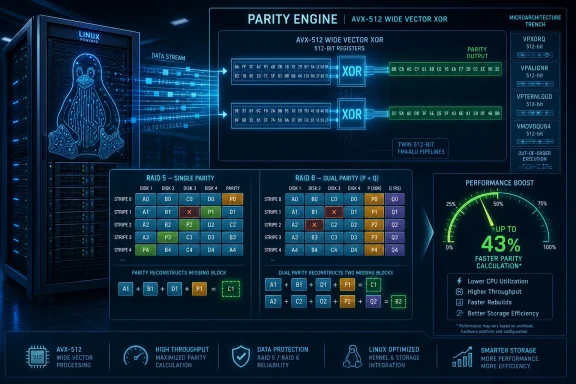
xor_gen() parity routine for review on the kernel mailing list, with Phoronix reporting on June 14, 2026, that the new version now shows performance gains of up to 43 percent in RAID-related workloads. The number is modestly higher than the first reported 41 percent result, but the real story is not the extra two points. It is that Linux storage performance is still finding meaningful speed in places most users never see: the low-level math that keeps arrays intact, filesystems consistent, and parity blocks useful. For WindowsForum readers, this is also a reminder that the operating-system wars are increasingly fought in the microarchitecture trenches, where one instruction family can tilt the cost of software storage.
 Linux Finds Free Speed in the Parity Path
The revised patch targets xor_gen(), a kernel function used to generate and validate parity blocks. That makes it relevant to software RAID, particularly RAID5 and RAID6-style parity work, and to filesystems that call into similar XOR machinery directly. Btrfs is the obvious Linux example, because it has long lived at the intersection of checksumming, redundancy, and performance anxiety.Parity computation is not glamorous work. It does not change the desktop shell, ship a new app, or make a release note sound like an AI roadmap. But it is exactly the kind of routine that can dominate performance when storage stacks are under sustained pressure, especially on systems where the CPU is responsible for redundancy rather than a dedicated RAID controller.
The first AVX-512 implementation reportedly delivered gains of up to 41 percent on an AMD Ryzen 9 9950X. The revised version nudges the maximum improvement to 43 percent and, more importantly, improves results across additional source-count sizes. That second clause matters more than the headline number, because kernel code must serve a messy spread of real configurations rather than one benchmark-friendly case.
This is the Linux kernel doing what it does best: slowly converting hardware capability into general-purpose operating-system advantage. The patch is still under review, so it is not a user-facing feature yet. But it is already a useful signal about where modern storage performance is heading.
AVX-512 Is No Longer Just a Datacenter Party Trick
AVX-512 has had a strange career. Intel introduced it as a wide-vector instruction set with obvious high-performance-computing appeal, then spent years complicating its reputation with uneven product support, frequency concerns, and consumer-market whiplash. AMD’s Zen 4 and Zen 5 era changed the tone by making AVX-512 more broadly relevant on enthusiast and workstation-class chips.That matters because Linux kernel optimizations do not become broadly useful simply because an instruction exists. They become useful when enough deployed machines can run them without turning the rest of the system into a thermal or scheduling compromise. The more AVX-512-capable CPUs appear in developer workstations, NAS builds, home labs, CI servers, and small-business boxes, the more attractive this kind of kernel plumbing becomes.
The
xor_gen() work fits into a broader pattern around Eric Biggers’ recent kernel performance work. Over the past couple of years, AVX-512 and related vector instructions have shown up in Linux discussions around CRC acceleration, AES-XTS, AES-GCM, and other routines where repeated arithmetic over blocks of data can be made dramatically faster. Storage is full of exactly that kind of work.The old caricature of AVX-512 as a feature for rare Xeons and scientific workloads is increasingly out of date. It is not universal, and it still needs careful dispatch logic. But on the right chips, it is now a practical accelerator for mundane infrastructure.
The Kernel’s Trick Is Choosing When Not to Be Clever
The hard part is not writing an AVX-512 version of a routine. The hard part is making it safe, useful, and boring inside a general-purpose kernel. Kernel code has to preserve CPU state correctly, avoid hurting latency-sensitive work, and pick the right implementation only on hardware where the win is real.That is why these patches matter even before they land. They show the kernel community continuing to refine the rules for using wide vector instructions in places that were once treated with caution. AVX-512 can be spectacularly fast, but it is not magic. On some CPUs, wide-vector use has carried frequency or warm-up penalties; on others, the penalty is smaller or the throughput win is large enough to justify it.
The storage stack is a particularly good candidate because parity generation is batch-friendly. It often works over blocks large enough to amortize setup costs, and its arithmetic is simple enough to map well to SIMD. XOR is not a complicated operation, but doing it across large buffers at high speed is precisely the kind of job wide registers were born to do.
That also explains why the revised implementation’s broader improvements across source counts are important. RAID parity does not always involve the same number of inputs. A patch that wins only in a narrow configuration is interesting; a patch that keeps winning as the shape of the parity calculation changes is much closer to production-worthy.
Software RAID Keeps Refusing to Die
For decades, administrators were told that “real” RAID meant hardware RAID. The controller had the cache, the firmware, the battery-backed write protection, and the vendor blessing. Software RAID was treated as the economical option, useful but somehow less serious.That divide has been eroding for years. CPUs became absurdly fast, NVMe changed the storage bottleneck, filesystems grew their own integrity models, and hardware RAID firmware became one more opaque component in the failure chain. Modern sysadmins are often less interested in whether parity is computed on a card or a CPU than in whether the stack is observable, recoverable, and well supported.
Linux software RAID benefits directly from optimizations like this because it competes on the assumption that the host CPU can do the work efficiently. If parity generation becomes cheaper, the case for software RAID gets stronger. That is especially true on machines that already have CPU headroom but are trying to push more storage bandwidth through commodity hardware.
This is not a claim that every NAS or server should abandon hardware RAID tomorrow. There are still environments where controller features, vendor validation, or operational familiarity matter. But the performance argument has become less one-sided, and every kernel-level parity improvement pushes it further toward software-defined storage.
The Windows Angle Is About Architecture, Not Envy
A Linux RAID patch may seem like an odd subject for a Windows-focused community, but Windows users have skin in this game. Storage Spaces, ReFS, NTFS, Hyper-V hosts, WSL-heavy developer machines, and cross-platform fleets all live under the same hardware economics. If Linux can extract more throughput from AVX-512 for parity and checksumming, the question naturally becomes where Windows and its ecosystem do the same.Microsoft has long optimized hot paths for modern CPU features, and Windows itself is not blind to vector hardware. But the open development model makes Linux’s micro-optimizations unusually visible. A patch appears, a maintainer argues for it, benchmarks are posted, and observers can watch the kernel inch toward better use of silicon.
That visibility has a competitive effect. It lets hardware enthusiasts and infrastructure engineers see which operating system is moving quickly on a given class of workload. It also gives enterprise buyers more reason to ask vendors what their storage stack actually does with the CPU features listed on the spec sheet.
For WindowsForum readers who run mixed environments, the practical lesson is not “Linux good, Windows bad.” It is that CPU instruction support is no longer an abstract line item. If your storage stack can use it, AVX-512 can become real performance. If it cannot, it is just silicon sitting idle.
The Benchmark Number Is Smaller Than the Implication
A 43 percent gain is large enough to get attention but small enough to invite misunderstanding. It does not mean a RAID array becomes 43 percent faster in every task. It means a specific parity-related kernel routine can improve by that much under benchmarked conditions on supported hardware.That distinction matters. Storage performance is a chain of bottlenecks: media latency, controller behavior, filesystem layout, queue depth, memory bandwidth, CPU scheduling, write amplification, and the workload’s own access pattern. Speeding up parity generation helps most when parity generation is a meaningful part of the cost.
In workloads dominated by random I/O latency, the improvement may be hidden. In workloads streaming large parity-protected writes or rebuild operations, it could matter more. In filesystems or storage layers that directly call the same XOR routines, it may show up as lower CPU consumption rather than a simple top-line throughput jump.
That is still valuable. In servers, saved CPU cycles are not cosmetic. They can become more headroom for containers, virtual machines, encryption, compression, checksumming, deduplication, or simply lower power under sustained load.
The Ryzen 9 9950X Detail Matters More Than It Looks
The earlier benchmark context around the Ryzen 9 9950X is worth pausing on because it shows how far enthusiast CPUs have moved into workstation territory. A desktop-class AMD chip with strong AVX-512 behavior is not the same market signal as an exotic accelerator or a high-end server-only SKU. It means the developer who writes the optimization may be testing on hardware that many serious hobbyists and prosumers can actually buy.That has downstream effects. Home lab builders, open-source contributors, small MSPs, and independent storage appliance vendors all benefit when high-end desktop CPUs expose features once reserved for pricier platforms. Linux tends to absorb those opportunities quickly because its maintainers are often optimizing on the same hardware the community is excited about.
This also complicates the conventional wisdom around NAS design. For years, the home and small-business NAS market emphasized low-power cores, ECC memory where possible, and enough SATA lanes to get the job done. That still makes sense for many systems. But as filesystems add checksumming, encryption, compression, and parity-heavy layouts, CPU feature selection becomes more than a passmark score.
A modern desktop CPU can look wasteful in a storage box until you remember that software storage keeps asking the CPU to behave like a data-plane accelerator. AVX-512 is one of the ways it can.
Btrfs Is the Quiet Beneficiary Waiting in the Wings
Phoronix notes thatxor_gen() is also used by some filesystems directly, including Btrfs. That is important because Btrfs remains one of Linux’s most ambitious and contentious filesystems: checksummed, copy-on-write, snapshot-friendly, and still debated in parity RAID contexts. Any low-level improvement that helps its data integrity machinery is worth watching.Btrfs users are accustomed to tradeoffs. They get snapshots, send/receive workflows, transparent compression, and checksums, but they also live with a filesystem whose most advanced redundancy modes have carried warnings and caveats. Performance improvements in shared primitives do not erase those architectural discussions, but they do improve the baseline economics.
The important point is that kernel primitives do not belong to one subsystem forever. A faster XOR routine may originate in a RAID performance discussion and still help filesystem code that uses the same library path. That is how a small kernel patch can have a wider impact than its filename suggests.
This is also why the Linux storage stack is so hard to summarize. md RAID, dm targets, Btrfs, XFS, ext4, ZFS-on-Linux, encryption layers, and volume managers all overlap in ways that administrators feel directly. A low-level optimization can ripple across that ecosystem if it lands in the right common function.
The Patch Review Is Where the Real Product Work Happens
It is tempting to treat a benchmarked patch as a nearly finished feature. Kernel history says otherwise. The review stage is where maintainers ask whether the improvement is worth the code complexity, whether CPU feature checks are correct, whether fallback behavior is safe, and whether the optimization creates maintenance debt.That review is especially important for architecture-specific code. AVX-512 paths are not self-maintaining. They require assembly or intrinsic-heavy implementation, careful testing across CPU generations, and a plan for what happens when future chips behave differently. A fast path that only one person understands can become a liability.
Still, the revised implementation’s existence suggests the first version received enough attention to justify refinement rather than abandonment. That is usually a healthy sign. The best performance work often arrives in iterations: first prove the concept, then widen the cases where it wins, then simplify the code enough that maintainers can live with it.
The Linux kernel does not merge every clever optimization, and it should not. But storage hot paths are among the places where complexity can be justified, because the cost is paid by every system that moves protected data at scale.
The Industry Is Rediscovering the CPU as a Storage Accelerator
For years, storage acceleration meant offload. RAID cards, HBAs, smart NICs, DPUs, and dedicated appliances all promised to move work away from the host CPU. That story is still alive, especially in large-scale infrastructure, but it now coexists with a different reality: general-purpose CPUs have become extremely good at specialized work when software uses them properly.AVX-512 turns the CPU into a broad data-parallel engine. It is not as specialized as an ASIC and not as massively parallel as a GPU, but it sits exactly where storage software already runs. That placement is powerful. There is no bus hop to an external accelerator, no vendor firmware boundary, and no need to redesign the application around a separate device.
The tradeoff is that the operating system must be smarter. It must decide when wide-vector execution is beneficial, how to avoid penalizing unrelated workloads, and how to make architecture-specific code coexist with portable fallbacks. Linux has been building that muscle for years, sometimes painfully.
Storage is a natural beneficiary because the data is already in memory and the math is often repetitive. Checksums, parity, encryption, compression, and erasure coding all look different at the algorithm level, but they share an appetite for moving through blocks quickly. The better the kernel gets at mapping those operations onto modern CPUs, the less convincing old assumptions about storage bottlenecks become.
AVX-512’s Reputation Is Finally Being Rewritten by Practical Wins
AVX-512 used to arrive in conversations with baggage. On some Intel generations, it was associated with downclocking, uneven availability, and developer frustration. Linus Torvalds famously criticized it years ago, reflecting a broader skepticism that the instruction set’s costs and fragmentation might outweigh its benefits for mainstream computing.That skepticism was not irrational. Operating systems cannot chase every hardware feature just because it looks good in a synthetic benchmark. If an instruction set is rare, expensive to use, or harmful to neighboring workloads, conservative maintainers will keep it at arm’s length.
The difference now is that real implementations are maturing, and the hardware base has changed. AMD’s support helped normalize AVX-512 outside Intel’s highest-end segments, while newer Intel server platforms improved the calculus for some workloads. Kernel developers now have more reason to distinguish between “AVX-512 as a troubled brand” and “AVX-512 as a useful tool on CPUs where it behaves well.”
The
xor_gen() patch is part of that reputational shift. It does not settle the debate, but it adds another practical win in a place where users care about throughput, rebuild time, and CPU overhead.Administrators Should Read This as a Capacity Planning Story
For IT pros, the immediate action item is not to rebuild storage policy around an unmerged patch. The better takeaway is to treat CPU capabilities as part of storage capacity planning. If two servers have the same drive bays and network ports but only one has a CPU with fast AVX-512 support, they may not behave the same under parity-heavy loads.This is especially relevant for virtualization hosts and lab servers that mix duties. A box running Linux storage services, VMs, containers, and perhaps Windows guests may benefit from lower parity overhead even if raw disk throughput is unchanged. The win may appear as fewer saturated cores during rebuilds or scrubs rather than a dramatic benchmark screenshot.
It also argues for more careful benchmarking. Administrators should test their actual storage layout, filesystem, kernel version, CPU, and workload. A headline gain in
xor_gen() is a useful clue, not a substitute for local measurement.The broader lesson is that software-defined storage keeps moving. A system built on “good enough” CPU assumptions in 2021 may have very different optimization opportunities in 2026. Kernel upgrades can change the performance profile without a single drive being swapped.
Enthusiasts Will Notice First, Enterprises Will Wait
The first audience to care will be enthusiasts and performance-focused Linux users. They are the people running new kernels, compiling patches, comparing Zen 5 and Sapphire Rapids behavior, and posting charts before vendors update their documentation. That is how many Linux performance stories begin.Enterprise adoption will be slower. Production fleets care about support windows, distribution kernels, regression risk, and predictable behavior. A patch landing upstream is only the beginning; it then has to flow into stable kernel releases, distributions, appliances, and vendor-certified stacks.
But enterprise IT should still pay attention early. Storage performance improvements often arrive quietly and then become baseline assumptions. By the time a feature appears in a long-term distribution kernel, the organizations that tracked it early already know where it might matter.
There is also a procurement angle. If software storage performance increasingly depends on CPU vector behavior, then CPU selection deserves more scrutiny in storage-heavy servers. Core count, clock speed, memory channels, PCIe lanes, and instruction-set performance all belong in the same conversation.
The Small XOR Patch That Tells a Bigger 2026 Story
This revised AVX-512xor_gen() work is not a revolution on its own, but it is a clean snapshot of where infrastructure computing is going. Performance is being harvested from hidden layers. Hardware features are becoming useful only when operating systems learn to apply them selectively. Storage stacks are becoming more CPU-aware, not less.The most concrete lessons are refreshingly practical:
- The revised Linux
xor_gen()AVX-512 implementation is under review and is not yet a guaranteed mainline feature. - Phoronix reports that the new version improves the peak benchmark result from up to 41 percent to up to 43 percent.
- The patch matters most for software RAID and other parity-generating code paths, not for every storage workload.
- Btrfs may benefit because it can use the same XOR generation machinery directly in some cases.
- Systems with modern, well-behaved AVX-512 support stand to gain more than older or unsupported CPUs.
- Windows and mixed-platform administrators should view the patch as evidence that CPU instruction support is now part of storage-stack competitiveness.
The revised
xor_gen() patch may land, change again, or wait for more review, but its direction is clear: modern operating systems are no longer content to treat storage redundancy as a fixed tax. They are teaching the CPU to pay that tax more efficiently, one hot path at a time, and the platforms that do it best will make tomorrow’s software-defined storage feel less like a compromise and more like the default.