

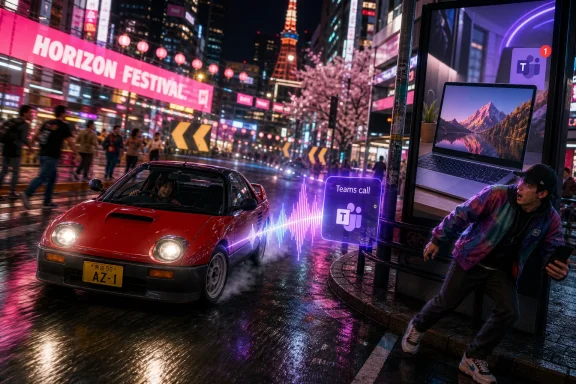
Forza Horizon 6, released for Xbox Series X|S and Windows PC on May 19, 2026, has turned one of Microsoft’s most hated workplace sounds into an in-game car horn that can convincingly mimic an incoming Microsoft Teams call. The joke is small, stupid, and mechanically trivial, but it lands because it weaponizes something modern players already carry around in their nervous systems. Playground Games has not just added another novelty unlock to a series famous for novelty unlocks; it has smuggled the office into the open road. That makes the “Microsoft Teams Meeting” horn one of the funniest and most revealing little details in a game otherwise defined by polish, safety, and the usual Horizon abundance.
Forza Horizon has always understood that cars are only half the fantasy. The other half is noise: turbo flutter, gravel spray, exhaust bangs, radio chatter, festival nonsense, and the deliberately irritating honks players use to announce themselves in public freeroam. The series’ horn collection has long been a museum of memes, Microsoft in-jokes, and playground pranks, from Windows startup and shutdown sounds to Halo and Rare-adjacent gag effects.
The Microsoft Teams Meeting horn belongs to that lineage, but it is sharper than the usual nostalgia bait. Windows XP Shutdown is funny because it points backward, toward beige towers, CRT monitors, and a simpler kind of computing annoyance. Teams is funny because it points sideways, toward the laptop still open on the desk, the headset still plugged in, and the workday that never quite ends.
That is why the gag works so well. A honk in a racing game is supposed to be disposable audio clutter. The first notes of a Teams call, however, carry context before the player has time to think. For millions of workers, they do not mean “someone is joking.” They mean “someone wants you now.”
In that instant, Forza Horizon 6 stops being a cheerful vacation in a fictionalized Japan and becomes a Pavlovian trap. It is not horror in the authored, scripted sense. It is worse, because it borrows its scare from real life.
That is slapstick, but it is also extremely 2026. The home office has changed the way games share space with work. A console in the living room, a Windows PC on the same desk, a Teams client idling in the background, and a player trying to decompress after a long week are no longer separate contexts. They are one room, one nervous system, one notification ecosystem.
Horror games understand anticipation. They understand that a sound can be more frightening than an image because the player’s imagination fills in the rest. The Teams horn works by the same principle, except the imagined monster is not a necromorph or a ghost child. It is a surprise video call.
That distinction matters. A Resident Evil scare is theatrical. A Silent Hill scare is symbolic. The Forza Teams scare is administrative. It hits the part of the brain that knows a spontaneous call after hours might mean something has gone wrong.
The problem is that Horizon has become so good at being Horizon that surprise now has to come from the margins. The driving is accessible, the presentation is lavish, the car list is enormous, the activities arrive in familiar showers, and the game is carefully engineered to make every ten minutes feel rewarding. That is a strength, but it also produces a kind of luxury fatigue.
When everything is generous, friction becomes memorable. When every stunt, board, mascot, event, speed zone, and seasonal objective fits neatly inside the established Horizon rhythm, the genuinely disruptive thing is not a new race type. It is another player abusing a corporate ringtone.
That does not make Forza Horizon 6 a lesser game. It makes it a mature franchise, which is both blessing and trap. Mature franchises rarely shock players through structure; they shock through texture. The Teams horn is texture with teeth.
That is more self-aware than it may first appear. Microsoft’s consumer and enterprise worlds increasingly overlap in awkward ways. Windows is where people work, play, stream, patch drivers, join meetings, install Game Pass titles, troubleshoot Bluetooth headsets, and pretend the same machine can cleanly separate all those identities. The Teams horn collapses that wall with two notes.
The result is not brand synergy in the polished keynote sense. It is brand hauntology. The sound of work follows the player into a racing festival, across Tokyo streets and Hakone corners, because that is what Microsoft’s ecosystem feels like in real life. The same account, the same notifications, the same hardware, the same cloud, the same login prompts, the same day bleeding into night.
For WindowsForum readers, that may be the most familiar part of the story. The joke is not merely that Teams is annoying. The joke is that the Windows PC is now both arcade cabinet and office terminal, and the distinction depends mostly on whether anybody decides to ring you.
In freeroam, the prank practically designs itself. Creep up behind a player who has stopped in a menu. Wait for them to return. Hit the horn. Watch them hesitate, pause, or swerve. No leaderboard changes hands, no credits are stolen, and no progression is blocked, but the attacker has still reached out of the game and touched the victim’s desktop life.
That is the rare harmless griefing tool that feels almost elegant. It does not require voice chat abuse or ramming someone off a line. It is obnoxious, but not destructive. The player being pranked is likely to understand the bit within seconds, and that moment of recognition is part of the payoff.
The social contract in Forza freeroam has always been loose. Some people cruise, some drift, some chase collectibles, some tune absurd kei trucks into physics crimes, and some exist purely to be irritating. The Teams horn gives that last group a precision instrument.
The Teams horn is noise that becomes meaning. It might drop beside a modest credit payout and a forgettable hatchback, yet it has more personality than many headline rewards. That imbalance exposes something important about live-service-adjacent design: abundance does not guarantee attachment.
Players remember the thing that creates a story. A rare hypercar can be impressive and still disappear into a garage full of rare hypercars. A stupid horn that makes someone think their boss is calling after hours becomes an anecdote, and anecdotes are the real currency of open-world multiplayer.
That is why cosmetic nonsense persists in games that otherwise obsess over cars, stats, and completion. The right cosmetic is not decorative. It changes the social weather. In this case, it turns a peaceful Japanese road into a miniature office panic simulator.
But the gag feels braver because Forza Horizon 6 is so controlled everywhere else. The series’ house style is relentlessly upbeat, relentlessly smooth, and relentlessly brand-safe. Its characters cheerlead, its festivals sparkle, its progression systems flatter, and its world is built to avoid making players feel stuck for long.
Within that tone, the Teams horn is deliciously mean. Not cruel, not edgy, not actually harmful — just mean enough to puncture the vibe. It is a reminder that play needs a little mischief, especially in games whose official voice often sounds like a motivational poster with a turbocharger.
Forza Horizon’s greatest risk is not failure. It is becoming so agreeable that nothing inside it has a rough edge. The Teams horn is a rough edge disguised as a joke unlock.
That player has muscle memory. They know the difference between a casual ping and a call. They know the little spike of dread when a meeting appears without warning. They know that a ringing Teams client can mean a trivial question, a broken service, a management escalation, or a colleague who has decided typing is optional.
The horn turns that muscle memory into gameplay. It does not ask whether the player likes Teams. It assumes the sound already owns a tiny piece of them.
For administrators and IT pros, there is an extra layer of comedy. These are the people who deploy, secure, troubleshoot, and sometimes defend the very collaboration tools that haunt them. Hearing one of those tools repurposed as a prank in a racing game is a reminder that enterprise software has a cultural life beyond release notes and admin centers.
Yet weeks after launch, the stories that stick are often smaller than the map. A perfect drift through Hakone. A ludicrous tune that turns a utility vehicle into a leaderboard weapon. A ghost car that appears at exactly the wrong emotional moment and honks like a meeting request from hell.
That is not a failure of world design. It is how open worlds live. The map provides the stage, but players remember incidents. The more authored a game’s spectacle becomes, the more valuable unscripted comedy feels.
The Teams horn is therefore not a distraction from Horizon Japan. It is one of the ways the setting becomes social. A beautiful road is scenery. A beautiful road where someone emotionally detonated you with enterprise audio is a place.
Horizon’s best moments often happen when the game’s immaculate machinery gives players enough room to be idiots. The Teams horn is a tool for idiocy, and idiocy is underrated design. It creates friction without punishment, personality without cutscenes, and community behavior without a tutorial card.
That is especially important as the franchise expands across platforms and audiences. A racing game with hundreds of cars can sell itself to enthusiasts. A racing game full of shareable, ridiculous stories sells itself to everyone else.
Microsoft should pay attention to that distinction. The most valuable engagement is not always another objective on the map. Sometimes it is a player laughing, swearing, clipping thirty seconds of footage, and sending it to friends with the caption: “I thought this was my actual job.”
 The Funniest Sound in Forza Is Also the Most Corporate One
Forza Horizon has always understood that cars are only half the fantasy. The other half is noise: turbo flutter, gravel spray, exhaust bangs, radio chatter, festival nonsense, and the deliberately irritating honks players use to announce themselves in public freeroam. The series’ horn collection has long been a museum of memes, Microsoft in-jokes, and playground pranks, from Windows startup and shutdown sounds to Halo and Rare-adjacent gag effects.The Microsoft Teams Meeting horn belongs to that lineage, but it is sharper than the usual nostalgia bait. Windows XP Shutdown is funny because it points backward, toward beige towers, CRT monitors, and a simpler kind of computing annoyance. Teams is funny because it points sideways, toward the laptop still open on the desk, the headset still plugged in, and the workday that never quite ends.
That is why the gag works so well. A honk in a racing game is supposed to be disposable audio clutter. The first notes of a Teams call, however, carry context before the player has time to think. For millions of workers, they do not mean “someone is joking.” They mean “someone wants you now.”
In that instant, Forza Horizon 6 stops being a cheerful vacation in a fictionalized Japan and becomes a Pavlovian trap. It is not horror in the authored, scripted sense. It is worse, because it borrows its scare from real life.
Playground Games Accidentally Built a Workplace Horror Mechanic
The brilliance of the horn is that it needs no animation, no jump-cut, no monster closet, and no design-document capital letters. It only needs a sound that many players have been trained to treat as urgent. The player hears it, pauses, looks away from the television, checks the PC, checks the notification area, and only then realizes that the threat is not a dean, manager, client, or incident bridge. It is an Autozam AZ-1 doing donuts.That is slapstick, but it is also extremely 2026. The home office has changed the way games share space with work. A console in the living room, a Windows PC on the same desk, a Teams client idling in the background, and a player trying to decompress after a long week are no longer separate contexts. They are one room, one nervous system, one notification ecosystem.
Horror games understand anticipation. They understand that a sound can be more frightening than an image because the player’s imagination fills in the rest. The Teams horn works by the same principle, except the imagined monster is not a necromorph or a ghost child. It is a surprise video call.
That distinction matters. A Resident Evil scare is theatrical. A Silent Hill scare is symbolic. The Forza Teams scare is administrative. It hits the part of the brain that knows a spontaneous call after hours might mean something has gone wrong.
Horizon Japan Is Beautiful, but the Formula Is Showing Its Mileage
The joke lands harder because Forza Horizon 6 is, by most accounts and by design, not a radical reinvention. Playground Games finally took the festival to Japan, the setting fans had demanded for years, and built a dense map that stretches from Tokyo City to mountain passes, rural roads, coastal routes, and alpine drama. It is the sort of premise that sells itself before a single car is rendered.The problem is that Horizon has become so good at being Horizon that surprise now has to come from the margins. The driving is accessible, the presentation is lavish, the car list is enormous, the activities arrive in familiar showers, and the game is carefully engineered to make every ten minutes feel rewarding. That is a strength, but it also produces a kind of luxury fatigue.
When everything is generous, friction becomes memorable. When every stunt, board, mascot, event, speed zone, and seasonal objective fits neatly inside the established Horizon rhythm, the genuinely disruptive thing is not a new race type. It is another player abusing a corporate ringtone.
That does not make Forza Horizon 6 a lesser game. It makes it a mature franchise, which is both blessing and trap. Mature franchises rarely shock players through structure; they shock through texture. The Teams horn is texture with teeth.
Microsoft’s Ecosystem Has Become Its Own Punchline
There is something especially funny about this particular gag appearing inside a first-party Xbox game. Teams is not just generic office software. It is part of Microsoft’s modern productivity empire, a product that became central to remote and hybrid work and then refused to leave the psychological premises. Forza Horizon 6 turns that corporate asset into a toy for griefers.That is more self-aware than it may first appear. Microsoft’s consumer and enterprise worlds increasingly overlap in awkward ways. Windows is where people work, play, stream, patch drivers, join meetings, install Game Pass titles, troubleshoot Bluetooth headsets, and pretend the same machine can cleanly separate all those identities. The Teams horn collapses that wall with two notes.
The result is not brand synergy in the polished keynote sense. It is brand hauntology. The sound of work follows the player into a racing festival, across Tokyo streets and Hakone corners, because that is what Microsoft’s ecosystem feels like in real life. The same account, the same notifications, the same hardware, the same cloud, the same login prompts, the same day bleeding into night.
For WindowsForum readers, that may be the most familiar part of the story. The joke is not merely that Teams is annoying. The joke is that the Windows PC is now both arcade cabinet and office terminal, and the distinction depends mostly on whether anybody decides to ring you.
The Best Multiplayer Pranks Are Social Engineering
The Microsoft Teams horn is not powerful because it is loud. It is powerful because it is plausible. A novelty horn that plays a cartoon sound is just a novelty horn. A novelty horn that imitates a real-world alert becomes a tiny social-engineering attack.In freeroam, the prank practically designs itself. Creep up behind a player who has stopped in a menu. Wait for them to return. Hit the horn. Watch them hesitate, pause, or swerve. No leaderboard changes hands, no credits are stolen, and no progression is blocked, but the attacker has still reached out of the game and touched the victim’s desktop life.
That is the rare harmless griefing tool that feels almost elegant. It does not require voice chat abuse or ramming someone off a line. It is obnoxious, but not destructive. The player being pranked is likely to understand the bit within seconds, and that moment of recognition is part of the payoff.
The social contract in Forza freeroam has always been loose. Some people cruise, some drift, some chase collectibles, some tune absurd kei trucks into physics crimes, and some exist purely to be irritating. The Teams horn gives that last group a precision instrument.
A Tiny Unlock Says More Than a Thousand Reward Screens
Forza Horizon’s reward economy has a long-running absurdity problem. Wheelspins and Super Wheelspins shower players with credits, cars, cosmetics, horns, clothes, and filler prizes at a pace that can make any individual unlock feel faintly meaningless. The game is constantly giving, but much of what it gives is noise.The Teams horn is noise that becomes meaning. It might drop beside a modest credit payout and a forgettable hatchback, yet it has more personality than many headline rewards. That imbalance exposes something important about live-service-adjacent design: abundance does not guarantee attachment.
Players remember the thing that creates a story. A rare hypercar can be impressive and still disappear into a garage full of rare hypercars. A stupid horn that makes someone think their boss is calling after hours becomes an anecdote, and anecdotes are the real currency of open-world multiplayer.
That is why cosmetic nonsense persists in games that otherwise obsess over cars, stats, and completion. The right cosmetic is not decorative. It changes the social weather. In this case, it turns a peaceful Japanese road into a miniature office panic simulator.
The Series’ Safeness Makes the Prank Feel Braver Than It Is
It would be easy to overstate the horn as some daring act of design rebellion. It is, after all, a small audio gag in a massive racing game. Nobody at Playground Games has reinvented multiplayer interaction by adding the sound of a meeting invite to a car.But the gag feels braver because Forza Horizon 6 is so controlled everywhere else. The series’ house style is relentlessly upbeat, relentlessly smooth, and relentlessly brand-safe. Its characters cheerlead, its festivals sparkle, its progression systems flatter, and its world is built to avoid making players feel stuck for long.
Within that tone, the Teams horn is deliciously mean. Not cruel, not edgy, not actually harmful — just mean enough to puncture the vibe. It is a reminder that play needs a little mischief, especially in games whose official voice often sounds like a motivational poster with a turbocharger.
Forza Horizon’s greatest risk is not failure. It is becoming so agreeable that nothing inside it has a rough edge. The Teams horn is a rough edge disguised as a joke unlock.
Windows Players Know This Sound Too Well
The reason this story belongs on a Windows community site is not merely that Forza Horizon 6 runs on PC. It is that the gag depends on PC culture as it exists now. The player most vulnerable to the prank is not someone sitting ten feet from a sealed console experience. It is someone whose gaming setup lives beside Outlook, Teams, OneDrive, Edge tabs, VPN clients, endpoint agents, and the rest of the modern Windows stack.That player has muscle memory. They know the difference between a casual ping and a call. They know the little spike of dread when a meeting appears without warning. They know that a ringing Teams client can mean a trivial question, a broken service, a management escalation, or a colleague who has decided typing is optional.
The horn turns that muscle memory into gameplay. It does not ask whether the player likes Teams. It assumes the sound already owns a tiny piece of them.
For administrators and IT pros, there is an extra layer of comedy. These are the people who deploy, secure, troubleshoot, and sometimes defend the very collaboration tools that haunt them. Hearing one of those tools repurposed as a prank in a racing game is a reminder that enterprise software has a cultural life beyond release notes and admin centers.
The Japan Setting Carries the Spectacle; the Horn Carries the Memory
Forza Horizon 6’s Japan is the headline feature, and rightly so. Tokyo’s density, mountain roads, drift culture, compact cars, expressways, and seasonal scenery give Playground Games a canvas fans had been sketching in their heads for more than a decade. The studio’s technical artists remain among the best in the business at turning landscape into invitation.Yet weeks after launch, the stories that stick are often smaller than the map. A perfect drift through Hakone. A ludicrous tune that turns a utility vehicle into a leaderboard weapon. A ghost car that appears at exactly the wrong emotional moment and honks like a meeting request from hell.
That is not a failure of world design. It is how open worlds live. The map provides the stage, but players remember incidents. The more authored a game’s spectacle becomes, the more valuable unscripted comedy feels.
The Teams horn is therefore not a distraction from Horizon Japan. It is one of the ways the setting becomes social. A beautiful road is scenery. A beautiful road where someone emotionally detonated you with enterprise audio is a place.
The Next Horizon Problem Is Not Bigger Maps
The larger lesson for Playground Games is not that Forza Horizon needs more meme horns, though it absolutely does. The lesson is that the series’ future depends on surprise at human scale. Bigger maps, denser cities, longer car lists, and more seasonal playlists can all be impressive without being memorable.Horizon’s best moments often happen when the game’s immaculate machinery gives players enough room to be idiots. The Teams horn is a tool for idiocy, and idiocy is underrated design. It creates friction without punishment, personality without cutscenes, and community behavior without a tutorial card.
That is especially important as the franchise expands across platforms and audiences. A racing game with hundreds of cars can sell itself to enthusiasts. A racing game full of shareable, ridiculous stories sells itself to everyone else.
Microsoft should pay attention to that distinction. The most valuable engagement is not always another objective on the map. Sometimes it is a player laughing, swearing, clipping thirty seconds of footage, and sending it to friends with the caption: “I thought this was my actual job.”
The Teams Horn Is the Joke That Explains the Whole Game
Forza Horizon 6’s Microsoft Teams Meeting horn is a throwaway reward that accidentally captures the state of modern gaming, modern work, and Microsoft’s blurred consumer-enterprise universe better than any marketing beat could. It is dumb in precisely the right way, and that is why it matters.- Forza Horizon 6 launched on May 19, 2026, for Xbox Series X|S and Windows PC, bringing the long-requested Japan setting to the series.
- The Microsoft Teams Meeting horn works because it mimics a sound many players associate with urgency, interruption, and workplace stress.
- The prank is most effective on PC-adjacent players whose gaming and working lives already share the same physical and digital space.
- The horn stands out because Forza Horizon 6 is otherwise polished, familiar, and relatively safe in its evolution of the series formula.
- The episode shows that small social tools can create more memorable multiplayer stories than many larger progression rewards.
- Playground Games’ best path forward is not just more scale, but more opportunities for players to create surprising, ridiculous moments inside that scale.
References
- Primary source: Forbes
Published: 2026-06-14T17:36:07.106696

A Stupid ‘Forza Horizon 6’ Horn Offers 2026’s Biggest Jumpscare
'Forza Horizon 6' may be a positive, happy arcade racing experience, but it has a horrible trick up its sleeve to shock players.www.forbes.com - Related coverage: pcgamer.com

Forza Horizon 6 Tokyo City Treasure Hunt location | PC Gamer
Here's where to find the Tokyo City Treasure Hunt in Forza Horizon 6 to complete the Festival Playlist challenge this week and nab the exclusive rides.www.pcgamer.com - Related coverage: gematsu.com

Forza Horizon 6 - Gematsu
Forza Horizon 6 is an open-world racing video game developed by Playground Games and published by Xbox Game Studios. About Discover the breathtaking landscapes…www.gematsu.com - Related coverage: forza.net

Forza Horizon 6 - Full Map Reveal
Forza Horizon 6 introduces our most dense and vertical map yet.forza.net - Related coverage: gamesradar.com
Complete Forza Horizon 6 guide | GamesRadar+
Forza Horizon 6 is officially here, so you can hit the roads of Japan now with our guides to help you win races and explorewww.gamesradar.com - Related coverage: allthings.how

Forza Horizon 6 Map: Every Confirmed Region, Road, and POI in Horizon Japan
A rundown of the regions, touge passes, expressway loops, and Tokyo districts spotted across the Horizon Japan map reveal.allthings.how
- Related coverage: motorsport.com

"Forza Horizon 6" set in Japan for 2026 as full reveals still to come
Playground Games has confirmed 'Forza Horizon 6' is set in Japan, launching in 2026 on Xbox Series X|S and PC with Game Pass at launchwww.motorsport.com - Related coverage: notebookcheck.net

Forza Horizon 6 officially confirmed for Japan with 2026 release window - Notebookcheck News
Forza Horizon 6 is now confirmed to be set in Japan, with a 2026 release window. An official Instagram post has put an end to months of speculation and leaks, with a full trailer expected during Tokyo Game Show 2025. www.notebookcheck.net
- Related coverage: windowscentral.com

Forza Horizon 6 pulls in over 270,000 Steam players at launch, and the number is still climbing as Playground’s racer picks up momentum | Windows Central
Forza Horizon 6 has officially launched worldwide, and Steam player numbers are already far beyond what Forza Horizon 5 achieved.www.windowscentral.com - Related coverage: traxion.gg

Forza Horizon 6's location confirmed as Japan, 2026 release | Traxion
“The next Forza” was already confirmed for 2026, and the next Forza was already known as Horizon - but just to be sure, we extra, extra, know.traxion.gg - Related coverage: news.xbox.com

『Forza Horizon 6』の舞台が日本になった理由とその描き方について - XBOX Wire Japan
『Forza Horizon 6』が 2026 年に登場することが決定し、その舞台は日本となります!news.xbox.com - Related coverage: creativebloq.com

Forza Horizon 6 review: pure video game joy at 200mph | Creative Bloq
Improving on its predecessor, this sandbox racer manages the unthinkable: to be all things to all people.www.creativebloq.com - Related coverage: as.com
- Related coverage: aftonbladet.se

Forza Horizon 6 släpps till Xbox och Playstation 5
Japanskt och socialt. Och turist blir proffs. Nu kommer nya bilder och nyheter kring ”Forza Horizon 6” – till Xbox och konkurrenten Playstation 5.www.aftonbladet.se