

Google Chrome before version 149.0.7827.115 contains CVE-2026-12012, a high-severity use-after-free flaw in the browser’s Network component, published by Chrome on June 11, 2026, and described as exploitable by an attacker with a privileged network position using malicious network traffic. The important part is not merely that Chrome has another memory-safety bug; it is where this one sits. A browser vulnerability in the network stack shifts attention away from the familiar “don’t click the bad page” model and toward the messier places where enterprise traffic is intercepted, inspected, proxied, tunneled, and sometimes manipulated. For Windows users and administrators, the right answer is simple — update — but the operational lesson is broader.
Most Chrome security stories are framed around the web page as the battleground. A crafted HTML document, a malicious JavaScript payload, a compromised ad network, or an exploit chain launched from a phishing page fits the mental model administrators have built over the last decade. CVE-2026-12012 is less tidy.
The description says the flaw is a use-after-free in Network and that exploitation requires a “privileged network position.” That phrase matters. It suggests an attacker is not merely posting a trap on the public web and waiting for victims to browse to it, but is instead positioned somewhere along the path of the victim’s traffic or inside an environment that can influence that traffic.
That does not automatically mean every coffee-shop Wi-Fi network is a Chrome exploit factory. The CVSS vector published by CISA’s ADP process rates attack complexity as high, which is a meaningful caveat. But high complexity is not the same thing as theoretical, especially in corporate networks where proxies, VPNs, TLS inspection devices, captive portals, and remote access appliances already occupy privileged positions by design.
The uncomfortable lesson is that the modern browser is no longer just an application rendering pages. It is a full network client, policy endpoint, identity surface, media platform, app runtime, and synchronization engine. When a bug lands in that plumbing, the attack model gets more interesting than “user visited bad site.”
For WindowsForum readers, the practical message is blunt: do not stop at “Chrome 149.” Point releases matter. A machine running an earlier 149 build may look current to a casual user while still missing the fix for this batch of vulnerabilities.
Chrome’s own update model is designed to make this boring. The browser updates itself, prompts for restart, and eventually drags most consumer systems forward without a ticket, a maintenance window, or a stern memo from IT. But enterprises do not live in the default path. They defer updates, pin versions, test browser releases against line-of-business apps, and sometimes run separate stable, extended stable, and managed channels across different user groups.
That is why CVE records still matter in an auto-update world. The CVE gives security teams a machine-readable way to ask a very specific question: which endpoints are still below the fixed build? The answer is more useful than a generic assurance that “Chrome updates automatically.”
Corporate networks routinely route browser traffic through security products. Schools and enterprises use filtering gateways. Remote workers connect over VPNs. Hotels, airports, and conference centers place users behind captive portals and middleboxes. Cloud-hosted desktops and virtual app environments may traverse brokered network paths before a user ever sees a page.
None of that means those devices are malicious. The point is that the browser’s network boundary is crowded. Every box that can alter, delay, replay, terminate, inspect, or synthesize traffic becomes part of the risk conversation when the vulnerability lives in the network component.
The CVSS vector assigns no user interaction requirement, which is another detail worth noticing. That does not prove exploitation is easy, and it does not reveal a working exploit path. But it does separate this bug from the more common browser vulnerability that depends on luring a user into clicking, opening, or visiting something.
Chrome has spent years hardening against this class of defect. Google has deployed mitigations such as MiraclePtr and has publicly pushed more security-sensitive code toward memory-safe languages where practical. Those efforts matter, but they have not made memory corruption disappear.
That is not a knock on Chrome alone. Browsers are among the most complex consumer applications ever shipped. They ingest hostile content, parse ancient formats, process streaming media, negotiate encrypted network sessions, run untrusted code at speed, and maintain backward compatibility with the web’s archaeological layers. The surprise is not that memory bugs still appear; the surprise is that the browser ecosystem has made them survivable often enough that users forget how dangerous they are.
CVE-2026-12012 is another reminder that “High” severity in Chrome is not a polite suggestion. Heap corruption in a browser component is the kind of primitive attackers love, even when a public exploit is not known and even when exploitation requires careful positioning.
That habit is increasingly dangerous. The CVE was published by Chrome, the vendor advisory exists, the weakness is identified as CWE-416, and CISA’s ADP scoring lists it as an 8.1 high-severity issue under CVSS 3.1. Waiting for every metadata field to settle is a governance instinct, not a security strategy.
The temporary messiness around CPE applicability is also not unusual. The NVD change history shows configurations being added for Chrome across Windows, Linux, and macOS. The presence of operating-system CPEs in the configuration logic can look odd to readers expecting a single Chrome application identifier, but vulnerability databases often express product applicability through combinations of application and platform entries.
That is why asset management systems should not blindly reduce the record to “Windows vulnerable” or “Linux vulnerable.” The vulnerable product is Chrome before the fixed version, running on affected desktop platforms. The operating system matters because Chrome builds and patch levels differ by platform, not because the Windows kernel or Linux kernel is itself the vulnerable component in this CVE.
Microsoft Edge, Brave, Vivaldi, Opera, and other Chromium-based browsers routinely inherit large portions of Chromium code, though their exposure to a specific bug depends on whether the affected component is present, how it is configured, and whether the downstream vendor has integrated the relevant fix. Administrators should therefore avoid the lazy mistake of treating a Chrome CVE as irrelevant simply because the corporate standard browser is Edge.
This is especially true for Windows shops that allow multiple browsers. It is common to find Chrome installed for developer tooling, Edge used for Microsoft 365 workflows, Firefox retained for compatibility testing, and Chromium embedded inside desktop apps. Browser inventory often looks clean in policy and chaotic on disk.
The right operational posture is to patch Chrome immediately and then verify Chromium-based derivatives against their vendors’ corresponding security releases. The absence of a product name in the first CVE description is not proof of absence of exposure across the Chromium family.
That approach is understandable, but CVE-2026-12012 is the kind of bug that argues for a tighter standard. Its described attack path does not require a malicious page in the classic sense. The attacker’s advantage is position, and position is often persistent.
A compromised network appliance, hostile proxy, or attacker-controlled access point may see many users before defenders understand what happened. A vulnerability reachable through malicious network traffic is the sort of issue where the user may have very little observable role in triggering the condition.
There is no public claim here that CVE-2026-12012 is being actively exploited. That distinction matters. But administrators should not interpret “no known exploitation” as “safe to defer.” The vulnerability class and component are enough to justify urgency.
Think of shared workstations, lab machines, contractor laptops, field devices, kiosks, VDI images, and systems that spend weeks asleep or disconnected from corporate management. These endpoints may sit outside the clean compliance graphs that executives see. They are also more likely to connect from hotels, client sites, manufacturing networks, or temporary access points where network trust is weaker.
The patch problem is not only downloading the update. Chrome must relaunch to complete it. Users can keep sessions alive for days, and managed devices can show the new update as available long before the vulnerable browser process has actually been replaced.
Security teams should therefore care about running version, not just installed package version. The difference sounds pedantic until an incident review shows that the fix had been staged for days while the vulnerable process remained open.
The fastest check is inside Chrome itself: open the About Chrome page and let the browser check for updates. If it downloads an update, relaunch it. If it already reports a fixed build, the immediate Chrome-specific concern is addressed.
For Microsoft Edge users, the comparable step is to check Edge’s About page and confirm Microsoft has delivered the relevant Chromium security updates in its own release train. Edge is not patched by Chrome’s updater, and Chrome is not patched by Edge’s updater. The shared engine does not mean shared update plumbing.
The Windows ecosystem has trained users to look for a single patching ritual. Chromium’s success has made that insufficient. A fully patched Windows 11 system can still contain an outdated Chrome install, an outdated Edge install, and an outdated Electron app, each with its own copy of the browser stack.
Security products are particularly awkward in this scenario because some of them occupy the very privileged network positions the CVE language asks us to consider. The same middlebox that protects users by inspecting traffic also becomes a critical trust dependency. If it malfunctions, is misconfigured, or is compromised, the browser may be exposed to traffic patterns users never intentionally requested.
This does not mean organizations should rip out proxies or abandon inspection. It means browser patching should be treated as a baseline control, not something made optional by the presence of perimeter defenses. Defense in depth fails when one layer is used as an excuse to neglect another.
The best security teams will use this CVE as a small audit trigger. They will ask not only whether Chrome is patched, but which devices can shape browser traffic, which users traverse untrusted networks, and whether browser relaunch deadlines are being enforced rather than merely suggested.
A CPE entry is supposed to help machines match vulnerabilities to products. But modern software distribution does not map neatly to old product dictionaries. Chrome is an application, Chromium is a project, Edge is a downstream browser, Electron bundles Chromium into apps, and operating systems may carry platform-specific builds with different fixed versions.
When NVD enrichment is still in progress, these relationships can look incomplete, overbroad, or strangely nested. That does not change the core remediation: identify Chrome installations below the fixed build and update them. But it does mean vulnerability management teams should be careful before writing detection logic solely from an early CPE configuration.
The better approach is layered. Use vendor advisories for fixed versions, CVE metadata for classification, endpoint inventory for installed and running builds, and browser management telemetry for relaunch status. Any one of those signals can be stale or misleading. Together, they form a more reliable picture.
But the same rhythm can make serious issues feel routine. A stable channel update lands. A list of CVEs appears. Some are high severity. Some bug details remain restricted. Users are told the rollout will happen over days or weeks. Everyone moves on.
That routine is useful until it dulls attention. CVE-2026-12012 deserves notice because it is not just another crafted-page memory bug. Its network positioning language should force defenders to widen the frame from web content to traffic handling.
The browser wars trained users to think in terms of features, performance, extensions, and battery life. The security reality is harsher. The browser is now a managed endpoint agent that happens to render websites. Treating it as anything less undersells the risk.
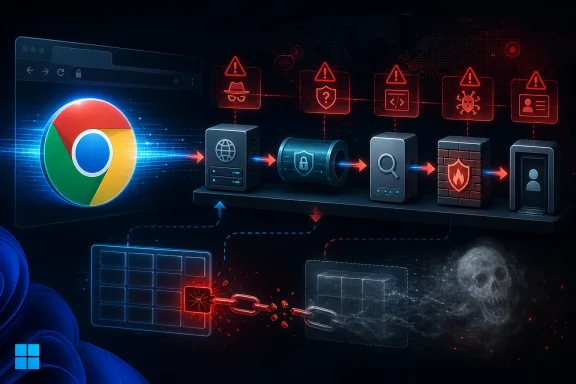 This Chrome Bug Lives Where Users Rarely Look
Most Chrome security stories are framed around the web page as the battleground. A crafted HTML document, a malicious JavaScript payload, a compromised ad network, or an exploit chain launched from a phishing page fits the mental model administrators have built over the last decade. CVE-2026-12012 is less tidy.The description says the flaw is a use-after-free in Network and that exploitation requires a “privileged network position.” That phrase matters. It suggests an attacker is not merely posting a trap on the public web and waiting for victims to browse to it, but is instead positioned somewhere along the path of the victim’s traffic or inside an environment that can influence that traffic.
That does not automatically mean every coffee-shop Wi-Fi network is a Chrome exploit factory. The CVSS vector published by CISA’s ADP process rates attack complexity as high, which is a meaningful caveat. But high complexity is not the same thing as theoretical, especially in corporate networks where proxies, VPNs, TLS inspection devices, captive portals, and remote access appliances already occupy privileged positions by design.
The uncomfortable lesson is that the modern browser is no longer just an application rendering pages. It is a full network client, policy endpoint, identity surface, media platform, app runtime, and synchronization engine. When a bug lands in that plumbing, the attack model gets more interesting than “user visited bad site.”
The Version Number Is the Boundary Between Theory and Exposure
The clean remediation line for CVE-2026-12012 is Chrome 149.0.7827.115 or later on platforms receiving that build, with Google’s stable desktop update rolling out in the 149.0.7827.114/.115 range for Windows and macOS and 149.0.7827.114 for Linux. That slightly awkward version split is normal for Chrome’s platform-specific release machinery, but it can be a source of confusion for administrators staring at inventory dashboards.For WindowsForum readers, the practical message is blunt: do not stop at “Chrome 149.” Point releases matter. A machine running an earlier 149 build may look current to a casual user while still missing the fix for this batch of vulnerabilities.
Chrome’s own update model is designed to make this boring. The browser updates itself, prompts for restart, and eventually drags most consumer systems forward without a ticket, a maintenance window, or a stern memo from IT. But enterprises do not live in the default path. They defer updates, pin versions, test browser releases against line-of-business apps, and sometimes run separate stable, extended stable, and managed channels across different user groups.
That is why CVE records still matter in an auto-update world. The CVE gives security teams a machine-readable way to ask a very specific question: which endpoints are still below the fixed build? The answer is more useful than a generic assurance that “Chrome updates automatically.”
“Privileged Network Position” Is the Phrase That Should Make Admins Sit Up
The phrase “privileged network position” tends to sound like a limitation, and in consumer threat models it often is. An attacker who needs to be on-path, adjacent, or otherwise able to interfere with traffic has a narrower opportunity than an attacker who can email a link to the entire internet. But in managed environments, privileged network positions are not exotic. They are everywhere.Corporate networks routinely route browser traffic through security products. Schools and enterprises use filtering gateways. Remote workers connect over VPNs. Hotels, airports, and conference centers place users behind captive portals and middleboxes. Cloud-hosted desktops and virtual app environments may traverse brokered network paths before a user ever sees a page.
None of that means those devices are malicious. The point is that the browser’s network boundary is crowded. Every box that can alter, delay, replay, terminate, inspect, or synthesize traffic becomes part of the risk conversation when the vulnerability lives in the network component.
The CVSS vector assigns no user interaction requirement, which is another detail worth noticing. That does not prove exploitation is easy, and it does not reveal a working exploit path. But it does separate this bug from the more common browser vulnerability that depends on luring a user into clicking, opening, or visiting something.
Use-After-Free Remains Chrome’s Oldest Modern Problem
A use-after-free bug is a memory lifetime error. Software frees an object, but some code path later continues to use a reference to it. In a large C++ codebase, that can become a route to heap corruption, and in the worst cases heap corruption can become code execution, sandbox escape support, or data compromise.Chrome has spent years hardening against this class of defect. Google has deployed mitigations such as MiraclePtr and has publicly pushed more security-sensitive code toward memory-safe languages where practical. Those efforts matter, but they have not made memory corruption disappear.
That is not a knock on Chrome alone. Browsers are among the most complex consumer applications ever shipped. They ingest hostile content, parse ancient formats, process streaming media, negotiate encrypted network sessions, run untrusted code at speed, and maintain backward compatibility with the web’s archaeological layers. The surprise is not that memory bugs still appear; the surprise is that the browser ecosystem has made them survivable often enough that users forget how dangerous they are.
CVE-2026-12012 is another reminder that “High” severity in Chrome is not a polite suggestion. Heap corruption in a browser component is the kind of primitive attackers love, even when a public exploit is not known and even when exploitation requires careful positioning.
NVD’s “Undergoing Reanalysis” Banner Is Not a Reason to Wait
The NVD entry for CVE-2026-12012 is still undergoing enrichment and reanalysis, with NIST not yet providing its own CVSS score at the time reflected in the record. That can create a false sense of ambiguity. Some organizations still treat NVD enrichment as the authoritative moment when a vulnerability becomes “real” for triage purposes.That habit is increasingly dangerous. The CVE was published by Chrome, the vendor advisory exists, the weakness is identified as CWE-416, and CISA’s ADP scoring lists it as an 8.1 high-severity issue under CVSS 3.1. Waiting for every metadata field to settle is a governance instinct, not a security strategy.
The temporary messiness around CPE applicability is also not unusual. The NVD change history shows configurations being added for Chrome across Windows, Linux, and macOS. The presence of operating-system CPEs in the configuration logic can look odd to readers expecting a single Chrome application identifier, but vulnerability databases often express product applicability through combinations of application and platform entries.
That is why asset management systems should not blindly reduce the record to “Windows vulnerable” or “Linux vulnerable.” The vulnerable product is Chrome before the fixed version, running on affected desktop platforms. The operating system matters because Chrome builds and patch levels differ by platform, not because the Windows kernel or Linux kernel is itself the vulnerable component in this CVE.
Microsoft Edge Is Not Named, But Chromium Makes This Everyone’s Problem
The NVD text names Google Chrome, and the vendor source is Chrome. That is the narrow truth. But Windows users live in a Chromium ecosystem, not a Chrome-only world.Microsoft Edge, Brave, Vivaldi, Opera, and other Chromium-based browsers routinely inherit large portions of Chromium code, though their exposure to a specific bug depends on whether the affected component is present, how it is configured, and whether the downstream vendor has integrated the relevant fix. Administrators should therefore avoid the lazy mistake of treating a Chrome CVE as irrelevant simply because the corporate standard browser is Edge.
This is especially true for Windows shops that allow multiple browsers. It is common to find Chrome installed for developer tooling, Edge used for Microsoft 365 workflows, Firefox retained for compatibility testing, and Chromium embedded inside desktop apps. Browser inventory often looks clean in policy and chaotic on disk.
The right operational posture is to patch Chrome immediately and then verify Chromium-based derivatives against their vendors’ corresponding security releases. The absence of a product name in the first CVE description is not proof of absence of exposure across the Chromium family.
The Network Stack Makes Patch Timing Less Forgiving
Browser updates are often prioritized by evidence of active exploitation. If Google says a flaw is being exploited in the wild, security teams scramble. If Google does not say that, the bug is triaged into the next patch cycle, especially when the update collides with compatibility testing or change-freeze windows.That approach is understandable, but CVE-2026-12012 is the kind of bug that argues for a tighter standard. Its described attack path does not require a malicious page in the classic sense. The attacker’s advantage is position, and position is often persistent.
A compromised network appliance, hostile proxy, or attacker-controlled access point may see many users before defenders understand what happened. A vulnerability reachable through malicious network traffic is the sort of issue where the user may have very little observable role in triggering the condition.
There is no public claim here that CVE-2026-12012 is being actively exploited. That distinction matters. But administrators should not interpret “no known exploitation” as “safe to defer.” The vulnerability class and component are enough to justify urgency.
Enterprise Controls Can Hide the Machines That Need the Patch Most
Managed Chrome deployments are supposed to make this easy. Admins can enforce update policies, set relaunch deadlines, monitor versions, and use endpoint management tools to confirm compliance. In practice, the machines most exposed to messy network paths are often the least visible.Think of shared workstations, lab machines, contractor laptops, field devices, kiosks, VDI images, and systems that spend weeks asleep or disconnected from corporate management. These endpoints may sit outside the clean compliance graphs that executives see. They are also more likely to connect from hotels, client sites, manufacturing networks, or temporary access points where network trust is weaker.
The patch problem is not only downloading the update. Chrome must relaunch to complete it. Users can keep sessions alive for days, and managed devices can show the new update as available long before the vulnerable browser process has actually been replaced.
Security teams should therefore care about running version, not just installed package version. The difference sounds pedantic until an incident review shows that the fix had been staged for days while the vulnerable process remained open.
Windows Users Should Check the Browser, Not Windows Update
For individual Windows users, this is one of those moments where muscle memory can mislead. Windows Update is essential, but it is not the primary delivery mechanism for Google Chrome security fixes. Chrome’s own updater is.The fastest check is inside Chrome itself: open the About Chrome page and let the browser check for updates. If it downloads an update, relaunch it. If it already reports a fixed build, the immediate Chrome-specific concern is addressed.
For Microsoft Edge users, the comparable step is to check Edge’s About page and confirm Microsoft has delivered the relevant Chromium security updates in its own release train. Edge is not patched by Chrome’s updater, and Chrome is not patched by Edge’s updater. The shared engine does not mean shared update plumbing.
The Windows ecosystem has trained users to look for a single patching ritual. Chromium’s success has made that insufficient. A fully patched Windows 11 system can still contain an outdated Chrome install, an outdated Edge install, and an outdated Electron app, each with its own copy of the browser stack.
Security Products Are Not a Substitute for Browser Freshness
It is tempting to imagine that endpoint detection, secure web gateways, TLS inspection, or DNS filtering will catch whatever malicious network traffic might trigger a bug like this. Sometimes they might. But that is not a patching strategy; it is a hope layered on top of unknown exploit mechanics.Security products are particularly awkward in this scenario because some of them occupy the very privileged network positions the CVE language asks us to consider. The same middlebox that protects users by inspecting traffic also becomes a critical trust dependency. If it malfunctions, is misconfigured, or is compromised, the browser may be exposed to traffic patterns users never intentionally requested.
This does not mean organizations should rip out proxies or abandon inspection. It means browser patching should be treated as a baseline control, not something made optional by the presence of perimeter defenses. Defense in depth fails when one layer is used as an excuse to neglect another.
The best security teams will use this CVE as a small audit trigger. They will ask not only whether Chrome is patched, but which devices can shape browser traffic, which users traverse untrusted networks, and whether browser relaunch deadlines are being enforced rather than merely suggested.
The CPE Confusion Points to a Bigger Metadata Problem
The user-visible NVD record raises a reasonable question: are we missing a CPE here? The short answer is that vulnerability metadata often lags the security reality, and CPE configurations can be both technically correct and operationally confusing.A CPE entry is supposed to help machines match vulnerabilities to products. But modern software distribution does not map neatly to old product dictionaries. Chrome is an application, Chromium is a project, Edge is a downstream browser, Electron bundles Chromium into apps, and operating systems may carry platform-specific builds with different fixed versions.
When NVD enrichment is still in progress, these relationships can look incomplete, overbroad, or strangely nested. That does not change the core remediation: identify Chrome installations below the fixed build and update them. But it does mean vulnerability management teams should be careful before writing detection logic solely from an early CPE configuration.
The better approach is layered. Use vendor advisories for fixed versions, CVE metadata for classification, endpoint inventory for installed and running builds, and browser management telemetry for relaunch status. Any one of those signals can be stale or misleading. Together, they form a more reliable picture.
Chrome’s Quiet Patch Rhythm Is Both Its Strength and Its Blind Spot
Google’s browser security machine is highly practiced. Vulnerabilities are reported, triaged, patched, and pushed through stable channels at a pace few enterprise software products can match. That speed is one reason Chrome can survive as the web’s dominant attack surface.But the same rhythm can make serious issues feel routine. A stable channel update lands. A list of CVEs appears. Some are high severity. Some bug details remain restricted. Users are told the rollout will happen over days or weeks. Everyone moves on.
That routine is useful until it dulls attention. CVE-2026-12012 deserves notice because it is not just another crafted-page memory bug. Its network positioning language should force defenders to widen the frame from web content to traffic handling.
The browser wars trained users to think in terms of features, performance, extensions, and battery life. The security reality is harsher. The browser is now a managed endpoint agent that happens to render websites. Treating it as anything less undersells the risk.
The Patch Is Simple; the Lesson Is Not
The immediate action list is short, but the implications reach into asset management, network architecture, and update enforcement. CVE-2026-12012 is exactly the sort of vulnerability that separates organizations with browser governance from organizations that merely hope auto-update works.- Chrome installations should be updated to the fixed 149.0.7827.115-era stable build or later, with administrators checking the running browser version rather than assuming a staged update has taken effect.
- Windows users should verify Chrome from the browser’s About page, because Windows Update alone does not prove Google Chrome has been patched.
- Enterprises should review Chrome, Edge, and other Chromium-based browsers separately, since shared Chromium code does not mean a single shared update mechanism.
- Security teams should treat “privileged network position” as a meaningful exposure clue, especially for users behind proxies, VPNs, captive portals, inspection devices, and untrusted networks.
- Vulnerability management teams should avoid over-relying on early NVD CPE data while enrichment is still in progress and should anchor detection to vendor fixed-version guidance.
- Browser relaunch enforcement matters, because an update that has downloaded but not replaced the running process is not yet the same as a completed fix.
References
- Primary source: NVD / Chromium
Published: 2026-06-15T07:00:31-07:00

NVD - CVE-2026-12012
 nvd.nist.gov
- Security advisory: MSRC
Published: 2026-06-15T07:00:31-07:00
Original feed URL

Security Update Guide - Microsoft Security Response Center
 msrc.microsoft.com
- Related coverage: cvefeed.io

CVE-2026-12012 - Google Chrome Use-After-Free
Use after free in Network in Google Chrome prior to 149.0.7827.115 allowed an attacker in a privileged network position to potentially exploit heap corruption via malicious network traffic. (Chromium security severity: High)cvefeed.io - Related coverage: govcert.gov.hk

GovCERT.HK - Security Alert (A26-06-27): Multiple Vulnerabilities in Google Chrome
Security Alert (A26-06-27): Multiple Vulnerabilities in Google Chromewww.govcert.gov.hk
- Official source: nvlpubs.nist.gov
Draft NISTIR 8246, NVD Metadata Submission Guidelines for CVE Numbering Authorities (CNAs) and Authorized Data Publishers
The purpose of this document is to leverage the strength of technical knowledge provided by the Common Vulnerabilities and Exposures (CVE) Numbering Authorities (CNAs) and the strength of applying consistent and unbiased CVE metadata provided by the National Vulnerability Database (NVD) Analyst...nvlpubs.nist.gov