

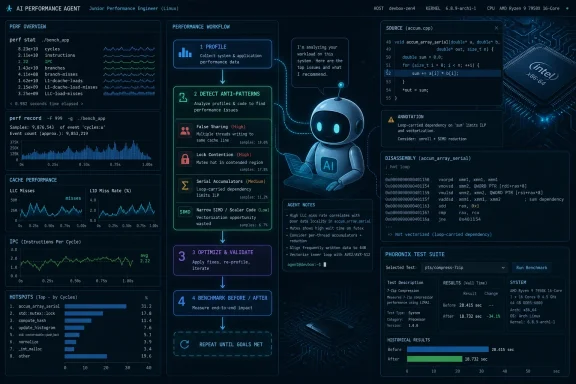
Intel’s new Intel Performance Skills project, reported by Phoronix on June 15, 2026, is an MIT-licensed open-source collection of AI agent workflows for profiling Linux CPU workloads, spotting common performance anti-patterns, and testing optimizations through tools such as perf and Phoronix Test Suite. The important part is not that Intel has discovered yet another way to put “AI” on a developer tool. It is that the company is trying to turn hard-won performance engineering habits into portable instructions that coding agents can follow. For Linux developers and sysadmins, that makes this project less a toy and more a preview of how low-level optimization work may soon be delegated, audited, and argued over.
Performance engineering has always had a folklore problem. The people who know why a loop is stuck at low IPC, why a workload stops scaling after eight cores, or why a cache line is ping-ponging between threads often learned it through years of profiling, bad guesses, and late-night sessions with disassembly. Intel Performance Skills tries to bottle some of that experience into structured skills that AI coding agents can load when a user asks why code is slow.
That framing matters. Most AI coding demos still center on generating code from a prompt, but performance work is not merely code generation. It is measurement, hypothesis, source inspection, counterfactual testing, and then a smaller change than the developer probably expected. Intel’s project is notable because it treats the agent less like an autocomplete engine and more like a junior performance engineer with a checklist.
The repository describes skills for Linux
This is exactly where AI assistance has a plausible opening. Not in replacing expert judgment, but in reducing the cost of the first disciplined pass. A human still has to decide whether the patch is maintainable, portable, and correct. But if the agent can reliably get from “it feels slow” to “the hot loop is serializing on a shared counter,” the economics of performance tuning start to change.
That is the right instinct. Developers do not want yet another performance portal they must remember to visit. They want their existing assistant to understand when “profile this” means
The skill model is also a subtle hedge against AI churn. Models will change, vendors will change, and today’s favorite coding agent may be tomorrow’s abandoned experiment. A skill directory that can be copied into different agent ecosystems is less glamorous than a proprietary assistant, but it is more durable. Intel is effectively saying that the performance knowledge is the asset; the agent runtime is a replaceable delivery mechanism.
There is a broader industry lesson in that. The next phase of developer AI may be less about single clever prompts and more about curated domain workflows. Security teams will have exploitation and remediation skills. Database teams will have query-plan skills. Kernel developers will have bisecting and regression-analysis skills. Intel’s version happens to begin where Intel has decades of institutional interest: making x86 Linux software run faster on CPUs.
The repository’s workflows include quick counter collection through
The skills also make explicit connections between profiling signals and known fixes. Low IPC with low cache misses may point toward dependency chains. HITM events may point toward false sharing. Hot
The benefit of encoding them is consistency. An agent can be taught not to jump from “slow” to “rewrite in SIMD” just because vectorization sounds impressive. It can be nudged to ask whether memory stalls, branch misses, lock contention, scalar floating-point instructions, or aliasing assumptions are actually visible in the data. That does not make it correct by default, but it makes it less random.
That is precisely why they are good targets for AI assistance. The agent does not need to invent a new compiler pass or discover a new microarchitectural law. It needs to recognize common shapes in source code and in profiling output, then suggest established remedies. Multiple accumulators, wider vector paths, padding structures, per-CPU counters, batching, and better lock strategies are all familiar tools.
The danger is that familiar tools can be misapplied. Padding a structure may reduce false sharing while increasing memory footprint. Adding
Still, there is value in having the obvious checks done quickly. Many real-world codebases are not slow because they need an academic breakthrough. They are slow because a hot path grew organically, nobody revisited it after hardware changed, or a scalability problem only appeared when the workload moved from a developer laptop to a many-core server. Those are exactly the cases where a structured first pass can uncover low-hanging fruit.
According to the project description, the Phoronix skill can install benchmarks, extract source, rebuild with debug symbols, deploy binaries, and record results. That turns a vague “make it faster” exercise into a loop: run the benchmark, profile it, change the code, rerun the benchmark, compare. For an AI agent, that loop is far more valuable than a pile of disconnected suggestions.
Phoronix reported that one benchmark example exposed a possible 16x optimization in the program under test. That number should be read carefully. A 16x improvement is thrilling, but it usually indicates a specific pathological case rather than a universal uplift waiting inside every Linux workload. The real story is not the magnitude; it is the ability to find, patch, and measure a concrete bottleneck through a reproducible benchmark path.
That matters for trust. AI-generated performance patches are especially prone to benchmark theater: cherry-picked workloads, unrepresentative inputs, and changes that optimize the measured path while damaging the general case. A well-known benchmark harness does not eliminate that risk, but it raises the friction for nonsense. The agent has to produce a result that can be rerun.
That does not make the project cynical. Vendor-driven open source can still be useful, especially when the output is readable, forkable, and licensed permissively. The MIT license lowers the barrier for teams that want to inspect, adapt, or embed these skills without signing up for a grand Intel platform strategy.
The more interesting tension is portability. The repository is explicitly about x86 Linux CPU performance, and some of the patterns involve AVX2 or AVX-512 thinking. Linux developers working across Intel, AMD, Arm, and cloud heterogeneity will need to separate general optimization advice from Intel-flavored tuning. A faster code path that assumes the wrong vector width, dispatch model, or cache behavior may be a maintenance trap.
This is where the project’s openness matters. If the skills are good, other vendors and community developers can argue with them in public. They can add caveats, extend patterns, improve dispatch advice, or build competing skill packs. Performance engineering has always involved vendor influence; the healthier version is the one where the recipes are inspectable.
The Windows ecosystem is heading into the same agent-shaped future. Visual Studio, GitHub Copilot, Windows Terminal workflows, PowerShell automation, ETW tracing, Windows Performance Analyzer, and vendor SDKs are all obvious candidates for similar skill-based integration. If Linux agents can learn a disciplined performance workflow around
For WindowsForum.com readers, the lesson is not that
That future will be useful and irritating in equal measure. Useful because many organizations lack dedicated performance engineers. Irritating because AI agents will produce confident explanations that still need review by people who understand the platform. The tooling will get better, but the burden of judgment will not disappear.
Performance is contextual. A patch that improves a benchmark by 8 percent can make debugging harder, reduce portability, or create a rare correctness bug. A vectorized implementation can regress on smaller inputs. Padding can improve throughput while hurting cache residency elsewhere. Removing a dependency chain can change floating-point behavior enough to matter for scientific software.
This is why Intel’s measurement-first framing is important, but not sufficient. Agents need guardrails around correctness tests, input diversity, compiler settings, CPU dispatch, and maintainability. They also need to distinguish between “this pattern often causes slowness” and “this pattern caused slowness here.” That distinction is the difference between engineering and superstition.
Sysadmins should be especially wary of AI-generated “optimization” patches that arrive without operational context. If an internal service is slow under production load, a synthetic benchmark may not capture the relevant contention, NUMA placement, I/O behavior, or noisy-neighbor effects. An agent can help narrow the search, but it cannot automatically know the service-level objective that matters.
A lot of software never receives even a modest profiling pass. Developers guess, ship, and move on. When costs rise or latency targets slip, the organization may scale out rather than optimize. Cloud spending has made that habit expensive, and many teams are now relearning that a few hours of profiling can be worth more than another month of infrastructure overprovisioning.
Agent skills can lower the activation energy. If a developer can ask the existing coding assistant to profile a local workload, produce a hotspot report, identify likely anti-patterns, and run a benchmark comparison, the first pass becomes less intimidating. That does not replace a senior engineer, but it may get more issues to the point where a senior engineer can make a high-quality decision.
There is also a documentation benefit. A structured agent workflow can produce a written trail: what was measured, what changed, what improved, and what remained uncertain. Performance work often fails to leave that trail, which means the next developer repeats the same investigation six months later. If AI agents do nothing else but standardize the report, that alone has value.
That makes Intel Performance Skills a useful yardstick for the broader AI developer-tools market. If agents can follow these workflows reliably, they become more than code generators. If they cannot, the failure will be visible in the most unforgiving way: benchmark results, broken builds, incorrect patches, and profiles that do not support the conclusion.
The project also hints at a future where vendor knowledge becomes machine-consumable. Intel already publishes optimization manuals, compiler documentation, tuning guides, and toolchains. But documentation assumes a human has time to read, interpret, and apply it. Skills compress that knowledge into operational routines that an agent can invoke at the moment of need.
That is powerful, and it deserves scrutiny. The agent’s recommendations will reflect the priorities and assumptions embedded in the skill. If those assumptions favor one architecture, one benchmark style, or one class of workload, users need to see that clearly. Open source gives the community a way to inspect the bias rather than merely suspect it.
The most concrete changes are likely to show up around repeatability and review. A patch that says “AI made it faster” is noise. A patch that includes counter data, a hotspot report, the suspected anti-pattern, the code change, benchmark commands, and before-and-after results is at least reviewable. Intel’s skills appear designed to push agents toward the second kind of patch.
That could improve the quality of performance discussions in open-source projects. Maintainers often reject optimization patches not because they dislike speed, but because the evidence is weak, the benchmark is unclear, or the change complicates the code for a marginal gain. An agent that packages the evidence cleanly may not win the argument, but it can make the argument worth having.
The uncomfortable possibility for vendors is that the same tooling can find missed opportunities in their own ecosystems. If agent-driven profiling becomes common, more developers will discover when a library, compiler flag, kernel behavior, or default configuration leaves performance on the table. Intel may benefit from that on x86 Linux, but it also invites sharper comparisons across CPUs, compilers, and operating systems.
 Intel Turns Performance Folklore Into Agent Instructions
Performance engineering has always had a folklore problem. The people who know why a loop is stuck at low IPC, why a workload stops scaling after eight cores, or why a cache line is ping-ponging between threads often learned it through years of profiling, bad guesses, and late-night sessions with disassembly. Intel Performance Skills tries to bottle some of that experience into structured skills that AI coding agents can load when a user asks why code is slow.That framing matters. Most AI coding demos still center on generating code from a prompt, but performance work is not merely code generation. It is measurement, hypothesis, source inspection, counterfactual testing, and then a smaller change than the developer probably expected. Intel’s project is notable because it treats the agent less like an autocomplete engine and more like a junior performance engineer with a checklist.
The repository describes skills for Linux
perf, performance-pattern detection, and Phoronix Test Suite workflows. In plain English, that means an agent can be told to profile an application, collect counter data, examine hotspots, look for known patterns such as false sharing or narrow SIMD usage, and then propose fixes that can be benchmarked before and after.This is exactly where AI assistance has a plausible opening. Not in replacing expert judgment, but in reducing the cost of the first disciplined pass. A human still has to decide whether the patch is maintainable, portable, and correct. But if the agent can reliably get from “it feels slow” to “the hot loop is serializing on a shared counter,” the economics of performance tuning start to change.
The Real Product Is a Workflow, Not a Model
Intel is not shipping a new large language model here. It is shipping instructions, recipes, and integration points for models and agents that developers are already using. The supported orbit includes GitHub CLI and Copilot, Claude Code, OpenAI Codex, Gemini CLI, and OpenCode, which tells us something about Intel’s strategy: meet the agent where it already lives.That is the right instinct. Developers do not want yet another performance portal they must remember to visit. They want their existing assistant to understand when “profile this” means
perf stat, when “why is this slow” means checking IPC and cache misses, and when “does not scale” means the answer may be in synchronization or cache-line contention rather than in algorithmic complexity.The skill model is also a subtle hedge against AI churn. Models will change, vendors will change, and today’s favorite coding agent may be tomorrow’s abandoned experiment. A skill directory that can be copied into different agent ecosystems is less glamorous than a proprietary assistant, but it is more durable. Intel is effectively saying that the performance knowledge is the asset; the agent runtime is a replaceable delivery mechanism.
There is a broader industry lesson in that. The next phase of developer AI may be less about single clever prompts and more about curated domain workflows. Security teams will have exploitation and remediation skills. Database teams will have query-plan skills. Kernel developers will have bisecting and regression-analysis skills. Intel’s version happens to begin where Intel has decades of institutional interest: making x86 Linux software run faster on CPUs.
Linux perf Becomes the Agent’s Lie Detector
The inclusion of Linuxperf is what keeps this from drifting into hand-wavy “AI optimization” marketing. Performance claims without measurement are vibes. perf brings hardware counters, annotated profiles, cache-line contention analysis, and the unpleasant discipline of numbers.The repository’s workflows include quick counter collection through
perf stat, deeper hotspot analysis with perf record and perf report, cache-line contention investigation with perf c2c, and scaling comparisons across core counts. That is a sensible path because many performance bugs look different depending on how hard the system is being pushed. A single-threaded microbenchmark can hide the lock convoy that wrecks production throughput.The skills also make explicit connections between profiling signals and known fixes. Low IPC with low cache misses may point toward dependency chains. HITM events may point toward false sharing. Hot
lock cmpxchg clusters may point toward spinlock behavior. These are not magic insights; they are the kind of pattern recognition experienced engineers already do.The benefit of encoding them is consistency. An agent can be taught not to jump from “slow” to “rewrite in SIMD” just because vectorization sounds impressive. It can be nudged to ask whether memory stalls, branch misses, lock contention, scalar floating-point instructions, or aliasing assumptions are actually visible in the data. That does not make it correct by default, but it makes it less random.
The Anti-Patterns Are Old, Which Is Why This Might Work
The most interesting thing about the project’s pattern catalog is how un-new it is. Serial accumulators, narrow SIMD, missingrestrict, false sharing, shared counters, and naive spinlocks are not exotic 2026 discoveries. They are recurring footguns in C and C++ performance work.That is precisely why they are good targets for AI assistance. The agent does not need to invent a new compiler pass or discover a new microarchitectural law. It needs to recognize common shapes in source code and in profiling output, then suggest established remedies. Multiple accumulators, wider vector paths, padding structures, per-CPU counters, batching, and better lock strategies are all familiar tools.
The danger is that familiar tools can be misapplied. Padding a structure may reduce false sharing while increasing memory footprint. Adding
restrict can be a correctness bug if aliasing actually happens. Rewriting a loop with intrinsics can make the code faster on one CPU generation and more brittle everywhere else. A coding agent that proposes such changes must be treated as a patch author, not an oracle.Still, there is value in having the obvious checks done quickly. Many real-world codebases are not slow because they need an academic breakthrough. They are slow because a hot path grew organically, nobody revisited it after hardware changed, or a scalability problem only appeared when the workload moved from a developer laptop to a many-core server. Those are exactly the cases where a structured first pass can uncover low-hanging fruit.
Phoronix Test Suite Gives the Project a Public Scoreboard
The Phoronix Test Suite integration is the project’s cleverest political move. It gives the agent a route from profiling to repeatable benchmarking, and it ties Intel’s optimization story to one of the Linux community’s most visible performance measurement ecosystems.According to the project description, the Phoronix skill can install benchmarks, extract source, rebuild with debug symbols, deploy binaries, and record results. That turns a vague “make it faster” exercise into a loop: run the benchmark, profile it, change the code, rerun the benchmark, compare. For an AI agent, that loop is far more valuable than a pile of disconnected suggestions.
Phoronix reported that one benchmark example exposed a possible 16x optimization in the program under test. That number should be read carefully. A 16x improvement is thrilling, but it usually indicates a specific pathological case rather than a universal uplift waiting inside every Linux workload. The real story is not the magnitude; it is the ability to find, patch, and measure a concrete bottleneck through a reproducible benchmark path.
That matters for trust. AI-generated performance patches are especially prone to benchmark theater: cherry-picked workloads, unrepresentative inputs, and changes that optimize the measured path while damaging the general case. A well-known benchmark harness does not eliminate that risk, but it raises the friction for nonsense. The agent has to produce a result that can be rerun.
Intel’s Motive Is Obvious, and That Does Not Make It Bad
Intel has a clear interest in making Linux software better at using CPU features. The company sells CPUs, and performance that lies dormant because code is scalar, synchronization-heavy, or cache-hostile is performance Intel cannot fully claim in benchmarks or customer deployments. An open-source skill pack that helps agents find those problems is good for Intel’s hardware story.That does not make the project cynical. Vendor-driven open source can still be useful, especially when the output is readable, forkable, and licensed permissively. The MIT license lowers the barrier for teams that want to inspect, adapt, or embed these skills without signing up for a grand Intel platform strategy.
The more interesting tension is portability. The repository is explicitly about x86 Linux CPU performance, and some of the patterns involve AVX2 or AVX-512 thinking. Linux developers working across Intel, AMD, Arm, and cloud heterogeneity will need to separate general optimization advice from Intel-flavored tuning. A faster code path that assumes the wrong vector width, dispatch model, or cache behavior may be a maintenance trap.
This is where the project’s openness matters. If the skills are good, other vendors and community developers can argue with them in public. They can add caveats, extend patterns, improve dispatch advice, or build competing skill packs. Performance engineering has always involved vendor influence; the healthier version is the one where the recipes are inspectable.
Windows Developers Should Pay Attention Anyway
At first glance, this is a Linux story. The workflows center on Linuxperf, Phoronix Test Suite, and x86 Linux CPU profiling. But Windows developers and administrators should not dismiss it as somebody else’s tooling experiment.The Windows ecosystem is heading into the same agent-shaped future. Visual Studio, GitHub Copilot, Windows Terminal workflows, PowerShell automation, ETW tracing, Windows Performance Analyzer, and vendor SDKs are all obvious candidates for similar skill-based integration. If Linux agents can learn a disciplined performance workflow around
perf, Windows agents can learn one around ETW, WPA traces, CPU sampling, wait analysis, and driver-level bottlenecks.For WindowsForum.com readers, the lesson is not that
perf is coming to replace Windows tools. It is that performance expertise is becoming something vendors will try to package for agents. The next time a developer asks an assistant why a Windows service spikes CPU, the assistant may not simply suggest generic logging. It may collect a trace, identify a hot call path, compare wait states, and propose a patch with a before-and-after measurement.That future will be useful and irritating in equal measure. Useful because many organizations lack dedicated performance engineers. Irritating because AI agents will produce confident explanations that still need review by people who understand the platform. The tooling will get better, but the burden of judgment will not disappear.
The Risk Is Automated Cargo Cult Optimization
The most obvious failure mode is cargo cult optimization at machine speed. An agent seesxmm registers and recommends wider SIMD. It sees a shared counter and recommends per-thread buckets. It sees lock contention and suggests a new spin strategy. Each of those changes might be right; each might also be an expensive detour.Performance is contextual. A patch that improves a benchmark by 8 percent can make debugging harder, reduce portability, or create a rare correctness bug. A vectorized implementation can regress on smaller inputs. Padding can improve throughput while hurting cache residency elsewhere. Removing a dependency chain can change floating-point behavior enough to matter for scientific software.
This is why Intel’s measurement-first framing is important, but not sufficient. Agents need guardrails around correctness tests, input diversity, compiler settings, CPU dispatch, and maintainability. They also need to distinguish between “this pattern often causes slowness” and “this pattern caused slowness here.” That distinction is the difference between engineering and superstition.
Sysadmins should be especially wary of AI-generated “optimization” patches that arrive without operational context. If an internal service is slow under production load, a synthetic benchmark may not capture the relevant contention, NUMA placement, I/O behavior, or noisy-neighbor effects. An agent can help narrow the search, but it cannot automatically know the service-level objective that matters.
The Better Future Is Boring, Repeatable Performance Work
The strongest case for Intel Performance Skills is not that it will create spectacular 16x wins. Those will be rare, memorable, and good for screenshots. The stronger case is that it could make routine performance hygiene more common.A lot of software never receives even a modest profiling pass. Developers guess, ship, and move on. When costs rise or latency targets slip, the organization may scale out rather than optimize. Cloud spending has made that habit expensive, and many teams are now relearning that a few hours of profiling can be worth more than another month of infrastructure overprovisioning.
Agent skills can lower the activation energy. If a developer can ask the existing coding assistant to profile a local workload, produce a hotspot report, identify likely anti-patterns, and run a benchmark comparison, the first pass becomes less intimidating. That does not replace a senior engineer, but it may get more issues to the point where a senior engineer can make a high-quality decision.
There is also a documentation benefit. A structured agent workflow can produce a written trail: what was measured, what changed, what improved, and what remained uncertain. Performance work often fails to leave that trail, which means the next developer repeats the same investigation six months later. If AI agents do nothing else but standardize the report, that alone has value.
The Patch Is Only Half the Story Intel Is Selling
Intel’s project arrives at a moment when AI coding tools are being judged less by novelty and more by whether they survive contact with real engineering work. Writing a toy function is easy. Navigating a messy native codebase, profiling it, preserving correctness, and producing a measured improvement is a much harder test.That makes Intel Performance Skills a useful yardstick for the broader AI developer-tools market. If agents can follow these workflows reliably, they become more than code generators. If they cannot, the failure will be visible in the most unforgiving way: benchmark results, broken builds, incorrect patches, and profiles that do not support the conclusion.
The project also hints at a future where vendor knowledge becomes machine-consumable. Intel already publishes optimization manuals, compiler documentation, tuning guides, and toolchains. But documentation assumes a human has time to read, interpret, and apply it. Skills compress that knowledge into operational routines that an agent can invoke at the moment of need.
That is powerful, and it deserves scrutiny. The agent’s recommendations will reflect the priorities and assumptions embedded in the skill. If those assumptions favor one architecture, one benchmark style, or one class of workload, users need to see that clearly. Open source gives the community a way to inspect the bias rather than merely suspect it.
What the First Wave of AI Performance Tuning Will Actually Change
The near-term impact will be uneven. Expert performance engineers will not suddenly hand over their jobs to a chatbot with aperf wrapper. Beginners, however, may get a better starting point than Stack Overflow snippets and vibes. Mid-level developers may use it as a checklist. Open-source maintainers may use it to triage performance patches that arrive with more structured evidence.The most concrete changes are likely to show up around repeatability and review. A patch that says “AI made it faster” is noise. A patch that includes counter data, a hotspot report, the suspected anti-pattern, the code change, benchmark commands, and before-and-after results is at least reviewable. Intel’s skills appear designed to push agents toward the second kind of patch.
That could improve the quality of performance discussions in open-source projects. Maintainers often reject optimization patches not because they dislike speed, but because the evidence is weak, the benchmark is unclear, or the change complicates the code for a marginal gain. An agent that packages the evidence cleanly may not win the argument, but it can make the argument worth having.
The uncomfortable possibility for vendors is that the same tooling can find missed opportunities in their own ecosystems. If agent-driven profiling becomes common, more developers will discover when a library, compiler flag, kernel behavior, or default configuration leaves performance on the table. Intel may benefit from that on x86 Linux, but it also invites sharper comparisons across CPUs, compilers, and operating systems.
The Signal Hidden Inside Intel’s Skill Pack
Intel Performance Skills is small today, but it points toward a bigger shift in how performance work is distributed.- Intel is packaging CPU performance expertise as open, reusable agent workflows rather than as a standalone proprietary assistant.
- The project’s credibility comes from tying AI suggestions to Linux
perfdata and repeatable Phoronix Test Suite benchmarking. - The first useful targets are familiar anti-patterns such as false sharing, serial accumulators, narrow SIMD, naive spinlocks, and shared hot-path counters.
- The largest risk is not that the agent fails to optimize, but that it optimizes the wrong thing with unjustified confidence.
- Windows developers should read this as a preview of similar agent workflows around ETW, Windows Performance Analyzer, Visual Studio, and platform-specific tracing tools.
- The best version of this future produces measured, reviewable patches rather than magical speed claims.
References
- Primary source: Phoronix
Published: Mon, 15 Jun 2026 20:15:00 GMT
Intel Performance Skills: New Open-Source Project Leveraging AI For Linux Performance Optimizations - Phoronix
The newest open-source project out of Intel is the Intel Performance Skills project that is providing AI agent skills to help with CPU performance analysis and performance optimizations on Linux.www.phoronix.com
- Related coverage: tomshardware.com
Intel mobile CPUs have achieved up to 95x performance uplift over the past two decades — benchmarking the gains from 45nm Penryn to 18A Panther Lake | Tom's Hardware
15 Intel CPUs, spanning generations, spotlight 18 years of relentless innovation.www.tomshardware.com - Related coverage: helpnetsecurity.com
Intel puts its data center performance knowledge on GitHub - Help Net Security
Intel's Optimization Zone GitHub repo centralizes data center tuning guides and performance recipes for Intel hardware.www.helpnetsecurity.com - Official source: github.com
GitHub - intel/pcm: Intel® Performance Counter Monitor (Intel® PCM) · GitHub
Intel® Performance Counter Monitor (Intel® PCM). Contribute to intel/pcm development by creating an account on GitHub. github.com
- Related coverage: community.intel.com
- Related coverage: intel.com
- Related coverage: intel.com.br
- Related coverage: skillsforinnovation.intel.com
