

Dario Amodei, OpenAI’s former vice president of research, left the company in December 2020 with a group of colleagues and went on to co-found Anthropic in early 2021 as a rival AI lab built around safety-first model development. The explanation now being revisited in Bloomberg-linked coverage is not simply a personality clash with Sam Altman or a founder’s itch to build something new. It is the origin story of the modern AI industry’s most important argument: whether safety is a constraint on the race, or the only way to survive it.
Silicon Valley loves a schism because it simplifies ambition into morality. One group stays, another group leaves, and the market spends the next decade deciding which side was right. In AI, the Amodei departure from OpenAI has become that kind of story: a personnel move that hardened into a worldview.
Amodei joined OpenAI in 2016, when the organization still carried more of the aura of a research nonprofit than a platform company. By the time he left, OpenAI had already begun its long transformation into the strange hybrid that now defines frontier AI: mission-driven rhetoric, venture-scale economics, cloud-scale compute, and a product roadmap that increasingly depends on mass adoption. That tension was not incidental. It was the business model arriving before the governance model had fully caught up.
The public record of the departure is spare. OpenAI announced on December 29, 2020, that Amodei was leaving after nearly five years at the company. But the importance of the exit comes from what followed. He did not leave to become a university researcher, a VC, or a detached critic of the field. He left with other OpenAI veterans, including Daniela Amodei, and built Anthropic directly across the street from OpenAI’s ambitions.
That choice matters. Anthropic was not a rejection of scaling. It was a rejection of scaling without a different institutional design around it. In the industry’s favorite shorthand, OpenAI became the company most associated with pushing AI into the mainstream; Anthropic became the company most associated with insisting that the way you push matters.
In fact, one of the central ideas behind both OpenAI’s rise and Anthropic’s rise is the same: scaling laws. Bigger models, larger datasets, more compute, and more sophisticated training pipelines tend to produce systems with broader and more powerful capabilities. Amodei’s disagreement with OpenAI was not that scaling was fake. It was that scaling was real enough to be dangerous.
That makes the split more consequential than the usual founder drama. If Amodei had simply believed OpenAI was overhyping AI, Anthropic would have been a boutique safety shop. Instead, Anthropic became one of the best-funded AI companies in the world, building Claude models that compete directly with GPT models in coding, writing, enterprise workflows, and agentic software tasks.
The company’s message is therefore more provocative than “slow down.” It is closer to: we know the acceleration is coming, so the brakes have to be engineered into the machine. That is a harder argument to dismiss, because it does not ask the market to abandon capability. It asks whether capability can be treated as inseparable from evaluation, interpretability, deployment policy, and misuse prevention.
This is where the rivalry with OpenAI becomes more than branding. OpenAI also talks about safety and alignment, and it employs serious researchers working on those problems. The dispute is over institutional priority. Does safety have veto power over deployment, or does it become one input in a competitive release cycle?
Anthropic has tried to answer that by formalizing safety thresholds and model release practices. Its Responsible Scaling Policy and related frameworks are meant to describe what happens as systems become more capable, especially if they begin to approach domains such as cyber operations, biological design, or autonomous research. The company’s critics will say such documents are half governance and half theater. Its defenders will answer that even theater can matter if it forces a company to specify what it would not ship.
The uncomfortable reality is that both sides have a point. Frontier AI companies now operate in a market where safety language improves trust, attracts enterprise buyers, reassures regulators, and differentiates products. That does not make the safety work fake. It does mean nobody should treat safety rhetoric as self-authenticating.
That success also made OpenAI’s structure look increasingly strained. A company created around a public-benefit mission had to finance a capital-intensive race against Google, Meta, Anthropic, xAI, and a growing set of Chinese and open-source competitors. The compute bill alone pushes these firms toward giant cloud alliances, premium subscriptions, enterprise contracts, and eventually deeper entanglement with governments.
Anthropic is not outside that logic. It too has taken enormous sums from strategic backers. It too needs enterprise revenue. It too is building models that customers expect to use in real production environments, not philosophy seminars. The company’s challenge is that its founding critique of OpenAI becomes more difficult to sustain as Anthropic grows into a similar shape.
That is what makes Amodei’s story interesting now. The departure from OpenAI was not the end of a moral argument. It was the beginning of a stress test. Anthropic must prove that a safety-first AI company can remain meaningfully different once it is playing the same capital-intensive game as everyone else.
That is particularly relevant to WindowsForum readers because the AI race is no longer an abstract drama among Bay Area executives. It is being baked into the tools sysadmins and developers use every day: coding assistants, document workflows, security triage, help desk automation, data analysis, browser-integrated agents, and cloud productivity suites. The identity of the model provider matters because the model provider increasingly shapes the operational boundary of the workplace.
OpenAI’s closest distribution relationship runs through Microsoft, which has embedded Copilot across Windows, Microsoft 365, GitHub, Azure, and enterprise administration surfaces. Anthropic, meanwhile, has pursued its own enterprise and cloud partnerships, presenting Claude as a model family that can serve many of the same high-value tasks. The result is not just competition between chatbots. It is competition over who gets trusted with the next layer of business process automation.
That trust question is where Amodei’s origin story still does commercial work. Anthropic can tell CIOs and regulators that it was founded by people who left OpenAI because they believed safety needed more institutional authority. That is a powerful sales narrative in a market where nobody wants to be the company that deployed the wrong autonomous agent into the wrong workflow.
This is not a side story. It is a perfect illustration of how the AI boom leaks into every available financial container. If a company is private, someone will try to create a proxy. If shares are restricted, someone will wrap claims in an instrument. If demand is intense enough, the distinction between owning equity and owning a token that gestures at equity becomes dangerously easy to blur.
For retail traders, that is the danger. A token that references Anthropic is not the same thing as Anthropic recognizing the holder as an investor. If the underlying company says unauthorized transfers are invalid, the buyer may be holding little more than a bet on someone else’s legal theory. That can produce real losses without producing real ownership.
For Anthropic, the episode is awkward but clarifying. The company can preach caution in AI deployment while the market builds speculative products around its name. Safety culture does not immunize a company from hype; if anything, it can make the brand more valuable to hype merchants because “responsible frontier AI” is a more bankable story than “another chatbot company.”
This does not make Anthropic hypocritical by default. It does make purity impossible. A serious AI safety company cannot remain pristine if it wants to influence the systems that actually get deployed. But once it becomes a major vendor, every release decision becomes a negotiation between safety theory and commercial pressure.
That tension has already become visible across the industry. AI companies talk about evaluation regimes while competing on coding performance. They warn about misuse while selling into sectors where automation, surveillance, cyber capability, and military relevance are never far from the surface. They publish alignment research while racing to make agents more autonomous.
Amodei’s distinction is that he has tried to make the contradiction explicit. He has repeatedly argued that powerful AI will bring both extraordinary benefits and serious risks, and that governments may need more authority to block or constrain dangerous deployments. That is not the posture of a founder who thinks market incentives alone will solve the problem. It is also not a posture that fits comfortably inside a hypergrowth company seeking customers, talent, and investor confidence.
When an organization adopts a frontier model, it inherits part of the vendor’s risk philosophy. That philosophy affects model behavior, refusal patterns, logging practices, data controls, release cadence, third-party integrations, and the likelihood that a feature appears before the documentation is mature. The differences may seem subtle in a chat window. They become much less subtle when models are embedded into ticket queues, code repositories, email systems, and administrative consoles.
Windows environments are especially exposed to this shift because Microsoft has made AI a native layer of its ecosystem. Copilot is not merely a website users visit; it is increasingly a feature surface across Microsoft 365, Windows, Edge, GitHub, Defender, Azure, and Power Platform. Even organizations that never buy Anthropic directly are operating in a market shaped by the OpenAI-Anthropic rivalry, because Microsoft’s AI roadmap must respond to competitive pressure from Claude and other frontier models.
That pressure can be good for customers. Rivalry improves model quality, lowers switching costs, and gives enterprise buyers more leverage. But it also increases release velocity, and release velocity is where governance failures hide. The vendor that wins the benchmark this quarter may not be the vendor that best fits a regulated workflow next quarter.
The divide is more institutional than emotional. Who has authority inside the company when capability and caution conflict? How much evidence is required before a model is held back? How much risk should be accepted because competitors will ship anyway? How much should government regulate before the most capable systems exist?
These are not abstract philosophical questions anymore. They determine whether an AI assistant can autonomously execute code, whether it can help analyze biological systems, whether it can chain together tools across an enterprise environment, and whether it can be deployed in government or military settings. The difference between a lab policy and a product feature may be one executive meeting.
That is why Amodei’s departure still resonates. It was a disagreement about the internal operating system of an AI company. Five years later, the entire technology sector is trying to decide which operating system should govern the next generation of software.
Neither claim should be accepted on branding alone. Buyers should evaluate actual controls, contractual terms, auditability, model behavior, incident response practices, and data-handling commitments. The fact that a company was founded around safety is relevant. It is not a substitute for due diligence.
The tokenized pre-IPO episode offers a parallel lesson for investors. The existence of a market does not mean the existence of enforceable rights. Synthetic exposure to a private AI company may satisfy the emotional urge to “get in early,” but it can collapse the moment the underlying company refuses to recognize the instrument.
For IT pros, the same caution applies in operational form. A slick AI integration can look like productivity while quietly creating unclear accountability. If an agent makes a bad recommendation, leaks sensitive context, writes vulnerable code, or automates the wrong administrative action, the procurement team’s faith in a vendor’s mission statement will not matter much.
For now, the market is rewarding both approaches. OpenAI has distribution, consumer mindshare, Microsoft integration, and a central role in the public imagination of AI. Anthropic has credibility with risk-sensitive buyers, a strong model family, and a founder narrative that turns caution into a competitive asset. Both companies are racing; they simply describe the race differently.
That distinction may narrow over time. OpenAI may become more procedurally cautious as regulatory pressure grows. Anthropic may become more commercially aggressive as revenue expectations rise. The frontier AI industry has a way of making competitors rhyme, even when they begin as critiques of one another.
Still, origin stories matter because they shape defaults. A company founded after a safety dispute may ask different questions in the room before launch. A company forged through mass-market deployment may move faster when users demand new capability. Neither default is automatically right, but customers should know which one they are buying.
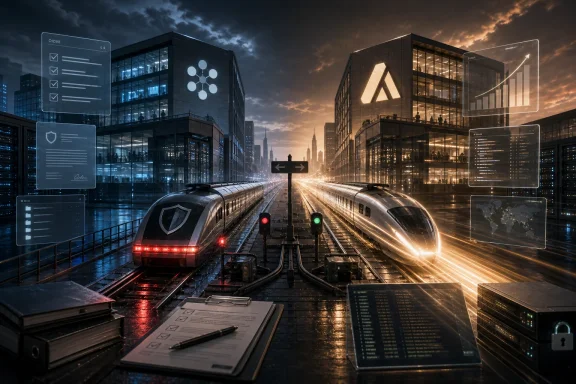 The OpenAI Breakup Became the Industry’s Founding Myth
Silicon Valley loves a schism because it simplifies ambition into morality. One group stays, another group leaves, and the market spends the next decade deciding which side was right. In AI, the Amodei departure from OpenAI has become that kind of story: a personnel move that hardened into a worldview.Amodei joined OpenAI in 2016, when the organization still carried more of the aura of a research nonprofit than a platform company. By the time he left, OpenAI had already begun its long transformation into the strange hybrid that now defines frontier AI: mission-driven rhetoric, venture-scale economics, cloud-scale compute, and a product roadmap that increasingly depends on mass adoption. That tension was not incidental. It was the business model arriving before the governance model had fully caught up.
The public record of the departure is spare. OpenAI announced on December 29, 2020, that Amodei was leaving after nearly five years at the company. But the importance of the exit comes from what followed. He did not leave to become a university researcher, a VC, or a detached critic of the field. He left with other OpenAI veterans, including Daniela Amodei, and built Anthropic directly across the street from OpenAI’s ambitions.
That choice matters. Anthropic was not a rejection of scaling. It was a rejection of scaling without a different institutional design around it. In the industry’s favorite shorthand, OpenAI became the company most associated with pushing AI into the mainstream; Anthropic became the company most associated with insisting that the way you push matters.
Amodei Did Not Walk Away From the Race — He Built a Different Race Car
The easiest caricature of Anthropic is that it is the cautious alternative to OpenAI: the lab with more caveats, more red-team language, more policy memos, and a tendency to sound like it has one foot in Washington before the product demo is even over. That caricature misses the key point. Amodei is not a small-model romantic, a slow-AI advocate, or a skeptic of scale.In fact, one of the central ideas behind both OpenAI’s rise and Anthropic’s rise is the same: scaling laws. Bigger models, larger datasets, more compute, and more sophisticated training pipelines tend to produce systems with broader and more powerful capabilities. Amodei’s disagreement with OpenAI was not that scaling was fake. It was that scaling was real enough to be dangerous.
That makes the split more consequential than the usual founder drama. If Amodei had simply believed OpenAI was overhyping AI, Anthropic would have been a boutique safety shop. Instead, Anthropic became one of the best-funded AI companies in the world, building Claude models that compete directly with GPT models in coding, writing, enterprise workflows, and agentic software tasks.
The company’s message is therefore more provocative than “slow down.” It is closer to: we know the acceleration is coming, so the brakes have to be engineered into the machine. That is a harder argument to dismiss, because it does not ask the market to abandon capability. It asks whether capability can be treated as inseparable from evaluation, interpretability, deployment policy, and misuse prevention.
Safety Became a Product Strategy, Not Just a Research Department
Anthropic’s founding thesis was that safety could not be something a company bolted onto a model after the leaderboard results came in. It had to shape the training process, the release process, and the company’s own internal decision-making. That is the intellectual through-line from Amodei’s OpenAI exit to Anthropic’s Claude lineup.This is where the rivalry with OpenAI becomes more than branding. OpenAI also talks about safety and alignment, and it employs serious researchers working on those problems. The dispute is over institutional priority. Does safety have veto power over deployment, or does it become one input in a competitive release cycle?
Anthropic has tried to answer that by formalizing safety thresholds and model release practices. Its Responsible Scaling Policy and related frameworks are meant to describe what happens as systems become more capable, especially if they begin to approach domains such as cyber operations, biological design, or autonomous research. The company’s critics will say such documents are half governance and half theater. Its defenders will answer that even theater can matter if it forces a company to specify what it would not ship.
The uncomfortable reality is that both sides have a point. Frontier AI companies now operate in a market where safety language improves trust, attracts enterprise buyers, reassures regulators, and differentiates products. That does not make the safety work fake. It does mean nobody should treat safety rhetoric as self-authenticating.
OpenAI’s Contradiction Became Anthropic’s Pitch
Amodei’s critique, as described in recent coverage, lands on a familiar contradiction: OpenAI said it was committed to safety and alignment, while its leadership drove the company toward increasingly aggressive commercialization. Sam Altman’s OpenAI became the public face of the AI boom precisely because it did not keep its most important technology in the lab. ChatGPT turned frontier AI into a consumer habit, an enterprise procurement item, and a political headache.That success also made OpenAI’s structure look increasingly strained. A company created around a public-benefit mission had to finance a capital-intensive race against Google, Meta, Anthropic, xAI, and a growing set of Chinese and open-source competitors. The compute bill alone pushes these firms toward giant cloud alliances, premium subscriptions, enterprise contracts, and eventually deeper entanglement with governments.
Anthropic is not outside that logic. It too has taken enormous sums from strategic backers. It too needs enterprise revenue. It too is building models that customers expect to use in real production environments, not philosophy seminars. The company’s challenge is that its founding critique of OpenAI becomes more difficult to sustain as Anthropic grows into a similar shape.
That is what makes Amodei’s story interesting now. The departure from OpenAI was not the end of a moral argument. It was the beginning of a stress test. Anthropic must prove that a safety-first AI company can remain meaningfully different once it is playing the same capital-intensive game as everyone else.
The Claude Era Turned a Philosophical Split Into a Platform War
Claude changed the stakes because it made Anthropic impossible to dismiss as merely a protest company. For users, Claude became a real alternative to ChatGPT. For developers, it became another frontier API to benchmark, integrate, and negotiate against. For enterprise IT, it became a way to avoid being locked into a single AI vendor while still buying into the top tier of model capability.That is particularly relevant to WindowsForum readers because the AI race is no longer an abstract drama among Bay Area executives. It is being baked into the tools sysadmins and developers use every day: coding assistants, document workflows, security triage, help desk automation, data analysis, browser-integrated agents, and cloud productivity suites. The identity of the model provider matters because the model provider increasingly shapes the operational boundary of the workplace.
OpenAI’s closest distribution relationship runs through Microsoft, which has embedded Copilot across Windows, Microsoft 365, GitHub, Azure, and enterprise administration surfaces. Anthropic, meanwhile, has pursued its own enterprise and cloud partnerships, presenting Claude as a model family that can serve many of the same high-value tasks. The result is not just competition between chatbots. It is competition over who gets trusted with the next layer of business process automation.
That trust question is where Amodei’s origin story still does commercial work. Anthropic can tell CIOs and regulators that it was founded by people who left OpenAI because they believed safety needed more institutional authority. That is a powerful sales narrative in a market where nobody wants to be the company that deployed the wrong autonomous agent into the wrong workflow.
The Investor Angle Shows How AI Hype Escapes the Company’s Control
The CryptoBriefing angle adds a useful, ugly coda to the Amodei story: even the companies most associated with safety cannot control the speculative machinery that forms around them. Tokenized pre-IPO instruments tied to Anthropic have reportedly traded on Solana, offering synthetic exposure to the company’s valuation before ordinary public-market investors can buy shares. In May 2026, Anthropic warned that unauthorized transfers of such instruments would be void under its transfer restrictions, and related tokens reportedly fell sharply.This is not a side story. It is a perfect illustration of how the AI boom leaks into every available financial container. If a company is private, someone will try to create a proxy. If shares are restricted, someone will wrap claims in an instrument. If demand is intense enough, the distinction between owning equity and owning a token that gestures at equity becomes dangerously easy to blur.
For retail traders, that is the danger. A token that references Anthropic is not the same thing as Anthropic recognizing the holder as an investor. If the underlying company says unauthorized transfers are invalid, the buyer may be holding little more than a bet on someone else’s legal theory. That can produce real losses without producing real ownership.
For Anthropic, the episode is awkward but clarifying. The company can preach caution in AI deployment while the market builds speculative products around its name. Safety culture does not immunize a company from hype; if anything, it can make the brand more valuable to hype merchants because “responsible frontier AI” is a more bankable story than “another chatbot company.”
The Safety Brand Now Faces Its Hardest Test
Anthropic’s growth puts Amodei in the same paradox that has shadowed OpenAI for years. To make AI safer at frontier scale, you need to be at frontier scale. To be at frontier scale, you need vast funding, infrastructure, customers, and political relevance. Each of those requirements pulls the company closer to the incentives it was created to counterbalance.This does not make Anthropic hypocritical by default. It does make purity impossible. A serious AI safety company cannot remain pristine if it wants to influence the systems that actually get deployed. But once it becomes a major vendor, every release decision becomes a negotiation between safety theory and commercial pressure.
That tension has already become visible across the industry. AI companies talk about evaluation regimes while competing on coding performance. They warn about misuse while selling into sectors where automation, surveillance, cyber capability, and military relevance are never far from the surface. They publish alignment research while racing to make agents more autonomous.
Amodei’s distinction is that he has tried to make the contradiction explicit. He has repeatedly argued that powerful AI will bring both extraordinary benefits and serious risks, and that governments may need more authority to block or constrain dangerous deployments. That is not the posture of a founder who thinks market incentives alone will solve the problem. It is also not a posture that fits comfortably inside a hypergrowth company seeking customers, talent, and investor confidence.
Enterprise IT Should Read the Breakup as a Governance Warning
For administrators, security teams, and technology leaders, the Amodei-OpenAI split is less interesting as gossip than as a governance case study. The lesson is not “choose Anthropic because it is safer” or “choose OpenAI because it is faster.” The lesson is that AI vendors are making foundational governance choices long before customers see a procurement document.When an organization adopts a frontier model, it inherits part of the vendor’s risk philosophy. That philosophy affects model behavior, refusal patterns, logging practices, data controls, release cadence, third-party integrations, and the likelihood that a feature appears before the documentation is mature. The differences may seem subtle in a chat window. They become much less subtle when models are embedded into ticket queues, code repositories, email systems, and administrative consoles.
Windows environments are especially exposed to this shift because Microsoft has made AI a native layer of its ecosystem. Copilot is not merely a website users visit; it is increasingly a feature surface across Microsoft 365, Windows, Edge, GitHub, Defender, Azure, and Power Platform. Even organizations that never buy Anthropic directly are operating in a market shaped by the OpenAI-Anthropic rivalry, because Microsoft’s AI roadmap must respond to competitive pressure from Claude and other frontier models.
That pressure can be good for customers. Rivalry improves model quality, lowers switching costs, and gives enterprise buyers more leverage. But it also increases release velocity, and release velocity is where governance failures hide. The vendor that wins the benchmark this quarter may not be the vendor that best fits a regulated workflow next quarter.
The Real Divide Is Not Optimism Versus Doom
The public debate about AI safety is often flattened into optimists versus doomers. That framing is too crude for the Amodei story. Anthropic is an optimistic company in the most material sense: it is spending heavily because it believes powerful AI systems can be built and sold. OpenAI is also a safety-conscious company in the formal sense: it has teams, policies, evaluations, and public commitments around risk.The divide is more institutional than emotional. Who has authority inside the company when capability and caution conflict? How much evidence is required before a model is held back? How much risk should be accepted because competitors will ship anyway? How much should government regulate before the most capable systems exist?
These are not abstract philosophical questions anymore. They determine whether an AI assistant can autonomously execute code, whether it can help analyze biological systems, whether it can chain together tools across an enterprise environment, and whether it can be deployed in government or military settings. The difference between a lab policy and a product feature may be one executive meeting.
That is why Amodei’s departure still resonates. It was a disagreement about the internal operating system of an AI company. Five years later, the entire technology sector is trying to decide which operating system should govern the next generation of software.
The Breakup Story Leaves Buyers With Harder Homework
The most concrete consequence of Amodei’s exit is that the AI market now has two powerful institutions telling different versions of the same promise. OpenAI argues, through its products and partnerships, that broad deployment can coexist with iterative safety work. Anthropic argues, through its origin story and policy-heavy posture, that safety must be more deeply integrated before deployment pressure takes over.Neither claim should be accepted on branding alone. Buyers should evaluate actual controls, contractual terms, auditability, model behavior, incident response practices, and data-handling commitments. The fact that a company was founded around safety is relevant. It is not a substitute for due diligence.
The tokenized pre-IPO episode offers a parallel lesson for investors. The existence of a market does not mean the existence of enforceable rights. Synthetic exposure to a private AI company may satisfy the emotional urge to “get in early,” but it can collapse the moment the underlying company refuses to recognize the instrument.
For IT pros, the same caution applies in operational form. A slick AI integration can look like productivity while quietly creating unclear accountability. If an agent makes a bad recommendation, leaks sensitive context, writes vulnerable code, or automates the wrong administrative action, the procurement team’s faith in a vendor’s mission statement will not matter much.
The Amodei-Altman Split Is Now Everyone’s Architecture Decision
The OpenAI-Anthropic rivalry has become a proxy for choices every organization will have to make as AI moves from assistant to operator. The relevant question is not which CEO gives the better interview. It is which governance model survives contact with scale.For now, the market is rewarding both approaches. OpenAI has distribution, consumer mindshare, Microsoft integration, and a central role in the public imagination of AI. Anthropic has credibility with risk-sensitive buyers, a strong model family, and a founder narrative that turns caution into a competitive asset. Both companies are racing; they simply describe the race differently.
That distinction may narrow over time. OpenAI may become more procedurally cautious as regulatory pressure grows. Anthropic may become more commercially aggressive as revenue expectations rise. The frontier AI industry has a way of making competitors rhyme, even when they begin as critiques of one another.
Still, origin stories matter because they shape defaults. A company founded after a safety dispute may ask different questions in the room before launch. A company forged through mass-market deployment may move faster when users demand new capability. Neither default is automatically right, but customers should know which one they are buying.
The Claude-Origin Story Has Practical Consequences Now
The Amodei departure is no longer just a Silicon Valley anecdote; it is a procurement, policy, and investment signal. The story explains why Anthropic talks the way it does, why OpenAI is judged against its own founding mission, and why the AI market keeps turning governance disputes into product differentiation.- Dario Amodei left OpenAI in December 2020 after nearly five years and co-founded Anthropic in early 2021 with other former OpenAI employees.
- The central dispute was not whether advanced AI would scale, but whether safety should be built into frontier development from the beginning.
- Anthropic’s Claude models turned that dispute into a real platform rivalry with OpenAI’s GPT products across consumer and enterprise markets.
- The company’s safety-first brand is valuable, but it must now survive the same funding, growth, and deployment pressures that define the rest of frontier AI.
- Tokenized pre-IPO claims tied to Anthropic show how AI hype can create financial instruments that may not give holders recognized ownership or legal protection.
- Enterprise buyers should treat vendor safety claims as a starting point for diligence, not as proof that an AI system is safe enough for sensitive workflows.
References
- Primary source: Crypto Briefing
Published: 2026-06-16T19:50:10.239751
Anthropic CEO Dario Amodei discusses departure from OpenAI
Anthropic CEO Dario Amodei explains why he left OpenAI in 2020, citing safety concerns and trust erosion, and what it means for AI investors today.cryptobriefing.com - Related coverage: axios.com
Anthropic CEO says government should block dangerous AI
Anthropic's ideas go far beyond anything currently under serious consideration in Washington.www.axios.com
- Official source: openai.com
Organizational update from OpenAI | OpenAI
It’s been a year of dramatic change and growth at OpenAI.openai.com - Related coverage: techcrunch.com
The trap Anthropic built for itself | TechCrunch
Anthropic, OpenAI, Google DeepMind, and others have long promised to govern themselves responsibly. Now, in the absence of rules, there's not a lot to protect them.techcrunch.com - Related coverage: coindesk.com
Anthropic, OpenAI tokens plunge as AI firms say pre-IPO share transfers are invalid
Tokens on Solana that claim to track the private-market valuations of Anthropic and OpenAI dropped sharply this week after both AI companies warned that the structures used to back the tokens may be invalid.www.coindesk.com - Related coverage: fortune.com
Anthropic CEO Dario Amodei admits his company struggles to balance safety with profits | Fortune
Anthropic’s CEO says intense commercial pressure is testing the company’s safety-first AI mission.fortune.com
- Related coverage: bloomberg.com
- Related coverage: bloomberglinea.com
Anthropic reabre conversaciones con el Pentágono tras disputa sobre la seguridad de la IA
Amodei había estado negociando con Emil Michael, subsecretario de Defensa para Investigación e Ingeniería, para cerrar un contrato que regule el acceso del Pentágono a la tecnología de Anthropic.www.bloomberglinea.com - Related coverage: elpais.com
- Related coverage: theweek.com
Who will win the AI IPO race: SpaceX, Anthropic or OpenAI? | The Week
SpaceX, Anthropic and OpenAI are all preparing initial public offerings, competing to be the biggest winner of the artificial intelligence era.theweek.com
