

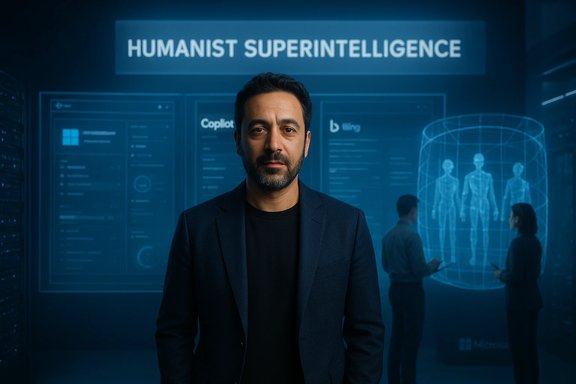
Mustafa Suleyman arrived at Microsoft with a simple but consequential mandate: to prove that advanced AI can be scaled inside a technology giant while remaining firmly under human control. Appointed Executive Vice President and CEO of the new Microsoft AI organization in March 2024, Suleyman has spent the subsequent months reorganizing product teams, recruiting talent from startups, and setting a public course — one he now calls Humanist Superintelligence — that reframes the company’s pursuit of capability as a mission-first, safety-first program for consumer AI and Copilot experiences. As Microsoft embeds its Copilot assistant deeper into Windows, Bing and Office and begins to field its first in-house models, Suleyman’s blend of research pedigree, product instincts and safety emphasis is shaping not just Microsoft’s roadmap, but industry expectations for how large companies should steward frontier AI.
Mustafa Suleyman co-founded DeepMind in 2010 and went on to lead applied AI efforts there before co-founding Inflection AI in 2022. Microsoft named him EVP and CEO of a newly created Microsoft AI division on March 19, 2024; the internal memo from Microsoft’s CEO reorganized consumer-facing AI teams — including Copilot, Bing and Edge — to report into the new organization. At the same time, Karén Simonyan — a prominent researcher and Inflection co-founder — joined as chief scientist, and several Inflection engineers moved into Microsoft AI. Inflection itself had raised large rounds of capital, including a headline-grabbing $1.3 billion funding round that underscored Suleyman’s ability to attract heavyweight backers and build compute-intensive projects.
This combination of startup agility, research credibility and enterprise muscle defines the political and technical context Suleyman inherited: Microsoft is both a major investor in external foundation model developers and a company that needs to productize AI for billions of users across Windows, Office and cloud services. Suleyman’s role — explicitly created to bridge product, research and consumer reach — places him at the center of Microsoft’s attempt to build trusted, consumer-first AI experiences without ceding its strategic posture as a partner to, and customer of, other model providers.
This model work has been paired with investments in purpose-built clusters and an operational pipeline geared toward product cycles. The goal is to develop models that are both efficient in compute and tuned for the experience of billions of users, rather than chase capability metrics in isolation.
This approach reframes safety not as a constraint on innovation but as the central organizing principle of a product-led research agenda. It also provides a language for engaging regulators and the public: the rhetoric asserts that Microsoft is not pursuing an unrestricted AGI at any cost, but rather targeted forms of advanced AI that are carefully bounded, audited and deployed with human oversight.
At the same time, this approach reframes competition: Microsoft is signaling that it will pursue an independent path on certain consumer capabilities while still partnering where it makes strategic sense. The result is a more layered competitive landscape — one in which differentiated, product-optimized models coexist with general-purpose foundation models from third parties.
This approach is not risk-free. Containment is technically and operationally difficult; consolidation draws regulatory attention; and balancing partnership obligations against in-house ambitions requires diplomatic execution. Yet Suleyman’s combination of research credibility, product-building experience and a public safety narrative provides Microsoft with an option set that could produce industry-defining consumer AI products — or, if mismanaged, lead to costly missteps.
For Windows users and enterprise customers, the promise is clear: more capable, more integrated Copilot experiences that are designed to be controllable, accountable and useful. For the industry, Suleyman’s tenure will be an important test of whether a major platform company can responsibly translate frontier research into safe, widely distributed products — and whether that model becomes the blueprint for the next decade of AI.
Source: AI Magazine How Mustafa Suleyman is Shaping Microsoft’s AI Strategy
 Background
Mustafa Suleyman co-founded DeepMind in 2010 and went on to lead applied AI efforts there before co-founding Inflection AI in 2022. Microsoft named him EVP and CEO of a newly created Microsoft AI division on March 19, 2024; the internal memo from Microsoft’s CEO reorganized consumer-facing AI teams — including Copilot, Bing and Edge — to report into the new organization. At the same time, Karén Simonyan — a prominent researcher and Inflection co-founder — joined as chief scientist, and several Inflection engineers moved into Microsoft AI. Inflection itself had raised large rounds of capital, including a headline-grabbing $1.3 billion funding round that underscored Suleyman’s ability to attract heavyweight backers and build compute-intensive projects.This combination of startup agility, research credibility and enterprise muscle defines the political and technical context Suleyman inherited: Microsoft is both a major investor in external foundation model developers and a company that needs to productize AI for billions of users across Windows, Office and cloud services. Suleyman’s role — explicitly created to bridge product, research and consumer reach — places him at the center of Microsoft’s attempt to build trusted, consumer-first AI experiences without ceding its strategic posture as a partner to, and customer of, other model providers.
Overview: What Suleyman is building inside Microsoft
Mustafa Suleyman’s strategy at Microsoft can be read across three concurrent initiatives:- Reorienting product teams to move faster on consumer-facing experiences, with Copilot as the central product.
- Establishing an in-house model program and specialized infrastructure to reduce single-point dependencies and to build models optimized for Microsoft products.
- Recasting the safety debate around containment and pragmatic human oversight under the banner of “Humanist Superintelligence.”
Reorganizing to ship Copilot faster
A defining early act of Suleyman’s tenure was the consolidation of teams working on Copilot, Bing and related consumer AI efforts into a single reporting line. That reorg gave Microsoft AI direct responsibility for the product experiences Microsoft markets as Copilot across Windows, Bing and Office. The practical effect is clarity of ownership: one leader accountable for consumer AI design, data, model selection and reliability. Consolidation matters because shipping AI features at scale forces constant trade-offs across latency, safety, privacy and UX — and those trade-offs are now routed through Suleyman’s organization.Building in-house models and infrastructure
Under Suleyman’s leadership, Microsoft AI began releasing and integrating Microsoft-built models for consumer scenarios. The organization previewed models designed to be efficient and product-ready — for example, a speech model optimized for fast, single-GPU synthesis and a text-preview model for instruction following. Those models are being integrated into Copilot use cases, Copilot Labs and Bing features. The aim is not to instantly displace third-party partners, but to establish an independent capability layer that lets Microsoft tune behavior and cost characteristics for consumer workloads.This model work has been paired with investments in purpose-built clusters and an operational pipeline geared toward product cycles. The goal is to develop models that are both efficient in compute and tuned for the experience of billions of users, rather than chase capability metrics in isolation.
Safety as a strategic differentiator: Humanist Superintelligence
Suleyman has moved quickly to frame Microsoft’s pursuit of advanced AI as one that must be explicitly human-centered. His “Humanist Superintelligence” concept emphasizes two linked ideas: (1) build domain-specific superintelligence that amplifies human capabilities in constrained, high-impact areas such as medicine and climate; (2) prioritize containment — enforceable technical and operational limits on autonomy — before or alongside alignment work that focuses on value-sensitive behavior.This approach reframes safety not as a constraint on innovation but as the central organizing principle of a product-led research agenda. It also provides a language for engaging regulators and the public: the rhetoric asserts that Microsoft is not pursuing an unrestricted AGI at any cost, but rather targeted forms of advanced AI that are carefully bounded, audited and deployed with human oversight.
Suleyman’s playbook: How he executes
Mustafa Suleyman brings a distinctive mix of founder instincts and institutional thinking. The following elements define his operational posture:- Talent consolidation: Recruiting small, tightly knit research teams from startups and folding them into Microsoft’s product engineering fabric while retaining a startup ethos of speed and experimentation.
- Product-first research: Aligning research goals directly to product metrics (e.g., successful-session rate for Copilot), rather than pursuing capability benchmarks alone.
- Infrastructure pragmatism: Prioritizing efficiency — training and inference economics that make consumer-scale deployments feasible without indefinite reliance on external partners.
- Safety-centred public framing: Using public essays, blog posts and media appearances to set expectations for what Microsoft will and won’t do with advanced AI.
Product metrics and user-centered KPIs
Suleyman has emphasized operational metrics that matter for product quality — such as daily active users, engagement distribution and, crucially, the rate of successful sessions where Copilot answers user intent without hallucination or dangerous behavior. This is a notable shift from research-era metrics like perplexity and benchmark scores; the signal here is clear: Microsoft AI will be judged more by how reliably it helps real people than by leaderboard placement.Products, models and integration: Where Microsoft AI is headed
Under Suleyman, Microsoft AI has focused on a layered approach that combines internal models, partner models and product-tailored orchestration. Key elements include:- Copilot as the central consumer interface: Copilot remains the product hub integrating chat, productivity workflows and multimodal features across Windows, Office and Microsoft’s consumer apps.
- Purpose-built models: Early Microsoft models target speech generation and instruction-following text to optimize latency and quality for consumer experiences.
- Multimodal and content generation integration: Visual and audio models are being rolled into image creation and audio experiences inside Copilot and Bing.
- Gradual rollouts: New models and capabilities are tested in controlled product surfaces and experimental lanes (e.g., Copilot Labs) before broader deployment.
Research and safety: Containment, alignment, and governance
Suleyman’s safety framing centers on two technical priorities:- Containment — building robust, enforceable limits on model autonomy and action scope.
- Alignment — ensuring model behavior is consistent with human intent and social norms.
Governance within the company
Centralizing consumer AI under a single leader gives Microsoft clearer lines for governance: model decisions, privacy trade-offs, safety audits and deployment approvals are consolidated. That can accelerate iteration, but it also concentrates responsibility — and risk — in one organization. Effective internal governance will require:- Transparent audit trails for model changes and deployment decisions.
- A separation of duties between model builders, product owners and safety auditors.
- External review mechanisms and oversight that include regulators, independent auditors and domain experts.
Business implications: Partnerships, monetization and competitive posture
Suleyman’s tenure reshapes Microsoft’s commercial posture in three ways:- Product monetization: Copilot is positioned both as a platform differentiator for Windows and as a subscription product or embedded service that can drive revenue across Microsoft’s consumer business.
- Strategic independence: Building in-house models gives Microsoft optionality — it can rely on partners for some workloads while running its own models where product requirements or cost considerations make sense.
- Competitive friction and partnership balance: Deepening in-house capability introduces potential friction with model providers and partners — but Microsoft’s ecosystem approach means it will continue to offer multi-model options inside Copilot.
Risks and headwinds
Suleyman’s strategy is promising — but it carries clear risks that merit careful scrutiny.1. Concentration risk and regulatory attention
Centralizing consumer AI, building in-house models and controlling massive deployment surfaces increases regulatory attention. Antitrust scrutiny, data-privacy investigations, and sectoral regulation around automated decision-making could all raise compliance costs and constrain features. Improved political economy — e.g., national security and data residency concerns — may require Microsoft to adopt differentiated regional models or hardened deployment modes.2. Safety and containment are hard engineering challenges
Containment — technically enforcing hard limits on adaptive models — is an unsolved research problem at scale. Industry-level disagreements about whether containment or alignment is more tractable mean Microsoft’s approach could run into theoretical and practical limits. Overconfidence in containment premature deployment could lead to harmful failures; underinvestment risks leaving promising capabilities unexploited.3. Talent and ecosystem impact
Recruiting teams from startups offers speed, but it can destabilize smaller players and concentrate expertise. The exodus of key engineers from a startup can alter the market for innovation; Microsoft must balance talent consolidation with healthy external collaborations and open research partnerships.4. Partnership tensions
Microsoft’s dual strategy — partner with outside model providers while building in-house models — may create commercial and technical tensions. Partners who contribute critical IP or compute may chafe if Microsoft’s in-house models compete with partner offerings. Managing these relationships delicately is essential to preserve access to models and to maintain its position in cloud and enterprise services.5. Operational complexity at consumer scale
Delivering consistent, safe experiences across Windows, Office and Bing — with billions of users — is vastly more complex than research deployments. Small failure modes (biased outputs, hallucinations, safety lapses) that are manageable in narrow deployments can become major reputational events at Microsoft’s scale. This amplifies the need for real-time monitoring, rollback capabilities and user-facing transparency.Strategic strengths Suleyman brings
Despite the challenges, Suleyman’s appointment unlocks substantive advantages for Microsoft:- Deep credibility across research and product worlds: His DeepMind pedigree and startup credentials make him a credible interlocutor with researchers, partners and policymakers.
- Product-first orientation with enterprise muscle: He knows how to move from prototype to product in organizations that are not built like startups.
- Ability to attract capital and compute partners: His track record at Inflection demonstrated he can rally funding and GPU capacity — valuable skills for operationalizing large model programs.
- Clear narrative for safety and governance: The Humanist Superintelligence framework provides a public-facing policy anchor that helps Microsoft lead the debate rather than only reacting to it.
Tactical recommendations for Microsoft AI (what Suleyman should prioritize now)
- Institutionalize external audits: Publish third-party audit summaries for major model releases and safety test results to build public trust.
- Expand regional governance: Build region-specific operational modes to handle data residency and national-security concerns without hampering global product consistency.
- Formalize a multi-partner model policy: Clarify how Microsoft will mix in-house models, OpenAI models and third-party models inside Copilot to reduce partner friction.
- Invest in containment R&D: Fund open research into containment techniques with transparent benchmarks and shared tooling across industry consortia.
- Strengthen human-in-the-loop design: Make human oversight the default at high-impact decision points and simplify escalation paths when models produce risky outputs.
Where this could leave the broader industry
Suleyman’s strategy is more than an internal Microsoft pivot; it’s a model for how a platform company can pursue advanced AI at scale. The combination of product-aligned research, in-house model development and explicit emphasis on containment could influence other large tech firms deciding whether to centralize AI functions or to remain partner-first.At the same time, this approach reframes competition: Microsoft is signaling that it will pursue an independent path on certain consumer capabilities while still partnering where it makes strategic sense. The result is a more layered competitive landscape — one in which differentiated, product-optimized models coexist with general-purpose foundation models from third parties.
Conclusion
Mustafa Suleyman’s stewardship of Microsoft AI is reshaping a major locus of consumer AI development. By consolidating product teams, investing in efficient, product-focused models and articulating a safety-first ethos through the Humanist Superintelligence framework, he has positioned Microsoft to push consumer AI forward while attempting to avoid the worst-case scenarios that worry regulators, researchers and the public.This approach is not risk-free. Containment is technically and operationally difficult; consolidation draws regulatory attention; and balancing partnership obligations against in-house ambitions requires diplomatic execution. Yet Suleyman’s combination of research credibility, product-building experience and a public safety narrative provides Microsoft with an option set that could produce industry-defining consumer AI products — or, if mismanaged, lead to costly missteps.
For Windows users and enterprise customers, the promise is clear: more capable, more integrated Copilot experiences that are designed to be controllable, accountable and useful. For the industry, Suleyman’s tenure will be an important test of whether a major platform company can responsibly translate frontier research into safe, widely distributed products — and whether that model becomes the blueprint for the next decade of AI.
Source: AI Magazine How Mustafa Suleyman is Shaping Microsoft’s AI Strategy
