
Microsoft announced Web IQ on June 2, 2026, at Build as a Bing-powered grounding system and API layer that gives AI agents fresh web evidence—pages, news, images, and videos—through machine-oriented retrieval rather than human search results. The company is not merely adding another search endpoint to Azure; it is arguing that the web itself needs a new access layer for software that reasons, plans, and calls tools. That claim is both plausible and self-serving. Web IQ matters because Microsoft is trying to turn Bing’s long, expensive second-place search business into first-class infrastructure for the agent era.
For most of the past two decades, Bing has lived in Google’s shadow as a consumer search engine. Microsoft could bundle it into Windows, Edge, Cortana, Start, and Copilot, but the basic contest remained brutally simple: users typed queries, saw ranked links, and overwhelmingly chose Google. Web IQ changes the frame. Microsoft is no longer asking whether humans want to visit Bing.com; it is asking whether agents need Bing’s index underneath everything else.
That is a clever pivot because agentic AI does not experience search as a page of ten blue links. An agent does not want a search results page, scan snippets, open tabs, and decide which site “feels” right. It wants compact evidence, freshness signals, source metadata, and enough ranking confidence to pass a useful bundle of context into a model without burning a fortune in tokens.
Microsoft’s language around Web IQ is therefore revealing. The company describes it as an AI-first web search stack, model-agnostic and MCP-native, built to return relevant passages rather than conventional search pages. The point is not to make Bing look prettier. The point is to make Bing disappear into the inference loop.
That has strategic consequences. If Microsoft can make Bing’s index the default grounding layer for Copilot, Azure AI Foundry, third-party agents, and even non-Microsoft models, then Bing stops being judged mainly by consumer search share. It becomes a utility: a low-latency, high-scale, always-updated substrate for AI systems that need to know what happened outside their training data.
Agents break that bargain. When a model calls a retrieval tool mid-task, a bad passage can become bad reasoning. A stale result can turn into a confident falsehood. A bloated result can crowd out better evidence in the context window. The user may never see the retrieval step at all, only the final answer or action.
That is why Microsoft’s emphasis on grounding is more than marketing vocabulary. In a classic search session, the retrieval system points a person toward documents. In an agentic workflow, the retrieval system shapes the model’s working memory. It decides what the model knows, what it ignores, and how much room remains for reasoning.
This is also why passage-level extraction matters. A full web page is usually a terrible unit of information for a model. It includes navigation, ads, boilerplate, repeated headers, comments, related links, cookie banners, and prose that may be only partially relevant. A focused passage with source metadata is more useful, cheaper to process, and less likely to drown the model in noise.
The shift is easy to underestimate because the user-facing experience still looks like “AI searched the web.” Underneath, however, the optimization target has changed. The system is no longer primarily ranking pages for a person. It is assembling evidence packets for a machine that may be halfway through a multi-step plan.
Latency benchmarks depend on query mix, geography, cache state, payload size, ranking depth, API shape, networking path, and how much work the “alternative” is actually doing. A retrieval endpoint returning short evidence snippets is not directly comparable to a search API returning richer web results, a crawler-backed research tool doing deeper synthesis, or a custom RAG pipeline running inside an enterprise network. Without independent benchmarks, Microsoft’s number should be read as a claim, not a law of physics.
There is also the practical question of where time is really spent. In many agent workflows, web retrieval is not the main bottleneck. LLM inference, tool orchestration, retry loops, memory handling, policy checks, and final response generation often dominate the wall clock. Shaving 100 or 200 milliseconds off a single retrieval call may be meaningful at scale, but it will not magically make a sluggish multi-agent workflow feel instantaneous.
Still, dismissing the speed claim entirely would be a mistake. Agents do not search once. They fan out, decompose, compare, verify, and iterate. A complex research agent might issue dozens of retrieval calls, and enterprise systems may run thousands or millions of such operations across users. Tail latency matters when retrieval sits inside the reasoning loop, because slow calls stack up and create unpredictable user experiences.
The more interesting point is not that Web IQ is “fast.” It is that Microsoft is treating retrieval latency, token efficiency, and evidence quality as one combined systems problem. In agentic AI, those variables are entangled. Faster retrieval is not useful if the model receives junk; better evidence is expensive if it arrives as a thousand irrelevant tokens; token savings can reduce cost but harm accuracy if the passage selection is too aggressive.
That sounds obvious until you consider how much of today’s AI browsing stack still resembles a brittle imitation of a human workflow. A model asks for a search. A tool returns results. The model opens pages. A parser strips markup. The model tries to infer which paragraphs matter. Then the model summarizes, cites, or acts. Every step introduces cost and failure.
Web IQ tries to collapse parts of that pipeline. Instead of asking every developer to build crawling, ranking, passage extraction, deduplication, freshness scoring, and source handling, Microsoft wants to sell those functions as infrastructure. For Azure customers already building agents, that is attractive. Most teams do not want to become search companies.
The token angle is especially important. Tokens are not just a billing unit; they are a design constraint. Every irrelevant sentence fed into a model costs money, adds latency, and competes with useful context. A retrieval system that reliably returns fewer, better passages can improve both economics and answer quality.
But evidence objects also shift power. If the agent consumes what the retrieval layer selects, then the retrieval layer becomes an editorial gatekeeper of the machine-readable web. Ranking was already powerful when humans clicked links. It becomes more powerful when agents silently incorporate selected passages into decisions, reports, code, purchases, and business processes.
That matters because web grounding is not just semantic search over a static corpus. The public web changes constantly. News breaks, pages vanish, scams appear, domains change hands, documentation updates, product pages drift, and spam farms adapt. A useful grounding layer has to know not only what content is relevant, but whether it is current, authoritative, duplicated, poisoned, or worth showing to a model at all.
Bing gives Microsoft a foundation that most agent startups cannot easily replicate. A startup can build a beautiful API and clever ranking models, but crawling and maintaining a broad, fresh, abuse-resistant web index is a punishingly expensive business. Google and Microsoft have spent decades building that machinery. Web IQ is Microsoft’s attempt to make that sunk cost newly valuable.
The timing is also important. As base models become more interchangeable for many enterprise tasks, the differentiator shifts toward context, data access, workflow integration, and governance. Microsoft has been saying this loudly through its broader Microsoft IQ pitch: Work IQ for organizational context, Fabric IQ for structured business semantics, Foundry IQ for knowledge orchestration, and Web IQ for the outside world.
That packaging is classic Microsoft. It turns a technical capability into a platform layer, then ties that layer to the company’s existing estate: Microsoft 365, Azure, GitHub, Foundry, Copilot Studio, Defender, Purview, Entra, and Windows. Web IQ may be “model-agnostic,” but it is clearly meant to make the Microsoft cloud feel like the natural home for agents.
That makes Microsoft’s “2.5x faster” positioning less decisive than it sounds. If a developer’s agent only needs quick factual lookup, many existing services are fast enough. If the agent is doing deep research, the limiting factor may be source evaluation and synthesis, not initial retrieval. If the agent is grounded primarily in internal enterprise documents, the public web layer may be peripheral.
But the crowded market also proves Microsoft’s point. Everyone building serious agents runs into the same wall: models need current, external information, and naive web browsing is unreliable. The old division between “search engine” and “AI assistant” is dissolving. Search APIs are becoming reasoning infrastructure.
Where Microsoft can stand out is not merely in latency, but in integration and trust. Enterprises already buying Azure services may prefer a grounding layer that fits into existing identity, compliance, billing, monitoring, and data residency patterns. They may not want to send retrieval traffic through a small vendor with unclear durability. In that environment, “good enough and governed” often beats “slightly better and unknown.”
The open question is whether Microsoft can make Web IQ compelling outside its own stack. If access is limited, pricing is opaque, documentation is thin, or performance gains depend heavily on Azure proximity, developers will treat it as another Microsoft preview rather than a new web primitive. The service has to prove itself in messy third-party workflows, not just in Microsoft’s own demos.
On the other hand, the agentic web narrows the user’s path to the original page. If an agent receives a passage, uses it to answer a question, and cites a source, the user may never visit the site. That is already the central anxiety around AI search: the web’s economic bargain weakens when content is consumed by answer engines rather than readers.
Web IQ intensifies that debate because it optimizes for machines. A human search result still carries the possibility of a click, a subscription, an ad impression, or a deeper relationship with a publication. A passage handed to an agent may become invisible input into a generated answer. Attribution helps, but attribution is not the same as traffic.
Microsoft’s answer will likely be that grounding systems need high-quality publisher content, and therefore must preserve incentives. That is true, but it does not solve the business model. If AI agents increasingly mediate the web, publishers will demand more than polite crawling. They will want visibility, control, compensation, and proof that their content is not being reduced to raw material for someone else’s interface.
This is where Web IQ becomes more than a developer product. It is part of a broader negotiation over what the web is for. Is the web a destination network for people, or a live knowledge substrate for agents? Microsoft’s answer is clearly “both,” but the money may not flow evenly to both sides.
The pattern is clear. Microsoft expects agents to run across local machines, cloud sandboxes, enterprise systems, and user-facing apps. Those agents need identity, isolation, tool permissions, memory, logs, policy enforcement, and grounding. Web IQ is the outside-world piece of that architecture.
That matters for Windows administrators because agents will not remain cute chatbots. They will schedule meetings, inspect files, summarize tickets, query internal systems, generate scripts, open pull requests, and eventually take actions with real operational consequences. Once agents act, the quality of their grounding becomes a security and reliability issue.
A helpdesk agent that retrieves stale vendor documentation can give bad remediation steps. A procurement agent that grounds on the wrong product page can recommend the wrong SKU. A security agent that trusts a poisoned or low-quality source can misclassify a threat. A coding agent that grabs outdated API guidance can generate vulnerable or broken code.
The Windows angle is therefore not “Web IQ will change your Start menu.” It is that Microsoft is building the stack that future Windows-connected agents may depend on. If those agents are going to operate in corporate environments, their web access cannot look like random scraping. It needs governance, logging, policy boundaries, and predictable behavior.
Developers will want to know what “model-agnostic” means in practice. Can Web IQ be used easily from non-Azure agent frameworks? How cleanly does it work with OpenAI, Anthropic, Google, Meta, Mistral, and local models? Does MCP-native support translate into portable tool use, or does the best experience still assume Microsoft’s own orchestration environment?
Administrators will ask different questions. What logs are retained? How are queries isolated? Can tenants control which agents use web grounding? Can organizations enforce source allowlists or blocklists? How does the service behave in regulated environments? What happens when grounding data conflicts with internal knowledge?
The answers will determine whether Web IQ becomes a serious enterprise primitive or a glossy layer inside Copilot. Microsoft has a long history of announcing broad platform visions that become powerful only after years of documentation, licensing clarity, ecosystem pressure, and administrative tooling. Web IQ may follow that path.
There is also a trust issue. Microsoft says the underlying grounding infrastructure already powers major AI assistants and enterprise systems. That gives the product credibility, but it also raises a question: how much of Web IQ is a newly packaged API for existing Bing AI retrieval, and how much is a genuinely new system rebuilt for third-party agents? The distinction matters less to marketers than to developers who need predictable capabilities.
That is the prize Microsoft wants. Not a flashy app, not a search portal, not a consumer destination, but the default pipe through which agents ask the live web what is true right now. If it wins that position, Microsoft gains leverage even when the model is not Microsoft’s and the user never sees Bing branding.
The competition will not stand still. Google has an even larger search position and its own AI ambitions. Perplexity has consumer mindshare around answer search. Brave has positioned its search API as independent infrastructure. Specialized retrieval startups are moving quickly and may outperform general web indexes for particular workloads. Open-source tools will keep improving for teams that want control.
But Microsoft’s bundle is unusually complete. It has cloud distribution, enterprise relationships, Bing infrastructure, Copilot demand, GitHub developer channels, Windows platform hooks, and security products that can be wrapped around agents. Web IQ does not have to beat every competitor on every metric. It has to be the easiest credible choice for organizations already living in Microsoft’s ecosystem.
That is why the launch should be read less as a search announcement and more as a platform maneuver. Microsoft is trying to own the context layer. Web IQ brings the public web into that strategy.
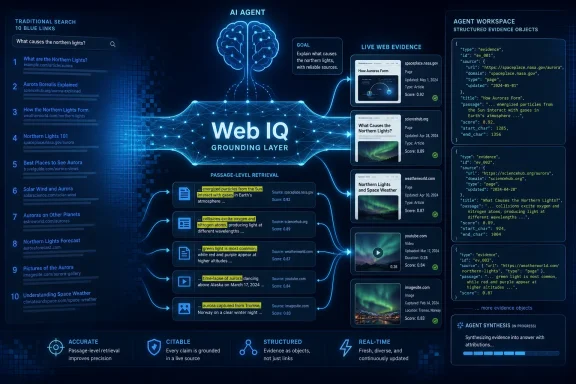 Microsoft Is Recasting Bing as Plumbing, Not a Destination
For most of the past two decades, Bing has lived in Google’s shadow as a consumer search engine. Microsoft could bundle it into Windows, Edge, Cortana, Start, and Copilot, but the basic contest remained brutally simple: users typed queries, saw ranked links, and overwhelmingly chose Google. Web IQ changes the frame. Microsoft is no longer asking whether humans want to visit Bing.com; it is asking whether agents need Bing’s index underneath everything else.That is a clever pivot because agentic AI does not experience search as a page of ten blue links. An agent does not want a search results page, scan snippets, open tabs, and decide which site “feels” right. It wants compact evidence, freshness signals, source metadata, and enough ranking confidence to pass a useful bundle of context into a model without burning a fortune in tokens.
Microsoft’s language around Web IQ is therefore revealing. The company describes it as an AI-first web search stack, model-agnostic and MCP-native, built to return relevant passages rather than conventional search pages. The point is not to make Bing look prettier. The point is to make Bing disappear into the inference loop.
That has strategic consequences. If Microsoft can make Bing’s index the default grounding layer for Copilot, Azure AI Foundry, third-party agents, and even non-Microsoft models, then Bing stops being judged mainly by consumer search share. It becomes a utility: a low-latency, high-scale, always-updated substrate for AI systems that need to know what happened outside their training data.
The Agentic Web Turns Search Inside Out
Traditional search was built around human recovery. If the ranking is imperfect, the user can reformulate the query, open three results, reject a spam page, and triangulate a better answer. That human-in-the-loop correction is messy, but it is also forgiving. Search engines could optimize for click satisfaction because the user remained part of the ranking system.Agents break that bargain. When a model calls a retrieval tool mid-task, a bad passage can become bad reasoning. A stale result can turn into a confident falsehood. A bloated result can crowd out better evidence in the context window. The user may never see the retrieval step at all, only the final answer or action.
That is why Microsoft’s emphasis on grounding is more than marketing vocabulary. In a classic search session, the retrieval system points a person toward documents. In an agentic workflow, the retrieval system shapes the model’s working memory. It decides what the model knows, what it ignores, and how much room remains for reasoning.
This is also why passage-level extraction matters. A full web page is usually a terrible unit of information for a model. It includes navigation, ads, boilerplate, repeated headers, comments, related links, cookie banners, and prose that may be only partially relevant. A focused passage with source metadata is more useful, cheaper to process, and less likely to drown the model in noise.
The shift is easy to underestimate because the user-facing experience still looks like “AI searched the web.” Underneath, however, the optimization target has changed. The system is no longer primarily ranking pages for a person. It is assembling evidence packets for a machine that may be halfway through a multi-step plan.
Speed Is the Flashy Claim, but Not the Whole Product
Microsoft’s headline performance number is bold: Web IQ reportedly delivers sub-165ms P95 latency and is nearly 2.5 times faster than the nearest alternative. That is the kind of metric vendors love because it sounds objective, impressive, and easy to repeat. It is also the kind of metric that deserves a raised eyebrow.Latency benchmarks depend on query mix, geography, cache state, payload size, ranking depth, API shape, networking path, and how much work the “alternative” is actually doing. A retrieval endpoint returning short evidence snippets is not directly comparable to a search API returning richer web results, a crawler-backed research tool doing deeper synthesis, or a custom RAG pipeline running inside an enterprise network. Without independent benchmarks, Microsoft’s number should be read as a claim, not a law of physics.
There is also the practical question of where time is really spent. In many agent workflows, web retrieval is not the main bottleneck. LLM inference, tool orchestration, retry loops, memory handling, policy checks, and final response generation often dominate the wall clock. Shaving 100 or 200 milliseconds off a single retrieval call may be meaningful at scale, but it will not magically make a sluggish multi-agent workflow feel instantaneous.
Still, dismissing the speed claim entirely would be a mistake. Agents do not search once. They fan out, decompose, compare, verify, and iterate. A complex research agent might issue dozens of retrieval calls, and enterprise systems may run thousands or millions of such operations across users. Tail latency matters when retrieval sits inside the reasoning loop, because slow calls stack up and create unpredictable user experiences.
The more interesting point is not that Web IQ is “fast.” It is that Microsoft is treating retrieval latency, token efficiency, and evidence quality as one combined systems problem. In agentic AI, those variables are entangled. Faster retrieval is not useful if the model receives junk; better evidence is expensive if it arrives as a thousand irrelevant tokens; token savings can reduce cost but harm accuracy if the passage selection is too aggressive.
Microsoft’s Real Bet Is on Evidence Objects
The most consequential Web IQ idea is not the performance chart. It is the move from documents to structured evidence. Microsoft is effectively saying that agents should not be handed the web as humans see it. They should be handed selected, compact, attributed pieces of the web in a format designed for reasoning systems.That sounds obvious until you consider how much of today’s AI browsing stack still resembles a brittle imitation of a human workflow. A model asks for a search. A tool returns results. The model opens pages. A parser strips markup. The model tries to infer which paragraphs matter. Then the model summarizes, cites, or acts. Every step introduces cost and failure.
Web IQ tries to collapse parts of that pipeline. Instead of asking every developer to build crawling, ranking, passage extraction, deduplication, freshness scoring, and source handling, Microsoft wants to sell those functions as infrastructure. For Azure customers already building agents, that is attractive. Most teams do not want to become search companies.
The token angle is especially important. Tokens are not just a billing unit; they are a design constraint. Every irrelevant sentence fed into a model costs money, adds latency, and competes with useful context. A retrieval system that reliably returns fewer, better passages can improve both economics and answer quality.
But evidence objects also shift power. If the agent consumes what the retrieval layer selects, then the retrieval layer becomes an editorial gatekeeper of the machine-readable web. Ranking was already powerful when humans clicked links. It becomes more powerful when agents silently incorporate selected passages into decisions, reports, code, purchases, and business processes.
Bing’s Infrastructure Finally Has a Native AI Job
Microsoft’s advantage here is not that it invented embeddings, approximate nearest-neighbor search, or passage ranking. It did not. The market is full of retrieval startups, vector databases, search APIs, RAG frameworks, and agent tooling. What Microsoft has is a mature web index, crawler operations, spam handling, freshness systems, publisher signals, and the operational discipline of serving search at enormous scale.That matters because web grounding is not just semantic search over a static corpus. The public web changes constantly. News breaks, pages vanish, scams appear, domains change hands, documentation updates, product pages drift, and spam farms adapt. A useful grounding layer has to know not only what content is relevant, but whether it is current, authoritative, duplicated, poisoned, or worth showing to a model at all.
Bing gives Microsoft a foundation that most agent startups cannot easily replicate. A startup can build a beautiful API and clever ranking models, but crawling and maintaining a broad, fresh, abuse-resistant web index is a punishingly expensive business. Google and Microsoft have spent decades building that machinery. Web IQ is Microsoft’s attempt to make that sunk cost newly valuable.
The timing is also important. As base models become more interchangeable for many enterprise tasks, the differentiator shifts toward context, data access, workflow integration, and governance. Microsoft has been saying this loudly through its broader Microsoft IQ pitch: Work IQ for organizational context, Fabric IQ for structured business semantics, Foundry IQ for knowledge orchestration, and Web IQ for the outside world.
That packaging is classic Microsoft. It turns a technical capability into a platform layer, then ties that layer to the company’s existing estate: Microsoft 365, Azure, GitHub, Foundry, Copilot Studio, Defender, Purview, Entra, and Windows. Web IQ may be “model-agnostic,” but it is clearly meant to make the Microsoft cloud feel like the natural home for agents.
The Market Is Crowded Because the Problem Is Real
The skepticism around Web IQ is healthy because Microsoft is not entering an empty field. Developers already use Google search products, Brave Search APIs, Perplexity-style answer engines, Tavily, Exa, SerpAPI-style wrappers, vector stores, custom crawlers, enterprise search systems, and open-source retrieval frameworks. Many of these tools can produce impressive results quickly, especially for straightforward queries.That makes Microsoft’s “2.5x faster” positioning less decisive than it sounds. If a developer’s agent only needs quick factual lookup, many existing services are fast enough. If the agent is doing deep research, the limiting factor may be source evaluation and synthesis, not initial retrieval. If the agent is grounded primarily in internal enterprise documents, the public web layer may be peripheral.
But the crowded market also proves Microsoft’s point. Everyone building serious agents runs into the same wall: models need current, external information, and naive web browsing is unreliable. The old division between “search engine” and “AI assistant” is dissolving. Search APIs are becoming reasoning infrastructure.
Where Microsoft can stand out is not merely in latency, but in integration and trust. Enterprises already buying Azure services may prefer a grounding layer that fits into existing identity, compliance, billing, monitoring, and data residency patterns. They may not want to send retrieval traffic through a small vendor with unclear durability. In that environment, “good enough and governed” often beats “slightly better and unknown.”
The open question is whether Microsoft can make Web IQ compelling outside its own stack. If access is limited, pricing is opaque, documentation is thin, or performance gains depend heavily on Azure proximity, developers will treat it as another Microsoft preview rather than a new web primitive. The service has to prove itself in messy third-party workflows, not just in Microsoft’s own demos.
Publishers Are Being Asked to Trust a Smaller Doorway
For publishers, Web IQ is both opportunity and threat. On one hand, Microsoft says the system respects publisher preferences and builds on Bing’s existing handling of robots rules and attribution. It also fits with Microsoft’s recent moves to expose more AI citation and grounding data to site owners. In theory, publishers get another path for their work to be discovered and cited by AI systems.On the other hand, the agentic web narrows the user’s path to the original page. If an agent receives a passage, uses it to answer a question, and cites a source, the user may never visit the site. That is already the central anxiety around AI search: the web’s economic bargain weakens when content is consumed by answer engines rather than readers.
Web IQ intensifies that debate because it optimizes for machines. A human search result still carries the possibility of a click, a subscription, an ad impression, or a deeper relationship with a publication. A passage handed to an agent may become invisible input into a generated answer. Attribution helps, but attribution is not the same as traffic.
Microsoft’s answer will likely be that grounding systems need high-quality publisher content, and therefore must preserve incentives. That is true, but it does not solve the business model. If AI agents increasingly mediate the web, publishers will demand more than polite crawling. They will want visibility, control, compensation, and proof that their content is not being reduced to raw material for someone else’s interface.
This is where Web IQ becomes more than a developer product. It is part of a broader negotiation over what the web is for. Is the web a destination network for people, or a live knowledge substrate for agents? Microsoft’s answer is clearly “both,” but the money may not flow evenly to both sides.
Windows Developers Should Read This as a Platform Signal
For WindowsForum readers, Web IQ may sound distant from the desktop. It is a cloud grounding API, not a Windows feature. But it belongs to the same Build 2026 story as Microsoft Execution Containers, Agent 365, Copilot integrations, Windows developer tooling, and Microsoft’s push to make Windows an agent-native environment.The pattern is clear. Microsoft expects agents to run across local machines, cloud sandboxes, enterprise systems, and user-facing apps. Those agents need identity, isolation, tool permissions, memory, logs, policy enforcement, and grounding. Web IQ is the outside-world piece of that architecture.
That matters for Windows administrators because agents will not remain cute chatbots. They will schedule meetings, inspect files, summarize tickets, query internal systems, generate scripts, open pull requests, and eventually take actions with real operational consequences. Once agents act, the quality of their grounding becomes a security and reliability issue.
A helpdesk agent that retrieves stale vendor documentation can give bad remediation steps. A procurement agent that grounds on the wrong product page can recommend the wrong SKU. A security agent that trusts a poisoned or low-quality source can misclassify a threat. A coding agent that grabs outdated API guidance can generate vulnerable or broken code.
The Windows angle is therefore not “Web IQ will change your Start menu.” It is that Microsoft is building the stack that future Windows-connected agents may depend on. If those agents are going to operate in corporate environments, their web access cannot look like random scraping. It needs governance, logging, policy boundaries, and predictable behavior.
Limited Access Keeps the Hard Questions Unanswered
The current Web IQ story still has gaps. Microsoft has announced the system and described its architecture, but broad availability, pricing, detailed API behavior, service-level commitments, and independent performance comparisons remain the real tests. A limited-access launch can validate interest, but it cannot settle whether Web IQ is meaningfully better than alternatives in production.Developers will want to know what “model-agnostic” means in practice. Can Web IQ be used easily from non-Azure agent frameworks? How cleanly does it work with OpenAI, Anthropic, Google, Meta, Mistral, and local models? Does MCP-native support translate into portable tool use, or does the best experience still assume Microsoft’s own orchestration environment?
Administrators will ask different questions. What logs are retained? How are queries isolated? Can tenants control which agents use web grounding? Can organizations enforce source allowlists or blocklists? How does the service behave in regulated environments? What happens when grounding data conflicts with internal knowledge?
The answers will determine whether Web IQ becomes a serious enterprise primitive or a glossy layer inside Copilot. Microsoft has a long history of announcing broad platform visions that become powerful only after years of documentation, licensing clarity, ecosystem pressure, and administrative tooling. Web IQ may follow that path.
There is also a trust issue. Microsoft says the underlying grounding infrastructure already powers major AI assistants and enterprise systems. That gives the product credibility, but it also raises a question: how much of Web IQ is a newly packaged API for existing Bing AI retrieval, and how much is a genuinely new system rebuilt for third-party agents? The distinction matters less to marketers than to developers who need predictable capabilities.
The Real Competition Is the Default Grounding Layer
Web IQ’s strongest chance is to become boring. That sounds like an insult, but it is the highest compliment for infrastructure. Developers should not have to think deeply about web grounding every time they build an agent. They should be able to call a reliable layer, get concise evidence, inspect attribution, apply policy, and move on.That is the prize Microsoft wants. Not a flashy app, not a search portal, not a consumer destination, but the default pipe through which agents ask the live web what is true right now. If it wins that position, Microsoft gains leverage even when the model is not Microsoft’s and the user never sees Bing branding.
The competition will not stand still. Google has an even larger search position and its own AI ambitions. Perplexity has consumer mindshare around answer search. Brave has positioned its search API as independent infrastructure. Specialized retrieval startups are moving quickly and may outperform general web indexes for particular workloads. Open-source tools will keep improving for teams that want control.
But Microsoft’s bundle is unusually complete. It has cloud distribution, enterprise relationships, Bing infrastructure, Copilot demand, GitHub developer channels, Windows platform hooks, and security products that can be wrapped around agents. Web IQ does not have to beat every competitor on every metric. It has to be the easiest credible choice for organizations already living in Microsoft’s ecosystem.
That is why the launch should be read less as a search announcement and more as a platform maneuver. Microsoft is trying to own the context layer. Web IQ brings the public web into that strategy.
The Web IQ Bet Comes Down to These Practical Tests
The useful way to judge Web IQ is not to repeat Microsoft’s launch language, but to watch what happens when developers and administrators put it into ordinary systems. A grounding layer succeeds only if it improves answers, reduces cost, survives adversarial content, and fits the operational model of the teams using it.- Web IQ is Microsoft’s attempt to turn Bing’s web index into a machine-facing grounding layer for AI agents, not merely another consumer search feature.
- The most important technical shift is the return of concise passages and structured evidence rather than full pages or traditional search result pages.
- Microsoft’s latency claims are notable, but their practical value will depend on independent benchmarks, real workloads, network placement, and how many retrieval calls an agent makes.
- The service could be especially attractive to Azure and Microsoft 365 customers if it plugs cleanly into governance, logging, identity, and agent management controls.
- Publishers should watch Web IQ closely because machine-oriented passage retrieval may further separate content use from human page visits.
- The unanswered questions are pricing, general availability, detailed API behavior, source controls, and whether the best experience is genuinely portable beyond Microsoft’s own stack.
References
- Primary source: quasa.io
Published: 2026-06-17T04:50:08.227481
Microsoft Launches Web IQ: A “Search Engine for AI Agents” Built on Bing
Microsoft is betting that as AI agents become mainstream, the quality, speed, and reliability of their connection to the real world will be a key differentiatorquasa.io
- Official source: microsoft.com
Microsoft IQ | Unified Enterprise Intelligence for AI
Microsoft IQ unifies enterprise data, context, and knowledge to power AI agents and Copilot with consistent, secure intelligence at scale.www.microsoft.com
- Official source: learn.microsoft.com
Microsoft IQ documentation | Microsoft Learn
Microsoft IQ is the enterprise intelligence layer of the Microsoft stack. It gives AI agents and Microsoft 365 Copilot a shared, continuously updated understanding of your organization by connecting how people work, how the business operates, and how agents unlock knowledge.learn.microsoft.com - Official source: blogs.microsoft.com
Microsoft Build 2026: Be yourself at work - The Official Microsoft Blog
Platforms shift when developers build. We explore, choose tools, dream, create. This platform shift comes with more information than ever, ready at your fingertips. This shift, it’s about building fast AND THEN: it’s about building, operating, optimizing and observing. Securing your...blogs.microsoft.com - Related coverage: windowscentral.com
"Agents are only as good as the context we give them": Microsoft IQ connects AI agents to your workspace data and the web | Windows Central
The newly unveiled Microsoft IQ data stack and Scout assistant turn generic AI into a personalized workplace tool.www.windowscentral.com - Official source: azure.microsoft.com
- Related coverage: searchenginejournal.com
Microsoft Web IQ Gives AI Agents Bing Grounding APIs
Microsoft announced Web IQ, a set of grounding APIs that connect AI agents to Bing's index. Pricing and general availability remain unclear.www.searchenginejournal.com - Official source: commandline.microsoft.com
Grounding at scale: Engineering the retrieval system for the agentic web - Command Line
Today at Build, we introduced Web IQ, a new grounding system for the agentic web.commandline.microsoft.com
