

Microsoft used the opening day of Build 2026 in San Francisco on June 2 to put Azure HorizonDB into public preview and to expose Web IQ, the web-grounding layer it says already supports Copilot and ChatGPT. The announcement is not just another database launch dressed in AI language. It is Microsoft’s clearest statement yet that the next cloud fight will be won less by the biggest model and more by the infrastructure that feeds, remembers, and constrains it. For WindowsForum readers, the practical question is whether Microsoft is building a genuinely better platform for agentic systems — or simply extending Azure gravity around every future AI workload.
For the last two years, enterprise AI has been sold mostly through the model. Bigger context windows, better reasoning scores, cheaper tokens, faster inference, and more fluent copilots have dominated the conversation. Build 2026 shifted the center of gravity downward: toward databases, retrieval systems, evidence objects, business context layers, and the boring machinery that decides whether an agent knows anything useful when it acts.
That shift matters because agentic AI breaks the comfortable assumptions of older application stacks. A conventional web application usually reads, writes, caches, and returns. An AI agent does something messier: it plans, searches, retrieves, re-ranks, writes intermediate state, calls tools, checks results, revises its plan, and loops until it either succeeds or exhausts the guardrails.
The infrastructure underneath that workflow is not a passive store. It becomes part of the reasoning system. If the database is slow, the agent hesitates; if retrieval is noisy, the model hallucinates; if grounding is stale, the answer is wrong before inference even begins.
That is the thesis behind Azure HorizonDB and Web IQ. Microsoft is no longer treating data services as supporting cast for AI demos. It is trying to turn Azure’s data plane into the control surface for enterprise agents.
Microsoft’s move is therefore both catch-up and escalation. HorizonDB is not being pitched as a better Azure Database for PostgreSQL Flexible Server. It is being pitched as a database rebuilt for the operational tempo of agents.
The core architectural claim is the “database-as-logs” design. Instead of treating the write-ahead log as an implementation detail beneath a traditional database engine, Microsoft is putting shared WAL storage at the center of the commit path. Transactions are committed directly to shared log storage, with compute nodes layered around that log-oriented foundation.
That matters because agents generate pathological database behavior. They are chatty, concurrent, repetitive, and impatient. A single human user may ask a question; an agent serving that user may perform dozens of retrieval and state-update operations before returning anything visible. Multiply that pattern across thousands of users, and the database stops looking like a back-office system. It starts looking like a real-time substrate for machine behavior.
Microsoft says HorizonDB can deliver sub-millisecond multi-zone commit latency. That is the kind of claim architects should treat as promising but provisional until it survives real workload testing outside Microsoft’s own benchmark lab. Still, the direction is clear: Microsoft wants HorizonDB to be evaluated not merely on throughput, but on whether it can support fast, repeated, reliable loops for agentic applications.
C and C++ remain deeply embedded in storage systems because performance still matters and because decades of database engineering were built around them. But they also bring familiar memory-safety risks. Rust offers a different bargain: high performance with compiler-enforced protections against large classes of memory bugs.
That is not magic. Rust does not make a database correct, fast, or secure by itself. It does, however, reduce the probability of certain catastrophic failures in systems that are expected to run under relentless pressure.
The agentic context sharpens the point. Autonomous systems do not politely wait for a human operator to notice a suspicious query pattern or a leaking process. They can hammer a backend at machine speed, amplify edge cases, and expose paths that traditional human-driven applications rarely touch. A memory-safe storage engine is not a marketing flourish in that environment; it is part of the argument that AI infrastructure needs to be less brittle than the software it is replacing.
This is the right shape for modern cloud databases. Disaggregation lets providers scale the expensive pieces separately, isolate failures more cleanly, and move maintenance operations away from the old model where every meaningful change felt like surgery on a live system. It also makes the product easier to plug into adjacent Azure services, including Fabric and Foundry.
But HorizonDB has a notable limitation: it is not yet serverless. Storage scales automatically; compute does not disappear into a zero-configuration abstraction. Developers still need to configure compute and manage replica capacity according to expected throughput.
That distinction will matter in procurement and architecture reviews. Some teams want predictable provisioned capacity because they value control, performance isolation, and cost modeling. Others have built around serverless elasticity because they do not want database capacity planning to become an operational project. HorizonDB currently serves the first group better than the second.
Microsoft can reasonably argue that preview is the time to expose the core architecture before adding every commercial packaging model. But the omission gives AWS, CockroachDB, and YugabyteDB an easy opening. If the future of agent workloads is spiky, unpredictable, and experimental, then serverless compute is not a luxury feature. It is part of the developer experience.
Vector search has become the duct tape of retrieval-augmented generation. Developers turn documents, messages, records, tickets, policies, and webpages into embeddings, then search for semantically similar items when a model needs context. The typical PostgreSQL approach has been to add vector capability through extensions, most visibly pgvector. That has made AI experimentation wonderfully accessible, but it has also created a ceiling.
HorizonDB’s bet is that vector search cannot remain a bolt-on forever. At enterprise scale, embeddings are not a side table in a demo database. They are a major data type with their own indexing, latency, memory, and recall tradeoffs.
DiskANN, originally developed by Microsoft Research, is designed for approximate nearest-neighbor search over large disk-resident datasets. That design matters because not every embedding corpus fits conveniently in memory, especially once organizations start embedding years of documents, support histories, code repositories, emails, compliance records, and operational telemetry. The promise is high-scale vector retrieval without forcing the entire index into RAM.
Spherical quantization strengthens the pitch by compressing vector representations while preserving angular relationships useful for similarity search. In plainer English, Microsoft is trying to make large embedding indexes cheaper to store and faster to search without destroying relevance. If it works as advertised, HorizonDB becomes more than a transactional store with AI features. It becomes a candidate system of record for the retrieval layer itself.
That is why HorizonDB’s hybrid search story is more important than its maximum vector dimension claim. Microsoft is combining vector similarity with full-text search through PostgreSQL-compatible mechanisms so a single query can consider both semantic relevance and lexical matching. This is the pattern most serious RAG systems eventually rediscover after their first wave of embedding-only prototypes produces confident nonsense.
The enterprise examples are obvious. A support agent needs to know that “blue screen after update” might map semantically to a known driver crash, but it also needs to respect the exact KB number, build number, device model, or error string. A compliance agent needs conceptual retrieval, but it cannot paraphrase its way around a specific policy clause. A code assistant needs semantic similarity, but it still has to care about function names, package versions, and stack traces.
In that sense, HorizonDB is less an AI novelty than a concession to reality. Retrieval systems need multiple signals. The best answer is rarely the nearest vector alone.
There are obvious benefits. Fewer moving parts can mean lower latency, simpler application code, and a cleaner path for teams that already live inside SQL and Azure. If embeddings, retrieval, inference calls, and transactional updates can be coordinated closer to the database, developers may spend less time gluing together queues, functions, vector stores, and external model gateways.
There are also risks. Databases became dependable partly because they had relatively well-defined responsibilities. Turning them into inference-aware execution environments can blur operational boundaries. A bad query is one thing; a bad query that triggers expensive model calls or autonomous workflows is another.
This is where enterprise governance will decide whether HorizonDB is a platform or a trap. Architects will need clear controls over which models can be called, which identities can invoke them, how costs are metered, how prompts are logged, and how sensitive data is prevented from leaking into the wrong inference path. Microsoft knows this, which is why Foundry and Fabric integration are not decorative. They are the governance story wrapped around the database story.
Traditional search engines were built for humans. They rank pages, show snippets, and let users decide what to trust. AI agents need something different. They need evidence selected, compressed, structured, and delivered in a form that can be consumed under token, latency, and reliability constraints.
Microsoft says Web IQ is rebuilt across indexing, retrieval, ranking, passage selection, and orchestration for inference-time grounding. The service sits on top of Bing’s web index, but the product claim is not “Bing API with AI branding.” The claim is that Microsoft has redesigned the retrieval pipeline around what models need at the moment they answer or act.
The unit of return is the giveaway. Web IQ returns passages and structured evidence objects rather than simply handing back full documents. That reflects an important truth: documents are often too large, too noisy, and too unevenly relevant for model context windows. A model does not need an entire webpage to answer a narrow question. It needs the specific evidence-bearing passage, plus enough metadata and structure to weigh it appropriately.
If Microsoft can make that work reliably, Web IQ becomes a foundational service. It would be less like a search API and more like a grounding utility for the agent economy.
That does not mean every developer will get the same behavior, coverage, latency, or ranking quality that Microsoft and OpenAI receive internally. Limited availability APIs often expose only part of an internal system, and commercial usage can differ sharply from first-party deployment. But the claim gives Web IQ credibility that a cold preview would not have.
It also says something about the Microsoft-OpenAI relationship. Even as OpenAI builds more of its own platform surface and Microsoft broadens Foundry beyond OpenAI models, the infrastructure entanglement remains deep. If ChatGPT grounding is already relying on Microsoft’s web intelligence layer in some capacity, then Azure’s role in the AI stack is not limited to compute hosting and enterprise distribution.
For developers, the model-agnostic positioning matters. Microsoft says Web IQ is exposed through JSON-RPC 2.0 transport and can work with any foundation model. That is the right answer for a market where enterprises increasingly want model choice. The open question is whether pricing, access controls, and operational integration will make it feel model-agnostic in practice.
A service can be technically portable and commercially sticky at the same time. Microsoft has mastered that distinction for decades.
This is the paradox of grounding. The more aggressively a system compresses information for efficiency, the more responsibility shifts to the retrieval layer. If passage selection is wrong, biased, stale, or stripped of essential context, the model may produce an answer that looks grounded while resting on a weak foundation.
Microsoft’s structured evidence object approach is an attempt to address this by packaging retrieved information in a form that carries more than raw text. But developers should be wary of treating the API response as truth. Grounding reduces hallucination risk; it does not abolish it.
This is especially important for Windows administrators and enterprise IT teams. Many real-world queries are not timeless facts. They involve current advisories, recently changed licensing terms, temporary service incidents, region-specific availability, and version-dependent behavior. Web grounding must be fresh, but it must also be auditable. The enterprise will not accept “the grounding layer said so” as a root-cause explanation.
Fabric IQ, Work IQ, Foundry IQ, and Web IQ are not just product names. They are Microsoft’s attempt to define the context layer as a first-class enterprise platform. If models are interchangeable, context becomes the moat. The company that controls where agents look, how they retrieve, and what evidence they receive can shape the entire application layer above.
The Database Hub in Fabric fits that strategy. Microsoft wants administrators to manage HorizonDB, Azure Database for PostgreSQL, Cosmos DB, and mirrored data through a more unified surface, with OneLake serving as the analytics convergence point. For shops already invested in Microsoft 365, Power Platform, Azure, and Fabric, the appeal is obvious: fewer seams, more shared governance, and a cleaner story for cross-database analytics.
The risk is equally obvious. Every simplification inside the Microsoft estate can become another dependency at the boundary. Enterprises will ask whether the convenience of unified context is worth deeper commitment to Azure data architecture. Microsoft will answer with productivity, security, governance, and integration. Competitors will answer with lock-in.
Both sides will have a point.
This matters because AI does not merely generate new workloads; it changes the economics of existing ones. Agents that analyze business data will not politely wait overnight for batch jobs. They will ask ad hoc questions, combine operational state with semantic context, and expect analytic systems to answer fast enough to stay inside an interactive loop.
Bringing GPU acceleration into a managed warehouse is part of Microsoft’s broader bet that the data platform must become more elastic, more heterogeneous, and more AI-adjacent. CPUs remain the workhorse of enterprise data. But the center of performance gravity is shifting where parallelism, vectorized execution, and AI-heavy workloads dominate.
The danger is that “GPU-accelerated” becomes another benchmark phrase that sounds better than it deploys. Query eligibility, workload shape, cost, capacity availability, and region support will matter more than headline multipliers. But the direction is unmistakable: Microsoft is preparing Fabric for a world where analytics and agentic action are no longer separate phases.
That makes HorizonDB a catch-up product in one sense. Azure needed a bigger, more cloud-native PostgreSQL story. The fact that Microsoft is now filling that gap says as much about customer demand as it does about technical innovation.
Where HorizonDB tries to leap ahead is in AI-native integration. Native DiskANN vector indexing, model invocation through database extensions, Foundry alignment, Fabric mirroring, and Web IQ adjacency create a more integrated Microsoft story than a generic PostgreSQL service with vector support. The company is not merely saying “bring your Postgres apps.” It is saying “bring your future agents.”
Whether that matters depends on workload maturity. If a team needs ordinary relational durability, managed backups, high availability, and predictable PostgreSQL behavior, Azure Database for PostgreSQL Flexible Server may remain the safer choice. If a team is building a retrieval-heavy agent platform that needs semantic search, hybrid retrieval, and Azure-native governance, HorizonDB becomes more interesting.
Preview status should cool any migration fever. Production databases are not upgraded on keynote energy. They are upgraded after painful testing, failure-mode analysis, cost modeling, and rollback planning.
That does not mean HorizonDB or Web IQ are anticompetitive by design. It does mean enterprises should evaluate them with exit costs in mind. PostgreSQL compatibility helps, but compatibility is not portability. A workload that depends on HorizonDB’s native vector indexing, in-database Azure AI invocation, Fabric mirroring, Web IQ grounding, and Foundry governance may become deeply Azure-shaped even if its tables look like Postgres.
This is the old Microsoft platform lesson in modern form. The company is at its best when it gives developers powerful abstractions that make hard things practical. It is at its most controversial when those abstractions quietly become the path of least resistance into a closed commercial loop.
The right enterprise response is not reflexive avoidance. It is architectural honesty. Use the differentiated features where they produce real value, but understand which parts of the design are portable, which are replaceable, and which are strategic commitments.
The same caution applies to Web IQ. Limited availability means Microsoft is still controlling access, likely shaping early usage around customers and scenarios that fit the service’s current strengths. Until pricing, quota behavior, service-level objectives, data handling terms, and auditability are clearer, Web IQ should be treated as a strategic preview rather than a commodity API.
For developers, the best use of this moment is evaluation, not commitment. Build prototypes that stress the agent patterns Microsoft is targeting: repeated retrieval, mixed semantic and keyword search, transactional state updates, model invocation, and grounding calls under latency pressure. Then compare those results against existing architectures rather than against Microsoft’s slides.
For administrators, the questions are more prosaic and more important. How does backup and restore behave? What does failover look like? How transparent are logs and metrics? How does identity work across database, model, and retrieval services? What happens when an agent runs away and turns a cheap workflow into a costly loop?
Those are not objections to HorizonDB or Web IQ. They are the questions that separate infrastructure from theater.
That architecture is coherent. It is also demanding. To get the full benefit, customers will need to align databases, analytics, identity, model access, observability, and governance inside a Microsoft-shaped stack. The reward may be faster agent development and fewer custom retrieval pipelines. The cost may be deeper platform dependency.
The most interesting thing about HorizonDB is not that it supports PostgreSQL. The most interesting thing about Web IQ is not that it uses Bing. The real story is that Microsoft is attempting to standardize the hidden infrastructure of AI applications before the market finishes deciding what that infrastructure should look like.
If it succeeds, future enterprise agents may be built less like applications and more like policy-constrained organisms living inside Microsoft’s data fabric. That is powerful. It is also exactly the sort of shift IT departments should examine before it becomes invisible.
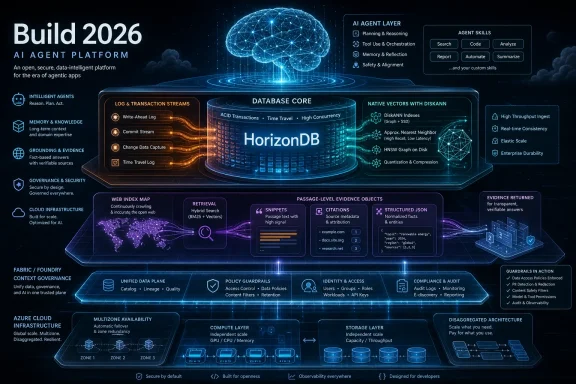 Microsoft Is Moving the AI Battle Below the Model Layer
For the last two years, enterprise AI has been sold mostly through the model. Bigger context windows, better reasoning scores, cheaper tokens, faster inference, and more fluent copilots have dominated the conversation. Build 2026 shifted the center of gravity downward: toward databases, retrieval systems, evidence objects, business context layers, and the boring machinery that decides whether an agent knows anything useful when it acts.That shift matters because agentic AI breaks the comfortable assumptions of older application stacks. A conventional web application usually reads, writes, caches, and returns. An AI agent does something messier: it plans, searches, retrieves, re-ranks, writes intermediate state, calls tools, checks results, revises its plan, and loops until it either succeeds or exhausts the guardrails.
The infrastructure underneath that workflow is not a passive store. It becomes part of the reasoning system. If the database is slow, the agent hesitates; if retrieval is noisy, the model hallucinates; if grounding is stale, the answer is wrong before inference even begins.
That is the thesis behind Azure HorizonDB and Web IQ. Microsoft is no longer treating data services as supporting cast for AI demos. It is trying to turn Azure’s data plane into the control surface for enterprise agents.
HorizonDB Is Microsoft’s Admission That Plain PostgreSQL Is Not Enough
Azure HorizonDB arrives with a familiar promise: PostgreSQL compatibility without traditional PostgreSQL bottlenecks. That formulation is now almost a genre in cloud infrastructure. Amazon Aurora made the commercial case for decoupled PostgreSQL-compatible storage more than a decade ago, Google AlloyDB followed with its own managed PostgreSQL ambitions, and distributed SQL vendors have spent years arguing that Postgres semantics can coexist with cloud-native scale.Microsoft’s move is therefore both catch-up and escalation. HorizonDB is not being pitched as a better Azure Database for PostgreSQL Flexible Server. It is being pitched as a database rebuilt for the operational tempo of agents.
The core architectural claim is the “database-as-logs” design. Instead of treating the write-ahead log as an implementation detail beneath a traditional database engine, Microsoft is putting shared WAL storage at the center of the commit path. Transactions are committed directly to shared log storage, with compute nodes layered around that log-oriented foundation.
That matters because agents generate pathological database behavior. They are chatty, concurrent, repetitive, and impatient. A single human user may ask a question; an agent serving that user may perform dozens of retrieval and state-update operations before returning anything visible. Multiply that pattern across thousands of users, and the database stops looking like a back-office system. It starts looking like a real-time substrate for machine behavior.
Microsoft says HorizonDB can deliver sub-millisecond multi-zone commit latency. That is the kind of claim architects should treat as promising but provisional until it survives real workload testing outside Microsoft’s own benchmark lab. Still, the direction is clear: Microsoft wants HorizonDB to be evaluated not merely on throughput, but on whether it can support fast, repeated, reliable loops for agentic applications.
Rust Is the Quietest Part of the Pitch, and Maybe the Most Revealing
Microsoft’s decision to build HorizonDB’s storage engine in Rust is easy to treat as a footnote. It should not be. In database infrastructure, language choice is a security, reliability, and hiring signal as much as an engineering preference.C and C++ remain deeply embedded in storage systems because performance still matters and because decades of database engineering were built around them. But they also bring familiar memory-safety risks. Rust offers a different bargain: high performance with compiler-enforced protections against large classes of memory bugs.
That is not magic. Rust does not make a database correct, fast, or secure by itself. It does, however, reduce the probability of certain catastrophic failures in systems that are expected to run under relentless pressure.
The agentic context sharpens the point. Autonomous systems do not politely wait for a human operator to notice a suspicious query pattern or a leaking process. They can hammer a backend at machine speed, amplify edge cases, and expose paths that traditional human-driven applications rarely touch. A memory-safe storage engine is not a marketing flourish in that environment; it is part of the argument that AI infrastructure needs to be less brittle than the software it is replacing.
Disaggregation Gives Azure a Better Scaling Story, but Not a Serverless One
HorizonDB separates compute and storage, with storage scaling automatically and compute scaling independently across primary and replica nodes. Microsoft is talking about storage growth up to 128 TB and compute scaling to thousands of virtual CPU cores across primaries and replicas. It also claims stateless compute nodes enable up to 15 read replicas and reduce downtime during maintenance.This is the right shape for modern cloud databases. Disaggregation lets providers scale the expensive pieces separately, isolate failures more cleanly, and move maintenance operations away from the old model where every meaningful change felt like surgery on a live system. It also makes the product easier to plug into adjacent Azure services, including Fabric and Foundry.
But HorizonDB has a notable limitation: it is not yet serverless. Storage scales automatically; compute does not disappear into a zero-configuration abstraction. Developers still need to configure compute and manage replica capacity according to expected throughput.
That distinction will matter in procurement and architecture reviews. Some teams want predictable provisioned capacity because they value control, performance isolation, and cost modeling. Others have built around serverless elasticity because they do not want database capacity planning to become an operational project. HorizonDB currently serves the first group better than the second.
Microsoft can reasonably argue that preview is the time to expose the core architecture before adding every commercial packaging model. But the omission gives AWS, CockroachDB, and YugabyteDB an easy opening. If the future of agent workloads is spiky, unpredictable, and experimental, then serverless compute is not a luxury feature. It is part of the developer experience.
Vector Search Stops Being an Extension and Becomes a Database Primitive
The most technically important part of HorizonDB is not the PostgreSQL compatibility claim. It is Microsoft’s decision to embed vector search natively using DiskANN with spherical quantization.Vector search has become the duct tape of retrieval-augmented generation. Developers turn documents, messages, records, tickets, policies, and webpages into embeddings, then search for semantically similar items when a model needs context. The typical PostgreSQL approach has been to add vector capability through extensions, most visibly pgvector. That has made AI experimentation wonderfully accessible, but it has also created a ceiling.
HorizonDB’s bet is that vector search cannot remain a bolt-on forever. At enterprise scale, embeddings are not a side table in a demo database. They are a major data type with their own indexing, latency, memory, and recall tradeoffs.
DiskANN, originally developed by Microsoft Research, is designed for approximate nearest-neighbor search over large disk-resident datasets. That design matters because not every embedding corpus fits conveniently in memory, especially once organizations start embedding years of documents, support histories, code repositories, emails, compliance records, and operational telemetry. The promise is high-scale vector retrieval without forcing the entire index into RAM.
Spherical quantization strengthens the pitch by compressing vector representations while preserving angular relationships useful for similarity search. In plainer English, Microsoft is trying to make large embedding indexes cheaper to store and faster to search without destroying relevance. If it works as advertised, HorizonDB becomes more than a transactional store with AI features. It becomes a candidate system of record for the retrieval layer itself.
Hybrid Search Is Where the Demo Becomes a Real Application
Pure vector search is often impressive in demos and disappointing in production. It can find semantically related material, but it can also miss exact terms, version numbers, error codes, product names, clauses, and identifiers that matter enormously to business users. Keyword search has the opposite problem: it is precise but frequently blind to meaning.That is why HorizonDB’s hybrid search story is more important than its maximum vector dimension claim. Microsoft is combining vector similarity with full-text search through PostgreSQL-compatible mechanisms so a single query can consider both semantic relevance and lexical matching. This is the pattern most serious RAG systems eventually rediscover after their first wave of embedding-only prototypes produces confident nonsense.
The enterprise examples are obvious. A support agent needs to know that “blue screen after update” might map semantically to a known driver crash, but it also needs to respect the exact KB number, build number, device model, or error string. A compliance agent needs conceptual retrieval, but it cannot paraphrase its way around a specific policy clause. A code assistant needs semantic similarity, but it still has to care about function names, package versions, and stack traces.
In that sense, HorizonDB is less an AI novelty than a concession to reality. Retrieval systems need multiple signals. The best answer is rarely the nearest vector alone.
In-Database AI Invocation Tightens the Loop and Raises the Stakes
HorizonDB also supports in-database model invocation through Azure AI integration, allowing developers to call AI capabilities from inside SQL workflows. This is a natural extension of Microsoft’s broader strategy: collapse orchestration layers, keep data close to Azure services, and make the database feel like an AI-aware runtime rather than a passive store.There are obvious benefits. Fewer moving parts can mean lower latency, simpler application code, and a cleaner path for teams that already live inside SQL and Azure. If embeddings, retrieval, inference calls, and transactional updates can be coordinated closer to the database, developers may spend less time gluing together queues, functions, vector stores, and external model gateways.
There are also risks. Databases became dependable partly because they had relatively well-defined responsibilities. Turning them into inference-aware execution environments can blur operational boundaries. A bad query is one thing; a bad query that triggers expensive model calls or autonomous workflows is another.
This is where enterprise governance will decide whether HorizonDB is a platform or a trap. Architects will need clear controls over which models can be called, which identities can invoke them, how costs are metered, how prompts are logged, and how sensitive data is prevented from leaking into the wrong inference path. Microsoft knows this, which is why Foundry and Fabric integration are not decorative. They are the governance story wrapped around the database story.
Web IQ Is the Bigger Announcement Wearing the Smaller Costume
HorizonDB is easier to explain because databases are tangible. Web IQ may be more strategically significant because it addresses the problem every general-purpose AI product runs into: the open web is huge, unstable, contradictory, and badly structured for machine reasoning.Traditional search engines were built for humans. They rank pages, show snippets, and let users decide what to trust. AI agents need something different. They need evidence selected, compressed, structured, and delivered in a form that can be consumed under token, latency, and reliability constraints.
Microsoft says Web IQ is rebuilt across indexing, retrieval, ranking, passage selection, and orchestration for inference-time grounding. The service sits on top of Bing’s web index, but the product claim is not “Bing API with AI branding.” The claim is that Microsoft has redesigned the retrieval pipeline around what models need at the moment they answer or act.
The unit of return is the giveaway. Web IQ returns passages and structured evidence objects rather than simply handing back full documents. That reflects an important truth: documents are often too large, too noisy, and too unevenly relevant for model context windows. A model does not need an entire webpage to answer a narrow question. It needs the specific evidence-bearing passage, plus enough metadata and structure to weigh it appropriately.
If Microsoft can make that work reliably, Web IQ becomes a foundational service. It would be less like a search API and more like a grounding utility for the agent economy.
ChatGPT and Copilot Make Web IQ a Platform Claim, Not a Preview Toy
Microsoft’s assertion that Web IQ already powers grounding experiences behind both Copilot and ChatGPT is the strongest part of the announcement. It changes the product from a speculative developer preview into a peek at infrastructure already operating at massive scale.That does not mean every developer will get the same behavior, coverage, latency, or ranking quality that Microsoft and OpenAI receive internally. Limited availability APIs often expose only part of an internal system, and commercial usage can differ sharply from first-party deployment. But the claim gives Web IQ credibility that a cold preview would not have.
It also says something about the Microsoft-OpenAI relationship. Even as OpenAI builds more of its own platform surface and Microsoft broadens Foundry beyond OpenAI models, the infrastructure entanglement remains deep. If ChatGPT grounding is already relying on Microsoft’s web intelligence layer in some capacity, then Azure’s role in the AI stack is not limited to compute hosting and enterprise distribution.
For developers, the model-agnostic positioning matters. Microsoft says Web IQ is exposed through JSON-RPC 2.0 transport and can work with any foundation model. That is the right answer for a market where enterprises increasingly want model choice. The open question is whether pricing, access controls, and operational integration will make it feel model-agnostic in practice.
A service can be technically portable and commercially sticky at the same time. Microsoft has mastered that distinction for decades.
The Passage-Level Web Is Also a Trust Problem
Returning passages instead of documents improves efficiency, but it also changes the trust model. Human users can scan a page, inspect surrounding context, compare sources, and judge whether an excerpt is representative. Models cannot do that unless the retrieval layer gives them enough surrounding evidence and provenance to reason about reliability.This is the paradox of grounding. The more aggressively a system compresses information for efficiency, the more responsibility shifts to the retrieval layer. If passage selection is wrong, biased, stale, or stripped of essential context, the model may produce an answer that looks grounded while resting on a weak foundation.
Microsoft’s structured evidence object approach is an attempt to address this by packaging retrieved information in a form that carries more than raw text. But developers should be wary of treating the API response as truth. Grounding reduces hallucination risk; it does not abolish it.
This is especially important for Windows administrators and enterprise IT teams. Many real-world queries are not timeless facts. They involve current advisories, recently changed licensing terms, temporary service incidents, region-specific availability, and version-dependent behavior. Web grounding must be fresh, but it must also be auditable. The enterprise will not accept “the grounding layer said so” as a root-cause explanation.
Fabric Is the Place Microsoft Wants All These Threads to Meet
HorizonDB and Web IQ make more sense when viewed through Microsoft Fabric. Microsoft is trying to assemble a layered context architecture in which agents can draw from work data, structured enterprise data, and live web knowledge without every developer reinventing retrieval from scratch.Fabric IQ, Work IQ, Foundry IQ, and Web IQ are not just product names. They are Microsoft’s attempt to define the context layer as a first-class enterprise platform. If models are interchangeable, context becomes the moat. The company that controls where agents look, how they retrieve, and what evidence they receive can shape the entire application layer above.
The Database Hub in Fabric fits that strategy. Microsoft wants administrators to manage HorizonDB, Azure Database for PostgreSQL, Cosmos DB, and mirrored data through a more unified surface, with OneLake serving as the analytics convergence point. For shops already invested in Microsoft 365, Power Platform, Azure, and Fabric, the appeal is obvious: fewer seams, more shared governance, and a cleaner story for cross-database analytics.
The risk is equally obvious. Every simplification inside the Microsoft estate can become another dependency at the boundary. Enterprises will ask whether the convenience of unified context is worth deeper commitment to Azure data architecture. Microsoft will answer with productivity, security, governance, and integration. Competitors will answer with lock-in.
Both sides will have a point.
GPU-Accelerated Fabric Shows the Data Warehouse Is Being Pulled Into AI’s Orbit
The Build announcement around GPU-accelerated analytics in Fabric Data Warehouse may seem adjacent, but it belongs in the same story. Microsoft says eligible warehouse queries can run on NVIDIA accelerated computing inside the execution engine without query rewrites, with internal benchmarks claiming large performance gains.This matters because AI does not merely generate new workloads; it changes the economics of existing ones. Agents that analyze business data will not politely wait overnight for batch jobs. They will ask ad hoc questions, combine operational state with semantic context, and expect analytic systems to answer fast enough to stay inside an interactive loop.
Bringing GPU acceleration into a managed warehouse is part of Microsoft’s broader bet that the data platform must become more elastic, more heterogeneous, and more AI-adjacent. CPUs remain the workhorse of enterprise data. But the center of performance gravity is shifting where parallelism, vectorized execution, and AI-heavy workloads dominate.
The danger is that “GPU-accelerated” becomes another benchmark phrase that sounds better than it deploys. Query eligibility, workload shape, cost, capacity availability, and region support will matter more than headline multipliers. But the direction is unmistakable: Microsoft is preparing Fabric for a world where analytics and agentic action are no longer separate phases.
The Competitive Reality Is Less Flattering Than the Keynote
Microsoft’s framing is ambitious, but HorizonDB does not enter an empty field. AWS has spent years teaching customers that managed PostgreSQL-compatible services can be cloud-native without feeling alien. Google has pushed AlloyDB as a performance-focused PostgreSQL-compatible platform with AI-adjacent features. CockroachDB, YugabyteDB, and others have long argued for distributed SQL as the more durable answer to global applications.That makes HorizonDB a catch-up product in one sense. Azure needed a bigger, more cloud-native PostgreSQL story. The fact that Microsoft is now filling that gap says as much about customer demand as it does about technical innovation.
Where HorizonDB tries to leap ahead is in AI-native integration. Native DiskANN vector indexing, model invocation through database extensions, Foundry alignment, Fabric mirroring, and Web IQ adjacency create a more integrated Microsoft story than a generic PostgreSQL service with vector support. The company is not merely saying “bring your Postgres apps.” It is saying “bring your future agents.”
Whether that matters depends on workload maturity. If a team needs ordinary relational durability, managed backups, high availability, and predictable PostgreSQL behavior, Azure Database for PostgreSQL Flexible Server may remain the safer choice. If a team is building a retrieval-heavy agent platform that needs semantic search, hybrid retrieval, and Azure-native governance, HorizonDB becomes more interesting.
Preview status should cool any migration fever. Production databases are not upgraded on keynote energy. They are upgraded after painful testing, failure-mode analysis, cost modeling, and rollback planning.
The Antitrust Shadow Is Part of the Architecture Discussion
Any new Azure infrastructure layer now lands in a regulatory environment more skeptical of cloud bundling than it was five years ago. Microsoft’s licensing practices and cloud competition posture have drawn attention from regulators and rivals, and procurement teams are increasingly aware that technical choices can become commercial constraints.That does not mean HorizonDB or Web IQ are anticompetitive by design. It does mean enterprises should evaluate them with exit costs in mind. PostgreSQL compatibility helps, but compatibility is not portability. A workload that depends on HorizonDB’s native vector indexing, in-database Azure AI invocation, Fabric mirroring, Web IQ grounding, and Foundry governance may become deeply Azure-shaped even if its tables look like Postgres.
This is the old Microsoft platform lesson in modern form. The company is at its best when it gives developers powerful abstractions that make hard things practical. It is at its most controversial when those abstractions quietly become the path of least resistance into a closed commercial loop.
The right enterprise response is not reflexive avoidance. It is architectural honesty. Use the differentiated features where they produce real value, but understand which parts of the design are portable, which are replaceable, and which are strategic commitments.
The Preview Label Should Keep Everyone Sober
Public preview is not general availability with a softer name. It is a testing period, and for databases especially, that distinction matters. Performance claims may shift, limits may change, regions may expand unevenly, pricing may surprise, and operational sharp edges may emerge only after customers put real workloads on the service.The same caution applies to Web IQ. Limited availability means Microsoft is still controlling access, likely shaping early usage around customers and scenarios that fit the service’s current strengths. Until pricing, quota behavior, service-level objectives, data handling terms, and auditability are clearer, Web IQ should be treated as a strategic preview rather than a commodity API.
For developers, the best use of this moment is evaluation, not commitment. Build prototypes that stress the agent patterns Microsoft is targeting: repeated retrieval, mixed semantic and keyword search, transactional state updates, model invocation, and grounding calls under latency pressure. Then compare those results against existing architectures rather than against Microsoft’s slides.
For administrators, the questions are more prosaic and more important. How does backup and restore behave? What does failover look like? How transparent are logs and metrics? How does identity work across database, model, and retrieval services? What happens when an agent runs away and turns a cheap workflow into a costly loop?
Those are not objections to HorizonDB or Web IQ. They are the questions that separate infrastructure from theater.
The Build 2026 Message for IT Is Written Between the Product Names
Microsoft’s Build 2026 announcements point to a future where enterprise AI is less about a chatbot window and more about a mesh of data services, retrieval layers, policy engines, and application runtimes. HorizonDB handles the memory and state problem. Web IQ handles the live-web grounding problem. Fabric and Foundry handle the context and governance problem. Windows, Copilot, and developer tools become the places where those layers surface to users.That architecture is coherent. It is also demanding. To get the full benefit, customers will need to align databases, analytics, identity, model access, observability, and governance inside a Microsoft-shaped stack. The reward may be faster agent development and fewer custom retrieval pipelines. The cost may be deeper platform dependency.
The most interesting thing about HorizonDB is not that it supports PostgreSQL. The most interesting thing about Web IQ is not that it uses Bing. The real story is that Microsoft is attempting to standardize the hidden infrastructure of AI applications before the market finishes deciding what that infrastructure should look like.
If it succeeds, future enterprise agents may be built less like applications and more like policy-constrained organisms living inside Microsoft’s data fabric. That is powerful. It is also exactly the sort of shift IT departments should examine before it becomes invisible.
Microsoft’s Agent Stack Now Has a Shape
The immediate lesson from Build is not that every Azure customer should move to HorizonDB or apply for Web IQ tomorrow. The lesson is that Microsoft’s agent platform is becoming concrete enough to evaluate as infrastructure rather than spectacle.- HorizonDB is a preview-stage PostgreSQL-compatible database aimed at agentic workloads, not a routine replacement for every existing Azure PostgreSQL deployment.
- Its most important technical differentiator is native vector and hybrid search built around DiskANN, rather than a simple extension-based approach.
- Web IQ turns Bing-scale web retrieval into a passage-level grounding API, which could make it a critical dependency for agents that need current external knowledge.
- Microsoft’s performance claims for both products remain vendor-published and should be validated under real workloads before architecture decisions depend on them.
- The lack of serverless compute in HorizonDB is a meaningful limitation for teams that expect fully automatic capacity scaling.
- The deeper strategic move is Microsoft’s attempt to make Fabric, Foundry, HorizonDB, and Web IQ the default context and data layer for enterprise agents.
References
- Primary source: Tech Times
Published: Wed, 03 Jun 2026 18:12:15 GMT
Azure HorizonDB Enters Public Preview: Web IQ Already Powers Copilot and ChatGPT
Azure HorizonDB enters public preview at Microsoft Build 2026 alongside Web IQ, a Bing-rebuilt AI grounding API already powering Copilot and ChatGPT. The PostgreSQL-native database uses a Rust-basedwww.techtimes.com - Related coverage: tomsguide.com
Microsoft Build 2026 preview — all the big announcements to expect | Tom's Guide
Microsoft Build 2026 should be a showcase for the company's latest and upcoming AI efforts. Here are some of the big announcements we expect to see.www.tomsguide.com - Official source: azure.microsoft.com
Azure HorizonDB | Microsoft Azure
Preview Azure HorizonDB and experience PostgreSQL performance with enterprise-grade scale, AI productivity, and ultra-low latency.azure.microsoft.com
- Official source: techcommunity.microsoft.com
Announcing Azure HorizonDB | Microsoft Community Hub
Affan Dar, Vice President of Engineering, PostgreSQL at MicrosoftCharles Feddersen, Partner Director of Program Management, PostgreSQL at Microsoft Today at... techcommunity.microsoft.com
- Related coverage: ebisuda.net
Microsoft Build 2026:Azure AI FoundryがFoundry IQ・HorizonDB・Claude統合でAIエージェント基盤を全面強化 | ebisuda.net
Build 2026でMicrosoftがAzure AI Foundryを刷新。外部データ連携レイヤー「Foundry IQ」、AIネイティブDB「HorizonDB」を投入、AnthropicのClaudeもファーストパーティ統合。www.ebisuda.net
- Related coverage: redmondmag.com
Microsoft Previews Azure HorizonDB as Cloud Native PostgreSQL Engine -- Redmondmag.com
Introduced at Ignite late last year, Azure HorizonDB is a new PostgreSQL service designed for higher performance and scalability, using disaggregated storage, zone-redundant architecture and a Rust-based engine to target large, cloud-native workloads.redmondmag.com
