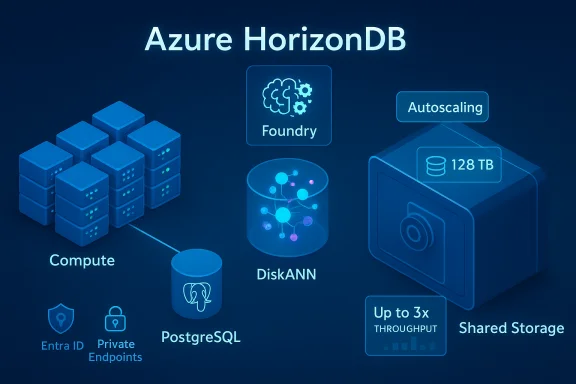
Microsoft's Azure HorizonDB launches as a full‑scale, cloud‑native distributed PostgreSQL service that aims to reframe how enterprises run transactional and AI‑augmented workloads in Azure, promising major gains in read scale, vector search, and integration with Microsoft's AI and Fabric ecosystem.
Azure already offers multiple PostgreSQL options — from single‑node managed engines to distributed table support through Cosmos DB for PostgreSQL — but HorizonDB represents a strategic leap: a purpose‑built, fully distributed PostgreSQL‑compatible service re‑engineered for hyperscale cloud operation. The product is being introduced in a limited preview and is positioned as a companion to Microsoft’s broader database portfolio and AI investments, including integrations with Microsoft Foundry and Fabric.
Microsoft bills HorizonDB as a cloud‑native Postgres experience with a redesigned storage layer, aggressive performance targets, and built‑in AI features. The vendor highlights a technical profile that includes autoscaling shared storage up to 128 TB, scale‑out compute to 3,072 vCores across primary and replica nodes, and sub‑millisecond multi‑zone commit latencies, while embedding vector search via DiskANN and one‑click model management into the service.
Multiple independent reports and Microsoft’s own announcement materials corroborate these headline specs and the private‑preview availability in select regions. At the same time, some implementation details remain fluid: pricing, GA timelines, and extension‑compatibility matrices have not been finalized publicly at launch.
Enterprise adopters should validate latency under their specific network and workload conditions before assuming identical results in production.
For teams leaning into AI‑driven features, this is an attractive proposition — provided the model lifecycle, governance, and cost models align with organizational requirements.
However, several pragmatic caveats apply:
Source: theregister.com Microsoft launches distributed PostgreSQL to rival AWS
 Background
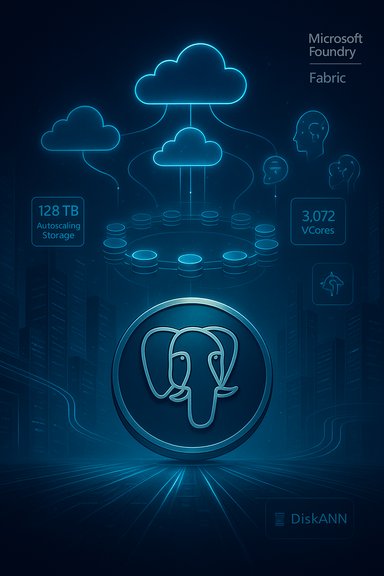
Azure already offers multiple PostgreSQL options — from single‑node managed engines to distributed table support through Cosmos DB for PostgreSQL — but HorizonDB represents a strategic leap: a purpose‑built, fully distributed PostgreSQL‑compatible service re‑engineered for hyperscale cloud operation. The product is being introduced in a limited preview and is positioned as a companion to Microsoft’s broader database portfolio and AI investments, including integrations with Microsoft Foundry and Fabric.Microsoft bills HorizonDB as a cloud‑native Postgres experience with a redesigned storage layer, aggressive performance targets, and built‑in AI features. The vendor highlights a technical profile that includes autoscaling shared storage up to 128 TB, scale‑out compute to 3,072 vCores across primary and replica nodes, and sub‑millisecond multi‑zone commit latencies, while embedding vector search via DiskANN and one‑click model management into the service.
Multiple independent reports and Microsoft’s own announcement materials corroborate these headline specs and the private‑preview availability in select regions. At the same time, some implementation details remain fluid: pricing, GA timelines, and extension‑compatibility matrices have not been finalized publicly at launch.
Overview: what Azure HorizonDB promises
Key technical claims
- PostgreSQL compatibility — Market messaging positions HorizonDB as PostgreSQL‑compatible; Microsoft asserts that developers can rely on Postgres semantics and tooling while running in a distributed, cloud‑native architecture.
- Scale and performance — The service advertises up to 3× transactional performance compared with vanilla open‑source Postgres in internal benchmarking, along with autoscaling storage up to 128 TB and scale‑out compute up to 3,072 vCores.
- Low commit latency — Microsoft claims less than 1 millisecond multi‑zone commit latency for transactions, enabled by the new storage and replication architecture.
- AI and vector features — Native vector search integration using DiskANN Advanced Filtering, plus AI model management and integration with Microsoft Foundry, are presented as differentiators aimed at reducing integration overhead for AI‑centric applications.
- Security and compliance — Enterprise features such as encryption, identity integration, and multi‑zone replication are included as baseline capabilities.
How HorizonDB differs from existing Azure Postgres offerings
Azure previously supported two main Postgres pathways for customers:- Azure Database for PostgreSQL — a managed service aimed at traditional PostgreSQL workloads (single‑node and hyperscale/Citus variants).
- Azure Cosmos DB for PostgreSQL — a distributed option primarily aimed at multi‑region workloads with distributed tables.
Deep dive: architecture and engineering choices
Cloud‑native storage + scale‑out compute
HorizonDB’s core technical differentiator is a reimagined storage layer that decouples storage from compute and allows the system to scale both independently. The architecture enables:- Shared, autoscaling storage up to 128 TB — eliminating per‑node storage limits common in monolithic Postgres deployments.
- Scale‑out compute across many nodes, aggregating to thousands of vCores to service heavy read workloads.
- Tiered caching and replica strategies to accelerate reads without forcing full logical replication or bespoke sharding in application code.
Transactional guarantees and latency
Microsoft is claiming sub‑millisecond, multi‑zone commit latencies. If achieved in production across realistic failure scenarios, that would be a substantial engineering feat for a distributed transactional system. However, readers should treat such latency claims with caution: measured latencies depend heavily on region topology, network paths, load patterns, and tuned client access paths.Enterprise adopters should validate latency under their specific network and workload conditions before assuming identical results in production.
Embedded vector search and predicate pushdown
A notable innovation is the integration of vector search directly into the transactional database via DiskANN Advanced Filtering. Rather than routing vector search through a separate vector index service or an external vector engine, HorizonDB aims to:- Merge vector similarity search and relational predicate filtering in a single query execution path.
- Push down filters to the DiskANN index to reduce post‑filtering overhead.
- Expose vector operations via Postgres‑compatible SQL/extension semantics, simplifying developer workflows.
AI model management and Foundry integration
HorizonDB offers built‑in model management to register, version, and invoke models close to the data. Integration with Microsoft Foundry provides a purported one‑click pathway to couple database operations with AI inference and data pipelines, shortening the time from data to model‑enhanced application features.For teams leaning into AI‑driven features, this is an attractive proposition — provided the model lifecycle, governance, and cost models align with organizational requirements.
Strengths: where HorizonDB could win
- Tighter integration between transactional data and vector/AI features. Embedding vector search and model management directly in the database reduces the number of moving parts developers must manage.
- Massive read scale without manual replication. HorizonDB’s scale‑out compute and shared storage let organizations scale read capacity without the complexity of maintaining many synchronous replicas or manual sharding.
- Enterprise security and platform integration. Built‑in identity, encryption, and multi‑zone replication align HorizonDB with enterprise compliance needs and Azure platform standards.
- Simplicity for Azure‑native teams. For organizations already invested in Microsoft’s ecosystem (Fabric, Foundry, VS Code, Entra ID), HorizonDB’s integrations could materially reduce operational friction.
- Performance claims backed by cloud engineering. The architecture mirrors design patterns that have delivered strong results in other cloud‑native RDBMS products; the aggressive vCore and storage ceilings indicate Microsoft engineered for large scale.
Risks, limitations, and open questions
Compatibility and extensions
- “PostgreSQL‑compatible” is not a single, binary guarantee. Compatibility has many dimensions: SQL syntax, procedural languages, index types, native extensions (for example, PostGIS), and tooling. Microsoft’s messaging emphasizes Postgres compatibility, but enterprises must validate extension support and behavior for their workloads.
- Extension support matrix may differ. Some Postgres extensions depend on process‑level hooks or assumptions about storage. Distributed architectures sometimes need adapted or reimplemented extensions. Teams relying on specific extensions (e.g., PostGIS, citus‑specific features, custom C extensions) should test thoroughly.
Pricing, operational cost, and cost predictability
- Microsoft has not disclosed full pricing details for HorizonDB at launch. The economics of scale‑out compute plus autoscaling storage must be validated against operational budgets.
- Serverless offerings are popular because they remove provisioning overhead and reduce idle costs. HorizonDB is not serverless at preview; customers are required to provision compute and manage replicas. That increases the burden of right‑sizing and could affect total cost of ownership versus serverless competitors.
Maturity and GA readiness
- HorizonDB is launching as a private preview. Production readiness, SLA definitions, patching cadence, and support paths will only be fully verifiable over time.
- Large‑scale distributed databases surface operational edge cases under production stress. Early adopters should plan for phased pilots and not assume GA‑level stability in preview environments.
Lock‑in and portability
- While leveraging Postgres compatibility helps portability, the new storage layer, integration points, and AI features are Azure‑native. Migrating off HorizonDB in the future could require significant effort if applications come to rely on DiskANN‑based predicate pushdown, Foundry integrations, or other platform features.
- Organizations should weigh the benefits of deeper Azure integration against long‑term multi‑cloud portability goals.
Latency claims vs. real‑world conditions
- Sub‑millisecond multi‑zone commit latencies are compelling on paper, but they will vary by geography, network conditions, and workload. Teams with strict latency SLAs should test in their production‑like network configurations and under sustained load.
How HorizonDB compares to other distributed Postgres offerings
The market already contains several distributed SQL systems and cloud provider Postgres derivatives. Observe these high‑level differentiators:- Cloud hyperscaler Postgres services (AlloyDB, Aurora DSQL) — Tight integration with their respective clouds; often provide geo‑replication, enterprise SLAs, and some proprietary performance optimizations.
- Open‑source or third‑party distributed Postgres platforms (CockroachDB, YugabyteDB, pgEdge) — Offer distributed SQL semantics with varying degrees of Postgres compatibility. Some are re‑architected databases that converge on Postgres wire protocol or SQL compatibility rather than being binary Postgres forks.
- PlanetScale and others moving into Postgres — Companies with experience in distributed MySQL variants are launching Postgres offerings, often adopting different architectural tradeoffs for global availability and multi‑region topologies.
- Full Postgres compatibility claims combined with a cloud‑native shared storage and tiered caching model.
- Native vector search and AI features integrated into the database, not bolted on as separate services.
- Deep integration with Microsoft Foundry and Fabric to create a simpler AI‑data path.
Migration and evaluation checklist for teams
Organizations considering a move to HorizonDB should run focused validation projects. A pragmatic evaluation plan should include the following steps.- Define representative workloads
- Capture OLTP and mixed‑workload transactions.
- Include heavy read paths, vector search queries, and real‑world concurrency patterns.
- Validate functional compatibility
- Test SQL semantics, procedural language behavior, and all essential Postgres extensions.
- Execute schema migration tools and run existing application test suites.
- Benchmark performance and latency
- Measure end‑to‑end transaction latency, commit times, and read throughput under peak loads.
- Test multi‑zone failover and recovery latencies in your target regions.
- Test vector search and AI features
- Reproduce your vector search workloads and confirm predicate pushdown delivers expected speedups.
- Validate model management, deployment workflow, and inference latency.
- Analyze costs and scaling behavior
- Model expected costs under realistic scaling scenarios and compare with current deployments.
- Include storage autoscaling behavior, compute provisioning, and integration costs for Foundry/AI features.
- Validate operational practices
- Confirm backup/restore semantics, point‑in‑time recovery, monitoring, and observability integration.
- Test patching, maintenance windows, and support response expectations.
- Plan for rollback and portability
- Create migration/rollback playbooks.
- Assess the effort needed to export data and reconstitute services in alternative architectures if needed.
Enterprise governance and security considerations
HorizonDB is presented with enterprise security primitives: encryption, identity integration, and multi‑zone replication. Corporations should verify:- Encryption at rest and in transit meet their compliance needs and whether customer‑managed keys are supported.
- Identity federation and role‑based access control align with corporate Entra ID or other identity governance models.
- Audit logging and compliance artefacts satisfy regulatory requirements for data residency and retention.
- Data residency controls for multi‑region deployments and cross‑region replication.
Business and ecosystem implications
For Microsoft
HorizonDB signals a deeper embrace of PostgreSQL within Microsoft’s cloud strategy while simultaneously weaving database services into Microsoft’s AI narrative. The offering strengthens Azure’s competitiveness with other hyperscalers and third‑party distributed SQL vendors by combining transactional scale with native AI integrations.For the PostgreSQL ecosystem
A major cloud provider investing in a distributed Postgres‑compatible service increases the prevalence of Postgres as a de‑facto cloud SQL standard. This may encourage greater interoperability — but it may also accelerate fragmentation if vendor‑specific features proliferate.For customers
- Teams that prioritize single‑vendor simplicity and tight AI integration may benefit from HorizonDB’s capabilities.
- Organizations requiring maximal portability or relying on niche Postgres extensions should proceed cautiously and validate compatibility before committing.
Final assessment and recommendations
Azure HorizonDB is a significant new entrant in the distributed PostgreSQL market, combining large‑scale transactional design with native vector search and AI management capabilities. Its strengths are most compelling for Azure‑native organizations building AI‑enhanced applications who need high read scale and integrated inference capabilities close to transactional data.However, several pragmatic caveats apply:
- Preview status means caution. Early adopters should plan for private‑preview constraints and be prepared to test extensively before production adoption.
- Verify extension and SQL compatibility. Not all Postgres features or extensions will necessarily behave identically in a distributed architecture; empirical testing is essential.
- Cost and serverless absence matter. HorizonDB’s model requires compute provisioning at preview; teams expecting serverless economics must evaluate cost implications.
- Watch for lock‑in risk. Native platform integrations deliver value but can raise migration hurdles if future portability is a priority.
- Start with a proof of concept that mirrors production traffic patterns.
- Prioritize testing of Postgres extensions and vector search workflows.
- Quantify TCO under expected scale, and compare with alternate distributed Postgres providers and hyperscaler offerings.
- Confirm security, backup, and compliance characteristics to match organizational policies.
Source: theregister.com Microsoft launches distributed PostgreSQL to rival AWS