

Microsoft’s preview of Azure HorizonDB signals a deliberate push to make PostgreSQL the anchor of large, cloud‑native and AI‑driven workloads on Azure, blending a scale‑out, disaggregated storage model with native vector search and an engine partly written in Rust.
Azure has offered PostgreSQL as a managed service for years, but HorizonDB represents a new architectural tier: a cloud‑native, shared‑storage, scale‑out PostgreSQL service aimed at mission‑critical OLTP and AI‑adjacent workloads. The service debuted in private preview at Microsoft Ignite and is positioned alongside Azure Database for PostgreSQL and Cosmos DB for PostgreSQL rather than replacing them.
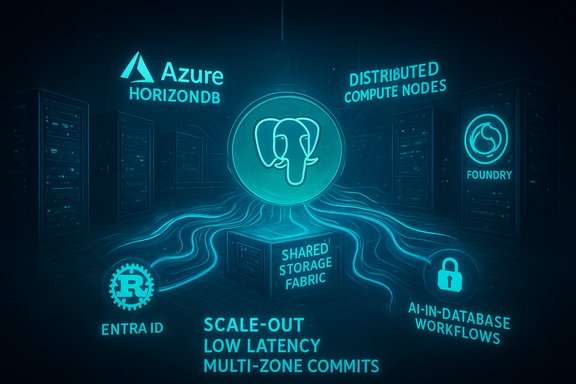
Microsoft’s messaging for HorizonDB focuses on three headline capabilities: disaggregated compute and storage for faster scaling and failover, native vector search powered by DiskANN and model management via Microsoft Foundry, and a storage engine implemented in Rust to reduce memory‑safety vulnerabilities. These claims are repeated across Microsoft collateral and early press coverage.
Caveat: measured latency depends heavily on region topology, client network, and workload patterns; the vendor’s sub‑millisecond figure should be validated under representative customer conditions.
Strengths of this choice:
Practical benefits:
Caveat: embedding model hosting and inference in the database simplifies small‑to‑medium workloads, but high‑throughput inference may still require dedicated inference clusters. Teams should measure cost and latency tradeoffs for model invocation inside HorizonDB versus decoupled inference infrastructure.
Operational notes:
For Azure‑centric enterprises, HorizonDB could deliver real value by simplifying architectures and accelerating time‑to‑production for AI features. For multi‑cloud strategies and teams dependent on specialized Postgres extensions, the tradeoffs are more nuanced: portability and extension support should weigh heavily in any adoption decision.
Source: Redmondmag.com Microsoft Previews Azure HorizonDB as Cloud Native PostgreSQL Engine -- Redmondmag.com
 Background
Azure has offered PostgreSQL as a managed service for years, but HorizonDB represents a new architectural tier: a cloud‑native, shared‑storage, scale‑out PostgreSQL service aimed at mission‑critical OLTP and AI‑adjacent workloads. The service debuted in private preview at Microsoft Ignite and is positioned alongside Azure Database for PostgreSQL and Cosmos DB for PostgreSQL rather than replacing them.Microsoft’s messaging for HorizonDB focuses on three headline capabilities: disaggregated compute and storage for faster scaling and failover, native vector search powered by DiskANN and model management via Microsoft Foundry, and a storage engine implemented in Rust to reduce memory‑safety vulnerabilities. These claims are repeated across Microsoft collateral and early press coverage.
Overview: what Microsoft claims HorizonDB delivers
HorizonDB is marketed with these principal specifications and design goals:- Scale and capacity: auto‑scaling storage up to 128 TB and scale‑out compute up to 3,072 vCores across primary and replicas.
- Performance uplift: vendor‑reported internal benchmarks of up to 3× transactional throughput versus community PostgreSQL for targeted workloads.
- Low multi‑zone commit latency: claims of sub‑millisecond multi‑zone commit latency enabled by shared, zone‑redundant storage.
- Native vector search: DiskANN‑backed vector indexing with predicate pushdown to combine vector similarity with relational filters.
- In‑database model management: integration with Microsoft Foundry to provision and invoke models from SQL workflows.
- Enterprise primitives: built‑in Entra ID integration, private endpoints, Azure Defender support, automated backups and point‑in‑time recovery.
Architecture deep dive
Disaggregated compute and shared storage
HorizonDB’s most consequential design decision is compute/storage separation. Compute nodes (primaries and multiple read replicas) attach to a shared, autoscaling storage layer rather than relying on local node disks. This enables:- Faster provisioning of replicas (no per‑node full data copy).
- Independent scaling of CPU/memory and storage capacity.
- Reduced operational complexity for read‑heavy workloads that can add replicas for throughput without duplicating storage.
Zone‑redundant blob storage and lower write latency
A key performance claim hinges on using Azure’s zone‑redundant storage. Rather than performing multiple network round‑trips between primary and a second synchronous copy, HorizonDB leverages a quorum‑acknowledged write to zone‑replicated blobs. Because replicas read from the same underlying zone‑replicated storage, Microsoft argues the traditional four‑round‑trip durable‑commit flow for synchronous replication can be shortened, which reduces write latency and accelerates failover. This is the mechanism Microsoft highlights to justify sub‑millisecond multi‑zone commit claims.Caveat: measured latency depends heavily on region topology, client network, and workload patterns; the vendor’s sub‑millisecond figure should be validated under representative customer conditions.
Sharding and partitioning for recovery and scale
HorizonDB uses sharding (logical partitioning) across storage to reduce the size of recovery operations and to distribute read I/O. Smaller partitions enable faster point‑in‑time recovery (PITR) and make background maintenance tasks less disruptive, a practical advantage for very large datasets. The shared‑storage model plus sharding aims to give architects predictable scaling without manual sharding at the application layer.A Rust‑based storage engine: why that matters
Microsoft developed parts of HorizonDB’s storage engine and some PostgreSQL extensions in Rust, citing memory safety and reduced buffer overflow risk as primary motivations. In a multi‑million‑line codebase with hundreds of developers, avoiding C/C++ buffer overflows and race conditions is a security and reliability benefit, because Rust enforces compile‑time memory‑safety guarantees. Microsoft also embedded DiskANN and other components that benefit from Rust’s safety and performance tradeoffs.Strengths of this choice:
- Security: fewer classes of exploitable memory bugs.
- Reliability: reduced risk of undefined behavior and memory corruption.
- Maintainability: clearer concurrency semantics in language design.
- The broader PostgreSQL ecosystem includes many C‑based extensions and native code. Compatibility with extensions and low‑level hooks may require adaptation, and customers should verify that required extensions are supported or have compatible implementations. This is an important migration consideration.
Vector search and AI model integration
DiskANN in the data plane
HorizonDB integrates DiskANN, Microsoft’s ANN engine, as a first‑class index type that supports predicate pushdown. This means vector similarity queries can be filtered by relational predicates before or during the ANN traversal, reducing post‑filtering overhead and improving throughput for typical RAG and recommendation queries. Embeddings can be stored and queried alongside relational data without synchronizing to an external vector store.Practical benefits:
- Simpler architecture: one service to manage rows, vectors and model results.
- Lower end‑to‑end latency: no network hops to an external vector database.
- Stronger governance: a single control plane for data lineage and access.
In‑database model lifecycle
Microsoft bundles model management and inference pathways—via integration with Microsoft Foundry—so developers can register, version and invoke models from SQL. This brings embeddings, semantic reranking and selective inference closer to the data, reducing data movement and simplifying RAG pipelines.Caveat: embedding model hosting and inference in the database simplifies small‑to‑medium workloads, but high‑throughput inference may still require dedicated inference clusters. Teams should measure cost and latency tradeoffs for model invocation inside HorizonDB versus decoupled inference infrastructure.
How HorizonDB compares with Aurora and AlloyDB
HorizonDB joins a competitive landscape where AWS Aurora and Google AlloyDB already offer managed, cloud‑native Postgres variants. High‑level contrasts:- Amazon Aurora: mature, proven production track record and deep AWS ecosystem integration. Aurora offers serverless variants and a long runway of real customer deployments. HorizonDB’s preview status means it has yet to match Aurora’s operational maturity.
- Google AlloyDB: emphasizes analytics and SQL‑native AI primitives in Google Cloud. AlloyDB AI and ScaNN integration are examples of Google’s approach to mixing analytics and vector workloads.
- Azure HorizonDB: differentiates by embedding DiskANN vector search and providing tight Foundry/Fabric integration, plus a Rust‑based engine and a shared‑storage model inspired by Azure Hyperscale design patterns. For Azure‑native customers focused on integrated AI + transactional workflows, HorizonDB is compelling—but it also increases platform lock‑in risk.
- Portability: HorizonDB’s Foundry and Fabric integrations favor Azure‑native stacks, making cross‑cloud portability more complex than a vanilla Postgres migration.
- Serverless economics: at preview, HorizonDB does not offer serverless compute; compute must be provisioned. That impacts TCO for spiky workloads compared with serverless Aurora options.
- Extension compatibility: some Postgres extensions (for example PostGIS or custom C extensions) may not work identically in a distributed or Rust‑backed storage environment; testing is essential.
Migration and evaluation checklist
For organizations evaluating HorizonDB, a staged, empirical validation plan reduces risk and delivers objective comparison data. Recommended steps:- Define representative workloads: include OLTP transactions, heavy read patterns, vector queries and concurrency levels.
- Test functional compatibility: validate SQL semantics, PL languages, triggers, stored procedures and required extensions.
- Benchmark performance: measure end‑to‑end latency, commit times, and throughput under realistic client conditions and multi‑zone scenarios. Treat vendor benchmarks as directional.
- Validate vector and model workflows: confirm index build and refresh times, predicate pushdown effectiveness, and in‑DB inference latency.
- Analyze economics: model expected costs at scale, including storage autoscaling, provisioned compute, and model inference charges.
- Plan rollback: prepare export and reconstitution strategies (vanilla Postgres + external vector DB) to limit migration risk.
Security, compliance and operations
HorizonDB ships with familiar enterprise features—Entra ID integration, private endpoints, encryption and Defender support—intended to meet enterprise governance expectations. However, compliance is region and configuration dependent: customers must verify encryption key options, audit logging, and compliance attestations (HIPAA, GDPR, FedRAMP, etc. for their target regions. Integration with Purview and Fabric may improve data governance but also ties governance artifacts to Azure services.Operational notes:
- Backups and PITR are included as managed features, but recovery time objectives (RTOs) and recovery point objectives (RPOs) must be validated for large datasets.
- Extension behavior and minor Postgres‑version differences can affect application behavior; run a compatibility sweep.
Strengths: where HorizonDB shines
- Unified data path for vectors and rows: reduces architectural complexity and data duplication for RAG, recommendations and semantic search.
- Scale‑out read capacity: shared storage allows many replicas to be provisioned without duplicating storage, simplifying scaling for read‑heavy workloads.
- Integrated model lifecycle: Foundry integration reduces friction for in‑DB inference and embedding generation.
- Security advantages from Rust: reduced memory‑safety vulnerabilities in the storage engine improves long‑term reliability.
Risks and open questions
- Vendor benchmark caution: the “up to 3×” throughput and sub‑millisecond commit claims come from vendor testing; independent validation with production‑like workloads is essential. Treat those claims as directional, not absolute.
- Extension compatibility: PostgreSQL’s ecosystem is vast; not all extensions will behave identically in a distributed, shared‑storage engine. Critical extensions must be verified.
- Lock‑in risk: deep integration with Foundry, Fabric and VS Code tooling accelerates adoption but increases migration complexity if the organization later wants to move off Azure.
- Operational maturity: HorizonDB is in private preview. SLA, GA timing, pricing, and large‑scale operational experience remain to be proven in broad production use.
Practical recommendations for IT leaders and DBAs
- Start with a representative proof of value during private preview that exercises your critical queries, extensions and vector workloads. Measure latency and throughput under load, and test multi‑zone failover behavior.
- Prioritize compatibility testing for procedural languages, triggers, and any custom extensions; include PostGIS or geospatial libraries if applicable.
- Model TCO conservatively: include provisioned compute, autoscaling storage, model inference costs and associated Fabric/Foundry usage patterns. Don’t assume serverless economics by default.
- Maintain a rollback plan: ensure you can export and reconstitute your dataset into a fallback architecture (community Postgres + vector DB) without extended downtime.
The strategic take: what HorizonDB means for the market
HorizonDB codifies a broader industry shift: databases are becoming AI platforms. Embeddings, vector search and lightweight model inference are moving into the data plane to reduce glue‑code complexity and lower latency for RAG and personalization workloads. Microsoft’s approach—pairing a Postgres‑compatible surface with DiskANN, a Rust‑based engine and integrated model management—may reshape how enterprises architect operational AI systems on Azure.For Azure‑centric enterprises, HorizonDB could deliver real value by simplifying architectures and accelerating time‑to‑production for AI features. For multi‑cloud strategies and teams dependent on specialized Postgres extensions, the tradeoffs are more nuanced: portability and extension support should weigh heavily in any adoption decision.
Conclusion
Azure HorizonDB is an ambitious move by Microsoft to fuse the relational familiarity of PostgreSQL with cloud‑native scale, native vector search and in‑database model management. Its shared storage architecture, Rust‑based storage engine and DiskANN integration reflect thoughtful engineering choices designed to reduce operational friction and accelerate AI workflows. The private preview shows promise, but the most important claims—3× throughput and sub‑millisecond multi‑zone commits—are vendor‑reported and require independent validation under real‑world workloads. Enterprises should treat HorizonDB as a strategic option for Azure‑native AI‑driven applications, pilot it with representative traffic, and verify extension compatibility, cost models and compliance posture before committing mission‑critical systems.Source: Redmondmag.com Microsoft Previews Azure HorizonDB as Cloud Native PostgreSQL Engine -- Redmondmag.com
