
Hell Let Loose: Vietnam is listed on Steam for an August 13, 2026 PC release from Expression Games and Team17, with current storefront requirements calling for Windows 10 or 11, modern six-core CPUs, and GPUs ranging from an RTX 2060 to an RTX 3070-class card. That matters because a separate published requirements table circulating this week describes a much lighter Windows 11-only target built around decade-old graphics cards. The practical takeaway for Windows players is not simply “can my PC run it?” but “which requirements sheet should I trust before spending money?” Right now, the safer answer is the official storefront, and the bigger story is how quickly PC hardware guidance can become a launch-risk signal.
The most eye-catching version of the Hell Let Loose: Vietnam PC requirements is the one that makes the game sound surprisingly forgiving. A GTX 960-class minimum and a GTX 1060-class recommendation would put the tactical shooter within reach of a huge slice of aging gaming PCs, particularly the sort of machines that have survived Windows 10, the GPU shortage, and several platform generations without a full rebuild.
That version is attractive because it feels plausible in spirit. The original Hell Let Loose built its reputation less on ray-traced spectacle than on scale, communication, map flow, and the grim friction of moving 100 players through a battlefield where one rifle round can end a push. A sequel that remains graphically modest while leaning on better onboarding, new terrain, and Vietnam-era mechanics would be an easy win for the PC community.
But the live Steam listing tells a less nostalgic story. It describes a minimum target of Windows 10 64-bit, an Intel Core i5-11600K or Ryzen 5 5600X, and an RTX 2060 or Radeon RX 5700 for 1080p at 60 frames per second. The recommended tier moves to Windows 11, an i5-12600K or Ryzen 5 7600X, and an RTX 3070 or RX 6700 XT for 1440p at 60 frames per second.
That is not a minor discrepancy. It is the difference between “your 2016 midrange card may be fine” and “this is a contemporary Unreal Engine 5 multiplayer shooter with real CPU and GPU expectations.” For WindowsForum readers, the distinction is not academic. It affects preorders, storage planning, driver updates, operating system choices, and whether a spare living-room PC becomes a viable squad machine or an expensive disappointment.
The current minimum spec is blunt but coherent. An RTX 2060 or RX 5700 target suggests that Expression Games is treating 1080p/60 as the baseline experience rather than the optimistic low-end fantasy often found in pre-release PC specs. Those GPUs also imply a rendering workload beyond the GTX 1060 era, even if the game does not require cutting-edge hardware by 2026 standards.
The CPU floor is just as telling. A Core i5-11600K or Ryzen 5 5600X is not bleeding-edge hardware, but it is comfortably beyond the quad-core age. For a 100-player multiplayer shooter, that makes sense. Frame time stability in games like this is often limited as much by simulation, networking, animation, audio, and asset streaming as by raw shader throughput.
That is why the lighter requirements table should be treated with caution unless Expression Games or Team17 explicitly explains the mismatch. It may reflect old placeholder data, a misread source, a prior build, or a reporting error. Whatever the cause, buyers should assume the storefront requirements are the ones that matter until the publisher says otherwise.
That distinction matters because Windows 10’s consumer support deadline has already reshaped the PC gaming conversation. Many capable machines remain on Windows 10 either because their owners prefer it, because a motherboard lacks supported TPM configuration, or because the machine is old enough to fall outside Microsoft’s official Windows 11 upgrade path. For those users, a Windows 11-only multiplayer shooter is not just a game requirement; it is a platform migration decision.
The storefront’s Windows 10 minimum softens that blow, at least for now. It implies that players with supported graphics hardware and sufficiently modern CPUs may still have a path into the game without upgrading the operating system immediately. But the recommendation of Windows 11 also signals where the developer expects the best-supported experience to sit.
For sysadmins and power users who double as PC gamers, this is familiar territory. The “minimum OS” gets you through the installer; the “recommended OS” often gets the longer runway for testing, driver assumptions, and support triage. If Hell Let Loose: Vietnam becomes a live-service-like multiplayer title with frequent patches, Windows 11 will likely be the environment with fewer edge-case surprises over time.
The RTX 2060 remains a meaningful line because it marks the entry point of Nvidia’s first RTX generation and a broader shift in PC games toward more modern feature assumptions. Even when ray tracing is not central, developers have increasingly optimized around newer GPU architectures, larger memory pools, and better support for contemporary APIs. AMD’s RX 5700 sits in a similar bracket as a late-2010s card that still belongs in the conversation but is not vintage hardware.
The recommended RTX 3070 or RX 6700 XT for 1440p/60 is also revealing. This is not a 4K showcase spec. It is a mid-to-upper midrange target from the previous hardware cycle, aimed at the resolution many PC gamers now treat as the sweet spot. That makes the requirement reasonable, but not trivial.
The biggest loser in this clarification is the 4GB GPU. Cards like the GTX 960 4GB and Radeon R9 380 4GB were heroic in their day, and they can still handle plenty of esports and older games. But large maps, modern textures, and dense multiplayer scenes have not been kind to 4GB VRAM. If the Steam requirements hold, those cards belong in the “try at your own risk” category, not the “minimum supported” tier.
Still, Windows users should not read “50GB available” as “50GB exactly.” Multiplayer games tend to need headroom for patch staging, shader caches, crash dumps, anti-cheat components, and temporary update files. On a nearly full SSD, a 50GB install can behave like a much larger obligation.
This is especially true on systems with smaller boot drives. A 512GB SSD that also holds Windows, productivity apps, several launchers, and a few other games can run into free-space pressure quickly. Once free space drops too low, Windows update behavior, game patching, and general system responsiveness all become less predictable.
The practical advice is simple: treat 50GB as the install footprint, not the planning target. If this is going onto an SSD you care about, leave substantially more free space than the store page asks for. A tactical shooter built around quick reactions and stable frame pacing is not where you want storage stalls making themselves known.
Kernel-level anti-cheat is common in competitive and large-scale online games because cheating has become both technically sophisticated and commercially organized. Publishers want deeper visibility into system behavior so they can catch tampering that user-mode tools may miss. Players want fair matches, and in a 50-versus-50 tactical shooter, a small number of cheaters can poison the match for dozens of people at once.
But kernel-level software is not just another overlay. It runs with privileges that make Windows enthusiasts and security-minded users understandably wary. The risk is not simply that a developer will act maliciously; it is that privileged software expands the attack surface and creates another component that must be patched, trusted, and removed cleanly.
For managed environments, this is even more important. Nobody should be installing a multiplayer shooter with kernel anti-cheat on a work machine, but the boundary between personal and professional hardware is not always as clean as IT departments wish. BYOD laptops, creator rigs, and “temporary” admin machines have a way of accumulating software that later becomes a security conversation.
Delays are not automatically bad. In multiplayer games, they can be a sign that the studio saw enough in beta feedback or internal testing to avoid shipping into a predictable backlash. Players may complain about waiting, but they complain much louder about rubber-banding, broken matchmaking, poor performance, and unstable servers.
The requirements mismatch should be viewed through that same lens. If the lighter specs were connected to an earlier public-facing materials package and the Steam page reflects a later performance target, the shift may be part of the same attempt to set more realistic expectations. It is better to tell players they need an RTX 2060 for 1080p/60 than to imply a GTX 960 will suffice and then watch the review score collapse under performance complaints.
For PC players, however, the delay also means requirements can still change. Steam’s own wording says the listed targets are subject to change. That does not mean buyers should ignore them. It means anyone close to the minimum line should wait for launch benchmarks, beta impressions, or a final developer clarification before treating a preorder discount as a hardware compatibility guarantee.
A game built around squads, officers, supply lines, garrisons, armor crews, recon, artillery, and map pressure cannot afford technical instability. When voice comms fail, frame pacing stutters, or server latency turns a careful push into a slideshow, the design suffers. These games live or die on the illusion that chaos is being produced by the battle, not by the engine.
Vietnam also changes the fantasy. Jungles, tunnels, helicopters, boats, and new movement systems imply a more vertical and dynamic battlefield than the hedgerows and town approaches that defined many of the original game’s best moments. That can be exciting, but it also creates new places for performance and readability to break down.
This is why modest hardware expectations would have been such a powerful selling point. If Expression Games could deliver a dense 100-player Vietnam shooter that ran well on old midrange PCs, that would be a significant technical achievement. The current Steam specs suggest a more conventional bargain: you get the scale and new systems, but you need a machine built for modern PC gaming.
The presence of Xbox Series S complicates the picture, but it does not magically preserve compatibility with decade-old PC hardware. Console optimization is targeted and predictable; PC compatibility is sprawling. A developer can tune aggressively for a fixed console memory layout and GPU profile while still setting a higher general-purpose PC minimum to reduce support chaos.
This is one reason Windows players sometimes see requirements that appear harsher than console specifications suggest. A console is a known box. A PC is a combinatorial explosion of CPUs, GPUs, RAM speeds, storage devices, background processes, drivers, overlays, BIOS settings, and third-party utilities. The listed PC minimum is often less about the absolute weakest hardware that can run the executable and more about the weakest hardware the studio is willing to support.
That distinction matters for community expectations. Someone will almost certainly try to run Hell Let Loose: Vietnam below spec. Some may even get acceptable results with aggressive settings and resolution scaling. But below-spec success stories are not the same as supported requirements, and they should not drive purchasing decisions for players who expect stable multiplayer performance.
The safer path is patience. Wait for final requirements, launch benchmarks, and real player reports from machines that resemble your own. That advice is boring, but boring advice has saved more PC gamers money than any amount of hype parsing.
If you are already on an RTX 3060, RTX 4060, RX 6600 XT, RX 7600, or better with a recent six-core CPU and 16GB of RAM, the current requirements suggest you should be in the conversation at 1080p, with settings doing the usual work. If you are still on a GTX 1060, RX 580, GTX 970, or 4GB-era card, the official listing is a warning flare. You may get the game to launch, but that is not the same as getting the battlefield experience the developers are targeting.
RAM is the quieter checkpoint. The lighter table mentions 12GB minimum and 16GB recommended, while the Steam listing currently omits a visible RAM line in the extracted requirements. In practice, 16GB should be treated as the sensible floor for a 2026 Windows gaming machine, particularly with launchers, Discord, browser tabs, capture tools, and anti-cheat services in the background.
The Steam listing at least provides targets: 1080p/60 at minimum, 1440p/60 at recommended. That is much better than the old habit of dumping part names into a table with no resolution, settings, frame-rate goal, or upscaling assumptions. A requirement without a performance target is a horoscope.
Still, Expression Games and Team17 would be wise to clean this up publicly. If the older GTX 960/GTX 1060 table is wrong, say so. If it reflected an earlier build, say that. If the Steam page is conservative and lower hardware may still work at reduced settings, explain the expected compromise. Silence leaves the community to reconcile contradictory tables, and communities tend to reconcile uncertainty in the least charitable way.
This matters beyond one game. PC gaming has become more technically demanding at the same time that storefront pages, press previews, beta branches, launcher ecosystems, and social posts all act as semi-official information channels. When those channels disagree, the burden falls on players to become procurement analysts. That is a bad look for any publisher asking for money before launch.
A modern GPU helps with frame rate, but a weak CPU can still turn crowded fights into uneven frame pacing. An SSD helps with loading and streaming, but a nearly full drive can sabotage updates. Windows 10 may be supported at minimum, but Windows 11 is where the developer is pointing recommended users. Easy Anti-Cheat may be normal for the genre, but it is still a privileged component on your system.
The multiplayer nature of the game amplifies every weakness. In a single-player campaign, lowering settings can be a private compromise. In Hell Let Loose, poor performance affects your ability to spot movement, respond to commands, fly or ride in vehicles, and hold angles under pressure. The minimum spec is not just about image quality; it is about whether you can participate effectively.
That is why WindowsForum readers should be more skeptical than the average preorder customer. The audience here knows that “runs” and “runs well” are different verbs. A game can satisfy the first while failing the second.
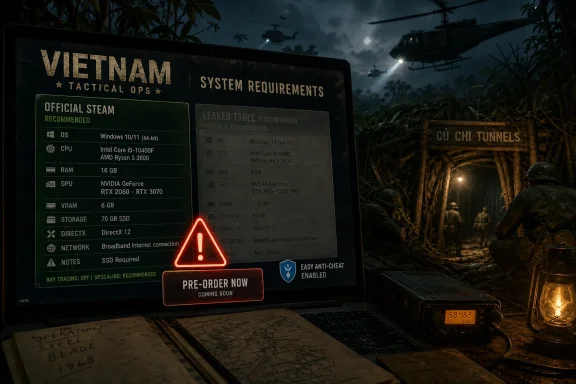 The Requirements Story Changed From Comforting to Cautionary
The most eye-catching version of the Hell Let Loose: Vietnam PC requirements is the one that makes the game sound surprisingly forgiving. A GTX 960-class minimum and a GTX 1060-class recommendation would put the tactical shooter within reach of a huge slice of aging gaming PCs, particularly the sort of machines that have survived Windows 10, the GPU shortage, and several platform generations without a full rebuild.That version is attractive because it feels plausible in spirit. The original Hell Let Loose built its reputation less on ray-traced spectacle than on scale, communication, map flow, and the grim friction of moving 100 players through a battlefield where one rifle round can end a push. A sequel that remains graphically modest while leaning on better onboarding, new terrain, and Vietnam-era mechanics would be an easy win for the PC community.
But the live Steam listing tells a less nostalgic story. It describes a minimum target of Windows 10 64-bit, an Intel Core i5-11600K or Ryzen 5 5600X, and an RTX 2060 or Radeon RX 5700 for 1080p at 60 frames per second. The recommended tier moves to Windows 11, an i5-12600K or Ryzen 5 7600X, and an RTX 3070 or RX 6700 XT for 1440p at 60 frames per second.
That is not a minor discrepancy. It is the difference between “your 2016 midrange card may be fine” and “this is a contemporary Unreal Engine 5 multiplayer shooter with real CPU and GPU expectations.” For WindowsForum readers, the distinction is not academic. It affects preorders, storage planning, driver updates, operating system choices, and whether a spare living-room PC becomes a viable squad machine or an expensive disappointment.
Steam’s Numbers Make More Sense for the Game Being Sold
The official listing describes Hell Let Loose: Vietnam as a 50-versus-50 tactical shooter with six large maps, six game modes, helicopters, patrol boats, tunnels, expanded movement, and a revamped user interface. In other words, it is not just a reskinned World War II shooter with jungle foliage. It is a network-heavy, CPU-sensitive, open-map multiplayer game with vehicles, large player counts, and enough environmental complexity to make old hardware targets suspicious.The current minimum spec is blunt but coherent. An RTX 2060 or RX 5700 target suggests that Expression Games is treating 1080p/60 as the baseline experience rather than the optimistic low-end fantasy often found in pre-release PC specs. Those GPUs also imply a rendering workload beyond the GTX 1060 era, even if the game does not require cutting-edge hardware by 2026 standards.
The CPU floor is just as telling. A Core i5-11600K or Ryzen 5 5600X is not bleeding-edge hardware, but it is comfortably beyond the quad-core age. For a 100-player multiplayer shooter, that makes sense. Frame time stability in games like this is often limited as much by simulation, networking, animation, audio, and asset streaming as by raw shader throughput.
That is why the lighter requirements table should be treated with caution unless Expression Games or Team17 explicitly explains the mismatch. It may reflect old placeholder data, a misread source, a prior build, or a reporting error. Whatever the cause, buyers should assume the storefront requirements are the ones that matter until the publisher says otherwise.
Windows 11 Is the Recommendation, Not the Whole Doorway
The Windows angle is more nuanced than the simplified requirements table suggests. One published version says Windows 11 64-bit is required at both minimum and recommended levels. The Steam listing, however, currently gives Windows 10 64-bit as the minimum operating system and Windows 11 64-bit as the recommended one.That distinction matters because Windows 10’s consumer support deadline has already reshaped the PC gaming conversation. Many capable machines remain on Windows 10 either because their owners prefer it, because a motherboard lacks supported TPM configuration, or because the machine is old enough to fall outside Microsoft’s official Windows 11 upgrade path. For those users, a Windows 11-only multiplayer shooter is not just a game requirement; it is a platform migration decision.
The storefront’s Windows 10 minimum softens that blow, at least for now. It implies that players with supported graphics hardware and sufficiently modern CPUs may still have a path into the game without upgrading the operating system immediately. But the recommendation of Windows 11 also signals where the developer expects the best-supported experience to sit.
For sysadmins and power users who double as PC gamers, this is familiar territory. The “minimum OS” gets you through the installer; the “recommended OS” often gets the longer runway for testing, driver assumptions, and support triage. If Hell Let Loose: Vietnam becomes a live-service-like multiplayer title with frequent patches, Windows 11 will likely be the environment with fewer edge-case surprises over time.
The GPU Floor Is the Real Buying Signal
A GTX 1060 recommendation would have been a love letter to old Steam survey workhorses. An RTX 2060 minimum is something else entirely. It does not make Hell Let Loose: Vietnam unusually demanding for 2026, but it does move the game out of the comfort zone for many budget and legacy systems.The RTX 2060 remains a meaningful line because it marks the entry point of Nvidia’s first RTX generation and a broader shift in PC games toward more modern feature assumptions. Even when ray tracing is not central, developers have increasingly optimized around newer GPU architectures, larger memory pools, and better support for contemporary APIs. AMD’s RX 5700 sits in a similar bracket as a late-2010s card that still belongs in the conversation but is not vintage hardware.
The recommended RTX 3070 or RX 6700 XT for 1440p/60 is also revealing. This is not a 4K showcase spec. It is a mid-to-upper midrange target from the previous hardware cycle, aimed at the resolution many PC gamers now treat as the sweet spot. That makes the requirement reasonable, but not trivial.
The biggest loser in this clarification is the 4GB GPU. Cards like the GTX 960 4GB and Radeon R9 380 4GB were heroic in their day, and they can still handle plenty of esports and older games. But large maps, modern textures, and dense multiplayer scenes have not been kind to 4GB VRAM. If the Steam requirements hold, those cards belong in the “try at your own risk” category, not the “minimum supported” tier.
Storage Is the Least Dramatic Number, but Still Worth Planning
The storage figure is less controversial. The lighter table says 52GB, while the Steam listing says 50GB available space. Either way, Hell Let Loose: Vietnam is not presenting itself as a 150GB monster. For a modern multiplayer shooter, that is almost restrained.Still, Windows users should not read “50GB available” as “50GB exactly.” Multiplayer games tend to need headroom for patch staging, shader caches, crash dumps, anti-cheat components, and temporary update files. On a nearly full SSD, a 50GB install can behave like a much larger obligation.
This is especially true on systems with smaller boot drives. A 512GB SSD that also holds Windows, productivity apps, several launchers, and a few other games can run into free-space pressure quickly. Once free space drops too low, Windows update behavior, game patching, and general system responsiveness all become less predictable.
The practical advice is simple: treat 50GB as the install footprint, not the planning target. If this is going onto an SSD you care about, leave substantially more free space than the store page asks for. A tactical shooter built around quick reactions and stable frame pacing is not where you want storage stalls making themselves known.
Anti-Cheat Makes This a Windows Platform Story, Too
The Steam listing also flags kernel-level anti-cheat, specifically Easy Anti-Cheat, and notes that it may require manual removal after uninstalling the game. That small line deserves more attention than it usually gets, because it makes Hell Let Loose: Vietnam part of a larger debate about trust, access, and multiplayer security on Windows.Kernel-level anti-cheat is common in competitive and large-scale online games because cheating has become both technically sophisticated and commercially organized. Publishers want deeper visibility into system behavior so they can catch tampering that user-mode tools may miss. Players want fair matches, and in a 50-versus-50 tactical shooter, a small number of cheaters can poison the match for dozens of people at once.
But kernel-level software is not just another overlay. It runs with privileges that make Windows enthusiasts and security-minded users understandably wary. The risk is not simply that a developer will act maliciously; it is that privileged software expands the attack surface and creates another component that must be patched, trusted, and removed cleanly.
For managed environments, this is even more important. Nobody should be installing a multiplayer shooter with kernel anti-cheat on a work machine, but the boundary between personal and professional hardware is not always as clean as IT departments wish. BYOD laptops, creator rigs, and “temporary” admin machines have a way of accumulating software that later becomes a security conversation.
The Delay Makes the Requirements Discrepancy More Interesting
The release-date trail adds another wrinkle. Hell Let Loose: Vietnam was originally announced for a June 18, 2026 digital launch on PC and current-generation consoles, with a Steam open beta planned before release. More recent reporting and the Steam listing now point to August 13, 2026, after Team17 and Expression Games delayed the game to spend more time on launch quality.Delays are not automatically bad. In multiplayer games, they can be a sign that the studio saw enough in beta feedback or internal testing to avoid shipping into a predictable backlash. Players may complain about waiting, but they complain much louder about rubber-banding, broken matchmaking, poor performance, and unstable servers.
The requirements mismatch should be viewed through that same lens. If the lighter specs were connected to an earlier public-facing materials package and the Steam page reflects a later performance target, the shift may be part of the same attempt to set more realistic expectations. It is better to tell players they need an RTX 2060 for 1080p/60 than to imply a GTX 960 will suffice and then watch the review score collapse under performance complaints.
For PC players, however, the delay also means requirements can still change. Steam’s own wording says the listed targets are subject to change. That does not mean buyers should ignore them. It means anyone close to the minimum line should wait for launch benchmarks, beta impressions, or a final developer clarification before treating a preorder discount as a hardware compatibility guarantee.
The Original Hell Let Loose Casts a Long Shadow
The first Hell Let Loose became beloved because it found a middle ground between hardcore milsim and accessible large-scale shooter. It asked for communication, patience, and map awareness without becoming impenetrable to players who did not want a second job in a virtual chain of command. That balance is fragile, and performance is part of it.A game built around squads, officers, supply lines, garrisons, armor crews, recon, artillery, and map pressure cannot afford technical instability. When voice comms fail, frame pacing stutters, or server latency turns a careful push into a slideshow, the design suffers. These games live or die on the illusion that chaos is being produced by the battle, not by the engine.
Vietnam also changes the fantasy. Jungles, tunnels, helicopters, boats, and new movement systems imply a more vertical and dynamic battlefield than the hedgerows and town approaches that defined many of the original game’s best moments. That can be exciting, but it also creates new places for performance and readability to break down.
This is why modest hardware expectations would have been such a powerful selling point. If Expression Games could deliver a dense 100-player Vietnam shooter that ran well on old midrange PCs, that would be a significant technical achievement. The current Steam specs suggest a more conventional bargain: you get the scale and new systems, but you need a machine built for modern PC gaming.
Console Parity Pushes PC Expectations Upward
Because Hell Let Loose: Vietnam is also coming to PlayStation 5 and Xbox Series X|S, the PC version is not being designed in isolation. Current-generation consoles effectively set a baseline of fast storage, Zen 2-class CPU cores, and RDNA 2-era graphics capability. That baseline has quietly raised the floor for PC games, especially as cross-generation development fades.The presence of Xbox Series S complicates the picture, but it does not magically preserve compatibility with decade-old PC hardware. Console optimization is targeted and predictable; PC compatibility is sprawling. A developer can tune aggressively for a fixed console memory layout and GPU profile while still setting a higher general-purpose PC minimum to reduce support chaos.
This is one reason Windows players sometimes see requirements that appear harsher than console specifications suggest. A console is a known box. A PC is a combinatorial explosion of CPUs, GPUs, RAM speeds, storage devices, background processes, drivers, overlays, BIOS settings, and third-party utilities. The listed PC minimum is often less about the absolute weakest hardware that can run the executable and more about the weakest hardware the studio is willing to support.
That distinction matters for community expectations. Someone will almost certainly try to run Hell Let Loose: Vietnam below spec. Some may even get acceptable results with aggressive settings and resolution scaling. But below-spec success stories are not the same as supported requirements, and they should not drive purchasing decisions for players who expect stable multiplayer performance.
Preorders Are Cheap; Bad Assumptions Are Expensive
Steam currently shows preorder pricing, including a discount window, which creates the familiar pressure to decide early. For players comfortably above the recommended spec, that decision is mostly about trust in the franchise and appetite for launch-week multiplayer turbulence. For players hovering near the minimum, it is a hardware decision disguised as a purchase button.The safer path is patience. Wait for final requirements, launch benchmarks, and real player reports from machines that resemble your own. That advice is boring, but boring advice has saved more PC gamers money than any amount of hype parsing.
If you are already on an RTX 3060, RTX 4060, RX 6600 XT, RX 7600, or better with a recent six-core CPU and 16GB of RAM, the current requirements suggest you should be in the conversation at 1080p, with settings doing the usual work. If you are still on a GTX 1060, RX 580, GTX 970, or 4GB-era card, the official listing is a warning flare. You may get the game to launch, but that is not the same as getting the battlefield experience the developers are targeting.
RAM is the quieter checkpoint. The lighter table mentions 12GB minimum and 16GB recommended, while the Steam listing currently omits a visible RAM line in the extracted requirements. In practice, 16GB should be treated as the sensible floor for a 2026 Windows gaming machine, particularly with launchers, Discord, browser tabs, capture tools, and anti-cheat services in the background.
The Real PC Requirement Is Trustworthy Communication
The problem here is not that Hell Let Loose: Vietnam appears to need stronger hardware than some players hoped. The problem is that conflicting requirements create uncertainty at precisely the moment publishers want players to preorder. PC gamers can forgive high requirements if they are honest, specific, and tied to a clear performance target.The Steam listing at least provides targets: 1080p/60 at minimum, 1440p/60 at recommended. That is much better than the old habit of dumping part names into a table with no resolution, settings, frame-rate goal, or upscaling assumptions. A requirement without a performance target is a horoscope.
Still, Expression Games and Team17 would be wise to clean this up publicly. If the older GTX 960/GTX 1060 table is wrong, say so. If it reflected an earlier build, say that. If the Steam page is conservative and lower hardware may still work at reduced settings, explain the expected compromise. Silence leaves the community to reconcile contradictory tables, and communities tend to reconcile uncertainty in the least charitable way.
This matters beyond one game. PC gaming has become more technically demanding at the same time that storefront pages, press previews, beta branches, launcher ecosystems, and social posts all act as semi-official information channels. When those channels disagree, the burden falls on players to become procurement analysts. That is a bad look for any publisher asking for money before launch.
Windows Players Should Read the Spec Sheet Like a Risk Register
The best way to approach Hell Let Loose: Vietnam is not to ask whether a single component clears a single line. Read the requirements as a risk register. CPU, GPU, OS, storage, RAM, network quality, anti-cheat tolerance, and driver support all matter more in a 100-player shooter than they do in a single-player game where you can brute-force through a rough patch.A modern GPU helps with frame rate, but a weak CPU can still turn crowded fights into uneven frame pacing. An SSD helps with loading and streaming, but a nearly full drive can sabotage updates. Windows 10 may be supported at minimum, but Windows 11 is where the developer is pointing recommended users. Easy Anti-Cheat may be normal for the genre, but it is still a privileged component on your system.
The multiplayer nature of the game amplifies every weakness. In a single-player campaign, lowering settings can be a private compromise. In Hell Let Loose, poor performance affects your ability to spot movement, respond to commands, fly or ride in vehicles, and hold angles under pressure. The minimum spec is not just about image quality; it is about whether you can participate effectively.
That is why WindowsForum readers should be more skeptical than the average preorder customer. The audience here knows that “runs” and “runs well” are different verbs. A game can satisfy the first while failing the second.
The Jungle War Comes With a Modern PC Checklist
The cleanest read of the current situation is that Hell Let Loose: Vietnam is shaping up as a modern midrange PC game, not a last-gen holdout. The fantasy of decade-old recommended hardware is appealing, but the official storefront points elsewhere. Before launch, buyers should treat the newer, higher requirements as the planning baseline.- Players should assume the Steam requirements are the safer guide unless Team17 or Expression Games directly confirms a lower table.
- Windows 10 appears to be the current minimum operating system, while Windows 11 is the recommended target for the best-supported PC experience.
- An RTX 2060 or RX 5700-class GPU should be treated as the practical 1080p/60 entry point based on the current listing.
- A GTX 1060, RX 580, or older 4GB GPU should be considered below the likely supported experience, even if the game eventually launches on such hardware.
- The 50GB storage requirement should be treated as a floor, with extra SSD headroom reserved for patches, caches, and update staging.
- Easy Anti-Cheat’s kernel-level presence makes the game a security and trust decision as well as a performance decision.
References
- Primary source: Shacknews
Published: Wed, 17 Jun 2026 04:40:00 GMT
Hell Let Loose: Vietnam minimum & recommended PC requirements | Shacknews
Check if your PC specs are up to the task of running Hell Let Loose: Vietnam.www.shacknews.com - Related coverage: gematsu.com
Hell Let Loose: Vietnam launches June 18 [Update: Delayed to August 13] - Gematsu
50-versus-50 first-person shooter Hell Let Loose: Vietnam will launch for PlayStation 5, Xbox Series, and PC via Steam and Epic Games Store on June 18…www.gematsu.com - Related coverage: gamespot.com
Hell Let Loose: Vietnam, A 50v50 Shooter, Delayed To August - GameSpot
Fans will have to wait a couple more months.www.gamespot.com - Related coverage: jeu.video
Hell Let Loose release date : Vietnam launches June 18, 2026 | JEU.VIDEO
The Hell Let Loose release date for Vietnam is June 18, 2026 on PC, PS5 and Xbox Series X|S, with a Steam open beta and official trailer.jeu.video
- Related coverage: gameinformer.com
Hell Let Loose: Vietnam Gets June Release Date, Open Beta Later This Month
The highly anticipated team-based shooter is coming to PlayStation 5, Xbox Series X/S, PC next month.gameinformer.com - Related coverage: videogamelegacy.com
Video Game Legacy Press Release #135 Hell Let Loose Vietnam - VIDEO GAME LEGACY.COM
Hell Let Loose: Vietnam Confirms June 18 Digital Release Date Physical edition launching August 4, pre-orders are now open and an Open Beta date is set for PCwww.videogamelegacy.com
- Related coverage: psu.com
Hell Let Loose Vietnam - PlayStation Universe
Stay up to date on the Hell Let Loose PS5 release date, gameplay, impressions, news, previews, reviews, videos, and wallpapers.www.psu.com - Related coverage: store.steampowered.com
Hell Let Loose: Vietnam Steam'de %10 İndirimli
Hell Let Loose: Vietnam ile savaşın dehşetini tecrübe et. 50'ye 50 oyunculu muharebelerde takım çalışması, taktikler ve yıkıcı bir cephanelikle tarihin en unutulmaz çatışmalarından birinde kilit rol oyna ve savaş meydanını kendi lehine göre şekillendir.store.steampowered.com
- Related coverage: gamesradar.com
Hell Let Loose: Vietnam devs say their new shooter isn't a replacement for the OG World War 2 game, and don't want fans to "feel like we've abandoned them in any way" | GamesRadar+
Gamescom 2025 | Hell Let Loose: Vietnam is all about giving players what they've been asking for when it launches in 2026www.gamesradar.com - Related coverage: pcgamer.com
If EA won't make another Battlefield Vietnam, Hell Let Loose: Vietnam is here to pick up the slack | PC Gamer
Helicopters and patrol boats headline the Hell Let Loose sequel.www.pcgamer.com
