
Microsoft’s loosening OpenAI exclusivity has become a live test of whether the company’s AI growth story is built on one privileged partnership or on a broader cloud, productivity, and developer platform that can survive losing its favorite shortcut. The answer matters because Microsoft has spent the last three years selling investors, customers, and administrators on a simple proposition: Azure is where enterprise AI becomes real. Khaveen Investments’ bullish framing is therefore not just another stock note; it is a useful proxy for the larger debate now facing Redmond. Microsoft can still be a winner in AI without exclusive control of OpenAI, but it now has to win the old-fashioned way — by making its platform indispensable.
The early Microsoft-OpenAI arrangement gave Redmond something no other hyperscaler could buy off the shelf: a credible claim to be the enterprise gateway to frontier AI. Azure OpenAI Service turned ChatGPT-era excitement into a procurement-friendly product, while Copilot gave Microsoft a way to inject that excitement into Windows, Microsoft 365, GitHub, Dynamics, Security, and the developer stack. For a while, the market treated that arrangement almost like a private toll road through the AI boom.
That was always an over-simple story. Microsoft’s advantage was never merely that it had access to OpenAI models; it was that it could package those models into workflows that already owned the workday. The company’s true moat sits in identity, compliance, Office documents, Teams conversations, enterprise data estates, Windows endpoints, GitHub repositories, and Azure infrastructure contracts. OpenAI gave Microsoft velocity, but Microsoft gave OpenAI distribution, capital, GPUs, and enterprise legitimacy.
The amended partnership changes the psychology of the trade more than it immediately changes the product reality. OpenAI can operate with more flexibility across clouds, and Microsoft’s model license is no longer exclusive. But Microsoft remains deeply embedded in OpenAI’s commercial history, and more importantly, it has had years to turn model access into product surface area.
That distinction is easy to miss if the only question is whether Microsoft “lost exclusivity.” Exclusivity is a contractual advantage. Platform gravity is an operational one. The first can be renegotiated in a boardroom; the second is built through thousands of customer deployments, admin controls, security defaults, billing relationships, and developer habits.
The second phase is more brutal. Customers are no longer buying demos; they are asking whether AI workloads improve margins, reduce support costs, accelerate software delivery, or create new revenue. That shift favors Microsoft in some ways and exposes it in others. Azure has the customer base and product integration to convert experiments into durable consumption, but the capital spending required to support AI remains enormous.
This is why the Seeking Alpha argument lands at an interesting moment. A robust growth outlook for Microsoft without OpenAI exclusivity is plausible, but not because exclusivity was irrelevant. It is plausible because the AI market is becoming too large, too heterogeneous, and too infrastructure-constrained for one model provider to define it. Enterprises will use OpenAI, Anthropic, Meta-derived open models, Google models, small specialized models, and domain-tuned systems. The winning cloud will be the one that orchestrates that complexity without making the customer feel like every model choice is a new architecture.
Microsoft has been preparing that pitch. Azure AI Foundry, Azure Machine Learning, Fabric, GitHub, Copilot Studio, Microsoft Entra, Purview, Defender, and the Power Platform all point toward a world where the model is one component inside a governed enterprise system. That is a better long-term business than reselling access to a single lab’s frontier models, even if it lacks the dramatic simplicity of the original OpenAI story.
Still, execution risk is real. If OpenAI’s most compelling products become just as easy to buy through AWS, Google Cloud, Oracle, or specialist AI clouds, Azure loses a unique acquisition hook. Microsoft then has to prove that its AI stack is better integrated, better governed, and more economical — not merely first in line.
The company’s Copilot strategy rests on a bet that AI assistants become more useful when they live inside the tools people already use. In Microsoft 365, that means documents, spreadsheets, meetings, email, and chat. In Windows, it means search, settings, automation, recall-style context, and eventually deeper interaction with local and cloud files. In GitHub, it means code generation, review, testing, and agentic development workflows.
The issue is that users judge these products differently from investors. Investors see annualized AI revenue, attach rates, and cloud consumption. Administrators see licensing complexity, data boundary questions, audit requirements, and support tickets. End users see whether the assistant actually saves time or merely produces another draft that must be checked, corrected, and rewritten.
This is where Microsoft’s advantage is both strongest and most fragile. No other company has as many natural insertion points into enterprise work. But that ubiquity also means disappointment travels fast. A weak Copilot answer inside Word, a clumsy Windows integration, or an unclear admin policy is not experienced as a frontier-model limitation; it is experienced as a Microsoft product problem.
The non-exclusive OpenAI era raises the bar. Microsoft can no longer rely on the implication that Copilot is uniquely blessed because of OpenAI. It must show that Copilot is uniquely useful because Microsoft understands the user’s context, permissions, files, meetings, code, and business processes better than anyone else.
AI is not a normal software cycle. Traditional Microsoft software scaled with extraordinary margins because the incremental cost of serving another Office user or Windows license was relatively low. Generative AI changes that equation. Every prompt, summary, image, code suggestion, and agentic workflow consumes compute. At scale, “software” starts looking more like an energy, semiconductor, and data-center business.
That does not mean Microsoft’s AI strategy is flawed. It means the market is right to ask tougher questions about returns. Azure growth and Microsoft Cloud revenue can look excellent while margins absorb pressure from GPUs, networking gear, data centers, power contracts, and depreciation. In that environment, revenue growth is necessary but not sufficient.
The bullish case is that Microsoft can use AI to expand average revenue per user across Microsoft 365, increase Azure consumption, defend developer mindshare through GitHub, and automate business processes through Dynamics and Power Platform. The bearish case is that customers experiment enthusiastically but standardize slowly, while infrastructure costs arrive immediately. Both can be true at different points in the cycle.
The OpenAI change sharpens this debate. If Microsoft no longer has the same exclusivity premium, investors will demand clearer evidence that AI spend translates into Microsoft-specific profit pools. The company cannot simply say it is exposed to AI demand. So are Amazon, Google, Oracle, Nvidia, CoreWeave, and a growing cast of model and infrastructure firms. Microsoft must show that demand becomes durable Microsoft revenue with Microsoft margins.
A more open AI market gives Microsoft room to present Azure as the control plane rather than the shrine. That is a healthier posture for enterprise IT. CIOs have lived through enough platform shifts to know that lock-in can be useful when it lowers complexity and dangerous when it removes leverage. A Microsoft AI stack that supports multiple models while preserving identity, policy, observability, and compliance is easier to defend than one perceived as a wrapper around OpenAI.
This matters especially in regulated sectors. Banks, governments, healthcare organizations, manufacturers, and defense contractors are unlikely to standardize every AI workload on a single external model provider. They will want model choice, private deployment options, auditability, data residency, and contractual clarity. Microsoft’s existing enterprise trust machinery gives it a strong hand, but only if the company treats model diversity as a feature rather than a concession.
There is also a developer angle. The next wave of AI applications will not be built solely by prompt boxes inside productivity suites. They will involve retrieval systems, agents, workflow automation, custom copilots, security filters, vector databases, event pipelines, and integration with business systems. Microsoft’s opportunity is to make Azure the place where those pieces are assembled, monitored, and governed.
OpenAI exclusivity helped Microsoft become synonymous with enterprise AI. Non-exclusivity may help Microsoft become less dependent on the fortunes, governance drama, and product roadmap of one AI lab. That trade-off is not painless, but it is strategically cleaner.
Windows remains Microsoft’s most visible consumer surface and one of its most important enterprise endpoints. If AI is to matter on Windows, it cannot just be a sidebar, a search box, or a marketing badge. It has to improve the daily mechanics of using a PC: finding files, understanding settings, automating repetitive work, summarizing local context safely, managing notifications, hardening security, and helping users move between apps without losing intent.
The challenge is trust. Windows has decades of accumulated baggage around telemetry, defaults, advertising, account pressure, and update behavior. An AI assistant that sees more context will be judged against that history. Microsoft can talk about privacy architecture and admin controls, but users will believe the design when the product behaves with restraint.
The OpenAI relationship once allowed Microsoft to imply that Windows AI features were riding the same wave as ChatGPT. That halo is weaker now. The Windows team has to make a more practical case: AI on the PC should be faster, more private where possible, more context-aware, and more controllable than a generic web chatbot. If that case is not made, users will keep treating Copilot as an optional cloud service rather than a reason to care about the next generation of Windows hardware.
This is where on-device AI becomes important. NPUs, local small models, and hybrid inference are not just silicon marketing points; they are the path to lower latency, lower cost, and better privacy boundaries for certain tasks. Microsoft does not need every AI interaction to run locally, but it does need a coherent division of labor between the PC and the cloud. Without that, Windows AI risks becoming a thin client for someone else’s model economics.
From that perspective, the loss of exclusivity is not automatically bad news. In fact, it may reduce concentration risk. If OpenAI can serve customers across multiple clouds, and Microsoft can support multiple models across Azure, customers have more ways to avoid being trapped by one vendor’s capacity constraints or pricing decisions. The enterprise AI market is likely to become multi-model and multi-cloud whether Microsoft likes it or not.
But flexibility also increases complexity. Security teams must understand where prompts go, where outputs are logged, how retrieval data is scoped, which models are approved, and how sensitive information is prevented from leaking into systems that should not see it. Administrators will need better policy tools, not just better demos. The more AI becomes embedded into productivity suites and business workflows, the more it resembles identity infrastructure rather than a productivity add-on.
Microsoft is well positioned here because its enterprise stack already contains many of the control points. Entra governs identity. Purview handles data governance and compliance. Defender and Sentinel cover security operations. Intune manages endpoints. Microsoft 365 contains the work graph. Azure hosts the custom workloads. The company’s opportunity is to connect those pieces into an AI governance fabric that customers can actually operate.
That is harder than shipping a chatbot. It is also more defensible. If Microsoft can make AI manageable for large organizations, its growth outlook becomes less dependent on whether OpenAI’s latest model is marginally better than a rival’s. The platform that makes AI governable may capture more durable value than the model that wins a benchmark for six months.
That competitive reality makes the end of OpenAI exclusivity less shocking than it first appears. OpenAI itself needs more compute, more distribution, and more strategic flexibility than any single partner can comfortably provide. If the AI market is as large as its boosters claim, the leading model companies will not behave like captive suppliers. They will behave like platform companies in their own right.
For Microsoft, that means the partnership can no longer substitute for differentiation. Azure has to compete on performance, availability, price, tooling, security, and customer integration. Microsoft 365 Copilot has to compete on measurable productivity gains. GitHub Copilot has to remain compelling as developer tools become more agentic and more contested. Windows has to justify its AI layer against browser-based assistants, local models, and rival ecosystems.
There is a danger here for Microsoft, but also a familiar playbook. The company has spent much of its modern history turning external platform shifts into enterprise products. It did not invent the internet, smartphones, open source, containers, or cloud-native development, and it stumbled badly in some of those transitions. But under Satya Nadella, Microsoft became skilled at meeting customers where they already were and then wrapping that heterogeneity in Microsoft control planes.
That is the AI opportunity now. Not to own every model. Not to monopolize every cloud path. Not to pretend OpenAI is a wholly contained Microsoft feature. The opportunity is to make Microsoft the safest, most useful, and most administrable way for organizations to consume AI at scale.
That is why the Seeking Alpha framing is useful but should be read with discipline. A robust growth outlook without OpenAI exclusivity is not the same as a risk-free outlook. It means Microsoft has multiple engines: Azure, Microsoft 365, LinkedIn, Dynamics, GitHub, security, gaming, Windows, and a vast partner ecosystem. It does not mean every AI dollar will earn an attractive return.
The question is whether Microsoft can sustain operating leverage while building the infrastructure for AI. In the classic cloud era, scale lowered unit costs and improved margins over time. AI may follow a similar curve, especially as inference becomes more efficient, custom silicon improves, model routing gets smarter, and smaller models take over routine tasks. But the near-term pressure is real because demand for compute is intense and hardware supply chains are expensive.
Investors should also be careful not to treat OpenAI’s independence as purely negative for Microsoft. If Microsoft no longer has to carry as much of OpenAI’s infrastructure burden alone, and if revenue-share mechanics become more favorable or capped, the economics could improve even as exclusivity declines. Strategic control and financial return are not always the same thing.
The ultimate test will be customer behavior. If enterprises keep expanding Microsoft AI consumption because Copilot, Azure AI, GitHub, and Microsoft’s governance stack solve real problems, the exclusivity debate will fade. If usage proves shallow or customers route major AI workloads elsewhere, the loss of exclusivity will be remembered as the moment Microsoft’s AI premium began to compress.
That machinery includes contracts, compliance frameworks, admin portals, identity systems, endpoint management, data governance, developer tooling, productivity apps, and partner channels. These are not the parts of AI that dominate social media. They are the parts that decide whether a technology survives contact with a 200,000-person company.
This is why Microsoft can lose exclusivity and still have a strong growth outlook. Its best customers are not buying AI in isolation. They are buying AI that can see the right SharePoint documents without seeing the wrong ones; AI that can summarize meetings without violating retention rules; AI that can help developers without leaking secrets; AI that can automate workflows without breaking audit trails; AI that can run inside the procurement, security, and compliance boundaries the organization already understands.
OpenAI remains critical to that story, but it is no longer sufficient to define it. Microsoft must become the company that makes AI operational. That may be less exciting than owning the hottest model lab outright, but it is much closer to Microsoft’s historical strengths.
There is an analogy to cloud itself. Azure did not win by being first. It won by becoming legible to enterprises already standardized on Windows Server, Active Directory, SQL Server, Office, and Microsoft’s licensing universe. AI may follow a similar path. The first wave belongs to the labs and the demos; the second wave belongs to the platforms that can survive procurement.
That means architecture choices made in 2026 should avoid unnecessary lock-in. Enterprises should design AI systems around data governance, identity, observability, and model abstraction wherever practical. The model layer will keep changing. The business processes and compliance requirements around it will change more slowly.
Microsoft customers should also press Redmond for clarity. Admins need transparent controls around data access, retention, prompt logging, model selection, regional availability, and licensing. They need to know which Copilot features use which classes of models, what can be disabled, what can be audited, and how usage maps to cost. The AI era will punish vague vendor assurances.
For Windows administrators, the key is to separate consumer AI enthusiasm from enterprise readiness. A feature may be impressive on a keynote stage and still be inappropriate for deployment without policy controls. Microsoft has the tools to make AI manageable, but customers should require those tools to be mature before enabling broad access.
The healthiest posture is neither AI maximalism nor reflexive rejection. It is controlled experimentation. Pilot the features, measure the workflows, track the costs, harden the policies, and keep an exit path. That is how enterprise IT turned cloud from a shadow-IT threat into standard infrastructure. AI will require the same discipline, only faster.
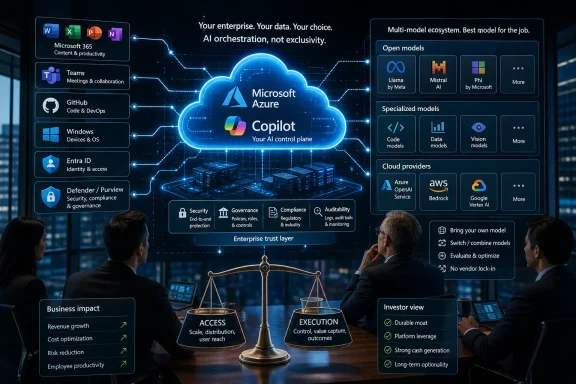 The OpenAI Halo Was Powerful, but It Was Never the Whole Business
The early Microsoft-OpenAI arrangement gave Redmond something no other hyperscaler could buy off the shelf: a credible claim to be the enterprise gateway to frontier AI. Azure OpenAI Service turned ChatGPT-era excitement into a procurement-friendly product, while Copilot gave Microsoft a way to inject that excitement into Windows, Microsoft 365, GitHub, Dynamics, Security, and the developer stack. For a while, the market treated that arrangement almost like a private toll road through the AI boom.That was always an over-simple story. Microsoft’s advantage was never merely that it had access to OpenAI models; it was that it could package those models into workflows that already owned the workday. The company’s true moat sits in identity, compliance, Office documents, Teams conversations, enterprise data estates, Windows endpoints, GitHub repositories, and Azure infrastructure contracts. OpenAI gave Microsoft velocity, but Microsoft gave OpenAI distribution, capital, GPUs, and enterprise legitimacy.
The amended partnership changes the psychology of the trade more than it immediately changes the product reality. OpenAI can operate with more flexibility across clouds, and Microsoft’s model license is no longer exclusive. But Microsoft remains deeply embedded in OpenAI’s commercial history, and more importantly, it has had years to turn model access into product surface area.
That distinction is easy to miss if the only question is whether Microsoft “lost exclusivity.” Exclusivity is a contractual advantage. Platform gravity is an operational one. The first can be renegotiated in a boardroom; the second is built through thousands of customer deployments, admin controls, security defaults, billing relationships, and developer habits.
Azure’s AI Story Is Moving From Scarcity to Execution
The first phase of generative AI in the cloud was about scarcity. Whoever had the chips, the model access, and the early enterprise narrative could command attention. Microsoft had all three, and the OpenAI relationship let Azure look less like the perennial number-two cloud and more like the place where the next platform shift was happening.The second phase is more brutal. Customers are no longer buying demos; they are asking whether AI workloads improve margins, reduce support costs, accelerate software delivery, or create new revenue. That shift favors Microsoft in some ways and exposes it in others. Azure has the customer base and product integration to convert experiments into durable consumption, but the capital spending required to support AI remains enormous.
This is why the Seeking Alpha argument lands at an interesting moment. A robust growth outlook for Microsoft without OpenAI exclusivity is plausible, but not because exclusivity was irrelevant. It is plausible because the AI market is becoming too large, too heterogeneous, and too infrastructure-constrained for one model provider to define it. Enterprises will use OpenAI, Anthropic, Meta-derived open models, Google models, small specialized models, and domain-tuned systems. The winning cloud will be the one that orchestrates that complexity without making the customer feel like every model choice is a new architecture.
Microsoft has been preparing that pitch. Azure AI Foundry, Azure Machine Learning, Fabric, GitHub, Copilot Studio, Microsoft Entra, Purview, Defender, and the Power Platform all point toward a world where the model is one component inside a governed enterprise system. That is a better long-term business than reselling access to a single lab’s frontier models, even if it lacks the dramatic simplicity of the original OpenAI story.
Still, execution risk is real. If OpenAI’s most compelling products become just as easy to buy through AWS, Google Cloud, Oracle, or specialist AI clouds, Azure loses a unique acquisition hook. Microsoft then has to prove that its AI stack is better integrated, better governed, and more economical — not merely first in line.
Copilot Is Where the Partnership Becomes a Product Test
For WindowsForum readers, the most important consequence is not whether Microsoft’s equity analysts adjust their target prices. It is whether Copilot becomes a durable layer across the Microsoft ecosystem or remains an expensive branding exercise draped over inconsistent product experiences. OpenAI exclusivity helped Microsoft move fast, but it did not automatically make Copilot indispensable.The company’s Copilot strategy rests on a bet that AI assistants become more useful when they live inside the tools people already use. In Microsoft 365, that means documents, spreadsheets, meetings, email, and chat. In Windows, it means search, settings, automation, recall-style context, and eventually deeper interaction with local and cloud files. In GitHub, it means code generation, review, testing, and agentic development workflows.
The issue is that users judge these products differently from investors. Investors see annualized AI revenue, attach rates, and cloud consumption. Administrators see licensing complexity, data boundary questions, audit requirements, and support tickets. End users see whether the assistant actually saves time or merely produces another draft that must be checked, corrected, and rewritten.
This is where Microsoft’s advantage is both strongest and most fragile. No other company has as many natural insertion points into enterprise work. But that ubiquity also means disappointment travels fast. A weak Copilot answer inside Word, a clumsy Windows integration, or an unclear admin policy is not experienced as a frontier-model limitation; it is experienced as a Microsoft product problem.
The non-exclusive OpenAI era raises the bar. Microsoft can no longer rely on the implication that Copilot is uniquely blessed because of OpenAI. It must show that Copilot is uniquely useful because Microsoft understands the user’s context, permissions, files, meetings, code, and business processes better than anyone else.
The Investment Case Now Depends Less on OpenAI and More on Operating Leverage
Khaveen’s thesis appears to lean into a broader point: Microsoft’s growth outlook can remain robust even if OpenAI’s relationship becomes less exclusive, because Microsoft’s AI opportunity is distributed across cloud, software, data, and enterprise productivity. That is a reasonable view. It is also incomplete unless paired with a hard look at cost.AI is not a normal software cycle. Traditional Microsoft software scaled with extraordinary margins because the incremental cost of serving another Office user or Windows license was relatively low. Generative AI changes that equation. Every prompt, summary, image, code suggestion, and agentic workflow consumes compute. At scale, “software” starts looking more like an energy, semiconductor, and data-center business.
That does not mean Microsoft’s AI strategy is flawed. It means the market is right to ask tougher questions about returns. Azure growth and Microsoft Cloud revenue can look excellent while margins absorb pressure from GPUs, networking gear, data centers, power contracts, and depreciation. In that environment, revenue growth is necessary but not sufficient.
The bullish case is that Microsoft can use AI to expand average revenue per user across Microsoft 365, increase Azure consumption, defend developer mindshare through GitHub, and automate business processes through Dynamics and Power Platform. The bearish case is that customers experiment enthusiastically but standardize slowly, while infrastructure costs arrive immediately. Both can be true at different points in the cycle.
The OpenAI change sharpens this debate. If Microsoft no longer has the same exclusivity premium, investors will demand clearer evidence that AI spend translates into Microsoft-specific profit pools. The company cannot simply say it is exposed to AI demand. So are Amazon, Google, Oracle, Nvidia, CoreWeave, and a growing cast of model and infrastructure firms. Microsoft must show that demand becomes durable Microsoft revenue with Microsoft margins.
The End of Exclusivity May Actually Make Microsoft’s Platform Pitch Cleaner
There is a counterintuitive upside to a less exclusive OpenAI relationship: it may force Microsoft to stop sounding like a single-model company. Enterprise customers do not want theological arguments about which frontier lab will dominate the next decade. They want optionality, governance, cost controls, data protection, and the ability to change models without rebuilding applications.A more open AI market gives Microsoft room to present Azure as the control plane rather than the shrine. That is a healthier posture for enterprise IT. CIOs have lived through enough platform shifts to know that lock-in can be useful when it lowers complexity and dangerous when it removes leverage. A Microsoft AI stack that supports multiple models while preserving identity, policy, observability, and compliance is easier to defend than one perceived as a wrapper around OpenAI.
This matters especially in regulated sectors. Banks, governments, healthcare organizations, manufacturers, and defense contractors are unlikely to standardize every AI workload on a single external model provider. They will want model choice, private deployment options, auditability, data residency, and contractual clarity. Microsoft’s existing enterprise trust machinery gives it a strong hand, but only if the company treats model diversity as a feature rather than a concession.
There is also a developer angle. The next wave of AI applications will not be built solely by prompt boxes inside productivity suites. They will involve retrieval systems, agents, workflow automation, custom copilots, security filters, vector databases, event pipelines, and integration with business systems. Microsoft’s opportunity is to make Azure the place where those pieces are assembled, monitored, and governed.
OpenAI exclusivity helped Microsoft become synonymous with enterprise AI. Non-exclusivity may help Microsoft become less dependent on the fortunes, governance drama, and product roadmap of one AI lab. That trade-off is not painless, but it is strategically cleaner.
Windows Still Needs a Better AI Argument
For Windows users, the AI boom has often felt oddly indirect. Microsoft talks about AI as a platform shift, but on the PC the experience has been uneven: Copilot branding has moved faster than deeply useful local workflows, and new hardware labels have sometimes outpaced software that ordinary users can describe. The end of OpenAI exclusivity does not change that problem. It makes solving it more urgent.Windows remains Microsoft’s most visible consumer surface and one of its most important enterprise endpoints. If AI is to matter on Windows, it cannot just be a sidebar, a search box, or a marketing badge. It has to improve the daily mechanics of using a PC: finding files, understanding settings, automating repetitive work, summarizing local context safely, managing notifications, hardening security, and helping users move between apps without losing intent.
The challenge is trust. Windows has decades of accumulated baggage around telemetry, defaults, advertising, account pressure, and update behavior. An AI assistant that sees more context will be judged against that history. Microsoft can talk about privacy architecture and admin controls, but users will believe the design when the product behaves with restraint.
The OpenAI relationship once allowed Microsoft to imply that Windows AI features were riding the same wave as ChatGPT. That halo is weaker now. The Windows team has to make a more practical case: AI on the PC should be faster, more private where possible, more context-aware, and more controllable than a generic web chatbot. If that case is not made, users will keep treating Copilot as an optional cloud service rather than a reason to care about the next generation of Windows hardware.
This is where on-device AI becomes important. NPUs, local small models, and hybrid inference are not just silicon marketing points; they are the path to lower latency, lower cost, and better privacy boundaries for certain tasks. Microsoft does not need every AI interaction to run locally, but it does need a coherent division of labor between the PC and the cloud. Without that, Windows AI risks becoming a thin client for someone else’s model economics.
Enterprise IT Will Care More About Governance Than Romance
The OpenAI-Microsoft story has always had a slightly cinematic quality: the old software giant, the fast-moving AI lab, the massive investment, the boardroom drama, the sudden acceleration of products across the stack. Enterprise IT departments are less romantic. They care about procurement, risk, uptime, compliance, exit plans, and whether a vendor’s roadmap will make next year’s architecture review more painful.From that perspective, the loss of exclusivity is not automatically bad news. In fact, it may reduce concentration risk. If OpenAI can serve customers across multiple clouds, and Microsoft can support multiple models across Azure, customers have more ways to avoid being trapped by one vendor’s capacity constraints or pricing decisions. The enterprise AI market is likely to become multi-model and multi-cloud whether Microsoft likes it or not.
But flexibility also increases complexity. Security teams must understand where prompts go, where outputs are logged, how retrieval data is scoped, which models are approved, and how sensitive information is prevented from leaking into systems that should not see it. Administrators will need better policy tools, not just better demos. The more AI becomes embedded into productivity suites and business workflows, the more it resembles identity infrastructure rather than a productivity add-on.
Microsoft is well positioned here because its enterprise stack already contains many of the control points. Entra governs identity. Purview handles data governance and compliance. Defender and Sentinel cover security operations. Intune manages endpoints. Microsoft 365 contains the work graph. Azure hosts the custom workloads. The company’s opportunity is to connect those pieces into an AI governance fabric that customers can actually operate.
That is harder than shipping a chatbot. It is also more defensible. If Microsoft can make AI manageable for large organizations, its growth outlook becomes less dependent on whether OpenAI’s latest model is marginally better than a rival’s. The platform that makes AI governable may capture more durable value than the model that wins a benchmark for six months.
The Competitive Map Has Changed Under Microsoft’s Feet
Microsoft is not defending its AI franchise in a vacuum. Amazon wants AWS to remain the default infrastructure layer for startups and enterprises. Google has its own models, TPUs, cloud platform, Android reach, Workspace footprint, and search distribution. Oracle has turned AI infrastructure into a surprising growth story. Nvidia sits at the center of the hardware economy. Anthropic, Meta, xAI, Mistral, and others ensure that model competition will not politely organize itself around Microsoft’s product plan.That competitive reality makes the end of OpenAI exclusivity less shocking than it first appears. OpenAI itself needs more compute, more distribution, and more strategic flexibility than any single partner can comfortably provide. If the AI market is as large as its boosters claim, the leading model companies will not behave like captive suppliers. They will behave like platform companies in their own right.
For Microsoft, that means the partnership can no longer substitute for differentiation. Azure has to compete on performance, availability, price, tooling, security, and customer integration. Microsoft 365 Copilot has to compete on measurable productivity gains. GitHub Copilot has to remain compelling as developer tools become more agentic and more contested. Windows has to justify its AI layer against browser-based assistants, local models, and rival ecosystems.
There is a danger here for Microsoft, but also a familiar playbook. The company has spent much of its modern history turning external platform shifts into enterprise products. It did not invent the internet, smartphones, open source, containers, or cloud-native development, and it stumbled badly in some of those transitions. But under Satya Nadella, Microsoft became skilled at meeting customers where they already were and then wrapping that heterogeneity in Microsoft control planes.
That is the AI opportunity now. Not to own every model. Not to monopolize every cloud path. Not to pretend OpenAI is a wholly contained Microsoft feature. The opportunity is to make Microsoft the safest, most useful, and most administrable way for organizations to consume AI at scale.
Wall Street’s AI Patience Is Not Infinite
The investor concern beneath all of this is simple: AI capex is front-loaded, while AI returns are still being proven. Microsoft’s reported cloud and AI growth gives bulls plenty to work with, but the spending curve is large enough that even strong numbers invite skepticism. The market is no longer satisfied with “we are investing for the future” as a complete answer.That is why the Seeking Alpha framing is useful but should be read with discipline. A robust growth outlook without OpenAI exclusivity is not the same as a risk-free outlook. It means Microsoft has multiple engines: Azure, Microsoft 365, LinkedIn, Dynamics, GitHub, security, gaming, Windows, and a vast partner ecosystem. It does not mean every AI dollar will earn an attractive return.
The question is whether Microsoft can sustain operating leverage while building the infrastructure for AI. In the classic cloud era, scale lowered unit costs and improved margins over time. AI may follow a similar curve, especially as inference becomes more efficient, custom silicon improves, model routing gets smarter, and smaller models take over routine tasks. But the near-term pressure is real because demand for compute is intense and hardware supply chains are expensive.
Investors should also be careful not to treat OpenAI’s independence as purely negative for Microsoft. If Microsoft no longer has to carry as much of OpenAI’s infrastructure burden alone, and if revenue-share mechanics become more favorable or capped, the economics could improve even as exclusivity declines. Strategic control and financial return are not always the same thing.
The ultimate test will be customer behavior. If enterprises keep expanding Microsoft AI consumption because Copilot, Azure AI, GitHub, and Microsoft’s governance stack solve real problems, the exclusivity debate will fade. If usage proves shallow or customers route major AI workloads elsewhere, the loss of exclusivity will be remembered as the moment Microsoft’s AI premium began to compress.
Redmond’s Strongest AI Moat Is Boring by Design
The most defensible version of Microsoft’s AI future is not glamorous. It is not a single model launch, a viral chatbot moment, or a stage demo that makes everyone gasp. It is a world in which AI becomes another managed enterprise layer, and Microsoft collects value because it already owns the boring machinery that makes enterprise technology deployable.That machinery includes contracts, compliance frameworks, admin portals, identity systems, endpoint management, data governance, developer tooling, productivity apps, and partner channels. These are not the parts of AI that dominate social media. They are the parts that decide whether a technology survives contact with a 200,000-person company.
This is why Microsoft can lose exclusivity and still have a strong growth outlook. Its best customers are not buying AI in isolation. They are buying AI that can see the right SharePoint documents without seeing the wrong ones; AI that can summarize meetings without violating retention rules; AI that can help developers without leaking secrets; AI that can automate workflows without breaking audit trails; AI that can run inside the procurement, security, and compliance boundaries the organization already understands.
OpenAI remains critical to that story, but it is no longer sufficient to define it. Microsoft must become the company that makes AI operational. That may be less exciting than owning the hottest model lab outright, but it is much closer to Microsoft’s historical strengths.
There is an analogy to cloud itself. Azure did not win by being first. It won by becoming legible to enterprises already standardized on Windows Server, Active Directory, SQL Server, Office, and Microsoft’s licensing universe. AI may follow a similar path. The first wave belongs to the labs and the demos; the second wave belongs to the platforms that can survive procurement.
The Practical Read for Microsoft Customers Is More Choice, Not Less Risk
For IT pros, the immediate lesson is not to panic about Copilot disappearing or Azure OpenAI collapsing. The Microsoft-OpenAI relationship remains significant, and Microsoft still has access to OpenAI technology for years. The more realistic change is that AI procurement will become more plural. Customers should expect a world where OpenAI services, Microsoft Copilot products, Azure-hosted models, AWS offerings, Google models, and specialized vendors coexist.That means architecture choices made in 2026 should avoid unnecessary lock-in. Enterprises should design AI systems around data governance, identity, observability, and model abstraction wherever practical. The model layer will keep changing. The business processes and compliance requirements around it will change more slowly.
Microsoft customers should also press Redmond for clarity. Admins need transparent controls around data access, retention, prompt logging, model selection, regional availability, and licensing. They need to know which Copilot features use which classes of models, what can be disabled, what can be audited, and how usage maps to cost. The AI era will punish vague vendor assurances.
For Windows administrators, the key is to separate consumer AI enthusiasm from enterprise readiness. A feature may be impressive on a keynote stage and still be inappropriate for deployment without policy controls. Microsoft has the tools to make AI manageable, but customers should require those tools to be mature before enabling broad access.
The healthiest posture is neither AI maximalism nor reflexive rejection. It is controlled experimentation. Pilot the features, measure the workflows, track the costs, harden the policies, and keep an exit path. That is how enterprise IT turned cloud from a shadow-IT threat into standard infrastructure. AI will require the same discipline, only faster.
The Microsoft-OpenAI Reset Leaves Five Hard Truths Behind
The cleanest reading of this moment is that Microsoft’s AI story has matured from a partnership narrative into an execution narrative. The company still has enviable assets, but the burden of proof has moved from access to outcomes. That shift should make customers more demanding and Microsoft more accountable.- Microsoft’s AI growth case no longer rests solely on exclusive OpenAI access; it rests on whether Azure, Copilot, GitHub, Microsoft 365, and the security stack can turn AI into repeatable enterprise value.
- OpenAI’s greater cloud flexibility weakens Microsoft’s simplest marketing claim, but it may also reduce concentration risk and push Azure toward a healthier multi-model platform strategy.
- Copilot is the product line where Microsoft must prove that deep workflow context matters more than chatbot novelty.
- Windows AI will need clearer local, private, and admin-controllable use cases if it is to become more than a cloud assistant attached to the operating system.
- Enterprise customers should treat model choice as temporary and governance architecture as permanent.
- Investors should watch margins, capex efficiency, and customer adoption depth as closely as headline AI revenue growth.
References
- Primary source: Seeking Alpha
Published: Wed, 17 Jun 2026 15:33:04 GMT
Microsoft: Growth Outlook Still Robust Without OpenAI Exclusivity (NASDAQ:MSFT) | Seeking Alpha
Microsoft’s OpenAI partnership update boosts gross margins and licensing flexibility. Click here to read more about the MSFT stock.seekingalpha.com - Related coverage: windowscentral.com
Investors say Microsoft inflated Copilot's success and OpenAI partnership — as Azure stumbles with growth concerns | Windows Central
Concerned investors accuse Microsoft of hiding cloud weakness while pouring billions into AI infrastructure.www.windowscentral.com - Official source: blogs.microsoft.com
Microsoft and OpenAI evolve partnership to drive the next phase of AI - The Official Microsoft Blog
We are thrilled to continue our strategic partnership with OpenAI and to partner on Stargate. Today’s announcement is complementary to what our two companies have been working on together since 2019. The key elements of our partnership remain in place for the duration of our contract through...blogs.microsoft.com - Related coverage: vaasblock.com
Microsoft-OpenAI Partnership 2026: The Non-Exclusive Era Begins
OpenAI's Azure exclusivity ended April 27, 2026. Other clouds can now license OpenAI models. What changed, what stayed, and what it means for cloud AI.www.vaasblock.com - Related coverage: tomshardware.com
Microsoft and OpenAI end exclusivity agreement, opening up potential partnerships with Amazon and Google — Microsoft will continue to receive revenue share through 2030 | Tom's Hardware
OpenAI has broken Microsoft's containment.www.tomshardware.com - Related coverage: arstechnica.com
OpenAI ends its exclusive partnership with Microsoft - Ars Technica
Amended agreement clears the way for OpenAI models to run on Amazon Bedrock.arstechnica.com
- Official source: openai.com
Comunicato congiunto di OpenAI e Microsoft | OpenAI
Microsoft e OpenAI continuano a collaborare a stretto contatto tra ricerca, ingegneria e sviluppo prodotto, forti di anni di collaborazione e risultati condivisi. openai.com
- Related coverage: forbes.com
Microsoft And OpenAI End Exclusive Partnership
The two companies are overhauling an agreement central to OpenAI’s for-profit model.www.forbes.com - Related coverage: iclarified.com
Microsoft and OpenAI Revise Partnership, Remove AGI Clause and Exclusivity - iClarified
Microsoft and OpenAI have updated their partnership, removing the AGI clause, loosening exclusivity, and revising licensing and revenue-sharing terms through 2032.www.iclarified.com - Related coverage: techradar.com
OpenAI and Microsoft make a huge change to their exclusive partnership - does this open the door for AWS to swoop in? | TechRadar
Microsoft is no longer OpenAI's exclusive cloud partnerwww.techradar.com - Related coverage: resultsense.com
Microsoft and OpenAI end exclusivity, freeing AWS and Google sales
Microsoft and OpenAI restructured their pact: exclusivity ends, the AGI escape clause is gone, and Microsoft's 20% revenue share is capped through 2030.www.resultsense.com
- Related coverage: elpais.com
Sacudida en la industria de la IA: Microsoft y OpenAI reformulan su alianza y recortan relaciones
El fabricante de Windows renuncia al derecho exclusivo para vender los modelos de inteligencia artificial de la ‘start-up’elpais.com
- Related coverage: axios.com
Anthropic lands $15 billion investment from Microsoft, Nvidia
The move is the latest in a series of deals that have all the big players partnering with one another.www.axios.com
- Official source: microsoft.com
FY26 Q3 - Performance - Investor Relations - Microsoft
FY26 Q3 - Performance - Investor Relations - Microsoftwww.microsoft.com
- Related coverage: doolpa.com
Microsoft Q3 FY26: $82.9B Revenue, Azure +40%, AI Hits $37B Run-Rate | Doolpa
Microsoft posted $82.89B Q3 FY26 revenue April 29 2026: Azure +40%, AI run-rate $37B (+123% YoY), capex $31.9B. Shares slipped 3% despite the beat.doolpa.com - Related coverage: finsee.ai
Microsoft Q3 2026 Earnings Review -
Microsoft (MSFT) Q3 2026 Earnings Review: Cloud Strength Masks Free Cash Flow Pressures from Massive AI Capex. Verdict: Bullish. finsee.ai
- Related coverage: autais.com
Microsoft Q3 FY2026 決算、AI 事業ARR $37B(前年比+123%)・Azure 成長40% | AI・DXニュース・トピックス | Autais
Microsoft が 2026年4月29日に発表した FY26 第3四半期決算で、売上 $82.9B(前年比+18%)、Azure 成長率 40%、AI 事業 ARR が $37B(前年比+123%)に到達。Microsoft 365 Copilot 有料シートは 20M 超、新規シート追加は前年比+250%。年間設備投資は $190B 規模に拡大見通し。autais.com - Related coverage: nequitco.com
Nequit V3
NeQuit Wealth equity research brief on Microsoft (NASDAQ: MSFT) Q3 FY2026 earnings. www.nequitco.com
- Related coverage: static.seekingalpha.com
