

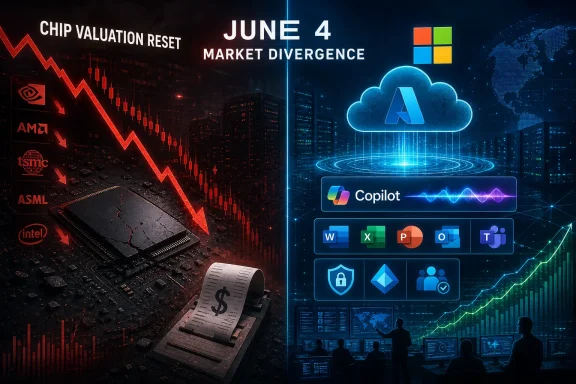
Microsoft did not suddenly become immune to the AI trade on June 4, 2026, but its stock finished higher while Broadcom and other semiconductor names sold off after investors punished chip suppliers for merely meeting, rather than expanding, already enormous AI expectations. That split is the market’s useful tells: Wall Street is starting to distinguish between companies that sell the shovels of the AI boom and companies that may collect rent on the software economy those shovels enable. Microsoft is not a risk-free way to own artificial intelligence, and its spending bill is now too large to dismiss as optional experimentation. But if the AI trade is moving from euphoria to accounting, Microsoft looks less like a momentum bet and more like the megacap that can survive the audit.
For the past two years, the simplest version of the AI investment thesis has been brutally effective: buy the companies closest to the data center bottleneck. If the world needed more accelerators, memory, networking silicon, and hyperscale infrastructure, then chip suppliers were the first and most obvious beneficiaries. The market rewarded scarcity, and scarcity lived in hardware.
That phase is not over, but it is maturing. Broadcom’s selloff was not a repudiation of AI demand in any simple sense. The company still has a major AI semiconductor business, and its long-range expectations remain large by any historical standard. The problem was that investors had come to expect acceleration on top of acceleration.
That is what makes the Microsoft comparison interesting. Microsoft rose modestly on a day when the semiconductor complex absorbed a valuation reset, not because investors decided AI chips no longer matter, but because they were reminded that the AI supply chain is not one trade. Hardware companies are exposed to order cycles, digestion periods, component constraints, and investor expectations that can move faster than customer budgets. Microsoft is exposed to all of that too, but through a thicker layer of enterprise software, cloud contracts, installed users, and recurring revenue.
The distinction matters because the market is no longer simply asking who benefits from AI. It is asking who can turn AI demand into durable revenue without having to re-win the entire thesis every quarter. That is a harder test, and it favors companies with distribution, customer lock-in, and multiple ways to monetize the same underlying platform shift.
Microsoft has those advantages. It also has one of the largest capital-spending programs in corporate history. The bullish case and the bear case now share the same evidence.
In its fiscal third quarter, which ended March 31, 2026, Microsoft said its AI business surpassed a $37 billion annual revenue run rate, up 123 percent from the prior year. That number is not small enough to wave away as investor-relations embroidery. It is already larger than many major technology companies, and it is being built into the operating fabric of Azure and Microsoft’s commercial cloud.
Total revenue rose 18 percent year over year to $82.9 billion, while earnings per share grew 23 percent. Azure and other cloud services revenue rose 40 percent, and Microsoft’s commercial remaining performance obligation reached $627 billion, almost double the prior-year level. Those figures do not make Microsoft cheap by themselves, but they do show why investors may be more comfortable owning AI through a company that already has enormous enterprise distribution.
The hardware supplier sells into the build-out. Microsoft sells into both the build-out and the usage layer that follows. A customer may buy fewer accelerators in one quarter, but still consume more cloud services, deploy more AI agents, expand identity controls, or pay for additional Microsoft 365 seats and add-ons. That does not eliminate cyclicality, but it changes the shape of it.
This is why Microsoft can be both an AI infrastructure company and a software compounder. It buys chips, rents compute, bundles intelligence into productivity tools, and gives developers a platform on which to build. The more enterprise AI shifts from pilot projects to workflows, the more Microsoft’s old strengths become relevant again.
That is the danger of the hardware side of the AI trade. When a semiconductor stock is valued as if every quarter must bring a larger backlog, a higher revenue guide, or a bigger long-term target, stability can look like disappointment. The company can remain fundamentally strong while the stock behaves as though something broke.
Microsoft is not immune to expectation risk, but its expectations are spread across more lines of business. A weaker Copilot adoption curve could be offset by Azure consumption. A period of constrained data-center capacity could still support pricing and backlog. Enterprise software renewals, Windows commercial activity, security growth, and database workloads all give the company more surfaces on which to absorb volatility.
That diversification is not glamorous, which is precisely why it may be valuable. The AI trade began as a scarcity story: who has the chips, who can package them, who can network them, who can deliver them fastest. The next phase is more likely to be a monetization story: who can persuade enterprises to pay for AI every month, inside tools they already use, with security and compliance that procurement departments understand.
Microsoft’s bet is that AI becomes less of a product category and more of a workload. Satya Nadella has framed agents as a consequential platform shift that changes the tech stack. That is CEO language, naturally, but it points to the actual strategic claim: if agents become a normal way businesses interact with software, Microsoft wants to be the control plane.
Capital expenditures in the fiscal third quarter were $31.9 billion, up sharply from a year earlier. Management has indicated that spending would climb again, with guidance pointing above $40 billion in the fiscal fourth quarter and roughly $190 billion across calendar 2026. These are not lab-budget numbers. They are the cost of trying to stay relevant in a platform war.
Microsoft argues that cloud and AI demand still exceed available capacity, and that supply constraints should persist at least through the end of the year. If true, that is a powerful defense of the spending plan. There is a large difference between building speculative data centers into a demand vacuum and racing to satisfy contracted or visible demand from customers already waiting for capacity.
Still, the margin risk is real. AI infrastructure is expensive, chips depreciate, power constraints matter, and data-center construction does not become profitable the moment a concrete pad is poured. If AI workloads do not generate enough high-margin software and cloud revenue, the same capital spending that supports the bull case can become a drag on free cash flow and investor patience.
This is where Microsoft’s old business model matters. The company can afford to spend because it has Windows, Office, server products, security, LinkedIn, gaming, and a cloud business with massive scale. Its diversification does not make the AI build-out cheap. It makes the balance sheet capable of enduring it.
Microsoft’s backlog and cloud growth are helped by demand from AI-native customers, including frontier model companies. That is strategically attractive because these customers consume enormous amounts of compute and validate Azure as a serious AI platform. But it also means some of Microsoft’s AI growth is tied to a narrow group of customers whose own economics remain young, capital-hungry, and fiercely competitive.
OpenAI is the most visible example. If its growth continues, Microsoft benefits as infrastructure partner, investor, and distribution ally. If the relationship changes, if model economics deteriorate, or if regulatory and competitive pressures reshape the frontier-model market, Microsoft’s AI narrative becomes more complicated.
This does not mean the partnership is a flaw. It may be one of the most successful strategic deals in modern technology. But it is not the same as selling another million Office seats. It is a high-conviction bet inside a company that is otherwise prized for being boringly diversified.
The safer Microsoft thesis, then, is not that everything is evenly distributed and low-risk. It is that Microsoft has enough other monetization paths to withstand turbulence in any single one. OpenAI may be the spark, but Microsoft’s ambition is to make AI revenue flow through Azure, Microsoft 365, GitHub, security, and business applications.
The appeal is obvious. Microsoft already owns the productivity layer for much of corporate life. Word, Excel, Outlook, Teams, SharePoint, PowerPoint, and the Microsoft Graph give the company context that competitors would struggle to replicate. If generative AI becomes useful in everyday office work, Microsoft has one of the best distribution channels on the planet.
But adoption is not automatic. Enterprises are cautious about data leakage, permissioning, hallucinations, compliance, and whether AI assistance saves enough time to justify premium pricing. Many organizations are still learning how to redesign processes around AI rather than simply sprinkling chatbots over existing workflows.
That is why the next stage of the Microsoft story is less about demos and more about renewal cycles. Copilot needs to become something procurement departments treat as normal enterprise software, not an experimental add-on. The bull case depends on AI moving from executive enthusiasm to line-item permanence.
For WindowsForum readers, this is where the market story becomes a workplace story. The same shift that investors debate as revenue run rate will show up for administrators as licensing complexity, identity governance, data classification, endpoint policy, and user training. Microsoft’s AI opportunity runs through the enterprise stack, which means it also runs through the people who have to secure and manage that stack.
The reported 40 percent growth in Azure and other cloud services is therefore the key number behind the market’s relative confidence. It suggests that demand is not confined to one AI product and that Microsoft is still gaining from the broader cloud migration cycle. AI may be the accelerant, but the platform is larger than AI.
That said, Azure’s strength also explains Microsoft’s capital burden. Cloud providers cannot recognize revenue from capacity they do not have. If demand exceeds supply, the company must build or lease more infrastructure, secure more chips, expand power access, and absorb the cost before the full revenue benefit appears. This is a timing mismatch investors tolerated during the first cloud transition and are now being asked to tolerate again.
The difference is that AI infrastructure may be more capital intensive and less predictable than conventional cloud expansion. Training and inference workloads have different hardware requirements, depreciation profiles, and utilization patterns. The industry is still learning where the durable profits settle: chips, clouds, models, applications, data, or some shifting mix of all five.
Microsoft’s advantage is that it plays in several layers at once. Its risk is that playing in several layers requires funding several layers at once.
That matters because the AI trade is increasingly separating companies by how much perfection is priced in. If a chip supplier sells off after reiterating a massive long-term target, the market is telling investors that expectations had outrun reality. Microsoft may still carry a premium, but its premium is supported by a broader earnings base.
The case for Microsoft as the safer megacap AI bet is not that it will outperform every semiconductor stock in a roaring AI hardware cycle. It probably will not. When capital spending accelerates and supply remains tight, hardware suppliers can produce explosive growth and equally explosive stock performance.
The case is that Microsoft may hold up better when the market starts asking harder questions. How recurring is the revenue? How diversified are the customers? How much of the AI opportunity attaches to existing enterprise relationships? How much spending is required to generate the next dollar of growth? How exposed is the stock to one guidance line?
On those questions, Microsoft looks sturdier than many AI hardware names. Not invulnerable. Sturdier.
Microsoft is positioned precisely because it already sells those things. That is why its AI monetization path may be more durable than a narrow hardware cycle. It can attach AI to existing contracts, bundle it into familiar platforms, and make adoption feel like an extension of the Microsoft estate rather than a new vendor revolution.
For sysadmins, that also means AI will arrive less as a dramatic new product and more as a creeping expansion of the Microsoft control plane. Copilot settings, audit logs, sensitivity labels, tenant configuration, conditional access, data residency, and endpoint readiness will become part of the normal operating burden. The AI boom will not just live in data centers. It will live in admin portals.
That is where Microsoft’s advantage becomes a form of pressure. Enterprises may choose Microsoft because integration reduces risk, but integration also deepens dependency. The same convenience that makes Microsoft a safer investment can make it harder for customers to resist licensing expansion or architectural lock-in.
This is the familiar Microsoft pattern, updated for the AI era. The company does not need every customer to become an AI visionary. It needs AI to become another layer of the enterprise stack that customers would rather buy from the vendor they already trust than assemble themselves from scratch.
Microsoft’s latest numbers give both sides ammunition. Bulls can point to the $37 billion AI run rate, Azure’s 40 percent growth, high-teens total revenue growth, faster earnings growth, and the enormous commercial backlog. Bears can point to the capex surge, cloud gross-margin pressure, dependence on scarce hardware, and concentration risk tied to large AI customers.
That is what makes the stock more interesting than a simple “safe haven” label. Microsoft is not avoiding the AI spending cycle. It is internalizing it. The company is taking hardware risk onto its own income statement and balance sheet so it can sell higher-level services to customers who do not want to manage that complexity themselves.
If that works, Microsoft becomes one of the primary toll collectors of the AI economy. If it fails, the company will still be Microsoft, but investors may decide they overpaid for growth that required too much concrete, too many GPUs, and too much patience.
The June 4 divergence was therefore less a verdict than a preview. It showed how the market may behave when AI enthusiasm becomes more selective. The companies with the most direct exposure to the hottest part of the cycle may also be the companies most vulnerable to disappointment when expectations stop rising.
 The AI Trade Is Leaving the Easy-Money Phase
For the past two years, the simplest version of the AI investment thesis has been brutally effective: buy the companies closest to the data center bottleneck. If the world needed more accelerators, memory, networking silicon, and hyperscale infrastructure, then chip suppliers were the first and most obvious beneficiaries. The market rewarded scarcity, and scarcity lived in hardware.That phase is not over, but it is maturing. Broadcom’s selloff was not a repudiation of AI demand in any simple sense. The company still has a major AI semiconductor business, and its long-range expectations remain large by any historical standard. The problem was that investors had come to expect acceleration on top of acceleration.
That is what makes the Microsoft comparison interesting. Microsoft rose modestly on a day when the semiconductor complex absorbed a valuation reset, not because investors decided AI chips no longer matter, but because they were reminded that the AI supply chain is not one trade. Hardware companies are exposed to order cycles, digestion periods, component constraints, and investor expectations that can move faster than customer budgets. Microsoft is exposed to all of that too, but through a thicker layer of enterprise software, cloud contracts, installed users, and recurring revenue.
The distinction matters because the market is no longer simply asking who benefits from AI. It is asking who can turn AI demand into durable revenue without having to re-win the entire thesis every quarter. That is a harder test, and it favors companies with distribution, customer lock-in, and multiple ways to monetize the same underlying platform shift.
Microsoft has those advantages. It also has one of the largest capital-spending programs in corporate history. The bullish case and the bear case now share the same evidence.
Microsoft Is Selling the AI Economy, Not Just AI Capacity
The most important thing about Microsoft’s AI exposure is that it does not live in one product. The company can sell AI through Azure infrastructure, through developer services, through Microsoft 365 Copilot, through Dynamics, through GitHub, through security tooling, through database and analytics services, and through its partnership ecosystem. That breadth is the difference between a company trying to sell a new category and a company trying to tax the expansion of an existing one.In its fiscal third quarter, which ended March 31, 2026, Microsoft said its AI business surpassed a $37 billion annual revenue run rate, up 123 percent from the prior year. That number is not small enough to wave away as investor-relations embroidery. It is already larger than many major technology companies, and it is being built into the operating fabric of Azure and Microsoft’s commercial cloud.
Total revenue rose 18 percent year over year to $82.9 billion, while earnings per share grew 23 percent. Azure and other cloud services revenue rose 40 percent, and Microsoft’s commercial remaining performance obligation reached $627 billion, almost double the prior-year level. Those figures do not make Microsoft cheap by themselves, but they do show why investors may be more comfortable owning AI through a company that already has enormous enterprise distribution.
The hardware supplier sells into the build-out. Microsoft sells into both the build-out and the usage layer that follows. A customer may buy fewer accelerators in one quarter, but still consume more cloud services, deploy more AI agents, expand identity controls, or pay for additional Microsoft 365 seats and add-ons. That does not eliminate cyclicality, but it changes the shape of it.
This is why Microsoft can be both an AI infrastructure company and a software compounder. It buys chips, rents compute, bundles intelligence into productivity tools, and gives developers a platform on which to build. The more enterprise AI shifts from pilot projects to workflows, the more Microsoft’s old strengths become relevant again.
The Chip Selloff Was a Valuation Event, Not an AI Funeral
The Broadcom reaction should be read carefully. Investors were not told that AI demand vanished. They were told that the next leg of growth might not exceed the story already embedded in the share price. In a market priced for heroic outcomes, that is enough to trigger a rout.That is the danger of the hardware side of the AI trade. When a semiconductor stock is valued as if every quarter must bring a larger backlog, a higher revenue guide, or a bigger long-term target, stability can look like disappointment. The company can remain fundamentally strong while the stock behaves as though something broke.
Microsoft is not immune to expectation risk, but its expectations are spread across more lines of business. A weaker Copilot adoption curve could be offset by Azure consumption. A period of constrained data-center capacity could still support pricing and backlog. Enterprise software renewals, Windows commercial activity, security growth, and database workloads all give the company more surfaces on which to absorb volatility.
That diversification is not glamorous, which is precisely why it may be valuable. The AI trade began as a scarcity story: who has the chips, who can package them, who can network them, who can deliver them fastest. The next phase is more likely to be a monetization story: who can persuade enterprises to pay for AI every month, inside tools they already use, with security and compliance that procurement departments understand.
Microsoft’s bet is that AI becomes less of a product category and more of a workload. Satya Nadella has framed agents as a consequential platform shift that changes the tech stack. That is CEO language, naturally, but it points to the actual strategic claim: if agents become a normal way businesses interact with software, Microsoft wants to be the control plane.
The Safer Bet Still Has a Very Expensive Engine Room
The word “safe” needs discipline here. Microsoft is safer than a pure AI chip momentum trade only in a relative sense. It is still making an enormous capital commitment to a market whose long-term unit economics are not yet fully visible.Capital expenditures in the fiscal third quarter were $31.9 billion, up sharply from a year earlier. Management has indicated that spending would climb again, with guidance pointing above $40 billion in the fiscal fourth quarter and roughly $190 billion across calendar 2026. These are not lab-budget numbers. They are the cost of trying to stay relevant in a platform war.
Microsoft argues that cloud and AI demand still exceed available capacity, and that supply constraints should persist at least through the end of the year. If true, that is a powerful defense of the spending plan. There is a large difference between building speculative data centers into a demand vacuum and racing to satisfy contracted or visible demand from customers already waiting for capacity.
Still, the margin risk is real. AI infrastructure is expensive, chips depreciate, power constraints matter, and data-center construction does not become profitable the moment a concrete pad is poured. If AI workloads do not generate enough high-margin software and cloud revenue, the same capital spending that supports the bull case can become a drag on free cash flow and investor patience.
This is where Microsoft’s old business model matters. The company can afford to spend because it has Windows, Office, server products, security, LinkedIn, gaming, and a cloud business with massive scale. Its diversification does not make the AI build-out cheap. It makes the balance sheet capable of enduring it.
OpenAI Is Both Microsoft’s Strategic Shortcut and Its Concentration Risk
No discussion of Microsoft as the safer AI megacap can ignore OpenAI. The partnership has given Microsoft a privileged position in the generative AI wave, helping it move faster than rivals and inject frontier-model capabilities into products that already sit on corporate desktops. It has also created a dependency that investors should not confuse with ordinary vendor exposure.Microsoft’s backlog and cloud growth are helped by demand from AI-native customers, including frontier model companies. That is strategically attractive because these customers consume enormous amounts of compute and validate Azure as a serious AI platform. But it also means some of Microsoft’s AI growth is tied to a narrow group of customers whose own economics remain young, capital-hungry, and fiercely competitive.
OpenAI is the most visible example. If its growth continues, Microsoft benefits as infrastructure partner, investor, and distribution ally. If the relationship changes, if model economics deteriorate, or if regulatory and competitive pressures reshape the frontier-model market, Microsoft’s AI narrative becomes more complicated.
This does not mean the partnership is a flaw. It may be one of the most successful strategic deals in modern technology. But it is not the same as selling another million Office seats. It is a high-conviction bet inside a company that is otherwise prized for being boringly diversified.
The safer Microsoft thesis, then, is not that everything is evenly distributed and low-risk. It is that Microsoft has enough other monetization paths to withstand turbulence in any single one. OpenAI may be the spark, but Microsoft’s ambition is to make AI revenue flow through Azure, Microsoft 365, GitHub, security, and business applications.
Copilot Is Where the Theory Has to Become a Habit
If Azure proves that Microsoft can sell AI infrastructure, Copilot has to prove that Microsoft can sell AI productivity at scale. That is a different challenge. Infrastructure demand can be concentrated among a smaller number of cloud and model customers, while Copilot’s success depends on broad adoption across enterprises that must justify new software spending seat by seat.The appeal is obvious. Microsoft already owns the productivity layer for much of corporate life. Word, Excel, Outlook, Teams, SharePoint, PowerPoint, and the Microsoft Graph give the company context that competitors would struggle to replicate. If generative AI becomes useful in everyday office work, Microsoft has one of the best distribution channels on the planet.
But adoption is not automatic. Enterprises are cautious about data leakage, permissioning, hallucinations, compliance, and whether AI assistance saves enough time to justify premium pricing. Many organizations are still learning how to redesign processes around AI rather than simply sprinkling chatbots over existing workflows.
That is why the next stage of the Microsoft story is less about demos and more about renewal cycles. Copilot needs to become something procurement departments treat as normal enterprise software, not an experimental add-on. The bull case depends on AI moving from executive enthusiasm to line-item permanence.
For WindowsForum readers, this is where the market story becomes a workplace story. The same shift that investors debate as revenue run rate will show up for administrators as licensing complexity, identity governance, data classification, endpoint policy, and user training. Microsoft’s AI opportunity runs through the enterprise stack, which means it also runs through the people who have to secure and manage that stack.
Azure Is the Center of Gravity
Azure remains the most important piece of the puzzle because it is where Microsoft’s AI ambition becomes measurable consumption. Every Copilot feature, model partnership, developer workload, and enterprise AI application ultimately needs compute, storage, networking, identity, monitoring, and security. Azure is not just a cloud business in this thesis; it is the operating base.The reported 40 percent growth in Azure and other cloud services is therefore the key number behind the market’s relative confidence. It suggests that demand is not confined to one AI product and that Microsoft is still gaining from the broader cloud migration cycle. AI may be the accelerant, but the platform is larger than AI.
That said, Azure’s strength also explains Microsoft’s capital burden. Cloud providers cannot recognize revenue from capacity they do not have. If demand exceeds supply, the company must build or lease more infrastructure, secure more chips, expand power access, and absorb the cost before the full revenue benefit appears. This is a timing mismatch investors tolerated during the first cloud transition and are now being asked to tolerate again.
The difference is that AI infrastructure may be more capital intensive and less predictable than conventional cloud expansion. Training and inference workloads have different hardware requirements, depreciation profiles, and utilization patterns. The industry is still learning where the durable profits settle: chips, clouds, models, applications, data, or some shifting mix of all five.
Microsoft’s advantage is that it plays in several layers at once. Its risk is that playing in several layers requires funding several layers at once.
Valuation Is the Argument for Patience, Not Complacency
The stock’s year-to-date decline changes the setup. Microsoft has trailed many big-tech peers in 2026, and that underperformance has pulled its valuation closer to a level that looks more defensible against its growth rate. A price-to-earnings multiple around the mid-20s is not bargain-bin territory, but it is also not the kind of extreme valuation that leaves no room for execution friction.That matters because the AI trade is increasingly separating companies by how much perfection is priced in. If a chip supplier sells off after reiterating a massive long-term target, the market is telling investors that expectations had outrun reality. Microsoft may still carry a premium, but its premium is supported by a broader earnings base.
The case for Microsoft as the safer megacap AI bet is not that it will outperform every semiconductor stock in a roaring AI hardware cycle. It probably will not. When capital spending accelerates and supply remains tight, hardware suppliers can produce explosive growth and equally explosive stock performance.
The case is that Microsoft may hold up better when the market starts asking harder questions. How recurring is the revenue? How diversified are the customers? How much of the AI opportunity attaches to existing enterprise relationships? How much spending is required to generate the next dollar of growth? How exposed is the stock to one guidance line?
On those questions, Microsoft looks sturdier than many AI hardware names. Not invulnerable. Sturdier.
Enterprise IT Will Feel the Rotation Before Retail Investors Understand It
The investor debate can sound abstract, but it maps closely to the practical choices facing IT departments. If AI spending moves from experimentation to production, enterprises will not simply buy “AI.” They will buy cloud capacity, identity integration, security controls, data governance, productivity features, developer tooling, and support agreements.Microsoft is positioned precisely because it already sells those things. That is why its AI monetization path may be more durable than a narrow hardware cycle. It can attach AI to existing contracts, bundle it into familiar platforms, and make adoption feel like an extension of the Microsoft estate rather than a new vendor revolution.
For sysadmins, that also means AI will arrive less as a dramatic new product and more as a creeping expansion of the Microsoft control plane. Copilot settings, audit logs, sensitivity labels, tenant configuration, conditional access, data residency, and endpoint readiness will become part of the normal operating burden. The AI boom will not just live in data centers. It will live in admin portals.
That is where Microsoft’s advantage becomes a form of pressure. Enterprises may choose Microsoft because integration reduces risk, but integration also deepens dependency. The same convenience that makes Microsoft a safer investment can make it harder for customers to resist licensing expansion or architectural lock-in.
This is the familiar Microsoft pattern, updated for the AI era. The company does not need every customer to become an AI visionary. It needs AI to become another layer of the enterprise stack that customers would rather buy from the vendor they already trust than assemble themselves from scratch.
The Market Is Rewarding Proof Over Poetry
There is a subtle but important change underway in AI investing. The first wave rewarded imagination. The second wave is rewarding evidence. Investors still want growth, but they increasingly want to know where the revenue is, how much capital it consumes, and whether the resulting margins can justify the build-out.Microsoft’s latest numbers give both sides ammunition. Bulls can point to the $37 billion AI run rate, Azure’s 40 percent growth, high-teens total revenue growth, faster earnings growth, and the enormous commercial backlog. Bears can point to the capex surge, cloud gross-margin pressure, dependence on scarce hardware, and concentration risk tied to large AI customers.
That is what makes the stock more interesting than a simple “safe haven” label. Microsoft is not avoiding the AI spending cycle. It is internalizing it. The company is taking hardware risk onto its own income statement and balance sheet so it can sell higher-level services to customers who do not want to manage that complexity themselves.
If that works, Microsoft becomes one of the primary toll collectors of the AI economy. If it fails, the company will still be Microsoft, but investors may decide they overpaid for growth that required too much concrete, too many GPUs, and too much patience.
The June 4 divergence was therefore less a verdict than a preview. It showed how the market may behave when AI enthusiasm becomes more selective. The companies with the most direct exposure to the hottest part of the cycle may also be the companies most vulnerable to disappointment when expectations stop rising.
The Safer AI Trade Still Comes With a Data-Center Bill
Microsoft now looks like the steadier megacap AI vehicle not because its risks are small, but because its revenue streams are broader and its enterprise position gives it more ways to turn AI demand into recurring dollars. The stock’s relative resilience during the chip selloff makes sense, but it should not be mistaken for immunity. The safer AI trade is still a trade on execution, capital discipline, and enterprise adoption.- Microsoft’s AI business is already large enough to matter to the company’s overall growth, with management describing a $37 billion annual revenue run rate in the March 2026 quarter.
- Azure remains the clearest proof point because 40 percent growth in Azure and other cloud services suggests that AI demand is feeding a broader cloud platform rather than a single product cycle.
- The semiconductor selloff showed that hardware names can be punished even when demand remains strong if valuations require constant upward revisions.
- Microsoft’s capital spending is the central risk because the company must build expensive infrastructure before investors can fully judge the returns from AI workloads.
- OpenAI and other frontier-model customers strengthen Microsoft’s AI position, but they also create concentration and dependency risks that do not exist in ordinary enterprise software.
- For Windows and enterprise IT professionals, Microsoft’s AI push will increasingly show up as licensing, governance, identity, compliance, and endpoint-management work rather than as a distant Wall Street theme.
References
- Primary source: The Motley Fool
Published: 2026-06-05T04:30:16.131824
Microsoft Held Up as AI Chips Sold Off. Is It the Safer Megacap Bet Now? | The Motley Fool
While much of the chip sector dropped sharply, the software and cloud giant barely budged -- and its diversified path to AI revenue may be the reason.www.fool.com - Related coverage: kiplinger.com
Broadcom Can't Cap Dow's 874-Point Bounce: Stock Market Today | Kiplinger
Technology was one of only two sectors not to close higher on Thursday, and it was basically all about one semiconductor stock.www.kiplinger.com - Official source: microsoft.com
Microsoft Fiscal Year 2026 Third Quarter Earnings Conference Call
www.microsoft.com
- Related coverage: investing.com
Broadcom set to shed $300 billion in value as AI results fail to impress By Reuters
Broadcom set to shed $300 billion in value as AI results fail to impresswww.investing.com - Related coverage: themarketcontext.com
Microsoft Hits $37B AI Run Rate as Azure Grows 40 Percent and Cloud Backlog Doubles to $627B (MSFT) – The Market Context
Microsoft reported $82.9 billion in Q3 fiscal 2026 revenue, up 18 percent, with the AI business hitting a $37 billion annual run rate. themarketcontext.com
- Related coverage: doolpa.com
Microsoft Q3 FY26: $82.9B Revenue, Azure +40%, AI Hits $37B Run-Rate | Doolpa
Microsoft posted $82.89B Q3 FY26 revenue April 29 2026: Azure +40%, AI run-rate $37B (+123% YoY), capex $31.9B. Shares slipped 3% despite the beat.doolpa.com
- Related coverage: techradar.com
Microsoft forced to up AI spending by $25 billion to cover hardware price rises — says it 'remains confident in the return on these investments' | TechRadar
Microsoft capex is being hit by rising priceswww.techradar.com - Related coverage: tomsguide.com
Microsoft earnings — 'You can think of agents as the new apps,' CEO Satya Nadella | Tom's Guide
Will we finally learn whether Microsoft’s big bet on AI has paid off?www.tomsguide.com - Related coverage: windowscentral.com
Everyone has an opinion on Microsoft’s spending, but the real story is what the numbers say about its position | Windows Central
Microsoft beat expectations again, but investors want proof that rising AI spending will deliver real profit down the road.www.windowscentral.com
