GitHub is reportedly turning to Amazon Web Services in June 2026 to add cloud capacity for AI-driven coding workloads, even as Microsoft continues a broader plan to move the GitHub platform more fully onto Azure by 2027. That is not a minor procurement oddity; it is a public stress fracture in the infrastructure story Microsoft wants to tell about the AI era. The company that owns Azure also owns the world’s default software collaboration platform, and the agent boom is now testing whether those two facts are operationally aligned. The answer, for the moment, appears to be: not fast enough.
For years, GitHub’s strategic value to Microsoft was easy to describe. It was the social graph of software, the center of open source gravity, and the natural front door for selling developer tools, cloud services, and eventually Copilot. The acquisition looked prescient because GitHub was where developers already lived.
The AI coding boom has changed the weight of that bet. GitHub is no longer just hosting human-written commits, pull requests, issues, and CI workflows. It is increasingly hosting the byproduct of autonomous and semi-autonomous systems that can inspect repositories, open branches, generate patches, request reviews, trigger Actions jobs, and retry failed work at machine tempo.
That shift sounds abstract until it shows up as degraded performance. GitHub’s own availability reports this spring described traffic growth driven in large part by AI-assisted and agentic development workflows. The company also acknowledged a sequence of incidents affecting pull requests, Actions, webhooks, Codespaces, Copilot code review, Copilot coding agent, and other services that now sit in the middle of modern development pipelines.
The uncomfortable lesson is that AI coding tools do not merely add users. They multiply activity. A human developer might open a pull request, wait for feedback, and return after lunch. An agent can spawn work, hit a rate limit, retry, fail a job, request another review, and continue pushing load into the same shared systems that were already under pressure.
Azure was not simply a hosting destination in this story. It was the scale answer. GitHub’s existing architecture had to move away from constrained legacy capacity and toward elastic infrastructure better suited to AI-era developer activity. In October 2025, the internal framing reportedly pointed toward a tenfold capacity expansion. By early 2026, according to reports, GitHub had concluded that ten times was not enough; the new target was closer to thirty times.
That is the part that should make every platform engineer sit up. A 30x capacity target is not a normal cloud migration. It is a redesign under load, with the plane airborne, passengers logged in, and agents in the cargo hold duplicating themselves.
GitHub’s May 2026 availability report said the company had moved 40 percent of monolith traffic to Azure, up from 8 percent in February, with Git traffic at 30 percent and repository replication at 99 percent. Those are meaningful numbers. They also underline the problem: moving a platform as large and entangled as GitHub is not the same as adding another Kubernetes cluster before the next product launch.
It does not mean Azure has failed. It does not mean GitHub is abandoning its Azure migration. It does not even necessarily mean AWS will host the core of GitHub.com. The more plausible reading is narrower and more pragmatic: certain workloads need relief now, and the fastest way to get that relief may involve more than one hyperscaler.
That still carries symbolic weight. Microsoft’s public AI posture depends on confidence that it can deliver compute at scale across OpenAI, Copilot, Azure customers, Windows features, Microsoft 365, GitHub, and internal engineering. Every one of those programs wants priority. Every one can claim strategic importance. GitHub is discovering what many cloud customers already know: even inside a hyperscaler’s empire, capacity is not infinite.
For AWS, the optics are delicious but the business logic is ordinary. Cloud customers choose regions, instances, storage tiers, network paths, and managed services based on availability and cost. If GitHub needs compute elasticity in a hurry, AWS is an obvious place to look. The fact that the customer is owned by Microsoft only makes the story more awkward, not less rational.
Agents compress those rhythms. They can work across multiple tasks at once, call APIs repeatedly, generate new branches, trigger CI, consume model inference, and involve multiple services in a single loop. A single coding request might touch Copilot, repository search, Git storage, Actions runners, pull request review systems, identity, authorization, webhooks, notifications, and third-party integrations.
That is why outages in this environment cascade in unfamiliar ways. A runner shortage is not just a CI inconvenience; it can block code review agents. A database migration on a hot table is not just a backend maintenance event; it can slow pull requests and authentication-dependent services across the platform. A routing mistake in a session API can stop Copilot cloud agent sessions from starting.
GitHub’s problem is therefore not merely “more traffic.” It is a shift in the shape of traffic. Machine-generated development work is burstier, more interconnected, more retry-prone, and more dependent on shared platform surfaces. Traditional rate limits, regional failover plans, and database isolation strategies can look adequate until an agentic workflow turns a small fault into a feedback loop.
That makes reliability a product feature. Developers may tolerate a flaky experimental agent. Enterprises will not tolerate a source control platform that becomes unpredictable because every agent rollout creates new load patterns. Security teams will not be amused if automated code changes, CI pipelines, and review workflows fail in ways that make audit trails harder to trust.
GitHub appears to understand this. Its recent engineering updates have emphasized availability before capacity, and capacity before new features. That ordering is telling. It is a quiet admission that the AI product roadmap cannot outrun the platform’s operational foundations forever.
There is a familiar pattern here for Windows administrators and enterprise IT teams. Microsoft often pushes a strategic platform vision first, then spends years hardening the operational details that make the vision survivable at scale. Windows Update, Microsoft 365, Teams, Azure AD, OneDrive, and Intune have all had versions of this story. GitHub is now living through the AI developer-platform version.
GitHub’s reported AWS move should be read in that messier tradition. Multi-cloud is expensive and operationally complicated. It creates identity, networking, observability, compliance, data movement, and cost-management problems that do not exist in quite the same way inside a single cloud. But when capacity demand is rising faster than the preferred migration path can absorb, architectural elegance loses to availability.
The interesting question is not whether multi-cloud is good in the abstract. The interesting question is which parts of GitHub can be safely spread across multiple providers without making the platform harder to reason about. Stateless workloads, burst compute, build runners, caching layers, and certain isolated services are more plausible candidates than deeply coupled database systems or latency-sensitive core paths.
GitHub’s own work to break apart its monolith and isolate shared failure points matters here. A platform cannot become meaningfully resilient across clouds if its internal dependencies still behave like a single brittle organism. Multi-cloud can reduce blast radius only if the application architecture is ready to use it.
Azure remains central to GitHub’s future. Microsoft has every reason to keep moving GitHub workloads into its own cloud: cost control, integration, telemetry, security posture, customer storytelling, and the larger AI platform flywheel. A GitHub deeply integrated with Azure, Copilot, Visual Studio Code, Microsoft Entra, and enterprise compliance products is exactly the kind of ecosystem lock-in Microsoft knows how to build.
But the calendar matters. If GitHub needs 30x capacity before the Azure migration reaches full maturity, then “Azure by 2027” is not enough on its own. Users experience outages in minutes, not roadmap quarters. Competitors exploit frustration immediately, not after the cloud migration steering committee meets.
This is where Microsoft’s problem becomes subtler than a cloud rivalry headline. The company is trying to execute one of the largest AI infrastructure expansions in corporate history while also migrating a critical developer platform, expanding Copilot, serving OpenAI-linked demand, and defending enterprise cloud share. Those goals reinforce each other strategically, but they compete for capacity operationally.
The early Copilot pitch felt simple: pay a subscription and receive a productivity boost. The agent era is less tidy. When tools can run longer tasks, invoke larger models, perform code review, generate tests, and operate in cloud sessions, usage variance explodes. One developer’s “normal day” can look like another team’s budget incident.
That creates a new governance problem for IT departments. Admins already had to manage GitHub seat licenses, Actions minutes, storage, package usage, enterprise policies, and security settings. Now they also have to think about model consumption, agent permissions, cloud runner availability, and whether automated development work is producing enough value to justify its compute appetite.
Microsoft and GitHub will likely keep tuning the knobs: quotas, credits, rate limits, model routing, enterprise controls, regional capacity, and perhaps workload-specific pricing. The industry should expect less unlimited-feeling AI and more metered AI. That is not a retreat from agents; it is the moment agents become infrastructure instead of magic.
When GitHub has incidents, the effect is not limited to open source maintainers waiting to merge a patch. CI/CD pipelines slow down. Release trains stall. Security fixes may wait. Automation built around webhooks, Actions, GitHub Apps, and repository events can fail in ways that ripple into internal operations.
The AI agent layer intensifies this dependency. Enterprises adopting coding agents need to understand where those agents run, what credentials they hold, which repositories they can touch, what Actions jobs they can trigger, and how failures are logged. An agent that cannot start a session is inconvenient. An agent that retries aggressively during a partial outage can become part of the outage’s load profile.
This is the sort of operational detail that separates a demo from a production system. The demo shows an agent fixing a bug. Production asks what happens when the agent opens fifty pull requests, half the tests fail, the runner pool is degraded, and the identity system is under pressure.
GitHub’s availability reports have become more candid because they have to be. The May report described nine incidents, including database pressure from an online schema migration, hosted runner failures in East US, Copilot cloud agent session failures after a routing change, pull request review thread failures, Actions degradation tied to account automation, and Copilot degradation caused by an upstream model provider issue. That is a complex failure landscape.
The common thread is dependency. GitHub is not one product; it is a dense mesh of source control, collaboration, CI/CD, identity, app integrations, AI services, model providers, cloud sessions, databases, storage systems, and regional compute. The more AI agents use GitHub as their workbench, the more that mesh is exercised in combinations that were previously less common.
Rebuilding that kind of platform is not glamorous. It means isolating databases, removing per-request lookups, creating stateless authentication paths, improving circuit breakers, regionally distributing traffic, rethinking migrations, and adding failover for model providers. These are the engineering investments that do not show well in keynote demos but determine whether the demos can survive Monday morning.
GitHub wants Copilot, Actions, pull requests, code review, security scanning, project management, Codespaces, and agent workflows to form one integrated environment. Cursor wants the IDE to become the agentic center of gravity. Anthropic’s Claude Code pushes power into the terminal. OpenAI’s Codex ambitions pull developers toward model-native workflows. JetBrains, Google, AWS, and others all have their own angles.
The winner will not be decided only by benchmark scores. It will be decided by trust, workflow integration, governance, cost, reliability, and whether teams can safely let agents act inside real repositories. GitHub has a huge advantage because it already hosts the work. That advantage becomes a liability if the work grows faster than the platform can handle.
This is why the AWS angle is more than corporate irony. If GitHub can use AWS capacity to stabilize agent-driven growth while Azure migration continues, Microsoft preserves the strategic position. If GitHub cannot make the platform feel reliable, developers may keep their repositories there but move more of the high-value agent workflow elsewhere.
Microsoft itself has become a bundle of overlapping dependencies. It competes with AWS, partners with OpenAI, sells Azure to enterprises, uses GitHub to reach developers, embeds Copilot across products, and must satisfy regulators and customers who want resilience rather than vendor theater. In that world, using a rival cloud can be embarrassing and necessary at the same time.
AWS, meanwhile, benefits from being the default answer to “we need capacity now.” Its pitch has always been operational breadth, global infrastructure, and the ability to absorb strange workloads at scale. If even a Microsoft-owned developer platform needs help, AWS can quietly point to the episode as proof that cloud pragmatism beats corporate symmetry.
But customers should not romanticize multi-cloud as a free resilience upgrade. Multi-cloud is not magic; it is another distributed system. The complexity tax is real, and the failure modes can be novel. The lesson is not that every enterprise should immediately spray workloads across clouds. The lesson is that the AI era rewards architectures that preserve options before the emergency arrives.
Agents change capacity planning because they change behavior. They do not simply help existing employees do the same work slightly faster. They create new loops of automated activity around code search, build systems, tests, reviews, deployments, documentation, and issue triage. Some of that work is valuable. Some of it is waste. All of it must be governed.
The next phase of AI adoption will expose organizations that treated agent rollout as a licensing decision rather than an infrastructure decision. The questions will become painfully concrete: how many concurrent agent sessions are allowed, what repositories are in scope, which models can be used, how much CI capacity agents may consume, and who pays when an automated workflow burns through a month’s budget in a day.
This is where GitHub’s pain becomes useful. It gives the rest of the industry a preview. The same forces hitting GitHub at hyperscale will hit enterprise platforms at smaller scale: shared databases, brittle integrations, insufficient rate limits, surprising retry storms, and security policies written for humans rather than autonomous workers.
Enterprises should do the same. If a critical developer platform depends on one region, one identity path, one runner pool, one model provider, or one overloaded integration, the agent era will find that weakness. Not because agents are malicious, but because they are relentless.
There is also a cultural adjustment ahead. Developers have been trained to see platform incidents as annoyances. In AI-assisted development, platform incidents can affect automated workers that are operating continuously and sometimes opaquely. Observability, approval gates, cost controls, and kill switches become first-class developer-experience features.
GitHub’s rebuild should therefore be watched less as a scandal and more as a case study. The company is trying to retrofit resilience into the platform that millions of developers now expect to serve as both source repository and AI automation hub. That is a difficult job. It is also the job every major software platform is about to face.
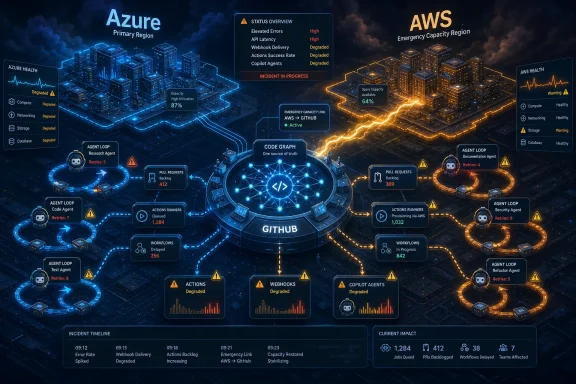 GitHub’s AI Boom Has Become an Infrastructure Problem
For years, GitHub’s strategic value to Microsoft was easy to describe. It was the social graph of software, the center of open source gravity, and the natural front door for selling developer tools, cloud services, and eventually Copilot. The acquisition looked prescient because GitHub was where developers already lived.The AI coding boom has changed the weight of that bet. GitHub is no longer just hosting human-written commits, pull requests, issues, and CI workflows. It is increasingly hosting the byproduct of autonomous and semi-autonomous systems that can inspect repositories, open branches, generate patches, request reviews, trigger Actions jobs, and retry failed work at machine tempo.
That shift sounds abstract until it shows up as degraded performance. GitHub’s own availability reports this spring described traffic growth driven in large part by AI-assisted and agentic development workflows. The company also acknowledged a sequence of incidents affecting pull requests, Actions, webhooks, Codespaces, Copilot code review, Copilot coding agent, and other services that now sit in the middle of modern development pipelines.
The uncomfortable lesson is that AI coding tools do not merely add users. They multiply activity. A human developer might open a pull request, wait for feedback, and return after lunch. An agent can spawn work, hit a rate limit, retry, fail a job, request another review, and continue pushing load into the same shared systems that were already under pressure.
Microsoft’s Azure Migration Was Supposed to Be the Clean Answer
The broad plan, as reported last year and reinforced by GitHub’s own engineering commentary, was to accelerate GitHub’s migration toward Azure. That made strategic sense. Microsoft has spent tens of billions building cloud and AI infrastructure, and GitHub is one of the crown jewels that can justify that investment.Azure was not simply a hosting destination in this story. It was the scale answer. GitHub’s existing architecture had to move away from constrained legacy capacity and toward elastic infrastructure better suited to AI-era developer activity. In October 2025, the internal framing reportedly pointed toward a tenfold capacity expansion. By early 2026, according to reports, GitHub had concluded that ten times was not enough; the new target was closer to thirty times.
That is the part that should make every platform engineer sit up. A 30x capacity target is not a normal cloud migration. It is a redesign under load, with the plane airborne, passengers logged in, and agents in the cargo hold duplicating themselves.
GitHub’s May 2026 availability report said the company had moved 40 percent of monolith traffic to Azure, up from 8 percent in February, with Git traffic at 30 percent and repository replication at 99 percent. Those are meaningful numbers. They also underline the problem: moving a platform as large and entangled as GitHub is not the same as adding another Kubernetes cluster before the next product launch.
AWS Enters as the Cloud Rival Microsoft Cannot Ignore
That is why the reported AWS involvement matters. Microsoft and Amazon compete brutally for enterprise cloud spend, AI workloads, government contracts, startup credits, developer mindshare, and infrastructure prestige. When Microsoft-owned GitHub reportedly reaches for AWS capacity, it punctures the neat narrative that every Microsoft AI workload can be absorbed by Azure on Microsoft’s preferred timeline.It does not mean Azure has failed. It does not mean GitHub is abandoning its Azure migration. It does not even necessarily mean AWS will host the core of GitHub.com. The more plausible reading is narrower and more pragmatic: certain workloads need relief now, and the fastest way to get that relief may involve more than one hyperscaler.
That still carries symbolic weight. Microsoft’s public AI posture depends on confidence that it can deliver compute at scale across OpenAI, Copilot, Azure customers, Windows features, Microsoft 365, GitHub, and internal engineering. Every one of those programs wants priority. Every one can claim strategic importance. GitHub is discovering what many cloud customers already know: even inside a hyperscaler’s empire, capacity is not infinite.
For AWS, the optics are delicious but the business logic is ordinary. Cloud customers choose regions, instances, storage tiers, network paths, and managed services based on availability and cost. If GitHub needs compute elasticity in a hurry, AWS is an obvious place to look. The fact that the customer is owned by Microsoft only makes the story more awkward, not less rational.
The Agent Era Breaks the Old Math of Developer Platforms
The older GitHub capacity model was built around human pacing. Developers clone repositories, push commits, open pull requests, wait for tests, review diffs, and merge code. Even at enormous scale, that work has rhythms shaped by sleep, meetings, review culture, and organizational friction.Agents compress those rhythms. They can work across multiple tasks at once, call APIs repeatedly, generate new branches, trigger CI, consume model inference, and involve multiple services in a single loop. A single coding request might touch Copilot, repository search, Git storage, Actions runners, pull request review systems, identity, authorization, webhooks, notifications, and third-party integrations.
That is why outages in this environment cascade in unfamiliar ways. A runner shortage is not just a CI inconvenience; it can block code review agents. A database migration on a hot table is not just a backend maintenance event; it can slow pull requests and authentication-dependent services across the platform. A routing mistake in a session API can stop Copilot cloud agent sessions from starting.
GitHub’s problem is therefore not merely “more traffic.” It is a shift in the shape of traffic. Machine-generated development work is burstier, more interconnected, more retry-prone, and more dependent on shared platform surfaces. Traditional rate limits, regional failover plans, and database isolation strategies can look adequate until an agentic workflow turns a small fault into a feedback loop.
Reliability Has Become GitHub’s Most Important AI Feature
GitHub’s competitive challenge is not just that Cursor, Claude Code, Codex, and other AI coding environments are gaining developer attention. It is that GitHub must remain the trusted substrate underneath many of them. The platform is not competing only at the chat window or IDE extension layer; it is competing as the system of record for software work.That makes reliability a product feature. Developers may tolerate a flaky experimental agent. Enterprises will not tolerate a source control platform that becomes unpredictable because every agent rollout creates new load patterns. Security teams will not be amused if automated code changes, CI pipelines, and review workflows fail in ways that make audit trails harder to trust.
GitHub appears to understand this. Its recent engineering updates have emphasized availability before capacity, and capacity before new features. That ordering is telling. It is a quiet admission that the AI product roadmap cannot outrun the platform’s operational foundations forever.
There is a familiar pattern here for Windows administrators and enterprise IT teams. Microsoft often pushes a strategic platform vision first, then spends years hardening the operational details that make the vision survivable at scale. Windows Update, Microsoft 365, Teams, Azure AD, OneDrive, and Intune have all had versions of this story. GitHub is now living through the AI developer-platform version.
Multi-Cloud Is Not a Philosophy When the Pager Is Screaming
Cloud vendors love to argue about architectural purity. Single-cloud strategies promise integration, predictable support, and lower operational complexity. Multi-cloud strategies promise bargaining power, resilience, and escape routes from regional or vendor-specific failures. In practice, most large organizations end up somewhere messier.GitHub’s reported AWS move should be read in that messier tradition. Multi-cloud is expensive and operationally complicated. It creates identity, networking, observability, compliance, data movement, and cost-management problems that do not exist in quite the same way inside a single cloud. But when capacity demand is rising faster than the preferred migration path can absorb, architectural elegance loses to availability.
The interesting question is not whether multi-cloud is good in the abstract. The interesting question is which parts of GitHub can be safely spread across multiple providers without making the platform harder to reason about. Stateless workloads, burst compute, build runners, caching layers, and certain isolated services are more plausible candidates than deeply coupled database systems or latency-sensitive core paths.
GitHub’s own work to break apart its monolith and isolate shared failure points matters here. A platform cannot become meaningfully resilient across clouds if its internal dependencies still behave like a single brittle organism. Multi-cloud can reduce blast radius only if the application architecture is ready to use it.
The Azure Question Is Now About Timing, Not Loyalty
Some will frame the AWS report as a humiliation for Microsoft. That is too simple. The more useful framing is that Microsoft’s strategic ambitions have collided with the physical and organizational limits of cloud buildout.Azure remains central to GitHub’s future. Microsoft has every reason to keep moving GitHub workloads into its own cloud: cost control, integration, telemetry, security posture, customer storytelling, and the larger AI platform flywheel. A GitHub deeply integrated with Azure, Copilot, Visual Studio Code, Microsoft Entra, and enterprise compliance products is exactly the kind of ecosystem lock-in Microsoft knows how to build.
But the calendar matters. If GitHub needs 30x capacity before the Azure migration reaches full maturity, then “Azure by 2027” is not enough on its own. Users experience outages in minutes, not roadmap quarters. Competitors exploit frustration immediately, not after the cloud migration steering committee meets.
This is where Microsoft’s problem becomes subtler than a cloud rivalry headline. The company is trying to execute one of the largest AI infrastructure expansions in corporate history while also migrating a critical developer platform, expanding Copilot, serving OpenAI-linked demand, and defending enterprise cloud share. Those goals reinforce each other strategically, but they compete for capacity operationally.
The Costs Will Not Stay Hidden From Developers
Infrastructure pressure eventually becomes pricing pressure. GitHub’s Copilot billing changes and developer complaints about fast-burning credits fit into the same broader story, even if they are not caused by the same specific capacity crunch. AI coding is expensive because inference, orchestration, storage, CI, and review automation all consume real resources.The early Copilot pitch felt simple: pay a subscription and receive a productivity boost. The agent era is less tidy. When tools can run longer tasks, invoke larger models, perform code review, generate tests, and operate in cloud sessions, usage variance explodes. One developer’s “normal day” can look like another team’s budget incident.
That creates a new governance problem for IT departments. Admins already had to manage GitHub seat licenses, Actions minutes, storage, package usage, enterprise policies, and security settings. Now they also have to think about model consumption, agent permissions, cloud runner availability, and whether automated development work is producing enough value to justify its compute appetite.
Microsoft and GitHub will likely keep tuning the knobs: quotas, credits, rate limits, model routing, enterprise controls, regional capacity, and perhaps workload-specific pricing. The industry should expect less unlimited-feeling AI and more metered AI. That is not a retreat from agents; it is the moment agents become infrastructure instead of magic.
Windows Shops Should Read This as a Platform Dependency Warning
For Windows-heavy organizations, GitHub’s scaling drama is not a distant Silicon Valley cloud story. GitHub Actions builds Windows software. GitHub hosts PowerShell modules, .NET projects, WinUI repositories, drivers, internal tools, documentation, and countless dependencies consumed by enterprise environments. Copilot and VS Code are already embedded in Microsoft’s developer workflow.When GitHub has incidents, the effect is not limited to open source maintainers waiting to merge a patch. CI/CD pipelines slow down. Release trains stall. Security fixes may wait. Automation built around webhooks, Actions, GitHub Apps, and repository events can fail in ways that ripple into internal operations.
The AI agent layer intensifies this dependency. Enterprises adopting coding agents need to understand where those agents run, what credentials they hold, which repositories they can touch, what Actions jobs they can trigger, and how failures are logged. An agent that cannot start a session is inconvenient. An agent that retries aggressively during a partial outage can become part of the outage’s load profile.
This is the sort of operational detail that separates a demo from a production system. The demo shows an agent fixing a bug. Production asks what happens when the agent opens fifty pull requests, half the tests fail, the runner pool is degraded, and the identity system is under pressure.
GitHub’s Architecture Is Being Rebuilt in Public
One reason this story resonates is that GitHub’s internal architecture is unusually visible to the people who depend on it. Developers notice when pull requests are slow. Admins notice when Actions queues stretch. Open source maintainers notice when webhooks or repository operations misbehave. Unlike many enterprise SaaS platforms, GitHub’s users are technically fluent enough to infer the shape of the failure.GitHub’s availability reports have become more candid because they have to be. The May report described nine incidents, including database pressure from an online schema migration, hosted runner failures in East US, Copilot cloud agent session failures after a routing change, pull request review thread failures, Actions degradation tied to account automation, and Copilot degradation caused by an upstream model provider issue. That is a complex failure landscape.
The common thread is dependency. GitHub is not one product; it is a dense mesh of source control, collaboration, CI/CD, identity, app integrations, AI services, model providers, cloud sessions, databases, storage systems, and regional compute. The more AI agents use GitHub as their workbench, the more that mesh is exercised in combinations that were previously less common.
Rebuilding that kind of platform is not glamorous. It means isolating databases, removing per-request lookups, creating stateless authentication paths, improving circuit breakers, regionally distributing traffic, rethinking migrations, and adding failover for model providers. These are the engineering investments that do not show well in keynote demos but determine whether the demos can survive Monday morning.
The AI Coding Race Is Really a Control-Plane Race
Most coverage of AI coding tools focuses on models: which one writes better Python, which one understands a monorepo, which one can refactor a service without hallucinating half the APIs. That matters, but it is not the whole contest. The deeper fight is over the control plane for software development.GitHub wants Copilot, Actions, pull requests, code review, security scanning, project management, Codespaces, and agent workflows to form one integrated environment. Cursor wants the IDE to become the agentic center of gravity. Anthropic’s Claude Code pushes power into the terminal. OpenAI’s Codex ambitions pull developers toward model-native workflows. JetBrains, Google, AWS, and others all have their own angles.
The winner will not be decided only by benchmark scores. It will be decided by trust, workflow integration, governance, cost, reliability, and whether teams can safely let agents act inside real repositories. GitHub has a huge advantage because it already hosts the work. That advantage becomes a liability if the work grows faster than the platform can handle.
This is why the AWS angle is more than corporate irony. If GitHub can use AWS capacity to stabilize agent-driven growth while Azure migration continues, Microsoft preserves the strategic position. If GitHub cannot make the platform feel reliable, developers may keep their repositories there but move more of the high-value agent workflow elsewhere.
The Cloud Wars Have Entered Their Awkward Alliance Phase
The old cloud-war narrative imagined neat camps: Azure shops, AWS shops, Google Cloud shops. AI has made that framing less realistic. Model availability, GPU supply, region constraints, compliance needs, latency, and cost now push workloads across provider boundaries even when executives would prefer a cleaner story.Microsoft itself has become a bundle of overlapping dependencies. It competes with AWS, partners with OpenAI, sells Azure to enterprises, uses GitHub to reach developers, embeds Copilot across products, and must satisfy regulators and customers who want resilience rather than vendor theater. In that world, using a rival cloud can be embarrassing and necessary at the same time.
AWS, meanwhile, benefits from being the default answer to “we need capacity now.” Its pitch has always been operational breadth, global infrastructure, and the ability to absorb strange workloads at scale. If even a Microsoft-owned developer platform needs help, AWS can quietly point to the episode as proof that cloud pragmatism beats corporate symmetry.
But customers should not romanticize multi-cloud as a free resilience upgrade. Multi-cloud is not magic; it is another distributed system. The complexity tax is real, and the failure modes can be novel. The lesson is not that every enterprise should immediately spray workloads across clouds. The lesson is that the AI era rewards architectures that preserve options before the emergency arrives.
The 30x Number Is a Warning Label for Everyone Else
The most important number in this story is not AWS’s market share or Azure’s migration percentage. It is 30x. If GitHub, with Microsoft’s backing and world-class engineering talent, can be surprised by the growth curve of AI coding agents, most enterprises should assume their own forecasts are soft.Agents change capacity planning because they change behavior. They do not simply help existing employees do the same work slightly faster. They create new loops of automated activity around code search, build systems, tests, reviews, deployments, documentation, and issue triage. Some of that work is valuable. Some of it is waste. All of it must be governed.
The next phase of AI adoption will expose organizations that treated agent rollout as a licensing decision rather than an infrastructure decision. The questions will become painfully concrete: how many concurrent agent sessions are allowed, what repositories are in scope, which models can be used, how much CI capacity agents may consume, and who pays when an automated workflow burns through a month’s budget in a day.
This is where GitHub’s pain becomes useful. It gives the rest of the industry a preview. The same forces hitting GitHub at hyperscale will hit enterprise platforms at smaller scale: shared databases, brittle integrations, insufficient rate limits, surprising retry storms, and security policies written for humans rather than autonomous workers.
The Practical Lesson Hiding Behind the Cloud Drama
The AWS headline is loud, but the operational lesson is quieter and more durable. GitHub is being forced to separate strategic cloud preference from immediate reliability needs. That is a mature move, even if it is awkward for Microsoft’s branding.Enterprises should do the same. If a critical developer platform depends on one region, one identity path, one runner pool, one model provider, or one overloaded integration, the agent era will find that weakness. Not because agents are malicious, but because they are relentless.
There is also a cultural adjustment ahead. Developers have been trained to see platform incidents as annoyances. In AI-assisted development, platform incidents can affect automated workers that are operating continuously and sometimes opaquely. Observability, approval gates, cost controls, and kill switches become first-class developer-experience features.
GitHub’s rebuild should therefore be watched less as a scandal and more as a case study. The company is trying to retrofit resilience into the platform that millions of developers now expect to serve as both source repository and AI automation hub. That is a difficult job. It is also the job every major software platform is about to face.
What GitHub’s AWS Detour Tells the People Running the Pipelines
GitHub’s reported turn to AWS is best understood as a capacity bridge, not a strategic divorce from Azure. For WindowsForum readers, the implications are practical rather than theatrical.- GitHub’s AI-driven growth is stressing the same services that enterprises rely on for pull requests, Actions, webhooks, code review, and automation.
- Microsoft’s Azure migration remains strategically important, but the 2027 target does not eliminate near-term reliability and capacity pressure.
- AWS involvement would be a pragmatic multi-cloud response to urgent demand, not proof that GitHub is abandoning Microsoft’s cloud.
- AI agents multiply platform load because they create automated loops around commits, tests, reviews, retries, and cloud sessions.
- IT teams should treat coding agents as infrastructure consumers with budgets, permissions, observability, and failure controls.
- The most important enterprise question is not which AI coding tool looks best in a demo, but which workflow remains reliable when agents operate at scale.
References
- Primary source: dev.ua
Published: 2026-06-17T14:30:09.539768
GitHub wants to increase its capacity 30 times due to the boom in AI agents. AWS will help the company with this | dev.ua
While GitHub continues to plan to fully migrate its platform to Microsoft Azure by 2027, current critical workloads have forced the company to make unexpected architectural changes.dev.ua - Related coverage: techradar.com
Microsoft forced to turn to AWS to boost GitHub cloud capacity following AI demand surge | TechRadar
GitHub is growing too aggressively for Azurewww.techradar.com - Related coverage: alicelabs.ai
EU AI Infrastructure and Compute Capacity Report 2026 | Alice Labs
EU AI infrastructure 2026: 6 AWS / 13 Azure / 11 GCP EU regions, 19 EuroHPC AI Factories, 76 Gigafactory EOIs, FLAP-D 3.6 GW, sovereign cloud GA. 80 sources, 32 indicators.alicelabs.ai - Related coverage: github.blog
GitHub availability report: May 2026 - The GitHub Blog
In May, we experienced nine incidents that resulted in degraded performance across GitHub services.github.blog
- Related coverage: techbytes.app
GitHub's 30x Capacity Rearchitecture [Deep Dive] [2026]
GitHub moved from a 10x to 30x capacity plan in months as pull requests hit 90M and commits 1.4B. We unpack the redesign and tradeoffs. Read now.techbytes.app - Related coverage: mejba.me
GitHub Outage April 2026: PR Bug, ElasticSearch, 30x Scaling
Inside GitHub's April 2026 availability crisis: vanishing pull requests, ElasticSearch collapse, and the 30x scaling target reshaping dev infrastructure.www.mejba.me
- Official source: github.com
- Related coverage: winbuzzer.com
AI Coding: GitHub Hit by Outages as AI Agents Flood Platform
GitHub has logged five incidents in two days as AI coding agents overwhelm its infrastructure, while Meta's token leaderboard fuels the surge. winbuzzer.com
- Related coverage: cloudcontraptions.com
GitHub Copilot in 2026: Chat, Edits, Agents, Spaces, and CLI
For more information on this course contact Cloud Contraptions LLC - https://cloudcontraptions.comwww.cloudcontraptions.com