

Fresh SWE-rebench results reported in late May 2026 show OpenAI’s GPT-5.5 ahead of Anthropic’s Claude Opus 4.8 on several practical software-engineering measures, including task completion efficiency, consistency across repeated attempts, and average token use on live GitHub-derived coding problems. The important part is not merely that one frontier model beat another. It is that the fight over AI coding agents is shifting from can it solve the bug? to how expensively, how repeatably, and how safely does it get there?
That is a more useful contest for developers and IT teams than the usual benchmark horse race. A model that solves one more issue but burns twice the context, takes twice the time, or behaves unpredictably across runs is not automatically the better engineering tool. In production, where AI coding assistants are being wired into IDEs, CI pipelines, internal developer platforms, and ticket queues, the spreadsheet matters as much as the leaderboard.
For the last two years, AI coding benchmarks have been treated like graphics-card benchmarks: a clean number, a winner, a loser, and a week of vendor triumphalism. SWE-bench, HumanEval, Terminal-Bench, and their cousins helped define the first wave of model comparison, but they also encouraged a simplistic reading of progress. If Model A scored 2.4 points above Model B, Model A was “better,” even if nobody could explain whether that margin survived real repositories, flaky tests, changing dependencies, or different agent scaffolds.
SWE-rebench is interesting because it presses on the part of the problem that synthetic coding tests often avoid. It is built around fresh GitHub issues and pull requests, and it asks models to operate more like junior maintainers than autocomplete engines. The model has to inspect a repository, infer intent from imperfect issue descriptions, edit code, and produce a result that survives tests rather than just look plausible in a chat window.
That makes the reported GPT-5.5 lead over Opus 4.8 less like a beauty contest and more like an early read on agentic software work. If GPT-5.5 Medium can solve more tasks while using fewer tokens and fewer reasoning steps than Claude Opus 4.8 High, the operational implication is straightforward: the OpenAI model is doing more with less in this specific evaluation setup. That does not settle every coding question. It does, however, put pressure on the idea that “bigger reasoning” is automatically better reasoning.
The industry has spent much of the frontier-model era celebrating visible thoughtfulness. Longer chains, more tool calls, more repository exploration, more self-checking, more generated tests: all of it feels reassuring. But software teams do not pay for reassurance. They pay for accepted patches, low regression rates, manageable review burden, and predictable cost.
Live or frequently refreshed benchmarks also attack one of the nastiest problems in AI evaluation: contamination. Static tests eventually leak into training data, documentation, tutorials, blog posts, and prompt libraries. Even when no one is cheating deliberately, the longer a benchmark sits in public, the less confidence we can have that a top score reflects general reasoning rather than memorized patterns.
SWE-rebench is not magic. It still depends on task selection, harness design, agent scaffolding, model access paths, cost assumptions, and how retries are counted. But its structure is pointed in the right direction. It treats software engineering as a situated activity rather than a puzzle-book exercise.
That distinction matters for WindowsForum readers because most organizations are not buying AI models to solve isolated algorithm questions. They are buying them to help maintain PowerShell scripts, internal web apps, deployment tooling, Azure integrations, desktop utilities, line-of-business services, and the glue code nobody wants to touch. A benchmark that approximates repository work is more relevant than one that rewards a model for writing an elegant binary tree traversal from memory.
Tokens are money, latency, context pressure, and sometimes failure surface. A model that wanders through a repository for too long can find useful clues, but it can also talk itself into changing code that should have been left alone. Extra reasoning is valuable only when it improves the odds of landing a correct patch.
This is where GPT-5.5’s reported performance becomes strategically important for OpenAI. The frontier-model race is no longer dominated by raw capability alone. Enterprise buyers care about cost per solved task because they are beginning to imagine AI agents not as occasional assistants but as always-on infrastructure. Once that happens, a few cents per request becomes a budget line.
If a company runs thousands or millions of coding-agent operations per month, the model that finishes with fewer tokens has an immediate advantage. It is easier to justify in procurement. It is easier to scale across teams. It is easier to leave enabled by default inside developer workflows. In short, efficiency is not a secondary feature. It is the difference between a demo and a deployment.
That is the right problem to solve. Anthropic’s Claude models have earned a reputation among developers for careful code reading, strong instruction following, and a willingness to handle large, messy contexts. Those strengths can turn into liabilities if the model uses too much context, spends too many steps deliberating, or becomes costly at scale.
The reported comparison with Opus 4.7 is especially telling. Opus 4.8 appears to deliver similar benchmark scores with far less token use and fewer average reasoning steps. That is exactly the kind of progress model vendors will increasingly emphasize: not a dramatic new capability, but a flatter cost curve.
For users, that kind of progress is more meaningful than it sounds. A model that performs roughly the same job at 60 or 70 percent of the previous cost changes where it can be used. It moves from executive-approved pilot to team-level utility. It can be embedded in more mundane workflows: bug triage, dependency updates, test repair, migration assistance, and code review prechecks.
That distinction deserves more attention than it will get in leaderboard screenshots. Pass@5 can reward a model that gets lucky once. Pass^5 rewards a model that repeatedly finds the solution. For production coding agents, the second behavior is often more valuable.
Software teams do not want an assistant that sometimes produces a brilliant patch and sometimes drifts into nonsense under the same prompt. They want a system that behaves predictably enough to wrap process around it. A model that can solve the same class of task reliably is easier to trust with automation, easier to monitor, and easier to escalate when it fails.
This is where benchmark culture has lagged behind deployment reality. A single best run is exciting. Repeatability is infrastructure. If GPT-5.5’s consistency gains hold up across other evaluations, that may matter more than a modest headline score increase.
Higher reasoning modes appear to encourage deeper repository exploration, additional validation, and more self-generated tests. In many cases, that is exactly what a human reviewer would want from an automated coding agent. The model is not just writing a patch; it is trying to prove to itself that the patch will survive.
The danger is that deeper reasoning can become performative. Models can spend tokens narrating uncertainty without resolving it, testing irrelevant paths, or generating elaborate changes to avoid a simpler fix. The question is not whether more reasoning helps. The question is when the marginal reasoning step is still worth buying.
This is where IT teams will need policy, not vibes. A low-risk documentation fix does not need the same reasoning budget as an authentication bug. A flaky unit test in an internal tool does not deserve the same compute as a production database migration. The useful future is not one universal reasoning setting; it is routing based on risk, complexity, and expected value.
In that world, efficiency is not merely a nicer user experience. It determines whether an organization can afford to let agents run continuously. If a model can inspect failing tests, propose fixes, and open draft PRs at predictable cost, it becomes part of the development factory. If it is too expensive or too erratic, it remains a specialist tool for carefully chosen tasks.
That is why SWE-rebench’s cost-per-problem framing matters. It converts model performance into something close to operational accounting. A resolved issue has a price. A failed attempt has a price. A retry has a price. A model that appears slightly worse in abstract capability may still win if it produces acceptable patches at much lower cost.
The inverse is also true. A model with stronger raw reasoning may be worth the premium for gnarly cross-repository refactors, security-sensitive changes, or migration work where a wrong patch is expensive. The point is not that the cheapest model wins. The point is that buyers will increasingly demand a reason to pay for the expensive one.
A strong pass@5 score suggests the model can find solutions when given enough attempts or enough reasoning room. Heavy token use suggests the model has not yet learned to reach those solutions economically. In other words, it may have the raw ingredients of a strong coding agent but not the discipline.
That is where reinforcement learning and agent-specific optimization become decisive. The next wave of coding models will not merely be trained to answer programming questions. They will be trained to navigate repositories efficiently, call tools sparingly, test strategically, and stop when the evidence is sufficient.
This is also where open and semi-open ecosystems can surprise the market. If a model is good enough and cheap enough, teams may tolerate rough edges, especially for internal workloads where privacy, customization, or deployment control matter. The frontier vendors still have the advantage, but the efficiency contest gives challengers a path into the conversation.
That is why SWE-rebench should be read as a signal, not a verdict. It tells us something about model behavior under a structured agentic setup. It does not tell us everything about security review, intellectual-property policy, dependency risk, prompt-injection exposure, or long-term maintainability.
For Windows and enterprise administrators, the same caution applies to AI-assisted scripting and infrastructure automation. A model that edits application code well may still make dangerous assumptions in PowerShell, Group Policy, Intune configuration, Azure permissions, or endpoint hardening. Coding capability is not the same as operational judgment.
The most mature organizations will treat these tools like powerful junior engineers with unusual memory and no accountability. They will be allowed to propose. They will be monitored when acting. They will be constrained in production environments. And their output will be measured not only by accepted patches but by downstream incidents.
The buyer’s interpretation should be more granular. A model that wins on SWE-rebench Medium settings may not be the best choice for every codebase, language, framework, or agent harness. A model that looks expensive on average may be cost-effective for hard tasks if it avoids retries. A model that performs well in an official benchmark may behave differently inside Cursor, GitHub Copilot-style workflows, Claude Code, custom agents, or internal tools.
This is the lesson many teams learned from cloud migration and are now relearning with AI. Published pricing is not the bill. Published performance is not the deployment. The real cost emerges from workload shape, caching behavior, retry policy, context size, latency tolerance, and human review time.
The smart move is not to crown a universal winner. It is to build an evaluation harness that resembles your own work. Feed models real bugs from your repositories, apply your coding standards, run your tests, measure human review effort, and track failures after merge. Only then does the leaderboard become useful rather than decorative.
That shift will be uncomfortable for vendors because it makes marketing harder. It will be healthy for customers because it makes procurement more honest. The best AI coding strategy will look less like choosing a religion and more like choosing a build matrix.
That is a more useful contest for developers and IT teams than the usual benchmark horse race. A model that solves one more issue but burns twice the context, takes twice the time, or behaves unpredictably across runs is not automatically the better engineering tool. In production, where AI coding assistants are being wired into IDEs, CI pipelines, internal developer platforms, and ticket queues, the spreadsheet matters as much as the leaderboard.
 The Coding Model Race Has Moved From Bragging Rights to Unit Economics
For the last two years, AI coding benchmarks have been treated like graphics-card benchmarks: a clean number, a winner, a loser, and a week of vendor triumphalism. SWE-bench, HumanEval, Terminal-Bench, and their cousins helped define the first wave of model comparison, but they also encouraged a simplistic reading of progress. If Model A scored 2.4 points above Model B, Model A was “better,” even if nobody could explain whether that margin survived real repositories, flaky tests, changing dependencies, or different agent scaffolds.SWE-rebench is interesting because it presses on the part of the problem that synthetic coding tests often avoid. It is built around fresh GitHub issues and pull requests, and it asks models to operate more like junior maintainers than autocomplete engines. The model has to inspect a repository, infer intent from imperfect issue descriptions, edit code, and produce a result that survives tests rather than just look plausible in a chat window.
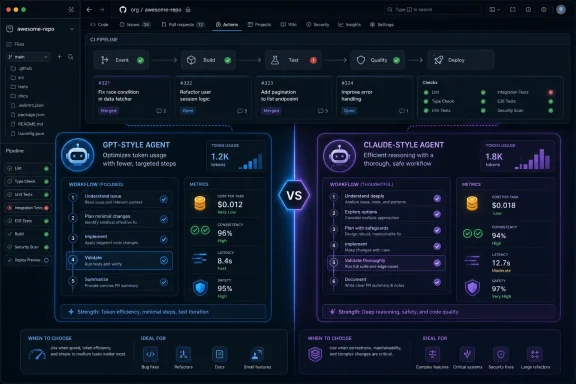
That makes the reported GPT-5.5 lead over Opus 4.8 less like a beauty contest and more like an early read on agentic software work. If GPT-5.5 Medium can solve more tasks while using fewer tokens and fewer reasoning steps than Claude Opus 4.8 High, the operational implication is straightforward: the OpenAI model is doing more with less in this specific evaluation setup. That does not settle every coding question. It does, however, put pressure on the idea that “bigger reasoning” is automatically better reasoning.
The industry has spent much of the frontier-model era celebrating visible thoughtfulness. Longer chains, more tool calls, more repository exploration, more self-checking, more generated tests: all of it feels reassuring. But software teams do not pay for reassurance. They pay for accepted patches, low regression rates, manageable review burden, and predictable cost.
SWE-Rebench Rewards the Boring Parts of Engineering
The benchmark’s appeal is that it tries to evaluate the drudgery that real developers recognize. A coding agent must read unfamiliar code, distinguish symptoms from causes, avoid overfitting to a single test, and stop itself from turning a small bug fix into an architectural rewrite. That is closer to the work inside a mature codebase than most one-shot programming tests.Live or frequently refreshed benchmarks also attack one of the nastiest problems in AI evaluation: contamination. Static tests eventually leak into training data, documentation, tutorials, blog posts, and prompt libraries. Even when no one is cheating deliberately, the longer a benchmark sits in public, the less confidence we can have that a top score reflects general reasoning rather than memorized patterns.
SWE-rebench is not magic. It still depends on task selection, harness design, agent scaffolding, model access paths, cost assumptions, and how retries are counted. But its structure is pointed in the right direction. It treats software engineering as a situated activity rather than a puzzle-book exercise.
That distinction matters for WindowsForum readers because most organizations are not buying AI models to solve isolated algorithm questions. They are buying them to help maintain PowerShell scripts, internal web apps, deployment tooling, Azure integrations, desktop utilities, line-of-business services, and the glue code nobody wants to touch. A benchmark that approximates repository work is more relevant than one that rewards a model for writing an elegant binary tree traversal from memory.
GPT-5.5’s Lead Is Really an Argument About Waste
The headline claim is that GPT-5.5 beats Opus 4.8, but the sharper claim is that GPT-5.5 appears to waste less motion. According to the reported runs, GPT-5.5 Medium solved more tasks than Claude Opus 4.8 High while consuming fewer tokens and taking fewer reasoning steps. In agentic coding, that is not a footnote; it is the business model.Tokens are money, latency, context pressure, and sometimes failure surface. A model that wanders through a repository for too long can find useful clues, but it can also talk itself into changing code that should have been left alone. Extra reasoning is valuable only when it improves the odds of landing a correct patch.
This is where GPT-5.5’s reported performance becomes strategically important for OpenAI. The frontier-model race is no longer dominated by raw capability alone. Enterprise buyers care about cost per solved task because they are beginning to imagine AI agents not as occasional assistants but as always-on infrastructure. Once that happens, a few cents per request becomes a budget line.
If a company runs thousands or millions of coding-agent operations per month, the model that finishes with fewer tokens has an immediate advantage. It is easier to justify in procurement. It is easier to scale across teams. It is easier to leave enabled by default inside developer workflows. In short, efficiency is not a secondary feature. It is the difference between a demo and a deployment.
Anthropic’s Progress Is the Part OpenAI Should Not Ignore
The results are not a simple story of Anthropic falling behind. Opus 4.8 reportedly makes substantial efficiency gains over Opus 4.6 and Opus 4.7, including fewer tokens per task, lower cost per problem, and shorter reasoning trajectories. That suggests Anthropic is attacking the same problem from the other side: not merely making Claude smarter, but making Claude less expensive to be smart.That is the right problem to solve. Anthropic’s Claude models have earned a reputation among developers for careful code reading, strong instruction following, and a willingness to handle large, messy contexts. Those strengths can turn into liabilities if the model uses too much context, spends too many steps deliberating, or becomes costly at scale.
The reported comparison with Opus 4.7 is especially telling. Opus 4.8 appears to deliver similar benchmark scores with far less token use and fewer average reasoning steps. That is exactly the kind of progress model vendors will increasingly emphasize: not a dramatic new capability, but a flatter cost curve.
For users, that kind of progress is more meaningful than it sounds. A model that performs roughly the same job at 60 or 70 percent of the previous cost changes where it can be used. It moves from executive-approved pilot to team-level utility. It can be embedded in more mundane workflows: bug triage, dependency updates, test repair, migration assistance, and code review prechecks.
Consistency Is the Metric Developers Learn to Care About Last
The most interesting reported GPT-5.5 improvement is not pass@5. It is pass^5, the stricter measure of whether a model solves the same task successfully in all five runs. GPT-5.5 Medium reportedly moved from 39 pass^5 tasks in the previous generation to 51, even while its broader pass@5 score stayed roughly stable.That distinction deserves more attention than it will get in leaderboard screenshots. Pass@5 can reward a model that gets lucky once. Pass^5 rewards a model that repeatedly finds the solution. For production coding agents, the second behavior is often more valuable.
Software teams do not want an assistant that sometimes produces a brilliant patch and sometimes drifts into nonsense under the same prompt. They want a system that behaves predictably enough to wrap process around it. A model that can solve the same class of task reliably is easier to trust with automation, easier to monitor, and easier to escalate when it fails.
This is where benchmark culture has lagged behind deployment reality. A single best run is exciting. Repeatability is infrastructure. If GPT-5.5’s consistency gains hold up across other evaluations, that may matter more than a modest headline score increase.
Higher Reasoning Modes Buy Accuracy by Spending Attention
The reported GPT-5.5 xHigh results tell a familiar engineering story: you can get better outcomes if you are willing to pay for them. Moving from Medium to xHigh reasoning reportedly raises pass@1 from 58.9 percent to 62.7 percent, while average cost per task more than doubles from about $0.98 to about $2.25. That is a real gain, but it is not a free one.Higher reasoning modes appear to encourage deeper repository exploration, additional validation, and more self-generated tests. In many cases, that is exactly what a human reviewer would want from an automated coding agent. The model is not just writing a patch; it is trying to prove to itself that the patch will survive.
The danger is that deeper reasoning can become performative. Models can spend tokens narrating uncertainty without resolving it, testing irrelevant paths, or generating elaborate changes to avoid a simpler fix. The question is not whether more reasoning helps. The question is when the marginal reasoning step is still worth buying.
This is where IT teams will need policy, not vibes. A low-risk documentation fix does not need the same reasoning budget as an authentication bug. A flaky unit test in an internal tool does not deserve the same compute as a production database migration. The useful future is not one universal reasoning setting; it is routing based on risk, complexity, and expected value.
The Real Customer Is the CI Pipeline
The consumer framing of AI coding tools still imagines a developer chatting with a model in an IDE. That will remain common, but the more consequential market is quieter. It is the CI pipeline, the issue tracker, the internal developer portal, and the automated pull request.In that world, efficiency is not merely a nicer user experience. It determines whether an organization can afford to let agents run continuously. If a model can inspect failing tests, propose fixes, and open draft PRs at predictable cost, it becomes part of the development factory. If it is too expensive or too erratic, it remains a specialist tool for carefully chosen tasks.
That is why SWE-rebench’s cost-per-problem framing matters. It converts model performance into something close to operational accounting. A resolved issue has a price. A failed attempt has a price. A retry has a price. A model that appears slightly worse in abstract capability may still win if it produces acceptable patches at much lower cost.
The inverse is also true. A model with stronger raw reasoning may be worth the premium for gnarly cross-repository refactors, security-sensitive changes, or migration work where a wrong patch is expensive. The point is not that the cheapest model wins. The point is that buyers will increasingly demand a reason to pay for the expensive one.
GLM 5.1 Shows Why the Field Is Not a Two-Company Race
The reported GLM 5.1 showing is a useful reminder that OpenAI and Anthropic are not the only players pushing coding agents forward. GLM 5.1 appears competitive on pass@5 while following heavier reasoning trajectories and consuming large numbers of tokens. That is both promising and revealing.A strong pass@5 score suggests the model can find solutions when given enough attempts or enough reasoning room. Heavy token use suggests the model has not yet learned to reach those solutions economically. In other words, it may have the raw ingredients of a strong coding agent but not the discipline.
That is where reinforcement learning and agent-specific optimization become decisive. The next wave of coding models will not merely be trained to answer programming questions. They will be trained to navigate repositories efficiently, call tools sparingly, test strategically, and stop when the evidence is sufficient.
This is also where open and semi-open ecosystems can surprise the market. If a model is good enough and cheap enough, teams may tolerate rough edges, especially for internal workloads where privacy, customization, or deployment control matter. The frontier vendors still have the advantage, but the efficiency contest gives challengers a path into the conversation.
Benchmarks Still Hide the Messiest Enterprise Questions
No benchmark can fully capture the politics of introducing AI coding agents into a real engineering organization. A model can pass tests and still produce code the team dislikes. It can fix a bug while violating local style. It can satisfy a harness while making a maintainer nervous. It can generate a correct patch that nobody wants to own.That is why SWE-rebench should be read as a signal, not a verdict. It tells us something about model behavior under a structured agentic setup. It does not tell us everything about security review, intellectual-property policy, dependency risk, prompt-injection exposure, or long-term maintainability.
For Windows and enterprise administrators, the same caution applies to AI-assisted scripting and infrastructure automation. A model that edits application code well may still make dangerous assumptions in PowerShell, Group Policy, Intune configuration, Azure permissions, or endpoint hardening. Coding capability is not the same as operational judgment.
The most mature organizations will treat these tools like powerful junior engineers with unusual memory and no accountability. They will be allowed to propose. They will be monitored when acting. They will be constrained in production environments. And their output will be measured not only by accepted patches but by downstream incidents.
The Vendor Story Is Simpler Than the Buyer Story
OpenAI will naturally prefer the interpretation that GPT-5.5 has found the better balance between intelligence and efficiency. Anthropic will prefer the interpretation that Opus 4.8 has made major optimization gains and remains highly competitive in complex coding contexts. Both can be true.The buyer’s interpretation should be more granular. A model that wins on SWE-rebench Medium settings may not be the best choice for every codebase, language, framework, or agent harness. A model that looks expensive on average may be cost-effective for hard tasks if it avoids retries. A model that performs well in an official benchmark may behave differently inside Cursor, GitHub Copilot-style workflows, Claude Code, custom agents, or internal tools.
This is the lesson many teams learned from cloud migration and are now relearning with AI. Published pricing is not the bill. Published performance is not the deployment. The real cost emerges from workload shape, caching behavior, retry policy, context size, latency tolerance, and human review time.
The smart move is not to crown a universal winner. It is to build an evaluation harness that resembles your own work. Feed models real bugs from your repositories, apply your coding standards, run your tests, measure human review effort, and track failures after merge. Only then does the leaderboard become useful rather than decorative.
The New Coding-Agent Scorecard Has More Columns Than a Leaderboard
The practical lesson from these SWE-rebench results is that software teams need a broader vocabulary for model quality. “Best coding model” is too vague now. The better question is which model produces the best blend of solved tasks, cost, consistency, latency, and reviewability for a given class of work.That shift will be uncomfortable for vendors because it makes marketing harder. It will be healthy for customers because it makes procurement more honest. The best AI coding strategy will look less like choosing a religion and more like choosing a build matrix.
- GPT-5.5’s reported advantage is strongest when the comparison includes efficiency, consistency, and cost per successful task rather than raw task-solving alone.
- Claude Opus 4.8’s reported gains show that Anthropic is compressing reasoning overhead, even if GPT-5.5 still appears more efficient in this benchmark run.
- Pass^5 matters because repeatable success is more valuable in production than a model that occasionally gets lucky across multiple attempts.
- Higher reasoning modes can improve first-attempt accuracy, but the extra cost makes them best suited for high-risk or high-complexity engineering work.
- GLM 5.1’s showing suggests that future coding-agent competition will include models that are capable but still need efficiency tuning.
- Enterprise teams should benchmark against their own repositories before standardizing on a model for automated coding workflows.
References
- Primary source: thewincentral.com
Published: 2026-06-01T09:16:10.498809
GPT-5.5 Beats Opus 4.8 in SWE-Rebench With Better Efficiency - WinCentral
GPT-5.5 outperforms Opus 4.8 in SWE-Rebench, delivering better coding efficiency, stronger consistency, and fewer tokens per solved task. - Read in AI News on WinCentral thewincentral.com
- Related coverage: llmreference.com
Claude Opus 4.8 vs GPT-5.5: Benchmarks & Pricing (2026) | LLMReference
Claude Opus 4.8 vs GPT-5.5 compared on price, benchmarks, and context. Pick Claude Opus 4.8 for coding; GPT-5.5 is better when coding workflow support matters…www.llmreference.com
- Related coverage: userightai.com
Claude Opus 4.8 vs GPT-5.5 (2026): Benchmarks, Price & Agents | UseRightAI
Claude Opus 4.8 vs GPT-5.5 compared on SWE-Bench Pro, Arena Elo, parallel subagents, API pricing, context window, and ecosystem fit. Launched May 27, 2026.www.userightai.com - Related coverage: swe-rebench.com
SWE-rebench Leaderboard
SWE-rebench: A Continuously Evolving and Decontaminated Benchmark for Software Engineering LLMsswe-rebench.com - Related coverage: creeta.com
- Related coverage: allthings.how
Claude Opus 4.8 Benchmarks: Scores, Rankings, and Pricing (May 2026)
Where Anthropic's new flagship leads, where it trails GPT-5.5, and what stays the same on price and context.allthings.how
- Related coverage: digitalapplied.com
Claude Opus 4.8 vs GPT-5.5: Benchmarks & Cost Compared
We compare Claude Opus 4.8 and GPT-5.5 on coding, agents, reasoning, and real cost — including where GPT-5.5 still wins and which model fits which job.www.digitalapplied.com - Related coverage: tokenmix.ai
Claude Opus 4.8 Review 2026: Pricing, Benchmarks, vs 4.7 and GPT-5.5 - TokenMix Blog
Claude Opus 4.8 launched May 28, 2026 at $5/$25 per M tokens, same as 4.7. SWE-Bench Pro +4.9 pts, GDPval-AA +137 Elo, but GPT-5.5 still wins Terminal-Bench. Real migration math inside.tokenmix.ai - Related coverage: promptsrush.com
10 Things Claude Opus 4.8 Does Better Than GPT-5.5 | PromptsRush
10 benchmark-backed areas where Claude Opus 4.8 beats GPT-5.5 — agentic coding, 1M context, tool use, writing quality, and honest uncertainty.promptsrush.com - Related coverage: hokai.io
Claude Opus 4.8: 88.6% SWE-bench, $5/$25 Per 1M (June 2026) | HokAI
Claude Opus 4.8 (released May 28, 2026): 1M context, 88.6% SWE-bench Verified, 96.7% USAMO. Agentic coding + reasoning. $5/$25/1M tokens. Tops GPT-5.5, Gemini. hokai.io
- Related coverage: vanja.io
Opus 4.8 Would Rather Tell You It Failed | Vanja Petreski
Anthropic's fourth Opus in six months: a model that flags its own broken code, runs hundreds of subagents, and an honest benchmark scorecard.vanja.io
- Related coverage: contracollective.com
GPT 5.5 vs Claude Opus 4.8: Frontier Coding and Reasoning Tested (2026) — Contra Collective
By mid 2026 the frontier has two clear leaders for engineering work, and they are not optimized for the same thing. Anthropic's Claude Opus 4.8, released May 28, 2026, leads the company's own launch table on real world issue resolution (SWE-Bench Pro), multidisciplinary reasoning (Humanity's...contracollective.com
