
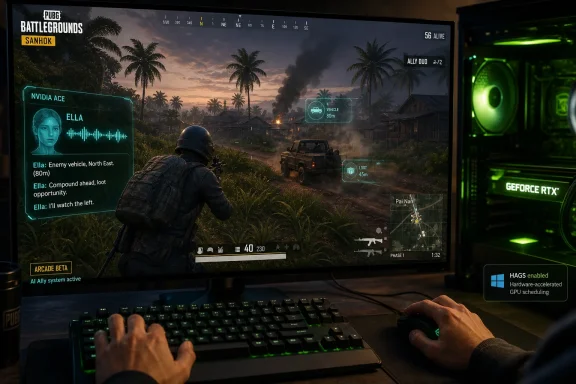
PUBG: Battlegrounds added its NVIDIA ACE-powered “Ally Duo” beta to PC on June 17, 2026, giving solo players a temporary Arcade mode where they queue into Sanhok with Ella, an AI teammate that can listen, speak, loot, drive, and fight. The feature is small in playlist terms, but large in what it asks players to accept. Krafton is not merely adding smarter bots; it is testing whether a competitive shooter can make a machine feel like a squadmate without making the match feel less human.
The old videogame bot had a modest job description. It filled empty slots, followed waypoints, missed shots in plausible ways, and reminded everyone that human opponents were still the real product. PUBG Ally is pitched differently: not as filler, but as a co-playable character that understands a player’s intent and acts on it.
That distinction matters because battle royale design has always been social even when players queue alone. Duo and squad modes are built around trust, timing, information, and the chaos of another person making a barely coordinated decision under pressure. PUBG’s new beta tries to simulate that relationship with a character named Ella, who responds through voice chat and operates alongside the player rather than merely occupying the map.
The experiment also arrives in a game whose competitive identity was forged in scarcity. PUBG became famous because every advantage had to be found, earned, improvised, or stolen. An AI teammate that can identify loot, move with the player, and fight other combatants introduces a new category of advantage: not better aim assist, not better matchmaking, but an automated second brain in a mode historically defined by imperfect human coordination.
For now, Krafton has wisely fenced the feature inside Arcade. Ally Duo is a limited-time beta, not a ranked overhaul or a permanent intrusion into every queue. But the fence is also the story. If the feature were trivial, it would not need this much containment.
That is not the configuration of a finished competitive mode. It is the configuration of an instrumented trial, a lab bolted onto a live service game. Sanhok keeps the geography compact, TPP keeps the mode familiar for a large portion of the PUBG audience, and the Arcade wrapper gives Krafton permission to change or remove the feature without destabilizing the core playlists.
The limitations are revealing. Spectating, death cam, and replay are disabled. If the player dies or leaves, Ella leaves too. Reconnecting is not supported. Voice chat with other players is disabled, leaving the player able to communicate only with Ella.
Those choices make the beta cleaner, but they also expose the awkwardness of putting generative AI into a PvP environment. Replays and death cams are not just entertainment features; they are accountability tools in competitive shooters. Turning them off may be understandable for a constrained beta, but it also means players are being asked to trust a system whose behavior they cannot inspect in the usual PUBG way.
That turns a gameplay feature into a hardware-filtered experience. PUBG has long scaled across a wide range of PCs, and its free-to-play era widened the audience even further. Ally Duo narrows that aperture again, not because Sanhok needs more polygons, but because an AI teammate needs local inference, driver support, memory headroom, and Windows features aligned just so.
The requirement for NVIDIA driver 555.85 or later is ordinary enough. The requirement for Windows Hardware-Accelerated GPU Scheduling is more interesting. HAGS is a Windows graphics scheduling feature that many players have ignored, toggled experimentally, or left disabled depending on system behavior; here, it becomes a gate to a mode.
Krafton’s own notes warn that Hardware-Accelerated GPU Scheduling may be disabled by default on some Windows 10 systems and that players must restart after enabling it. That is the kind of small Windows setting that becomes a support headache at scale. It is also the kind of setting that reminds players that “AI gameplay” is not floating in the cloud as marketing haze; it lands as drivers, memory pressure, GPU scheduling, microphone setup, and performance compromise.
The beta even tells players that if Ella’s responses feel delayed, they should lower graphics settings or resolution. That is a brutally honest sentence. It means the AI teammate is competing with the game itself for local resources, and on some systems the cost of having a synthetic partner may be visual fidelity, frame rate, or responsiveness.
The technical stack is also a strategic advertisement. NVIDIA wants gaming AI to be something that benefits from NVIDIA GPUs, NVIDIA software, and NVIDIA’s surrounding developer ecosystem. A mode that simply refuses to launch without GeForce RTX hardware makes the point more forcefully than any keynote slide could.
For Krafton, the calculus is more complicated. PUBG gets to look like a pioneer, and that matters for a franchise that is no longer the cultural shockwave it was in 2017. The battle royale genre matured, fragmented, and absorbed PUBG’s ideas into the wider shooter vocabulary. A credible AI teammate gives Krafton a fresh way to argue that PUBG is still a test bed rather than merely a veteran live service defending its territory.
But the risk is asymmetric. If Ally Duo works, NVIDIA gets to say ACE is real. If it feels unfair, uncanny, laggy, or pointless, PUBG players will blame PUBG. Hardware companies sell capability; game studios inherit the community consequences.
That is why the term “co-playable character” is doing so much work. It distances Ella from the word “bot,” which carries years of baggage in online shooters. It also avoids calling her a teammate in the full human sense. The phrase is corporate, but it is precise: this is an actor designed to play with you, not merely against you, and not quite instead of a person.
The more important question is whether her mistakes feel legible. A human teammate can be reckless, distracted, generous, selfish, brilliant, or catastrophically overconfident, and the social contract of multiplayer absorbs that variance. A machine teammate that makes the same bad decision can feel less like personality and more like system failure.
Krafton appears aware of that problem. Ella cannot drop independently and follows the player’s drop, which keeps the opening phase under human control. Her language depends on the client setting, with Korean, Simplified Chinese, and English as the practical options. Her knowledge is also bounded: Krafton says it is based on game information available before Update 41.1, meaning she may not understand newer additions from May onward.
That last limitation is oddly reassuring. A teammate who knows everything instantly would feel less like a companion and more like a cheat sheet. A teammate with stale knowledge, by contrast, is closer to the human experience of returning after a patch and misremembering what changed.
Still, imperfection only works if players believe the boundaries are deliberate. If Ella misses a newly added item because her knowledge cutoff is old, that is acceptable once. If she repeatedly misreads the battlefield, delays a callout, or burns a fight because local performance dipped, players will not philosophize about AI safety. They will alt-tab, complain, and go back to normal queues.
But voice also raises the stakes. Text commands would make Ally feel like a tool. Push-to-talk makes her feel like a participant. The mode fixes the voice channel to Team Only and voice input to Push to Talk, instructing players to hold the input key, speak, and release to send the message.
That setup is familiar to PC players, but it adds friction PUBG cannot fully hide. Microphone quality varies wildly. Background noise is messy. Accents, slang, and game-specific shorthand can strain recognition systems, even when the underlying model is strong. In a shooter where a second of delay can decide the fight, a misunderstood instruction is not a funny chatbot moment; it is a lost duel.
Voice isolation also changes the social texture of the match. Ally Duo disables voice chat with other players, which keeps the test focused but makes the mode feel sealed off. PUBG’s battlefield has always been lonely in stretches, but the knowledge that every “conversation” is with a local AI companion gives that loneliness a different flavor.
This is where the novelty cuts both ways. For players who hate random teammates, Ella may be a relief. For players who see multiplayer as a rare remaining refuge from synthetic interaction, she may feel like an invasion even when locked to an Arcade beta.
A teammate can be valuable by spotting movement, remembering where shots came from, carrying extra supplies, driving at the right time, reviving efficiently, or simply never rage-quitting after a bad drop. If an AI companion reliably does those things, it can tilt a match even without superhuman aim. If it does them only for players with eligible NVIDIA hardware, the optics get worse.
Krafton’s decision to keep Ally Duo outside ranked play is therefore essential. The beta does not ask whether AI teammates belong in the most competitive PUBG environment. It asks whether they can be fun, technically stable, and socially acceptable in a contained mode.
Even there, the mode’s mixed population of players, Ella, and bots invites scrutiny. Players will want to know what killed them, how often Ella secures knocks, how she prioritizes targets, whether she hears or sees more than a human could, and whether local hardware changes her responsiveness. Those are design questions, but they are also trust questions.
Competitive communities can tolerate powerful tools when the rules are visible. They are less forgiving when a system feels opaque. If Krafton wants Ally to grow beyond this beta, it will need to explain not only what Ella can do, but what she is forbidden from doing.
That is a useful reminder of where PC gaming is heading. Features once described as “AI” in broad marketing language are becoming tightly coupled to OS-level scheduling, GPU memory, driver versions, and local inference pipelines. The game is no longer just asking whether your GPU can render the scene. It is asking whether your PC can render the scene while running a conversational agent that perceives and acts inside it.
This has practical consequences. Players on Windows 10 may need to check whether HAGS is enabled, restart, and troubleshoot if the Play button remains disabled. Players with older GTX cards, AMD GPUs, or Intel graphics are excluded from the beta regardless of whether PUBG itself runs acceptably on their machines. Players close to the minimum spec may find themselves lowering settings to make the AI interaction feel responsive.
That last point deserves emphasis because it complicates the usual PC upgrade narrative. In traditional gaming, more GPU buys more frames, more resolution, more effects, or more headroom. In AI-assisted gaming, more GPU may buy a more responsive companion. That is a subtler and potentially more divisive performance axis.
It also creates a support burden that straddles Krafton, NVIDIA, and Microsoft. If Ally Duo does not launch, is the problem the game client, the GPU driver, HAGS, Windows 10 defaults, Windows 11 behavior, microphone permissions, or insufficient VRAM? The answer may be all of the above depending on the system.
But the Arcade label does not make the philosophical debate disappear. PUBG is a competitive shooter even in its casual modes. Players care about the integrity of the fight because the entire game is built around the emotional force of being eliminated by someone else’s decision.
That is why “it is only a beta” will not satisfy everyone. A beta is a promise of intent. Krafton is testing Ally because it may want Ally, or something like Ally, to become more important later. Players are not reacting only to the current playlist; they are reacting to the direction of travel.
The same dynamic has played out across other live service changes, from bots to skill-based matchmaking to input assist. A feature can begin as accessibility, onboarding, or experimentation and later become part of the competitive baseline. PUBG’s community is old enough and skeptical enough to understand that temporary modes often function as market research.
Still, there is a generous reading. PUBG has always been punishing to learn, and duo play can be miserable when a new player lacks a patient partner. If Ella can teach rotations, reduce early frustration, and make solo practice more useful, she may serve the game’s long-term health. The problem is not that an AI teammate exists. The problem is deciding where such a teammate stops.
A good random teammate can be the reason a player comes back. A bad one can be the reason they queue solo forever. Krafton is exploiting that tension by offering a partner who will not insult you, abandon you, demand your Discord, or disconnect because dinner arrived.
That sounds attractive because online multiplayer has made many players tired of other people. The toxicity, the inconsistency, the language barriers, the performance anxiety, and the simple scheduling problem of adulthood all create demand for a teammate who is always available. In that sense, Ella is not an alien product idea. She is a response to a real social deficit in live games.
But solving loneliness with simulation is not neutral. If the best teammate is the one who never pushes back, never has an off day, and never needs anything from you, the design may quietly train players to prefer cooperation without reciprocity. That is efficient. It is also a little bleak.
PUBG does not need to answer that cultural question in a two-week beta. It does need to understand that the question will follow the feature wherever it goes. The more human Ella becomes, the more players will judge her not only as technology, but as a replacement for something multiplayer used to promise.
 Krafton Turns the Bot Into a Co-Worker
The old videogame bot had a modest job description. It filled empty slots, followed waypoints, missed shots in plausible ways, and reminded everyone that human opponents were still the real product. PUBG Ally is pitched differently: not as filler, but as a co-playable character that understands a player’s intent and acts on it.That distinction matters because battle royale design has always been social even when players queue alone. Duo and squad modes are built around trust, timing, information, and the chaos of another person making a barely coordinated decision under pressure. PUBG’s new beta tries to simulate that relationship with a character named Ella, who responds through voice chat and operates alongside the player rather than merely occupying the map.
The experiment also arrives in a game whose competitive identity was forged in scarcity. PUBG became famous because every advantage had to be found, earned, improvised, or stolen. An AI teammate that can identify loot, move with the player, and fight other combatants introduces a new category of advantage: not better aim assist, not better matchmaking, but an automated second brain in a mode historically defined by imperfect human coordination.
For now, Krafton has wisely fenced the feature inside Arcade. Ally Duo is a limited-time beta, not a ranked overhaul or a permanent intrusion into every queue. But the fence is also the story. If the feature were trivial, it would not need this much containment.
The Two-Week Beta Is a Product Test Disguised as a Playlist
Ally Duo runs from June 17 after PC maintenance through July 1 at 07:00 UTC, and its shape is deliberately controlled. Players enter through Play, Arcade, and Ally Duo, then matchmake solo before dropping into Sanhok as a duo with Ella. The mode uses third-person perspective, caps the match at 64 total participants across players, Ella instances, and bots, and disables some features that would complicate the test.That is not the configuration of a finished competitive mode. It is the configuration of an instrumented trial, a lab bolted onto a live service game. Sanhok keeps the geography compact, TPP keeps the mode familiar for a large portion of the PUBG audience, and the Arcade wrapper gives Krafton permission to change or remove the feature without destabilizing the core playlists.
The limitations are revealing. Spectating, death cam, and replay are disabled. If the player dies or leaves, Ella leaves too. Reconnecting is not supported. Voice chat with other players is disabled, leaving the player able to communicate only with Ella.
Those choices make the beta cleaner, but they also expose the awkwardness of putting generative AI into a PvP environment. Replays and death cams are not just entertainment features; they are accountability tools in competitive shooters. Turning them off may be understandable for a constrained beta, but it also means players are being asked to trust a system whose behavior they cannot inspect in the usual PUBG way.
The Hardware Gate Is the First Real Controversy
The most immediate complaint is not philosophical. It is practical: Ally Duo is available only on PCs with NVIDIA GeForce RTX hardware, and the requirements are not casual. Krafton lists an RTX 2080 Ti or RTX 3060 with 8GB of VRAM and 16GB of system RAM as the minimum, while recommending an RTX 4070 with 12GB of VRAM and 24GB of RAM.That turns a gameplay feature into a hardware-filtered experience. PUBG has long scaled across a wide range of PCs, and its free-to-play era widened the audience even further. Ally Duo narrows that aperture again, not because Sanhok needs more polygons, but because an AI teammate needs local inference, driver support, memory headroom, and Windows features aligned just so.
The requirement for NVIDIA driver 555.85 or later is ordinary enough. The requirement for Windows Hardware-Accelerated GPU Scheduling is more interesting. HAGS is a Windows graphics scheduling feature that many players have ignored, toggled experimentally, or left disabled depending on system behavior; here, it becomes a gate to a mode.
Krafton’s own notes warn that Hardware-Accelerated GPU Scheduling may be disabled by default on some Windows 10 systems and that players must restart after enabling it. That is the kind of small Windows setting that becomes a support headache at scale. It is also the kind of setting that reminds players that “AI gameplay” is not floating in the cloud as marketing haze; it lands as drivers, memory pressure, GPU scheduling, microphone setup, and performance compromise.
The beta even tells players that if Ella’s responses feel delayed, they should lower graphics settings or resolution. That is a brutally honest sentence. It means the AI teammate is competing with the game itself for local resources, and on some systems the cost of having a synthetic partner may be visual fidelity, frame rate, or responsiveness.
NVIDIA Gets the Showcase It Wanted, but PUBG Gets the Risk
For NVIDIA, Ally Duo is a tidy demonstration of the ACE pitch. The company has been talking for years about AI characters that can perceive, converse, and act inside games. Tech demos are easy to admire and easier to ignore; a live beta inside PUBG is harder to dismiss.The technical stack is also a strategic advertisement. NVIDIA wants gaming AI to be something that benefits from NVIDIA GPUs, NVIDIA software, and NVIDIA’s surrounding developer ecosystem. A mode that simply refuses to launch without GeForce RTX hardware makes the point more forcefully than any keynote slide could.
For Krafton, the calculus is more complicated. PUBG gets to look like a pioneer, and that matters for a franchise that is no longer the cultural shockwave it was in 2017. The battle royale genre matured, fragmented, and absorbed PUBG’s ideas into the wider shooter vocabulary. A credible AI teammate gives Krafton a fresh way to argue that PUBG is still a test bed rather than merely a veteran live service defending its territory.
But the risk is asymmetric. If Ally Duo works, NVIDIA gets to say ACE is real. If it feels unfair, uncanny, laggy, or pointless, PUBG players will blame PUBG. Hardware companies sell capability; game studios inherit the community consequences.
That is why the term “co-playable character” is doing so much work. It distances Ella from the word “bot,” which carries years of baggage in online shooters. It also avoids calling her a teammate in the full human sense. The phrase is corporate, but it is precise: this is an actor designed to play with you, not merely against you, and not quite instead of a person.
Ella Is Most Interesting When She Is Imperfect
The temptation with AI companions is to ask whether they are good. In PUBG, that is almost the wrong question. If Ella is too weak, the mode becomes a novelty for a weekend; if she is too strong, the mode becomes a fairness argument with a microphone.The more important question is whether her mistakes feel legible. A human teammate can be reckless, distracted, generous, selfish, brilliant, or catastrophically overconfident, and the social contract of multiplayer absorbs that variance. A machine teammate that makes the same bad decision can feel less like personality and more like system failure.
Krafton appears aware of that problem. Ella cannot drop independently and follows the player’s drop, which keeps the opening phase under human control. Her language depends on the client setting, with Korean, Simplified Chinese, and English as the practical options. Her knowledge is also bounded: Krafton says it is based on game information available before Update 41.1, meaning she may not understand newer additions from May onward.
That last limitation is oddly reassuring. A teammate who knows everything instantly would feel less like a companion and more like a cheat sheet. A teammate with stale knowledge, by contrast, is closer to the human experience of returning after a patch and misremembering what changed.
Still, imperfection only works if players believe the boundaries are deliberate. If Ella misses a newly added item because her knowledge cutoff is old, that is acceptable once. If she repeatedly misreads the battlefield, delays a callout, or burns a fight because local performance dipped, players will not philosophize about AI safety. They will alt-tab, complain, and go back to normal queues.
Voice Is the Feature and the Liability
PUBG Ally is being sold around communication, and that is sensible. A silent AI squadmate is just a fancy bot with better pathing. Voice lets Ella occupy the emotional space normally reserved for the random duo partner who pings a compound, asks for ammo, panics in a firefight, and occasionally saves the match by saying the obvious thing at the right second.But voice also raises the stakes. Text commands would make Ally feel like a tool. Push-to-talk makes her feel like a participant. The mode fixes the voice channel to Team Only and voice input to Push to Talk, instructing players to hold the input key, speak, and release to send the message.
That setup is familiar to PC players, but it adds friction PUBG cannot fully hide. Microphone quality varies wildly. Background noise is messy. Accents, slang, and game-specific shorthand can strain recognition systems, even when the underlying model is strong. In a shooter where a second of delay can decide the fight, a misunderstood instruction is not a funny chatbot moment; it is a lost duel.
Voice isolation also changes the social texture of the match. Ally Duo disables voice chat with other players, which keeps the test focused but makes the mode feel sealed off. PUBG’s battlefield has always been lonely in stretches, but the knowledge that every “conversation” is with a local AI companion gives that loneliness a different flavor.
This is where the novelty cuts both ways. For players who hate random teammates, Ella may be a relief. For players who see multiplayer as a rare remaining refuge from synthetic interaction, she may feel like an invasion even when locked to an Arcade beta.
Fairness Is Not Just About Aim
The loudest objections to AI teammates tend to imagine a robot outshooting humans. That is the obvious nightmare, but not the only one. In PUBG, fairness lives in the entire information economy of the match.A teammate can be valuable by spotting movement, remembering where shots came from, carrying extra supplies, driving at the right time, reviving efficiently, or simply never rage-quitting after a bad drop. If an AI companion reliably does those things, it can tilt a match even without superhuman aim. If it does them only for players with eligible NVIDIA hardware, the optics get worse.
Krafton’s decision to keep Ally Duo outside ranked play is therefore essential. The beta does not ask whether AI teammates belong in the most competitive PUBG environment. It asks whether they can be fun, technically stable, and socially acceptable in a contained mode.
Even there, the mode’s mixed population of players, Ella, and bots invites scrutiny. Players will want to know what killed them, how often Ella secures knocks, how she prioritizes targets, whether she hears or sees more than a human could, and whether local hardware changes her responsiveness. Those are design questions, but they are also trust questions.
Competitive communities can tolerate powerful tools when the rules are visible. They are less forgiving when a system feels opaque. If Krafton wants Ally to grow beyond this beta, it will need to explain not only what Ella can do, but what she is forbidden from doing.
Windows Becomes Part of the Gameplay Loop
For WindowsForum readers, the most interesting line in the patch notes may be the least glamorous one: Windows Hardware-Accelerated GPU Scheduling must be enabled. Suddenly, a Windows graphics subsystem toggle becomes a prerequisite for a new kind of gameplay.That is a useful reminder of where PC gaming is heading. Features once described as “AI” in broad marketing language are becoming tightly coupled to OS-level scheduling, GPU memory, driver versions, and local inference pipelines. The game is no longer just asking whether your GPU can render the scene. It is asking whether your PC can render the scene while running a conversational agent that perceives and acts inside it.
This has practical consequences. Players on Windows 10 may need to check whether HAGS is enabled, restart, and troubleshoot if the Play button remains disabled. Players with older GTX cards, AMD GPUs, or Intel graphics are excluded from the beta regardless of whether PUBG itself runs acceptably on their machines. Players close to the minimum spec may find themselves lowering settings to make the AI interaction feel responsive.
That last point deserves emphasis because it complicates the usual PC upgrade narrative. In traditional gaming, more GPU buys more frames, more resolution, more effects, or more headroom. In AI-assisted gaming, more GPU may buy a more responsive companion. That is a subtler and potentially more divisive performance axis.
It also creates a support burden that straddles Krafton, NVIDIA, and Microsoft. If Ally Duo does not launch, is the problem the game client, the GPU driver, HAGS, Windows 10 defaults, Windows 11 behavior, microphone permissions, or insufficient VRAM? The answer may be all of the above depending on the system.
The Arcade Label Gives Krafton Room, but Not Immunity
Putting Ally Duo in Arcade is the right move. It frames the feature as an experiment, gives players an easy way to opt in, and prevents the immediate panic that would follow if AI teammates appeared in standard ranked or esports-adjacent modes. It also lets Krafton collect data from real matches without pretending the system is finished.But the Arcade label does not make the philosophical debate disappear. PUBG is a competitive shooter even in its casual modes. Players care about the integrity of the fight because the entire game is built around the emotional force of being eliminated by someone else’s decision.
That is why “it is only a beta” will not satisfy everyone. A beta is a promise of intent. Krafton is testing Ally because it may want Ally, or something like Ally, to become more important later. Players are not reacting only to the current playlist; they are reacting to the direction of travel.
The same dynamic has played out across other live service changes, from bots to skill-based matchmaking to input assist. A feature can begin as accessibility, onboarding, or experimentation and later become part of the competitive baseline. PUBG’s community is old enough and skeptical enough to understand that temporary modes often function as market research.
Still, there is a generous reading. PUBG has always been punishing to learn, and duo play can be miserable when a new player lacks a patient partner. If Ella can teach rotations, reduce early frustration, and make solo practice more useful, she may serve the game’s long-term health. The problem is not that an AI teammate exists. The problem is deciding where such a teammate stops.
The Real Test Is Whether Players Feel More Alone
The promise of PUBG Ally is companionship. The danger is that it becomes an efficient substitute for the messy human thing PUBG was built around. Multiplayer games are not merely content delivery systems; they are social machines with weapons attached.A good random teammate can be the reason a player comes back. A bad one can be the reason they queue solo forever. Krafton is exploiting that tension by offering a partner who will not insult you, abandon you, demand your Discord, or disconnect because dinner arrived.
That sounds attractive because online multiplayer has made many players tired of other people. The toxicity, the inconsistency, the language barriers, the performance anxiety, and the simple scheduling problem of adulthood all create demand for a teammate who is always available. In that sense, Ella is not an alien product idea. She is a response to a real social deficit in live games.
But solving loneliness with simulation is not neutral. If the best teammate is the one who never pushes back, never has an off day, and never needs anything from you, the design may quietly train players to prefer cooperation without reciprocity. That is efficient. It is also a little bleak.
PUBG does not need to answer that cultural question in a two-week beta. It does need to understand that the question will follow the feature wherever it goes. The more human Ella becomes, the more players will judge her not only as technology, but as a replacement for something multiplayer used to promise.
The Chicken Dinner Now Comes With System Requirements
The concrete lesson from Ally Duo is that AI in games is no longer just a content-production controversy or a keynote demo. It is arriving as a playable feature with compatibility rules, performance costs, and design tradeoffs. PUBG’s beta makes those tradeoffs unusually visible.- Ally Duo is a PC-only limited beta running from June 17 to July 1, 2026, inside PUBG’s Arcade menu.
- The mode pairs a solo player with Ella, an NVIDIA ACE-powered AI teammate, on Sanhok in third-person duo play.
- Access requires an NVIDIA GeForce RTX GPU, with Krafton listing an RTX 2080 Ti or RTX 3060-class card as the minimum and an RTX 4070-class card as recommended.
- Players must use NVIDIA driver 555.85 or later and enable Windows Hardware-Accelerated GPU Scheduling, with a restart required after changing the setting.
- Krafton has contained the test by disabling features such as other-player voice chat, spectating, death cam, replay, and reconnect support.
- The biggest unanswered question is not whether Ella can function, but whether players will accept an AI companion as fair, useful, and emotionally compatible with PUBG’s competitive identity.
References
- Primary source: TechPowerUp
Published: Wed, 17 Jun 2026 21:22:00 GMT
PUBG Gets NVIDIA Ace AI Teammates with High Demands | TechPowerUp
There has been a lot of talk in recent months about AI-powered teammates in video games of late, with everyone from NVIDIA to Ubisoft and Take-Two expressing interest in the feature. That same Ace AI tech that NVIDIA demonstrated over a year ago has now made its way into PUBG: Battlegrounds as a...www.techpowerup.com - Independent coverage: Wccftech
Published: Wed, 17 Jun 2026 14:36:00 GMT
NVIDIA ACE-Powered PUBG Ally AI-Teammates now Available in PUBG Duos for Two-Week Beta
You can play PUBG with an NVIDIA ACE-powered AI teammate, PUBG Ally, for the next two weeks as part of a beta test.wccftech.com
- Related coverage: duelmasters.io
- Related coverage: talkesport.com
PUBG Ally Duo Beta Is Live: How AI Teammate Ella Actually Works
PUBG Ally Duo beta runs June 17 to July 1, 2026. Here's how the AI teammate Ella works, what NVIDIA ACE does, and what players need to know before jumping in.www.talkesport.com - Related coverage: nvidia.com
NVIDIA Redefines Game AI With ACE Autonomous Game Characters
PUBG: BATTLEGROUNDS, inZOI, MIR5 & NARAKA: BLADEPOINT MOBILE PC VERSION are the first games to incorporate autonomous companions, enemies, and game systems powered by NVIDIA ACE.www.nvidia.com - Related coverage: gamespot.com
PUBG And Nvidia Reveal New AI-Powered Characters Designed To Act Like Real People - GameSpot
Get an early look at what could be a future feature in PUBG.www.gamespot.com
- Related coverage: windowscentral.com
PUBG adds AI squadmates that listen, loot, and fight like real players — powered by NVIDIA’s ACE tech | Windows Central
PUBG and other top games are about to change? NVIDIA’s ACE technology aims to introduce human-like AI squadmates ready to play, listen, and adapt alongside you.www.windowscentral.com - Related coverage: invenglobal.com
PlayerUnknown's Battlegrounds Launches AI-Powered 'Ally Duo' Mode on the 17th - Inven Global
©KRAFTONOn the 17th, KRAFTON will launch 'Ally Duo,' a beta arcade mode for PlayerUnknown's Battlegrounds that introduces 'PUBG Ally,' a new AI technology.www.invenglobal.com - Related coverage: sportsdunia.com
PUBG Ally Update Brings NVIDIA ACE-Powered AI Teammates
Learn how the PUBG Ally update adds command-based AI squadmates, tactical rotations, and long-term learning shown at CES 2026.www.sportsdunia.com - Related coverage: itechpost.com
'PUBG' Adds AI-Powered NPCs Called 'Allies' in Partnership with NVIDIA's ACE
“PUBG” will soon have players dropping in with Allies, AI-powered NPCs that assist them in-game, powered by NVIDIA.www.itechpost.com - Related coverage: gamingamigos.com
PUBG Ally Revealed: Krafton’s AI Co‑Playable Character Arrives in 2026 - Gaming Amigos
Krafton reveals PUBG Ally, an AI teammate powered by NVIDIA ACE, launching in 2026 with voice chat, strategy planning, and real-time support. - Gaming Amigos www.gamingamigos.com
- Related coverage: gamegpu.com
PUBG BATTLEGROUNDS получила AI-напарника PUBG Ally с памятью на базе NVIDIA ACE
KRAFTON показала развитие PUBG Ally — AI-напарника для PUBG: BATTLEGROUNDS на базе NVIDIA ACE, который понимает голосовые команды и реагирует на ситуацию в матче. На CES 2026 ему добавили долговременную память, а первые пользовательские тесты запланированы на первую половину 2026 года.gamegpu.com
- Related coverage: simulationdaily.com
PUBG: Battlegrounds Announce Testing Schedule for Its AI-Powered Co-op NPC PUBG Ally - Simulation Daily
Today, Krafton joined Nvidia to present the next innovation for its hit battle royale title, PUBG: Battlegrounds. Find out more inside.simulationdaily.com - Related coverage: tweakers.net
- Related coverage: techradar.com
Nvidia has finally done the one AI thing I've been dreading — and PC gaming might never be the same | TechRadar
Missing the pointwww.techradar.com - Related coverage: nvidianews.nvidia.com
NVIDIA RTX Platform Brings Real-Time Ray Tracing and AI to Barrage of Blockbuster Games
PDF documentnvidianews.nvidia.com
- Related coverage: pubg.com
- Related coverage: gameswelt.de
PUBG: Battlegrounds: Beta-Testphase für KI-Modus Ally Duo angekündigt - News von Gameswelt
In PUBG: Battlegrounds dürft ihr in Kürze einen neuen Arcade-Modus ausprobieren.www.gameswelt.de - Related coverage: axyo.de
KRAFTON startet die Beta-Testphase von PUBG Ally - AXYO
Am 17. Juni startet KRAFTON, Inc. die Beta-Version von Ally Duo, einem neuen Arcade-Modus für PUBG: BATTLEGROUNDS, der auf PUBG Ally basiert. Ally Duo ist ein neuer Arcade-Modus, in dem Spieler ein Zweierteam mit der KI-Figur Ella bilden und auf der Karte Sanhok spielen. Spieler können über... axyo.de
- Related coverage: insider-gaming.com
PUBG Beta Testing New AI-Focused 'Ally Duo' Game Mode, Dates Revealed - Insider Gaming
PUBG continues to evolve as Krafton has announced a global beta test for the upcoming Ally Duo game mode in the shooter.insider-gaming.com - Related coverage: pixelcritics.com
PUBG: Battlegrounds bekommt einen KI-Kumpel – und der hört per Sprache auf deine Befehle - PixelCritics
KRAFTON startet am 17. Juni die globale Beta von Ally Duo, einem KI-Duo-Modus für PUBG: Battlegrounds, der Solo-Spieler mit der sprachgesteuerten Begleiterin Ella zusammenspannt.pixelcritics.com - Related coverage: zonammorpg.com
