

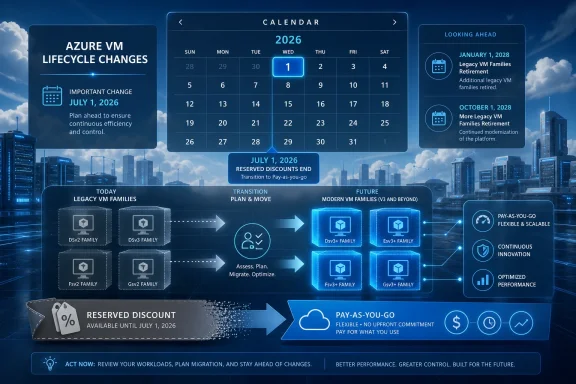
Microsoft will stop new purchases and renewals of Azure Reserved VM Instances for select older virtual-machine series on July 1, 2026, affecting one-year reservations for fourteen retiring families and one- and three-year reservations for four still-active v3 families across Azure outside China. The move is not a sudden shutdown, but it is a bright line in the calendar for customers who have treated legacy VM sizes as a cheap, stable, low-drama corner of the cloud. Microsoft is using the reservation system to nudge workloads off aging hardware long before the final retirement dates arrive in 2028. That makes this less a story about obscure SKU housekeeping than a reminder that the cloud’s most comforting promise — abstract away the hardware — has always had an expiration date.
The immediate change is financial, not operational. Existing reserved instances continue to apply through the end of their term, and virtual machines do not vanish from customer subscriptions on July 1, 2026. But after that date, customers running the affected families lose the ability to renew certain reservations, which means the discount structure that may have justified leaving those workloads untouched starts to erode.
That distinction matters because enterprise migrations rarely begin with a server being switched off. They begin when a spreadsheet stops making sense. Once a workload falls back to pay-as-you-go pricing, the business case for doing nothing becomes harder to defend, even if the application itself is still humming along.
The VM families in the first bucket include older general purpose, compute optimized, memory optimized, and storage optimized names that have been familiar in Azure estates for years: Av2, Amv2, Bv1, D, Ds, Dv2, Dsv2, F, Fs, Fsv2, G, Gs, Ls, and Lsv2. Microsoft’s guidance says one-year reserved instance purchases and renewals for these families end on July 1, 2026. Many of those lines are then scheduled for retirement in May or November 2028.
A second bucket — Dv3, Dsv3, Ev3, and Esv3 — is subtler. Microsoft is not retiring those families on the 2028 timeline, at least not for now, but it is ending new one-year and three-year reservations for them. That is the cloud provider’s polite way of saying these sizes may remain serviceable, but they are no longer where Microsoft wants customers to place long-term commitments.
That is precisely why the reservation change has teeth. Cloud estates accrete old assumptions. A VM family can become legacy not only because the processor is old, but because the organization’s automation, documentation, monitoring thresholds, and chargeback models were built around it.
Microsoft’s newer VM generations offer better density, better power efficiency, newer processor platforms, and broader alignment with current Azure capacity planning. From Microsoft’s perspective, keeping older families around indefinitely means preserving islands of infrastructure that consume space, power, operational attention, and capacity-management effort while delivering less useful work per watt than modern servers.
For customers, the picture is messier. A newer VM may be faster on paper and cheaper per unit of performance, but a migration still has to be tested. The operating system must boot, agents must behave, storage and networking characteristics must be checked, licensing assumptions must be revisited, and performance baselines must be rebuilt. “Just resize it” is accurate for some workloads and dangerously casual for others.
Reserved instances are how many Azure customers make steady-state workloads economically tolerable. If a VM runs continuously, a reservation can turn Azure from an expensive rental into something closer to a planned infrastructure line item. Remove the ability to renew that commitment, and the economics of inertia deteriorate before the technical retirement arrives.
That is why this is an end-of-sale event masquerading as a billing update. Microsoft is not saying every affected VM stops this summer. It is saying customers can no longer assume the old bargain will be renewed.
The company’s preferred alternatives are predictable. Customers can move workloads to newer VM generations that still support reserved instances, or they can use Azure savings plans for compute, which trade SKU specificity for a broader spend commitment. Each option solves a different problem. Reservations reward standardization on known sizes; savings plans reward predictable compute spend across a more flexible estate.
Azure VM sizes are abstractions, but they are not magic. They map to physical hosts, processor generations, storage capabilities, network designs, and regional capacity pools. A decade-old VM family is a product surface wrapped around hardware that Microsoft would rather replace, consolidate, or repurpose.
That tension is becoming more visible across the hyperscale cloud market. AI demand has made data center capacity more strategic and more constrained. Power, cooling, rack density, accelerator supply, and processor efficiency are no longer background engineering concerns; they are board-level constraints. In that environment, leaving older general-purpose fleets untouched is a luxury.
Microsoft does not need to say that AI is driving every infrastructure rationalization for the signal to be obvious. The company is under pressure to make every megawatt and every rack count. Legacy VM families that once represented Azure’s mainstream now compete with newer general-purpose hosts, specialized compute, and accelerated infrastructure for space in the same global platform.
But enterprise risk rarely hides in the simple case. It hides in the old domain controller nobody wants to touch, the vendor appliance pinned to a certified size, the licensing model that charges by core, the database whose performance profile depends on storage latency, or the production system whose maintenance window is negotiated with three business units and a legal department.
The operational work is also broader than the VM itself. Infrastructure-as-code templates must be updated. Azure Policy rules may need revision. Backup and disaster recovery plans must be retested. Monitoring thresholds may change because newer processors behave differently under the same workload. Cost allocation reports must be adjusted so that finance teams understand why a familiar SKU disappeared from the bill.
That is the unglamorous labor Microsoft is pushing into the next two years. The final retirement date is only the cliff. The migration program has to begin much earlier if organizations want to avoid turning routine modernization into an emergency change freeze.
It tells customers that “not retired” is no longer the same as “strategic.” A VM size can remain available while losing its place in Microsoft’s long-term economic model. In practical terms, the cloud platform is creating tiers of confidence: current-generation SKUs worth reserving, older-but-running SKUs better covered by savings plans, and legacy SKUs that customers should leave before the retirement date forces the issue.
This matters for planning because many enterprises use reservation eligibility as a sign of maturity. If a VM family supports long commitments, it feels stable. If those commitments disappear, procurement and architecture teams should read that as a warning, even if the service health dashboard remains green.
The v3 families are not ancient curiosities. They are still widely encountered in real estates because they represented a sensible landing zone for years. Their treatment suggests Microsoft wants customers to think of VM lifecycle not as a binary supported-or-retired status, but as a gradient of platform preference.
That flexibility can be valuable during migration. If an organization is moving from Dv3 to Dsv5, testing AMD alternatives, or consolidating workloads across regions, a savings plan may absorb some of the churn better than a reservation tied to a specific VM family. It can also reduce the risk of buying the wrong reservation just before a modernization wave.
But savings plans also move the optimization problem up a level. Instead of matching reservations to known VM usage, customers must forecast aggregate compute spend. Overcommit and the unused commitment becomes waste. Undercommit and more usage lands at pay-as-you-go prices. The spreadsheet does not disappear; it becomes more abstract.
That is why the reservation cutoff should trigger both an engineering review and a FinOps review. The migration path that looks best to a systems team may not be the one that produces the best long-term cost profile. Conversely, the cheapest commitment model may constrain the technical team at exactly the moment it needs freedom to test newer sizes.
On-premises infrastructure gave organizations more control over the timing of obsolescence. That control was not always healthy. Plenty of companies ran unsupported servers because nobody could fund the replacement, and plenty of admins inherited hardware old enough to vote. But the timing was at least locally negotiable.
In Azure, the platform owner sets the outer boundary. Customers can choose when to move inside that window, but they cannot extend the life of a retired VM family by keeping a dusty host alive in the corner of a server room. This is one of the tradeoffs of cloud: less hardware burden, less hardware sovereignty.
That tradeoff is not inherently bad. Forced modernization can reduce risk, improve performance, and push organizations away from brittle legacy configurations. But it also compresses planning for teams already juggling operating-system end-of-support deadlines, security mandates, application refactoring, and budget scrutiny.
A good inventory should distinguish between machines that are easy to move, machines that require application-owner validation, and machines whose dependencies are poorly understood. The last group is the danger zone. If a VM is important enough to keep running but obscure enough that nobody knows how to test it, the retirement notice has exposed a governance problem, not just a compute problem.
Testing should be empirical. Newer VM generations may deliver better performance, but a one-to-one vCPU and memory match is not always the right target. Some workloads can downsize because newer processors are faster. Others need more memory bandwidth, better local disk characteristics, or different storage choices. The right migration is measured, not guessed.
This is also a moment to clean up sprawl. A retirement-driven project can become a useful excuse to shut down zombie machines, consolidate underused services, or move suitable workloads to platform services. If the only outcome is swapping every old VM for a similarly shaped new VM, the organization may miss the larger opportunity.
Those dates may sound generous, but they are not generous for every estate. A small business with a handful of VMs can test replacements in a week. A large enterprise with hundreds or thousands of instances, regulatory constraints, regional deployment differences, and multiple application owners may need most of the runway.
The hidden risk is not that Microsoft has given too little notice. It is that the first deadline arrives through procurement rather than operations. A reservation that cannot be renewed can create a cost surprise long before a workload is deallocated.
This is where IT leadership needs to be disciplined. Treating July 2026 as a reminder and 2028 as the “real” deadline is the wrong read. July 2026 is when the old economic model starts closing. The 2028 dates are when the technical tolerance ends.
That does not mean every workload must chase the newest instance family. Stability still matters, and not every application benefits from constant tuning. But “stable” should mean deliberately maintained, not accidentally forgotten.
The organizations with mature FinOps and platform engineering practices will fold this into normal operations. They will track previous-generation SKUs, review reservations before renewal windows close, maintain approved target families, and test resize paths before the business asks why the Azure bill changed. The organizations without those practices will discover the same facts through invoices, service tickets, and hurried change requests.
This is the cloud lifecycle becoming more explicit. Microsoft is telling customers that old VM families are not just old; they are strategically expensive for the platform to keep privileging. Customers should believe it.
Source: Techzine Global Microsoft is ending reservations for older instance types
 Microsoft Turns a Pricing Change Into a Migration Clock
The immediate change is financial, not operational. Existing reserved instances continue to apply through the end of their term, and virtual machines do not vanish from customer subscriptions on July 1, 2026. But after that date, customers running the affected families lose the ability to renew certain reservations, which means the discount structure that may have justified leaving those workloads untouched starts to erode.That distinction matters because enterprise migrations rarely begin with a server being switched off. They begin when a spreadsheet stops making sense. Once a workload falls back to pay-as-you-go pricing, the business case for doing nothing becomes harder to defend, even if the application itself is still humming along.
The VM families in the first bucket include older general purpose, compute optimized, memory optimized, and storage optimized names that have been familiar in Azure estates for years: Av2, Amv2, Bv1, D, Ds, Dv2, Dsv2, F, Fs, Fsv2, G, Gs, Ls, and Lsv2. Microsoft’s guidance says one-year reserved instance purchases and renewals for these families end on July 1, 2026. Many of those lines are then scheduled for retirement in May or November 2028.
A second bucket — Dv3, Dsv3, Ev3, and Esv3 — is subtler. Microsoft is not retiring those families on the 2028 timeline, at least not for now, but it is ending new one-year and three-year reservations for them. That is the cloud provider’s polite way of saying these sizes may remain serviceable, but they are no longer where Microsoft wants customers to place long-term commitments.
The Old Azure Workhorse Is Being Put Out to Pasture
The affected VM families come from the era when many organizations were still doing their first serious lift-and-shift projects. They were the safe choices: recognizable x86 shapes, relatively predictable performance, and enough regional availability to become defaults in scripts, templates, marketplace images, and operational habits. In many environments, these SKUs are not there because someone recently chose them; they are there because nobody had a strong enough reason to stop choosing them.That is precisely why the reservation change has teeth. Cloud estates accrete old assumptions. A VM family can become legacy not only because the processor is old, but because the organization’s automation, documentation, monitoring thresholds, and chargeback models were built around it.
Microsoft’s newer VM generations offer better density, better power efficiency, newer processor platforms, and broader alignment with current Azure capacity planning. From Microsoft’s perspective, keeping older families around indefinitely means preserving islands of infrastructure that consume space, power, operational attention, and capacity-management effort while delivering less useful work per watt than modern servers.
For customers, the picture is messier. A newer VM may be faster on paper and cheaper per unit of performance, but a migration still has to be tested. The operating system must boot, agents must behave, storage and networking characteristics must be checked, licensing assumptions must be revisited, and performance baselines must be rebuilt. “Just resize it” is accurate for some workloads and dangerously casual for others.
The Reservation Deadline Is the Real End-of-Sale Signal
Cloud retirement notices often sound distant because the final date is years away. May 1, 2028, and November 15, 2028, are far enough out that a busy infrastructure team could be forgiven for putting the task into a backlog and returning to more immediate fires. The July 1, 2026 reservation cutoff changes that psychology.Reserved instances are how many Azure customers make steady-state workloads economically tolerable. If a VM runs continuously, a reservation can turn Azure from an expensive rental into something closer to a planned infrastructure line item. Remove the ability to renew that commitment, and the economics of inertia deteriorate before the technical retirement arrives.
That is why this is an end-of-sale event masquerading as a billing update. Microsoft is not saying every affected VM stops this summer. It is saying customers can no longer assume the old bargain will be renewed.
The company’s preferred alternatives are predictable. Customers can move workloads to newer VM generations that still support reserved instances, or they can use Azure savings plans for compute, which trade SKU specificity for a broader spend commitment. Each option solves a different problem. Reservations reward standardization on known sizes; savings plans reward predictable compute spend across a more flexible estate.
Hardware Abstraction Was Never Hardware Independence
The cloud sold itself, in part, on the idea that customers would stop caring about physical servers. That was true in the same way commercial aviation frees passengers from caring about engine maintenance: the customer is spared the wrench work, but not the consequences of fleet renewal. When the operator changes the economics of the fleet, the passenger still sees the schedule change.Azure VM sizes are abstractions, but they are not magic. They map to physical hosts, processor generations, storage capabilities, network designs, and regional capacity pools. A decade-old VM family is a product surface wrapped around hardware that Microsoft would rather replace, consolidate, or repurpose.
That tension is becoming more visible across the hyperscale cloud market. AI demand has made data center capacity more strategic and more constrained. Power, cooling, rack density, accelerator supply, and processor efficiency are no longer background engineering concerns; they are board-level constraints. In that environment, leaving older general-purpose fleets untouched is a luxury.
Microsoft does not need to say that AI is driving every infrastructure rationalization for the signal to be obvious. The company is under pressure to make every megawatt and every rack count. Legacy VM families that once represented Azure’s mainstream now compete with newer general-purpose hosts, specialized compute, and accelerated infrastructure for space in the same global platform.
The Customer’s Problem Is Not Compatibility, It Is Coordination
For many workloads, the technical migration path will be straightforward. A VM can often be resized to a newer family, restarted, validated, and returned to service without rearchitecting the application. Microsoft’s migration guidance points customers toward replacement families in the v5 and v6 generations, including newer D, E, and related AMD and Intel variants.But enterprise risk rarely hides in the simple case. It hides in the old domain controller nobody wants to touch, the vendor appliance pinned to a certified size, the licensing model that charges by core, the database whose performance profile depends on storage latency, or the production system whose maintenance window is negotiated with three business units and a legal department.
The operational work is also broader than the VM itself. Infrastructure-as-code templates must be updated. Azure Policy rules may need revision. Backup and disaster recovery plans must be retested. Monitoring thresholds may change because newer processors behave differently under the same workload. Cost allocation reports must be adjusted so that finance teams understand why a familiar SKU disappeared from the bill.
That is the unglamorous labor Microsoft is pushing into the next two years. The final retirement date is only the cliff. The migration program has to begin much earlier if organizations want to avoid turning routine modernization into an emergency change freeze.
The v3 Decision Sends the More Interesting Signal
The four v3 families — Dv3, Dsv3, Ev3, and Esv3 — deserve special attention because Microsoft is not putting them on the same retirement clock. They remain active products, but their one-year and three-year reserved instance paths are closing. That is a more ambiguous message, and arguably a more strategic one.It tells customers that “not retired” is no longer the same as “strategic.” A VM size can remain available while losing its place in Microsoft’s long-term economic model. In practical terms, the cloud platform is creating tiers of confidence: current-generation SKUs worth reserving, older-but-running SKUs better covered by savings plans, and legacy SKUs that customers should leave before the retirement date forces the issue.
This matters for planning because many enterprises use reservation eligibility as a sign of maturity. If a VM family supports long commitments, it feels stable. If those commitments disappear, procurement and architecture teams should read that as a warning, even if the service health dashboard remains green.
The v3 families are not ancient curiosities. They are still widely encountered in real estates because they represented a sensible landing zone for years. Their treatment suggests Microsoft wants customers to think of VM lifecycle not as a binary supported-or-retired status, but as a gradient of platform preference.
Savings Plans Are Flexibility, Not a Free Escape Hatch
Microsoft’s guidance points customers who want to keep using affected active families toward Azure savings plans for compute. That recommendation is sensible, but it is not the same thing as a reserved instance renewal. A savings plan commits the customer to a consistent hourly spend in exchange for discounted rates across eligible compute usage. It is broader and more flexible, but also less precise.That flexibility can be valuable during migration. If an organization is moving from Dv3 to Dsv5, testing AMD alternatives, or consolidating workloads across regions, a savings plan may absorb some of the churn better than a reservation tied to a specific VM family. It can also reduce the risk of buying the wrong reservation just before a modernization wave.
But savings plans also move the optimization problem up a level. Instead of matching reservations to known VM usage, customers must forecast aggregate compute spend. Overcommit and the unused commitment becomes waste. Undercommit and more usage lands at pay-as-you-go prices. The spreadsheet does not disappear; it becomes more abstract.
That is why the reservation cutoff should trigger both an engineering review and a FinOps review. The migration path that looks best to a systems team may not be the one that produces the best long-term cost profile. Conversely, the cheapest commitment model may constrain the technical team at exactly the moment it needs freedom to test newer sizes.
Cloud Modernization Now Comes With a Forced March
There is an understandable temptation to frame this as Microsoft cleaning up old inventory. That is true as far as it goes, but it undersells the customer impact. The cloud is not merely retiring hardware; it is retiring the assumptions that accumulated around that hardware.On-premises infrastructure gave organizations more control over the timing of obsolescence. That control was not always healthy. Plenty of companies ran unsupported servers because nobody could fund the replacement, and plenty of admins inherited hardware old enough to vote. But the timing was at least locally negotiable.
In Azure, the platform owner sets the outer boundary. Customers can choose when to move inside that window, but they cannot extend the life of a retired VM family by keeping a dusty host alive in the corner of a server room. This is one of the tradeoffs of cloud: less hardware burden, less hardware sovereignty.
That tradeoff is not inherently bad. Forced modernization can reduce risk, improve performance, and push organizations away from brittle legacy configurations. But it also compresses planning for teams already juggling operating-system end-of-support deadlines, security mandates, application refactoring, and budget scrutiny.
The Best Migration Is the One That Starts With Inventory
The organizations that handle this well will not begin by picking a replacement SKU. They will begin by identifying where the affected families exist, who owns the workloads, which reservations expire when, and which applications can tolerate a resize with minimal drama. Only then does the technical mapping exercise become useful.A good inventory should distinguish between machines that are easy to move, machines that require application-owner validation, and machines whose dependencies are poorly understood. The last group is the danger zone. If a VM is important enough to keep running but obscure enough that nobody knows how to test it, the retirement notice has exposed a governance problem, not just a compute problem.
Testing should be empirical. Newer VM generations may deliver better performance, but a one-to-one vCPU and memory match is not always the right target. Some workloads can downsize because newer processors are faster. Others need more memory bandwidth, better local disk characteristics, or different storage choices. The right migration is measured, not guessed.
This is also a moment to clean up sprawl. A retirement-driven project can become a useful excuse to shut down zombie machines, consolidate underused services, or move suitable workloads to platform services. If the only outcome is swapping every old VM for a similarly shaped new VM, the organization may miss the larger opportunity.
Microsoft’s Calendar Leaves Little Room for Nostalgia
The concrete dates are now the planning framework. July 1, 2026, is the commercial inflection point for affected reservations. May 1, 2028, is the retirement date for several older D, Ds, Dv2, Dsv2, and Ls lines. November 15, 2028, is the date attached to many of the remaining affected families, including Av2, Amv2, Bv1, F, Fs, Fsv2, G, Gs, and Lsv2.Those dates may sound generous, but they are not generous for every estate. A small business with a handful of VMs can test replacements in a week. A large enterprise with hundreds or thousands of instances, regulatory constraints, regional deployment differences, and multiple application owners may need most of the runway.
The hidden risk is not that Microsoft has given too little notice. It is that the first deadline arrives through procurement rather than operations. A reservation that cannot be renewed can create a cost surprise long before a workload is deallocated.
This is where IT leadership needs to be disciplined. Treating July 2026 as a reminder and 2028 as the “real” deadline is the wrong read. July 2026 is when the old economic model starts closing. The 2028 dates are when the technical tolerance ends.
The Azure Estate Needs a Retirement Budget, Not a Panic Fund
The practical lesson is that Azure customers need a standing lifecycle budget for VM families, not an emergency fund for each retirement notice. Hyperscale clouds will keep evolving their fleets. Processor generations will keep turning over. Specialized hardware will keep reshaping capacity priorities. The idea that a VM size chosen in 2017 can remain a default forever is no longer credible.That does not mean every workload must chase the newest instance family. Stability still matters, and not every application benefits from constant tuning. But “stable” should mean deliberately maintained, not accidentally forgotten.
The organizations with mature FinOps and platform engineering practices will fold this into normal operations. They will track previous-generation SKUs, review reservations before renewal windows close, maintain approved target families, and test resize paths before the business asks why the Azure bill changed. The organizations without those practices will discover the same facts through invoices, service tickets, and hurried change requests.
This is the cloud lifecycle becoming more explicit. Microsoft is telling customers that old VM families are not just old; they are strategically expensive for the platform to keep privileging. Customers should believe it.
The Dates That Should Be on Every Azure Capacity Plan
This change is manageable, but only if treated as a program rather than a ticket. The work spans architecture, finance, procurement, operations, and application ownership, which is why the reservation cutoff deserves executive attention even though no VM shuts down that day.- Microsoft ends affected Azure Reserved VM Instance purchases and renewals on July 1, 2026, while existing reservations continue through their current terms.
- One-year reservations end for Av2, Amv2, Bv1, D, Ds, Dv2, Dsv2, F, Fs, Fsv2, G, Gs, Ls, and Lsv2.
- One-year and three-year reservations end for Dv3, Dsv3, Ev3, and Esv3, even though those four families remain active beyond the 2028 retirement window.
- Several older D, Ds, Dv2, Dsv2, and Ls families are scheduled for retirement on May 1, 2028.
- Several Av2, Amv2, Bv1, F, Fs, Fsv2, G, Gs, and Lsv2 families are scheduled for retirement on November 15, 2028.
- Customers that do nothing risk losing reservation discounts first and facing forced resizing or deallocation later.
Source: Techzine Global Microsoft is ending reservations for older instance types
