
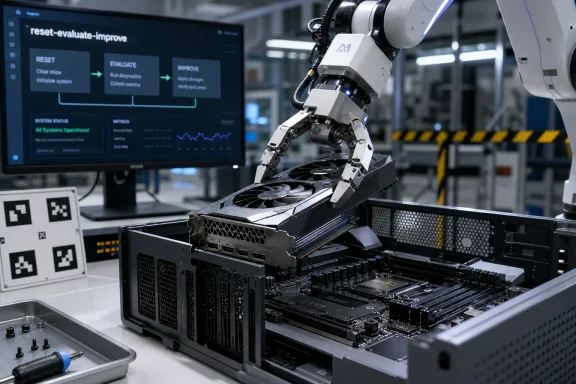
Nvidia and academic collaborators on June 17, 2026, detailed ENPIRE, a robotics research framework that lets AI coding agents run real hardware experiments, verify results, rewrite policy code, and iterate toward tasks such as installing a GPU into a motherboard. The headline image is irresistible: a robot handling the kind of delicate PC-building move that makes even experienced humans slow down. But the bigger story is not that a machine can seat a graphics card. It is that Nvidia is trying to turn robotics research into a self-improving software pipeline.
The PC-builder angle is the perfect demo because GPU installation is both familiar and physically unforgiving. A graphics card has to be aligned with a PCIe slot, lowered cleanly, and seated without brute force. It is a task defined by contact, tolerance, and consequences — exactly the kind of thing that exposes the gap between a robot that looks smart in a video and a robot that can survive the messiness of the real world.
ENPIRE matters because it moves the AI-agent story out of the code editor and into the lab bench. Software agents can already write tests, inspect logs, and revise programs. Nvidia’s claim here is that the same loop can be extended to physical experimentation: the agent proposes a change, the robot tries it, the system judges the result, and the agent rewrites the policy.
That is a different kind of robotics progress from a polished one-off demo. It suggests a future where robot development is less like hand-tuning a fragile prototype and more like running a continuous integration system — except the test runner has motors, cameras, grippers, and the ability to break things.
That mundane reset step is one reason real-world robot learning has lagged behind simulation-heavy AI. A lab can scale compute, but it cannot always scale the number of humans willing to stand beside a robot all day, reset the scene, label the outcome, and decide whether the next run is safe enough to try. ENPIRE’s wager is that this bottleneck can be attacked directly.
The framework reportedly breaks the loop into modules for resetting the environment, running physical trials, improving policy code, and sharing successful ideas across agents. That may sound bureaucratic, but it is exactly the kind of scaffolding robotics needs if it is going to absorb the productivity gains that coding agents brought to software development.
The important phrase is closed loop. A robot that can perform a task after extensive human preparation is useful. A system that can manage repeated attempts, evaluate itself, and improve without a person stepping in between every run is infrastructure.
But ENPIRE is interesting precisely because it does not pretend simulation is enough. Contact-rich manipulation — inserting pins, routing straps, seating expansion cards — is where the real world keeps humiliating clean digital models. Friction varies. Lighting changes. Parts flex. Sensors lie. A millimeter can decide whether a policy succeeds or fails.
The reported Push-T results are a useful reality check. Agents that solved the task in simulation did not all transfer cleanly to hardware. That is not a footnote; it is the central lesson. ENPIRE does not abolish the sim-to-real gap. It gives AI agents a way to discover that gap through repeated physical trials and then adapt around it.
That distinction matters for enterprise readers. The robotics industry is littered with demos that look inevitable until they leave the stage. The systems that will matter in factories, repair depots, labs, and warehouses are not the ones that never fail. They are the ones that can fail productively and recover faster than a human engineering team can manually diagnose every attempt.
That is a meaningful shift in how AI agents are being framed. In the first wave, agents were marketed as assistants. Then they became junior developers. ENPIRE casts them as experimentalists — systems that can run a hypothesis against the physical world and update their own methods based on observed failure.
The Git-based coordination detail is especially telling. Rather than inventing an exotic orchestration layer, the framework reportedly lets agents share progress through the same version-control concepts software teams already use. A successful branch can propagate. A failed idea can be pruned. Research becomes something closer to a distributed engineering workflow.
That does not mean the agents are “scientists” in the romantic sense. They are not deciding what robotics should be for, what risks are acceptable, or what safety margin a deployment requires. But they may be increasingly capable of taking over the repetitive experimental grind that makes robotics research expensive and slow.
That familiarity makes the demo easier to understand than a laboratory benchmark. Everyone who has built a gaming rig or workstation knows there is a gap between “the card fits” and “the card is seated correctly.” A robot solving that problem points toward a world where machines can handle more of the physical assembly and repair tasks that still depend on trained hands.
But it would be a mistake to jump straight from one demo to automated PC repair shops. A lab robot inserting a GPU under controlled conditions is not the same as a general-purpose service robot diagnosing a random ATX build with sagging cables, aftermarket brackets, dust, broken retention clips, and a user’s questionable cable-management choices.
The value is narrower and more immediate. ENPIRE shows how AI agents could accelerate the development of robotic skills for precise, repeatable, hardware-adjacent tasks. The path from there to mass deployment still runs through reliability testing, safety validation, cost control, and a brutal amount of edge-case engineering.
That is why ENPIRE fits the company’s 2026 messaging so neatly. Nvidia has spent the year emphasizing robotics, autonomous systems, Cosmos, Isaac, GR00T, Jetson, and the idea that AI is moving from screens into machines. ENPIRE gives that story a research-lab proof point: not just models that reason about the physical world, but agents that can use robots to improve their own behavior in it.
The business logic is clear. If robotics development becomes more automated, the demand for compute does not disappear. It likely grows. More agents running more experiments, more video analysis, more policy training, more simulation, more edge deployment — all of it feeds the appetite for accelerated computing.
That does not invalidate the research. It does mean we should read Nvidia’s framing with the usual vendor filter. The company is not a neutral observer of the robotics future. It is building the roads, selling the trucks, and publishing maps showing why everyone should drive farther.
ENPIRE appears aimed at controlled research environments, not unsupervised deployment in public or consumer spaces. That boundary matters. A robot station designed for autonomous trials can be instrumented, bounded, monitored, and reset in ways that a normal workplace cannot.
Even so, the framework’s premise creates a validation challenge. The faster agents can generate policy changes, the faster a lab must decide which changes are safe to run. Autonomy in experimentation does not remove the need for safety engineering; it shifts that need into the design of the environment, the evaluator, the task constraints, and the kill mechanisms.
This is where IT pros should be skeptical in a productive way. The world has learned, painfully, that automation without observability becomes a liability. If physical AI is going to enter factories, depots, hospitals, and offices, administrators will want logs, rollback, access control, auditability, and policy enforcement — the same boring disciplines that made enterprise software survivable.
If ENPIRE becomes a real open framework rather than a promotional artifact, it could give universities and robotics startups a common language for agent-driven physical experimentation. That would be useful even for teams that do not reproduce Nvidia’s exact GPU insertion setup. The reset-evaluate-improve pattern is portable, even when the hardware is not.
The catch is cost. Fleet scaling reportedly reduces wall-clock time, but it consumes more robot time, more tokens, more compute, and more coordination overhead. That is not a problem for Nvidia’s marketing department. It is a problem for labs with limited hardware budgets and for companies that need to justify automation against human labor and conventional fixtures.
The likely near-term winners are well-funded research groups, industrial automation teams, and companies already invested in Nvidia’s robotics stack. The long-term impact depends on whether the framework can be made boring enough for ordinary engineers to use.
ENPIRE points toward that kind of change. If robots can reset their own scenes and agents can run experiments around the clock, the limiting factor shifts from manual trial management to the quality of evaluation, the design of tasks, and the economics of compute. That is a profound shift, even if today’s system is still confined to carefully prepared research stations.
For Windows users and PC enthusiasts, the story is also a reminder that AI’s physical turn will not stay in warehouses and automotive labs. The same techniques used to seat a GPU could eventually influence electronics assembly, device refurbishment, data-center maintenance, and hardware testing. The machines that build and service our computers may become some of the earliest beneficiaries of AI systems trained to manipulate parts with human-like patience and machine-like repetition.
 Nvidia’s GPU-Installing Robot Is Really a Research Automation Story
The PC-builder angle is the perfect demo because GPU installation is both familiar and physically unforgiving. A graphics card has to be aligned with a PCIe slot, lowered cleanly, and seated without brute force. It is a task defined by contact, tolerance, and consequences — exactly the kind of thing that exposes the gap between a robot that looks smart in a video and a robot that can survive the messiness of the real world.ENPIRE matters because it moves the AI-agent story out of the code editor and into the lab bench. Software agents can already write tests, inspect logs, and revise programs. Nvidia’s claim here is that the same loop can be extended to physical experimentation: the agent proposes a change, the robot tries it, the system judges the result, and the agent rewrites the policy.
That is a different kind of robotics progress from a polished one-off demo. It suggests a future where robot development is less like hand-tuning a fragile prototype and more like running a continuous integration system — except the test runner has motors, cameras, grippers, and the ability to break things.
The Human Reset Was the Hidden Bottleneck
Robotics has always had a speed problem. In software, a failed experiment can be rerun instantly. In robotics, a failed experiment can leave the object in the wrong place, the cable tangled, the tool dropped, or the scene physically invalid for the next attempt.That mundane reset step is one reason real-world robot learning has lagged behind simulation-heavy AI. A lab can scale compute, but it cannot always scale the number of humans willing to stand beside a robot all day, reset the scene, label the outcome, and decide whether the next run is safe enough to try. ENPIRE’s wager is that this bottleneck can be attacked directly.
The framework reportedly breaks the loop into modules for resetting the environment, running physical trials, improving policy code, and sharing successful ideas across agents. That may sound bureaucratic, but it is exactly the kind of scaffolding robotics needs if it is going to absorb the productivity gains that coding agents brought to software development.
The important phrase is closed loop. A robot that can perform a task after extensive human preparation is useful. A system that can manage repeated attempts, evaluate itself, and improve without a person stepping in between every run is infrastructure.
Simulation Still Has a Physics Problem
The last decade of robotics has leaned hard on simulation because simulation is cheap, fast, and safe. Nvidia itself has built much of its robotics strategy around simulated worlds, synthetic data, Isaac tooling, and GPU-accelerated training. That is not going away.But ENPIRE is interesting precisely because it does not pretend simulation is enough. Contact-rich manipulation — inserting pins, routing straps, seating expansion cards — is where the real world keeps humiliating clean digital models. Friction varies. Lighting changes. Parts flex. Sensors lie. A millimeter can decide whether a policy succeeds or fails.
The reported Push-T results are a useful reality check. Agents that solved the task in simulation did not all transfer cleanly to hardware. That is not a footnote; it is the central lesson. ENPIRE does not abolish the sim-to-real gap. It gives AI agents a way to discover that gap through repeated physical trials and then adapt around it.
That distinction matters for enterprise readers. The robotics industry is littered with demos that look inevitable until they leave the stage. The systems that will matter in factories, repair depots, labs, and warehouses are not the ones that never fail. They are the ones that can fail productively and recover faster than a human engineering team can manually diagnose every attempt.
Coding Agents Are Becoming Lab Technicians
The most provocative part of ENPIRE is not the robot arm. It is the role assigned to the coding agent. The agent is not merely generating a script once and handing it off. It is participating in the research cycle: reviewing traces, comparing attempts, editing policy code, and deciding what to test next.That is a meaningful shift in how AI agents are being framed. In the first wave, agents were marketed as assistants. Then they became junior developers. ENPIRE casts them as experimentalists — systems that can run a hypothesis against the physical world and update their own methods based on observed failure.
The Git-based coordination detail is especially telling. Rather than inventing an exotic orchestration layer, the framework reportedly lets agents share progress through the same version-control concepts software teams already use. A successful branch can propagate. A failed idea can be pruned. Research becomes something closer to a distributed engineering workflow.
That does not mean the agents are “scientists” in the romantic sense. They are not deciding what robotics should be for, what risks are acceptable, or what safety margin a deployment requires. But they may be increasingly capable of taking over the repetitive experimental grind that makes robotics research expensive and slow.
The GPU Demo Lands Because It Invades the PC Builder’s Workbench
For WindowsForum readers, the GPU insertion demo has a special charge. Installing a graphics card is not an abstract industrial manipulation task. It is a ritual of PC ownership: remove the side panel, line up the bracket, watch the slot latch, hope the cooler clears the cables, and apply just enough pressure to feel wrong without actually being wrong.That familiarity makes the demo easier to understand than a laboratory benchmark. Everyone who has built a gaming rig or workstation knows there is a gap between “the card fits” and “the card is seated correctly.” A robot solving that problem points toward a world where machines can handle more of the physical assembly and repair tasks that still depend on trained hands.
But it would be a mistake to jump straight from one demo to automated PC repair shops. A lab robot inserting a GPU under controlled conditions is not the same as a general-purpose service robot diagnosing a random ATX build with sagging cables, aftermarket brackets, dust, broken retention clips, and a user’s questionable cable-management choices.
The value is narrower and more immediate. ENPIRE shows how AI agents could accelerate the development of robotic skills for precise, repeatable, hardware-adjacent tasks. The path from there to mass deployment still runs through reliability testing, safety validation, cost control, and a brutal amount of edge-case engineering.
Nvidia Is Selling the Workflow Around Physical AI
Nvidia’s broader strategy is not subtle. The company wants to be more than the supplier of GPUs that train models. It wants to own the stack around physical AI: simulation, synthetic data, robot foundation models, edge inference hardware, developer tooling, and now agentic research loops that tie real hardware back into training.That is why ENPIRE fits the company’s 2026 messaging so neatly. Nvidia has spent the year emphasizing robotics, autonomous systems, Cosmos, Isaac, GR00T, Jetson, and the idea that AI is moving from screens into machines. ENPIRE gives that story a research-lab proof point: not just models that reason about the physical world, but agents that can use robots to improve their own behavior in it.
The business logic is clear. If robotics development becomes more automated, the demand for compute does not disappear. It likely grows. More agents running more experiments, more video analysis, more policy training, more simulation, more edge deployment — all of it feeds the appetite for accelerated computing.
That does not invalidate the research. It does mean we should read Nvidia’s framing with the usual vendor filter. The company is not a neutral observer of the robotics future. It is building the roads, selling the trucks, and publishing maps showing why everyone should drive farther.
Automation Makes the Lab Faster, Not Magically Safer
The safety question sits under every claim about self-improving physical systems. A coding agent that writes a bad web app can create security problems. A coding agent that writes bad robot policy code can move hardware unpredictably in the same room as people, tools, fragile parts, and expensive equipment.ENPIRE appears aimed at controlled research environments, not unsupervised deployment in public or consumer spaces. That boundary matters. A robot station designed for autonomous trials can be instrumented, bounded, monitored, and reset in ways that a normal workplace cannot.
Even so, the framework’s premise creates a validation challenge. The faster agents can generate policy changes, the faster a lab must decide which changes are safe to run. Autonomy in experimentation does not remove the need for safety engineering; it shifts that need into the design of the environment, the evaluator, the task constraints, and the kill mechanisms.
This is where IT pros should be skeptical in a productive way. The world has learned, painfully, that automation without observability becomes a liability. If physical AI is going to enter factories, depots, hospitals, and offices, administrators will want logs, rollback, access control, auditability, and policy enforcement — the same boring disciplines that made enterprise software survivable.
The Open-Source Promise Will Decide Who Can Reproduce the Magic
According to reports, Nvidia plans to release ENPIRE as open source, though no specific date has been confirmed. That detail will matter almost as much as the paper itself. Robotics research is notoriously hard to reproduce because results depend on hardware, camera placement, calibration, parts, lighting, grippers, and dozens of small decisions that rarely survive the jump from lab to lab.If ENPIRE becomes a real open framework rather than a promotional artifact, it could give universities and robotics startups a common language for agent-driven physical experimentation. That would be useful even for teams that do not reproduce Nvidia’s exact GPU insertion setup. The reset-evaluate-improve pattern is portable, even when the hardware is not.
The catch is cost. Fleet scaling reportedly reduces wall-clock time, but it consumes more robot time, more tokens, more compute, and more coordination overhead. That is not a problem for Nvidia’s marketing department. It is a problem for labs with limited hardware budgets and for companies that need to justify automation against human labor and conventional fixtures.
The likely near-term winners are well-funded research groups, industrial automation teams, and companies already invested in Nvidia’s robotics stack. The long-term impact depends on whether the framework can be made boring enough for ordinary engineers to use.
The Agentic Robotics Story Has Crossed From Cute to Consequential
The easy reaction to the GPU video is amusement. The harder reaction is to recognize that robotics may be entering the same phase software entered when automated testing, CI/CD, and cloud infrastructure changed the tempo of development. The breakthrough was not that any one test became clever. The breakthrough was that iteration became cheap enough to reshape the culture around it.ENPIRE points toward that kind of change. If robots can reset their own scenes and agents can run experiments around the clock, the limiting factor shifts from manual trial management to the quality of evaluation, the design of tasks, and the economics of compute. That is a profound shift, even if today’s system is still confined to carefully prepared research stations.
For Windows users and PC enthusiasts, the story is also a reminder that AI’s physical turn will not stay in warehouses and automotive labs. The same techniques used to seat a GPU could eventually influence electronics assembly, device refurbishment, data-center maintenance, and hardware testing. The machines that build and service our computers may become some of the earliest beneficiaries of AI systems trained to manipulate parts with human-like patience and machine-like repetition.
The Real Lesson From Nvidia’s Robot Bench
ENPIRE is not proof that general-purpose household robots are around the corner, and it is not proof that AI agents can be trusted to improvise around expensive hardware without guardrails. It is evidence of something more specific and more important: Nvidia and its research partners are attacking the cycle time of robotics itself.- Nvidia’s ENPIRE framework reportedly lets AI coding agents run physical robot trials, evaluate outcomes, revise policy code, and continue iterating without human intervention between attempts.
- The GPU installation demo is compelling because it involves high-precision contact, not because it proves robots can handle arbitrary PC repair.
- The framework does not eliminate the sim-to-real gap, but it gives agents a faster way to learn from real-world failures.
- The system still requires task-specific setup, including self-resetting environments and reliable auto-evaluation pipelines.
- Fleet scaling can shorten research time, but it also raises compute, token, coordination, and hardware costs.
- The promised open-source release will determine whether ENPIRE becomes a reproducible research tool or remains mostly a showcase for Nvidia’s physical AI stack.
References
- Primary source: Tom's Hardware
Published: Wed, 17 Jun 2026 12:06:48 GMT
- Independent coverage: Decrypt
Published: Wed, 17 Jun 2026 20:16:27 GMT
Nvidia Built Robots That Train Themselves Using AI Coding Agents - Decrypt
Nvidia's ENPIRE hands an entire robot fleet to coding agents like Codex and Claude Code, letting them write training code, test it on real hardware, and improve without a human watching.decrypt.co - Independent coverage: Tech Times
Published: 2026-06-17T20:10:54.421690
NVIDIA ENPIRE Closes the Loop: AI Agents Now Run Robotics Research on Real Hardware
NVIDIA ENPIRE robot learning framework — released June 17 by NVIDIA GEAR Lab, CMU, and UC Berkeley — lets AI coding agents autonomously run robotics experiments on real hardware, achieving 99%www.techtimes.com - Independent coverage: the-decoder.com
Published: Wed, 17 Jun 2026 14:58:07 GMT
Nvidia research shows robots that train themselves through AI coding agents
Researchers from Nvidia, Carnegie Mellon University, and UC Berkeley are using AI coding agents to teach robots dexterous grasping in the real world. A fleet of eight robots hits up to 99 percent success on tricky tasks.the-decoder.com - Related coverage: blogs.nvidia.com
NVIDIA Enables the Next Era Of Physical AI Research With Agent Skills For Autonomous Vehicles, Robotics And Vision AI | NVIDIA Blog
New physical AI agent skills, powered by NVIDIA Cosmos 3, help researchers accelerate data generation, simulation, policy training and evaluation for autonomous system development.blogs.nvidia.com - Related coverage: research.nvidia.com
GEAR - Generalist Embodied Agent Research
Building Generally Capable Agents in Many Worlds, Virtual and Realresearch.nvidia.com
- Related coverage: nvidia.com
Research at NVIDIA
NVIDIA Research is passionate about developing the technology and finding the breakthroughs that bring positive change to the world.www.nvidia.com - Related coverage: techcrunch.com
Nvidia wants to be the Android of generalist robotics | TechCrunch
Nvidia unveiled a full-stack robotics ecosystem at CES 2026, including foundation models, simulation tools, and hardware. It wants to be the default platform for robotics.techcrunch.com - Related coverage: trendforce.com
[Insights] NVIDIA Expands Robotics Ecosystem at GTC as Physical AI Moves Toward Large-Scale Deployment
NVIDIA showcased its robotics technologies at GTC 2026. According to TrendForce, the company integrated Cosmos, Isaac, and GR00T to link virtual simul...www.trendforce.com - Related coverage: nvidianews.nvidia.com
- Related coverage: news.synopsys.com
Synopsys Showcases NVIDIA Partnership Impact and Ecosystem Innovation at GTC 2026 - Mar 16, 2026
PDF documentnews.synopsys.com
