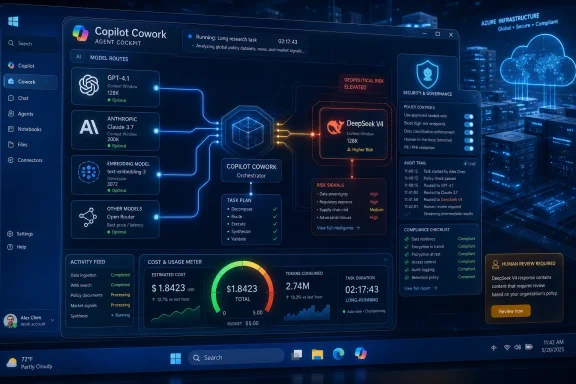
Microsoft is considering a Microsoft-hosted version of DeepSeek-V4 as a lower-cost model option for Copilot Cowork on June 16, 2026, as it moves the enterprise AI agent toward usage-based pricing and a broader multi-model strategy inside Microsoft 365. The choice is not merely a procurement tweak. It is a test of whether Microsoft can make AI economics work without remaining permanently captive to OpenAI, Anthropic, or any other single frontier-model supplier. It is also a test of whether Washington will tolerate a U.S. software giant wrapping a Chinese-origin open-weight model in Azure compliance controls and selling it to enterprise customers.
The immediate issue is simple: agents are expensive in a way chatbots were not. A chatbot answers a prompt; an agent keeps working, planning, reading, calling tools, retrying, and burning tokens while the user goes back to email. That difference turns AI from a feature into a metered utility, and it explains why Microsoft is now talking about Copilot Cowork in the language of compute consumption rather than unlimited productivity magic.
Copilot Cowork sits in the category Microsoft and its rivals have spent the last year hyping hardest: agentic AI for office work. These systems are meant to do more than summarize a document or draft a reply. They are supposed to coordinate tasks, manipulate files, reason across enterprise data, and behave less like a search box than a junior colleague with access to the corporate nervous system.
That pitch breaks if the meter spins too fast. Microsoft reportedly found that Copilot Cowork could not be offered responsibly on an all-you-can-eat basis, which is another way of saying that the most exciting AI demos are often the least compatible with predictable software margins. The company can either charge customers by usage, absorb runaway inference costs, or find cheaper models for work that does not require the most expensive intelligence available.
DeepSeek enters this story because price has become strategy. If a modified, self-hosted DeepSeek-V4 can handle enough Copilot Cowork tasks at acceptable quality, Microsoft gets a pressure valve. Customers get a cheaper tier. Microsoft gets leverage over model suppliers. The model providers get a reminder that their pricing power is not infinite.
That was useful when GPT-class models were the clear center of gravity. It became less comfortable once AI moved from novelty to operating cost. A productivity suite vendor does not want its most important new margin engine controlled by a partner with its own ambitions, its own pricing model, and its own direct enterprise relationships.
Microsoft has been steadily loosening that dependency. Copilot experiences have already expanded beyond a single-model worldview, with Anthropic models entering parts of the Microsoft 365 Copilot stack and Microsoft’s own model families showing up in more places. Azure AI Foundry, meanwhile, is explicitly built around model choice: OpenAI, Microsoft models, DeepSeek, Meta, Hugging Face, Grok, Mistral, and others all sit inside a catalog that tells customers the future is plural.
The DeepSeek report is therefore not an abrupt ideological turn. It is the logical endpoint of Microsoft’s platform instincts. Windows succeeded because Microsoft made the operating layer more important than any one application. Azure succeeded by turning infrastructure into a control plane for other people’s software. Copilot only becomes a durable Microsoft business if the orchestration layer matters more than whichever model happens to be fashionable this quarter.
That “good enough” threshold matters. Not every Copilot Cowork task requires the most powerful model Microsoft can access. An agent that classifies messages, drafts internal summaries, extracts fields, prepares routine research, or performs long-context document review may benefit more from cost efficiency and context length than from a marginal benchmark win. If Microsoft can route work across models intelligently, the premium model becomes the specialist rather than the default.
But DeepSeek carries geopolitical baggage that Claude or GPT does not. It is a Chinese-origin model family in a policy climate that increasingly treats AI capability as a national-security asset. Even if Microsoft hosts the model entirely in Azure, keeps customer data inside Microsoft’s cloud, and applies enterprise compliance and data-residency controls, the branding alone invites scrutiny.
That scrutiny will not be purely technical. A self-hosted model is not the same as sending prompts to a foreign API, but Washington’s AI politics are not always interested in that distinction. Policymakers who worry about training provenance, model behavior, censorship tendencies, export controls, or strategic dependence may still see a DeepSeek-powered Copilot feature as an unacceptable normalization of Chinese AI inside U.S. enterprise infrastructure.
That distinction is real. Enterprises already make similar judgments when they use open-source databases, Linux distributions, container images, cryptographic libraries, and machine-learning models with globally distributed origins. The legal and operational question is often not “Where did the code begin?” but “Who operates it, who updates it, who can access the data, and what contractual controls apply?”
Still, AI models are not ordinary software packages. Their behavior is probabilistic, their training data can be murky, and their safety properties are harder to audit than a conventional library. A model can be hosted in Azure and still raise questions about embedded biases, refusal behavior, susceptibility to manipulation, or whether its outputs reflect politically constrained training.
For sysadmins and IT architects, that means Azure hosting is necessary but insufficient. The enterprise review will need to cover data flow, logging, retention, model update cadence, evaluation results, red-team findings, contractual indemnities, and whether customers can disable or select models by workload. Microsoft can reduce the risk surface, but it cannot make the model’s origin disappear.
Against that backdrop, Microsoft considering DeepSeek for Copilot Cowork is more than a vendor-management story. It puts two U.S. policy impulses in conflict. One impulse wants American AI companies to dominate global markets. The other wants to restrict foreign or potentially adversarial AI capabilities from becoming embedded in critical workflows.
A Microsoft-hosted DeepSeek option sits awkwardly between those positions. It is an American cloud company controlling the deployment, billing, customer relationship, and compliance perimeter. But it is also a Chinese-origin model potentially performing enterprise work inside Microsoft 365, the productivity layer used across corporate, government, education, and regulated environments.
That is exactly the kind of ambiguity regulators dislike. If the government blesses it, critics will say Washington is letting Chinese AI into the enterprise through the Azure side door. If it blocks it, customers abroad will hear a different message: U.S. cloud AI can be politically switched off, and model sovereignty is not a theoretical concern.
At another level, it is a Microsoft strategy memo in public. If models become interchangeable components inside an enterprise learning system, Microsoft wins. The company owns the identity layer, the productivity suite, the developer platform, the security tooling, the cloud control plane, and the business data connectors. In that world, the model is important, but it is not sovereign.
DeepSeek fits that worldview perfectly. It is not about Microsoft deciding that a Chinese model is inherently better than Anthropic or OpenAI. It is about proving that Copilot can route tasks across a portfolio of models, each chosen for a blend of price, latency, capability, compliance, and customer preference. The more substitutable the model becomes, the more durable Microsoft’s orchestration layer becomes.
That is also why OpenAI should read this as a warning even if DeepSeek never ships in Copilot Cowork. Microsoft does not need to replace frontier models wholesale to weaken their leverage. It only needs credible alternatives for enough work that “use the most expensive model for everything” stops being the default assumption.
Those questions are not bureaucratic nitpicks. Agentic AI is dangerous precisely because it acts across systems. A model embedded in Copilot Cowork may touch email, SharePoint, Teams, OneDrive, line-of-business documents, calendars, and workflow automation. The model is only one part of the risk; the permissions wrapped around it are often the larger concern.
Microsoft has an advantage here because it can integrate model choice with familiar enterprise controls. Purview, Entra, Defender, sensitivity labels, audit logs, data-loss prevention, and Azure policy are the kind of unglamorous machinery that makes CIOs more comfortable saying yes. But comfort depends on visibility. A multi-model Copilot that behaves like a black box will be a governance nightmare.
This is where Microsoft’s consumer and enterprise instincts diverge. Consumers may not care which model answered a question. Enterprises absolutely will. If Copilot Cowork becomes a model marketplace hidden behind a friendly brand, admins will demand switches, logs, assurances, and contractual language before they let it near sensitive work.
That is why “tokenmaxxing” has moved from joke to business problem. Power users can turn a fixed-price AI plan into a loss leader by asking agents to run long coding sessions, analyze giant document sets, or iterate through complex workflows. Vendors have responded with caps, credits, premium tiers, and compute-based billing because the alternative is subsidizing the most expensive customers indefinitely.
For Microsoft, the danger is reputational as much as financial. Copilot was sold as a productivity revolution, not a slot machine for tokens. If customers feel every useful agentic workflow triggers a surprise bill, adoption slows. If Microsoft hides the cost, margins suffer. If it lowers the cost with cheaper models, it has a fighting chance to make agentic AI feel like software again.
DeepSeek is therefore not just a model candidate. It is a pricing instrument. A cheaper model tier lets Microsoft preserve the dream of broadly deployed AI labor without forcing every workflow through premium inference. The quality bar remains high, but the economic bar may be even higher.
That culture is now arriving in Microsoft 365. Office workers may not talk about tokens, but finance departments will. Legal teams will care whether long-context review can be done cheaply enough to scale. Operations teams will ask whether an agent that monitors tickets or drafts reports needs a premium model every minute of the day.
Microsoft’s challenge is to make model selection invisible when it should be invisible and controllable when it must be controlled. That is harder than it sounds. Too much abstraction makes admins nervous. Too much choice makes users confused. Too much cost optimization makes everyone wonder whether they are getting the discount model for important work.
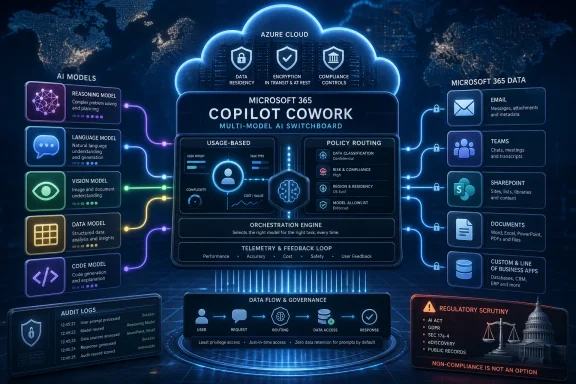
The winning design is probably policy-driven routing. The user asks Copilot Cowork to do a job; Microsoft routes it according to workload, data sensitivity, tenant policy, budget, and performance needs. If DeepSeek is in that portfolio, it should appear as an admin-governed option, not as a surprise ingredient.
Infrastructure is not sentimental. It is routed, benchmarked, metered, cached, governed, deprecated, and replaced. Microsoft knows this better than almost anyone. The company that once sold shrink-wrapped software now runs planetary-scale cloud services where tiny efficiency gains become enormous financial advantages.
That is the lens through which to view this move. Microsoft is not flirting with DeepSeek because it wants a geopolitical fight. It is doing so because the AI stack is becoming too expensive and too strategically important to leave in the hands of a few suppliers. A model portfolio is the natural response to supplier concentration, price volatility, and uncertain regulation.
The irony is that the more Microsoft succeeds at making models interchangeable, the more political the model layer becomes. A cheap open-weight model is attractive because it reduces dependence on U.S. frontier labs. It is controversial because it may increase dependence on technology associated with China. In AI, diversification and sovereignty are no longer automatically aligned.
The concrete implications are already visible:
 Microsoft’s AI Bill Has Become the Product Roadmap
The immediate issue is simple: agents are expensive in a way chatbots were not. A chatbot answers a prompt; an agent keeps working, planning, reading, calling tools, retrying, and burning tokens while the user goes back to email. That difference turns AI from a feature into a metered utility, and it explains why Microsoft is now talking about Copilot Cowork in the language of compute consumption rather than unlimited productivity magic.Copilot Cowork sits in the category Microsoft and its rivals have spent the last year hyping hardest: agentic AI for office work. These systems are meant to do more than summarize a document or draft a reply. They are supposed to coordinate tasks, manipulate files, reason across enterprise data, and behave less like a search box than a junior colleague with access to the corporate nervous system.
That pitch breaks if the meter spins too fast. Microsoft reportedly found that Copilot Cowork could not be offered responsibly on an all-you-can-eat basis, which is another way of saying that the most exciting AI demos are often the least compatible with predictable software margins. The company can either charge customers by usage, absorb runaway inference costs, or find cheaper models for work that does not require the most expensive intelligence available.
DeepSeek enters this story because price has become strategy. If a modified, self-hosted DeepSeek-V4 can handle enough Copilot Cowork tasks at acceptable quality, Microsoft gets a pressure valve. Customers get a cheaper tier. Microsoft gets leverage over model suppliers. The model providers get a reminder that their pricing power is not infinite.
The OpenAI Marriage Was Never Going to Stay Monogamous
Microsoft’s relationship with OpenAI reshaped the software industry, but it also created a strategic discomfort that was obvious from the beginning. Microsoft poured capital, cloud capacity, and distribution into OpenAI, then built Copilot branding across Windows, GitHub, Microsoft 365, security tools, and developer products. For a while, “Copilot” and “OpenAI-backed” felt almost interchangeable.That was useful when GPT-class models were the clear center of gravity. It became less comfortable once AI moved from novelty to operating cost. A productivity suite vendor does not want its most important new margin engine controlled by a partner with its own ambitions, its own pricing model, and its own direct enterprise relationships.
Microsoft has been steadily loosening that dependency. Copilot experiences have already expanded beyond a single-model worldview, with Anthropic models entering parts of the Microsoft 365 Copilot stack and Microsoft’s own model families showing up in more places. Azure AI Foundry, meanwhile, is explicitly built around model choice: OpenAI, Microsoft models, DeepSeek, Meta, Hugging Face, Grok, Mistral, and others all sit inside a catalog that tells customers the future is plural.
The DeepSeek report is therefore not an abrupt ideological turn. It is the logical endpoint of Microsoft’s platform instincts. Windows succeeded because Microsoft made the operating layer more important than any one application. Azure succeeded by turning infrastructure into a control plane for other people’s software. Copilot only becomes a durable Microsoft business if the orchestration layer matters more than whichever model happens to be fashionable this quarter.
DeepSeek Is Cheap, Capable, and Politically Radioactive
DeepSeek’s appeal is not hard to understand. Its models have been associated with unusually low inference costs, strong reasoning and coding performance, and open-weight availability that makes them attractive to companies trying to avoid dependence on closed U.S. APIs. For enterprises, the key question is not whether DeepSeek is glamorous. It is whether it is good enough for enough tasks to lower the blended cost of AI work.That “good enough” threshold matters. Not every Copilot Cowork task requires the most powerful model Microsoft can access. An agent that classifies messages, drafts internal summaries, extracts fields, prepares routine research, or performs long-context document review may benefit more from cost efficiency and context length than from a marginal benchmark win. If Microsoft can route work across models intelligently, the premium model becomes the specialist rather than the default.
But DeepSeek carries geopolitical baggage that Claude or GPT does not. It is a Chinese-origin model family in a policy climate that increasingly treats AI capability as a national-security asset. Even if Microsoft hosts the model entirely in Azure, keeps customer data inside Microsoft’s cloud, and applies enterprise compliance and data-residency controls, the branding alone invites scrutiny.
That scrutiny will not be purely technical. A self-hosted model is not the same as sending prompts to a foreign API, but Washington’s AI politics are not always interested in that distinction. Policymakers who worry about training provenance, model behavior, censorship tendencies, export controls, or strategic dependence may still see a DeepSeek-powered Copilot feature as an unacceptable normalization of Chinese AI inside U.S. enterprise infrastructure.
Azure Hosting Is Microsoft’s Best Defense, but Not a Force Field
Microsoft’s likely argument is straightforward: if customers choose DeepSeek inside Copilot Cowork, they would not be handing sensitive corporate data to a Chinese service. They would be using a Microsoft-hosted version running in Azure, subject to Microsoft’s enterprise security, compliance, governance, and residency commitments. In cloud terms, Microsoft wants the conversation to be about deployment architecture, not nationality.That distinction is real. Enterprises already make similar judgments when they use open-source databases, Linux distributions, container images, cryptographic libraries, and machine-learning models with globally distributed origins. The legal and operational question is often not “Where did the code begin?” but “Who operates it, who updates it, who can access the data, and what contractual controls apply?”
Still, AI models are not ordinary software packages. Their behavior is probabilistic, their training data can be murky, and their safety properties are harder to audit than a conventional library. A model can be hosted in Azure and still raise questions about embedded biases, refusal behavior, susceptibility to manipulation, or whether its outputs reflect politically constrained training.
For sysadmins and IT architects, that means Azure hosting is necessary but insufficient. The enterprise review will need to cover data flow, logging, retention, model update cadence, evaluation results, red-team findings, contractual indemnities, and whether customers can disable or select models by workload. Microsoft can reduce the risk surface, but it cannot make the model’s origin disappear.
Washington Just Made Model Choice a Compliance Problem
The timing could hardly be more combustible. The Trump administration has recently shown a willingness to intervene directly in access to advanced AI models on national-security grounds, including the high-profile order affecting Anthropic’s latest Fable and Mythos models. That episode rattled the industry because it suggested frontier models may be regulated not only through chips, exports, or cloud infrastructure, but through access to the model itself.Against that backdrop, Microsoft considering DeepSeek for Copilot Cowork is more than a vendor-management story. It puts two U.S. policy impulses in conflict. One impulse wants American AI companies to dominate global markets. The other wants to restrict foreign or potentially adversarial AI capabilities from becoming embedded in critical workflows.
A Microsoft-hosted DeepSeek option sits awkwardly between those positions. It is an American cloud company controlling the deployment, billing, customer relationship, and compliance perimeter. But it is also a Chinese-origin model potentially performing enterprise work inside Microsoft 365, the productivity layer used across corporate, government, education, and regulated environments.
That is exactly the kind of ambiguity regulators dislike. If the government blesses it, critics will say Washington is letting Chinese AI into the enterprise through the Azure side door. If it blocks it, customers abroad will hear a different message: U.S. cloud AI can be politically switched off, and model sovereignty is not a theoretical concern.
Nadella’s Ecosystem Argument Suddenly Looks Less Abstract
Satya Nadella’s recent “frontier without an ecosystem” argument reads differently in light of the DeepSeek report. At one level, it is a broad economic statement: AI value should not accrue only to a tiny number of frontier-model labs. Companies need learning loops, domain knowledge, tools, workflows, and human judgment around models, or else the model layer absorbs too much of the value.At another level, it is a Microsoft strategy memo in public. If models become interchangeable components inside an enterprise learning system, Microsoft wins. The company owns the identity layer, the productivity suite, the developer platform, the security tooling, the cloud control plane, and the business data connectors. In that world, the model is important, but it is not sovereign.
DeepSeek fits that worldview perfectly. It is not about Microsoft deciding that a Chinese model is inherently better than Anthropic or OpenAI. It is about proving that Copilot can route tasks across a portfolio of models, each chosen for a blend of price, latency, capability, compliance, and customer preference. The more substitutable the model becomes, the more durable Microsoft’s orchestration layer becomes.
That is also why OpenAI should read this as a warning even if DeepSeek never ships in Copilot Cowork. Microsoft does not need to replace frontier models wholesale to weaken their leverage. It only needs credible alternatives for enough work that “use the most expensive model for everything” stops being the default assumption.
Enterprise IT Will Ask the Boring Questions That Decide the Outcome
The public debate will focus on Trump, China, DeepSeek, and Microsoft’s post-OpenAI independence. Enterprise IT will focus on quieter questions that matter more in deployment. Can admins choose which model is used? Can regulated tenants block specific model families? Can usage be capped by department, workflow, geography, or sensitivity label? Can auditors see when DeepSeek was used and why?Those questions are not bureaucratic nitpicks. Agentic AI is dangerous precisely because it acts across systems. A model embedded in Copilot Cowork may touch email, SharePoint, Teams, OneDrive, line-of-business documents, calendars, and workflow automation. The model is only one part of the risk; the permissions wrapped around it are often the larger concern.
Microsoft has an advantage here because it can integrate model choice with familiar enterprise controls. Purview, Entra, Defender, sensitivity labels, audit logs, data-loss prevention, and Azure policy are the kind of unglamorous machinery that makes CIOs more comfortable saying yes. But comfort depends on visibility. A multi-model Copilot that behaves like a black box will be a governance nightmare.
This is where Microsoft’s consumer and enterprise instincts diverge. Consumers may not care which model answered a question. Enterprises absolutely will. If Copilot Cowork becomes a model marketplace hidden behind a friendly brand, admins will demand switches, logs, assurances, and contractual language before they let it near sensitive work.
The Pricing Shift Is the Real Admission
Usage-based pricing is often presented as fairness: customers pay for what they consume. In AI, it is also a confession that vendors do not yet know how to package agentic work into stable subscription economics. The familiar SaaS model assumes that most users do not consume the service heavily enough to destroy margins. Agents challenge that assumption because their whole purpose is to do more work than the user manually would.That is why “tokenmaxxing” has moved from joke to business problem. Power users can turn a fixed-price AI plan into a loss leader by asking agents to run long coding sessions, analyze giant document sets, or iterate through complex workflows. Vendors have responded with caps, credits, premium tiers, and compute-based billing because the alternative is subsidizing the most expensive customers indefinitely.
For Microsoft, the danger is reputational as much as financial. Copilot was sold as a productivity revolution, not a slot machine for tokens. If customers feel every useful agentic workflow triggers a surprise bill, adoption slows. If Microsoft hides the cost, margins suffer. If it lowers the cost with cheaper models, it has a fighting chance to make agentic AI feel like software again.
DeepSeek is therefore not just a model candidate. It is a pricing instrument. A cheaper model tier lets Microsoft preserve the dream of broadly deployed AI labor without forcing every workflow through premium inference. The quality bar remains high, but the economic bar may be even higher.
Developers Have Already Learned the Model Is a Commodity
The developer community reached this conclusion before the enterprise procurement world did. GitHub Copilot, Claude Code, Codex-style tools, local models, API proxies, and open-weight alternatives have created a culture where model switching is normal. Developers compare latency, context windows, reasoning quality, code accuracy, and cost with the same ruthlessness they once brought to cloud instances.That culture is now arriving in Microsoft 365. Office workers may not talk about tokens, but finance departments will. Legal teams will care whether long-context review can be done cheaply enough to scale. Operations teams will ask whether an agent that monitors tickets or drafts reports needs a premium model every minute of the day.
Microsoft’s challenge is to make model selection invisible when it should be invisible and controllable when it must be controlled. That is harder than it sounds. Too much abstraction makes admins nervous. Too much choice makes users confused. Too much cost optimization makes everyone wonder whether they are getting the discount model for important work.
The winning design is probably policy-driven routing. The user asks Copilot Cowork to do a job; Microsoft routes it according to workload, data sensitivity, tenant policy, budget, and performance needs. If DeepSeek is in that portfolio, it should appear as an admin-governed option, not as a surprise ingredient.
The DeepSeek Option Would Mark Microsoft’s Real Break From AI Romanticism
The first phase of the Copilot era was romantic. AI was described as a companion, assistant, coworker, and creative partner. The demos were fluid, the branding was soft, and the economics were someone else’s problem. The DeepSeek discussion belongs to the second phase, where AI becomes infrastructure and infrastructure gets optimized.Infrastructure is not sentimental. It is routed, benchmarked, metered, cached, governed, deprecated, and replaced. Microsoft knows this better than almost anyone. The company that once sold shrink-wrapped software now runs planetary-scale cloud services where tiny efficiency gains become enormous financial advantages.
That is the lens through which to view this move. Microsoft is not flirting with DeepSeek because it wants a geopolitical fight. It is doing so because the AI stack is becoming too expensive and too strategically important to leave in the hands of a few suppliers. A model portfolio is the natural response to supplier concentration, price volatility, and uncertain regulation.
The irony is that the more Microsoft succeeds at making models interchangeable, the more political the model layer becomes. A cheap open-weight model is attractive because it reduces dependence on U.S. frontier labs. It is controversial because it may increase dependence on technology associated with China. In AI, diversification and sovereignty are no longer automatically aligned.
The Copilot Cowork Bet Comes Down to Control
Microsoft’s reported DeepSeek testing should be judged less by the name of the model and more by the control surface around it. If Microsoft can give enterprises transparent choice, strong isolation, clear auditability, and credible performance tiers, a DeepSeek-backed option may become just another pragmatic tool in the Copilot stack. If it cannot, the model’s origin will become a proxy for every unresolved fear about agentic AI.The concrete implications are already visible:
- Microsoft is moving Copilot Cowork toward usage-based pricing because agentic AI workloads can consume far more compute than traditional subscription software can comfortably absorb.
- A Microsoft-hosted DeepSeek-V4 option would give Copilot Cowork a cheaper model tier while keeping deployment, customer data handling, and enterprise controls inside Azure.
- The move would further reduce Microsoft’s dependence on OpenAI and Anthropic, continuing its shift toward a multi-model Copilot architecture.
- Regulatory backlash is plausible because U.S. AI policy is increasingly treating model access, model origin, and national-security risk as connected issues.
- Enterprise adoption will depend on whether admins can approve, block, audit, and budget model usage at a granular level rather than trusting the Copilot brand as a blanket assurance.
References
- Primary source: Gizmodo
Published: 2026-06-16T21:34:14.693268
Microsoft Mulls China's DeepSeek for Copilot, Probably to Trump's Chagrin
Don't see this going over well. gizmodo.com
- Related coverage: axios.com
Microsoft explores DeepSeek for Copilot Cowork
Microsoft will also shift to usage-based pricing for the enterprise agent.www.axios.com
- Related coverage: techradar.com
'The last thing any of us want': Microsoft CEO Satya Nadella warns AI dominance could 'hollow out entire industries' | TechRadar
Satya Nadella says current AI transition is like early years of globalizationwww.techradar.com - Related coverage: frandroid.com
Satya Nadella : l'IA n'est pas qu'une question de modèle — Frandroid
Satya Nadella, CEO de Microsoft, a publié un long texte sur X où il invente deux notions : le « capital humain » et le « capital de tokens ». Derrière le vwww.frandroid.com - Related coverage: windowscentral.com
This is Microsoft's new "Copilot Cowork": An experiment with Anthropic's Claude AI models that plans and delegates your work | Windows Central
Microsoft ships Copilot Cowork to its Frontier program.www.windowscentral.com - Related coverage: tomshardware.com
Github Copilot customers report up to 100-fold price hikes — AI sticker shock bites as Microsoft switches to usage-based pricing | Tom's Hardware
The AI investment chickens have come home to roost.www.tomshardware.com
- Related coverage: bighatgroup.com
DeepSeek V4 for Microsoft-Shop Enterprises: A CIO's Decision Framework | Big Hat Group Inc.
DeepSeek V4 launched April 24 with a 1M-token context window and pricing 50x cheaper than Claude Opus. A decision framework for Microsoft-shop CIOs covering Azure deployment, Entity List risk, and governance.www.bighatgroup.com - Related coverage: venturebeat.com
DeepSeek-V4 arrives with near state-of-the-art intelligence at 1/6th the cost of Opus 4.7, GPT-5.5 | VentureBeat
DeepSeek's quest to keep frontier AI models open is of benefit to the entire planet of potential AI users, especially enterprises looking to adopt the cutting-edge at the lowest possible cost.venturebeat.com - Related coverage: geekwire.com
Microsoft's new Copilot Cowork integrates Anthropic's Claude in rollout of new E7 licensing tier – GeekWire
Microsoft is launching Copilot Cowork, a new AI assistant built with Anthropic that can run tasks in the background and work across Microsoft 365 apps, as part of a broader wave of updates including a new $99-per-user E7 licensing tier.www.geekwire.com - Related coverage: arstechnica.com
Anthropic shuts down Fable, Mythos models following Trump admin directive - Ars Technica
Commerce dept. worries that a Fable 5 "jailbreak" could be a national security threat.arstechnica.com