
Microsoft said on June 17, 2026, that codename MDASH, its multi-model agentic vulnerability-scanning system, has moved from benchmark validation into active use across Windows, Azure, and identity engineering workflows, with newly reported discoveries spanning Hyper-V, the Windows kernel, Active Directory, Remote Desktop, HTTP.sys, DNS, and DHCP. The company is not merely claiming a better scanner; it is arguing for a different tempo of software defense. If the pitch holds, security review stops being an episodic checkpoint and becomes a continuous, AI-assisted engineering loop. That is a big claim, and the interesting part is not the benchmark score—it is what happens when a benchmark-winning system starts touching production code.
For decades, the economics of vulnerability discovery have been lopsided in a way every Windows administrator understands instinctively. Attackers need one path in; defenders need enough coverage to make that path hard to find, hard to weaponize, and ideally short-lived once discovered. The problem is that modern platforms are too large, too old, and too interconnected for manual review to scale cleanly.
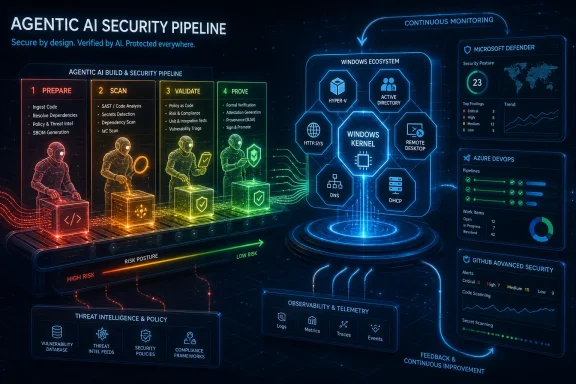
MDASH is Microsoft’s latest answer to that imbalance. The system, short for Microsoft Security’s multi-model agentic scanning harness, is designed to discover, validate, prove, and help remediate software vulnerabilities through a structured pipeline of specialized AI agents. It is not presented as a single magic model trained to “understand Windows,” but as an orchestration layer that breaks vulnerability research into smaller jobs.
That distinction matters. Security vendors have spent the last two years applying “AI” to everything from alert summarization to phishing triage, often with thin evidence that the model changed the underlying security outcome. MDASH is being positioned differently: as an engineering system meant to reason over source code, route work among specialist agents, validate findings, generate proof, and feed the result back into developer workflows.
The shift from “AI scanner” to “agentic pipeline” is where Microsoft’s argument becomes serious. A scanner that produces a pile of speculative warnings is just another queue for exhausted engineers. A system that can move a finding into GitHub Advanced Security, Azure DevOps, and Microsoft Defender with enough context to assign ownership and drive remediation is a different proposition.
Benchmarks are useful because they force claims into numbers. They are dangerous because numbers invite a false sense of completion. A 96.5 percent score sounds close to solved; in vulnerability discovery, the remaining percentage points may hide the exact cases that matter most in the real world.
Microsoft’s own post is unusually candid on that point. The company says MDASH still missed 52 tasks in its benchmark analysis, and most of the failures occurred not in the early discovery phase but in proof-of-concept generation. That tracks with what security researchers already know: finding a suspicious code path is one thing; constructing a reliable, valid input that reaches it in the right environment is another.
The most valuable part of the announcement is therefore not the top-line score. It is the taxonomy of failure. Microsoft is effectively saying that the system has become good enough at early bug discovery that the hard frontier is now proving exploitability across complex build systems, weird file formats, generated code, and target-specific harnesses.
That is a more believable story than “AI finds all bugs now.” It also suggests that the future of automated vulnerability discovery will be less about one model’s reasoning prowess and more about toolchains: fuzzing integration, build reproducibility, instrumentation, call graph accuracy, and the stubborn plumbing required to turn a hunch into a crash.
Kernel and hypervisor code have long been among the most sensitive parts of the Windows security model. A flaw there may turn a contained compromise into a system-level compromise, or create an escape route from an isolation boundary. Networking code, HTTP.sys, DNS, DHCP, and Remote Desktop sit close to untrusted input and operationally critical services. Active Directory remains the beating heart of many enterprise identity environments, and any remote code execution risk there deserves immediate attention from defenders.
The June cohort Microsoft describes includes high-severity and critical-class issues across exactly those layers. The list includes Hyper-V remote code execution flaws, a Windows kernel use-after-free rated 9.8, an HTTP.sys integer overflow rated 9.8, an Active Directory Domain Services stack-based buffer overflow rated 8.8, and a Remote Desktop Client heap-based buffer overflow rated 8.8. It also includes DNS Client elevation of privilege and DHCP Client information disclosure issues.
The company’s point is not that MDASH found garden-variety bugs in small open-source utilities. It is that the system is being turned loose on the kinds of proprietary, platform-specific codebases where context matters and where traditional review is both expensive and incomplete. Windows internals are not neatly summarized in a public training corpus. Hyper-V and kernel object lifetimes are not things a general-purpose chatbot can safely infer from vibes.
That is why the agentic framing is important. Microsoft is arguing that the surrounding system can supply structure that the model alone lacks: repository scoping, threat modeling, call graph construction, validation logic, proof attempts, and routing among agents. In other words, MDASH is less an oracle than an industrial process wrapped around probabilistic reasoning.
Microsoft says its recent gains came largely from the “prepare” and “scan” stages. The system now distinguishes more clearly between code under audit and contextual dependency code, improves threat modeling of attack surfaces, identifies entry points for untrusted input more effectively, strengthens call graph reliability, and routes tasks more intelligently to specialized agents. These are not glamorous upgrades, but they are exactly the kinds of changes that separate a demo from a production system.
Security people have seen this movie before. Static analysis tools often fail not because they cannot identify dangerous patterns, but because they lack enough context to distinguish reachable flaws from theoretical ones. Dynamic testing can find real crashes, but only if the harness, seed corpus, environment, and instrumentation cooperate. Human reviewers excel at judgment, but they are scarce and cannot continuously inspect every change across a hyperscale codebase.
MDASH is trying to combine those strengths while reducing their bottlenecks. The promise is that AI agents can do broader first-pass exploration, validation logic can cut down speculation, proof generation can convert plausible issues into concrete evidence, and DevSecOps integration can keep the result from becoming another orphaned security report.
The risk is that each stage also introduces its own failure mode. A bad scope can hide the vulnerable file. A weak call graph can make reachable code look unreachable. A speculative scan result can be rejected by validation. A valid finding can die in proof generation because the build environment is wrong or the input format is too structured. Microsoft’s write-up shows all of those things happening.
That should temper any breathless reading of the benchmark. In real vulnerability management, proof matters. A validated crash changes the conversation with an engineering team. It clarifies severity, reachability, reproducibility, and often root cause. Without it, even a good finding can become a negotiation between security and product teams.
Microsoft lists several reasons proof generation fails. Some targets require highly structured binary inputs, including formats such as fonts, PDFs, WPG, IVF, and AV1. Some attempts degraded into fuzzing until timeout. Some crashes reproduced locally but not in the evaluation harness. Some build processes were too complex, too slow, or mismatched with the target setup.
These are not edge cases; they are the normal texture of security research. Real codebases have build flags, generated files, platform assumptions, ancient dependencies, internal harnesses, and formats that punish approximate reasoning. An AI agent that can describe a likely bug but cannot navigate that operational mess is useful, but not revolutionary.
Microsoft’s proposed path forward is therefore telling. The company wants to integrate existing fuzzing ecosystems such as OSS-Fuzz, reuse build pipelines, draw from seed corpora, expand analysis beyond conventional source code to generated artifacts such as lex/yacc outputs, and tighten agent instructions and structured outputs. That is not a model-only roadmap. It is a systems engineering roadmap.
The most interesting example Microsoft gives involves a vague baseline finding that framed a use-after-free as a risk “if” cleanup code freed a pointer. A newer model instead identified a concrete path involving a destructor call and a freed parameter. That is exactly the difference between a bug-shaped idea and a finding that validation can reason about.
Still, Microsoft is careful not to overclaim. The proof-stage gains were real but more modest than the scan-stage gains, and the company says the dataset is not sufficient to conclude consistent superiority across all proof-of-concept tasks. That caution is warranted. Security workloads are heterogeneous, and a model that excels at one family of parsing bugs may stumble on another target with a hostile build system or obscure format semantics.
The broader lesson is that model improvement and pipeline improvement compound. Better models produce more concrete scan results; better pipelines give models better context and better routes to action. But neither replaces the other. A frontier model without a harness is a brilliant intern wandering a warehouse. A harness without sufficient reasoning is just a workflow engine.
For Microsoft, that complementarity is strategically convenient. The company can swap in stronger models over time while continuing to build proprietary advantage in integration, telemetry, internal code access, and enterprise workflows. For customers and competitors, it means the security tooling race will not be won simply by renting the best model API on a given Tuesday.
That integration is not a footnote. It is the difference between discovery as research and discovery as operations. Security teams already have enough portals. Developers already have enough dashboards. The only way a high-volume AI vulnerability system becomes useful is if it speaks the language of the software development lifecycle.
If MDASH can reliably attach findings to owners, pull requests, pipelines, and remediation work items, then Microsoft is not just finding bugs faster. It is trying to shorten the distance between “this code may be vulnerable” and “this change fixed it.” That distance is where many security programs lose momentum.
For enterprise IT, the appeal is obvious. The scariest bugs are not always the ones nobody knows about; they are the ones discovered internally, assigned vaguely, and left to drift because the fix path is unclear. A tool that ties vulnerability reasoning to build gates and developer workflow could make secure coding less dependent on heroic review cycles.
The counterweight is equally obvious. If the system is noisy, it will be routed around. If it blocks builds without convincing evidence, it will become a political problem. If it finds subtle issues but cannot explain them in developer-native terms, it will join the graveyard of security tools that technically worked and organizationally failed.
The right enterprise question is not whether AI can find vulnerabilities. It clearly can. The right question is whether AI-assisted findings can be trusted enough, explained enough, reproduced enough, and prioritized enough to change patching and development behavior.
In Microsoft’s own estate, MDASH has a privileged environment. It can be aimed at Windows, Azure, and identity systems by people who understand those codebases and can integrate deeply with internal tools. That is a best-case scenario for agentic security. Customer environments are more fragmented, with uneven build systems, third-party dependencies, legacy code, outsourced development, and compliance constraints.
That does not weaken the significance of the work. It simply locates it. MDASH is not a consumer antivirus feature with a new AI badge. It is a signal that hyperscale software vendors are beginning to embed AI vulnerability research directly into their development and security pipelines.
The long-term consequence could be substantial. If Microsoft can find and fix more platform vulnerabilities before Patch Tuesday, Windows users benefit even if they never see MDASH. If similar systems spread across major software vendors, the baseline for secure development may rise. But if attackers gain comparable automation faster than defenders operationalize it, the same technology widens the blast radius of offensive discovery.
For WindowsForum readers, the practical lesson is that AI-assisted discovery could make Patch Tuesday both better and more complicated. Better, because more bugs may be found before attackers exploit them. More complicated, because the volume and sophistication of vendor-discovered vulnerabilities may increase, forcing administrators to improve prioritization rather than simply watch headline severity.
A kernel RCE and an HTTP.sys RCE rated 9.8 will naturally command attention. Hyper-V bugs matter to virtualized environments. Active Directory flaws matter to domain-centric enterprises. Remote Desktop Client vulnerabilities matter in organizations where users connect to untrusted or semi-trusted systems. DNS and DHCP issues may look less glamorous, but they sit in traffic paths administrators cannot casually ignore.
The fact that MDASH found or helped surface these classes of issues does not change the basic advice: patch, test, stage, monitor, and understand exposure. What it changes is the upstream story. A future Patch Tuesday may increasingly reflect not only human research and external reporting, but internal AI systems constantly sweeping code before release.
That could also shift how defenders read Microsoft advisories. A vulnerability discovered by an internal agentic system before exploitation may carry a different risk profile from a bug already used in the wild. But defenders should avoid complacency. Once a patch ships, reverse engineering begins. AI may speed the defender’s clock, but it can also speed the attacker’s diffing, analysis, and exploit development.
Benchmarks reward what they can measure. If the task is reproducing known vulnerabilities under known constraints, systems will improve at that task. That is valuable, but it is not identical to discovering unknown vulnerabilities in a massive proprietary codebase where the interesting bug may be undocumented, the build target may be unclear, and the exploitability argument may depend on deployment context.
The next generation of security benchmarks will need to measure end-to-end workflows rather than isolated wins. Can the agent find a previously unknown issue? Can it prove reachability? Can it avoid false positives? Can it propose a minimal fix? Can it avoid introducing a regression? Can it explain the issue to a maintainer? Can it operate under realistic time and cost constraints?
That last point matters more than vendors like to admit. At enterprise scale, a security system that is technically impressive but economically irrational is a research artifact. Microsoft repeatedly emphasizes cost-efficient discovery and integrated remediation, which suggests the company knows that raw agent cycles are not free. The future will belong to systems that can decide when to reason deeply, when to fuzz, when to instrument, and when to stop.
A mature benchmark would also test the messy social layer of software security. Findings do not fix themselves. Someone has to accept the report, understand the root cause, make the change, run tests, and ship. If AI security systems are judged only by discovery, they will optimize for the most theatrical part of the job and neglect the part that actually reduces risk.
Microsoft’s own examples depend on human-shaped security judgment. The system must understand which targets matter, which inputs are untrusted, which findings are reachable, which proof strategies are worth trying, and which fixes can safely move through production pipelines. Those are not clerical tasks. They are the grammar of software security.
What changes is scale. A human security researcher can hold a complex bug in mind, but cannot hold all of Windows, Azure, Hyper-V, and Active Directory in mind at once. An agentic system can search broadly, revisit code repeatedly, and surface candidates that humans would not have time to inspect. The best use of AI here is not to replace the expert’s intuition; it is to buy that intuition more chances to matter.
That is especially relevant for old, critical code. Mature platforms accumulate invariants that are rarely written down completely. They contain paths nobody wants to touch, compatibility behaviors nobody wants to break, and interfaces whose threat models have changed over decades. An AI system that can help map and test that terrain is valuable precisely because the terrain is hostile to clean-sheet security review.
But the human role may become more demanding, not less. Security engineers will need to audit the auditors, tune the pipeline, interpret model output, decide when proof is sufficient, and make calls about remediation risk. The future security expert may spend less time manually hunting every candidate bug and more time supervising a fleet of semi-autonomous hunters.
For Windows and Microsoft-stack administrators, this is not a tool to deploy broadly tomorrow. It is a signal about how Microsoft’s own security engineering is changing, and about how future developer and defender products may behave. The company is clearly moving toward systems where source-code findings, runtime signals, threat intelligence, and remediation workflows are treated as one connected loop.
That loop will not eliminate Patch Tuesday pain. It will not make every CVE preventable. It will not stop attackers from using AI to accelerate their own research. But it may reduce the number of high-impact bugs that survive simply because no human team had enough hours to inspect the relevant corner of the codebase.
 Microsoft Wants Vulnerability Discovery to Move at Build-System Speed
For decades, the economics of vulnerability discovery have been lopsided in a way every Windows administrator understands instinctively. Attackers need one path in; defenders need enough coverage to make that path hard to find, hard to weaponize, and ideally short-lived once discovered. The problem is that modern platforms are too large, too old, and too interconnected for manual review to scale cleanly.MDASH is Microsoft’s latest answer to that imbalance. The system, short for Microsoft Security’s multi-model agentic scanning harness, is designed to discover, validate, prove, and help remediate software vulnerabilities through a structured pipeline of specialized AI agents. It is not presented as a single magic model trained to “understand Windows,” but as an orchestration layer that breaks vulnerability research into smaller jobs.
That distinction matters. Security vendors have spent the last two years applying “AI” to everything from alert summarization to phishing triage, often with thin evidence that the model changed the underlying security outcome. MDASH is being positioned differently: as an engineering system meant to reason over source code, route work among specialist agents, validate findings, generate proof, and feed the result back into developer workflows.
The shift from “AI scanner” to “agentic pipeline” is where Microsoft’s argument becomes serious. A scanner that produces a pile of speculative warnings is just another queue for exhausted engineers. A system that can move a finding into GitHub Advanced Security, Azure DevOps, and Microsoft Defender with enough context to assign ownership and drive remediation is a different proposition.
The Benchmark Was the Trailer, Not the Movie
Microsoft’s earlier MDASH announcement leaned heavily on CyberGym, a benchmark built around 1,507 real-world vulnerability tasks. In May, the company said MDASH had reached an 88.45 percent success rate on that benchmark, enough to top the published leaderboard at the time. By June, Microsoft was citing a 96.5 percent “any crash” result, with later experiments using newer models suggesting projected performance above 98 percent under certain assumptions.Benchmarks are useful because they force claims into numbers. They are dangerous because numbers invite a false sense of completion. A 96.5 percent score sounds close to solved; in vulnerability discovery, the remaining percentage points may hide the exact cases that matter most in the real world.
Microsoft’s own post is unusually candid on that point. The company says MDASH still missed 52 tasks in its benchmark analysis, and most of the failures occurred not in the early discovery phase but in proof-of-concept generation. That tracks with what security researchers already know: finding a suspicious code path is one thing; constructing a reliable, valid input that reaches it in the right environment is another.
The most valuable part of the announcement is therefore not the top-line score. It is the taxonomy of failure. Microsoft is effectively saying that the system has become good enough at early bug discovery that the hard frontier is now proving exploitability across complex build systems, weird file formats, generated code, and target-specific harnesses.
That is a more believable story than “AI finds all bugs now.” It also suggests that the future of automated vulnerability discovery will be less about one model’s reasoning prowess and more about toolchains: fuzzing integration, build reproducibility, instrumentation, call graph accuracy, and the stubborn plumbing required to turn a hunch into a crash.
The Windows Targets Are Where the Claim Gets Real
Microsoft says MDASH is now being applied across Windows, the kernel, Hyper-V, the networking stack, Azure virtualization and core infrastructure services, and identity systems including Active Directory Domain Services. That is not a random tour of the Microsoft estate. It is a list of places where bugs can become expensive quickly.Kernel and hypervisor code have long been among the most sensitive parts of the Windows security model. A flaw there may turn a contained compromise into a system-level compromise, or create an escape route from an isolation boundary. Networking code, HTTP.sys, DNS, DHCP, and Remote Desktop sit close to untrusted input and operationally critical services. Active Directory remains the beating heart of many enterprise identity environments, and any remote code execution risk there deserves immediate attention from defenders.
The June cohort Microsoft describes includes high-severity and critical-class issues across exactly those layers. The list includes Hyper-V remote code execution flaws, a Windows kernel use-after-free rated 9.8, an HTTP.sys integer overflow rated 9.8, an Active Directory Domain Services stack-based buffer overflow rated 8.8, and a Remote Desktop Client heap-based buffer overflow rated 8.8. It also includes DNS Client elevation of privilege and DHCP Client information disclosure issues.
The company’s point is not that MDASH found garden-variety bugs in small open-source utilities. It is that the system is being turned loose on the kinds of proprietary, platform-specific codebases where context matters and where traditional review is both expensive and incomplete. Windows internals are not neatly summarized in a public training corpus. Hyper-V and kernel object lifetimes are not things a general-purpose chatbot can safely infer from vibes.
That is why the agentic framing is important. Microsoft is arguing that the surrounding system can supply structure that the model alone lacks: repository scoping, threat modeling, call graph construction, validation logic, proof attempts, and routing among agents. In other words, MDASH is less an oracle than an industrial process wrapped around probabilistic reasoning.
The Pipeline Is the Product
One of the more revealing lines in Microsoft’s post is that “the model is one input, the system around it is the product.” That sentence should be read as both a technical claim and a market claim. In the AI security race, model quality matters, but durable advantage may come from the proprietary machinery that tells models what to inspect, how to reason, when to escalate, and how to translate output into work developers will actually do.Microsoft says its recent gains came largely from the “prepare” and “scan” stages. The system now distinguishes more clearly between code under audit and contextual dependency code, improves threat modeling of attack surfaces, identifies entry points for untrusted input more effectively, strengthens call graph reliability, and routes tasks more intelligently to specialized agents. These are not glamorous upgrades, but they are exactly the kinds of changes that separate a demo from a production system.
Security people have seen this movie before. Static analysis tools often fail not because they cannot identify dangerous patterns, but because they lack enough context to distinguish reachable flaws from theoretical ones. Dynamic testing can find real crashes, but only if the harness, seed corpus, environment, and instrumentation cooperate. Human reviewers excel at judgment, but they are scarce and cannot continuously inspect every change across a hyperscale codebase.
MDASH is trying to combine those strengths while reducing their bottlenecks. The promise is that AI agents can do broader first-pass exploration, validation logic can cut down speculation, proof generation can convert plausible issues into concrete evidence, and DevSecOps integration can keep the result from becoming another orphaned security report.
The risk is that each stage also introduces its own failure mode. A bad scope can hide the vulnerable file. A weak call graph can make reachable code look unreachable. A speculative scan result can be rejected by validation. A valid finding can die in proof generation because the build environment is wrong or the input format is too structured. Microsoft’s write-up shows all of those things happening.
Proof-of-Concept Generation Is Still the Hard Wall
The most sobering part of Microsoft’s analysis is where the misses cluster. Of the 52 benchmark tasks the system failed, 34 reportedly failed at the prove stage. That means the system often got far enough to have a candidate issue but could not generate a working proof-of-concept within the constraints of the task.That should temper any breathless reading of the benchmark. In real vulnerability management, proof matters. A validated crash changes the conversation with an engineering team. It clarifies severity, reachability, reproducibility, and often root cause. Without it, even a good finding can become a negotiation between security and product teams.
Microsoft lists several reasons proof generation fails. Some targets require highly structured binary inputs, including formats such as fonts, PDFs, WPG, IVF, and AV1. Some attempts degraded into fuzzing until timeout. Some crashes reproduced locally but not in the evaluation harness. Some build processes were too complex, too slow, or mismatched with the target setup.
These are not edge cases; they are the normal texture of security research. Real codebases have build flags, generated files, platform assumptions, ancient dependencies, internal harnesses, and formats that punish approximate reasoning. An AI agent that can describe a likely bug but cannot navigate that operational mess is useful, but not revolutionary.
Microsoft’s proposed path forward is therefore telling. The company wants to integrate existing fuzzing ecosystems such as OSS-Fuzz, reuse build pipelines, draw from seed corpora, expand analysis beyond conventional source code to generated artifacts such as lex/yacc outputs, and tighten agent instructions and structured outputs. That is not a model-only roadmap. It is a systems engineering roadmap.
Newer Models Help, but They Do Not Erase the Plumbing
Microsoft’s model experiments provide a useful corrective to both AI maximalists and AI skeptics. The company says it held the model configuration constant in its primary evaluation to isolate pipeline improvements, then separately tested newer models on the 52 previously failed cases. In those experiments, newer OpenAI models improved scan-stage precision, while GPT-5.5 and a cyber-specialized variant reportedly outperformed Claude Opus 4.6 on proof generation in that limited dataset.The most interesting example Microsoft gives involves a vague baseline finding that framed a use-after-free as a risk “if” cleanup code freed a pointer. A newer model instead identified a concrete path involving a destructor call and a freed parameter. That is exactly the difference between a bug-shaped idea and a finding that validation can reason about.
Still, Microsoft is careful not to overclaim. The proof-stage gains were real but more modest than the scan-stage gains, and the company says the dataset is not sufficient to conclude consistent superiority across all proof-of-concept tasks. That caution is warranted. Security workloads are heterogeneous, and a model that excels at one family of parsing bugs may stumble on another target with a hostile build system or obscure format semantics.
The broader lesson is that model improvement and pipeline improvement compound. Better models produce more concrete scan results; better pipelines give models better context and better routes to action. But neither replaces the other. A frontier model without a harness is a brilliant intern wandering a warehouse. A harness without sufficient reasoning is just a workflow engine.
For Microsoft, that complementarity is strategically convenient. The company can swap in stronger models over time while continuing to build proprietary advantage in integration, telemetry, internal code access, and enterprise workflows. For customers and competitors, it means the security tooling race will not be won simply by renting the best model API on a given Tuesday.
Defender, GitHub, and Azure DevOps Are the Real Distribution Channel
The most consequential part of MDASH may be where its findings land. Microsoft says validated findings can surface in GitHub Advanced Security as code scanning alerts, appear inline on pull requests and in repository security views, flow into Azure DevOps to gate builds and create work items, and enter Microsoft Defender where they can be prioritized alongside threat intelligence and runtime signals.That integration is not a footnote. It is the difference between discovery as research and discovery as operations. Security teams already have enough portals. Developers already have enough dashboards. The only way a high-volume AI vulnerability system becomes useful is if it speaks the language of the software development lifecycle.
If MDASH can reliably attach findings to owners, pull requests, pipelines, and remediation work items, then Microsoft is not just finding bugs faster. It is trying to shorten the distance between “this code may be vulnerable” and “this change fixed it.” That distance is where many security programs lose momentum.
For enterprise IT, the appeal is obvious. The scariest bugs are not always the ones nobody knows about; they are the ones discovered internally, assigned vaguely, and left to drift because the fix path is unclear. A tool that ties vulnerability reasoning to build gates and developer workflow could make secure coding less dependent on heroic review cycles.
The counterweight is equally obvious. If the system is noisy, it will be routed around. If it blocks builds without convincing evidence, it will become a political problem. If it finds subtle issues but cannot explain them in developer-native terms, it will join the graveyard of security tools that technically worked and organizationally failed.
The Enterprise Question Is Trust, Not Magic
Administrators and security leaders should resist reading MDASH as a reason to relax. The system is currently described primarily in Microsoft’s own engineering context and preview ecosystem, and the most sensitive details remain necessarily opaque. We know the classes of components, the benchmark figures, and the claimed workflow integrations; we do not know how the system performs across every messy enterprise codebase or how its confidence scoring behaves under pressure.The right enterprise question is not whether AI can find vulnerabilities. It clearly can. The right question is whether AI-assisted findings can be trusted enough, explained enough, reproduced enough, and prioritized enough to change patching and development behavior.
In Microsoft’s own estate, MDASH has a privileged environment. It can be aimed at Windows, Azure, and identity systems by people who understand those codebases and can integrate deeply with internal tools. That is a best-case scenario for agentic security. Customer environments are more fragmented, with uneven build systems, third-party dependencies, legacy code, outsourced development, and compliance constraints.
That does not weaken the significance of the work. It simply locates it. MDASH is not a consumer antivirus feature with a new AI badge. It is a signal that hyperscale software vendors are beginning to embed AI vulnerability research directly into their development and security pipelines.
The long-term consequence could be substantial. If Microsoft can find and fix more platform vulnerabilities before Patch Tuesday, Windows users benefit even if they never see MDASH. If similar systems spread across major software vendors, the baseline for secure development may rise. But if attackers gain comparable automation faster than defenders operationalize it, the same technology widens the blast radius of offensive discovery.
Patch Tuesday Becomes a Report Card for the AI Security Era
The June vulnerability list is a useful reminder that the output of this work still arrives in familiar packaging. CVEs, severity scores, Patch Tuesday, administrator triage, change windows, testing rings, emergency approvals, and the same uneasy calculation every IT shop makes when critical infrastructure needs updating. The AI may be new; the operational burden remains very recognizable.For WindowsForum readers, the practical lesson is that AI-assisted discovery could make Patch Tuesday both better and more complicated. Better, because more bugs may be found before attackers exploit them. More complicated, because the volume and sophistication of vendor-discovered vulnerabilities may increase, forcing administrators to improve prioritization rather than simply watch headline severity.
A kernel RCE and an HTTP.sys RCE rated 9.8 will naturally command attention. Hyper-V bugs matter to virtualized environments. Active Directory flaws matter to domain-centric enterprises. Remote Desktop Client vulnerabilities matter in organizations where users connect to untrusted or semi-trusted systems. DNS and DHCP issues may look less glamorous, but they sit in traffic paths administrators cannot casually ignore.
The fact that MDASH found or helped surface these classes of issues does not change the basic advice: patch, test, stage, monitor, and understand exposure. What it changes is the upstream story. A future Patch Tuesday may increasingly reflect not only human research and external reporting, but internal AI systems constantly sweeping code before release.
That could also shift how defenders read Microsoft advisories. A vulnerability discovered by an internal agentic system before exploitation may carry a different risk profile from a bug already used in the wild. But defenders should avoid complacency. Once a patch ships, reverse engineering begins. AI may speed the defender’s clock, but it can also speed the attacker’s diffing, analysis, and exploit development.
The Benchmark Will Have to Grow Up
Microsoft’s post argues that CyberGym has been useful for rapid iteration, but that real-world vulnerability discovery involves ambiguity, incomplete information, and evolving software ecosystems beyond a fixed benchmark. That is not special pleading; it is a real limitation of almost every AI evaluation right now.Benchmarks reward what they can measure. If the task is reproducing known vulnerabilities under known constraints, systems will improve at that task. That is valuable, but it is not identical to discovering unknown vulnerabilities in a massive proprietary codebase where the interesting bug may be undocumented, the build target may be unclear, and the exploitability argument may depend on deployment context.
The next generation of security benchmarks will need to measure end-to-end workflows rather than isolated wins. Can the agent find a previously unknown issue? Can it prove reachability? Can it avoid false positives? Can it propose a minimal fix? Can it avoid introducing a regression? Can it explain the issue to a maintainer? Can it operate under realistic time and cost constraints?
That last point matters more than vendors like to admit. At enterprise scale, a security system that is technically impressive but economically irrational is a research artifact. Microsoft repeatedly emphasizes cost-efficient discovery and integrated remediation, which suggests the company knows that raw agent cycles are not free. The future will belong to systems that can decide when to reason deeply, when to fuzz, when to instrument, and when to stop.
A mature benchmark would also test the messy social layer of software security. Findings do not fix themselves. Someone has to accept the report, understand the root cause, make the change, run tests, and ship. If AI security systems are judged only by discovery, they will optimize for the most theatrical part of the job and neglect the part that actually reduces risk.
The Windows Security Story Is Becoming More Automated and More Human
There is a tempting narrative in every AI security announcement: machines replacing experts. MDASH points to something more interesting and less cinematic. The system appears designed to expand the reach of expert teams, not remove them from the loop.Microsoft’s own examples depend on human-shaped security judgment. The system must understand which targets matter, which inputs are untrusted, which findings are reachable, which proof strategies are worth trying, and which fixes can safely move through production pipelines. Those are not clerical tasks. They are the grammar of software security.
What changes is scale. A human security researcher can hold a complex bug in mind, but cannot hold all of Windows, Azure, Hyper-V, and Active Directory in mind at once. An agentic system can search broadly, revisit code repeatedly, and surface candidates that humans would not have time to inspect. The best use of AI here is not to replace the expert’s intuition; it is to buy that intuition more chances to matter.
That is especially relevant for old, critical code. Mature platforms accumulate invariants that are rarely written down completely. They contain paths nobody wants to touch, compatibility behaviors nobody wants to break, and interfaces whose threat models have changed over decades. An AI system that can help map and test that terrain is valuable precisely because the terrain is hostile to clean-sheet security review.
But the human role may become more demanding, not less. Security engineers will need to audit the auditors, tune the pipeline, interpret model output, decide when proof is sufficient, and make calls about remediation risk. The future security expert may spend less time manually hunting every candidate bug and more time supervising a fleet of semi-autonomous hunters.
The Part of the Announcement Administrators Should Actually Remember
The headline version of MDASH is that Microsoft built an AI vulnerability system with a high CyberGym score. The operational version is more grounded: Microsoft is trying to wire AI-assisted vulnerability discovery into the same systems that build, scan, prioritize, and fix code. That is the part likely to matter over time.For Windows and Microsoft-stack administrators, this is not a tool to deploy broadly tomorrow. It is a signal about how Microsoft’s own security engineering is changing, and about how future developer and defender products may behave. The company is clearly moving toward systems where source-code findings, runtime signals, threat intelligence, and remediation workflows are treated as one connected loop.
That loop will not eliminate Patch Tuesday pain. It will not make every CVE preventable. It will not stop attackers from using AI to accelerate their own research. But it may reduce the number of high-impact bugs that survive simply because no human team had enough hours to inspect the relevant corner of the codebase.
- Microsoft says MDASH has moved beyond benchmark validation into active use across Windows, Azure, and identity engineering workflows.
- The June 2026 discoveries Microsoft describes include critical and high-severity issues in Hyper-V, the Windows kernel, Active Directory Domain Services, Remote Desktop Client, HTTP.sys, DNS Client, and DHCP Client.
- The strongest evidence for MDASH is not the 96.5 percent CyberGym score alone, but Microsoft’s description of how findings flow into GitHub Advanced Security, Azure DevOps, and Defender workflows.
- Microsoft’s own failure analysis shows proof-of-concept generation remains the hardest bottleneck, especially for structured inputs, complex builds, and environment-sensitive targets.
- Newer models improved some scan and proof results, but Microsoft’s data suggests the surrounding pipeline is just as important as the model choice.
- Administrators should treat AI-discovered CVEs like any other serious advisories: prioritize by exposure, test quickly, patch deliberately, and assume attackers will analyze fixes fast.
References
- Primary source: Microsoft
Published: 2026-06-17T19:50:49.134957
Loading…
www.microsoft.com - Related coverage: techtimes.com
Loading…
www.techtimes.com - Official source: blogs.microsoft.com
Advancing AI evaluation with the Center for AI Standards (US) and Innovation and the AI Security Institute (UK) - Microsoft On the Issues
Today, Microsoft is announcing new agreements with the Center for AI Standards and Innovation (CAISI) in the US and the AI Security Institute (AISI) in the UK to advance the science of AI testing and evaluation, including through collaborative work to test Microsoft’s frontier models, assess... blogs.microsoft.com
- Related coverage: geekwire.com
Loading…
www.geekwire.com - Official source: news.microsoft.com
Loading…
news.microsoft.com - Related coverage: techradar.com
Microsoft unveils MDASH, its AI agent-driven security platform
100 AI agents worked in unison to discover 16 flaws, including four critical-severity ones.www.techradar.com