
Pax8 said on June 9, 2026, that it will add inforcer to the Pax8 Marketplace this summer, giving managed service providers a new route to buy Microsoft 365 security, governance, and Copilot-readiness tooling for small and midsize business customers. The announcement is not just another channel listing. It is a bet that the next phase of Microsoft 365 services will be less about license resale and more about continuous control. For MSPs, the important shift is that AI adoption is becoming inseparable from tenant hygiene, identity governance, device policy, and evidence that settings have not drifted into risk.
The simplest reading of Pax8’s inforcer announcement is that a marketplace distributor is adding another Microsoft 365 management vendor. That is accurate, but incomplete. The more revealing reading is that Pax8 is trying to turn the messy preconditions for AI adoption into a packaged service motion MSPs can sell repeatedly.
Microsoft 365 Copilot has changed the sales conversation around the Microsoft stack. A customer that once asked whether it needed more email storage or a better endpoint plan is now asking whether employees can safely use AI across documents, chats, meetings, and business data. That question sounds futuristic, but the answer is painfully administrative: permissions, retention, sharing controls, identity configuration, endpoint posture, and data governance.
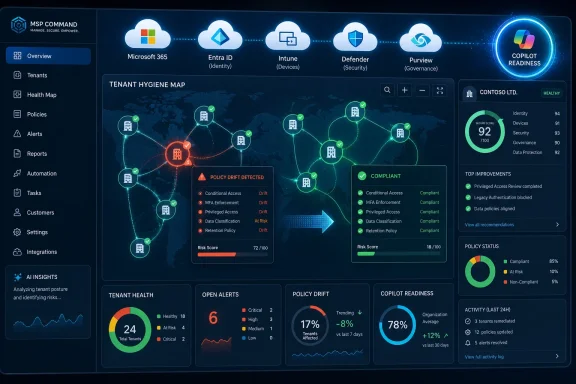
That is where inforcer fits. The company sells software for MSPs to standardize Microsoft 365 environments across many customer tenants, automate configuration tasks, monitor compliance, and detect policy drift. Its pitch is that Copilot readiness is not a one-time assessment but a continuing managed service, because the tenant that was clean on Monday can be misconfigured by Friday.
Pax8’s own framing leans hard into that operational reality. The company says SMBs are already adopting AI, but not yet in the deep, organization-wide way vendors want. Its cited research says 62 percent of SMBs are using AI, while only 18.5 percent use it extensively across multiple functions. That gap is the commercial opening: MSPs are being invited to sell the road between casual experimentation and governed deployment.
That phrase may sound dry, but it is where much of the MSP margin is moving. Reselling Microsoft 365 licenses is necessary, but it is rarely enough to differentiate a provider. The defensible value is in keeping tenants secure, compliant, documented, and ready for whatever Microsoft adds next.
inforcer gives Pax8 partners a way to build repeatable service offerings around that work. Instead of each technician auditing a customer tenant with scripts, spreadsheets, tribal knowledge, and admin-center spelunking, the MSP can define a baseline and apply it across customers. The company says the platform can standardize security and data governance policies, automate configuration, monitor compliance in real time, and spot drift from approved settings.
That matters because Microsoft 365 administration is deceptively fragmented. A small business may think of Microsoft 365 as “email and Office,” while an MSP sees Exchange Online, SharePoint, Teams, Entra ID, Intune, Defender, Purview, conditional access, app consent, external sharing, audit logs, device rules, and licensing dependencies. Copilot adds another layer because AI features can surface information that was technically accessible but practically buried.
The Pax8 marketplace listing therefore functions as a distribution shortcut and a narrative device. It tells partners that Microsoft 365 security posture, governance, and Copilot readiness belong in the same bundle. It also tells SMB customers that AI adoption should not be treated as a side project handled after the fact.
That is configuration drift, and it is not glamorous enough to dominate vendor keynotes. But it is one of the main reasons MSP operations become expensive as they scale. The more customers an MSP supports, the more dangerous inconsistency becomes.
Microsoft’s cloud admin model gives organizations enormous flexibility, but flexibility becomes debt when it is not governed. Tenants evolve through acquisitions, staff turnover, emergency fixes, licensing changes, partial migrations, and years of “temporary” exceptions. By the time an MSP tries to roll out a standardized AI policy, it may discover that the real project is cleaning up half a decade of uneven administration.
inforcer’s relevance is that it addresses this class of work directly. It is not primarily trying to replace Microsoft’s native controls. It is trying to give MSPs a way to apply, measure, and prove those controls across many organizations.
That distinction matters. Microsoft provides the platform capabilities, but MSPs need operational tooling that reflects their business model. A single-company IT department can live inside one tenant and one policy universe. An MSP lives across dozens, hundreds, or thousands of tenants, each with its own history and tolerance for change.
That does not mean Copilot magically breaks permissions. It does mean organizations are forced to confront whether their existing permissions reflect what employees should actually be able to discover, summarize, and reuse. A poorly governed SharePoint estate becomes a bigger problem when natural-language search and AI summarization make it easier to find sensitive material.
This is why Copilot readiness has become such a useful wedge for MSPs. It gives providers a business reason to revisit identity hygiene, data classification, external sharing, user access reviews, and endpoint controls. The customer may ask for AI productivity; the provider gets to explain that productivity depends on trust boundaries.
inforcer’s Copilot Readiness Assessments, Copilot Manager, and Shadow AI detection are aimed at that intersection. The assessment product is designed to evaluate whether a tenant is ready for Copilot across security posture, data governance, and technical configuration. Copilot Manager and Shadow AI detection push the story beyond readiness into oversight: who is using AI, how adoption is developing, and where unsanctioned tools may be introducing risk.
For WindowsForum readers, this is the part to watch. The PC is still the endpoint where much of this work becomes real. Identity policy, device compliance, browser access, Office apps, Teams usage, and endpoint management all collide at the Windows desktop. AI governance may sound like a cloud discussion, but it lands in the daily behavior of users sitting in front of managed machines.
That is exactly the kind of gap MSPs exist to fill. Pax8’s cited figure that 84 percent of SMBs would trust an external technology adviser to help implement AI is unsurprising, but important. It suggests that the channel has permission to lead, provided it can turn AI from a vague promise into a managed operating discipline.
The challenge is that “AI readiness” can easily become a hollow assessment sold once and forgotten. An MSP runs a scan, delivers a report, recommends some changes, and moves on. Six months later, the customer’s settings have changed, new users have been added, external sharing has expanded, and the original readiness posture no longer exists.
The better commercial model is recurring governance. That means packaged offers with periodic checks, policy baselines, remediation workflows, executive reporting, and proof that controls remain in place. Pax8 and inforcer are clearly positioning their relationship around that recurring model rather than a one-off Copilot deployment.
This is also why the announcement matters more for MSP business design than for any single feature. The providers that succeed in AI services are unlikely to be the ones that merely resell Copilot seats. They will be the ones that can say, credibly, that they know whether a customer’s tenant is safe enough to use AI productively.
For inforcer, Pax8 offers reach. The marketplace operator says it serves more than 47,000 IT partners and 800,000 SMBs. Even a small conversion rate across that base would materially expand inforcer’s footprint.
For Pax8, inforcer adds depth in a category the company clearly sees as strategic. Pax8 has been leaning into the language of managed intelligence, a term meant to describe MSPs that help customers orchestrate AI, automation, security, and cloud services. Whether that term sticks is less important than the behavior behind it: distributors want partners to package higher-value advisory and operational services around Microsoft’s platform.
The risk is that marketplace listings can make complex services look simpler than they are. Governance is not a button. Copilot readiness is not achieved by buying a tool, any more than endpoint security is achieved by buying an agent and never tuning it.
Still, tools shape behavior. If Pax8 can make tenant standardization, policy drift monitoring, and Copilot readiness easier to buy and bundle, more MSPs may incorporate those disciplines into baseline service offerings. That would be a meaningful change for SMB customers that currently receive Microsoft 365 administration only when something breaks.
The old model of Microsoft 365 administration was reactive and bespoke. A customer needed a setting changed, a mailbox recovered, a device enrolled, or a security feature enabled. A technician performed the task, documented it if everyone was lucky, and moved on to the next ticket.
The newer model is policy-driven and recurring. An MSP defines what “good” looks like for a class of customer, applies that standard across tenants, monitors deviations, and sells the result as a managed outcome. That model is more scalable because it reduces dependence on individual technicians remembering each customer’s quirks.
It also changes the conversation with customers. Instead of billing for isolated tasks, the MSP can discuss posture, risk, readiness, and auditability. That language is closer to how boards, insurers, regulators, and business owners increasingly think about technology.
inforcer’s value proposition sits squarely in that shift. It gives MSPs a way to turn Microsoft 365 security and governance into something measurable and repeatable. The Pax8 listing could accelerate that shift by placing the tool inside a purchasing ecosystem many MSPs already use.
That creates opportunities and dependencies. On the opportunity side, providers can simplify their stack, train staff deeply, and build repeatable offers around a common customer base. On the dependency side, they become more exposed to Microsoft licensing changes, product bundling decisions, admin center redesigns, and the pace of Microsoft’s own AI roadmap.
Pax8’s inforcer move reinforces the gravitational pull of Microsoft. The announcement is not about a broad, platform-neutral governance layer for every SaaS application. It is specifically about Microsoft 365 security, data governance, and Copilot readiness.
That focus is commercially rational. Microsoft 365 remains one of the most important platforms in the SMB IT estate, and Copilot gives Microsoft and its partners a fresh reason to revisit every tenant. But it also means MSPs must be careful not to confuse Microsoft alignment with complete governance.
Most SMBs use more than Microsoft. They have accounting platforms, CRMs, payroll systems, vertical SaaS tools, personal AI accounts, browser extensions, unmanaged file shares, and legacy applications. Microsoft 365 governance is necessary, but it is not the whole map.
For SMBs, that behavior is often invisible. There may be no formal AI policy, no approved tool list, no data handling guidance, and no clear way to know whether sensitive information is being sent into consumer-grade services. The company may believe it is “not using AI” while its employees use it every day.
inforcer’s Shadow AI detection is meant to help MSPs identify that gap. In practical terms, the service opportunity is to move customers from accidental AI use to governed AI use. That means discovering what is happening, deciding what should be allowed, and creating policies that users can actually follow.
This is where MSPs can add more value than a vendor dashboard alone. A tool may detect usage patterns, but someone has to translate that into customer-specific policy. A law firm, construction company, medical practice, retailer, and nonprofit may all use Microsoft 365, but they do not have the same data sensitivity or compliance exposure.
The danger for MSPs is overpromising. Shadow AI visibility is not the same as total control, especially when users can access services from unmanaged devices or personal accounts. Providers will need to be precise about what they can detect, what they can enforce, and where customer policy and user training remain essential.
Customers increasingly need proof that controls exist. Cyber insurance applications ask sharper questions. Larger clients ask suppliers about data protection. Regulators and industry frameworks push even smaller organizations toward documented security practices. Business owners may not know the details of conditional access or external sharing policies, but they understand the pain of being unable to answer a security questionnaire.
A platform that monitors compliance and policy drift can help MSPs produce evidence. That evidence may be used in quarterly business reviews, renewal discussions, insurance workflows, or remediation projects. It also helps shift the relationship from break-fix support to risk management.
The word “compliance” should still be handled carefully. A Microsoft 365 configuration tool cannot make a business compliant with every legal or industry requirement. Compliance involves people, processes, contracts, data handling, retention practices, and jurisdiction-specific obligations.
But configuration evidence is a real part of the puzzle. If an MSP can show that multifactor authentication, device policies, sharing controls, and governance baselines are applied consistently, it has something concrete to offer. That is more persuasive than telling customers to trust that the tenant is probably fine.
The operational burden will not disappear. MSPs still need skilled staff who understand Microsoft 365, Entra ID, Intune, Defender, Purview, and the practical realities of SMB administration. Automation can reduce repetitive work, but it cannot decide every exception or explain every tradeoff to a business owner.
Training will matter as much as tooling. If an MSP uses inforcer merely to generate reports without building remediation processes, customer-facing service packages, and escalation playbooks, the platform will become another dashboard. The value comes when the MSP builds a rhythm around it: assess, standardize, monitor, remediate, report, and revisit.
Pricing will matter too. SMBs are cost-sensitive, and AI governance can sound abstract until a concrete risk appears. Providers will need to package the service in terms customers understand: safer Copilot rollout, reduced data exposure, cleaner Microsoft 365 configuration, better insurance readiness, and fewer surprises during audits or vendor reviews.
The winners will be the MSPs that make governance feel practical rather than punitive. Users do not want a lecture about data classification every time they open Teams. They want tools that work, policies that make sense, and confidence that AI will not expose yesterday’s poor permissions decisions.
What is changing is the baseline expectation. A few years ago, many SMBs could get by with Microsoft 365 licensing, basic email security, endpoint protection, backups, and occasional admin help. Today, the same customers are being asked to think about AI access, data governance, identity risk, device trust, and auditability.
That forces MSPs to raise their own floor. A provider that cannot explain a customer’s Microsoft 365 posture will struggle to guide that customer into Copilot. A provider that cannot detect drift will struggle to promise ongoing governance. A provider that treats AI as just another license line item will leave risk and margin on the table.
Pax8’s marketplace power is that it can normalize a category. When a distributor places a tool like inforcer in front of thousands of partners, it signals that Microsoft 365 governance is not a boutique add-on for mature MSPs only. It is becoming part of the expected operating kit.
That does not mean every MSP should adopt inforcer specifically, nor that Pax8’s marketplace is the only route. It does mean the category deserves attention. If SMB customers are going to adopt AI inside Microsoft 365, someone has to do the unglamorous work of making the tenant ready and keeping it that way.
 The Copilot Gold Rush Now Has a Prerequisite Layer
The simplest reading of Pax8’s inforcer announcement is that a marketplace distributor is adding another Microsoft 365 management vendor. That is accurate, but incomplete. The more revealing reading is that Pax8 is trying to turn the messy preconditions for AI adoption into a packaged service motion MSPs can sell repeatedly.Microsoft 365 Copilot has changed the sales conversation around the Microsoft stack. A customer that once asked whether it needed more email storage or a better endpoint plan is now asking whether employees can safely use AI across documents, chats, meetings, and business data. That question sounds futuristic, but the answer is painfully administrative: permissions, retention, sharing controls, identity configuration, endpoint posture, and data governance.
That is where inforcer fits. The company sells software for MSPs to standardize Microsoft 365 environments across many customer tenants, automate configuration tasks, monitor compliance, and detect policy drift. Its pitch is that Copilot readiness is not a one-time assessment but a continuing managed service, because the tenant that was clean on Monday can be misconfigured by Friday.
Pax8’s own framing leans hard into that operational reality. The company says SMBs are already adopting AI, but not yet in the deep, organization-wide way vendors want. Its cited research says 62 percent of SMBs are using AI, while only 18.5 percent use it extensively across multiple functions. That gap is the commercial opening: MSPs are being invited to sell the road between casual experimentation and governed deployment.
Pax8 Is Selling the Operating Model, Not Just the Tool
Pax8 has spent years positioning itself as more than a cloud software catalog. The company wants to be the place where MSPs source, bundle, provision, and operationalize services for smaller customers that cannot build enterprise IT functions internally. Adding inforcer makes sense because it strengthens a specific service pattern: Microsoft-first managed governance.That phrase may sound dry, but it is where much of the MSP margin is moving. Reselling Microsoft 365 licenses is necessary, but it is rarely enough to differentiate a provider. The defensible value is in keeping tenants secure, compliant, documented, and ready for whatever Microsoft adds next.
inforcer gives Pax8 partners a way to build repeatable service offerings around that work. Instead of each technician auditing a customer tenant with scripts, spreadsheets, tribal knowledge, and admin-center spelunking, the MSP can define a baseline and apply it across customers. The company says the platform can standardize security and data governance policies, automate configuration, monitor compliance in real time, and spot drift from approved settings.
That matters because Microsoft 365 administration is deceptively fragmented. A small business may think of Microsoft 365 as “email and Office,” while an MSP sees Exchange Online, SharePoint, Teams, Entra ID, Intune, Defender, Purview, conditional access, app consent, external sharing, audit logs, device rules, and licensing dependencies. Copilot adds another layer because AI features can surface information that was technically accessible but practically buried.
The Pax8 marketplace listing therefore functions as a distribution shortcut and a narrative device. It tells partners that Microsoft 365 security posture, governance, and Copilot readiness belong in the same bundle. It also tells SMB customers that AI adoption should not be treated as a side project handled after the fact.
Microsoft 365 Drift Is the Quiet Enemy of MSP Scale
Every MSP knows the problem even if it uses different language for it. Customer A has conditional access set up one way, Customer B has a legacy exception, Customer C has guest sharing enabled too broadly because of a long-finished project, and Customer D has an executive who insists on bypassing a control because “it only takes a minute.”That is configuration drift, and it is not glamorous enough to dominate vendor keynotes. But it is one of the main reasons MSP operations become expensive as they scale. The more customers an MSP supports, the more dangerous inconsistency becomes.
Microsoft’s cloud admin model gives organizations enormous flexibility, but flexibility becomes debt when it is not governed. Tenants evolve through acquisitions, staff turnover, emergency fixes, licensing changes, partial migrations, and years of “temporary” exceptions. By the time an MSP tries to roll out a standardized AI policy, it may discover that the real project is cleaning up half a decade of uneven administration.
inforcer’s relevance is that it addresses this class of work directly. It is not primarily trying to replace Microsoft’s native controls. It is trying to give MSPs a way to apply, measure, and prove those controls across many organizations.
That distinction matters. Microsoft provides the platform capabilities, but MSPs need operational tooling that reflects their business model. A single-company IT department can live inside one tenant and one policy universe. An MSP lives across dozens, hundreds, or thousands of tenants, each with its own history and tolerance for change.
AI Makes Old Permissions Problems Newly Dangerous
The Copilot angle is not marketing fluff, even if the channel has developed a talent for making every announcement sound like an AI revolution. Generative AI changes the practical consequences of bad information governance. Data that was once hidden by inconvenience can become newly visible through a prompt.That does not mean Copilot magically breaks permissions. It does mean organizations are forced to confront whether their existing permissions reflect what employees should actually be able to discover, summarize, and reuse. A poorly governed SharePoint estate becomes a bigger problem when natural-language search and AI summarization make it easier to find sensitive material.
This is why Copilot readiness has become such a useful wedge for MSPs. It gives providers a business reason to revisit identity hygiene, data classification, external sharing, user access reviews, and endpoint controls. The customer may ask for AI productivity; the provider gets to explain that productivity depends on trust boundaries.
inforcer’s Copilot Readiness Assessments, Copilot Manager, and Shadow AI detection are aimed at that intersection. The assessment product is designed to evaluate whether a tenant is ready for Copilot across security posture, data governance, and technical configuration. Copilot Manager and Shadow AI detection push the story beyond readiness into oversight: who is using AI, how adoption is developing, and where unsanctioned tools may be introducing risk.
For WindowsForum readers, this is the part to watch. The PC is still the endpoint where much of this work becomes real. Identity policy, device compliance, browser access, Office apps, Teams usage, and endpoint management all collide at the Windows desktop. AI governance may sound like a cloud discussion, but it lands in the daily behavior of users sitting in front of managed machines.
The SMB Market Wants AI Help, but Not an Enterprise Consulting Bill
Small and midsize businesses are in an awkward phase of AI adoption. Many are already experimenting with tools, but few have the staff, policy maturity, or budget to build a formal AI governance program. They want the upside of automation and productivity without hiring a CISO, a data governance lead, and a Microsoft architect.That is exactly the kind of gap MSPs exist to fill. Pax8’s cited figure that 84 percent of SMBs would trust an external technology adviser to help implement AI is unsurprising, but important. It suggests that the channel has permission to lead, provided it can turn AI from a vague promise into a managed operating discipline.
The challenge is that “AI readiness” can easily become a hollow assessment sold once and forgotten. An MSP runs a scan, delivers a report, recommends some changes, and moves on. Six months later, the customer’s settings have changed, new users have been added, external sharing has expanded, and the original readiness posture no longer exists.
The better commercial model is recurring governance. That means packaged offers with periodic checks, policy baselines, remediation workflows, executive reporting, and proof that controls remain in place. Pax8 and inforcer are clearly positioning their relationship around that recurring model rather than a one-off Copilot deployment.
This is also why the announcement matters more for MSP business design than for any single feature. The providers that succeed in AI services are unlikely to be the ones that merely resell Copilot seats. They will be the ones that can say, credibly, that they know whether a customer’s tenant is safe enough to use AI productively.
Marketplace Distribution Turns Governance Into a SKU
One reason MSPs like marketplaces is that they reduce procurement friction. If a provider already buys through Pax8, adding another vendor through the same commercial channel is easier than negotiating a separate agreement, integrating billing manually, and training the operations team from scratch. That convenience can decide whether a tool becomes part of a standard stack or remains an interesting demo.For inforcer, Pax8 offers reach. The marketplace operator says it serves more than 47,000 IT partners and 800,000 SMBs. Even a small conversion rate across that base would materially expand inforcer’s footprint.
For Pax8, inforcer adds depth in a category the company clearly sees as strategic. Pax8 has been leaning into the language of managed intelligence, a term meant to describe MSPs that help customers orchestrate AI, automation, security, and cloud services. Whether that term sticks is less important than the behavior behind it: distributors want partners to package higher-value advisory and operational services around Microsoft’s platform.
The risk is that marketplace listings can make complex services look simpler than they are. Governance is not a button. Copilot readiness is not achieved by buying a tool, any more than endpoint security is achieved by buying an agent and never tuning it.
Still, tools shape behavior. If Pax8 can make tenant standardization, policy drift monitoring, and Copilot readiness easier to buy and bundle, more MSPs may incorporate those disciplines into baseline service offerings. That would be a meaningful change for SMB customers that currently receive Microsoft 365 administration only when something breaks.
inforcer Is Riding a Shift From Admin Labor to Service Products
inforcer says it has more than 1,200 MSP partners across North America, Europe, the Middle East, Africa, and Asia-Pacific, with more than 100 new providers joining each month. Those numbers should be read as company positioning, but they also match a real market trend. MSPs are trying to productize work that used to live in technician time.The old model of Microsoft 365 administration was reactive and bespoke. A customer needed a setting changed, a mailbox recovered, a device enrolled, or a security feature enabled. A technician performed the task, documented it if everyone was lucky, and moved on to the next ticket.
The newer model is policy-driven and recurring. An MSP defines what “good” looks like for a class of customer, applies that standard across tenants, monitors deviations, and sells the result as a managed outcome. That model is more scalable because it reduces dependence on individual technicians remembering each customer’s quirks.
It also changes the conversation with customers. Instead of billing for isolated tasks, the MSP can discuss posture, risk, readiness, and auditability. That language is closer to how boards, insurers, regulators, and business owners increasingly think about technology.
inforcer’s value proposition sits squarely in that shift. It gives MSPs a way to turn Microsoft 365 security and governance into something measurable and repeatable. The Pax8 listing could accelerate that shift by placing the tool inside a purchasing ecosystem many MSPs already use.
The Microsoft-Centric MSP Stack Keeps Getting Denser
There is a broader ecosystem story here. Many MSPs have standardized around Microsoft because their SMB customers already live in Windows, Office, Teams, Outlook, OneDrive, and SharePoint. Once Microsoft 365 becomes the center of collaboration, it is natural for identity, device management, endpoint security, compliance, backup, and now AI governance to orbit the same platform.That creates opportunities and dependencies. On the opportunity side, providers can simplify their stack, train staff deeply, and build repeatable offers around a common customer base. On the dependency side, they become more exposed to Microsoft licensing changes, product bundling decisions, admin center redesigns, and the pace of Microsoft’s own AI roadmap.
Pax8’s inforcer move reinforces the gravitational pull of Microsoft. The announcement is not about a broad, platform-neutral governance layer for every SaaS application. It is specifically about Microsoft 365 security, data governance, and Copilot readiness.
That focus is commercially rational. Microsoft 365 remains one of the most important platforms in the SMB IT estate, and Copilot gives Microsoft and its partners a fresh reason to revisit every tenant. But it also means MSPs must be careful not to confuse Microsoft alignment with complete governance.
Most SMBs use more than Microsoft. They have accounting platforms, CRMs, payroll systems, vertical SaaS tools, personal AI accounts, browser extensions, unmanaged file shares, and legacy applications. Microsoft 365 governance is necessary, but it is not the whole map.
Shadow AI Turns User Behavior Into a Managed Service Problem
The shadow AI element may prove more important than it first appears. Employees do not wait for IT to produce a governance framework before trying tools that make their work easier. They paste text into chatbots, summarize documents, generate sales emails, analyze spreadsheets, and experiment with browser-based assistants.For SMBs, that behavior is often invisible. There may be no formal AI policy, no approved tool list, no data handling guidance, and no clear way to know whether sensitive information is being sent into consumer-grade services. The company may believe it is “not using AI” while its employees use it every day.
inforcer’s Shadow AI detection is meant to help MSPs identify that gap. In practical terms, the service opportunity is to move customers from accidental AI use to governed AI use. That means discovering what is happening, deciding what should be allowed, and creating policies that users can actually follow.
This is where MSPs can add more value than a vendor dashboard alone. A tool may detect usage patterns, but someone has to translate that into customer-specific policy. A law firm, construction company, medical practice, retailer, and nonprofit may all use Microsoft 365, but they do not have the same data sensitivity or compliance exposure.
The danger for MSPs is overpromising. Shadow AI visibility is not the same as total control, especially when users can access services from unmanaged devices or personal accounts. Providers will need to be precise about what they can detect, what they can enforce, and where customer policy and user training remain essential.
Compliance Proof Is Becoming Part of the Product
One of the more consequential claims in the Pax8-inforcer messaging is continuous compliance. For MSPs, that is not just a technical feature. It is a sales and retention mechanism.Customers increasingly need proof that controls exist. Cyber insurance applications ask sharper questions. Larger clients ask suppliers about data protection. Regulators and industry frameworks push even smaller organizations toward documented security practices. Business owners may not know the details of conditional access or external sharing policies, but they understand the pain of being unable to answer a security questionnaire.
A platform that monitors compliance and policy drift can help MSPs produce evidence. That evidence may be used in quarterly business reviews, renewal discussions, insurance workflows, or remediation projects. It also helps shift the relationship from break-fix support to risk management.
The word “compliance” should still be handled carefully. A Microsoft 365 configuration tool cannot make a business compliant with every legal or industry requirement. Compliance involves people, processes, contracts, data handling, retention practices, and jurisdiction-specific obligations.
But configuration evidence is a real part of the puzzle. If an MSP can show that multifactor authentication, device policies, sharing controls, and governance baselines are applied consistently, it has something concrete to offer. That is more persuasive than telling customers to trust that the tenant is probably fine.
The Channel Will Need Discipline, Not Just More AI Branding
The MSP market has never lacked enthusiasm for a new acronym. “Managed intelligence” may capture a genuine transition, but it also risks becoming another banner under which ordinary software resale is dressed up as strategy. Pax8 and inforcer will be judged by whether partners can turn the tooling into durable services customers understand and value.The operational burden will not disappear. MSPs still need skilled staff who understand Microsoft 365, Entra ID, Intune, Defender, Purview, and the practical realities of SMB administration. Automation can reduce repetitive work, but it cannot decide every exception or explain every tradeoff to a business owner.
Training will matter as much as tooling. If an MSP uses inforcer merely to generate reports without building remediation processes, customer-facing service packages, and escalation playbooks, the platform will become another dashboard. The value comes when the MSP builds a rhythm around it: assess, standardize, monitor, remediate, report, and revisit.
Pricing will matter too. SMBs are cost-sensitive, and AI governance can sound abstract until a concrete risk appears. Providers will need to package the service in terms customers understand: safer Copilot rollout, reduced data exposure, cleaner Microsoft 365 configuration, better insurance readiness, and fewer surprises during audits or vendor reviews.
The winners will be the MSPs that make governance feel practical rather than punitive. Users do not want a lecture about data classification every time they open Teams. They want tools that work, policies that make sense, and confidence that AI will not expose yesterday’s poor permissions decisions.
The Real Pax8-inforcer Story Is the MSP Baseline Moving Up
This announcement is easy to underestimate because no single product category is new. Microsoft 365 management tools exist. Copilot readiness assessments exist. MSP marketplaces exist. Security baselines, compliance monitoring, and policy automation are familiar ideas.What is changing is the baseline expectation. A few years ago, many SMBs could get by with Microsoft 365 licensing, basic email security, endpoint protection, backups, and occasional admin help. Today, the same customers are being asked to think about AI access, data governance, identity risk, device trust, and auditability.
That forces MSPs to raise their own floor. A provider that cannot explain a customer’s Microsoft 365 posture will struggle to guide that customer into Copilot. A provider that cannot detect drift will struggle to promise ongoing governance. A provider that treats AI as just another license line item will leave risk and margin on the table.
Pax8’s marketplace power is that it can normalize a category. When a distributor places a tool like inforcer in front of thousands of partners, it signals that Microsoft 365 governance is not a boutique add-on for mature MSPs only. It is becoming part of the expected operating kit.
That does not mean every MSP should adopt inforcer specifically, nor that Pax8’s marketplace is the only route. It does mean the category deserves attention. If SMB customers are going to adopt AI inside Microsoft 365, someone has to do the unglamorous work of making the tenant ready and keeping it that way.
The Summer Listing Puts a Price on Tenant Hygiene
The practical implications of the Pax8-inforcer deal are clearest when viewed from the technician’s desk, the MSP owner’s P&L, and the SMB customer’s risk register. The announcement is about distribution, but the underlying issue is whether Microsoft 365 governance can be made repeatable enough to sell at scale.- Pax8 plans to add inforcer to its marketplace in summer 2026, giving MSPs an easier procurement path for Microsoft 365 governance and Copilot-readiness tooling.
- inforcer’s core pitch is standardizing security and data governance policies across customer tenants while monitoring for configuration drift.
- The Copilot opportunity depends on older Microsoft 365 hygiene work, including permissions, identity controls, device posture, sharing settings, and compliance evidence.
- SMB AI adoption creates a recurring service opportunity because many businesses are experimenting with AI before they have mature governance in place.
- The listing reinforces Pax8’s broader push to move partners from license resale toward managed intelligence, advisory services, and operationalized AI support.
- MSPs should treat the tool as an enabler of process, not a substitute for Microsoft 365 expertise, customer policy design, or clear service packaging.
References
- Primary source: SecurityBrief UK
Published: 2026-06-18T02:12:08.258560
Pax8 adds inforcer for Microsoft 365 security tools
The tie-up gives managed service providers a way to standardise Microsoft 365 security and prepare SMB customers for Copilot adoption. securitybrief.co.uk
- Related coverage: inforcer.com
Microsoft 365 Copilot Readiness Assessments | inforcer
Quickly assess Microsoft 365 Copilot readiness across customer tenants. Understand AI maturity and identify key areas to address before rolling out Copilot. www.inforcer.com
- Related coverage: globenewswire.com
Pax8 to Launch Relationship with inforcer, Expanding
Upcoming Pax8 Marketplace availability helps MSPs standardize and secure Microsoft 365 at scale while creating a clear on-ramp to managed intelligence for...www.globenewswire.com - Related coverage: pax8.com
One cloud marketplace. Infinite growth.| Pax8
The Pax8 Marketplace: Where MSPs, MIPs and vendors come together to turn SMB demand into measurable growth, powered by cloud, AI, enablement and community.www.pax8.com - Related coverage: msp-channel.com
Pax8 and Inforcer's collaboration enhances AI and security offerings for MSPs
The new collaboration between Pax8 and inforcer aims to allow MSPs to enhance AI security and data governance with Microsoft 365.www.msp-channel.com - Related coverage: windowsforum.com
Pax8 Adds inforcer: Microsoft 365 Copilot Readiness as Repeatable MSP Service | Windows Forum
Pax8 said on June 9, 2026, that it will add inforcer to the Pax8 Marketplace this summer, giving managed service providers a new route to buy and deploy...windowsforum.com
- Related coverage: itpro.com
Pax8 and Microsoft are teaming up to supercharge MSP growth | ChannelPro
The new agreement includes integration between Pax8 and Microsoft Marketplace alongside a new OneCloud Guided Growth enablement initiativewww.itpro.com - Related coverage: pax8nebula.com