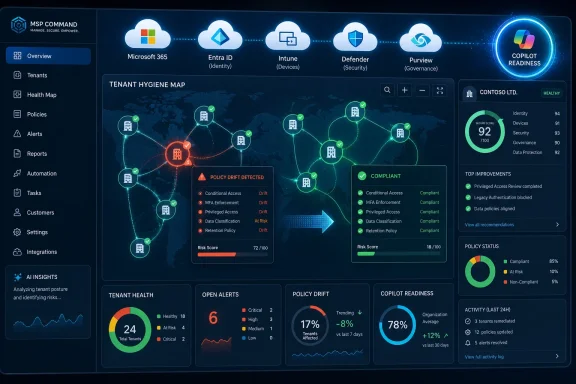
Pax8 said on June 9, 2026, that it will add inforcer to the Pax8 Marketplace this summer, giving managed service providers a new route to buy Microsoft 365 security, governance, and Copilot-readiness tooling for SMB customers. The announcement is not just another vendor listing in a crowded channel catalogue. It is a signal that the next phase of Microsoft 365 managed services will be less about reselling licenses and more about proving that every tenant is configured, governed, and ready for AI before customers let Copilot loose on their data. For WindowsForum readers, the story matters because Microsoft 365 has become the operating layer for many small businesses, and the weakest point is increasingly not the endpoint but the unmanaged setting, the stale exception, and the policy that drifted after the last onboarding project ended.
The obvious reading of the Pax8-inforcer deal is that Pax8 is expanding its Microsoft 365 security catalogue. That is true, but too small. Pax8 is really adding a way for MSPs to turn Microsoft 365 configuration management into a recurring service with a repeatable operating model.
That distinction matters because Microsoft 365 security is no longer a single-product problem. Identity settings sit in Entra ID, device controls live in Intune, email security sprawls across Exchange Online Protection and Defender, collaboration governance touches Teams, SharePoint, OneDrive, and Purview, and Copilot introduces a new reason to care about all of it at once. A customer can be “on Microsoft 365” and still have a wildly inconsistent security posture across tenants, users, groups, devices, retention policies, and sharing defaults.
inforcer’s pitch is that MSPs need a standardization layer across those environments. The company’s software is designed to automate configuration tasks, monitor compliance, detect policy drift, and help providers apply consistent rules across multiple customer tenants. That is not glamorous in the way endpoint detection or zero-day response can be glamorous, but it is the work that decides whether Microsoft 365 is a managed platform or a collection of admin portals.
Pax8’s marketplace role makes the move more consequential. A tool available through a distributor used by tens of thousands of partners can become a packaging primitive: something an MSP adds to a managed Microsoft 365 bundle, a Copilot-readiness engagement, or a compliance monitoring service. The deal gives inforcer reach, but it also gives Pax8 partners a product category that speaks to the daily pain of operating Microsoft’s cloud stack at scale.
That is where the old MSP model starts to creak. A provider can onboard a tenant, harden obvious settings, enable MFA, configure device policies, and document the result. Six months later, a customer may have added new users, changed sharing behavior, adopted a new app, enabled a Copilot trial, exempted a troublesome executive, or accepted a default introduced by a Microsoft update. The configuration snapshot becomes a memory, not a control.
The industry term for this is policy drift, but the phrase undersells the risk. Drift is how good intentions become bad baselines. It is how an MSP’s standard build gradually becomes 200 slightly different Microsoft 365 environments, each with just enough variation to make support slower, audits harder, and security claims less defensible.
The point of multi-tenant governance tooling is to replace artisanal administration with continuous conformance. That does not remove the need for technical judgment, and it certainly does not eliminate Microsoft 365 expertise. It changes the unit of work from “log in and fix this tenant” to “define the standard, apply the standard, show where reality no longer matches the standard.”
That is why the inforcer addition is tied so tightly to Copilot readiness. The company offers Copilot Readiness Assessments, Copilot Manager, and Shadow AI detection, all aimed at helping MSPs assess preparedness, govern deployments, and track usage patterns. Those are not side features bolted onto a security tool; they are a recognition that AI adoption is now a governance project with a productivity wrapper.
Pax8’s own research gives the channel logic. The company says 62 percent of SMBs are already using AI, but only 18.5 percent use it extensively across multiple business functions. It also says 84 percent of SMBs would trust an external technology adviser to help implement AI. For MSPs, that gap is the commercial opening: customers are experimenting, but many have not yet built the controls needed to make AI routine.
The danger is that “AI readiness” becomes a slogan for selling licenses before the plumbing is done. A serious readiness offer has to ask awkward questions. Who can access sensitive files? Which users have unmanaged devices? Are guest accounts reviewed? Are retention and data loss prevention policies meaningful or merely present? Are security baselines applied consistently, or do they vary by whichever technician last touched the tenant?
The more defensible role is to become the operator of trust boundaries. That means setting identity rules, governing data access, enforcing device posture, managing exceptions, documenting compliance, and making AI adoption auditable. Customers may not want to buy “governance” as an abstract concept, but they do want to know that Copilot will not surface payroll data to the wrong person or that a terminated user cannot still reach business files from an unmanaged phone.
inforcer fits that emerging MSP motion because it is not positioned as a single-customer security appliance. It is built for providers that need to manage many Microsoft 365 tenants with repeatable policies and packaged services. That matters in the SMB channel, where labor efficiency is the difference between a profitable managed service and a heroic but unscalable consulting habit.
The interesting part is not whether inforcer can automate every setting an MSP cares about. No tool will. The interesting part is that Pax8 sees enough demand to put Microsoft 365 standardization and Copilot governance in front of its partner base as a marketplace motion. That suggests the channel’s Microsoft business is moving up the stack from procurement to operational assurance.
That disorder is exactly why MSPs are being pulled into AI strategy. The average SMB does not have a CISO, a data protection officer, an AI governance board, and a Microsoft 365 architect waiting in the wings. It has an owner, an operations manager, a finance lead, a handful of power users, and an MSP that already knows where the licensing skeletons are buried.
Pax8’s survey numbers make the moment look like a classic channel inflection point. AI usage is already common, but broad operational maturity is not. Trust in external advisers is high, but customers still need packaged offerings they can understand and afford. That is the gap Pax8 and inforcer want MSPs to fill.
The risk for customers is that they buy AI assistance without buying the administrative discipline around it. The risk for MSPs is that they treat AI as a one-time deployment project instead of a managed lifecycle. The opportunity is to turn Microsoft 365 governance into a monthly service with measurable outputs: readiness scores, drift reports, policy alignment, user behavior monitoring, and documented remediation.
That does not mean every customer gets the same configuration. A medical clinic, a nonprofit, a legal practice, and a construction firm may need different retention policies, sharing controls, and device requirements. But the MSP needs a way to express those differences as controlled templates rather than tribal knowledge.
Microsoft 365 makes this both possible and maddening. The platform contains a deep set of security and governance capabilities, especially when customers have Business Premium, E3, E5, or add-on licensing. But the capabilities are distributed across products and portals, and the defaults are not a substitute for a customer-specific risk model. The result is that many SMBs pay for controls they do not fully use.
inforcer’s value proposition sits in that gap between license entitlement and operational reality. If an MSP can turn included Microsoft 365 security features into a managed baseline, it can improve customer outcomes without always leading with another standalone security SKU. That is attractive in a market where SMBs are cost-sensitive and where Microsoft’s own bundle strategy has already pulled many security conversations into the Microsoft 365 licensing stack.
That is strategically sensible. Microsoft 365 is sticky, ubiquitous, and increasingly positioned as the workspace where AI will be consumed. If Pax8 can help MSPs wrap operational services around that workspace, it becomes harder for partners to view the marketplace as a commodity procurement layer. The more Pax8 can connect licensing, tooling, enablement, and service packaging, the more it can defend its role in the channel.
There is also a defensive angle. Microsoft’s own marketplace ambitions and partner programs continue to evolve, and distributors need to prove they add value beyond pass-through billing. A marketplace that helps MSPs build Copilot-readiness offerings, governance bundles, and standardized security services has a clearer claim than one that simply exposes a shopping cart.
For inforcer, the Pax8 relationship offers scale and credibility. The company says it has more than 1,200 MSP partners globally and has been adding more than 100 providers per month. A Pax8 listing gives it access to a much larger partner population at the precise moment many providers are deciding how to monetize AI governance.
There is also a trust problem embedded in any multi-tenant management story. The more centralized the tool, the more important its own access model, auditability, security practices, and failure modes become. MSPs adopting platforms that touch multiple customer tenants need to understand permissions, least privilege, logging, delegated administration, and incident response. A governance tool that is poorly governed becomes an irony at best and a supply-chain risk at worst.
The other challenge is Microsoft’s pace of change. New features, renamed services, licensing changes, retired controls, and shifting admin experiences can all alter what “best practice” means. A platform built around Microsoft 365 governance has to keep up not only with security threats, but with Microsoft’s product churn.
Still, the direction is difficult to argue with. SMBs need help turning Microsoft 365 from a subscription into a managed environment. MSPs need leverage that reduces manual work without erasing accountability. Pax8 needs marketplace offerings that support higher-value services. inforcer needs distribution. The incentives line up.
This is especially true before Copilot enters the tenant. AI does not create every permission problem, but it can expose the consequences of years of permissive sharing and inconsistent governance. A tenant that was merely messy before Copilot may become politically risky after users can ask natural-language questions across business content.
MSPs that want to build credible AI services should start with the dull questions. They should know which customers have conditional access gaps, unmanaged devices, stale guests, overly broad SharePoint permissions, weak data classification, and inconsistent retention. They should also know how quickly those gaps reappear after remediation.
The Pax8-inforcer move is a reminder that the market is beginning to productize that discipline. The providers that already treat Microsoft 365 as an actively governed estate will have an advantage. The providers still relying on checklists, one-off scripts, and memory will find AI readiness harder to sell and harder to defend.
 Pax8 Is Selling Control, Not Just Another Security Tool
The obvious reading of the Pax8-inforcer deal is that Pax8 is expanding its Microsoft 365 security catalogue. That is true, but too small. Pax8 is really adding a way for MSPs to turn Microsoft 365 configuration management into a recurring service with a repeatable operating model.That distinction matters because Microsoft 365 security is no longer a single-product problem. Identity settings sit in Entra ID, device controls live in Intune, email security sprawls across Exchange Online Protection and Defender, collaboration governance touches Teams, SharePoint, OneDrive, and Purview, and Copilot introduces a new reason to care about all of it at once. A customer can be “on Microsoft 365” and still have a wildly inconsistent security posture across tenants, users, groups, devices, retention policies, and sharing defaults.
inforcer’s pitch is that MSPs need a standardization layer across those environments. The company’s software is designed to automate configuration tasks, monitor compliance, detect policy drift, and help providers apply consistent rules across multiple customer tenants. That is not glamorous in the way endpoint detection or zero-day response can be glamorous, but it is the work that decides whether Microsoft 365 is a managed platform or a collection of admin portals.
Pax8’s marketplace role makes the move more consequential. A tool available through a distributor used by tens of thousands of partners can become a packaging primitive: something an MSP adds to a managed Microsoft 365 bundle, a Copilot-readiness engagement, or a compliance monitoring service. The deal gives inforcer reach, but it also gives Pax8 partners a product category that speaks to the daily pain of operating Microsoft’s cloud stack at scale.
The Microsoft 365 Admin Problem Has Outgrown the Admin Center
The Microsoft 365 admin experience has improved over the years, but the operational problem has grown faster. SMB customers increasingly expect enterprise-grade security outcomes without enterprise-grade IT headcount. MSPs are left to translate Microsoft’s licensing, portals, defaults, security baselines, and rapidly changing features into something a 75-person law firm or manufacturer can actually live with.That is where the old MSP model starts to creak. A provider can onboard a tenant, harden obvious settings, enable MFA, configure device policies, and document the result. Six months later, a customer may have added new users, changed sharing behavior, adopted a new app, enabled a Copilot trial, exempted a troublesome executive, or accepted a default introduced by a Microsoft update. The configuration snapshot becomes a memory, not a control.
The industry term for this is policy drift, but the phrase undersells the risk. Drift is how good intentions become bad baselines. It is how an MSP’s standard build gradually becomes 200 slightly different Microsoft 365 environments, each with just enough variation to make support slower, audits harder, and security claims less defensible.
The point of multi-tenant governance tooling is to replace artisanal administration with continuous conformance. That does not remove the need for technical judgment, and it certainly does not eliminate Microsoft 365 expertise. It changes the unit of work from “log in and fix this tenant” to “define the standard, apply the standard, show where reality no longer matches the standard.”
Copilot Turns Governance From Housekeeping Into a Sales Prerequisite
Microsoft 365 Copilot changes the economics of governance because it makes latent data exposure visible. A misconfigured SharePoint library, overly broad Teams access, or stale guest account may have existed quietly for years. Once an AI assistant can summarize, retrieve, and recombine information across Microsoft 365, the same loose permissions become a business concern the customer can understand.That is why the inforcer addition is tied so tightly to Copilot readiness. The company offers Copilot Readiness Assessments, Copilot Manager, and Shadow AI detection, all aimed at helping MSPs assess preparedness, govern deployments, and track usage patterns. Those are not side features bolted onto a security tool; they are a recognition that AI adoption is now a governance project with a productivity wrapper.
Pax8’s own research gives the channel logic. The company says 62 percent of SMBs are already using AI, but only 18.5 percent use it extensively across multiple business functions. It also says 84 percent of SMBs would trust an external technology adviser to help implement AI. For MSPs, that gap is the commercial opening: customers are experimenting, but many have not yet built the controls needed to make AI routine.
The danger is that “AI readiness” becomes a slogan for selling licenses before the plumbing is done. A serious readiness offer has to ask awkward questions. Who can access sensitive files? Which users have unmanaged devices? Are guest accounts reviewed? Are retention and data loss prevention policies meaningful or merely present? Are security baselines applied consistently, or do they vary by whichever technician last touched the tenant?
Managed Intelligence Is a Rebrand Only If MSPs Let It Be
Pax8 has been leaning into the language of “managed intelligence,” a phrase that risks sounding like channel marketing in search of a category. But underneath the branding is a real strategic shift. If MSPs remain license brokers and reactive help desks, AI will compress their margins rather than expand their value.The more defensible role is to become the operator of trust boundaries. That means setting identity rules, governing data access, enforcing device posture, managing exceptions, documenting compliance, and making AI adoption auditable. Customers may not want to buy “governance” as an abstract concept, but they do want to know that Copilot will not surface payroll data to the wrong person or that a terminated user cannot still reach business files from an unmanaged phone.
inforcer fits that emerging MSP motion because it is not positioned as a single-customer security appliance. It is built for providers that need to manage many Microsoft 365 tenants with repeatable policies and packaged services. That matters in the SMB channel, where labor efficiency is the difference between a profitable managed service and a heroic but unscalable consulting habit.
The interesting part is not whether inforcer can automate every setting an MSP cares about. No tool will. The interesting part is that Pax8 sees enough demand to put Microsoft 365 standardization and Copilot governance in front of its partner base as a marketplace motion. That suggests the channel’s Microsoft business is moving up the stack from procurement to operational assurance.
The SMB AI Boom Is Arriving Before the Controls Are Mature
Small businesses rarely adopt technology in the tidy sequence vendors prefer. They do not first establish a data governance committee, then classify files, then rationalize identity roles, then pilot AI in a controlled department. They hear about productivity gains, discover that employees are already using ChatGPT or Copilot-like tools, and ask their IT provider what is safe, affordable, and useful.That disorder is exactly why MSPs are being pulled into AI strategy. The average SMB does not have a CISO, a data protection officer, an AI governance board, and a Microsoft 365 architect waiting in the wings. It has an owner, an operations manager, a finance lead, a handful of power users, and an MSP that already knows where the licensing skeletons are buried.
Pax8’s survey numbers make the moment look like a classic channel inflection point. AI usage is already common, but broad operational maturity is not. Trust in external advisers is high, but customers still need packaged offerings they can understand and afford. That is the gap Pax8 and inforcer want MSPs to fill.
The risk for customers is that they buy AI assistance without buying the administrative discipline around it. The risk for MSPs is that they treat AI as a one-time deployment project instead of a managed lifecycle. The opportunity is to turn Microsoft 365 governance into a monthly service with measurable outputs: readiness scores, drift reports, policy alignment, user behavior monitoring, and documented remediation.
Standardization Is the Unfashionable Work That Makes Security Real
Security vendors like to sell differentiation. MSPs often need the opposite: sameness. A standard baseline across customers is what allows a provider to train technicians, automate remediation, reduce mistakes, and respond quickly when Microsoft changes a control or a new threat makes a setting urgent.That does not mean every customer gets the same configuration. A medical clinic, a nonprofit, a legal practice, and a construction firm may need different retention policies, sharing controls, and device requirements. But the MSP needs a way to express those differences as controlled templates rather than tribal knowledge.
Microsoft 365 makes this both possible and maddening. The platform contains a deep set of security and governance capabilities, especially when customers have Business Premium, E3, E5, or add-on licensing. But the capabilities are distributed across products and portals, and the defaults are not a substitute for a customer-specific risk model. The result is that many SMBs pay for controls they do not fully use.
inforcer’s value proposition sits in that gap between license entitlement and operational reality. If an MSP can turn included Microsoft 365 security features into a managed baseline, it can improve customer outcomes without always leading with another standalone security SKU. That is attractive in a market where SMBs are cost-sensitive and where Microsoft’s own bundle strategy has already pulled many security conversations into the Microsoft 365 licensing stack.
Pax8’s Marketplace Strategy Is Becoming More Microsoft-Centric
Pax8’s catalogue has always depended heavily on the Microsoft ecosystem, but the company’s recent direction suggests a deeper bet. The distributor wants partners to use its marketplace not merely to transact licenses, but to assemble services around Microsoft cloud, AI, security, and governance. Adding inforcer is consistent with that arc.That is strategically sensible. Microsoft 365 is sticky, ubiquitous, and increasingly positioned as the workspace where AI will be consumed. If Pax8 can help MSPs wrap operational services around that workspace, it becomes harder for partners to view the marketplace as a commodity procurement layer. The more Pax8 can connect licensing, tooling, enablement, and service packaging, the more it can defend its role in the channel.
There is also a defensive angle. Microsoft’s own marketplace ambitions and partner programs continue to evolve, and distributors need to prove they add value beyond pass-through billing. A marketplace that helps MSPs build Copilot-readiness offerings, governance bundles, and standardized security services has a clearer claim than one that simply exposes a shopping cart.
For inforcer, the Pax8 relationship offers scale and credibility. The company says it has more than 1,200 MSP partners globally and has been adding more than 100 providers per month. A Pax8 listing gives it access to a much larger partner population at the precise moment many providers are deciding how to monetize AI governance.
The Channel Still Has to Prove the Promise
The announcement lands well because the pain is real. But marketplace availability is not the same as operational success. MSPs still have to decide how to package inforcer, how to price the service, how to train technicians, how to define baselines, and how to explain governance outputs to business owners who do not care which Microsoft portal produced the warning.There is also a trust problem embedded in any multi-tenant management story. The more centralized the tool, the more important its own access model, auditability, security practices, and failure modes become. MSPs adopting platforms that touch multiple customer tenants need to understand permissions, least privilege, logging, delegated administration, and incident response. A governance tool that is poorly governed becomes an irony at best and a supply-chain risk at worst.
The other challenge is Microsoft’s pace of change. New features, renamed services, licensing changes, retired controls, and shifting admin experiences can all alter what “best practice” means. A platform built around Microsoft 365 governance has to keep up not only with security threats, but with Microsoft’s product churn.
Still, the direction is difficult to argue with. SMBs need help turning Microsoft 365 from a subscription into a managed environment. MSPs need leverage that reduces manual work without erasing accountability. Pax8 needs marketplace offerings that support higher-value services. inforcer needs distribution. The incentives line up.
Windows Admins Should Read This as a Warning About Drift
For Windows and Microsoft 365 administrators, the practical lesson is blunt: the baseline is the product. It is not enough to know that a customer has Microsoft 365 Business Premium, Entra ID policies, Intune, Defender, or Purview features available. What matters is whether those capabilities are configured, monitored, enforced, and revisited when the environment changes.This is especially true before Copilot enters the tenant. AI does not create every permission problem, but it can expose the consequences of years of permissive sharing and inconsistent governance. A tenant that was merely messy before Copilot may become politically risky after users can ask natural-language questions across business content.
MSPs that want to build credible AI services should start with the dull questions. They should know which customers have conditional access gaps, unmanaged devices, stale guests, overly broad SharePoint permissions, weak data classification, and inconsistent retention. They should also know how quickly those gaps reappear after remediation.
The Pax8-inforcer move is a reminder that the market is beginning to productize that discipline. The providers that already treat Microsoft 365 as an actively governed estate will have an advantage. The providers still relying on checklists, one-off scripts, and memory will find AI readiness harder to sell and harder to defend.
The Pax8-inforcer Bet Comes Down to Five Operational Truths
This deal is best understood as a channel bet on repeatability. Pax8 is not just adding a vendor; it is helping MSPs package the hidden work that sits between Microsoft 365 licensing and trustworthy AI adoption.- Pax8 plans to add inforcer to its marketplace in summer 2026, following its Beyond 2026 conference.
- inforcer gives MSPs tooling for standardizing Microsoft 365 security, governance, compliance monitoring, and policy drift detection across customer tenants.
- The Copilot angle matters because AI adoption makes identity, permissions, device posture, and data governance more visible and more consequential.
- Pax8’s SMB research suggests many small businesses are interested in AI but still need external advisers to turn experimentation into governed deployment.
- MSPs that package continuous Microsoft 365 governance as a managed service will be better positioned than providers that treat security hardening as an onboarding task.
- The real test will be whether partners can translate marketplace availability into profitable, auditable services that customers understand and trust.
References
- Primary source: SecurityBrief Australia
Published: 2026-06-18T01:44:12.493512
Pax8 adds inforcer for Microsoft 365 security tools
The tie-up gives managed service providers a way to standardise Microsoft 365 security and prepare SMB customers for Copilot adoption. securitybrief.com.au
- Related coverage: pax8.com
Pax8 to Launch Relationship with inforcer, Expanding Microsoft 365 Security, Governance and Copilot Readiness for MSPs | Pax8
Upcoming Pax8 Marketplace availability helps MSPs standardize and secure Microsoft 365 at scale while creating a clear on-ramp to managed intelligence for SMB customerswww.pax8.com - Related coverage: inforcer.com
inforcer | Standardize 365 policies across multiple tenants
inforcer helps MSPs standardize Microsoft 365 security across all client tenants, from policy deployment to compliance monitoring. Book a demo today. www.inforcer.com
- Related coverage: msp-channel.com
Pax8 and Inforcer's collaboration enhances AI and security offerings for MSPs
The new collaboration between Pax8 and inforcer aims to allow MSPs to enhance AI security and data governance with Microsoft 365.www.msp-channel.com - Related coverage: windowsforum.com
Pax8 Adds inforcer: Microsoft 365 Copilot Readiness as Repeatable MSP Service | Windows Forum
Pax8 said on June 9, 2026, that it will add inforcer to the Pax8 Marketplace this summer, giving managed service providers a new route to buy and deploy...windowsforum.com - Related coverage: itbranschen.com
Pax8 | IT Industry
Explore IT articles and news related to Pax8 on IT-Branschen – your Nordic channel for technology, innovation and business insights.itbranschen.com
- Related coverage: securitybrief.ca
Pax8 adds inforcer for Microsoft 365 security tools
The tie-up gives managed service providers a way to standardise Microsoft 365 security and prepare SMB customers for Copilot adoption. securitybrief.ca
- Related coverage: techradar.com
Pax8 accidentally exposes partner data - 1,800 MSPs have customer info and licensing details exposed | TechRadar
A Pax8 employee apparently sent an email with the wrong attachmentwww.techradar.com - Related coverage: itpro.com
Pax8 and Microsoft are teaming up to supercharge MSP growth | ChannelPro
The new agreement includes integration between Pax8 and Microsoft Marketplace alongside a new OneCloud Guided Growth enablement initiativewww.itpro.com - Related coverage: pax8nebula.com
- Related coverage: networksplus.com