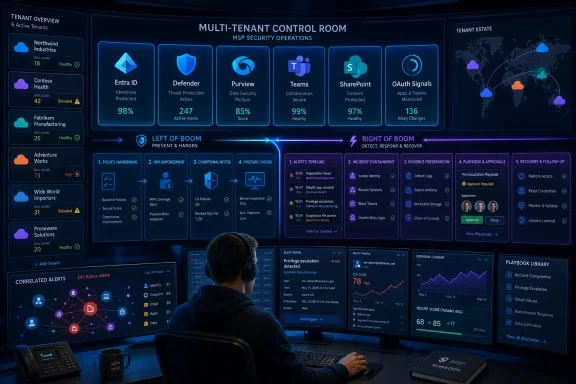
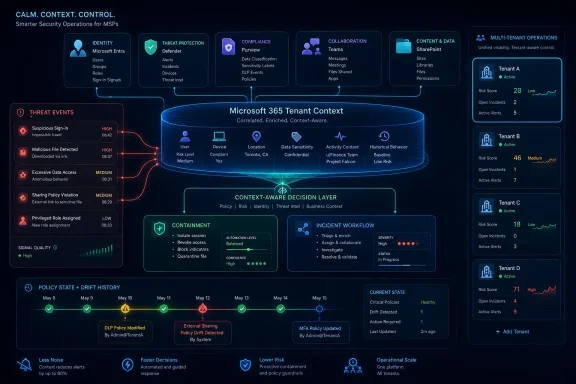
Inforcer launched a threat detection and response platform on June 8, 2026, aimed at helping managed service providers detect, investigate, and respond to attacks across Microsoft 365 environments from a multi-tenant security console. The move matters because Microsoft 365 has become both the default productivity backbone for small and midsize businesses and one of the most profitable hunting grounds for identity-driven attackers. Inforcer is not simply adding another acronym to the MSP security shelf; it is making a bet that prevention and response have to live in the same operational workflow. For the channel, that is a timely argument — and a potentially uncomfortable one.
For the past several years, Inforcer’s pitch has been relatively clean: help MSPs standardize Microsoft 365 security baselines, apply controls across customers, and keep tenant configurations from drifting into danger. That is a familiar pain point for any provider managing dozens or hundreds of Microsoft 365 tenants, where a single customer’s “just this once” exception can become tomorrow’s compromise.
The new threat detection and response offering changes the company’s center of gravity. Instead of living only in the world of policy enforcement and readiness assessments, Inforcer now wants to sit in the moment after something suspicious happens. That means correlating telemetry across Entra ID, Defender, Purview, Teams, SharePoint, OneDrive, and other parts of the Microsoft stack.
That is the right problem to attack. The modern Microsoft 365 breach is rarely a single dramatic event. It is more often a slow sequence: a compromised identity, a strange login, mailbox rules, data access, OAuth consent, file movement, lateral phishing, and persistence mechanisms that look innocuous when viewed one at a time.
Inforcer’s claim is that MSPs do not need yet another noisy alert stream. They need a way to turn Microsoft 365 signals into incidents that tell a coherent story. That framing is more important than the product launch itself, because it gets to the central weakness in SMB cloud security: there is plenty of telemetry, but not enough operational meaning.
That concentration creates efficiency, but it also creates a single high-value control plane. A Windows endpoint compromise is bad. A Microsoft 365 tenant compromise can be existential. It can expose email, documents, Teams chats, SharePoint data, user identities, administrative permissions, business relationships, and the trust fabric attackers need to pivot into suppliers and customers.
The old MSP model was built around endpoints, servers, backups, and tickets. Microsoft 365 forced providers to become identity administrators, compliance advisers, data governance consultants, and cloud security operators. Many did so unevenly, because Microsoft’s own administrative experience was not designed primarily around MSP multi-tenancy.
That is the gap Inforcer has been exploiting. Microsoft builds powerful enterprise security tooling, but MSPs live in a different world. They need repeatable baselines, cross-tenant visibility, delegated workflows, exception handling, and proof that controls are actually applied across a customer base that may span very small businesses and regulated midmarket firms.
TDR is therefore not an adjacent product so much as a recognition that configuration management alone cannot carry the full burden. Once Microsoft 365 becomes the operational core of a customer, security has to include both posture and behavior. The lock matters, but so does the alarm.
That distinction is crucial. The issue is not that Microsoft lacks signals. The issue is that Microsoft’s signals often arrive inside portals, licensing tiers, policy models, and alerting systems that assume a level of staffing and specialization many SMB customers simply do not have. MSPs are expected to absorb that complexity on the customer’s behalf.
Inforcer’s value proposition is built around translating the Microsoft estate into something MSPs can manage at scale. If its TDR platform can stitch together identity anomalies, file activity, mailbox behavior, app consent, and security control gaps into a single incident narrative, it could reduce one of the most expensive forms of security work: analyst interpretation.
That is also where the product will have to prove itself. The MSP security market is crowded with vendors promising lower noise, better context, and faster response. Those claims are easy to make in a launch briefing and difficult to sustain in production, where customers differ wildly in licensing, configuration quality, user behavior, and risk tolerance.
The winners in this category will not be the vendors that surface the most suspicious events. They will be the ones that consistently distinguish between a messy workday and an actual intrusion. In Microsoft 365, that line is often blurry.
That is a real problem. An impossible travel alert may be meaningful, or it may be a VPN, a mobile carrier artifact, a user on holiday, or a false positive caused by imperfect geolocation. A suspicious inbox rule may be malicious, or it may be a legitimate user trying to cope with mail overload. A file download spike may indicate exfiltration, or it may be a finance employee preparing for an audit.
Security tools often push that ambiguity downstream. MSPs then face the worst of both worlds: they are accountable for missing attacks but cannot afford to investigate every weak signal as if it were a breach. Over time, teams tune out alerts, suppress them, or route them into ticket queues where urgency evaporates.
Inforcer’s “complete attack story” framing is a direct answer to that problem. A single identity anomaly is weak. An identity anomaly followed by mass OneDrive downloads, new forwarding rules, suspicious enterprise app consent, and persistent access over several weeks is stronger. Correlation turns noise into judgment.
This is where Microsoft 365-specific focus may help. A vendor trying to normalize every possible telemetry source across every platform can provide breadth, but breadth often comes at the cost of domain nuance. A vendor focused narrowly on Microsoft 365 can build detections around the real ways attackers abuse that ecosystem.
Inforcer is arguing that an incident should not merely generate a ticket. It should point back to the control that failed, the baseline that was not applied, or the exception that created risk. That is a more useful loop than “detect, respond, move on.”
If a compromised user created a forwarding rule, the MSP should be able to see whether mailbox rule auditing, alerting, or policy controls were in place. If attackers abused OAuth consent, the platform should point to app consent governance. If sensitive SharePoint content was accessed broadly, the lesson may be about permissions sprawl rather than only identity compromise.
That connection between right-of-boom response and left-of-boom hardening is where the product could become more than another SOC-adjacent console. It could help MSPs convert incidents into standardized improvements across all customers. One customer’s breach pattern becomes another customer’s prevention control.
This is also commercially clever. MSPs struggle to sell security hardening when customers perceive it as friction. A detection story gives the provider evidence. It turns abstract best practice into a concrete explanation: this is the behavior we saw, this is the control that would have reduced the blast radius, and this is why the change is worth the inconvenience.
Conditional Access policies can break workflows. Multi-factor authentication can annoy users. External sharing restrictions can frustrate sales teams. App consent governance can slow down departments that have grown accustomed to connecting SaaS tools at will. Least privilege is always popular until someone loses access to a folder five minutes before a deadline.
This is why the “balance protection and productivity” language matters. It is not just vendor diplomacy. It reflects the reality that MSPs operate through consent, persuasion, and contract scope. They cannot always dictate the security posture they would choose for themselves.
TDR becomes the compensating mechanism when prevention is incomplete. That does not mean detection is a substitute for controls. It means MSPs need visibility into the residual risk that remains after customers negotiate down the hardening plan.
There is a danger here, though. If TDR becomes the excuse for weak baselines, the model fails. Detection is not a moral absolution for bad configuration. It is a safety net, not a trampoline.
For MSPs, AI services are becoming a new revenue opportunity. Customers want help adopting Copilot, measuring usage, controlling shadow AI, and proving return on investment. But those services depend on trust in the underlying tenant. A customer that cannot answer who has access to what, where sensitive data lives, and how identities are protected is not ready for broad AI enablement.
That is why Inforcer’s expansion makes strategic sense. A platform that manages security baselines, Copilot readiness, shadow AI visibility, and now threat detection can be positioned as an MSP operating layer for Microsoft 365. The company is trying to own the workflow before, during, and after AI adoption.
The security logic is straightforward. AI increases the premium on identity integrity and data governance. If attackers compromise an account with broad access, the presence of AI tooling may make discovery and misuse of information easier. If employees paste sensitive data into unauthorized AI tools, the organization faces a governance problem that may not look like a traditional intrusion but still creates real risk.
Inforcer does not need to claim that AI creates entirely new classes of Microsoft 365 compromise to make its case. It only needs to show that AI makes existing weaknesses harder to ignore.
That shift is visible across the market. Vendors are packaging Microsoft 365 security, XDR, MDR, email protection, cloud app visibility, and compliance workflows into offerings aimed specifically at MSPs. The promise is familiar: reduce tool sprawl, increase margin, and give providers a repeatable service they can sell across many customers.
The risk is equally familiar. Consolidation can simplify operations, but it can also create dependency on a vendor’s detection quality, integration depth, and response model. MSPs should be wary of any platform that turns Microsoft 365 security into a black box. The whole point of context is to make decisions more explainable, not less.
Inforcer’s advantage is focus. It is not trying to secure every cloud, every endpoint, every network, and every SaaS application. It is betting that Microsoft 365 is deep enough, complex enough, and important enough to justify specialization. For many MSPs, especially those standardized heavily on Microsoft Business Premium and related security licensing, that bet will resonate.
But focus cuts both ways. Customers do not live only in Microsoft 365. They use CRMs, finance systems, browser-based SaaS tools, unmanaged devices, personal phones, and third-party AI services. Inforcer’s TDR may become a strong Microsoft 365 layer, but MSPs will still need to decide how it fits into broader security operations.
Inforcer’s platform can help manage and interpret what is available, but it cannot repeal Microsoft’s licensing model. Some detections, logs, retention windows, and response actions will depend on what the customer has actually bought and enabled. That reality should temper any expectation that TDR will behave identically across every tenant.
This is also where MSPs have to be precise in their own packaging. If a security service promises detection and response across Microsoft 365, the provider must define the licensing prerequisites, supported controls, response actions, and exclusions. Otherwise, the MSP inherits the gap between marketing language and operational reality.
There is a practical upside. A platform that surfaces missing controls and ties incidents back to baseline gaps can help MSPs justify license upgrades. Instead of saying, “You should buy a better Microsoft plan,” a provider can say, “This incident showed why this specific capability matters.”
That is a stronger conversation. It is also one that customers may still resist until after an incident. The economics of SMB security often remain stubbornly reactive.
For MSPs, automation is attractive because attackers move quickly and human analysts are scarce. But automation across multiple customer tenants also increases the blast radius of mistakes. A false positive that disables a CEO’s account during a major deal is not a theoretical problem. It is a ticket escalation with commercial consequences.
The best TDR platforms therefore need graduated response. Some actions can be recommended. Others can require approval. Some can be automated only for high-confidence detections. Others may be customer-specific depending on contract scope and risk appetite.
Inforcer’s prevention heritage could help here. If the platform already understands customer baselines and accepted exceptions, response can be more contextual. A tenant with strict security posture may allow more automated containment. A customer with fragile workflows may require more human approval.
The real test will be how well Inforcer supports MSP governance: audit trails, role-based access, customer-specific policies, technician permissions, escalation paths, and post-incident reporting. Detection quality gets attention at launch. Operational control determines whether MSPs keep using the product six months later.
Scale also changes the meaning of trust. MSPs are not just trusting Inforcer with a console. They are trusting it with detection logic, prioritization, remediation guidance, and potentially response workflows across customer environments. That is a deeper relationship than posture reporting.
The company’s pitch is that its Microsoft-only focus gives it enough depth to earn that trust. It can understand the nuances of Entra ID sign-ins, OneDrive activity, SharePoint permissions, Teams behavior, Defender signals, Purview events, and the messy overlap between security and productivity. It can also turn those observations into repeatable MSP services.
That is plausible. It is not guaranteed. The market will judge the platform on false positives, missed detections, remediation clarity, integration reliability, and whether technicians actually feel less overwhelmed. In security, less noise is not a slogan; it is a measurable product outcome.
Inforcer’s challenge is to prove that its TDR offering makes Microsoft 365 safer without making MSP operations heavier. The launch frames the right battle. The product now has to win it in the field.
For WindowsForum readers who live in the trenches of admin centers, Conditional Access policies, Defender portals, and customer exceptions, the practical lessons are clear:
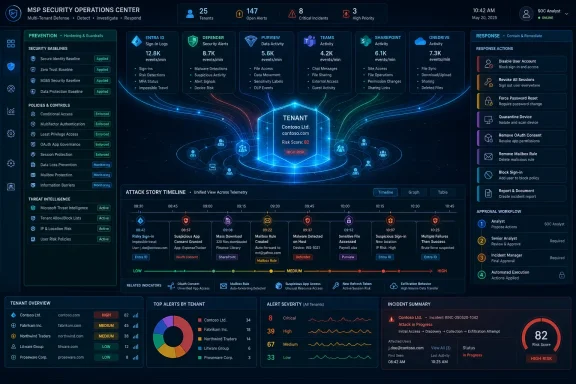 Inforcer Moves From Locking the Door to Watching the Hallway
For the past several years, Inforcer’s pitch has been relatively clean: help MSPs standardize Microsoft 365 security baselines, apply controls across customers, and keep tenant configurations from drifting into danger. That is a familiar pain point for any provider managing dozens or hundreds of Microsoft 365 tenants, where a single customer’s “just this once” exception can become tomorrow’s compromise.The new threat detection and response offering changes the company’s center of gravity. Instead of living only in the world of policy enforcement and readiness assessments, Inforcer now wants to sit in the moment after something suspicious happens. That means correlating telemetry across Entra ID, Defender, Purview, Teams, SharePoint, OneDrive, and other parts of the Microsoft stack.
That is the right problem to attack. The modern Microsoft 365 breach is rarely a single dramatic event. It is more often a slow sequence: a compromised identity, a strange login, mailbox rules, data access, OAuth consent, file movement, lateral phishing, and persistence mechanisms that look innocuous when viewed one at a time.
Inforcer’s claim is that MSPs do not need yet another noisy alert stream. They need a way to turn Microsoft 365 signals into incidents that tell a coherent story. That framing is more important than the product launch itself, because it gets to the central weakness in SMB cloud security: there is plenty of telemetry, but not enough operational meaning.
The Tenant Really Has Become the New Server
The MSP world has spent years repeating a phrase that used to sound like marketing: the tenant is the new server. It is now closer to an architectural fact. For many SMBs, Microsoft 365 is the identity provider, mail platform, document repository, collaboration layer, compliance surface, and increasingly the substrate for AI-assisted work.That concentration creates efficiency, but it also creates a single high-value control plane. A Windows endpoint compromise is bad. A Microsoft 365 tenant compromise can be existential. It can expose email, documents, Teams chats, SharePoint data, user identities, administrative permissions, business relationships, and the trust fabric attackers need to pivot into suppliers and customers.
The old MSP model was built around endpoints, servers, backups, and tickets. Microsoft 365 forced providers to become identity administrators, compliance advisers, data governance consultants, and cloud security operators. Many did so unevenly, because Microsoft’s own administrative experience was not designed primarily around MSP multi-tenancy.
That is the gap Inforcer has been exploiting. Microsoft builds powerful enterprise security tooling, but MSPs live in a different world. They need repeatable baselines, cross-tenant visibility, delegated workflows, exception handling, and proof that controls are actually applied across a customer base that may span very small businesses and regulated midmarket firms.
TDR is therefore not an adjacent product so much as a recognition that configuration management alone cannot carry the full burden. Once Microsoft 365 becomes the operational core of a customer, security has to include both posture and behavior. The lock matters, but so does the alarm.
Microsoft’s Security Stack Is Powerful, but MSPs Need Translation
Microsoft has spent years building out a security portfolio that now touches identity, endpoint, email, data loss prevention, SIEM, XDR, cloud apps, and AI-assisted investigation. For enterprise security teams with dedicated analysts, that breadth can be a strategic advantage. For MSPs supporting many small customers with lean teams, it can become an operational maze.That distinction is crucial. The issue is not that Microsoft lacks signals. The issue is that Microsoft’s signals often arrive inside portals, licensing tiers, policy models, and alerting systems that assume a level of staffing and specialization many SMB customers simply do not have. MSPs are expected to absorb that complexity on the customer’s behalf.
Inforcer’s value proposition is built around translating the Microsoft estate into something MSPs can manage at scale. If its TDR platform can stitch together identity anomalies, file activity, mailbox behavior, app consent, and security control gaps into a single incident narrative, it could reduce one of the most expensive forms of security work: analyst interpretation.
That is also where the product will have to prove itself. The MSP security market is crowded with vendors promising lower noise, better context, and faster response. Those claims are easy to make in a launch briefing and difficult to sustain in production, where customers differ wildly in licensing, configuration quality, user behavior, and risk tolerance.
The winners in this category will not be the vendors that surface the most suspicious events. They will be the ones that consistently distinguish between a messy workday and an actual intrusion. In Microsoft 365, that line is often blurry.
Alert Fatigue Is the Enemy Inforcer Is Really Selling Against
The most revealing part of Inforcer’s launch is not the feature list. It is the critique of alert fatigue. The company is saying, in effect, that MSPs have become numb to security tools that technically detect things but operationally bury the team.That is a real problem. An impossible travel alert may be meaningful, or it may be a VPN, a mobile carrier artifact, a user on holiday, or a false positive caused by imperfect geolocation. A suspicious inbox rule may be malicious, or it may be a legitimate user trying to cope with mail overload. A file download spike may indicate exfiltration, or it may be a finance employee preparing for an audit.
Security tools often push that ambiguity downstream. MSPs then face the worst of both worlds: they are accountable for missing attacks but cannot afford to investigate every weak signal as if it were a breach. Over time, teams tune out alerts, suppress them, or route them into ticket queues where urgency evaporates.
Inforcer’s “complete attack story” framing is a direct answer to that problem. A single identity anomaly is weak. An identity anomaly followed by mass OneDrive downloads, new forwarding rules, suspicious enterprise app consent, and persistent access over several weeks is stronger. Correlation turns noise into judgment.
This is where Microsoft 365-specific focus may help. A vendor trying to normalize every possible telemetry source across every platform can provide breadth, but breadth often comes at the cost of domain nuance. A vendor focused narrowly on Microsoft 365 can build detections around the real ways attackers abuse that ecosystem.
Prevention and Response Are Finally Being Put in the Same Room
The most interesting part of Inforcer’s strategy is the connection between its prevention work and its new response capability. In many security programs, posture management and detection live in separate silos. One team checks configurations. Another watches alerts. A third handles remediation. MSPs rarely have the luxury of that separation.Inforcer is arguing that an incident should not merely generate a ticket. It should point back to the control that failed, the baseline that was not applied, or the exception that created risk. That is a more useful loop than “detect, respond, move on.”
If a compromised user created a forwarding rule, the MSP should be able to see whether mailbox rule auditing, alerting, or policy controls were in place. If attackers abused OAuth consent, the platform should point to app consent governance. If sensitive SharePoint content was accessed broadly, the lesson may be about permissions sprawl rather than only identity compromise.
That connection between right-of-boom response and left-of-boom hardening is where the product could become more than another SOC-adjacent console. It could help MSPs convert incidents into standardized improvements across all customers. One customer’s breach pattern becomes another customer’s prevention control.
This is also commercially clever. MSPs struggle to sell security hardening when customers perceive it as friction. A detection story gives the provider evidence. It turns abstract best practice into a concrete explanation: this is the behavior we saw, this is the control that would have reduced the blast radius, and this is why the change is worth the inconvenience.
The Customer Acceptance Problem Is the Channel’s Open Secret
Inforcer co-founder Will Connor’s most important observation is that MSPs often know what they want to implement but cannot always get customers to accept it. That is the channel’s open secret. Security is easy to prescribe in a vacuum and hard to impose on a business that sees every extra prompt, restriction, and approval workflow as lost productivity.Conditional Access policies can break workflows. Multi-factor authentication can annoy users. External sharing restrictions can frustrate sales teams. App consent governance can slow down departments that have grown accustomed to connecting SaaS tools at will. Least privilege is always popular until someone loses access to a folder five minutes before a deadline.
This is why the “balance protection and productivity” language matters. It is not just vendor diplomacy. It reflects the reality that MSPs operate through consent, persuasion, and contract scope. They cannot always dictate the security posture they would choose for themselves.
TDR becomes the compensating mechanism when prevention is incomplete. That does not mean detection is a substitute for controls. It means MSPs need visibility into the residual risk that remains after customers negotiate down the hardening plan.
There is a danger here, though. If TDR becomes the excuse for weak baselines, the model fails. Detection is not a moral absolution for bad configuration. It is a safety net, not a trampoline.
AI Readiness Raises the Stakes Beyond Email Compromise
Inforcer is also tying TDR to AI readiness, and that is more than a convenient 2026 buzzword. Microsoft 365 Copilot and related AI tools make tenant hygiene more consequential because they increase the value of well-governed data and the danger of poorly governed data. If permissions are sloppy, AI does not magically fix them. It can make their consequences more visible.For MSPs, AI services are becoming a new revenue opportunity. Customers want help adopting Copilot, measuring usage, controlling shadow AI, and proving return on investment. But those services depend on trust in the underlying tenant. A customer that cannot answer who has access to what, where sensitive data lives, and how identities are protected is not ready for broad AI enablement.
That is why Inforcer’s expansion makes strategic sense. A platform that manages security baselines, Copilot readiness, shadow AI visibility, and now threat detection can be positioned as an MSP operating layer for Microsoft 365. The company is trying to own the workflow before, during, and after AI adoption.
The security logic is straightforward. AI increases the premium on identity integrity and data governance. If attackers compromise an account with broad access, the presence of AI tooling may make discovery and misuse of information easier. If employees paste sensitive data into unauthorized AI tools, the organization faces a governance problem that may not look like a traditional intrusion but still creates real risk.
Inforcer does not need to claim that AI creates entirely new classes of Microsoft 365 compromise to make its case. It only needs to show that AI makes existing weaknesses harder to ignore.
The MSP Platform War Is Moving Up the Stack
Inforcer’s launch also fits a larger trend: MSP platforms are moving beyond traditional remote monitoring and management into Microsoft 365 operations, identity security, and cloud governance. The old center of gravity was the endpoint agent. The new one is increasingly the SaaS control plane.That shift is visible across the market. Vendors are packaging Microsoft 365 security, XDR, MDR, email protection, cloud app visibility, and compliance workflows into offerings aimed specifically at MSPs. The promise is familiar: reduce tool sprawl, increase margin, and give providers a repeatable service they can sell across many customers.
The risk is equally familiar. Consolidation can simplify operations, but it can also create dependency on a vendor’s detection quality, integration depth, and response model. MSPs should be wary of any platform that turns Microsoft 365 security into a black box. The whole point of context is to make decisions more explainable, not less.
Inforcer’s advantage is focus. It is not trying to secure every cloud, every endpoint, every network, and every SaaS application. It is betting that Microsoft 365 is deep enough, complex enough, and important enough to justify specialization. For many MSPs, especially those standardized heavily on Microsoft Business Premium and related security licensing, that bet will resonate.
But focus cuts both ways. Customers do not live only in Microsoft 365. They use CRMs, finance systems, browser-based SaaS tools, unmanaged devices, personal phones, and third-party AI services. Inforcer’s TDR may become a strong Microsoft 365 layer, but MSPs will still need to decide how it fits into broader security operations.
The Licensing Reality Will Decide How Far This Goes
Every Microsoft 365 security conversation eventually crashes into licensing. Capabilities vary across Business Basic, Business Standard, Business Premium, E3, E5, Defender add-ons, Entra tiers, Purview features, and the rest of Microsoft’s packaging. MSPs know this pain intimately because customers often want enterprise-grade security at commodity productivity pricing.Inforcer’s platform can help manage and interpret what is available, but it cannot repeal Microsoft’s licensing model. Some detections, logs, retention windows, and response actions will depend on what the customer has actually bought and enabled. That reality should temper any expectation that TDR will behave identically across every tenant.
This is also where MSPs have to be precise in their own packaging. If a security service promises detection and response across Microsoft 365, the provider must define the licensing prerequisites, supported controls, response actions, and exclusions. Otherwise, the MSP inherits the gap between marketing language and operational reality.
There is a practical upside. A platform that surfaces missing controls and ties incidents back to baseline gaps can help MSPs justify license upgrades. Instead of saying, “You should buy a better Microsoft plan,” a provider can say, “This incident showed why this specific capability matters.”
That is a stronger conversation. It is also one that customers may still resist until after an incident. The economics of SMB security often remain stubbornly reactive.
Response Automation Must Be Useful Without Becoming Reckless
Threat detection is only half the promise. Response is where things get operationally sensitive. In Microsoft 365, response actions can include disabling accounts, revoking sessions, resetting passwords, removing inbox rules, blocking applications, adjusting Conditional Access, quarantining messages, or changing sharing permissions. These are powerful moves.For MSPs, automation is attractive because attackers move quickly and human analysts are scarce. But automation across multiple customer tenants also increases the blast radius of mistakes. A false positive that disables a CEO’s account during a major deal is not a theoretical problem. It is a ticket escalation with commercial consequences.
The best TDR platforms therefore need graduated response. Some actions can be recommended. Others can require approval. Some can be automated only for high-confidence detections. Others may be customer-specific depending on contract scope and risk appetite.
Inforcer’s prevention heritage could help here. If the platform already understands customer baselines and accepted exceptions, response can be more contextual. A tenant with strict security posture may allow more automated containment. A customer with fragile workflows may require more human approval.
The real test will be how well Inforcer supports MSP governance: audit trails, role-based access, customer-specific policies, technician permissions, escalation paths, and post-incident reporting. Detection quality gets attention at launch. Operational control determines whether MSPs keep using the product six months later.
The New Inforcer Bet Comes Down to Trust at Scale
Inforcer says it now works with more than 1,200 MSPs protecting over 60,000 tenants. Those numbers matter because multi-tenant security is a scale problem before it is a feature problem. A tool that works beautifully for five tenants can fall apart when applied across hundreds with different licenses, industries, geographies, and tolerance for friction.Scale also changes the meaning of trust. MSPs are not just trusting Inforcer with a console. They are trusting it with detection logic, prioritization, remediation guidance, and potentially response workflows across customer environments. That is a deeper relationship than posture reporting.
The company’s pitch is that its Microsoft-only focus gives it enough depth to earn that trust. It can understand the nuances of Entra ID sign-ins, OneDrive activity, SharePoint permissions, Teams behavior, Defender signals, Purview events, and the messy overlap between security and productivity. It can also turn those observations into repeatable MSP services.
That is plausible. It is not guaranteed. The market will judge the platform on false positives, missed detections, remediation clarity, integration reliability, and whether technicians actually feel less overwhelmed. In security, less noise is not a slogan; it is a measurable product outcome.
Inforcer’s challenge is to prove that its TDR offering makes Microsoft 365 safer without making MSP operations heavier. The launch frames the right battle. The product now has to win it in the field.
The Microsoft 365 Security Fight Is Becoming More Concrete
Inforcer’s TDR launch is best understood as a signpost for where the MSP market is heading rather than as a standalone product announcement. Microsoft 365 security is no longer a checklist exercise. It is becoming a continuous operating discipline that blends baseline enforcement, identity monitoring, data governance, AI readiness, and incident response.For WindowsForum readers who live in the trenches of admin centers, Conditional Access policies, Defender portals, and customer exceptions, the practical lessons are clear:
- MSPs can no longer treat Microsoft 365 as a bundle of productivity apps that happens to include security settings.
- Detection tools must correlate behavior across identity, mail, files, applications, and collaboration surfaces to be useful.
- Security baselines are stronger when incidents feed back into policy improvements across every managed tenant.
- Customer resistance to strict controls makes visibility and response essential, but it does not make prevention optional.
- AI adoption raises the stakes for identity security and data governance because Copilot-era value depends on trustworthy tenant hygiene.
- Any MSP evaluating TDR should test noise reduction, response governance, licensing assumptions, and reporting quality before standardizing on a platform.
References
- Primary source: crn.com
Published: Mon, 08 Jun 2026 18:09:00 GMT
Inforcer Launches Threat Detection And Response Platform To Help MSPs Thwart Microsoft 365 Threats
Inforcer expands platform to help MSPs spot threats earlier across Microsoft 365.www.crn.com - Related coverage: inforcer.com
inforcer | Standardize 365 policies across multiple tenants
inforcer helps MSPs standardize Microsoft 365 security across all client tenants, from policy deployment to compliance monitoring. Book a demo today. www.inforcer.com
- Related coverage: proofpoint.com
Proofpoint Launches Dedicated MSP Business Unit and Introduces 365 Total Protection for North America | Proofpoint US
New MSP Platform business unit, AI-powered all-in-one Microsoft 365 protection, and Marketplace partnership with Pax8 strengthen Proofpoint’s commitment to channel and small and mid-sizewww.proofpoint.com
- Related coverage: itpro.com
Inforcer launches new Copilot Manager to help MSPs scale AI services | ChannelPro
The tool aims to give greater visibility into Copilot usage and shadow AI risks across customer environmentswww.itpro.com - Related coverage: msp.toolsinfo.com
inforcer: Pricing, Reviews & Features 2026 | MSP Tools
inforcer helps MSPs Microsoft 365 Security Policy Management at Scale.. unknown. increase margins & reduce tickets. See if it's right for you.msp.toolsinfo.com - Official source: microsoft.com
How Microsoft Defender Experts for XDR helps triage, investigate, and respond to cyberthreats | Microsoft Security Blog
Take a closer look at how Microsoft Defender Experts for XDR augments your team to provide continuous monitoring, investigation, and remediation.www.microsoft.com
- Related coverage: ontinue.com
2216163156
Abstract digital background featuring flowing blue and green lines with glowing yellow particles, evoking a sense of data flow or neural networks.www.ontinue.com
- Official source: learn.microsoft.com