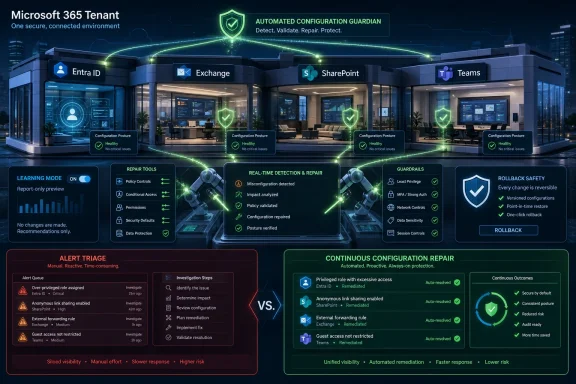
Huntress made Managed Identity Security Posture Management generally available on June 30, 2026, extending its security platform for Microsoft 365 tenants with managed hardening across Entra ID, Exchange, SharePoint, and Teams after an Early Access program covering more than 12,000 tenants. The announcement is not just another checkbox in the crowded posture-management market. It is a bet that small and midsize organizations do not merely need another dashboard telling them their Microsoft 365 environments are risky; they need somebody to keep fixing the boring, dangerous misconfigurations that attackers exploit every day.
That distinction matters because identity security has become the new Windows hygiene problem. For years, the endpoint was the place where defenders concentrated their operational muscle: agents, alerts, isolation, remediation, patching, and rollback. Now the same operational burden has moved into Microsoft 365, where a single weak Conditional Access policy, excessive admin role, stale mailbox rule, or over-permissive collaboration setting can become the front door to a compromise.
The phrase Identity Security Posture Management sounds like something born in a conference-room taxonomy exercise, but the underlying problem is painfully practical. Microsoft 365 tenants are living systems. Users join and leave, admins create exceptions, MSPs inherit half-configured environments, Teams policies drift, SharePoint sharing rules evolve, and Conditional Access often reflects the last urgent business exception rather than the current threat model.
Traditional posture tools identify that mess and score it. Huntress is trying to productize the next step: managed policy deployment, impact analysis, continuous tuning, and rollback confidence. That is why the company is framing Managed ISPM as part of its broader “agentic” security platform rather than as a reporting module bolted onto ITDR.
The company says the product was hardened in Early Access across more than 12,000 Microsoft 365 tenants. The numbers it disclosed are exactly the kind that make administrators wince because they are not exotic: more than 60 percent of organizations were missing at least half of Huntress’ recommended ISPM controls, 66 percent lacked recommended MFA configurations, 59 percent were missing key restrictions on admin accounts, and 55 percent had standard users who could perform administrative functions.
Those are not zero-day problems. They are posture failures, which is what makes them strategically important. Attackers do not need novel malware when they can log in, abuse consent, manipulate mailboxes, or escalate through permissions that never should have existed in the first place.
Entra ID may be the identity control plane, but attackers rarely respect product boundaries. A compromised account becomes more useful when Exchange rules can hide correspondence, SharePoint links can leak data, Teams can be used for social engineering, and admin roles can unlock tenant-wide changes. Huntress’ GA release therefore matters because it expands beyond Entra ID into Exchange, SharePoint, and Teams.
That expansion is not cosmetic. Business email compromise is rarely just a sign-in event. It is often a sequence: access is obtained, persistence is established, mailbox behavior changes, data is searched, conversations are monitored, and eventually money or information is redirected. Posture management that stops at identity configuration can miss the operational pathways that make the compromise profitable.
For sysadmins, this is also where Microsoft 365 security becomes politically difficult. The technically safest configuration is often the one that breaks someone’s workflow. A finance team may need external sharing. Executives may travel. A vendor may require guest access. A legacy application may still be limping along with assumptions that modern authentication policies punish. The security work is not only deciding what is ideal; it is getting from the current state to the safer state without creating a help-desk fire.
Conditional Access policies can be powerful, but they are also one of the fastest ways for a small IT team to ruin a Monday morning. A badly staged policy can lock out users, block legitimate locations, break unmanaged device workflows, or expose a brittle dependency nobody documented. Microsoft provides report-only modes and policy insights, but many smaller organizations still lack the staffing or confidence to interpret the blast radius.
Huntress says Learning Mode shows who would be affected by a policy before enforcement. That sounds mundane until you consider the audience. For a two-person IT department or an MSP managing dozens of tenants, knowing the likely impact is the difference between postponing hardening indefinitely and finally turning the policy on.
The company also says Early Access deployments produced tens of thousands of policies with a rollback rate below 0.04 percent. Vendor-supplied rollout statistics deserve a skeptical reading, because they depend on how rollback is defined and what kinds of tenants participated. Still, the figure supports the central pitch: Huntress wants to remove the operational terror from identity hardening.
That is where Managed ISPM may prove more consequential than a pure scanner. A report that says “your MFA posture is weak” is useful once. A managed system that stages, explains, deploys, and updates controls is useful every time policy drift reappears.
That timing matters in the MSP market, where product expansion can look like logo collecting unless it lands in operational workflows. Huntress already had a strong channel presence around managed endpoint detection and response, then expanded into Managed ITDR. Inside Agent gave it posture-management DNA at the moment when customers were beginning to understand that detecting identity attacks after the fact was not enough.
The company’s own framing has shifted accordingly. In the acquisition announcement, Huntress discussed assessing more than 100 checks and balances across environments, including misconfigurations, stale accounts, and excessive privileges. In the GA announcement, the language is more operational: managed deployments, learning mode, expanded Microsoft 365 coverage, and a feedback loop between ITDR and ISPM.
That feedback loop is the strategic center of the release. ITDR sees active identity threats; ISPM closes the gaps that made those threats easier. If that loop works, Huntress can use observed attacker behavior to prioritize posture changes, rather than relying only on generic best-practice baselines.
For administrators, the promise is attractive but also worth scrutinizing. “Based on real-world attacker behavior” is a strong claim in security marketing. The value will depend on how transparently Huntress explains the controls it recommends, how much tenant-specific context it preserves, and how well it avoids treating every organization as a template.
Identity security has made that balance harder. A compromised Microsoft 365 account can generate enormous ambiguity. Is a login from a new location travel or theft? Is a mailbox rule automation or concealment? Is an OAuth app a legitimate integration or persistence? The more identity becomes the primary attack surface, the more detection teams drown in context problems.
That is why posture management is having a moment. Every risky control that gets fixed upstream is one fewer ambiguous alert downstream. If MFA is properly enforced, admin roles are constrained, legacy authentication is gone, guest access is governed, and mailbox forwarding is restricted, ITDR has less noise to triage and fewer high-confidence incidents to contain.
Huntress says identity-based attacks accounted for 79 percent of the critical and high-severity incidents it responded to last year, with most stemming from preventable gaps. It also says fully deploying the posture improvements seen through Managed ISPM could have prevented 35 percent of identity-based incidents in its Managed ITDR data from the past six months, with the figure projected to rise to 80 percent by the end of the third quarter of 2026 as additional controls are added.
The projection is ambitious, and it should be read as a vendor forecast rather than an industry constant. But the direction of travel is credible. In identity security, a depressingly large share of successful attacks still depends on controls that were available, documented, and not fully deployed.
That audience has a different problem from the enterprise. It does not merely lack tools; it lacks time, repeatability, and political cover. An MSP can run assessments across clients, but turning findings into enforced policies across dozens or hundreds of organizations is a different operational challenge. Each tenant has its own exceptions, VIP users, legacy workflows, and tolerance for disruption.
Managed ISPM is pitched directly at that scale problem. Huntress says managed policies are continuously updated based on attacker behavior, Microsoft guidance, and industry standards, so customers are not left maintaining static baselines on their own. That phrase, static baselines, is the villain of the story. A baseline that is not continuously maintained becomes documentation of what the environment used to need.
There is also a business-model implication. MSPs have historically sold security layers as bundles: endpoint protection, backup, patching, email filtering, awareness training, MDR, SIEM, and identity add-ons. If Huntress can make posture hardening feel like an extension of managed detection rather than a separate consulting project, it could become easier for MSPs to standardize identity controls across their base.
But this is also where friction will surface. Customers may resist controls that change daily workflows. MSPs may want more customization than a managed policy library allows. Some environments will have legitimate reasons to deviate from recommended settings. Huntress will have to prove that “managed” does not become “opaque.”
Many tenants still reflect years of incremental changes. A setting enabled during a migration remains in place. A guest sharing exception becomes normal. A global admin account survives because nobody wants to risk removing it. A user is given elevated privileges for a project and keeps them. A mailbox forwarding rule is created for convenience and never reviewed.
Microsoft’s platform offers the controls to address much of this, but smaller organizations rarely have the same identity governance maturity as large enterprises. They may not have a dedicated Entra administrator. They may not have a security engineer reviewing Conditional Access policy interactions. They may not even know which defaults are dangerous because those defaults were inherited years ago.
This is why vendors like Huntress have room to operate around Microsoft’s own security stack. They are not necessarily replacing Microsoft controls; they are operationalizing them for customers who cannot spend their days living inside admin portals. In that sense, Managed ISPM is less a competitor to Microsoft’s native capabilities than an indictment of how difficult those capabilities are to maintain well at scale.
For WindowsForum readers, the lesson is familiar. The best control is not the one that exists in a portal. It is the one that is configured, monitored, tuned, documented, and still in force six months later.
There is a useful idea underneath the hype. Security teams are overwhelmed by systems that produce obligations without execution. A scanner says fix this. A SIEM says investigate that. A posture tool says improve your score. An agentic workflow, at least in theory, should close the loop by doing more of the work safely.
Managed ISPM is a plausible example because identity hardening is policy-driven and repeatable. A system can evaluate settings, model impact, stage changes, deploy policies, and roll back if needed. That is a better fit for automation than many areas of incident response, where human judgment and messy evidence still dominate.
The risk is that the word “agentic” becomes a way to blur accountability. If an automated or managed system changes Conditional Access, blocks a workflow, or modifies tenant behavior, administrators need to know what changed and why. The more security platforms act on behalf of customers, the more they must preserve explainability.
Huntress’ Learning Mode and managed deployment language suggests the company understands that trust is the product. It is not enough to be right in the abstract. The platform has to make customers comfortable enough to let it touch controls that can affect every user in the tenant.
No tenant will be perfect. Users will still be phished. Tokens will still be stolen. OAuth abuse will still happen. Attackers will still find creative ways to blend into legitimate cloud activity. The goal is to make every stage harder: harder to sign in from the wrong place, harder to persist, harder to access sensitive data, harder to abuse admin rights, and harder to hide mailbox manipulation.
That is why the combination of Managed ITDR and Managed ISPM makes strategic sense. Detection handles the incident that gets through. Posture management reduces the probability and severity of the next one. The loop is only valuable if each side informs the other.
The announcement’s customer quotes also reveal the intended emotional sell. A fast-growing company with a two-person IT team does not want a compliance lecture; it wants confidence that it has fewer hidden admin accounts and fewer identity gaps. An MSP does not want another list of tenant problems; it wants a repeatable way to improve controls without breaking clients.
That is the market Huntress is pursuing: organizations mature enough to know Microsoft 365 identity is dangerous, but not staffed enough to harden it continuously by hand.
That ordinariness is precisely why the GA release matters. Security vendors often chase novelty because novelty sells. But most successful intrusions are built on boring weaknesses that remained boring until they became expensive.
The reported 12,000-tenant Early Access footprint also gives Huntress a useful data advantage if the telemetry is handled responsibly. Cross-tenant posture patterns can reveal which misconfigurations are most common, which controls are most disruptive, and which policy sequences lead to the safest hardening path. That operational learning is difficult for a single organization to replicate.
Still, data scale cuts both ways. Recommendations based on broad patterns can miss local context. A nonprofit, law firm, manufacturer, and distributed software company may all use Microsoft 365, but their collaboration patterns and risk tolerance differ. The best version of Managed ISPM will use fleet-scale knowledge without flattening every tenant into the same configuration.
This is where administrators should ask hard questions before handing over policy authority. What exactly is being changed? Can changes be previewed? Are exceptions documented? How are rollbacks handled? How are Microsoft licensing differences accounted for? How does the service distinguish a business requirement from a risky habit?
Managed ISPM lands in that reality. It assumes the security boundary is no longer the endpoint alone, and it assumes the admin burden cannot be solved by another alert stream. In that sense, it reflects the broader transformation of Windows IT from machine management to access management.
That shift has practical consequences. Admins need better processes for role assignment, break-glass accounts, guest access, mailbox rules, app consent, external sharing, and Conditional Access testing. They also need tools that respect the fact that Microsoft 365 tenants are production environments. A posture change is not a theoretical improvement if it blocks the sales team from a customer call.
The best administrators already know this. They stage changes, communicate impact, test with pilot groups, document exceptions, and revisit decisions. Huntress is effectively trying to package that discipline for organizations that cannot dedicate a team to it.
That is not a small ambition. If it works, it could raise the security floor for a large class of businesses that have historically been underserved by enterprise-first security products.
Huntress has some advantages. It has an MSP-friendly brand, an existing managed security operations model, and a clear identity story that began before this release. It also has a natural path for bundling posture and detection into a single customer conversation.
But the market will judge Managed ISPM on outcomes rather than vocabulary. Does it reduce incidents? Does it lower alert volume? Does it prevent business email compromise? Does it help administrators enforce better controls without generating support chaos? Does it keep pace with Microsoft’s constantly changing admin experience and security recommendations?
The company’s own projected prevention numbers create a high bar. Claiming that expanded controls could eventually prevent up to 80 percent of identity-based incidents is the sort of figure customers will remember. Huntress will need to back it with transparent reporting, careful definitions, and real-world case studies that go beyond launch-day optimism.
There is also competitive pressure. Microsoft continues to evolve its native security posture, identity protection, and management tooling. Other vendors are pushing cloud security posture, SaaS security posture, and identity governance from adjacent angles. Huntress’ differentiation rests on being managed, practical, and channel-friendly. Those are strengths, but only if execution remains tight.
The most useful way to read this release is as a market signal. Identity posture is becoming an operational security category, not an annual project. The Microsoft 365 controls that used to be “nice to tune someday” are increasingly table stakes for resisting account takeover and business email compromise.
That distinction matters because identity security has become the new Windows hygiene problem. For years, the endpoint was the place where defenders concentrated their operational muscle: agents, alerts, isolation, remediation, patching, and rollback. Now the same operational burden has moved into Microsoft 365, where a single weak Conditional Access policy, excessive admin role, stale mailbox rule, or over-permissive collaboration setting can become the front door to a compromise.
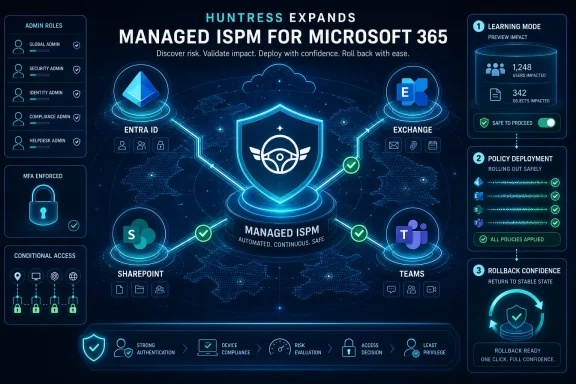 Huntress Is Selling the Fix, Not Just the Finding
The phrase Identity Security Posture Management sounds like something born in a conference-room taxonomy exercise, but the underlying problem is painfully practical. Microsoft 365 tenants are living systems. Users join and leave, admins create exceptions, MSPs inherit half-configured environments, Teams policies drift, SharePoint sharing rules evolve, and Conditional Access often reflects the last urgent business exception rather than the current threat model.Traditional posture tools identify that mess and score it. Huntress is trying to productize the next step: managed policy deployment, impact analysis, continuous tuning, and rollback confidence. That is why the company is framing Managed ISPM as part of its broader “agentic” security platform rather than as a reporting module bolted onto ITDR.
The company says the product was hardened in Early Access across more than 12,000 Microsoft 365 tenants. The numbers it disclosed are exactly the kind that make administrators wince because they are not exotic: more than 60 percent of organizations were missing at least half of Huntress’ recommended ISPM controls, 66 percent lacked recommended MFA configurations, 59 percent were missing key restrictions on admin accounts, and 55 percent had standard users who could perform administrative functions.
Those are not zero-day problems. They are posture failures, which is what makes them strategically important. Attackers do not need novel malware when they can log in, abuse consent, manipulate mailboxes, or escalate through permissions that never should have existed in the first place.
Microsoft 365 Has Become the New Flat Network
Windows veterans will recognize the pattern. The old flat LAN created reliable opportunities for lateral movement because convenience kept winning over segmentation. Microsoft 365 now has its own version of that dilemma: collaboration defaults, delegated administration, legacy exceptions, OAuth consent sprawl, and mailbox access patterns that are legitimate until they are not.Entra ID may be the identity control plane, but attackers rarely respect product boundaries. A compromised account becomes more useful when Exchange rules can hide correspondence, SharePoint links can leak data, Teams can be used for social engineering, and admin roles can unlock tenant-wide changes. Huntress’ GA release therefore matters because it expands beyond Entra ID into Exchange, SharePoint, and Teams.
That expansion is not cosmetic. Business email compromise is rarely just a sign-in event. It is often a sequence: access is obtained, persistence is established, mailbox behavior changes, data is searched, conversations are monitored, and eventually money or information is redirected. Posture management that stops at identity configuration can miss the operational pathways that make the compromise profitable.
For sysadmins, this is also where Microsoft 365 security becomes politically difficult. The technically safest configuration is often the one that breaks someone’s workflow. A finance team may need external sharing. Executives may travel. A vendor may require guest access. A legacy application may still be limping along with assumptions that modern authentication policies punish. The security work is not only deciding what is ideal; it is getting from the current state to the safer state without creating a help-desk fire.
Learning Mode Is the Feature That Admits the Real Obstacle
Huntress’ Learning Mode is the most revealing feature in the GA announcement because it acknowledges the reason many organizations fail to enforce better identity controls. The barrier is not always ignorance. It is fear.Conditional Access policies can be powerful, but they are also one of the fastest ways for a small IT team to ruin a Monday morning. A badly staged policy can lock out users, block legitimate locations, break unmanaged device workflows, or expose a brittle dependency nobody documented. Microsoft provides report-only modes and policy insights, but many smaller organizations still lack the staffing or confidence to interpret the blast radius.
Huntress says Learning Mode shows who would be affected by a policy before enforcement. That sounds mundane until you consider the audience. For a two-person IT department or an MSP managing dozens of tenants, knowing the likely impact is the difference between postponing hardening indefinitely and finally turning the policy on.
The company also says Early Access deployments produced tens of thousands of policies with a rollback rate below 0.04 percent. Vendor-supplied rollout statistics deserve a skeptical reading, because they depend on how rollback is defined and what kinds of tenants participated. Still, the figure supports the central pitch: Huntress wants to remove the operational terror from identity hardening.
That is where Managed ISPM may prove more consequential than a pure scanner. A report that says “your MFA posture is weak” is useful once. A managed system that stages, explains, deploys, and updates controls is useful every time policy drift reappears.
The Inside Agent Acquisition Now Looks Like the Opening Move
Huntress acquired Inside Agent in November 2025, describing it at the time as a way to strengthen Microsoft 365 identity security posture management. Less than a year later, the GA release shows how quickly the company wanted to fold that capability into its core identity story.That timing matters in the MSP market, where product expansion can look like logo collecting unless it lands in operational workflows. Huntress already had a strong channel presence around managed endpoint detection and response, then expanded into Managed ITDR. Inside Agent gave it posture-management DNA at the moment when customers were beginning to understand that detecting identity attacks after the fact was not enough.
The company’s own framing has shifted accordingly. In the acquisition announcement, Huntress discussed assessing more than 100 checks and balances across environments, including misconfigurations, stale accounts, and excessive privileges. In the GA announcement, the language is more operational: managed deployments, learning mode, expanded Microsoft 365 coverage, and a feedback loop between ITDR and ISPM.
That feedback loop is the strategic center of the release. ITDR sees active identity threats; ISPM closes the gaps that made those threats easier. If that loop works, Huntress can use observed attacker behavior to prioritize posture changes, rather than relying only on generic best-practice baselines.
For administrators, the promise is attractive but also worth scrutinizing. “Based on real-world attacker behavior” is a strong claim in security marketing. The value will depend on how transparently Huntress explains the controls it recommends, how much tenant-specific context it preserves, and how well it avoids treating every organization as a template.
Prevention Is Back in Fashion Because Detection Got Too Expensive
Cybersecurity has spent years teaching organizations to assume breach, and rightly so. But assume breach was never supposed to mean neglect prevention. It meant defenders should build layered systems that survive failure.Identity security has made that balance harder. A compromised Microsoft 365 account can generate enormous ambiguity. Is a login from a new location travel or theft? Is a mailbox rule automation or concealment? Is an OAuth app a legitimate integration or persistence? The more identity becomes the primary attack surface, the more detection teams drown in context problems.
That is why posture management is having a moment. Every risky control that gets fixed upstream is one fewer ambiguous alert downstream. If MFA is properly enforced, admin roles are constrained, legacy authentication is gone, guest access is governed, and mailbox forwarding is restricted, ITDR has less noise to triage and fewer high-confidence incidents to contain.
Huntress says identity-based attacks accounted for 79 percent of the critical and high-severity incidents it responded to last year, with most stemming from preventable gaps. It also says fully deploying the posture improvements seen through Managed ISPM could have prevented 35 percent of identity-based incidents in its Managed ITDR data from the past six months, with the figure projected to rise to 80 percent by the end of the third quarter of 2026 as additional controls are added.
The projection is ambitious, and it should be read as a vendor forecast rather than an industry constant. But the direction of travel is credible. In identity security, a depressingly large share of successful attacks still depends on controls that were available, documented, and not fully deployed.
The MSP Angle Is the Real Market Test
Huntress’ most important audience may not be the security architect with a mature Microsoft 365 governance program. It is the MSP and the lean internal IT team that inherited a tenant, took over from a previous provider, or grew faster than its controls.That audience has a different problem from the enterprise. It does not merely lack tools; it lacks time, repeatability, and political cover. An MSP can run assessments across clients, but turning findings into enforced policies across dozens or hundreds of organizations is a different operational challenge. Each tenant has its own exceptions, VIP users, legacy workflows, and tolerance for disruption.
Managed ISPM is pitched directly at that scale problem. Huntress says managed policies are continuously updated based on attacker behavior, Microsoft guidance, and industry standards, so customers are not left maintaining static baselines on their own. That phrase, static baselines, is the villain of the story. A baseline that is not continuously maintained becomes documentation of what the environment used to need.
There is also a business-model implication. MSPs have historically sold security layers as bundles: endpoint protection, backup, patching, email filtering, awareness training, MDR, SIEM, and identity add-ons. If Huntress can make posture hardening feel like an extension of managed detection rather than a separate consulting project, it could become easier for MSPs to standardize identity controls across their base.
But this is also where friction will surface. Customers may resist controls that change daily workflows. MSPs may want more customization than a managed policy library allows. Some environments will have legitimate reasons to deviate from recommended settings. Huntress will have to prove that “managed” does not become “opaque.”
The Microsoft Baseline Problem Is Bigger Than Huntress
It is tempting to read this announcement as a Huntress product story, but the deeper issue is the complexity of Microsoft 365 administration. Microsoft has dramatically improved identity security capabilities over the past decade, especially around Conditional Access, risk-based authentication, admin roles, device compliance, and audit visibility. The problem is that capability and adoption are not the same thing.Many tenants still reflect years of incremental changes. A setting enabled during a migration remains in place. A guest sharing exception becomes normal. A global admin account survives because nobody wants to risk removing it. A user is given elevated privileges for a project and keeps them. A mailbox forwarding rule is created for convenience and never reviewed.
Microsoft’s platform offers the controls to address much of this, but smaller organizations rarely have the same identity governance maturity as large enterprises. They may not have a dedicated Entra administrator. They may not have a security engineer reviewing Conditional Access policy interactions. They may not even know which defaults are dangerous because those defaults were inherited years ago.
This is why vendors like Huntress have room to operate around Microsoft’s own security stack. They are not necessarily replacing Microsoft controls; they are operationalizing them for customers who cannot spend their days living inside admin portals. In that sense, Managed ISPM is less a competitor to Microsoft’s native capabilities than an indictment of how difficult those capabilities are to maintain well at scale.
For WindowsForum readers, the lesson is familiar. The best control is not the one that exists in a portal. It is the one that is configured, monitored, tuned, documented, and still in force six months later.
“Agentic” Security Needs More Than a Marketing Glow
Huntress describes Managed ISPM as part of its Agentic Security Platform, and that term deserves some unpacking. In 2026, agentic has become one of the security industry’s favorite adjectives. It implies systems that do not merely alert, but act: triage, recommend, deploy, remediate, and adapt.There is a useful idea underneath the hype. Security teams are overwhelmed by systems that produce obligations without execution. A scanner says fix this. A SIEM says investigate that. A posture tool says improve your score. An agentic workflow, at least in theory, should close the loop by doing more of the work safely.
Managed ISPM is a plausible example because identity hardening is policy-driven and repeatable. A system can evaluate settings, model impact, stage changes, deploy policies, and roll back if needed. That is a better fit for automation than many areas of incident response, where human judgment and messy evidence still dominate.
The risk is that the word “agentic” becomes a way to blur accountability. If an automated or managed system changes Conditional Access, blocks a workflow, or modifies tenant behavior, administrators need to know what changed and why. The more security platforms act on behalf of customers, the more they must preserve explainability.
Huntress’ Learning Mode and managed deployment language suggests the company understands that trust is the product. It is not enough to be right in the abstract. The platform has to make customers comfortable enough to let it touch controls that can affect every user in the tenant.
Identity Resilience Is a Better Goal Than Identity Perfection
The strongest part of Huntress’ announcement is not the claim that it can eliminate identity attacks. It is the more realistic argument that identity resilience comes from continuously reducing preventable exposure.No tenant will be perfect. Users will still be phished. Tokens will still be stolen. OAuth abuse will still happen. Attackers will still find creative ways to blend into legitimate cloud activity. The goal is to make every stage harder: harder to sign in from the wrong place, harder to persist, harder to access sensitive data, harder to abuse admin rights, and harder to hide mailbox manipulation.
That is why the combination of Managed ITDR and Managed ISPM makes strategic sense. Detection handles the incident that gets through. Posture management reduces the probability and severity of the next one. The loop is only valuable if each side informs the other.
The announcement’s customer quotes also reveal the intended emotional sell. A fast-growing company with a two-person IT team does not want a compliance lecture; it wants confidence that it has fewer hidden admin accounts and fewer identity gaps. An MSP does not want another list of tenant problems; it wants a repeatable way to improve controls without breaking clients.
That is the market Huntress is pursuing: organizations mature enough to know Microsoft 365 identity is dangerous, but not staffed enough to harden it continuously by hand.
The Numbers Tell a Story of Neglect, Not Novelty
Huntress’ Early Access findings are striking because they are ordinary. Missing MFA configurations, weak admin restrictions, and standard users with administrative capabilities are not cutting-edge problems. They are the cloud equivalent of exposed RDP and local admin sprawl.That ordinariness is precisely why the GA release matters. Security vendors often chase novelty because novelty sells. But most successful intrusions are built on boring weaknesses that remained boring until they became expensive.
The reported 12,000-tenant Early Access footprint also gives Huntress a useful data advantage if the telemetry is handled responsibly. Cross-tenant posture patterns can reveal which misconfigurations are most common, which controls are most disruptive, and which policy sequences lead to the safest hardening path. That operational learning is difficult for a single organization to replicate.
Still, data scale cuts both ways. Recommendations based on broad patterns can miss local context. A nonprofit, law firm, manufacturer, and distributed software company may all use Microsoft 365, but their collaboration patterns and risk tolerance differ. The best version of Managed ISPM will use fleet-scale knowledge without flattening every tenant into the same configuration.
This is where administrators should ask hard questions before handing over policy authority. What exactly is being changed? Can changes be previewed? Are exceptions documented? How are rollbacks handled? How are Microsoft licensing differences accounted for? How does the service distinguish a business requirement from a risky habit?
The Windows Admin’s Job Keeps Moving Up the Stack
For decades, Windows administration meant mastering desktops, servers, domains, Group Policy, patching, storage, and networking. That job has not disappeared, but the center of gravity has shifted upward into identity and cloud collaboration. The domain controller has company in the form of Entra ID. The file share has company in SharePoint. The help-desk password reset has company in MFA fatigue, token theft, and risky consent grants.Managed ISPM lands in that reality. It assumes the security boundary is no longer the endpoint alone, and it assumes the admin burden cannot be solved by another alert stream. In that sense, it reflects the broader transformation of Windows IT from machine management to access management.
That shift has practical consequences. Admins need better processes for role assignment, break-glass accounts, guest access, mailbox rules, app consent, external sharing, and Conditional Access testing. They also need tools that respect the fact that Microsoft 365 tenants are production environments. A posture change is not a theoretical improvement if it blocks the sales team from a customer call.
The best administrators already know this. They stage changes, communicate impact, test with pilot groups, document exceptions, and revisit decisions. Huntress is effectively trying to package that discipline for organizations that cannot dedicate a team to it.
That is not a small ambition. If it works, it could raise the security floor for a large class of businesses that have historically been underserved by enterprise-first security products.
The Hard Part Starts After General Availability
General Availability is a milestone, not proof of durability. The product will now meet messier tenants, impatient customers, edge-case integrations, channel expectations, and the unforgiving reality of security operations at scale.Huntress has some advantages. It has an MSP-friendly brand, an existing managed security operations model, and a clear identity story that began before this release. It also has a natural path for bundling posture and detection into a single customer conversation.
But the market will judge Managed ISPM on outcomes rather than vocabulary. Does it reduce incidents? Does it lower alert volume? Does it prevent business email compromise? Does it help administrators enforce better controls without generating support chaos? Does it keep pace with Microsoft’s constantly changing admin experience and security recommendations?
The company’s own projected prevention numbers create a high bar. Claiming that expanded controls could eventually prevent up to 80 percent of identity-based incidents is the sort of figure customers will remember. Huntress will need to back it with transparent reporting, careful definitions, and real-world case studies that go beyond launch-day optimism.
There is also competitive pressure. Microsoft continues to evolve its native security posture, identity protection, and management tooling. Other vendors are pushing cloud security posture, SaaS security posture, and identity governance from adjacent angles. Huntress’ differentiation rests on being managed, practical, and channel-friendly. Those are strengths, but only if execution remains tight.
The Practical Read for Microsoft 365 Shops
Huntress’ announcement should not send every administrator rushing to outsource identity hardening tomorrow. It should, however, force a sober review of whether the tenant is being continuously hardened or merely periodically assessed.The most useful way to read this release is as a market signal. Identity posture is becoming an operational security category, not an annual project. The Microsoft 365 controls that used to be “nice to tune someday” are increasingly table stakes for resisting account takeover and business email compromise.
- Organizations should treat Microsoft 365 posture drift as a recurring operational risk, not as a one-time configuration problem solved during deployment.
- Administrators should review MFA enforcement, Conditional Access coverage, admin role assignments, guest access, external sharing, mailbox forwarding, and app consent with the assumption that attackers already know where weak tenants usually fail.
- MSPs should pay attention to whether Managed ISPM can standardize safer controls across clients without erasing the local context that keeps businesses running.
- Huntress’ Learning Mode is important because safe preview and staged enforcement are often what separate good identity policy from help-desk chaos.
- The most credible promise in the announcement is not that identity attacks disappear, but that fewer preventable gaps remain available when attackers arrive.
- Customers evaluating the product should demand clear change logs, rollback mechanics, exception handling, and explanations for every managed policy that affects their tenant.
References
- Primary source: The Manila Times
Published: 2026-06-30T14:12:15.326221
Huntress Announces the General Availability of Managed ISPM, Expanding its Agentic Security Platform with Proactive Controls that Strengthen Identity Resilience at Scale | The Manila Times
Successfully hardening more than 12,000 Microsoft 365 tenants in Early Access, Managed ISPM helps organizations find and continuously fix identity security gaps based on real-world attacker techniques www.manilatimes.net
- Related coverage: huntress.com
Huntress Acquires Inside Agent to Strengthen Identity Security Posture Management | Huntress
Accelerating the development of a new Identity Security Posture Management (ISPM) solution designed to proactively strengthen defenses for businesses of all sizeswww.huntress.com - Related coverage: support.huntress.io
Huntress Managed ISPM (Early Access) Readiness and Requirements – Huntress Support
TEAM: Huntress Managed ITDR, ISPMPRODUCT: Huntress ISPMENVIRONMENT: Microsoft 365SUMMARY: How to prepare and enroll for Early Access into...support.huntress.io - Related coverage: crn.com
Huntress Doubles Down On Identity Security With Acquisition Of Inside Agent
Huntress announced Tuesday the next major step of its identity protection strategy with the acquisition of Inside Agent, a startup that provides capabilities for identity security posture management.www.crn.com - Related coverage: channele2e.com
Huntress Expands Identity Security With Inside Agent Acquisition | news | ChannelE2E
Huntress deepens its identity security strategy with the Inside Agent acquisition and a Sherweb partnership that makes adoption easier for MSPs.www.channele2e.com - Related coverage: businessof.tech
Huntress Expands Into Identity Security as N-able Adds CMMC Controls, Signaling New Expectations for MSP Discipline – Business of Tech
Huntress has officially acquired Inside Agent , a London-based firm focused on enhancing Microsoft 365 security against various threats. The new Identity Securibusinessof.tech
- Related coverage: assets.publishing.service.gov.uk
- Related coverage: userevidence.com
- Related coverage: info.userevidence.com