
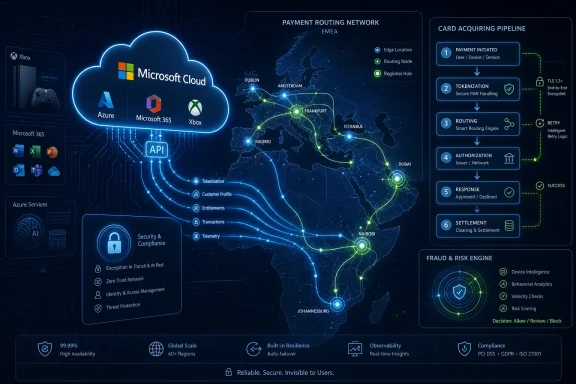
Microsoft has selected Checkout.com to provide card acquiring and digital payment routing for Xbox, Microsoft 365, Azure, and other Microsoft products across Europe, the Middle East, and Africa, connecting the London payments company directly to Microsoft’s payments API as part of a regional rollout. The headline sounds like payments plumbing, but the move is more strategic than a processor swap. Microsoft is tightening the commerce layer beneath subscriptions, cloud usage, gaming, and enterprise billing at a moment when failed payments are no longer a tolerable cost of doing digital business. For Windows users and IT buyers, the change will mostly be invisible — and that is precisely the point.
The interesting part of the Checkout.com deal is not that Microsoft needs someone to accept cards. A company that sells Xbox subscriptions, Microsoft 365 seats, Azure consumption, developer tools, storage, support, and consumer apps already has a global payments machine. The notable shift is that Microsoft is choosing to simplify and optimize that machine across a sprawling region where payment behavior varies sharply by market.
Europe, the Middle East, and Africa is not a tidy commercial territory. It contains mature card economies, fast-growing digital markets, local banking quirks, regulatory variation, currency complexity, and cross-border purchase patterns that do not behave like a single checkout funnel. A failed renewal for a family Microsoft 365 plan and a failed Azure payment for a business workload are both “declines” in a payments dashboard, but their consequences are very different.
Checkout.com will sit closer to Microsoft’s payment flow through direct integration with Microsoft’s payments API. That matters because payment orchestration has become a first-order operational concern for large software platforms. The less a company depends on a fragmented chain of intermediaries, the more room it has to tune authorizations, retry logic, routing, fraud decisions, and reporting.
This is the cloud-platform logic applied to money movement. Microsoft has spent years convincing businesses that compute, identity, security, and collaboration should be programmable and centrally managed. Now the company is applying the same discipline to the transaction layer that turns those services into recurring revenue.
That is why Checkout.com’s Intelligent Acceptance product is central to the announcement. The company says the system uses real-time network data to route transactions and improve authorization rates, with tens of thousands of optimizations per minute and more than $20 billion in merchant revenue unlocked. Those are vendor-supplied figures, and they should be read as sales claims rather than independent audits. But the underlying problem is real: authorization is not binary, and “card declined” often hides a routing or formatting decision that could have gone another way.
This is especially important for Microsoft because its payment flows are not uniform. Xbox transactions include game purchases, add-ons, subscriptions, family accounts, and impulse buys. Microsoft 365 involves consumer renewals, small-business seats, and corporate purchasing patterns. Azure introduces higher-value business transactions, usage-based billing, and customers that may be running revenue-generating workloads on top of Microsoft’s cloud.
In that environment, payment optimization is not cosmetic. A marginal improvement in authorization rates can become meaningful when applied across millions of transactions. The boring work of getting more legitimate payments approved becomes a growth lever precisely because the products being purchased are already embedded in daily life and business operations.
That is where acquiring strategy becomes more than procurement. Local acquiring relationships can affect approval rates, cost, fraud treatment, data quality, and resilience. For a merchant at Microsoft’s scale, routing a transaction through one path instead of another can determine whether a valid customer keeps access to a service.
The stakes are also different across Microsoft’s portfolio. A failed Xbox purchase might lose a game sale. A failed Microsoft 365 renewal could lock a user out of storage or productivity features. A failed Azure payment could become a business continuity issue, depending on the customer and workload.
Microsoft’s decision to use a single provider for card acceptance across business lines suggests a desire to reduce variation in the payment stack. Standardization can be a quiet advantage: fewer integrations to maintain, fewer regional exceptions to reconcile, and more consistent telemetry about why payments fail or succeed.
This is not just another online retailer. Microsoft’s flows span entertainment, productivity, developer ecosystems, cloud infrastructure, and enterprise purchasing. That mix gives Checkout.com a showcase across both consumer and business payments, including recurring billing and potentially complex cross-border scenarios.
The timing also matters. Checkout.com spent the last several years navigating the post-2021 fintech reset, when valuations compressed and payment companies had to prove they were more than pandemic-era growth stories. Returning to profitability and reporting higher processed volume helps the company’s case, but strategic enterprise wins do something financial metrics cannot. They suggest that large customers still see value in specialist infrastructure rather than treating payment processing as a commodity race to the bottom.
Microsoft is not likely to choose a provider for EMEA payments on brand sizzle. The integration will have been judged on resilience, authorization performance, scheme relationships, fraud handling, compliance posture, reporting, and the ability to operate at scale. That makes the partnership a proof point in Checkout.com’s broader campaign to be seen as high-performance commerce infrastructure for the internet’s largest platforms.
That invisibility is what makes payments infrastructure both thankless and important. Users notice payment systems only when they fail, when a renewal does not go through, when a bank blocks a transaction, when a currency conversion looks odd, or when a subscription is suspended despite a valid card. The best payment stack is the one that disappears.
For WindowsForum readers, the practical impact is likely to show up at the margins. A customer in an EMEA market may see fewer false declines. A business with recurring Microsoft 365 billing may experience smoother renewals. An Azure customer may find that card-based payments clear more reliably. None of this changes product licensing, pricing, or entitlements by itself.
The consumer-facing story is therefore modest, but the platform story is not. Microsoft’s commerce systems sit underneath a growing share of digital work and entertainment. Improving the reliability of that layer supports the company’s larger transition toward subscriptions, cloud consumption, and AI services that will be billed continuously rather than sold once.
Azure customers range from developers testing workloads to companies running production systems. Many enterprise customers pay through invoicing or negotiated commercial agreements, but card acceptance still matters for smaller businesses, startups, developers, and self-service cloud buyers. Microsoft has spent years making Azure easier to adopt without a traditional enterprise procurement cycle; that strategy depends on reliable digital payment rails.
A failed payment for a cloud service is not like a failed retail cart. It may trigger service warnings, administrative intervention, or restrictions. Even when Microsoft provides grace periods and recovery paths, payment friction adds operational noise for customers and support teams.
That is why the same infrastructure can serve very different business goals. For Xbox, payment optimization protects conversion and subscription retention. For Microsoft 365, it protects continuity. For Azure, it supports trust in a self-service cloud platform where developers expect the commercial layer to be as reliable as the technical one.
AI changes the transaction model in subtle ways. Some spending will be subscription-based, but other spending may be usage-based, metered, bundled, upgraded, or triggered by automated workflows. As vendors experiment with agents that can take actions on behalf of users or businesses, payment authorization, risk scoring, and transaction routing become even more sensitive.
Checkout.com has also been talking about agentic commerce, which is a useful signal even if the term is still more industry posture than settled reality. The direction is clear: software will increasingly initiate, recommend, or complete purchases in contexts where the buyer may not be staring at a traditional checkout page. That puts pressure on payment systems to distinguish legitimate automation from fraud, and to do it without adding friction.
Microsoft does not need Checkout.com to invent that future. But it does need payment infrastructure that can keep up if the company’s AI products produce more frequent, more varied, and more automated billing events. The EMEA rollout looks like a regional payments decision, but it also fits the broader need to prepare commerce systems for a more programmable software economy.
Large merchants want more control because regulatory friction can quickly become customer friction. If a transaction requires additional authentication, the merchant needs a clean handoff. If a bank rejects a payment, the merchant needs useful reason codes. If a retry is appropriate, the system needs to know when and how to attempt it. If fraud rules are too strict, legitimate customers suffer; if they are too loose, the merchant absorbs risk.
A direct API integration does not magically solve all of that. But it can reduce ambiguity. Microsoft can see more of the payment lifecycle, tune more decisions, and coordinate payment outcomes across products rather than treating each line of business as a separate island.
This is also where enterprise IT should pay attention. Payments are increasingly part of the operational fabric of SaaS and cloud services. The same administrators who think carefully about identity, licensing, backup, and compliance may need to care more about billing resilience, procurement pathways, and payment method governance.
This is not unusual. Big Tech frequently relies on partners for logistics, content delivery, customer support, tax calculation, identity federation, payment rails, and regional compliance support. The public tends to see the vertically integrated brand. Underneath, the platform is a federation of specialized systems.
The difference is that payments touch revenue directly. Outsourcing part of the acquiring and routing stack means trusting a partner with a sensitive, high-volume operational function. That trust is not casual. It reflects the reality that modern payments require scale, bank relationships, network data, regulatory coverage, and constant optimization.
For Checkout.com, that makes Microsoft an endorsement. For Microsoft, it is a bet that a specialist can improve a layer where even small percentage gains matter. For customers, it is another reminder that the Microsoft account, Xbox subscription, Microsoft 365 tenant, and Azure billing profile are backed by a complex commercial infrastructure that must work across borders every minute of the day.
Payment processing is competitive, margin-sensitive, and often invisible. But the hardest part is not accepting a card on a website. The hard part is doing it reliably across markets, currencies, banks, products, devices, risk signals, and regulatory regimes while improving authorization outcomes at scale.
That is why enterprise merchants still care about payments performance. A cheaper provider that causes more false declines may be more expensive in practice. A provider with weak regional coverage can create operational drag. A fragmented payment stack can make it harder to understand customer behavior, fraud patterns, and revenue leakage.
Checkout.com’s pitch is that its network data and acquiring capabilities can produce better outcomes for very large digital merchants. Microsoft’s adoption gives that pitch more weight. It does not prove every claimed optimization, but it does show that one of the world’s most sophisticated software companies sees payments as an area worth active modernization.
Small businesses and departments that pay Microsoft directly by card should make sure billing contacts, backup payment methods, tax information, and renewal notices are current. If payment routing changes behind the scenes, most customers should see no disruption, but stale billing data is always where invisible infrastructure changes become visible.
Administrators should also distinguish between payment processing and account security. A new acquiring partner does not mean users should expect emails asking them to re-enter credentials or update payment information through unfamiliar links. In fact, any wave of coverage around Microsoft payments can become bait for phishing campaigns. The safest route remains the Microsoft account portal, the Microsoft 365 admin center, or Azure’s billing interface.
The larger governance point is that payment methods are credentials of a different kind. They authorize spending, renew services, and keep workloads alive. Treating them casually is no longer compatible with cloud-dependent operations.
That creates an incentive to make commerce feel frictionless. The smoother the payment layer, the easier it is for Microsoft to sell incremental services. A user who can add storage, a gamer who can buy a subscription, a small business that can expand Microsoft 365 seats, and a developer who can spin up Azure services are all participating in the same commercial pattern.
This is where the partnership becomes strategically revealing. Microsoft is not merely collecting money for existing products. It is preparing the rails for a portfolio that depends on recurring engagement and modular expansion. Payments become part of product design because they shape how easily customers can move from free to paid, from trial to subscription, from small workload to larger deployment.
That can be good for customers when it reduces frustration and prevents accidental service interruptions. It can be less welcome when it makes spending too easy or when billing complexity obscures cost control. The same optimized payment layer that prevents false declines can also make upsell paths smoother.
Stripe, Adyen, PayPal, Worldpay, Checkout.com, and others are not merely competing on processing fees. They are competing on developer experience, authorization rates, fraud tools, reporting, local market coverage, and the ability to support new transaction models. For a company like Microsoft, the choice of partner can influence both operational efficiency and customer experience.
This is also why payments news increasingly belongs in technology coverage, not just finance coverage. The transaction layer affects how software is bought, renewed, bundled, and automated. It sits between product strategy and revenue recognition, between user experience and banking infrastructure.
Microsoft’s decision is therefore a signal to the market: even companies with enormous internal engineering capacity still want external specialists for payment performance. That is not a retreat from platform power. It is platform power expressed through selective dependency.
 Microsoft Is Treating Payments Like Infrastructure Now
The interesting part of the Checkout.com deal is not that Microsoft needs someone to accept cards. A company that sells Xbox subscriptions, Microsoft 365 seats, Azure consumption, developer tools, storage, support, and consumer apps already has a global payments machine. The notable shift is that Microsoft is choosing to simplify and optimize that machine across a sprawling region where payment behavior varies sharply by market.Europe, the Middle East, and Africa is not a tidy commercial territory. It contains mature card economies, fast-growing digital markets, local banking quirks, regulatory variation, currency complexity, and cross-border purchase patterns that do not behave like a single checkout funnel. A failed renewal for a family Microsoft 365 plan and a failed Azure payment for a business workload are both “declines” in a payments dashboard, but their consequences are very different.
Checkout.com will sit closer to Microsoft’s payment flow through direct integration with Microsoft’s payments API. That matters because payment orchestration has become a first-order operational concern for large software platforms. The less a company depends on a fragmented chain of intermediaries, the more room it has to tune authorizations, retry logic, routing, fraud decisions, and reporting.
This is the cloud-platform logic applied to money movement. Microsoft has spent years convincing businesses that compute, identity, security, and collaboration should be programmable and centrally managed. Now the company is applying the same discipline to the transaction layer that turns those services into recurring revenue.
The Decline Rate Is the Hidden Tax on Subscriptions
For ordinary users, a failed payment is an annoyance. For a platform company, it is leakage. Every unnecessary decline can mean churn, support cost, delayed cash collection, lost conversion, or an interrupted service relationship.That is why Checkout.com’s Intelligent Acceptance product is central to the announcement. The company says the system uses real-time network data to route transactions and improve authorization rates, with tens of thousands of optimizations per minute and more than $20 billion in merchant revenue unlocked. Those are vendor-supplied figures, and they should be read as sales claims rather than independent audits. But the underlying problem is real: authorization is not binary, and “card declined” often hides a routing or formatting decision that could have gone another way.
This is especially important for Microsoft because its payment flows are not uniform. Xbox transactions include game purchases, add-ons, subscriptions, family accounts, and impulse buys. Microsoft 365 involves consumer renewals, small-business seats, and corporate purchasing patterns. Azure introduces higher-value business transactions, usage-based billing, and customers that may be running revenue-generating workloads on top of Microsoft’s cloud.
In that environment, payment optimization is not cosmetic. A marginal improvement in authorization rates can become meaningful when applied across millions of transactions. The boring work of getting more legitimate payments approved becomes a growth lever precisely because the products being purchased are already embedded in daily life and business operations.
EMEA Makes the Plumbing Harder Than the Product Page Suggests
The phrase “EMEA rollout” can make the deal sound like a regional sales expansion, but the region is really a stress test for payments architecture. A card issued in one country, processed through another, used for a subscription billed in a third currency, and evaluated by a risk engine trained on global patterns is not an edge case in modern commerce. It is normal.That is where acquiring strategy becomes more than procurement. Local acquiring relationships can affect approval rates, cost, fraud treatment, data quality, and resilience. For a merchant at Microsoft’s scale, routing a transaction through one path instead of another can determine whether a valid customer keeps access to a service.
The stakes are also different across Microsoft’s portfolio. A failed Xbox purchase might lose a game sale. A failed Microsoft 365 renewal could lock a user out of storage or productivity features. A failed Azure payment could become a business continuity issue, depending on the customer and workload.
Microsoft’s decision to use a single provider for card acceptance across business lines suggests a desire to reduce variation in the payment stack. Standardization can be a quiet advantage: fewer integrations to maintain, fewer regional exceptions to reconcile, and more consistent telemetry about why payments fail or succeed.
Checkout.com Gets a Reference Customer Money Cannot Easily Buy
For Checkout.com, landing Microsoft is a credibility event. The company has already positioned itself as an enterprise payments provider for high-volume digital merchants, and it reported processing more than $300 billion in ecommerce payment volume in 2025. But Microsoft is a different kind of logo.This is not just another online retailer. Microsoft’s flows span entertainment, productivity, developer ecosystems, cloud infrastructure, and enterprise purchasing. That mix gives Checkout.com a showcase across both consumer and business payments, including recurring billing and potentially complex cross-border scenarios.
The timing also matters. Checkout.com spent the last several years navigating the post-2021 fintech reset, when valuations compressed and payment companies had to prove they were more than pandemic-era growth stories. Returning to profitability and reporting higher processed volume helps the company’s case, but strategic enterprise wins do something financial metrics cannot. They suggest that large customers still see value in specialist infrastructure rather than treating payment processing as a commodity race to the bottom.
Microsoft is not likely to choose a provider for EMEA payments on brand sizzle. The integration will have been judged on resilience, authorization performance, scheme relationships, fraud handling, compliance posture, reporting, and the ability to operate at scale. That makes the partnership a proof point in Checkout.com’s broader campaign to be seen as high-performance commerce infrastructure for the internet’s largest platforms.
The User Experience Will Be Invisible Until It Fails
Most Microsoft customers will never know Checkout.com is in the path. They will not see a new branded checkout page. They will not experience this as a feature update in Windows, Xbox, Microsoft 365, or Azure. If the rollout works, it will feel like nothing happened.That invisibility is what makes payments infrastructure both thankless and important. Users notice payment systems only when they fail, when a renewal does not go through, when a bank blocks a transaction, when a currency conversion looks odd, or when a subscription is suspended despite a valid card. The best payment stack is the one that disappears.
For WindowsForum readers, the practical impact is likely to show up at the margins. A customer in an EMEA market may see fewer false declines. A business with recurring Microsoft 365 billing may experience smoother renewals. An Azure customer may find that card-based payments clear more reliably. None of this changes product licensing, pricing, or entitlements by itself.
The consumer-facing story is therefore modest, but the platform story is not. Microsoft’s commerce systems sit underneath a growing share of digital work and entertainment. Improving the reliability of that layer supports the company’s larger transition toward subscriptions, cloud consumption, and AI services that will be billed continuously rather than sold once.
Azure Makes This More Than an Xbox Checkout Story
It would be easy to file this under gaming payments because Xbox is the most recognizable consumer brand in the announcement. But Azure is the more consequential inclusion. Cloud billing is where payments become part of operational risk.Azure customers range from developers testing workloads to companies running production systems. Many enterprise customers pay through invoicing or negotiated commercial agreements, but card acceptance still matters for smaller businesses, startups, developers, and self-service cloud buyers. Microsoft has spent years making Azure easier to adopt without a traditional enterprise procurement cycle; that strategy depends on reliable digital payment rails.
A failed payment for a cloud service is not like a failed retail cart. It may trigger service warnings, administrative intervention, or restrictions. Even when Microsoft provides grace periods and recovery paths, payment friction adds operational noise for customers and support teams.
That is why the same infrastructure can serve very different business goals. For Xbox, payment optimization protects conversion and subscription retention. For Microsoft 365, it protects continuity. For Azure, it supports trust in a self-service cloud platform where developers expect the commercial layer to be as reliable as the technical one.
Microsoft’s AI Ambitions Need a Cleaner Commerce Layer
The announcement also lands in the middle of Microsoft’s push to monetize AI across consumer, business, and developer products. Copilot subscriptions, AI features in Microsoft 365, Azure AI services, GitHub-related developer spending, and future agentic workflows all create more payment moments, not fewer.AI changes the transaction model in subtle ways. Some spending will be subscription-based, but other spending may be usage-based, metered, bundled, upgraded, or triggered by automated workflows. As vendors experiment with agents that can take actions on behalf of users or businesses, payment authorization, risk scoring, and transaction routing become even more sensitive.
Checkout.com has also been talking about agentic commerce, which is a useful signal even if the term is still more industry posture than settled reality. The direction is clear: software will increasingly initiate, recommend, or complete purchases in contexts where the buyer may not be staring at a traditional checkout page. That puts pressure on payment systems to distinguish legitimate automation from fraud, and to do it without adding friction.
Microsoft does not need Checkout.com to invent that future. But it does need payment infrastructure that can keep up if the company’s AI products produce more frequent, more varied, and more automated billing events. The EMEA rollout looks like a regional payments decision, but it also fits the broader need to prepare commerce systems for a more programmable software economy.
The Regulatory Backdrop Rewards Control and Observability
Payments in EMEA are not just a technical challenge. They are a compliance challenge. Strong customer authentication, data protection rules, scheme requirements, anti-fraud obligations, sanctions screening, and local payment regulations shape what a merchant can do and how much friction customers encounter.Large merchants want more control because regulatory friction can quickly become customer friction. If a transaction requires additional authentication, the merchant needs a clean handoff. If a bank rejects a payment, the merchant needs useful reason codes. If a retry is appropriate, the system needs to know when and how to attempt it. If fraud rules are too strict, legitimate customers suffer; if they are too loose, the merchant absorbs risk.
A direct API integration does not magically solve all of that. But it can reduce ambiguity. Microsoft can see more of the payment lifecycle, tune more decisions, and coordinate payment outcomes across products rather than treating each line of business as a separate island.
This is also where enterprise IT should pay attention. Payments are increasingly part of the operational fabric of SaaS and cloud services. The same administrators who think carefully about identity, licensing, backup, and compliance may need to care more about billing resilience, procurement pathways, and payment method governance.
The Deal Shows How Much of Big Tech Runs on Specialized Vendors
Microsoft is one of the largest technology companies in the world, but it is not trying to own every layer of its commerce stack. That is the quiet lesson of the Checkout.com arrangement. Even hyperscale companies outsource specialized functions when the outside provider can offer better reach, performance, or operational focus.This is not unusual. Big Tech frequently relies on partners for logistics, content delivery, customer support, tax calculation, identity federation, payment rails, and regional compliance support. The public tends to see the vertically integrated brand. Underneath, the platform is a federation of specialized systems.
The difference is that payments touch revenue directly. Outsourcing part of the acquiring and routing stack means trusting a partner with a sensitive, high-volume operational function. That trust is not casual. It reflects the reality that modern payments require scale, bank relationships, network data, regulatory coverage, and constant optimization.
For Checkout.com, that makes Microsoft an endorsement. For Microsoft, it is a bet that a specialist can improve a layer where even small percentage gains matter. For customers, it is another reminder that the Microsoft account, Xbox subscription, Microsoft 365 tenant, and Azure billing profile are backed by a complex commercial infrastructure that must work across borders every minute of the day.
The Fintech Reset Did Not Kill the Infrastructure Story
The payments sector has gone through a sharp narrative correction since the boom years. Valuations fell, easy money disappeared, and “fintech” stopped being a magic word. Yet the Microsoft-Checkout.com deal shows why the best infrastructure companies did not lose their relevance.Payment processing is competitive, margin-sensitive, and often invisible. But the hardest part is not accepting a card on a website. The hard part is doing it reliably across markets, currencies, banks, products, devices, risk signals, and regulatory regimes while improving authorization outcomes at scale.
That is why enterprise merchants still care about payments performance. A cheaper provider that causes more false declines may be more expensive in practice. A provider with weak regional coverage can create operational drag. A fragmented payment stack can make it harder to understand customer behavior, fraud patterns, and revenue leakage.
Checkout.com’s pitch is that its network data and acquiring capabilities can produce better outcomes for very large digital merchants. Microsoft’s adoption gives that pitch more weight. It does not prove every claimed optimization, but it does show that one of the world’s most sophisticated software companies sees payments as an area worth active modernization.
Administrators Should Read the Fine Print Behind the Smooth Checkout
For IT administrators, the immediate action list is not dramatic. This is not a Windows update that changes settings, a licensing model overhaul, or an Azure deprecation notice. But it is still relevant because payment infrastructure is part of service continuity.Small businesses and departments that pay Microsoft directly by card should make sure billing contacts, backup payment methods, tax information, and renewal notices are current. If payment routing changes behind the scenes, most customers should see no disruption, but stale billing data is always where invisible infrastructure changes become visible.
Administrators should also distinguish between payment processing and account security. A new acquiring partner does not mean users should expect emails asking them to re-enter credentials or update payment information through unfamiliar links. In fact, any wave of coverage around Microsoft payments can become bait for phishing campaigns. The safest route remains the Microsoft account portal, the Microsoft 365 admin center, or Azure’s billing interface.
The larger governance point is that payment methods are credentials of a different kind. They authorize spending, renew services, and keep workloads alive. Treating them casually is no longer compatible with cloud-dependent operations.
The Microsoft Customer Relationship Is Becoming More Continuous
Software used to be sold in chunks: a license, a box, a version, a renewal cycle. Microsoft’s modern business is different. It is a set of continuing relationships billed monthly, annually, by seat, by consumption, by add-on, and increasingly by AI capacity.That creates an incentive to make commerce feel frictionless. The smoother the payment layer, the easier it is for Microsoft to sell incremental services. A user who can add storage, a gamer who can buy a subscription, a small business that can expand Microsoft 365 seats, and a developer who can spin up Azure services are all participating in the same commercial pattern.
This is where the partnership becomes strategically revealing. Microsoft is not merely collecting money for existing products. It is preparing the rails for a portfolio that depends on recurring engagement and modular expansion. Payments become part of product design because they shape how easily customers can move from free to paid, from trial to subscription, from small workload to larger deployment.
That can be good for customers when it reduces frustration and prevents accidental service interruptions. It can be less welcome when it makes spending too easy or when billing complexity obscures cost control. The same optimized payment layer that prevents false declines can also make upsell paths smoother.
The Real Competition Is for the Commerce Layer of Software
The Microsoft-Checkout.com tie-up sits inside a broader contest among payment companies, cloud platforms, software vendors, and fintech infrastructure providers. Everyone wants to own or influence the commerce layer where identity, risk, billing, payment method choice, and customer data intersect.Stripe, Adyen, PayPal, Worldpay, Checkout.com, and others are not merely competing on processing fees. They are competing on developer experience, authorization rates, fraud tools, reporting, local market coverage, and the ability to support new transaction models. For a company like Microsoft, the choice of partner can influence both operational efficiency and customer experience.
This is also why payments news increasingly belongs in technology coverage, not just finance coverage. The transaction layer affects how software is bought, renewed, bundled, and automated. It sits between product strategy and revenue recognition, between user experience and banking infrastructure.
Microsoft’s decision is therefore a signal to the market: even companies with enormous internal engineering capacity still want external specialists for payment performance. That is not a retreat from platform power. It is platform power expressed through selective dependency.
The Commerce Layer Is Now Part of Microsoft’s Reliability Story
The practical lessons from this rollout are narrower than the corporate language around it, but they are still important. Microsoft is not announcing a new consumer feature; it is tuning the machinery that keeps digital services paid for, renewed, and available across a complex region.- Microsoft is using Checkout.com for card acceptance and payment routing across EMEA for products including Xbox, Microsoft 365, and Azure.
- The direct API integration suggests Microsoft wants tighter control and better visibility over payment performance across multiple business lines.
- Checkout.com’s Intelligent Acceptance system is intended to reduce avoidable failed transactions by optimizing how payments are routed and formatted.
- The inclusion of Azure makes the deal relevant to developers and businesses, not just consumers buying games or subscriptions.
- Users should not need to take action because of the rollout, but administrators should keep official billing details and backup payment methods current.
- Any message asking users to “update Microsoft payment details” outside official Microsoft account, Microsoft 365, or Azure billing channels should be treated with suspicion.
References
- Primary source: IT Brief UK
Published: Thu, 18 Jun 2026 09:00:00 GMT
Microsoft taps Checkout.com for EMEA payments rollout
The deal aims to lift payment approval rates across Microsoft's gaming, software and cloud businesses as card acceptance varies across EMEA. itbrief.co.uk
- Related coverage: checkout.com
- Related coverage: crowdfundinsider.com
- Related coverage: globalbankingmonitor.com
Checkout.com Returns to Profitability and Surpasses $300 Billion in Payment Volume
Checkout.com processed $300 billion in total payment volume during 2025, a 64 per cent increase year-over-year, while returning to full-year EBITDA profitability with adjusted margins exceeding 10 per cent. Net revenue grew by more than 30 per cent for the second consecutive year. The...globalbankingmonitor.com
- Related coverage: app.dealroom.co
Checkout.com hits profitability, processes $300B in payment volume after 64% growth | Dealroom.co
London-based payments fintech Checkout.com has increased headcount by 15 per cent to 2,000 staff and achieved full-year EBITDA profitability in 2025, according to its annual letter. The company, valued at $12 billion following an employee share sale last year, opened new hubs in San Francisco...app.dealroom.co - Related coverage: tradeinformer.com
Checkout.com says Asia-Pacific volume rose 71% in 2025 as it expands enterprise push - TradeInformer
The London payments firm said Asia-Pacific processing volume climbed 71% year over year, alongside a third straight year of 50% net revenue growth. The update comes as Checkout.com scales hiring across key hubs and positions for AI-led checkout protocols.tradeinformer.com
- Related coverage: sacra-pdfs.s3.us-east-2.amazonaws.com
- Related coverage: tei.forrester.com

