
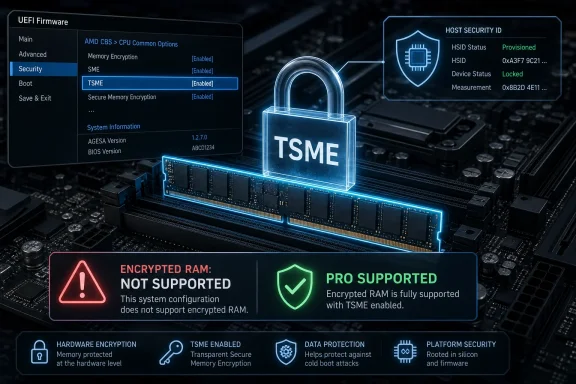
AMD’s firmware path for some recent consumer Ryzen systems began reporting Transparent Secure Memory Encryption as unsupported after AGESA 1.2.7.0 updates in 2026, while Ryzen Pro and Epyc parts continued to expose the feature across tested boards. That is the plain answer to the mystery, but not the satisfying one. The more important story is that a security capability some users had verified, enabled, and built assumptions around appears to have been converted into a product-tier boundary without a public technical explanation. In modern PC security, that silence is not a footnote; it is the breach of trust.
Transparent Secure Memory Encryption, or TSME, was never the kind of feature that sold gaming desktops on a retail shelf. It does not boost frame rates, it does not make a Cinebench bar longer, and it does not give motherboard vendors another RGB badge to print on a box. Its value is quieter: when enabled, the platform encrypts system memory below the operating system, so the data sitting on DIMMs is not simply readable to someone with physical access and the right tools.
That makes TSME a feature for a narrow but serious audience. Privacy-conscious laptop users, developers carrying secrets, journalists crossing borders, security researchers, administrators with sensitive endpoints, and anyone who treats physical access as part of a realistic threat model care about this class of protection. The average gaming tower under a desk may never need it, but that is not the same as saying the feature does not matter.
The controversy is not that AMD segments security features. AMD has long marketed “Pro” silicon as the home of manageability and enterprise security extras, and Intel has played similar games across vPro, corporate SKUs, and platform qualification. The controversy is that systems that previously reported working TSME now report that RAM encryption is not supported, and the explanation has arrived only after users, board vendors, and engineers started pulling apart firmware behavior in public.
A company can say a feature was never guaranteed on consumer chips. It can say firmware exposed it by mistake. It can say validation failed outside the Pro stack. It can say the silicon behavior is not reliable enough for support. What it cannot do, at least not without inviting suspicion, is let BIOS toggles survive while the underlying firmware path says “no” and then offer users little more than a product-family slogan.
On earlier firmware, his system had reported encrypted RAM. After the newer firmware path, HSI reported “encrypted RAM: not supported,” even though the motherboard firmware still presented a TSME setting in BIOS. That gap matters. A BIOS option gives users the impression of control; a runtime security report tells them whether the machine actually did what they asked.
The discovery would have been less combustible if it had ended with one buggy motherboard. Consumer PC firmware is a wilderness of vendor menus, half-documented settings, shared AGESA blobs, and platform-specific weirdness. A single MSI board failing to turn on a rarely used security feature would be disappointing, but not necessarily evidence of an AMD-wide policy change.
Instead, testing widened. MSI engineers compared firmware versions, boards, and CPU classes. The reported pattern was stark: with older AGESA firmware, some consumer Ryzen processors exposed TSME; with AGESA 1.2.7.0, those same consumer-class systems reported TSME as unsupported. Pro-branded Ryzen chips, by contrast, continued to show TSME support across tested boards and AGESA revisions.
That is why this story has legs. It is not merely a Linux utility misreading a register, and it is not merely a board vendor forgetting to wire up a menu option. The evidence points toward AMD’s own firmware initialization path deciding differently depending on the CPU class.
That is why a change in AGESA can feel like a hardware change even when the motherboard and processor have not moved an inch. A CPU feature can exist physically, appear in older firmware, vanish in newer firmware, and still leave the end user arguing with a BIOS screen that says the option is enabled. The machine’s truth is not in the menu; it is in the initialization code.
The MSI analysis reportedly narrowed the question to AMD Boot Loader behavior inside AGESA. One internal flag, DfIsTsmeEnabled, appears to determine whether TSME actually becomes active during firmware initialization. In the dumps described by Kilpatrick, that flag returned false for a Ryzen 9800X3D even when BIOS configuration was set to automatic or enabled. On a Ryzen Pro part and Epyc hardware, the same class of setting returned true.
That distinction is important because it reframes the issue. If consumer Ryzen silicon were physically incapable of TSME, users might be annoyed at old firmware reports, but the matter would be relatively simple. If the silicon is capable and firmware policy now withholds the feature from non-Pro SKUs, the question becomes commercial, not technical.
AMD’s public-facing answer, as reported, was that TSME is a security feature applied only to Pro CPUs as part of AMD Pro Technologies. That may be the current policy. It does not explain why the feature appears to have worked before, why some BIOS options still imply availability, or whether older consumer enablement was accidental, unsupported, risky, or simply inconvenient to validate.
SME is operating-system managed. It allows memory pages to be encrypted under OS control, and AMD has historically tied that class of capability to Pro and Epyc tiers. TSME is different. It is firmware-managed and transparent to the operating system, encrypting all memory once enabled at the platform level.
That distinction made TSME particularly attractive to users outside enterprise fleets. You did not need Windows Enterprise policy plumbing, a corporate management stack, or a custom kernel threat model. If the BIOS exposed TSME and the platform enabled it, the machine got a broad physical-memory defense without the OS making page-by-page decisions.
AMD has also marketed full-system memory encryption in the Pro world under Memory Guard branding. That is a cleaner enterprise message: buy Pro, get a validated security bundle. But the historical record users are pointing to is messier. AMD engineers previously discussed TSME on consumer Ryzen in ways that did not sound like a hard Pro-only wall, and real systems reportedly exposed the feature for years.
This is where AMD’s position may be technically defensible yet editorially weak. A vendor can maintain that only Pro CPUs are validated, supported, and guaranteed for a feature. But if consumer hardware has been shipping with working firmware support, and if knowledgeable users were encouraged by past engineering comments to use it when exposed by BIOS, then removing it silently is not just SKU hygiene. It is a platform behavior change with security consequences.
But security features are rarely built for “most users” in the abstract. Full-disk encryption also looks excessive until a laptop is stolen. Secure Boot looks bureaucratic until bootkits enter the conversation. Firmware update hygiene sounds dull until a platform vulnerability needs mitigation. The whole point of layered security is that different layers matter under different failure conditions.
TSME specifically helps in scenarios where secrets remain in memory while a system is powered on, suspended, recently powered off, or physically manipulated. Full-disk encryption protects storage at rest, but keys and decrypted data must exist in memory while the system is usable. If an attacker can extract or observe that memory, disk encryption is not the whole answer.
There are limits. Memory encryption without integrity protection is not magic. It does not make a compromised OS safe, it does not stop malware running with privileges, and it may not defeat advanced physical attacks that exploit deterministic encryption behavior or platform-specific weaknesses. But “not magic” is not the same as “worthless.”
For the WindowsForum audience, the practical framing is simple: if your security model begins and ends with remote malware, TSME is probably not the feature that changes your life. If your model includes seizure, theft, lab access, hostile repair shops, cross-border travel, hardware implants, or high-value secrets on mobile systems, then losing transparent memory encryption matters.
The problem is not only cosmetic. Administrators and power users often rely on a chain of evidence: firmware setting, OS report, inventory output, compliance scanner, and documented platform capability. When one layer says “enabled” and another says “not supported,” the burden shifts to the user to reverse-engineer the vendor’s intent.
That burden should not exist for a security feature. If TSME is Pro-only, the BIOS should say so or hide the option on unsupported processors. If consumer support was removed in AGESA 1.2.7.0, release notes should say that. If the feature remains visible but inert because motherboard vendors reuse menu templates, AMD should require clearer behavior from OEMs.
This is not merely about enthusiasts feeling cheated. Silent security-state drift is poison for fleet management. A small business could deploy machines under one assumption, update firmware for unrelated fixes, and unknowingly lose a protection that had been verified before. Even if the feature was never contractually guaranteed, that is still the kind of change vendors should disclose.
The old PC industry defense — “check the supported features for your exact SKU” — is inadequate when firmware updates can change the reported state after purchase. Users cannot be expected to treat every AGESA revision as a fresh security certification exercise unless AMD and board vendors publish the relevant deltas.
Another plausible explanation is validation cost. Security features that touch memory initialization are not free to support across every consumer CPU, motherboard, memory kit, firmware branch, sleep state, overclocking configuration, and OS reporting path. A feature that works on a hobbyist’s system may still be something AMD does not want to promise across the chaotic consumer ecosystem.
There could also be performance, reliability, or compatibility tradeoffs. Memory encryption has historically carried latency or bandwidth considerations, and platform vendors may choose defaults based on stability. If AMD concluded that TSME on consumer chips caused support risk, saying so would be better than letting users infer commercial upsell.
The darker theories practically write themselves when a vendor refuses detail. Users begin to suspect intentional segmentation, pressure to differentiate Pro products, or a desire to quietly remove a feature many people did not know they had. Some of those theories may be unfair. AMD’s sparse response makes them inevitable.
Security communication has a rhythm. Acknowledge the observed behavior, define affected products, state whether the change is intentional, explain whether older enablement was supported, and tell users what they should do now. AMD has not delivered that kind of statement, at least not in the public record surrounding this incident. In a trust-sensitive domain, a product-tier slogan is not enough.
The TSME episode cuts against that story. It suggests that a capability may exist in silicon and may have worked in practice, but can still be withdrawn through firmware policy if it does not fit the product stack. That is not unique to AMD, but it is particularly visible because AGESA updates are a normal part of life on AM5 systems.
For Windows users, this is also a reminder that hardware security is increasingly firmware-defined. A processor’s feature table is no longer the final word. The motherboard BIOS, embedded firmware, platform security processor, OS attestation tools, and vendor policy all decide what security properties the machine actually has.
That is why this story belongs on a Windows forum even though the initial investigation leaned on Linux tooling. Windows users rely on the same firmware. They install the same BIOS updates. They buy the same consumer and Pro SKUs. If a feature vanishes below the OS, Windows will not rescue it.
The most practical consequence is purchasing clarity. If memory encryption is a requirement, consumers should no longer assume that a non-Pro Ryzen chip will provide it just because a BIOS menu says TSME or because an older forum post says a similar CPU worked. The safe assumption, pending a fuller AMD explanation, is that validated AMD memory-encryption capability lives in Ryzen Pro, Threadripper Pro, and Epyc territory.
Yet the decisive logic appears to live inside AMD’s supplied firmware components. Board vendors can expose settings, integrate AGESA, ship BIOS updates, and relay support guidance. They cannot fully explain a policy decision embedded in AMD’s initialization code unless AMD tells them what that decision is.
This is a structural problem in the modern PC ecosystem. The company whose logo is on the motherboard often faces the user, but the deepest platform behavior comes from the CPU vendor’s opaque blobs. When something breaks, the user is bounced between board vendor, firmware vendor, CPU vendor, OS tool, and community maintainers.
That is exactly what happened here. AMD engineers initially suggested toggling BIOS settings or reporting the problem to MSI. MSI later came back with evidence pointing to AGESA behavior and, according to Kilpatrick, a message that AMD had officially communicated TSME as Pro-only. The support loop ended where it should have started: with AMD defining the platform policy.
If AMD wants Pro-only TSME, board vendors need a clean contract. Hide the option for consumer chips. Report unsupported consistently. Document the change in release notes. Do not leave motherboard makers shipping zombie toggles that invite users to believe they have enabled a protection the firmware will not activate.
For IT pros, this means memory encryption should be treated like Secure Boot, TPM readiness, virtualization-based security, or BitLocker escrow: something to inventory, validate, and periodically re-check after firmware changes. If a feature matters to your compliance or threat model, bake verification into the update process instead of assuming firmware updates are security-monotonic.
For enthusiasts, the lesson is harsher. Consumer platforms increasingly inherit enterprise-grade hardware blocks, but inheritance is not entitlement. Vendors may fuse, hide, disable, or de-support capabilities through firmware even when the silicon could plausibly do the work. The difference between “works today” and “supported tomorrow” is where product segmentation lives.
AMD could still improve the situation. It could publish a short technical note clarifying which Ryzen generations and SKUs support TSME, whether AGESA 1.2.7.0 intentionally changed behavior, and whether older consumer enablement was unsupported. It could also pressure board vendors to make BIOS menus reflect actual CPU support.
The worst outcome would be for the issue to disappear into the usual forum churn. A rare security feature will affect only a minority of users, and that makes it easy for vendors to wait out the complaint cycle. But the principle is larger than TSME: security capabilities should not silently regress behind a firmware update and a vague branding answer.
 AMD Turns a Security Feature Into a Product-Line Argument
Transparent Secure Memory Encryption, or TSME, was never the kind of feature that sold gaming desktops on a retail shelf. It does not boost frame rates, it does not make a Cinebench bar longer, and it does not give motherboard vendors another RGB badge to print on a box. Its value is quieter: when enabled, the platform encrypts system memory below the operating system, so the data sitting on DIMMs is not simply readable to someone with physical access and the right tools.That makes TSME a feature for a narrow but serious audience. Privacy-conscious laptop users, developers carrying secrets, journalists crossing borders, security researchers, administrators with sensitive endpoints, and anyone who treats physical access as part of a realistic threat model care about this class of protection. The average gaming tower under a desk may never need it, but that is not the same as saying the feature does not matter.
The controversy is not that AMD segments security features. AMD has long marketed “Pro” silicon as the home of manageability and enterprise security extras, and Intel has played similar games across vPro, corporate SKUs, and platform qualification. The controversy is that systems that previously reported working TSME now report that RAM encryption is not supported, and the explanation has arrived only after users, board vendors, and engineers started pulling apart firmware behavior in public.
A company can say a feature was never guaranteed on consumer chips. It can say firmware exposed it by mistake. It can say validation failed outside the Pro stack. It can say the silicon behavior is not reliable enough for support. What it cannot do, at least not without inviting suspicion, is let BIOS toggles survive while the underlying firmware path says “no” and then offer users little more than a product-family slogan.
The Discovery Started With a Mismatch, Not a Marketing Claim
The episode began in the most unglamorous way possible: a user checked his system. Ben Kilpatrick, described in the original reporting as a privacy-conscious Linux hobbyist, installed a new operating system on a Ryzen 7 9700X machine and ran Host Security ID, the hardware and firmware security checker associated with fwupd. His habit was to verify that security features he expected were actually active.On earlier firmware, his system had reported encrypted RAM. After the newer firmware path, HSI reported “encrypted RAM: not supported,” even though the motherboard firmware still presented a TSME setting in BIOS. That gap matters. A BIOS option gives users the impression of control; a runtime security report tells them whether the machine actually did what they asked.
The discovery would have been less combustible if it had ended with one buggy motherboard. Consumer PC firmware is a wilderness of vendor menus, half-documented settings, shared AGESA blobs, and platform-specific weirdness. A single MSI board failing to turn on a rarely used security feature would be disappointing, but not necessarily evidence of an AMD-wide policy change.
Instead, testing widened. MSI engineers compared firmware versions, boards, and CPU classes. The reported pattern was stark: with older AGESA firmware, some consumer Ryzen processors exposed TSME; with AGESA 1.2.7.0, those same consumer-class systems reported TSME as unsupported. Pro-branded Ryzen chips, by contrast, continued to show TSME support across tested boards and AGESA revisions.
That is why this story has legs. It is not merely a Linux utility misreading a register, and it is not merely a board vendor forgetting to wire up a menu option. The evidence points toward AMD’s own firmware initialization path deciding differently depending on the CPU class.
AGESA Is Where Platform Promises Become Reality
For ordinary users, AGESA is one of those acronyms that appears only in BIOS changelogs when something breaks or a new CPU needs support. For AMD platforms, it is much more consequential. AMD’s Generic Encapsulated Software Architecture is the firmware foundation that motherboard vendors integrate, shaping early boot, CPU initialization, memory training, security feature exposure, and platform capability reporting.That is why a change in AGESA can feel like a hardware change even when the motherboard and processor have not moved an inch. A CPU feature can exist physically, appear in older firmware, vanish in newer firmware, and still leave the end user arguing with a BIOS screen that says the option is enabled. The machine’s truth is not in the menu; it is in the initialization code.
The MSI analysis reportedly narrowed the question to AMD Boot Loader behavior inside AGESA. One internal flag, DfIsTsmeEnabled, appears to determine whether TSME actually becomes active during firmware initialization. In the dumps described by Kilpatrick, that flag returned false for a Ryzen 9800X3D even when BIOS configuration was set to automatic or enabled. On a Ryzen Pro part and Epyc hardware, the same class of setting returned true.
That distinction is important because it reframes the issue. If consumer Ryzen silicon were physically incapable of TSME, users might be annoyed at old firmware reports, but the matter would be relatively simple. If the silicon is capable and firmware policy now withholds the feature from non-Pro SKUs, the question becomes commercial, not technical.
AMD’s public-facing answer, as reported, was that TSME is a security feature applied only to Pro CPUs as part of AMD Pro Technologies. That may be the current policy. It does not explain why the feature appears to have worked before, why some BIOS options still imply availability, or whether older consumer enablement was accidental, unsupported, risky, or simply inconvenient to validate.
TSME Was the Quiet Cousin of AMD Memory Guard
Part of the confusion comes from AMD’s own security vocabulary. Secure Memory Encryption, TSME, SEV, SME, and AMD Memory Guard all orbit the same basic idea — protecting memory contents — but they live in different product stories and are not interchangeable. To users trying to understand whether their RAM is encrypted, the naming can feel like a deliberately foggy map.SME is operating-system managed. It allows memory pages to be encrypted under OS control, and AMD has historically tied that class of capability to Pro and Epyc tiers. TSME is different. It is firmware-managed and transparent to the operating system, encrypting all memory once enabled at the platform level.
That distinction made TSME particularly attractive to users outside enterprise fleets. You did not need Windows Enterprise policy plumbing, a corporate management stack, or a custom kernel threat model. If the BIOS exposed TSME and the platform enabled it, the machine got a broad physical-memory defense without the OS making page-by-page decisions.
AMD has also marketed full-system memory encryption in the Pro world under Memory Guard branding. That is a cleaner enterprise message: buy Pro, get a validated security bundle. But the historical record users are pointing to is messier. AMD engineers previously discussed TSME on consumer Ryzen in ways that did not sound like a hard Pro-only wall, and real systems reportedly exposed the feature for years.
This is where AMD’s position may be technically defensible yet editorially weak. A vendor can maintain that only Pro CPUs are validated, supported, and guaranteed for a feature. But if consumer hardware has been shipping with working firmware support, and if knowledgeable users were encouraged by past engineering comments to use it when exposed by BIOS, then removing it silently is not just SKU hygiene. It is a platform behavior change with security consequences.
Physical Attacks Are Niche Until They Are Your Threat Model
The easy dismissal is that cold-boot attacks and DRAM snooping are exotic. For most desktop users, that is true. If an attacker is in your house with tools and uninterrupted access to your machine, you probably have larger problems than whether your RAM bus is encrypted.But security features are rarely built for “most users” in the abstract. Full-disk encryption also looks excessive until a laptop is stolen. Secure Boot looks bureaucratic until bootkits enter the conversation. Firmware update hygiene sounds dull until a platform vulnerability needs mitigation. The whole point of layered security is that different layers matter under different failure conditions.
TSME specifically helps in scenarios where secrets remain in memory while a system is powered on, suspended, recently powered off, or physically manipulated. Full-disk encryption protects storage at rest, but keys and decrypted data must exist in memory while the system is usable. If an attacker can extract or observe that memory, disk encryption is not the whole answer.
There are limits. Memory encryption without integrity protection is not magic. It does not make a compromised OS safe, it does not stop malware running with privileges, and it may not defeat advanced physical attacks that exploit deterministic encryption behavior or platform-specific weaknesses. But “not magic” is not the same as “worthless.”
For the WindowsForum audience, the practical framing is simple: if your security model begins and ends with remote malware, TSME is probably not the feature that changes your life. If your model includes seizure, theft, lab access, hostile repair shops, cross-border travel, hardware implants, or high-value secrets on mobile systems, then losing transparent memory encryption matters.
The BIOS Toggle That Lies by Omission
One of the most irritating parts of this saga is the surviving BIOS setting. Firmware setup screens have always had a loose relationship with reality, especially on enthusiast motherboards where vendors expose inherited options before every combination is fully meaningful. Still, a security setting that says enabled while the platform reports unsupported is a bad user experience.The problem is not only cosmetic. Administrators and power users often rely on a chain of evidence: firmware setting, OS report, inventory output, compliance scanner, and documented platform capability. When one layer says “enabled” and another says “not supported,” the burden shifts to the user to reverse-engineer the vendor’s intent.
That burden should not exist for a security feature. If TSME is Pro-only, the BIOS should say so or hide the option on unsupported processors. If consumer support was removed in AGESA 1.2.7.0, release notes should say that. If the feature remains visible but inert because motherboard vendors reuse menu templates, AMD should require clearer behavior from OEMs.
This is not merely about enthusiasts feeling cheated. Silent security-state drift is poison for fleet management. A small business could deploy machines under one assumption, update firmware for unrelated fixes, and unknowingly lose a protection that had been verified before. Even if the feature was never contractually guaranteed, that is still the kind of change vendors should disclose.
The old PC industry defense — “check the supported features for your exact SKU” — is inadequate when firmware updates can change the reported state after purchase. Users cannot be expected to treat every AGESA revision as a fresh security certification exercise unless AMD and board vendors publish the relevant deltas.
AMD’s Silence Creates More Theories Than It Prevents
The strangest part of AMD’s handling is that the least damaging explanation may be the most obvious one: consumer TSME was never supposed to be exposed, some firmware paths enabled it anyway, and AMD later aligned AGESA behavior with official Pro-only support. That would disappoint users, but it would be understandable. It would also be easy to say.Another plausible explanation is validation cost. Security features that touch memory initialization are not free to support across every consumer CPU, motherboard, memory kit, firmware branch, sleep state, overclocking configuration, and OS reporting path. A feature that works on a hobbyist’s system may still be something AMD does not want to promise across the chaotic consumer ecosystem.
There could also be performance, reliability, or compatibility tradeoffs. Memory encryption has historically carried latency or bandwidth considerations, and platform vendors may choose defaults based on stability. If AMD concluded that TSME on consumer chips caused support risk, saying so would be better than letting users infer commercial upsell.
The darker theories practically write themselves when a vendor refuses detail. Users begin to suspect intentional segmentation, pressure to differentiate Pro products, or a desire to quietly remove a feature many people did not know they had. Some of those theories may be unfair. AMD’s sparse response makes them inevitable.
Security communication has a rhythm. Acknowledge the observed behavior, define affected products, state whether the change is intentional, explain whether older enablement was supported, and tell users what they should do now. AMD has not delivered that kind of statement, at least not in the public record surrounding this incident. In a trust-sensitive domain, a product-tier slogan is not enough.
The Consumer Ryzen Bargain Gets a Little More Complicated
Ryzen’s rise was built on giving mainstream buyers more than they expected: more cores, more platform longevity, more performance per dollar, and often a friendlier posture toward enthusiast features than Intel’s rigid segmentation. That reputation matters because AMD buyers have often tolerated firmware rough edges in exchange for the sense that the platform was generous.The TSME episode cuts against that story. It suggests that a capability may exist in silicon and may have worked in practice, but can still be withdrawn through firmware policy if it does not fit the product stack. That is not unique to AMD, but it is particularly visible because AGESA updates are a normal part of life on AM5 systems.
For Windows users, this is also a reminder that hardware security is increasingly firmware-defined. A processor’s feature table is no longer the final word. The motherboard BIOS, embedded firmware, platform security processor, OS attestation tools, and vendor policy all decide what security properties the machine actually has.
That is why this story belongs on a Windows forum even though the initial investigation leaned on Linux tooling. Windows users rely on the same firmware. They install the same BIOS updates. They buy the same consumer and Pro SKUs. If a feature vanishes below the OS, Windows will not rescue it.
The most practical consequence is purchasing clarity. If memory encryption is a requirement, consumers should no longer assume that a non-Pro Ryzen chip will provide it just because a BIOS menu says TSME or because an older forum post says a similar CPU worked. The safe assumption, pending a fuller AMD explanation, is that validated AMD memory-encryption capability lives in Ryzen Pro, Threadripper Pro, and Epyc territory.
Board Vendors Are Caught Holding AMD’s Black Box
Motherboard vendors are not innocent in PC firmware confusion, but this particular story shows the limits of what they can solve. MSI reportedly tested multiple boards, compared AGESA versions, examined early boot output, and escalated the issue. That is more than a typical consumer support path ever receives.Yet the decisive logic appears to live inside AMD’s supplied firmware components. Board vendors can expose settings, integrate AGESA, ship BIOS updates, and relay support guidance. They cannot fully explain a policy decision embedded in AMD’s initialization code unless AMD tells them what that decision is.
This is a structural problem in the modern PC ecosystem. The company whose logo is on the motherboard often faces the user, but the deepest platform behavior comes from the CPU vendor’s opaque blobs. When something breaks, the user is bounced between board vendor, firmware vendor, CPU vendor, OS tool, and community maintainers.
That is exactly what happened here. AMD engineers initially suggested toggling BIOS settings or reporting the problem to MSI. MSI later came back with evidence pointing to AGESA behavior and, according to Kilpatrick, a message that AMD had officially communicated TSME as Pro-only. The support loop ended where it should have started: with AMD defining the platform policy.
If AMD wants Pro-only TSME, board vendors need a clean contract. Hide the option for consumer chips. Report unsupported consistently. Document the change in release notes. Do not leave motherboard makers shipping zombie toggles that invite users to believe they have enabled a protection the firmware will not activate.
Security Features Need Receipts, Not Vibes
The lesson for users is not to distrust every platform feature. It is to demand verifiable state. A BIOS setting is an intention, not proof. Marketing language is a promise only if it maps to a specific SKU, firmware version, and operating condition. Security tooling is valuable precisely because it can reveal when the stack says one thing and does another.For IT pros, this means memory encryption should be treated like Secure Boot, TPM readiness, virtualization-based security, or BitLocker escrow: something to inventory, validate, and periodically re-check after firmware changes. If a feature matters to your compliance or threat model, bake verification into the update process instead of assuming firmware updates are security-monotonic.
For enthusiasts, the lesson is harsher. Consumer platforms increasingly inherit enterprise-grade hardware blocks, but inheritance is not entitlement. Vendors may fuse, hide, disable, or de-support capabilities through firmware even when the silicon could plausibly do the work. The difference between “works today” and “supported tomorrow” is where product segmentation lives.
AMD could still improve the situation. It could publish a short technical note clarifying which Ryzen generations and SKUs support TSME, whether AGESA 1.2.7.0 intentionally changed behavior, and whether older consumer enablement was unsupported. It could also pressure board vendors to make BIOS menus reflect actual CPU support.
The worst outcome would be for the issue to disappear into the usual forum churn. A rare security feature will affect only a minority of users, and that makes it easy for vendors to wait out the complaint cycle. But the principle is larger than TSME: security capabilities should not silently regress behind a firmware update and a vague branding answer.
The Ryzen Memory-Encryption Fine Print Finally Matters
This is the point where the practical story becomes more important than the outrage. Most Ryzen users do not need to panic, but anyone who relied on TSME should stop treating consumer support as dependable until AMD says otherwise.- Users who require transparent RAM encryption on AMD systems should plan around Ryzen Pro, Threadripper Pro, or Epyc rather than standard consumer Ryzen parts.
- A BIOS setting labeled TSME or memory encryption should not be treated as proof that RAM encryption is active.
- Firmware updates can change security-feature behavior, so HSI-style verification after BIOS updates is now part of the responsible maintenance routine.
- Full-disk encryption still matters, but it does not replace memory encryption when the threat involves live memory extraction or physical probing.
- AMD should publish a clear affected-SKU and affected-AGESA statement, because “Pro-only” does not explain the prior behavior users observed.
- Motherboard vendors should remove or annotate inert TSME settings on consumer Ryzen systems so users are not misled by menus that no longer map to reality.
References
- Primary source: TechSpot
Published: 2026-06-17T11:40:08.243359
AMD quietly disabled RAM encryption on some Ryzen CPUs and users want to know why | TechSpot
The change came to light in April, when Ben Kilpatrick installed a new OS on a Ryzen 7 9700X system built on AMD's Zen 5 architecture. He...www.techspot.com - Related coverage: tomshardware.com
AMD silently removes memory encryption from consumer Ryzen CPUs, leaving users unaware that they may be vulnerable — security feature vanishes after newer AGESA firmware, AMD engineers go radio silent when pressed about the change | Tom's Hardw
AMD engineer shuts down discussions on the issuewww.tomshardware.com - Related coverage: kucoin.com
AMD Removes Memory Encryption from Consumer CPUs, Sparks User Concerns | KuCoin
For nearly a decade, AMD offered a quiet but powerful security feature on many of its consumer processors: Transparent Secure Memory Encryption, or TSME. It encwww.kucoin.com - Related coverage: thenextweb.com
Your Ryzen CPU used to encrypt your RAM. A firmware update silently turned that off.
AMD silently disabled TSME memory encryption on consumer Ryzen chips via a firmware update. The feature still works on Pro CPUs. AMD won't say why.thenextweb.com - Related coverage: meteoraweb.com
- Related coverage: arstechnica.com
Encryption-breaking, password-leaking bug in many AMD CPUs could take months to fix - Ars Technica
Zenbleed" bug affects all Zen 2-based Ryzen, Threadripper, and EPYC CPUs.arstechnica.com
- Related coverage: hwupgrade.it
AMD ha disattivato una funzione di sicurezza sui Ryzen? Un cambiamento scoperto per caso | Hardware Upgrade
Sembra che AMD abbia disabilitato il supporto a TSME sui processori Ryzen consumer con i firmware AGESA più recenti. La funzionalità, che cifra automaticamente l'intera memoria RAM, resta disponibile solo sui modelli PRO ed EPYC. L'azienda non ha fornito spiegazioni dettagliate, ma una...www.hwupgrade.it - Related coverage: diariobitcoin.com
AMD desata críticas por retirar cifrado de memoria TSME en CPUs Ryzen de consumo - DiarioBitcoin
La decisión de AMD de retirar, sin aviso claro, la función de cifrado de memoria TSME en CPUs Ryzen de consumo ha abierto una controversia técnica y reputacional. Usuarios, ingenieros de placas madre y especialistas en seguridad ahora cuestionan si se trató de una política deliberada o de una...www.diariobitcoin.com - Related coverage: elchapuzasinformatico.com
AMD bloquea el cifrado de memoria TSME en los Ryzen de PC
AMD bloquea TSME para los Ryzen de PC y portátiles sin previo aviso deshabilitando la opción en AGESA, aunque aparece activa. elchapuzasinformatico.com
- Related coverage: amd.com
CSO_0f4d336d-007a-4242-a0a4-f300cc0d20de
Female engineer working in server room at modern data center; Shutterstock ID 2060226743; purchase_order: -; job: -; client: -; other: -www.amd.com
