

AMD’s Real Weapon Is Not the NPU, It Is the Memory Map
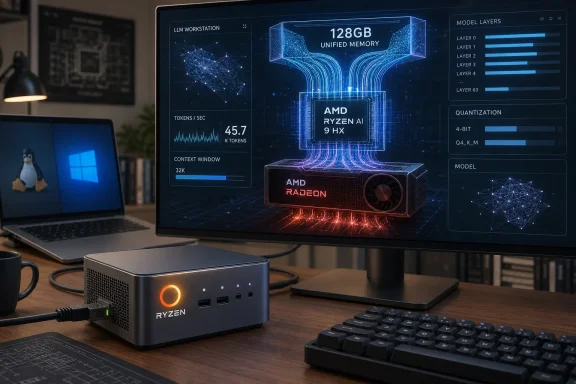
For the past two years, PC makers have marketed AI PCs around TOPS numbers, neural processing units, and vague promises of on-device intelligence. Strix Halo cuts through that fog with something far more practical: memory capacity that a local model can actually use. The Ryzen AI Max+ 395’s 128GB unified memory configuration matters because large language models are constrained less by marketing labels than by how much fast memory can be addressed by the compute engine doing the work.
That is why this chip feels different from the thin-and-light laptop silicon that came before it. The Ryzen AI Max+ 395 combines 16 Zen 5 cores and 32 threads with Radeon 8060S integrated graphics, using 40 RDNA 3.5 compute units and LPDDR5X-8000 memory shared across the CPU and GPU. AMD’s Variable Graphics Memory can expose a very large portion of that pool as GPU-addressable memory, with some systems advertising up to 96GB usable as VRAM.
That does not magically turn integrated graphics into a high-end RTX workstation card. Bandwidth, software maturity, driver behavior, and framework support still matter enormously. But it does mean a small box can load models that would otherwise be awkward, impossible, or expensive on conventional consumer GPUs with 12GB, 16GB, or even 24GB of VRAM.
This is the key distinction between the new Strix Halo mini PCs and the Copilot+ laptop wave. The NPU is useful for certain low-power, fixed-function workloads, but local AI developers are not buying $2,400-to-$4,000 boxes to run webcam effects. They are buying memory, thermals, ports, Linux support, and a machine that can sit under a monitor while chewing through quantized models without a cloud invoice ticking in the background.
The Mini PC Has Become the New Workstation Shape
The workstation used to announce itself physically. It was a tower under the desk, a rackmount node in a lab, or a fat mobile workstation with fans that spun up like a hair dryer. Strix Halo points to a different future: the workstation as a dense, quiet-ish square on the desk, closer in spirit to a Mac Studio than to a gaming PC.
That shift is not cosmetic. Developers increasingly want local inference for privacy, latency, cost control, and experimentation. They may still train in the cloud, but they want to test agents, run retrieval pipelines, evaluate models, and prototype applications without sending every prompt to a remote API. A compact machine with 128GB of unified memory is not a data center replacement, but it can become the developer’s local staging ground.
This is where AMD’s strategy is clever. It is not asking buyers to accept a strange new appliance with a new software religion. These machines are generally Windows 11 Pro or Linux PCs. They have USB-C, HDMI, fast Ethernet, Wi-Fi 7, and familiar storage options. The message is not “buy into a sealed AI appliance”; it is “buy a small workstation that happens to have unusually AI-friendly memory.”
That ordinary-PC framing matters for WindowsForum readers. A sysadmin can imagine imaging one of these boxes, putting it on a developer’s desk, joining it to existing management systems, and treating it as part of the fleet. A hobbyist can imagine using it as both a daily desktop and a local model machine. A researcher can imagine swapping between Linux tooling and Windows software without treating the hardware as a single-purpose box.
NVIDIA Still Owns the Software Story AMD Wants to Borrow
The obvious comparison is NVIDIA’s DGX Spark, now positioned as a compact personal AI supercomputer with 128GB of unified memory and NVIDIA’s Blackwell-era AI stack. DGX Spark is not merely a box of parts. It is NVIDIA trying to compress the DGX identity — CUDA, AI Enterprise, optimized frameworks, container workflows, and developer familiarity — into something that can sit on a desk.
That is why AMD’s challenge is both real and limited. On paper, Strix Halo mini PCs can undercut or at least pressure DGX Spark on price, especially where OEMs sell Ryzen AI Max+ 395 configurations closer to the lower end of the market. In practice, buyers who live inside CUDA may still see NVIDIA’s software ecosystem as the product, with the hardware as the delivery mechanism.
This has been AMD’s recurring problem in AI. The company can produce compelling silicon, and in many markets it has forced NVIDIA to compete harder. But AI developers are not just buying FLOPS. They are buying compatibility with PyTorch builds, inference runtimes, libraries, examples, Docker images, documentation, and the accumulated muscle memory of a decade of CUDA dominance.
ROCm, Vulkan paths, llama.cpp support, ONNX Runtime experiments, and broader open tooling have improved the picture. For local inference enthusiasts, AMD hardware is no longer a curiosity. But the gap between “this can run” and “this is the default supported path” remains the battlefield. Strix Halo’s hardware is good enough to make that battle worth fighting; it does not automatically win it.
The Price Story Is Already Messier Than the Launch Pitch
Early coverage framed Ryzen AI Max+ 395 mini PCs as a roughly $2,000-to-$3,000 alternative to NVIDIA’s pricier compact AI systems. That remains directionally true for some OEM machines, but the current U.S. market is already more fragmented. Configurations from brands such as Beelink, Corsair, Framework, GMKtec, HP, and others vary widely depending on memory, storage, chassis design, support, and positioning.
The surprise is that AMD’s own Ryzen AI Halo developer platform appears less like a bargain-basement reference box and more like a premium dev kit. Recent U.S. preorder reporting has put it around $3,999, which still undercuts DGX Spark’s higher pricing but is not the $2,000 fantasy some buyers may have hoped for. That matters because a $4,000 AMD box competes in a very different mental category than a $2,399 enthusiast mini PC.
At $2,399, Strix Halo feels disruptive. At $3,999, it becomes a workstation purchase that must justify itself against DGX Spark, a discrete-GPU PC, a Mac Studio, or cloud compute. AMD may still win on x86 flexibility and unified memory, but the buyer becomes more demanding. Warranty, thermals, BIOS controls, Linux stability, storage expansion, and support channels suddenly matter as much as benchmark screenshots.
This is why the OEM spread is not just noise. It is the market deciding what Strix Halo actually is. In one chassis it is a local-AI hobbyist’s dream machine; in another it is a corporate workstation; in another it is a boutique dev box priced uncomfortably close to NVIDIA’s halo product.
Running a 70B Model Locally Is a Milestone, Not a Miracle
The most seductive claim around 128GB unified-memory mini PCs is that they can run 70-billion-parameter models locally. That is broadly plausible with quantized models, and it is genuinely important. A few years ago, the idea of loading a model of that class on a compact desktop without a discrete GPU would have sounded absurd.
But “can run” is not the same as “will run like a cloud endpoint backed by accelerator racks.” Quantization trades precision for memory savings. Token generation speed varies dramatically by model, backend, drivers, prompt length, context size, and whether the workload leans on GPU acceleration efficiently. Users expecting datacenter-class throughput from a 149mm mini PC are setting themselves up for disappointment.
The better way to understand Strix Halo is as a machine that expands what is locally possible. It lets developers test larger models, keep sensitive prompts on-premises, iterate without per-token billing, and work in disconnected or controlled environments. That is valuable even if the experience is not always fast enough for production serving.
For many Windows and Linux developers, the real win will be breadth rather than peak speed. A Strix Halo box can act as a coding workstation, a model testbed, a small inference server, and a general desktop. NVIDIA’s DGX Spark may remain more purpose-built for AI workflows, but AMD’s mini PC ecosystem has a chance to succeed precisely because it is less exotic.
Windows Is Now Part of the Local-AI Workstation Fight
The local-AI workstation market is no longer a Linux-only niche. Windows matters because developers, creators, analysts, and enterprise users already live there. A machine that can boot Windows 11 Pro, run familiar productivity and development tools, and still host local models has a broader addressable audience than a specialized appliance requiring a new operating model.
That does not mean Windows is always the best environment for open AI tooling. Linux still tends to get the cleanest first-class support for many frameworks, drivers, and containerized workflows. But dual-boot, WSL, native Windows AI runtimes, and cross-platform model tools are making the boundary less rigid. For IT departments, the fact that these boxes can be treated as PCs rather than mysterious lab gear is a significant advantage.
Microsoft has its own incentive to make this category work. Copilot+ PCs introduced the public to on-device AI, but those systems are mostly about efficiency and user-facing features. Strix Halo-class machines are about developers and power users. They are the missing middle between thin-client cloud AI and full workstation towers.
If Microsoft, AMD, and OEMs can make Windows a credible host for local model workflows, NVIDIA’s software moat narrows slightly. Not because CUDA disappears, but because a class of users may decide that “good enough, local, manageable, and cheaper” is preferable to “best supported, more expensive, and more specialized.”
The Hardware Is Compact, but the Buying Decision Is Not
The specifications invite easy comparison shopping: same Ryzen AI Max+ 395, same 128GB memory ceiling, same Radeon 8060S branding. The reality is more complicated. Mini PCs live or die by thermals, power limits, firmware, fan curves, port layout, storage access, and vendor support.
A Strix Halo system allowed to sustain higher power will behave differently from a quieter, smaller, more conservative design. A box with better cooling may be worth more than one with a larger SSD. A corporate HP workstation with enterprise support is not the same product as a barebones-style enthusiast mini PC, even if the APU is similar.
That makes the current OEM explosion both exciting and risky. Competition should lower prices and create useful variety, but it also makes the market harder to read. Buyers need to know whether they are paying for support, industrial design, storage, software bundles, or simply brand markup.
The most dangerous assumption is that every Ryzen AI Max+ 395 mini PC will deliver the same AI experience. They will not. Sustained performance, driver updates, BIOS options for graphics memory allocation, Linux compatibility, and noise levels may vary enough to change the value proposition completely.
AMD Has Built the Anti-Gaming PC for AI Developers
The traditional enthusiast answer to local AI has been obvious: buy a big NVIDIA GPU, preferably with as much VRAM as possible, and build around it. That still works, and for many workloads it remains the best performance-per-dollar route. But it also comes with the usual baggage of power draw, heat, case size, PCIe slots, and the awkward economics of high-VRAM graphics cards.
Strix Halo offers a different bargain. Instead of a discrete GPU with a smaller pool of very fast VRAM, it gives the system a large shared memory pool and a competent integrated GPU. That is not a universal substitute. For training, heavy image generation, CUDA-specific workflows, and maximum throughput, discrete NVIDIA hardware remains formidable.
But for local LLM inference, agent development, coding assistants, document analysis, and experimentation with larger quantized models, the shape of the compromise is appealing. The machine is compact. The memory pool is large. The CPU is strong enough to be useful outside AI. The integrated GPU is not an afterthought in the way integrated graphics used to be.
That is why the Ryzen AI Max+ 395 mini PC is not just a cheaper DGX Spark. It is also an argument against the idea that every serious local-AI machine must look like a gaming rig with professional aspirations. AMD is betting that many developers want a small, quiet, general-purpose box that happens to have enough memory to make local AI interesting.
NVIDIA’s Premium Is a Bet on Certainty
NVIDIA’s counterargument is simple: time is money, and software certainty is worth paying for. DGX Spark is designed to inherit the trust of NVIDIA’s larger AI ecosystem. If a developer or enterprise team wants the smoothest path through NVIDIA-optimized software, the premium may be rational.
That matters especially in organizations where local AI boxes are not toys. If a workstation is part of a product team’s workflow, downtime and debugging matter. If a model must be deployed, benchmarked, containerized, and integrated with existing AI infrastructure, the stack can matter more than the spec sheet.
AMD’s opportunity is to make that premium feel excessive for a growing class of users. If an x86 Strix Halo mini PC can run the models a team cares about, integrate with normal desktop management, and cost less than NVIDIA’s compact system, the buying calculus changes. The strongest challenge to NVIDIA is not beating it in every benchmark; it is making NVIDIA unnecessary for enough day-to-day local inference work.
That is how platform shifts often begin. The incumbent remains best for the high end, but the challenger becomes sufficient for the expanding middle. Strix Halo is aimed squarely at that middle: serious enough for developers, accessible enough for enthusiasts, and familiar enough for IT.
The AI PC Finally Has a Workstation Use Case
The phrase “AI PC” has suffered from too much abstraction. Consumers were told their next laptop would be AI-ready, but the use cases often felt thin: background blur, local summaries, search, and future Windows features that may or may not arrive on schedule. Strix Halo gives the category a more concrete identity.
Here, the AI claim is not primarily about a magic button in the operating system. It is about a machine that can load large models locally because it has enough memory to do so. That is easier to understand, easier to test, and easier to justify.
For Windows enthusiasts, this is refreshing. The PC has always been most compelling when it is a general-purpose machine stretched into new roles by better hardware and impatient users. Strix Halo fits that tradition better than many corporate AI narratives do. It gives tinkerers and professionals a real capability to evaluate rather than a promise to await.
The danger is that OEMs will smother that clarity with confusing branding and inflated prices. If every 128GB Strix Halo machine drifts toward $4,000, the platform risks becoming another boutique workstation category. If competition keeps credible configurations closer to the mid-$2,000 range, AMD has a much more disruptive story.
The Small Box That Makes Local Models Feel Negotiable
The most important buying advice is not to treat Ryzen AI Max+ 395 as a single product. It is a platform appearing in many bodies, with prices and priorities that differ more than the shared silicon suggests. For anyone considering one, the decision should begin with the workload, not the logo on the chassis.
- A Ryzen AI Max+ 395 mini PC is most compelling for local inference, model testing, development, and privacy-sensitive experimentation rather than heavy model training.
- The 128GB unified-memory configuration is the platform’s defining feature, because it lets compact systems load larger quantized models than ordinary consumer GPUs can comfortably handle.
- NVIDIA’s DGX Spark remains the cleaner bet for buyers who value NVIDIA’s AI software stack, CUDA compatibility, and appliance-like positioning more than x86 flexibility.
- Prices vary enough across OEM systems that comparison shopping is mandatory, especially when the same APU appears in machines separated by more than a thousand dollars.
- Windows 11 Pro and Linux support make Strix Halo systems easier to imagine inside normal developer and IT workflows than many specialized AI appliances.
- Sustained performance will depend heavily on thermals, firmware, power limits, graphics-memory controls, and driver support, not just the Ryzen AI Max+ 395 name.
The Ryzen AI Max+ 395 mini PC does not dethrone NVIDIA in AI workstations, but it does something almost as important: it makes the category contestable. If AMD and its OEM partners can keep prices sane, firmware flexible, and software support improving, Strix Halo could become the machine that turns local AI from a specialist’s hardware project into a normal workstation purchase. NVIDIA still owns the premium AI developer story, but AMD has put a credible x86 alternative on the desk — and in a market moving this quickly, credible alternatives have a habit of becoming the next default.