
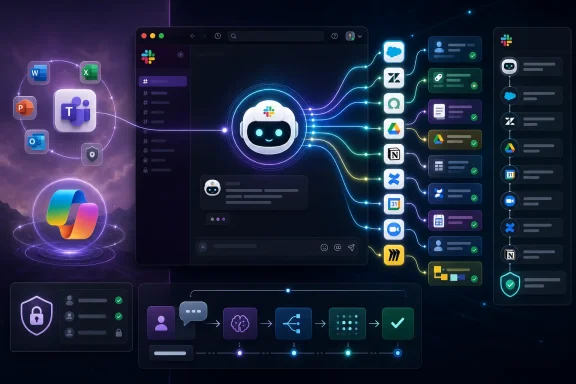
Slack has made Slackbot’s Model Context Protocol client generally available in 2026, turning the familiar workplace bot into an AI front end for more than 20 enterprise applications inside the Slack interface. The pitch is simple enough: stop making workers hop between tabs, bots, dashboards, and copilots just to complete one business task. The strategic implication is much larger. Slack is trying to make the collaboration layer the command line for the enterprise, and that puts it on a collision course with Microsoft Teams, Microsoft 365 Copilot, and the whole gravitational field of Office.
Slack has always sold itself as more than chat. In its best telling, Slack is where work becomes visible: the room where decisions happen, documents are passed around, alerts arrive, and institutional memory accumulates in public channels rather than private inboxes. The problem is that modern work did not consolidate around one interface; it metastasized into ticketing systems, design boards, file repositories, CRM records, document tools, video meetings, and a new crop of AI assistants sitting beside all of them.
That is the fragmentation Slackbot’s MCP client is meant to attack. Model Context Protocol, or MCP, gives AI systems a standard way to discover and interact with external tools and data sources. In less technical language, it is an attempt to stop every AI assistant from needing a bespoke integration for every app it touches.
Slack’s move matters because MCP is not merely another connector story. Connectors have existed for decades, and most workers still spend their day copying context from one system into another. The difference now is that AI assistants are being asked not just to retrieve information, but to do work across systems: summarize a meeting, update a ticket, draft a contract note, find the supporting file, ping the right person, and preserve the decision trail.
Slack wants Slackbot to be the place where that sequence starts and ends. Instead of opening Atlassian, Box, Canva, Docusign, Miro, Notion, Zoom, and whatever else the enterprise has accumulated, the user asks Slackbot to act across them. The promise is not fewer apps in the procurement spreadsheet. It is fewer app boundaries in the user’s working day.
So Slack is making a different argument. If enterprises are already hybrid in their software choices, the collaboration hub should be the place that respects that heterogeneity rather than punishing it. That is the heart of Slack’s bet: openness becomes a product feature when no single vendor owns the whole work graph.
This is not a sentimental defense of best-of-breed software. It is hard-nosed platform strategy. Slack does not need to own the document editor, the whiteboard, the CRM, and the video meeting if it can own the orchestration moment. The interface that understands the user’s request, summons the right tool, applies permissions, and returns a useful result becomes far more valuable than a passive notification stream.
Microsoft understands this perfectly, which is why Teams is no longer just a meeting and chat client either. Teams is increasingly a surface for Microsoft 365 Copilot, Copilot Studio agents, line-of-business app integrations, and administrative policy. The collaboration market is not about which app has better emoji reactions. It is about which platform becomes the trusted runtime for AI-mediated work.
That is why Slack’s MCP client is both technically modest and strategically aggressive. It does not abolish the fragmented enterprise stack. It says Slack can tame it.
That gives Microsoft’s AI efforts a native advantage. Microsoft 365 Copilot can reason across Outlook, Teams, Word, Excel, PowerPoint, SharePoint, and OneDrive because those systems are already joined by enterprise identity and governance. For IT departments, that matters as much as the assistant’s prose quality. The value of an AI assistant is inseparable from what it is allowed to see and what it is trusted to change.
Slack’s counter is that many enterprises do not actually work in a pure Microsoft monoculture. Developers may live in GitHub and Jira. Product teams may live in Notion, Figma, and Miro. Sales teams may use Salesforce. Legal teams may route through Docusign. Marketing may use Canva or Box. Executives may think they bought a suite, but their employees quietly assembled a workflow archipelago.
Slack has always thrived in that archipelago. Its cultural power came from integrating alerts, bots, and conversations across tools that did not otherwise share much. MCP gives Slack a chance to repackage that historical advantage for the AI era: not just notifications from everywhere, but action across everywhere.
Still, Microsoft’s moat is deeper than Slack’s messaging heritage. A Teams user working inside a heavily Microsoft 365 organization may not feel fragmentation as sharply, because Word documents, SharePoint permissions, Outlook meetings, and Copilot summaries are already close at hand. Slack’s open pitch lands hardest in organizations where Microsoft is important but not total.
That distinction matters. Slack does not have to beat Teams everywhere to make MCP important. It has to become indispensable in the companies where work already crosses vendor boundaries faster than IT can rationalize them.
Slackbot’s MCP client attacks that problem by letting users express intent in natural language and have Slackbot reach into connected systems. In theory, the user stops acting as the human API gateway. The assistant retrieves the right context, invokes the right tool, and keeps the interaction in one conversational thread.
But context switching is only the visible cost. The hidden cost is the loss of institutional continuity. A task completed across five systems often leaves no coherent record of why it happened, who approved it, what source material informed it, and what changed afterward. The work gets done, but the organization cannot easily reconstruct the reasoning.
This is where Slack has an interesting opportunity. If Slackbot-mediated workflows happen inside channels, threads, and auditable conversations, Slack can turn AI actions into shared team memory. A good assistant should not merely complete a task; it should leave behind enough context for the next human or agent to understand the decision.
That is a higher bar than “fewer clicks.” Enterprises are increasingly skeptical of AI productivity claims that amount to better autocomplete. The durable value comes when AI reduces coordination overhead, preserves rationale, and makes work reusable. Slack’s product story gestures toward that future, but the proof will come from whether teams actually change their workflows around it.
A Slackbot command that updates a ticket is useful. A Slackbot workflow that links the customer conversation, summarizes the decision, updates the ticket, notifies engineering, attaches the relevant contract clause, and logs the action under the correct permissions is a platform shift. The difference is execution.
The security model is therefore not a footnote. It is the product. If Slackbot can only access what the user is allowed to access, and if administrators can approve apps, manage scopes, inspect activity, and enforce retention policies, the system has a plausible enterprise story. If permissions become opaque, inconsistent, or difficult to audit, adoption will stall in exactly the customers Slack most wants to impress.
MCP also introduces a broader operational challenge. A protocol can standardize how tools are exposed, but it does not magically standardize the quality, safety, or behavior of every tool. One server may be well maintained, another may be brittle, and a third may expose actions that are too powerful for casual conversational use. The more Slackbot becomes a universal interface, the more Slack inherits user frustration when some connected system behaves badly.
That is where Microsoft’s integrated stack has an advantage. Microsoft can offer a more vertically controlled experience across identity, compliance, app surfaces, and administrative policy. It can also bundle governance into the same procurement and security conversations IT already has around Microsoft 365. Slack must persuade administrators that an open orchestration layer can be governed as confidently as a suite-native one.
The cultural issue may be even harder than the technical one. Security teams are already uneasy about generative AI systems that summarize sensitive information. An assistant that can take actions across business systems raises the stakes. Enterprises will not just ask whether Slackbot can save time. They will ask whether they can explain its actions during an audit, reverse mistakes, and prevent privilege creep.
The winners in this phase of enterprise AI will not be the vendors with the cleverest demos. They will be the vendors that make AI activity boringly governable.
Slackbot’s MCP client sits squarely in that shift. It is a conversational layer on top of integration architecture. That makes it more approachable for end users, but also more politically charged for IT. The assistant is no longer a side panel that writes nicer messages. It becomes a broker among business systems.
This is why MCP has attracted so much attention across the industry. If every AI system needs custom wiring to every enterprise app, the market becomes slow, expensive, and fragmented. A shared protocol gives vendors and developers a cleaner pattern: expose tools and resources once, let compliant clients discover and use them, and avoid rebuilding the same integration for each assistant.
But protocols do not eliminate platform competition. They often intensify it. Web standards did not stop browser wars. SQL did not stop database competition. Kubernetes did not make cloud providers interchangeable. MCP may make integrations easier while making the battle over the client surface more important.
Slack wants its client surface to be Slackbot. Microsoft wants that surface to be Copilot across Microsoft 365 and Teams. Salesforce wants Agentforce and Slack to reinforce each other. Atlassian, Notion, Zoom, Box, and others want access without surrendering their customer relationship. Every participant praises interoperability while quietly trying to occupy the highest-value layer.
That layer is intent capture. Whoever receives the user’s request first can shape the workflow, choose the tool, present the result, and collect the usage signal. In the AI workplace, the prompt box is not a widget. It is the new front door.
On the other hand, Slack’s open-ecosystem argument depends on trust from vendors that may also compete with Salesforce. If Slackbot becomes too obviously a Salesforce control plane, some partners and customers may become wary. The value of Slack has long been that it can sit between systems without feeling like it is merely steering users back to one parent company’s stack.
This is a delicate balance. Slack needs Salesforce’s AI investment, enterprise sales muscle, and customer data gravity. But it also needs to remain the neutral-feeling workspace where Atlassian, Box, Canva, Docusign, Miro, Notion, Zoom, and others are not second-class citizens. The more Slackbot becomes an orchestration layer, the more neutrality becomes a product attribute.
Microsoft has a different problem. Its integration story is strongest when customers are all-in on Microsoft 365, but that strength can look like lock-in. The company can support open standards and third-party connectors while still benefiting from the fact that most enterprise work is easier when it stays inside the Microsoft estate. For many CIOs, that is a feature rather than a bug.
Slack’s opportunity is to make openness feel less like compromise and more like control. If Slackbot can orchestrate across best-of-breed tools while preserving governance, Slack can argue that enterprises do not need to collapse into one suite to get coherent AI workflows. If it cannot, Microsoft’s bundled convenience will be hard to resist.
That means the assistant has to be fast, accurate, and action-oriented. If users ask Slackbot to complete a cross-app task and receive a vague summary, a permission error, or a half-completed workflow, they will revert to the old way. The tolerance for AI novelty is shrinking. By 2026, enterprise users have seen enough demos to know the difference between a polished launch video and a tool that survives Monday morning.
The hardest part is not simple retrieval. The hard part is multi-step work under real constraints. A user may ask Slackbot to prepare for a customer renewal, but the relevant information may live in Salesforce, contract files, support tickets, meeting transcripts, product roadmaps, and private messages. Some of it may be outdated, restricted, contradictory, or politically sensitive. The assistant must know when to act, when to ask, and when to stop.
That last behavior is underrated. Enterprise AI systems gain trust not only by doing things, but by refusing to overreach. A Slackbot that confidently updates the wrong field will lose credibility quickly. A Slackbot that explains what it can access, what it cannot verify, and what approval it needs may feel slower in the moment but safer in production.
This is where Slack’s conversational DNA could help. Slack is built around social context: channels, mentions, threads, approvals, reactions, and shared visibility. If Slackbot uses those mechanics intelligently, it can make AI work feel collaborative rather than solitary. The assistant can pull humans into the loop without forcing them into a separate workflow product.
That does not mean Slack is doomed to niche status. Defaults can be beaten when the alternative solves a painful enough problem. Slack has repeatedly won teams that value speed, openness, and developer-friendly integrations. The question is whether AI orchestration turns those preferences into a board-level platform argument.
For IT leaders, the calculus will be pragmatic. If Slackbot’s MCP client reduces tool sprawl without reducing tool choice, it will get attention. If it produces measurable improvements in response time, project coordination, customer handoffs, or engineering throughput, it will get budget. If it merely creates another AI place where employees ask questions and receive uneven answers, it will be treated as another feature in the collaboration bundle.
Microsoft’s likely response is not to dismiss openness, but to absorb enough of it. Microsoft can support MCP, deepen third-party connectors, and still make the best experience happen inside Microsoft 365. That is the classic platform incumbent move: embrace the standard, then differentiate through the surrounding ecosystem.
Slack’s defense is to move faster at the edges where Microsoft’s suite logic is less natural. Cross-company collaboration, developer operations, incident response, sales-to-support handoffs, product planning, and mixed-vendor workflows are all places where Slack can make a credible case. The company does not need every workflow. It needs the workflows where openness is not ideology but necessity.
Slack’s wager is appealing because it starts from the world as it is. Most enterprises are messy. They have inherited systems, departmental favorites, shadow workflows, regulatory constraints, and employees who simply use the tools that help them get work done. A universal assistant that respects that mess could be more valuable than another suite-native helper that pretends the mess does not exist.
But the mess is also dangerous. The same fragmentation that creates opportunity for Slack creates complexity for Slackbot. Permissions differ. Data models differ. App quality differs. Business processes differ. A conversational interface can hide that complexity from the user, but it cannot make the complexity disappear.
This is why the Slack-versus-Teams framing is useful but incomplete. The deeper contest is between two theories of enterprise AI. One theory says the future belongs to deeply integrated suites with unified governance and native context. The other says the future belongs to orchestration layers that can span the heterogeneous reality of modern work. Microsoft is the strongest expression of the first theory. Slack is trying to become the strongest expression of the second.
Both theories will coexist for years. The market will not crown one universal winner. Instead, enterprises will decide workflow by workflow where the assistant should live, which systems it can touch, and how much autonomy it deserves. Slackbot’s MCP client is important because it pushes that decision out of the abstract and into daily work.
 Slack Is Trying to Turn Chat Into the Enterprise Control Plane
Slack has always sold itself as more than chat. In its best telling, Slack is where work becomes visible: the room where decisions happen, documents are passed around, alerts arrive, and institutional memory accumulates in public channels rather than private inboxes. The problem is that modern work did not consolidate around one interface; it metastasized into ticketing systems, design boards, file repositories, CRM records, document tools, video meetings, and a new crop of AI assistants sitting beside all of them.That is the fragmentation Slackbot’s MCP client is meant to attack. Model Context Protocol, or MCP, gives AI systems a standard way to discover and interact with external tools and data sources. In less technical language, it is an attempt to stop every AI assistant from needing a bespoke integration for every app it touches.
Slack’s move matters because MCP is not merely another connector story. Connectors have existed for decades, and most workers still spend their day copying context from one system into another. The difference now is that AI assistants are being asked not just to retrieve information, but to do work across systems: summarize a meeting, update a ticket, draft a contract note, find the supporting file, ping the right person, and preserve the decision trail.
Slack wants Slackbot to be the place where that sequence starts and ends. Instead of opening Atlassian, Box, Canva, Docusign, Miro, Notion, Zoom, and whatever else the enterprise has accumulated, the user asks Slackbot to act across them. The promise is not fewer apps in the procurement spreadsheet. It is fewer app boundaries in the user’s working day.
The Open Standard Is Also a Competitive Weapon
Slack’s use of MCP is being framed as an open-ecosystem play, and that framing is not accidental. Microsoft’s collaboration advantage is the sheer density of Microsoft 365: Teams meetings, Outlook calendars, SharePoint documents, OneDrive files, Loop components, Entra identity, Purview compliance, Defender signals, Power Platform workflows, and Copilot threaded through the stack. Slack cannot out-Microsoft Microsoft inside a Microsoft estate.So Slack is making a different argument. If enterprises are already hybrid in their software choices, the collaboration hub should be the place that respects that heterogeneity rather than punishing it. That is the heart of Slack’s bet: openness becomes a product feature when no single vendor owns the whole work graph.
This is not a sentimental defense of best-of-breed software. It is hard-nosed platform strategy. Slack does not need to own the document editor, the whiteboard, the CRM, and the video meeting if it can own the orchestration moment. The interface that understands the user’s request, summons the right tool, applies permissions, and returns a useful result becomes far more valuable than a passive notification stream.
Microsoft understands this perfectly, which is why Teams is no longer just a meeting and chat client either. Teams is increasingly a surface for Microsoft 365 Copilot, Copilot Studio agents, line-of-business app integrations, and administrative policy. The collaboration market is not about which app has better emoji reactions. It is about which platform becomes the trusted runtime for AI-mediated work.
That is why Slack’s MCP client is both technically modest and strategically aggressive. It does not abolish the fragmented enterprise stack. It says Slack can tame it.
Microsoft’s Moat Is Not Chat, It Is the Work Graph
The most dangerous mistake in reading this fight is to compare Slackbot and Teams as if they are equivalent chatbots in rival chat apps. Microsoft’s strength is not that Teams has channels and meetings. Microsoft’s strength is that Teams sits inside a tenant where identity, documents, calendars, mail, endpoint management, security telemetry, compliance labels, and productivity apps already live.That gives Microsoft’s AI efforts a native advantage. Microsoft 365 Copilot can reason across Outlook, Teams, Word, Excel, PowerPoint, SharePoint, and OneDrive because those systems are already joined by enterprise identity and governance. For IT departments, that matters as much as the assistant’s prose quality. The value of an AI assistant is inseparable from what it is allowed to see and what it is trusted to change.
Slack’s counter is that many enterprises do not actually work in a pure Microsoft monoculture. Developers may live in GitHub and Jira. Product teams may live in Notion, Figma, and Miro. Sales teams may use Salesforce. Legal teams may route through Docusign. Marketing may use Canva or Box. Executives may think they bought a suite, but their employees quietly assembled a workflow archipelago.
Slack has always thrived in that archipelago. Its cultural power came from integrating alerts, bots, and conversations across tools that did not otherwise share much. MCP gives Slack a chance to repackage that historical advantage for the AI era: not just notifications from everywhere, but action across everywhere.
Still, Microsoft’s moat is deeper than Slack’s messaging heritage. A Teams user working inside a heavily Microsoft 365 organization may not feel fragmentation as sharply, because Word documents, SharePoint permissions, Outlook meetings, and Copilot summaries are already close at hand. Slack’s open pitch lands hardest in organizations where Microsoft is important but not total.
That distinction matters. Slack does not have to beat Teams everywhere to make MCP important. It has to become indispensable in the companies where work already crosses vendor boundaries faster than IT can rationalize them.
The Context-Switching Tax Is Real, but It Is Not the Whole Bill
Every collaboration vendor now talks about reducing context switching, and for good reason. The modern knowledge worker’s day is a badly optimized distributed system. Information arrives in chat, decisions happen in meetings, evidence sits in documents, tasks live in project-management software, and final approvals disappear into email threads.Slackbot’s MCP client attacks that problem by letting users express intent in natural language and have Slackbot reach into connected systems. In theory, the user stops acting as the human API gateway. The assistant retrieves the right context, invokes the right tool, and keeps the interaction in one conversational thread.
But context switching is only the visible cost. The hidden cost is the loss of institutional continuity. A task completed across five systems often leaves no coherent record of why it happened, who approved it, what source material informed it, and what changed afterward. The work gets done, but the organization cannot easily reconstruct the reasoning.
This is where Slack has an interesting opportunity. If Slackbot-mediated workflows happen inside channels, threads, and auditable conversations, Slack can turn AI actions into shared team memory. A good assistant should not merely complete a task; it should leave behind enough context for the next human or agent to understand the decision.
That is a higher bar than “fewer clicks.” Enterprises are increasingly skeptical of AI productivity claims that amount to better autocomplete. The durable value comes when AI reduces coordination overhead, preserves rationale, and makes work reusable. Slack’s product story gestures toward that future, but the proof will come from whether teams actually change their workflows around it.
A Slackbot command that updates a ticket is useful. A Slackbot workflow that links the customer conversation, summarizes the decision, updates the ticket, notifies engineering, attaches the relevant contract clause, and logs the action under the correct permissions is a platform shift. The difference is execution.
Governance Will Decide Whether Slackbot Becomes Useful or Untrusted
The obvious risk in letting an AI assistant operate across enterprise apps is that it may become a beautifully designed way to create governance headaches at machine speed. Slack is emphasizing native compliance and permission controls for a reason. No serious enterprise wants a conversational interface that quietly bypasses the controls painstakingly configured in Box, Atlassian, Docusign, Salesforce, or Microsoft 365.The security model is therefore not a footnote. It is the product. If Slackbot can only access what the user is allowed to access, and if administrators can approve apps, manage scopes, inspect activity, and enforce retention policies, the system has a plausible enterprise story. If permissions become opaque, inconsistent, or difficult to audit, adoption will stall in exactly the customers Slack most wants to impress.
MCP also introduces a broader operational challenge. A protocol can standardize how tools are exposed, but it does not magically standardize the quality, safety, or behavior of every tool. One server may be well maintained, another may be brittle, and a third may expose actions that are too powerful for casual conversational use. The more Slackbot becomes a universal interface, the more Slack inherits user frustration when some connected system behaves badly.
That is where Microsoft’s integrated stack has an advantage. Microsoft can offer a more vertically controlled experience across identity, compliance, app surfaces, and administrative policy. It can also bundle governance into the same procurement and security conversations IT already has around Microsoft 365. Slack must persuade administrators that an open orchestration layer can be governed as confidently as a suite-native one.
The cultural issue may be even harder than the technical one. Security teams are already uneasy about generative AI systems that summarize sensitive information. An assistant that can take actions across business systems raises the stakes. Enterprises will not just ask whether Slackbot can save time. They will ask whether they can explain its actions during an audit, reverse mistakes, and prevent privilege creep.
The winners in this phase of enterprise AI will not be the vendors with the cleverest demos. They will be the vendors that make AI activity boringly governable.
The AI Assistant Is Becoming the New Middleware
For years, enterprise integration meant APIs, workflow engines, robotic process automation, and middleware platforms that most end users never saw. AI changes the interface, but not the underlying need. Systems still have to authenticate, exchange data, respect policies, handle failures, and maintain logs. The difference is that users now expect to initiate those flows by asking a question or giving an instruction.Slackbot’s MCP client sits squarely in that shift. It is a conversational layer on top of integration architecture. That makes it more approachable for end users, but also more politically charged for IT. The assistant is no longer a side panel that writes nicer messages. It becomes a broker among business systems.
This is why MCP has attracted so much attention across the industry. If every AI system needs custom wiring to every enterprise app, the market becomes slow, expensive, and fragmented. A shared protocol gives vendors and developers a cleaner pattern: expose tools and resources once, let compliant clients discover and use them, and avoid rebuilding the same integration for each assistant.
But protocols do not eliminate platform competition. They often intensify it. Web standards did not stop browser wars. SQL did not stop database competition. Kubernetes did not make cloud providers interchangeable. MCP may make integrations easier while making the battle over the client surface more important.
Slack wants its client surface to be Slackbot. Microsoft wants that surface to be Copilot across Microsoft 365 and Teams. Salesforce wants Agentforce and Slack to reinforce each other. Atlassian, Notion, Zoom, Box, and others want access without surrendering their customer relationship. Every participant praises interoperability while quietly trying to occupy the highest-value layer.
That layer is intent capture. Whoever receives the user’s request first can shape the workflow, choose the tool, present the result, and collect the usage signal. In the AI workplace, the prompt box is not a widget. It is the new front door.
Slack’s Salesforce Ownership Cuts Both Ways
Slack’s position inside Salesforce gives it both resources and complications. On one hand, Salesforce has every incentive to make Slack the conversational surface for agentic work. Agentforce, CRM data, customer workflows, and Slack conversations are a natural bundle if the company can make them feel coherent. A sales team that can ask Slackbot to summarize an account, update an opportunity, prepare a follow-up, and coordinate with support is exactly the kind of story Salesforce wants to tell.On the other hand, Slack’s open-ecosystem argument depends on trust from vendors that may also compete with Salesforce. If Slackbot becomes too obviously a Salesforce control plane, some partners and customers may become wary. The value of Slack has long been that it can sit between systems without feeling like it is merely steering users back to one parent company’s stack.
This is a delicate balance. Slack needs Salesforce’s AI investment, enterprise sales muscle, and customer data gravity. But it also needs to remain the neutral-feeling workspace where Atlassian, Box, Canva, Docusign, Miro, Notion, Zoom, and others are not second-class citizens. The more Slackbot becomes an orchestration layer, the more neutrality becomes a product attribute.
Microsoft has a different problem. Its integration story is strongest when customers are all-in on Microsoft 365, but that strength can look like lock-in. The company can support open standards and third-party connectors while still benefiting from the fact that most enterprise work is easier when it stays inside the Microsoft estate. For many CIOs, that is a feature rather than a bug.
Slack’s opportunity is to make openness feel less like compromise and more like control. If Slackbot can orchestrate across best-of-breed tools while preserving governance, Slack can argue that enterprises do not need to collapse into one suite to get coherent AI workflows. If it cannot, Microsoft’s bundled convenience will be hard to resist.
The User Experience Has to Beat the Tab Habit
The enterprise collaboration wars are often described in procurement terms, but adoption is won at the level of habit. Workers already have muscle memory for opening Jira, searching Drive, checking Outlook, joining Zoom, updating Salesforce, or asking Copilot inside a Microsoft app. Slackbot must be better enough to interrupt those habits.That means the assistant has to be fast, accurate, and action-oriented. If users ask Slackbot to complete a cross-app task and receive a vague summary, a permission error, or a half-completed workflow, they will revert to the old way. The tolerance for AI novelty is shrinking. By 2026, enterprise users have seen enough demos to know the difference between a polished launch video and a tool that survives Monday morning.
The hardest part is not simple retrieval. The hard part is multi-step work under real constraints. A user may ask Slackbot to prepare for a customer renewal, but the relevant information may live in Salesforce, contract files, support tickets, meeting transcripts, product roadmaps, and private messages. Some of it may be outdated, restricted, contradictory, or politically sensitive. The assistant must know when to act, when to ask, and when to stop.
That last behavior is underrated. Enterprise AI systems gain trust not only by doing things, but by refusing to overreach. A Slackbot that confidently updates the wrong field will lose credibility quickly. A Slackbot that explains what it can access, what it cannot verify, and what approval it needs may feel slower in the moment but safer in production.
This is where Slack’s conversational DNA could help. Slack is built around social context: channels, mentions, threads, approvals, reactions, and shared visibility. If Slackbot uses those mechanics intelligently, it can make AI work feel collaborative rather than solitary. The assistant can pull humans into the loop without forcing them into a separate workflow product.
Teams Remains the Default Until Slack Proves a Better Pattern
Microsoft Teams has a powerful default advantage. In many organizations, Teams is already deployed, governed, trained, and bundled. The marginal cost of using more Teams and Copilot features can look lower than expanding Slack’s role, even when workers prefer Slack’s interface or integrations.That does not mean Slack is doomed to niche status. Defaults can be beaten when the alternative solves a painful enough problem. Slack has repeatedly won teams that value speed, openness, and developer-friendly integrations. The question is whether AI orchestration turns those preferences into a board-level platform argument.
For IT leaders, the calculus will be pragmatic. If Slackbot’s MCP client reduces tool sprawl without reducing tool choice, it will get attention. If it produces measurable improvements in response time, project coordination, customer handoffs, or engineering throughput, it will get budget. If it merely creates another AI place where employees ask questions and receive uneven answers, it will be treated as another feature in the collaboration bundle.
Microsoft’s likely response is not to dismiss openness, but to absorb enough of it. Microsoft can support MCP, deepen third-party connectors, and still make the best experience happen inside Microsoft 365. That is the classic platform incumbent move: embrace the standard, then differentiate through the surrounding ecosystem.
Slack’s defense is to move faster at the edges where Microsoft’s suite logic is less natural. Cross-company collaboration, developer operations, incident response, sales-to-support handoffs, product planning, and mixed-vendor workflows are all places where Slack can make a credible case. The company does not need every workflow. It needs the workflows where openness is not ideology but necessity.
The Real Test Is Whether Slackbot Can Make the Mess Productive
The immediate news is that Slackbot’s MCP client connects Slack to a growing roster of partner applications. The bigger story is that collaboration software is becoming the interface layer for enterprise AI. That shift will reward vendors that can combine context, action, governance, and user trust without forcing companies into brittle single-vendor assumptions.Slack’s wager is appealing because it starts from the world as it is. Most enterprises are messy. They have inherited systems, departmental favorites, shadow workflows, regulatory constraints, and employees who simply use the tools that help them get work done. A universal assistant that respects that mess could be more valuable than another suite-native helper that pretends the mess does not exist.
But the mess is also dangerous. The same fragmentation that creates opportunity for Slack creates complexity for Slackbot. Permissions differ. Data models differ. App quality differs. Business processes differ. A conversational interface can hide that complexity from the user, but it cannot make the complexity disappear.
This is why the Slack-versus-Teams framing is useful but incomplete. The deeper contest is between two theories of enterprise AI. One theory says the future belongs to deeply integrated suites with unified governance and native context. The other says the future belongs to orchestration layers that can span the heterogeneous reality of modern work. Microsoft is the strongest expression of the first theory. Slack is trying to become the strongest expression of the second.
Both theories will coexist for years. The market will not crown one universal winner. Instead, enterprises will decide workflow by workflow where the assistant should live, which systems it can touch, and how much autonomy it deserves. Slackbot’s MCP client is important because it pushes that decision out of the abstract and into daily work.
The Slackbot Bet Comes Down to Five Enterprise Proof Points
Slack’s MCP client should be judged less by launch partner count than by whether it changes how teams execute work under real constraints. The announcement is a platform move, but its success will be visible in mundane operational details.- Slackbot must prove that open orchestration can produce faster outcomes than simply staying inside Microsoft 365 and Teams.
- Enterprises will need clear evidence that permissions, approvals, audit trails, and retention policies remain intact when AI actions cross application boundaries.
- Partner breadth will matter only if the integrations support meaningful work rather than shallow search and notification flows.
- Microsoft’s response will likely combine MCP support with deeper Copilot integration, making Slack’s user experience and neutrality more important.
- The strongest use cases will come from mixed-vendor workflows where no single suite already owns the full business process.
- Slack’s advantage will grow if Slackbot turns conversational work into durable team knowledge rather than transient AI output.
References
- Primary source: The Futurum Group
Published: Thu, 18 Jun 2026 15:41:19 GMT
Loading…
futurumgroup.com - Related coverage: techradar.com
Microsoft makes Copilot Cowork open to everyone, and wants to help you tackle even the trickiest work tasks | TechRadar
Copilot Cowork gets an upgrade as it opens to all userswww.techradar.com - Related coverage: slack.com
Loading…
slack.com - Related coverage: docs.slack.dev
Loading…
docs.slack.dev - Related coverage: agentmarketcap.ai
Microsoft Copilot Studio MCP Server GA: 16M Enterprise Seats Meet the Universal Agent Protocol | AgentMarketCap
Microsoft's GA of MCP in Copilot Studio and federated connectors creates the largest single MCP client deployment, reshaping enterprise agent infrastructure.agentmarketcap.ai - Related coverage: clickup.com
Loading…
clickup.com
- Official source: blogs.microsoft.com
Introducing the First Frontier Suite built on Intelligence + Trust - The Official Microsoft Blog
Today Microsoft is announcing: Wave 3 of Microsoft 365 Copilot Expanded model diversity with Claude and next-gen OpenAI models available today General availability of Agent 365 on May 1 for $15 per user General availability of the new Microsoft 365 E7: The Frontier Suite on May 1 for $99 per...blogs.microsoft.com - Official source: techcommunity.microsoft.com
Loading…
techcommunity.microsoft.com - Related coverage: rcpmag.com
Microsoft Announces General Availability of Copilot Cowork Following Successful Preview -- Redmond Channel Partner
Microsoft has officially launched Copilot Cowork for organizations worldwide.rcpmag.com - Related coverage: itpro.com
Loading…
www.itpro.com - Related coverage: windowscentral.com
Microsoft Copilot Wave 3 adds AI agents and E7 Frontier Suite | Windows Central
Microsoft Copilot is rolling out more agentic AI control and model support in a new subscription tier for Microsoft 365.www.windowscentral.com