On June 18, 2026, CISA republished Mitsubishi Electric’s advisory for CVE-2026-8806, a high-severity denial-of-service flaw affecting all versions of the MELSEC iQ-F Series FX5-ENET/IP Ethernet module used in industrial control networks worldwide, with no firmware fix currently planned. The vulnerability is not exotic; it is a network-flooding failure mode in a device whose job is to keep industrial communications predictable. That makes the advisory more important, not less, because the most dangerous industrial weaknesses are often the ones that turn ordinary packets into operational downtime. The story here is not a dramatic remote takeover, but the quieter reality that availability remains the soft underbelly of factory automation.
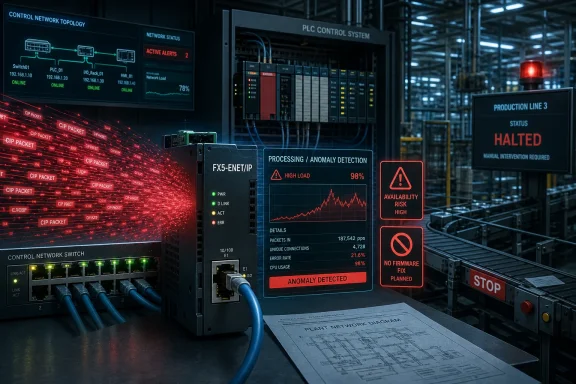
CVE-2026-8806 sits in the uncomfortable category of vulnerabilities that sound simple until they are mapped onto a production floor. According to the advisory, an unauthenticated remote attacker can cause a denial-of-service condition by sending a large number of communication packets to the Ethernet port in a short period of time. The packet burst increases the module’s processing load, prevents internal anomaly-detection processing from running as intended, and can cause the communication function to stop.
That is a remarkably direct chain of failure. The attacker does not need credentials. The attacker does not need a user to click anything. The attacker does not need physical access if the device is reachable over a network path. The CVSS 3.1 score of 7.5 and CVSS 4.0 score of 8.7 both land in “high” territory because the impact is concentrated on availability, the property industrial environments often value above almost everything else.
For WindowsForum readers used to thinking in terms of endpoint compromise, privilege escalation, and ransomware payloads, this advisory is a reminder that industrial cybersecurity plays by a different clock. A Windows workstation outage is disruptive; a PLC communications outage can halt a cell, interrupt a process, or force operators into a recovery state they would rather not enter during production hours. In operational technology, “just a DoS” is rarely just anything.
The affected product is the MELSEC iQ-F Series FX5-ENET/IP Ethernet Module, specifically FX5-ENET/IP, and the advisory describes all versions as affected. Mitsubishi Electric is headquartered in Japan, while CISA lists deployment as worldwide and the affected critical infrastructure sector as Critical Manufacturing. That combination matters: this is not a niche lab device in a narrow vertical, but a component from a major automation vendor in a product family likely to appear in real industrial networks.
That phrase changes the burden of defense. In the normal enterprise software world, administrators wait for a patch, test it, stage it, and deploy it. In industrial control systems, especially with embedded modules tied to long equipment lifecycles, the answer is often less satisfying. The vendor may document compensating controls rather than ship firmware that changes device behavior, certification assumptions, or support expectations.
That does not mean Mitsubishi is ignoring the risk. The advisory points customers to Mitsubishi’s own security bulletin and recommends mitigations including firewalls, VPNs, LAN-only operation, IP filtering, physical access restrictions, and anti-virus software on PCs that can access the device. Those are sensible controls, but they are environmental controls. They reduce exposure; they do not remove the underlying condition from the module.
This distinction is where IT and OT teams often talk past each other. A security team may ask, reasonably, when the patched firmware will arrive. A controls engineer may respond, also reasonably, that the production line was validated with this hardware, that downtime windows are scarce, and that changing communication behavior is not a casual maintenance task. The result is a world where “remediation” frequently means redesigning trust around a vulnerable asset rather than correcting the asset itself.
CISA’s republication also carries a disclaimer that it is converting and republishing Mitsubishi’s CSAF advisory for visibility. That is bureaucratic language, but it points to a broader shift in vulnerability management. Industrial advisories increasingly travel through machine-readable formats, government portals, vendor PDFs, and downstream security feeds. The information moves faster; the plant floor still moves at the speed of maintenance windows, procurement cycles, and risk acceptance meetings.
That description deserves more attention than it will probably get. The module appears to have some form of anomaly-detection logic, but the failure path involves starving or preventing that logic from running under load. This is an old security lesson in an industrial wrapper: defenses that cannot operate under stress may become part of the failure mode they are meant to prevent.
Network-level denial-of-service vulnerabilities are easy to dismiss because they lack the glamour of code execution. There is no shell, no implant, no stolen credential dump. Yet in an industrial environment, the attacker’s objective may simply be interruption. If the business impact is a stopped machine, delayed shipment, scrapped batch, or safety review, a packet flood can be operationally effective without ever becoming a Hollywood-grade intrusion.
The advisory does not say the vulnerability has been exploited in the wild, and it credits Mitsubishi Electric with discovering it. That matters because defenders should not inflate the report into evidence of an active campaign. But absence of known exploitation is not a reason to defer action. Reachability is the key variable, and reachability is often worse than asset owners believe.
Industrial networks are full of exceptions. A vendor support tunnel left in place after commissioning. A Windows engineering workstation with dual network access. A firewall rule opened for troubleshooting and never closed. A remote access path justified during the pandemic and normalized afterward. A vulnerability like this punishes messy network reality.
That trade was inevitable. Manufacturers want production data, predictive maintenance, quality analytics, remote support, and integration with enterprise systems. Engineers want standard cabling, standard switches, and familiar diagnostics. Vendors want modules that speak protocols widely used across automation ecosystems. The result is a plant floor that looks more like an enterprise network every year, while still carrying physical consequences enterprise IT does not usually own.
EtherNet/IP should not be confused with “Ethernet plus security.” It is an industrial protocol family built for control communications, not a magic boundary against hostile traffic. The security model of many industrial deployments still relies heavily on segmentation, trust zones, and controlled access paths. When those boundaries are weak, the protocol’s usefulness becomes the attacker’s route.
This is why CISA’s standing guidance reads like a greatest-hits album of industrial network defense: minimize exposure, keep control systems off the open internet, isolate control networks from business networks, and use secure remote access when remote access is unavoidable. These recommendations are repeated so often that they risk becoming wallpaper. CVE-2026-8806 is the reason they keep being repeated.
For Windows administrators, the practical takeaway is that the risk may not sit on the PLC module alone. It may sit on the Windows systems that can reach it. Engineering stations, HMI boxes, historian servers, remote support laptops, and jump hosts can all become the bridge between an attacker and an industrial Ethernet module. If those Windows endpoints are poorly segmented or overprivileged, the OT device’s network vulnerability becomes part of the Windows estate’s attack surface.
“All versions affected” simplifies one part of the triage and complicates another. There is no fine-grained firmware threshold to check. If the module is FX5-ENET/IP, the advisory applies. But that also means organizations cannot narrow the problem to laggards who failed to update. The installed base itself becomes the remediation population.
The absence of a planned fixed version also makes lifecycle planning harder. If a module is critical, exposed only to a tightly controlled LAN, and protected by filtering, the rational move may be to document compensating controls and monitor. If the module sits in a flatter network with broad host reachability, the risk decision becomes sharper. At some point, “no fix planned” becomes a procurement and architecture issue rather than a patching issue.
This is where security teams should resist the urge to treat the advisory as a simple ticket. “Apply vendor mitigation” is not an adequate closure note unless the network path has been verified, firewall rules have been inspected, IP filtering has been configured where practical, and remote access routes have been reviewed. The point is not to produce paperwork; it is to determine whether an unauthenticated packet burst can reach a device whose failure would matter.
The better organizations will use this advisory to validate their model of the plant network. They will ask which hosts can talk to the module, whether any routing path exists from business networks, whether remote vendors can reach the segment, whether monitoring would notice packet bursts, and whether operations has a recovery procedure for a stopped communication function. The weaker organizations will file the PDF and hope obscurity holds.
None of those recommendations is wrong. The problem is that each is only as strong as its implementation. A VPN does not make a vulnerable industrial device safe if every remote laptop connected through it can route freely into the control network. A firewall does not help if the rulebase is a decade of accumulated exceptions. Anti-virus on an engineering workstation is useful, but it will not stop a permitted packet flood from a compromised trusted host.
The IP filter recommendation is especially important because it moves part of the access decision closer to the device. In principle, allowing only known trusted hosts to communicate with the module can reduce the blast radius if some other part of the network is compromised. But IP filtering is not a substitute for segmentation. It is a last-mile constraint, not a network security strategy.
Physical access controls also deserve more respect than they often receive in IT-centric discussions. Industrial cabinets, switch closets, engineering laptops, maintenance ports, and temporary connections are all part of the threat surface. A plant network is not an abstract diagram; it is a physical system operated by people under time pressure. Security that ignores that reality tends to fail at the worst moments.
The strongest mitigation posture is layered. The module should not be internet-reachable. The control network should be isolated from the business network. Remote access should terminate through controlled jump infrastructure, not broad routing. Only necessary hosts should be able to communicate with the module. Monitoring should look for abnormal traffic bursts. Operators should know how to recover communication cleanly if the module stops functioning.
Engineering workstations are often Windows machines. HMIs are often Windows machines. Maintenance laptops, historians, reporting servers, programming tools, and remote support endpoints are frequently Windows machines. If those systems can reach the FX5-ENET/IP module, they are part of the control path. A compromised Windows host may not need to exploit a Windows vulnerability next; it may simply need to send traffic at an industrial device that cannot handle it.
That changes how defenders should read advisories like this. The question is not merely whether the Mitsubishi module is exposed to the internet. It is whether any compromised or unmanaged Windows system could become a launch point. Flat networks turn ordinary endpoint compromise into industrial disruption. Poorly governed remote support turns a vendor laptop into a possible route to the cell.
Microsoft’s own security ecosystem has pushed enterprises toward stronger identity controls, endpoint detection, attack surface reduction, and conditional access. Those controls matter, but they must be connected to OT reachability. An EDR alert on an engineering workstation is more urgent if that workstation can talk to control equipment. A local administrator password reused across maintenance laptops is more dangerous if those laptops sit in trusted OT zones.
The Windows lesson is not that every industrial vulnerability becomes a Microsoft problem. It is that Windows infrastructure often mediates access to industrial risk. If IT owns Active Directory, endpoint hardening, remote access, patching, and monitoring, then IT owns many of the paths an attacker would use before touching a PLC module. OT may own the process; IT often owns the bridge.
But “not on the internet” is not the same as “safe.” The modern plant is connected through enterprise networks, cloud reporting, remote vendors, managed service providers, cellular routers, VPN concentrators, and sometimes improvised temporary paths. Attackers rarely need a public IP address on the final target if they can compromise something upstream.
This matters for denial-of-service vulnerabilities because the source of malicious traffic may be internal. A compromised engineering workstation could flood the module. A misconfigured monitoring tool could produce abnormal traffic. A vendor remote session could be abused. A malware infection on a host with OT access could create disruption without understanding the process in any sophisticated way.
Segmentation therefore needs to be specific, not aspirational. The relevant question is not whether the plant network is “behind a firewall.” It is which source addresses can reach the module’s Ethernet port, which ports and protocols are allowed, whether the access is required for normal operations, and whether abnormal rates would be detected or blocked. Network diagrams must be tested against actual routes.
This is the hard, unglamorous work of OT security. It does not produce the neat closure of a patch deployment. It produces smaller blast radii, cleaner trust boundaries, and fewer surprises when an advisory lands. That is the difference between a vulnerability being a manageable risk and a production incident waiting for a trigger.
What the numbers cannot express is the value of the affected process. A communication outage in a test bench is annoying. The same outage in a production cell during a tight delivery window can be expensive. In regulated manufacturing, disruption can have documentation, quality, and validation consequences. In continuous operations, even short interruptions may cascade.
This is why industrial risk assessment must start with process context. Security teams need to know which equipment the module supports, what happens if communications stop, whether the failure state is safe, how operators detect the condition, and how long recovery takes. A high CVSS score is a prompt, not a complete risk decision.
The advisory’s Critical Manufacturing designation should focus minds. Manufacturing organizations have spent years digitizing operations, integrating supply chains, and increasing remote visibility. Those gains are real. They also create dependency on networks that may not have been designed for hostile traffic conditions. Availability vulnerabilities reveal how much operational confidence now rests on communications modules, switches, firewalls, and endpoints.
The security conversation should therefore move beyond “is there a patch?” to “can the process tolerate this failure mode?” If the answer is no, mitigation needs to be treated as operational resilience, not just vulnerability management.
That does not make Mitsubishi uniquely negligent. It makes Mitsubishi part of the broader industrial automation transition. Vendors are building products that must last for years, integrate with mixed environments, satisfy safety and reliability expectations, and remain supportable across a global installed base. Security fixes in that world are rarely as simple as shipping a monthly cumulative update.
Still, customers are entitled to expect clarity. “No fix planned” should be accompanied by precise mitigation guidance, clear affected-product identification, and enough technical detail for defenders to make informed decisions. Mitsubishi’s advisory does provide concrete recommendations, including IP filtering and LAN restriction. But the industry as a whole still needs better ways to communicate whether “no fix” means technically infeasible, commercially unsupported, risk-accepted by design, or deferred to future hardware.
CISA’s role as amplifier is useful but limited. Republication increases visibility, standardizes metadata, and helps vulnerability management systems ingest the advisory. It cannot segment a plant network. It cannot validate a firewall rule. It cannot tell a manufacturer whether a production line can tolerate a communications stop. That responsibility stays with asset owners.
The uncomfortable truth is that many industrial organizations now need the discipline of enterprise vulnerability management without the convenience of enterprise patching. They need inventories, exposure analysis, compensating controls, monitoring, and governance. They also need humility about systems that may be reachable in ways no diagram admits.
The work should include both IT and OT. IT can help with network discovery, firewall analysis, endpoint controls, VPN posture, and monitoring. OT can explain process impact, device function, allowable downtime, recovery procedures, and operational constraints. Neither side has the full picture alone.
There is also a communications task. Plant managers and operations leaders need to understand that “no fix planned” does not mean “nothing to do.” It means the fix lives in architecture, access control, and operating practice. Security teams need to avoid overstating the risk as if exploitation were confirmed or remote code execution were involved. Accurate urgency is more persuasive than alarmism.
 Mitsubishi’s Unpatched Module Turns Availability Into the Security Boundary
CVE-2026-8806 sits in the uncomfortable category of vulnerabilities that sound simple until they are mapped onto a production floor. According to the advisory, an unauthenticated remote attacker can cause a denial-of-service condition by sending a large number of communication packets to the Ethernet port in a short period of time. The packet burst increases the module’s processing load, prevents internal anomaly-detection processing from running as intended, and can cause the communication function to stop.That is a remarkably direct chain of failure. The attacker does not need credentials. The attacker does not need a user to click anything. The attacker does not need physical access if the device is reachable over a network path. The CVSS 3.1 score of 7.5 and CVSS 4.0 score of 8.7 both land in “high” territory because the impact is concentrated on availability, the property industrial environments often value above almost everything else.
For WindowsForum readers used to thinking in terms of endpoint compromise, privilege escalation, and ransomware payloads, this advisory is a reminder that industrial cybersecurity plays by a different clock. A Windows workstation outage is disruptive; a PLC communications outage can halt a cell, interrupt a process, or force operators into a recovery state they would rather not enter during production hours. In operational technology, “just a DoS” is rarely just anything.
The affected product is the MELSEC iQ-F Series FX5-ENET/IP Ethernet Module, specifically FX5-ENET/IP, and the advisory describes all versions as affected. Mitsubishi Electric is headquartered in Japan, while CISA lists deployment as worldwide and the affected critical infrastructure sector as Critical Manufacturing. That combination matters: this is not a niche lab device in a narrow vertical, but a component from a major automation vendor in a product family likely to appear in real industrial networks.
The Most Important Line Is “No Fix Planned”
The advisory’s most consequential sentence is not the CVSS vector or the vulnerability description. It is the remediation status: no fix planned.That phrase changes the burden of defense. In the normal enterprise software world, administrators wait for a patch, test it, stage it, and deploy it. In industrial control systems, especially with embedded modules tied to long equipment lifecycles, the answer is often less satisfying. The vendor may document compensating controls rather than ship firmware that changes device behavior, certification assumptions, or support expectations.
That does not mean Mitsubishi is ignoring the risk. The advisory points customers to Mitsubishi’s own security bulletin and recommends mitigations including firewalls, VPNs, LAN-only operation, IP filtering, physical access restrictions, and anti-virus software on PCs that can access the device. Those are sensible controls, but they are environmental controls. They reduce exposure; they do not remove the underlying condition from the module.
This distinction is where IT and OT teams often talk past each other. A security team may ask, reasonably, when the patched firmware will arrive. A controls engineer may respond, also reasonably, that the production line was validated with this hardware, that downtime windows are scarce, and that changing communication behavior is not a casual maintenance task. The result is a world where “remediation” frequently means redesigning trust around a vulnerable asset rather than correcting the asset itself.
CISA’s republication also carries a disclaimer that it is converting and republishing Mitsubishi’s CSAF advisory for visibility. That is bureaucratic language, but it points to a broader shift in vulnerability management. Industrial advisories increasingly travel through machine-readable formats, government portals, vendor PDFs, and downstream security feeds. The information moves faster; the plant floor still moves at the speed of maintenance windows, procurement cycles, and risk acceptance meetings.
Packet Floods Are Boring Until They Stop a Line
The technical core of CVE-2026-8806 is an expected behavior violation, mapped to CWE-440. In plain English, the device can be driven into behavior it should not exhibit when it receives too many packets too quickly. The flood raises the processing load enough that internal anomaly-detection processing is not performed, after which the communication function may stop.That description deserves more attention than it will probably get. The module appears to have some form of anomaly-detection logic, but the failure path involves starving or preventing that logic from running under load. This is an old security lesson in an industrial wrapper: defenses that cannot operate under stress may become part of the failure mode they are meant to prevent.
Network-level denial-of-service vulnerabilities are easy to dismiss because they lack the glamour of code execution. There is no shell, no implant, no stolen credential dump. Yet in an industrial environment, the attacker’s objective may simply be interruption. If the business impact is a stopped machine, delayed shipment, scrapped batch, or safety review, a packet flood can be operationally effective without ever becoming a Hollywood-grade intrusion.
The advisory does not say the vulnerability has been exploited in the wild, and it credits Mitsubishi Electric with discovering it. That matters because defenders should not inflate the report into evidence of an active campaign. But absence of known exploitation is not a reason to defer action. Reachability is the key variable, and reachability is often worse than asset owners believe.
Industrial networks are full of exceptions. A vendor support tunnel left in place after commissioning. A Windows engineering workstation with dual network access. A firewall rule opened for troubleshooting and never closed. A remote access path justified during the pandemic and normalized afterward. A vulnerability like this punishes messy network reality.
EtherNet/IP Made Factories More Connected and More Exposed
The FX5-ENET/IP module exists because modern automation depends on Ethernet. Industrial Ethernet helped move factories away from isolated islands of proprietary fieldbus communications and toward faster, more flexible, more observable systems. It also collapsed some of the distance between plant-floor devices and the broader IP networking world.That trade was inevitable. Manufacturers want production data, predictive maintenance, quality analytics, remote support, and integration with enterprise systems. Engineers want standard cabling, standard switches, and familiar diagnostics. Vendors want modules that speak protocols widely used across automation ecosystems. The result is a plant floor that looks more like an enterprise network every year, while still carrying physical consequences enterprise IT does not usually own.
EtherNet/IP should not be confused with “Ethernet plus security.” It is an industrial protocol family built for control communications, not a magic boundary against hostile traffic. The security model of many industrial deployments still relies heavily on segmentation, trust zones, and controlled access paths. When those boundaries are weak, the protocol’s usefulness becomes the attacker’s route.
This is why CISA’s standing guidance reads like a greatest-hits album of industrial network defense: minimize exposure, keep control systems off the open internet, isolate control networks from business networks, and use secure remote access when remote access is unavoidable. These recommendations are repeated so often that they risk becoming wallpaper. CVE-2026-8806 is the reason they keep being repeated.
For Windows administrators, the practical takeaway is that the risk may not sit on the PLC module alone. It may sit on the Windows systems that can reach it. Engineering stations, HMI boxes, historian servers, remote support laptops, and jump hosts can all become the bridge between an attacker and an industrial Ethernet module. If those Windows endpoints are poorly segmented or overprivileged, the OT device’s network vulnerability becomes part of the Windows estate’s attack surface.
The Advisory Is Also a Test of Asset Reality
Every industrial security advisory asks a basic question before it asks anything else: do you know whether you own the affected thing? For mature organizations, the answer should come from an asset inventory that maps vendor, product, firmware, network zone, process owner, and business criticality. For many organizations, the answer still begins with emails, spreadsheets, tribal knowledge, and someone walking the floor.“All versions affected” simplifies one part of the triage and complicates another. There is no fine-grained firmware threshold to check. If the module is FX5-ENET/IP, the advisory applies. But that also means organizations cannot narrow the problem to laggards who failed to update. The installed base itself becomes the remediation population.
The absence of a planned fixed version also makes lifecycle planning harder. If a module is critical, exposed only to a tightly controlled LAN, and protected by filtering, the rational move may be to document compensating controls and monitor. If the module sits in a flatter network with broad host reachability, the risk decision becomes sharper. At some point, “no fix planned” becomes a procurement and architecture issue rather than a patching issue.
This is where security teams should resist the urge to treat the advisory as a simple ticket. “Apply vendor mitigation” is not an adequate closure note unless the network path has been verified, firewall rules have been inspected, IP filtering has been configured where practical, and remote access routes have been reviewed. The point is not to produce paperwork; it is to determine whether an unauthenticated packet burst can reach a device whose failure would matter.
The better organizations will use this advisory to validate their model of the plant network. They will ask which hosts can talk to the module, whether any routing path exists from business networks, whether remote vendors can reach the segment, whether monitoring would notice packet bursts, and whether operations has a recovery procedure for a stopped communication function. The weaker organizations will file the PDF and hope obscurity holds.
Mitigation Is Architecture, Not Checkbox Compliance
Mitsubishi’s recommended mitigations are conventional because the vulnerability is fundamentally about exposure. Use firewalls or VPNs when internet access is required. Keep the product within a LAN. Block untrusted networks and hosts. Use the module’s IP filter function. Restrict physical access to the product and connected PCs or network devices. Install anti-virus software on PCs that can access the affected product.None of those recommendations is wrong. The problem is that each is only as strong as its implementation. A VPN does not make a vulnerable industrial device safe if every remote laptop connected through it can route freely into the control network. A firewall does not help if the rulebase is a decade of accumulated exceptions. Anti-virus on an engineering workstation is useful, but it will not stop a permitted packet flood from a compromised trusted host.
The IP filter recommendation is especially important because it moves part of the access decision closer to the device. In principle, allowing only known trusted hosts to communicate with the module can reduce the blast radius if some other part of the network is compromised. But IP filtering is not a substitute for segmentation. It is a last-mile constraint, not a network security strategy.
Physical access controls also deserve more respect than they often receive in IT-centric discussions. Industrial cabinets, switch closets, engineering laptops, maintenance ports, and temporary connections are all part of the threat surface. A plant network is not an abstract diagram; it is a physical system operated by people under time pressure. Security that ignores that reality tends to fail at the worst moments.
The strongest mitigation posture is layered. The module should not be internet-reachable. The control network should be isolated from the business network. Remote access should terminate through controlled jump infrastructure, not broad routing. Only necessary hosts should be able to communicate with the module. Monitoring should look for abnormal traffic bursts. Operators should know how to recover communication cleanly if the module stops functioning.
Windows Still Owns a Large Piece of This Risk
It may seem odd for a Windows-focused community to dwell on a Mitsubishi Electric industrial Ethernet module. It should not. Windows remains deeply embedded in the operational ecosystem around PLCs and industrial networks, even when the vulnerable device itself is not running Windows.Engineering workstations are often Windows machines. HMIs are often Windows machines. Maintenance laptops, historians, reporting servers, programming tools, and remote support endpoints are frequently Windows machines. If those systems can reach the FX5-ENET/IP module, they are part of the control path. A compromised Windows host may not need to exploit a Windows vulnerability next; it may simply need to send traffic at an industrial device that cannot handle it.
That changes how defenders should read advisories like this. The question is not merely whether the Mitsubishi module is exposed to the internet. It is whether any compromised or unmanaged Windows system could become a launch point. Flat networks turn ordinary endpoint compromise into industrial disruption. Poorly governed remote support turns a vendor laptop into a possible route to the cell.
Microsoft’s own security ecosystem has pushed enterprises toward stronger identity controls, endpoint detection, attack surface reduction, and conditional access. Those controls matter, but they must be connected to OT reachability. An EDR alert on an engineering workstation is more urgent if that workstation can talk to control equipment. A local administrator password reused across maintenance laptops is more dangerous if those laptops sit in trusted OT zones.
The Windows lesson is not that every industrial vulnerability becomes a Microsoft problem. It is that Windows infrastructure often mediates access to industrial risk. If IT owns Active Directory, endpoint hardening, remote access, patching, and monitoring, then IT owns many of the paths an attacker would use before touching a PLC module. OT may own the process; IT often owns the bridge.
“No Internet Exposure” Is Necessary and Not Nearly Enough
CISA’s standard control-systems advice starts with minimizing internet exposure, and it is still the right first move. Industrial control devices should not be directly reachable from the public internet unless there is an extraordinary and well-defended reason. In 2026, that should be table stakes.But “not on the internet” is not the same as “safe.” The modern plant is connected through enterprise networks, cloud reporting, remote vendors, managed service providers, cellular routers, VPN concentrators, and sometimes improvised temporary paths. Attackers rarely need a public IP address on the final target if they can compromise something upstream.
This matters for denial-of-service vulnerabilities because the source of malicious traffic may be internal. A compromised engineering workstation could flood the module. A misconfigured monitoring tool could produce abnormal traffic. A vendor remote session could be abused. A malware infection on a host with OT access could create disruption without understanding the process in any sophisticated way.
Segmentation therefore needs to be specific, not aspirational. The relevant question is not whether the plant network is “behind a firewall.” It is which source addresses can reach the module’s Ethernet port, which ports and protocols are allowed, whether the access is required for normal operations, and whether abnormal rates would be detected or blocked. Network diagrams must be tested against actual routes.
This is the hard, unglamorous work of OT security. It does not produce the neat closure of a patch deployment. It produces smaller blast radii, cleaner trust boundaries, and fewer surprises when an advisory lands. That is the difference between a vulnerability being a manageable risk and a production incident waiting for a trigger.
CVSS Gets the Severity Right but Not the Business Impact
The CVSS 3.1 vector for CVE-2026-8806 is straightforward: network attack vector, low attack complexity, no privileges required, no user interaction, unchanged scope, no confidentiality impact, no integrity impact, and high availability impact. CVSS 4.0 similarly emphasizes high impact to vulnerable-system availability. The numbers do their job.What the numbers cannot express is the value of the affected process. A communication outage in a test bench is annoying. The same outage in a production cell during a tight delivery window can be expensive. In regulated manufacturing, disruption can have documentation, quality, and validation consequences. In continuous operations, even short interruptions may cascade.
This is why industrial risk assessment must start with process context. Security teams need to know which equipment the module supports, what happens if communications stop, whether the failure state is safe, how operators detect the condition, and how long recovery takes. A high CVSS score is a prompt, not a complete risk decision.
The advisory’s Critical Manufacturing designation should focus minds. Manufacturing organizations have spent years digitizing operations, integrating supply chains, and increasing remote visibility. Those gains are real. They also create dependency on networks that may not have been designed for hostile traffic conditions. Availability vulnerabilities reveal how much operational confidence now rests on communications modules, switches, firewalls, and endpoints.
The security conversation should therefore move beyond “is there a patch?” to “can the process tolerate this failure mode?” If the answer is no, mitigation needs to be treated as operational resilience, not just vulnerability management.
The Pattern Is Bigger Than One Mitsubishi Advisory
CVE-2026-8806 is not arriving in isolation. Mitsubishi’s MELSEC iQ-F line has seen other denial-of-service advisories in 2026 involving Ethernet functions and related modules. Some have had version-specific remediation paths; this one, as described in the CISA republication, does not. The pattern is familiar across industrial vendors: connectivity expands faster than the security assumptions around legacy-style device behavior can be retired.That does not make Mitsubishi uniquely negligent. It makes Mitsubishi part of the broader industrial automation transition. Vendors are building products that must last for years, integrate with mixed environments, satisfy safety and reliability expectations, and remain supportable across a global installed base. Security fixes in that world are rarely as simple as shipping a monthly cumulative update.
Still, customers are entitled to expect clarity. “No fix planned” should be accompanied by precise mitigation guidance, clear affected-product identification, and enough technical detail for defenders to make informed decisions. Mitsubishi’s advisory does provide concrete recommendations, including IP filtering and LAN restriction. But the industry as a whole still needs better ways to communicate whether “no fix” means technically infeasible, commercially unsupported, risk-accepted by design, or deferred to future hardware.
CISA’s role as amplifier is useful but limited. Republication increases visibility, standardizes metadata, and helps vulnerability management systems ingest the advisory. It cannot segment a plant network. It cannot validate a firewall rule. It cannot tell a manufacturer whether a production line can tolerate a communications stop. That responsibility stays with asset owners.
The uncomfortable truth is that many industrial organizations now need the discipline of enterprise vulnerability management without the convenience of enterprise patching. They need inventories, exposure analysis, compensating controls, monitoring, and governance. They also need humility about systems that may be reachable in ways no diagram admits.
The FX5-ENET/IP Warning Should Change Tomorrow’s Maintenance Meeting
This advisory should not send teams into panic, but it should change the agenda. The most useful response is a targeted exposure review, not a vague memo about industrial cybersecurity. Organizations using the affected module should identify every instance, map network reachability, validate remote access paths, and decide whether the current architecture can withstand an unauthenticated denial-of-service attempt.The work should include both IT and OT. IT can help with network discovery, firewall analysis, endpoint controls, VPN posture, and monitoring. OT can explain process impact, device function, allowable downtime, recovery procedures, and operational constraints. Neither side has the full picture alone.
There is also a communications task. Plant managers and operations leaders need to understand that “no fix planned” does not mean “nothing to do.” It means the fix lives in architecture, access control, and operating practice. Security teams need to avoid overstating the risk as if exploitation were confirmed or remote code execution were involved. Accurate urgency is more persuasive than alarmism.
The Lesson Mitsubishi Did Not Patch Into Firmware
The concrete response to CVE-2026-8806 is narrow, but the lesson is broader: industrial devices that cannot be patched out of a failure mode must be protected by design around that failure mode. For affected environments, the priority is to reduce who can send traffic to the module, reduce where that traffic can originate, and improve confidence that abnormal communication patterns will be noticed quickly.- Organizations should treat every FX5-ENET/IP module as affected unless they have authoritative evidence that it is not the Mitsubishi Electric MELSEC iQ-F Series module covered by the advisory.
- Network teams should verify, not assume, that the module is unreachable from the internet, business networks, guest networks, vendor networks, and unmanaged maintenance devices.
- OT teams should use the module’s IP filter function where practical, but should treat it as one layer in a segmented design rather than the primary security boundary.
- Windows engineering workstations and HMIs that can reach the module should receive special scrutiny because endpoint compromise can become a path to industrial denial of service.
- Incident response plans should include the operational steps for recognizing and recovering from a stopped communication function, not merely the cybersecurity steps for investigating suspicious traffic.
- Procurement and lifecycle planning should account for the fact that this advisory currently has no planned firmware fix, making compensating controls the long-term control strategy.
References
- Primary source: CISA
Published: 2026-06-18T12:00:00+00:00
- Related coverage: 1898advisories.burnsmcd.com

Mitsubishi Electric: High-Severity Denial-of-Service Vulnerability in MELSEC iQ-F Series FX5-EIP EtherNet/IP Module
Mitsubishi Electric Corporation has disclosed a high-severity vulnerability affecting the MELSEC iQ-F Series FX5-EIP EtherNet/IP Module, tracked as CVE-2026-1875, with a CVSS v4.0 score of 8.7.
1898advisories.burnsmcd.com
- Related coverage: mitsubishielectric.com
FX5-ENET/IP Download(Manual) Network related products Programmable Controllers MELSEC Search by specification|Mitsubishi Electric F.A.
You can see Mitsubishi Electric Factory Automation Productswww.mitsubishielectric.com - Related coverage: app.opencve.io
Melsec Iq-f Fx5-enet\/ip CVEs and Security Vulnerabilities - OpenCVE
Explore the latest vulnerabilities and security issues of Melsec Iq-f Fx5-enet\/ip in the CVE databaseapp.opencve.io