
On June 18, 2026, CISA warned Fortinet customers worldwide to harden internet-facing FortiGate firewalls and SSL VPN gateways after reports that attackers used compromised credentials tied to roughly 74,000 devices across government and private-sector networks. The alert is not framed as a new zero-day panic, and that is precisely why it matters. FortiBleed is the kind of incident that exposes the uncomfortable middle ground between patch management, identity hygiene, and edge-device administration. For Windows-heavy shops, it is another reminder that the firewall is not just a perimeter appliance; it is often the front door to Active Directory.
The most important detail in CISA’s warning is not the number of devices, alarming as it is. It is the mechanism. The agency says malicious actors are targeting internet-accessible Fortinet devices using compromised credentials, which moves this incident away from the familiar rhythm of “patch the CVE and move on.”
That does not make it less serious. In many environments, a FortiGate appliance or SSL VPN gateway sits at the boundary between the public internet and the internal Windows estate. If attackers can authenticate to that device with valid credentials, defenders may not see the kind of exploit signature they have been trained to hunt.
This is the grim elegance of credential-driven compromise. A successful login is, at least initially, supposed to look successful. The attacker does not need to smash the window if the key still works.
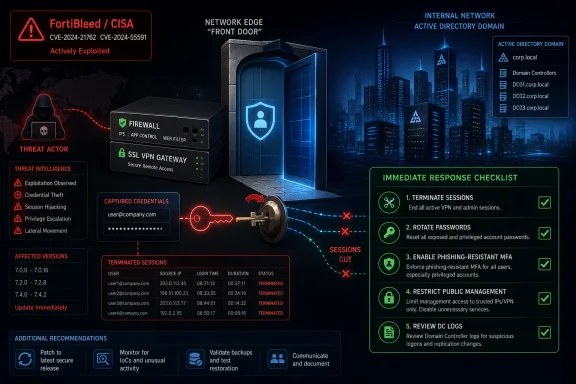
CISA’s advice reflects that reality. Terminating sessions, resetting VPN and administrative passwords, reviewing logs, enforcing phishing-resistant MFA, and removing management interfaces from the public internet are not cosmetic steps. They are the response plan for an incident in which the identity layer may already be contaminated.
Firewalls, VPN concentrators, secure web gateways, and management portals are no longer merely hardened boxes that sit between the internet and the network. They are identity brokers, traffic observers, configuration stores, and privileged administration surfaces. A compromise there can yield credentials, topology, routing details, domain relationships, and clues about where to move next.
That is why CISA’s warning includes domain controller logs alongside firewall, VPN, and authentication logs. The agency is implicitly telling administrators not to think of this as a Fortinet-only cleanup job. If an attacker authenticated to the VPN or administrative interface, the next question is what they touched after that.
The lesson for Windows administrators is especially sharp. Remote access appliances often bridge contractors, help desks, privileged administrators, and internal domain resources. If those paths are protected by passwords that were leaked, reused, weakly stored, or never rotated after prior exposure, the perimeter becomes a credential replay platform.
CISA’s alert points to compromised credentials rather than a fresh unknown Fortinet flaw. That distinction matters, but it should not be used to minimize the incident. A credential campaign can be messier than a vulnerability campaign because the remediation depends on knowing which identities were exposed, where else those identities work, and whether attackers established persistence before defenders began rotating passwords.
This is where some organizations will make the wrong call. They will check firmware, confirm they are not exposed to a specific recent Fortinet bug, and assume the risk is contained. That approach misses the heart of the alert.
The device may be fully patched and still unsafe if valid credentials are circulating. The VPN gateway may be running a supported release and still function as an attacker’s authenticated entry point. The administrative interface may have no exploitable flaw and still be dangerous if it is reachable from the public internet.
That matters because configuration data is valuable. If an attacker obtains device configuration files that contain password hashes, the strength of the hashing scheme affects how useful those hashes are after exfiltration. PBKDF2 is designed to make password guessing more computationally expensive than simple fast hashing schemes.
But this is not a magic eraser. Fortinet’s own guidance indicates that upgraded systems may still retain older hashes until administrator accounts successfully authenticate and are converted. In practical terms, an appliance can be upgraded into a safer world while still carrying artifacts from the older one.
That is why CISA’s wording is so operationally specific. It is not enough to be “on a fixed version” if dormant administrator accounts, stale password hashes, or legacy credential material remain in the configuration. Administrators need to confirm the actual credential-storage state, not just the firmware banner.
Killing sessions means interrupting remote users, administrators, vendors, and automated workflows. It may break a maintenance window, strand a traveling executive, or trigger a wave of help desk tickets. In normal operations, those are reasons to slow down.
In a credential exposure event, they are reasons to move faster. If an attacker is already authenticated, a password reset alone may not evict them from an existing session. Session termination forces every connection to prove itself again under the new credential regime.
That is a principle Windows administrators already understand from domain compromise response. Resetting a password is not enough if tokens, tickets, sessions, or cached credentials remain usable. The perimeter appliance has its own version of that problem, and FortiBleed pushes it into view.
The exception might be a break-glass administrator account, a legacy VPN profile, a contractor group, an API-adjacent workflow, a local admin on the firewall, or a management interface reachable from a trusted IP range that is not as trustworthy as everyone assumes. Attackers do not need the main policy to be weak if the forgotten side door is weaker.
Phishing-resistant MFA raises the bar because it reduces reliance on one-time codes and push approvals that can be tricked, proxied, or socially engineered. But the phrase can become a compliance ornament if it is not enforced everywhere remote access and administrative control actually happen.
For Fortinet customers, the hard question is not “Do we have MFA?” It is “Can any internet-facing Fortinet administrative or VPN path still be accessed with only a password?” If the answer is yes, the FortiBleed alert should be treated as a direct warning.
The same logic applies to VPN portals, but management interfaces are particularly sensitive. A VPN login may give access to internal resources, depending on policy. A firewall administrative login can give access to the rules, routes, logs, VPN settings, local users, certificates, and sometimes the means to create new paths into the environment.
Restricting management access to trusted internal networks, dedicated admin VPNs, jump hosts, or out-of-band management paths is not a best-practice flourish. It is the difference between being scanned by the whole internet and being reachable only through a smaller, monitored control plane.
There is a temptation to treat IP allowlisting as enough. It helps, but it should not be mistaken for identity security. Trusted source networks can be compromised, cloud-hosted infrastructure can shift, and remote administration patterns tend to sprawl unless someone actively prunes them.
The moment an attacker gets remote access, they can begin testing domain credentials, enumerating reachable services, probing file shares, accessing web apps, and looking for administrative paths. If the exposed Fortinet credentials overlap with Active Directory accounts, privileged domain users, service accounts, or reused local administrator passwords, the boundary between appliance compromise and Windows compromise collapses.
CISA’s recommendation to review domain controller logs is not incidental. Domain controllers will show authentication attempts, unusual account behavior, lateral movement indicators, and signs that a VPN login was merely the first step. Security teams should correlate Fortinet VPN events with Windows logon events, especially for privileged accounts and unusual source geographies.
The practical move is to build a timeline. Which accounts authenticated to Fortinet devices? When did they connect? What internal systems did those accounts touch afterward? Did domain controllers see failed logons, new service tickets, remote management activity, or privileged group changes around the same period?
If an administrator used the same password for a FortiGate local admin account and a domain account, the appliance reset does not solve the enterprise problem. If a contractor VPN account shares a password with a SaaS account, the exposure may extend beyond the network edge. If a local firewall admin password has been copied across multiple sites, one compromised appliance may imply many.
This is why credential incident response is often more painful than patch response. Password rotation has to be scoped by identity reuse, privilege, and access path rather than by product boundary. A narrow reset is easier to communicate, but it can leave the real blast radius untouched.
Organizations should also be careful with service accounts. Remote access environments often accumulate integration users, monitoring accounts, RADIUS bindings, LDAP connectors, and automation credentials. These accounts are easy to omit from a human-focused password reset campaign and attractive to attackers precisely because they are stable.
VPN logs may roll quickly. Firewall administrative logs may not be exported centrally. Domain controller logs may exist but lack the context needed to tie a logon to a specific VPN session. SIEM ingestion may capture the event but not the configuration diff that matters most.
That gap is not unique to Fortinet environments. Edge appliances are often monitored for availability and bandwidth before they are monitored as identity-critical security systems. FortiBleed argues for the opposite priority.
Configuration changes deserve special attention. Attackers with administrative access may create new users, alter VPN policies, weaken logging, add routes, modify firewall rules, export certificates, or change authentication settings. A clean password reset after those changes may still leave behind a network that has been subtly rearranged.
Both arguments contain some truth, and neither helps an administrator on Thursday night. Edge-device security lives in a shared-responsibility zone that is less tidy than cloud marketing diagrams. Vendors build defaults, storage mechanisms, upgrade paths, authentication features, logging capabilities, and management surfaces. Customers decide exposure, credential practices, MFA enforcement, firmware cadence, account lifecycle, and monitoring.
The uncomfortable point is that attackers do not care whose responsibility chart looks better. They care whether a working username and password gets them into a firewall, a VPN, or a management console. If it does, the compromise is real regardless of where the blame lands.
That is why CISA’s alert is framed around immediate defensive actions rather than root-cause certainty. The agency does not need to settle every attribution question before telling organizations to kill sessions, rotate credentials, harden hashing, inspect logs, enforce MFA, and close public management.
The modern perimeter is not a clean line around the office. It is a set of authentication portals, device trust decisions, conditional access rules, admin consoles, and routing policies. Fortinet appliances often sit directly in that mesh.
This makes credential hygiene a perimeter control. A password reused from an earlier breach is not merely an identity risk; it is a network exposure. A missing MFA requirement is not merely an access-management flaw; it is a potential firewall compromise. A public management interface is not merely an operations shortcut; it is an internet-facing attack surface waiting for the next credential dump.
Zero trust does not abolish this problem. It reframes it. Every access path must be continuously verified, narrowly scoped, and monitored as if credentials will eventually leak. FortiBleed is an argument for that model, delivered the hard way.
That creates a concentration risk. A provider may administer many Fortinet appliances across many tenants. If credentials are reused, stored poorly, shared among technicians, or exposed through a compromised workstation, the damage can jump organizational boundaries.
Even without cross-customer credential reuse, MSP workflows often favor convenience: publicly reachable management, broad administrator accounts, emergency access users, and remote tooling exceptions. Those practices may have seemed manageable when the threat model was occasional manual intrusion. They look very different under mass credential validation at internet scale.
Customers should ask providers direct questions. Are Fortinet management interfaces exposed? Are administrative accounts unique per customer and per technician? Is phishing-resistant MFA enforced for every administrative path? Are logs exported to a system the customer can review? Are local break-glass accounts rotated and monitored?
Session termination and password resets are emergency response. PBKDF2 verification is configuration hygiene. Log review is incident investigation. MFA enforcement is identity control. Management-interface lockdown is attack-surface reduction. Each solves a different part of the problem, and none substitutes for the others.
The danger is that organizations will execute only the most visible step. They will reset passwords, send a closure email, and leave public administration reachable. Or they will disable public management and leave old hashes in configuration. Or they will enable MFA for normal users while exempting the very administrative accounts attackers want most.
Good security programs do not treat CISA alerts as isolated tickets. They translate them into control checks that can be measured again next month. The FortiBleed checklist should become a recurring audit of edge identity, not a frantic one-off.
 FortiBleed Turns the Edge Into an Identity Problem
The most important detail in CISA’s warning is not the number of devices, alarming as it is. It is the mechanism. The agency says malicious actors are targeting internet-accessible Fortinet devices using compromised credentials, which moves this incident away from the familiar rhythm of “patch the CVE and move on.”That does not make it less serious. In many environments, a FortiGate appliance or SSL VPN gateway sits at the boundary between the public internet and the internal Windows estate. If attackers can authenticate to that device with valid credentials, defenders may not see the kind of exploit signature they have been trained to hunt.
This is the grim elegance of credential-driven compromise. A successful login is, at least initially, supposed to look successful. The attacker does not need to smash the window if the key still works.
CISA’s advice reflects that reality. Terminating sessions, resetting VPN and administrative passwords, reviewing logs, enforcing phishing-resistant MFA, and removing management interfaces from the public internet are not cosmetic steps. They are the response plan for an incident in which the identity layer may already be contaminated.
The Number Is Big, but the Pattern Is Bigger
The reported exposure of credentials associated with about 74,000 Fortinet devices is large enough to command attention on its own. But the more durable story is the pattern: attackers are increasingly treating edge appliances as both targets and collection points.Firewalls, VPN concentrators, secure web gateways, and management portals are no longer merely hardened boxes that sit between the internet and the network. They are identity brokers, traffic observers, configuration stores, and privileged administration surfaces. A compromise there can yield credentials, topology, routing details, domain relationships, and clues about where to move next.
That is why CISA’s warning includes domain controller logs alongside firewall, VPN, and authentication logs. The agency is implicitly telling administrators not to think of this as a Fortinet-only cleanup job. If an attacker authenticated to the VPN or administrative interface, the next question is what they touched after that.
The lesson for Windows administrators is especially sharp. Remote access appliances often bridge contractors, help desks, privileged administrators, and internal domain resources. If those paths are protected by passwords that were leaked, reused, weakly stored, or never rotated after prior exposure, the perimeter becomes a credential replay platform.
This Is Not the Comforting Kind of Vulnerability Story
Security teams like vulnerability stories because they have a clean operational grammar. There is a CVE, a version number, a patch, a deadline, a scanner result, and eventually a dashboard cell that turns green. FortiBleed does not fit that grammar neatly.CISA’s alert points to compromised credentials rather than a fresh unknown Fortinet flaw. That distinction matters, but it should not be used to minimize the incident. A credential campaign can be messier than a vulnerability campaign because the remediation depends on knowing which identities were exposed, where else those identities work, and whether attackers established persistence before defenders began rotating passwords.
This is where some organizations will make the wrong call. They will check firmware, confirm they are not exposed to a specific recent Fortinet bug, and assume the risk is contained. That approach misses the heart of the alert.
The device may be fully patched and still unsafe if valid credentials are circulating. The VPN gateway may be running a supported release and still function as an attacker’s authenticated entry point. The administrative interface may have no exploitable flaw and still be dangerous if it is reachable from the public internet.
PBKDF2 Is a Clue About Old Decisions Coming Due
CISA’s reference to Fortinet guidance on PBKDF2 may sound like a low-level implementation detail, but it is one of the most revealing parts of the advisory. Fortinet has moved administrator password storage in newer FortiOS releases toward PBKDF2, replacing weaker legacy hashing behavior for administrator credentials in supported branches.That matters because configuration data is valuable. If an attacker obtains device configuration files that contain password hashes, the strength of the hashing scheme affects how useful those hashes are after exfiltration. PBKDF2 is designed to make password guessing more computationally expensive than simple fast hashing schemes.
But this is not a magic eraser. Fortinet’s own guidance indicates that upgraded systems may still retain older hashes until administrator accounts successfully authenticate and are converted. In practical terms, an appliance can be upgraded into a safer world while still carrying artifacts from the older one.
That is why CISA’s wording is so operationally specific. It is not enough to be “on a fixed version” if dormant administrator accounts, stale password hashes, or legacy credential material remain in the configuration. Administrators need to confirm the actual credential-storage state, not just the firmware banner.
Session Termination Is the Move Many Teams Delay
The first emergency step in CISA’s list is also the one that disrupts users most visibly: terminate active SSL VPN and administrative sessions. That instruction is easy to understand and hard to execute in a politically sensitive enterprise environment.Killing sessions means interrupting remote users, administrators, vendors, and automated workflows. It may break a maintenance window, strand a traveling executive, or trigger a wave of help desk tickets. In normal operations, those are reasons to slow down.
In a credential exposure event, they are reasons to move faster. If an attacker is already authenticated, a password reset alone may not evict them from an existing session. Session termination forces every connection to prove itself again under the new credential regime.
That is a principle Windows administrators already understand from domain compromise response. Resetting a password is not enough if tokens, tickets, sessions, or cached credentials remain usable. The perimeter appliance has its own version of that problem, and FortiBleed pushes it into view.
MFA Only Helps When It Is Actually on the Door Being Used
CISA’s call for phishing-resistant MFA is another important tell. Many organizations can truthfully say they use MFA for remote access while still leaving exceptions wide enough for attackers to walk through.The exception might be a break-glass administrator account, a legacy VPN profile, a contractor group, an API-adjacent workflow, a local admin on the firewall, or a management interface reachable from a trusted IP range that is not as trustworthy as everyone assumes. Attackers do not need the main policy to be weak if the forgotten side door is weaker.
Phishing-resistant MFA raises the bar because it reduces reliance on one-time codes and push approvals that can be tricked, proxied, or socially engineered. But the phrase can become a compliance ornament if it is not enforced everywhere remote access and administrative control actually happen.
For Fortinet customers, the hard question is not “Do we have MFA?” It is “Can any internet-facing Fortinet administrative or VPN path still be accessed with only a password?” If the answer is yes, the FortiBleed alert should be treated as a direct warning.
Public Management Interfaces Are a Self-Inflicted Wound
CISA’s guidance to make firewall administration inaccessible from the public internet is the kind of advice that has been repeated for years because organizations keep needing to hear it. Internet-exposed management is convenient, especially for lean IT teams, managed service providers, and distributed enterprises. It is also an invitation to turn every credential leak into a live administrative access attempt.The same logic applies to VPN portals, but management interfaces are particularly sensitive. A VPN login may give access to internal resources, depending on policy. A firewall administrative login can give access to the rules, routes, logs, VPN settings, local users, certificates, and sometimes the means to create new paths into the environment.
Restricting management access to trusted internal networks, dedicated admin VPNs, jump hosts, or out-of-band management paths is not a best-practice flourish. It is the difference between being scanned by the whole internet and being reachable only through a smaller, monitored control plane.
There is a temptation to treat IP allowlisting as enough. It helps, but it should not be mistaken for identity security. Trusted source networks can be compromised, cloud-hosted infrastructure can shift, and remote administration patterns tend to sprawl unless someone actively prunes them.
Windows Shops Should Read “Fortinet” as “Domain Risk”
The WindowsForum audience should resist the urge to file this as a network-team story. In a Microsoft-centric enterprise, VPN and firewall compromise often becomes a Windows identity story within minutes.The moment an attacker gets remote access, they can begin testing domain credentials, enumerating reachable services, probing file shares, accessing web apps, and looking for administrative paths. If the exposed Fortinet credentials overlap with Active Directory accounts, privileged domain users, service accounts, or reused local administrator passwords, the boundary between appliance compromise and Windows compromise collapses.
CISA’s recommendation to review domain controller logs is not incidental. Domain controllers will show authentication attempts, unusual account behavior, lateral movement indicators, and signs that a VPN login was merely the first step. Security teams should correlate Fortinet VPN events with Windows logon events, especially for privileged accounts and unusual source geographies.
The practical move is to build a timeline. Which accounts authenticated to Fortinet devices? When did they connect? What internal systems did those accounts touch afterward? Did domain controllers see failed logons, new service tickets, remote management activity, or privileged group changes around the same period?
Password Resets Must Be Broader Than the Appliance
CISA specifically urges impacted organizations to reset Fortinet VPN and administrative passwords, especially on internet-facing systems. That is the minimum. The more difficult judgment is whether those passwords were reused elsewhere or belonged to identities with broader reach.If an administrator used the same password for a FortiGate local admin account and a domain account, the appliance reset does not solve the enterprise problem. If a contractor VPN account shares a password with a SaaS account, the exposure may extend beyond the network edge. If a local firewall admin password has been copied across multiple sites, one compromised appliance may imply many.
This is why credential incident response is often more painful than patch response. Password rotation has to be scoped by identity reuse, privilege, and access path rather than by product boundary. A narrow reset is easier to communicate, but it can leave the real blast radius untouched.
Organizations should also be careful with service accounts. Remote access environments often accumulate integration users, monitoring accounts, RADIUS bindings, LDAP connectors, and automation credentials. These accounts are easy to omit from a human-focused password reset campaign and attractive to attackers precisely because they are stable.
Logs Will Tell the Story, If They Still Exist
CISA’s logging advice is straightforward: review firewall, VPN, authentication, and domain controller logs for lateral movement, unusual access, suspicious accounts, and unauthorized configuration changes. The challenge is that many organizations do not retain enough edge-device telemetry to reconstruct what happened.VPN logs may roll quickly. Firewall administrative logs may not be exported centrally. Domain controller logs may exist but lack the context needed to tie a logon to a specific VPN session. SIEM ingestion may capture the event but not the configuration diff that matters most.
That gap is not unique to Fortinet environments. Edge appliances are often monitored for availability and bandwidth before they are monitored as identity-critical security systems. FortiBleed argues for the opposite priority.
Configuration changes deserve special attention. Attackers with administrative access may create new users, alter VPN policies, weaken logging, add routes, modify firewall rules, export certificates, or change authentication settings. A clean password reset after those changes may still leave behind a network that has been subtly rearranged.
The Vendor Boundary Does Not Match the Defender’s Problem
There will be a predictable debate over fault. If FortiBleed relies on compromised credentials rather than a new Fortinet vulnerability, some will argue that this is primarily a customer hygiene failure. Others will point to Fortinet’s history as a high-value target and ask whether edge vendors should design more aggressively against predictable customer mistakes.Both arguments contain some truth, and neither helps an administrator on Thursday night. Edge-device security lives in a shared-responsibility zone that is less tidy than cloud marketing diagrams. Vendors build defaults, storage mechanisms, upgrade paths, authentication features, logging capabilities, and management surfaces. Customers decide exposure, credential practices, MFA enforcement, firmware cadence, account lifecycle, and monitoring.
The uncomfortable point is that attackers do not care whose responsibility chart looks better. They care whether a working username and password gets them into a firewall, a VPN, or a management console. If it does, the compromise is real regardless of where the blame lands.
That is why CISA’s alert is framed around immediate defensive actions rather than root-cause certainty. The agency does not need to settle every attribution question before telling organizations to kill sessions, rotate credentials, harden hashing, inspect logs, enforce MFA, and close public management.
The Old Perimeter Is Gone, but the New One Still Has Passwords
For years, security vendors have declared the perimeter dead. In one sense, they were right: SaaS, remote work, cloud infrastructure, mobile devices, and zero-trust architectures have dissolved the neat castle-and-moat model. Yet incidents like FortiBleed show that a perimeter of sorts remains, and it is often concentrated in VPN gateways and firewalls.The modern perimeter is not a clean line around the office. It is a set of authentication portals, device trust decisions, conditional access rules, admin consoles, and routing policies. Fortinet appliances often sit directly in that mesh.
This makes credential hygiene a perimeter control. A password reused from an earlier breach is not merely an identity risk; it is a network exposure. A missing MFA requirement is not merely an access-management flaw; it is a potential firewall compromise. A public management interface is not merely an operations shortcut; it is an internet-facing attack surface waiting for the next credential dump.
Zero trust does not abolish this problem. It reframes it. Every access path must be continuously verified, narrowly scoped, and monitored as if credentials will eventually leak. FortiBleed is an argument for that model, delivered the hard way.
The MSP Angle Deserves More Attention
Managed service providers and outsourced IT teams should be especially uneasy about this alert. Fortinet devices are common in small and midsize business environments, branch offices, distributed organizations, and customer networks where external administrators need remote access.That creates a concentration risk. A provider may administer many Fortinet appliances across many tenants. If credentials are reused, stored poorly, shared among technicians, or exposed through a compromised workstation, the damage can jump organizational boundaries.
Even without cross-customer credential reuse, MSP workflows often favor convenience: publicly reachable management, broad administrator accounts, emergency access users, and remote tooling exceptions. Those practices may have seemed manageable when the threat model was occasional manual intrusion. They look very different under mass credential validation at internet scale.
Customers should ask providers direct questions. Are Fortinet management interfaces exposed? Are administrative accounts unique per customer and per technician? Is phishing-resistant MFA enforced for every administrative path? Are logs exported to a system the customer can review? Are local break-glass accounts rotated and monitored?
Hardening Is Not a One-Time Cleanup
CISA’s recommendations are immediate, but their real value is as a durable operating model. The hardening work should not end when the FortiBleed news cycle moves on.Session termination and password resets are emergency response. PBKDF2 verification is configuration hygiene. Log review is incident investigation. MFA enforcement is identity control. Management-interface lockdown is attack-surface reduction. Each solves a different part of the problem, and none substitutes for the others.
The danger is that organizations will execute only the most visible step. They will reset passwords, send a closure email, and leave public administration reachable. Or they will disable public management and leave old hashes in configuration. Or they will enable MFA for normal users while exempting the very administrative accounts attackers want most.
Good security programs do not treat CISA alerts as isolated tickets. They translate them into control checks that can be measured again next month. The FortiBleed checklist should become a recurring audit of edge identity, not a frantic one-off.
The FortiGate Checklist That Should Survive the News Cycle
The practical response to FortiBleed is short enough to state plainly, but serious enough that it should be tracked as an incident-response workstream rather than a routine maintenance note. CISA’s guidance points toward a layered cleanup: evict possible intruders, invalidate exposed secrets, strengthen credential storage, hunt for misuse, and reduce future exposure.- Organizations should terminate active SSL VPN and administrative sessions before assuming password resets have removed authenticated attackers.
- Fortinet VPN and administrative passwords should be reset broadly, with special attention to reused credentials, privileged users, service accounts, and internet-facing systems.
- Administrators should verify that supported FortiOS versions are using PBKDF2 for administrator credential storage and should remove weaker legacy hashes according to Fortinet’s guidance.
- Security teams should correlate Fortinet logs with Windows authentication and domain controller events to look for suspicious access, lateral movement, new accounts, and unauthorized configuration changes.
- Phishing-resistant MFA should be enforced on every remote access and administrative path, not merely on the most common user-facing VPN profile.
- Firewall management interfaces should be removed from the public internet and restricted to trusted administrative networks, jump hosts, or tightly controlled internal access paths.
References
- Primary source: CISA
Published: 2026-06-18T12:00:00+00:00
- Related coverage: community.fortinet.com
Technical Tip: Enforcing PBKDF2 as hash function for administrator accounts in FortiOS v7.2.11 and later | Community
Description This article describes how to ensure PBKDF2 is used to hash administrator passwords after upgrading FortiOS. Scope FortiGate v7.2, v7...community.fortinet.com
- Related coverage: techcrunch.com
Cybercriminals allegedly hacked tens of thousands of Fortinet firewalls used by major companies all over the world | TechCrunch
An alleged Russian-speaking group of cybercriminals is reportedly compromising and targeting several major companies that use Fortinet Firewalls and VPNs through previously known passwords.techcrunch.com - Related coverage: docs.fortinet.com
- Related coverage: fortinetweb.s3.amazonaws.com
- Related coverage: docs2.fortinet.com

FortiGate / FortiOS 7.2
docs2.fortinet.com



- Related coverage: darkreading.com
Sweeping Credential Heist Compromises 30K+ Fortinet Devices
Attackers are targeting various sectors across nearly 200 countries and have compiled working credentials for tends of thousands of devices.www.darkreading.com - Related coverage: techradar.com
Fortinet patches FortiGate Firewall vulnerabilities that allowed hackers to steal enterprise credentials | TechRadar
Three bugs were recently fixedwww.techradar.com - Related coverage: aha.org
- Related coverage: fortinet.com
