

Fortinet has confirmed a new, actively exploited authentication‑bypass flaw—tracked as CVE‑2026‑24858—that allows an attacker who controls a FortiCloud account and a registered device to gain administrative access to other Fortinet devices where FortiCloud single sign‑on (SSO) is enabled. This is not a theoretical risk: vendor telemetry shows in‑the‑wild abuse, Fortinet temporarily disabled FortiCloud SSO as an emergency control, and U.S. federal authorities have added the CVE to the Known Exploited Vulnerabilities (KEV) Catalog, forcing immediate remediation for affected federal systems.
Fortinet’s Product Security Incident Response Team (PSIRT) published advisory FG‑IR‑26‑060 describing an Authentication Bypass Using an Alternate Path or Channel (CWE‑288) in the FortiCloud SSO flow that impacts multiple product families when SSO is enabled on devices. The vulnerability affects FortiOS, FortiManager, FortiAnalyzer, FortiProxy and certain FortiWeb builds; Fortinet observed exploitation originating from FortiCloud accounts and took cloud‑side actions to contain the threat.
Key operational timeline (vendor/authoritative dates you should treat as facts):
Remaining risks are real and immediate:
Act now—this is the kind of vulnerability that turns appliance access into broad network compromise if left unaddressed.
Source: CISA Fortinet Releases Guidance to Address Ongoing Exploitation of Authentication Bypass Vulnerability CVE-2026-24858 | CISA
 Background / Overview
Fortinet’s Product Security Incident Response Team (PSIRT) published advisory FG‑IR‑26‑060 describing an Authentication Bypass Using an Alternate Path or Channel (CWE‑288) in the FortiCloud SSO flow that impacts multiple product families when SSO is enabled on devices. The vulnerability affects FortiOS, FortiManager, FortiAnalyzer, FortiProxy and certain FortiWeb builds; Fortinet observed exploitation originating from FortiCloud accounts and took cloud‑side actions to contain the threat. Key operational timeline (vendor/authoritative dates you should treat as facts):
- Fortinet observed malicious FortiCloud accounts and locked them out on January 22, 2026.
- Fortinet disabled FortiCloud SSO on the cloud side as an emergency mitigation on January 26, 2026, then re‑enabled the service with stricter checks on January 27, 2026.
- CISA added CVE‑2026‑24858 to its KEV Catalog on January 27, 2026, elevating remediation urgency for federal agencies.
Why this vulnerability is dangerous
The attack model — cross‑account SSO abuse
At a high level, the flaw breaks the isolation assumption between FortiCloud accounts and registered devices: a FortiCloud session tied to one account (and device) could be accepted by a different device that had FortiCloud SSO enabled. The result is a low‑complexity, remote administrative takeover without the target’s credentials. That alternate‑path authentication bypass is precisely why CWE‑288 is a critical classification.Amplified impact on management planes and MSP environments
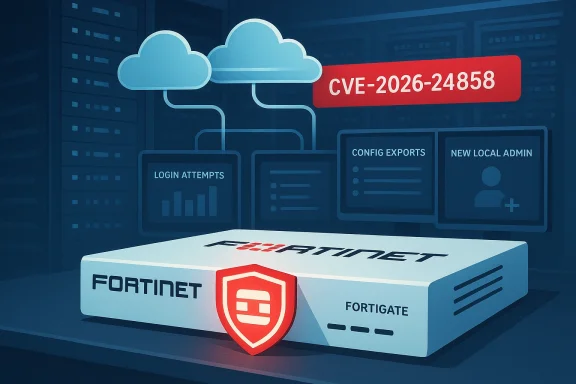
Network security appliances are high‑value targets. Administrative control yields immediate opportunities to:- Export device configurations (often containing VPN credentials, pre‑shared keys, and certificates).
- Create persistent local administrator accounts and backdoors.
- Alter VPN and access policies to allow lateral movement or long‑term persistence.
Fortinet observed exactly these behaviors during the incidents tied to CVE‑2026‑24858—unauthorized config exports, rogue account creation, and VPN changes—underscoring the real‑world consequences.
Not just a missing patch — architectural trust erosion
This isn’t only a bug to fix and forget. The root cause is an architectural trust decision: a remote cloud SSO channel was implicitly trusted across account boundaries in some product builds. Even after technical fixes, organizations must reconsider default enablement of remote SSO, device registration practices, and the governance controls around cloud management features.Affected products and version guidance
Fortinet’s advisory and public vulnerability databases list the affected product branches and build ranges. Representative impacted families include (confirm exact build numbers for your environment against Fortinet’s PSIRT table before acting):- FortiOS: vulnerable in many 7.0, 7.2, 7.4, and 7.6 builds; vendors pointed upgrade targets to fixed builds (examples: 7.6.6+, 7.4.11+, 7.2.13+, 7.0.19+ depending on branch).
- FortiManager and FortiAnalyzer: analogous vulnerable ranges across 7.0/7.2/7.4/7.6 branches; fixed builds are provided per branch.
- FortiProxy: multiple 7.x branches affected and need branch‑specific updates.
- FortiWeb and FortiSwitch Manager: under investigation or listed with specific affected builds in vendor notices; treat them as potentially impacted until you confirm.
Immediate action checklist — what to do in the next 6–48 hours
If you operate Fortinet appliances, treat CVE‑2026‑24858 as an active incident until you can validate otherwise. Follow this prioritized checklist immediately:- Inventory and triage
- Enumerate all Fortinet devices (FortiGate/FortiOS, FortiManager, FortiAnalyzer, FortiProxy, FortiWeb, FortiSwitch Manager).
- Record exact firmware/OS build strings and whether FortiCloud SSO is enabled on each device.
- Contain and harden
- If you cannot immediately patch, disable FortiCloud SSO on devices where it is enabled (the client‑side toggle is an available workaround). Also restrict management interfaces (HTTP/HTTPS/SSH) to trusted IPs/VPNs and block management plane access from the public internet.
- Patch urgently
- Apply Fortinet‑published fixed builds for your product branch as soon as they are available and tested for your environment. Confirm successful upgrade and validate that SSO behavior is corrected only after reaching a non‑vulnerable build.
- Hunt for compromise
- Search logs for the IoC usernames and IP addresses Fortinet published, sudden configuration exports, and newly created local administrator accounts with names like audit, backup, itadmin, secadmin, support, deploy, remoteadmin, svcadmin, or system. If any of those are present, escalate to incident response.
- Rotate secrets
- If compromise is suspected or confirmed, rotate any credentials, VPN PSKs, API tokens, certificates, and shared keys that may have been exposed in configuration backups or logs. Assume exported configs are sensitive.
- Document and report
- For U.S. federal agencies: follow Binding Operational Directive (BOD) 22‑01 timelines as the CISA KEV listing assigns remediation dates; report incidents if required. For private organizations, document remediation steps and consider notifying affected partners/customers.
Detection and hunting guidance — concrete checks
To detect exploitation or remnants of an attack, focus on management and SSO artifacts:- Admin login events: correlate FortiCloud SSO login events with subsequent actions like config export or account creation. Flag SSO logins from unexpected FortiCloud usernames or unfamiliar IP addresses.
- Configuration exports/backups: attackers often export configurations first to harvest secrets. Monitor for unexpected export/backup activity.
- New local admin accounts: alert on creation of new administrative users and compare against change management records. Pay attention to generic names intended to blend in.
- Logging/telemetry changes: attackers commonly alter logging endpoints or disable telemetry to hide tracks—monitor NTP, syslog, and remote management changes.
- Outbound connections: watch for management appliances making outbound connections to unknown destinations shortly after SSO events.
For Managed Service Providers (MSPs) and multi‑tenant operators
MSPs must act immediately and transparently:- Inventory customer devices registered to your FortiCloud accounts and confirm device SSO state and build versions.
- If any customer devices are on vulnerable builds, either upgrade them promptly or disable FortiCloud SSO until patched. Consider scheduling emergency maintenance windows and communicating timelines and compensating controls to customers.
- Reevaluate onboarding: require explicit admin confirmation to opt into cloud SSO, enforce device attestation, and use allowlists or per‑device MFA before enabling remote administrative features. These governance changes reduce future risk from cross‑account trust failures.
Why patching alone may not be enough — the incident response perspective
Applying vendor patches removes the immediate technical vulnerability, but patching does not guarantee an appliance was not already abused. Incident response teams should assume potential historic compromise until evidence shows otherwise and should:- Perform forensic integrity checks on device binaries and configurations.
- Review change histories for out‑of‑band modifications prior to patch application.
- Reissue credentials, certificates, and VPN shared secrets as a precaution where compromise is suspected.
Broader lessons and longer‑term mitigations
This incident exposes recurring problems in appliance ecosystems. Use this event to make systemic improvements:- Harden management planes by default: require explicit opt‑in for cloud SSO features and prevent implicit enablement during registration flows.
- Enforce least privilege for device registration: apply MFA, device attestation, or per‑device allowlists before enabling remote admin capabilities.
- Improve telemetry: centralize logging for admin actions, config exports, and account creations, and keep logs long enough for retrospective hunts.
- Treat KEV additions as emergency events: update vulnerability management procedures to triage KEV catalog entries to “emergency” with assigned owners and tracked closure evidence. Federal BOD 22‑01 processes are a helpful template.
- Build recovery playbooks: ensure you can isolate, reprovision, rekey, and reestablish secure management connectivity to a device quickly if compromise is confirmed.
What we can verify and what remains uncertain
Verified, cross‑referenced facts:- Fortinet published PSIRT advisory FG‑IR‑26‑060 describing FortiCloud SSO authentication bypass and provided affected version ranges and mitigation guidance.
- Fortinet observed malicious FortiCloud accounts, disabled SSO on Jan 26, 2026, and re‑enabled it on Jan 27, 2026 with additional checks; CISA added CVE‑2026‑24858 to the KEV Catalog on Jan 27, 2026.
- Public trackers and news outlets corroborate active exploitation and rapid scanning/activity tied to SSO abuse, and they report automated attack patterns resulting in config exfiltration and rogue account creation.
- Some third‑party reports have suggested wider product impact or differing fixed build numbers in early coverage. Those shorthand lists are useful for triage but must be validated against Fortinet’s definitive PSIRT version matrix for your specific hardware/VM images. If you see conflicting version guidance, default to Fortinet’s advisory and NVD entries as authoritative.
- Reports of widespread, fully automated mass compromise across all Fortinet deployments are plausible given PoCs and scanning activity—but organizational exposure will vary. Confirm compromise claims against your telemetry before concluding your environment was impacted.
Practical remediation playbook (recommended sequence)
- Within 1–6 hours: inventory and identify high‑risk internet‑facing management devices, and if you cannot patch immediately, disable FortiCloud SSO and restrict management interfaces.
- Within 24–48 hours: apply vendor‑recommended fixed builds to prioritized appliances (internet‑facing first), validate post‑patch behavior, and initiate hunting for IoCs.
- Within 7–14 days: complete patch rollouts across all affected devices, rotate secrets and certificates where exposure is suspected, and conduct forensic checks for devices that show suspicious activity.
- 30–90 days: harden onboarding and cloud‑SSO governance, centralize telemetry for management events, and run tabletop incident simulations to validate your detection and recovery playbooks.
Final assessment — strengths, risks, and the call to action
Fortinet’s response demonstrates clear strengths: rapid disclosure, cloud‑side containment (temporary SSO disablement), published IoCs, and published fixed builds for affected branches. Those actions materially reduced attacker opportunity and supplied defenders with actionable steps.Remaining risks are real and immediate:
- Mixed inventories and constrained maintenance windows mean many organizations will remain exposed for operational reasons.
- Attackers have demonstrated automation patterns (SSO login → config export → account creation) that can quickly compromise unpatched systems; public PoCs will accelerate scanning and opportunistic exploitation.
- The underlying trust model for cloud SSO requires governance fixes beyond technical patches; organizations must change defaults and onboarding workflows to reduce future risk.
Act now—this is the kind of vulnerability that turns appliance access into broad network compromise if left unaddressed.
Source: CISA Fortinet Releases Guidance to Address Ongoing Exploitation of Authentication Bypass Vulnerability CVE-2026-24858 | CISA
