

Microsoft has cataloged CVE-2026-21527 as a Microsoft Exchange Server spoofing vulnerability in its Security Update Guide, but the public technical detail remains limited — a situation that demands urgent, pragmatic remediation while cautioning defenders against speculative technical conclusions. (msrc.microsoft.com)
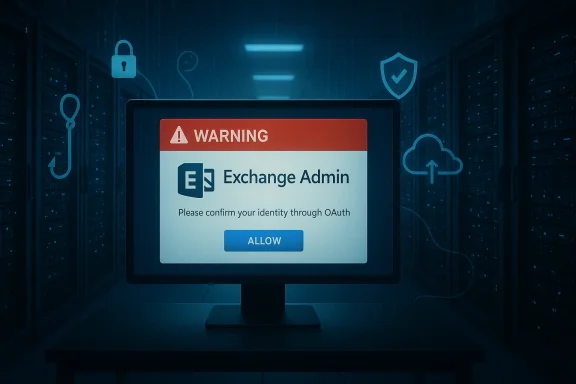
Microsoft Exchange Server remains a high-value target for attackers because it is a central choke point for enterprise email, identity flows, and hybrid cloud trust. A spoofing classification for an Exchange bug typically indicates a presentation-layer or input-validation issue that can mislead users, management consoles, or automation into trusting attacker-controlled content. That deception can be weaponized to harvest credentials, capture OAuth tokens, or induce administrative approvals that enable follow‑on compromise.
Vendor acknowledgement of a CVE ID in the Microsoft Security Response Center (MSRC) is the canonical signal that an issue exists and should drive patch planning. However, Microsoft’s Update Guide often publishes terse entries first, leaving the disclosure confidence at an identifier-only stage until KB mappings, technical notes, or independent research surface. This disclosure model reduces the immediate risk of widespread weaponization but shifts the operational burden to defenders: confirm KB → SKU mappings, roll out patches quickly, and deploy compensating controls while technical details remain scarce. (msrc.microsoft.com)
Source: MSRC Security Update Guide - Microsoft Security Response Center
 Background / Overview
Microsoft Exchange Server remains a high-value target for attackers because it is a central choke point for enterprise email, identity flows, and hybrid cloud trust. A spoofing classification for an Exchange bug typically indicates a presentation-layer or input-validation issue that can mislead users, management consoles, or automation into trusting attacker-controlled content. That deception can be weaponized to harvest credentials, capture OAuth tokens, or induce administrative approvals that enable follow‑on compromise.Vendor acknowledgement of a CVE ID in the Microsoft Security Response Center (MSRC) is the canonical signal that an issue exists and should drive patch planning. However, Microsoft’s Update Guide often publishes terse entries first, leaving the disclosure confidence at an identifier-only stage until KB mappings, technical notes, or independent research surface. This disclosure model reduces the immediate risk of widespread weaponization but shifts the operational burden to defenders: confirm KB → SKU mappings, roll out patches quickly, and deploy compensating controls while technical details remain scarce. (msrc.microsoft.com)
What we know (and what we don’t)
Vendor confirmation — the single most important fact
- Microsoft has registered CVE-2026-21527 in the MSRC Update Guide. That entry is the authoritative confirmation that Microsoft is tracking and addressing the issue. Treat the Update Guide entry as the starting point for remediation mapping. (msrc.microsoft.com)
Public technical detail — limited or absent
- As of this writing, no vendor-published technical write-up, patch diff, or Microsoft KB article with in-depth exploit mechanics is broadly available in the public record. Independent, high‑quality write‑ups or reproducible proof‑of‑concepts (PoCs) have not been widely circulated. Where third‑party posts claim exploit mechanics, those claims should be treated as provisional until corroborated by Microsoft or by multiple independent researchers.
Likely impact class — presentation‑layer deception
- The MSRC label “spoofing” strongly suggests the vulnerability affects displayed information, header processing, or UI provenance rather than causing direct remote code execution. Presentation‑layer faults are often lower in technical complexity but can be high-leverage because they exploit human trust and automated approval workflows. Expect primary impacts to be integrity-related (misleading or forged displays) with downstream risks including credential or token theft.
Attacker model — realistic and low-bar
- Public feeds for recent Exchange spoofing CVEs commonly show a network attack vector with low complexity and no privileges required, meaning any attacker who can reach an exposed Exchange endpoint (mail intake, Autodiscover, OWA, EWS) could attempt exploitation. Even if the initial exploit does not yield code execution, practical attacks rely on social engineering or automated flows to convert spoofed content into credential capture or illicit approval.
Why “spoofing” in Exchange matters operationally
Spoofing is more than cosmetic: it weakens the signal operators and automated systems rely on to make security decisions. The real-world consequences include:- Credential harvests via counterfeit sign-in prompts or email content that looks internal.
- Illicit administrative approvals when an operator is tricked into granting consent, enabling connectors, or approving OAuth access on the mistaken belief the action originates from a trusted system.
- Hybrid escalation where on‑premise Exchange misbehavior causes cloud trust flows (hybrid service principals, connectors) to accept attacker-controlled states, enabling lateral movement into Exchange Online. Past hybrid‑trust incidents demonstrate how on‑prem vulnerabilities can cascade into tenant compromise.
Confidence metric: assessing how sure we should be
The disclosure lifecycle typically advances through three stages:- Identifier-only (low public detail): Vendor lists CVE and short description — existence confirmed; exploit mechanics unknown. Responders must act on plausible impact models rather than exact technical reproduction.
- Independent corroboration (medium): One or more research teams publish technical write‑ups or PoCs consistent with the vendor description. This raises confidence in exploit mechanics and detection signatures.
- Vendor-validated KB mapping and technical notes (high): Microsoft publishes KBs tied to specific cumulative updates (CUs), often accompanied by remediation guidance and, sometimes, technical analysis.
Operational runbook — prioritized, verifiable steps
The following runbook is actionable and conservative; apply it immediately.1. Confirm affected SKUs and KB mappings (T=Now)
- Open Microsoft’s Security Update Guide entry for CVE-2026-21527 and extract the per‑SKU KB identifiers. This mapping is authoritative for deciding which packages to deploy. Do not rely exclusively on third‑party CVE aggregators for KB mapping — they can lag or mis-map KBs across Exchange servicing branches. ([msrc.microsoft.com](Security Update Guide - Microsoft Security Response Center# 2. Inventory and exposure triage (within 24 hours)
- Identify every Exchange server and document:
- Exact product and Cumulative Update (CU) level.
- Roles exposed to the internet (OWA, ECP, EWS, Autodiscover, edge transports).
- Hybrid status (is the server part of an Exchange hybrid estate?).
- Prioritize internet-facing and hybrid-connected servers for immediate patching or temporary mitigations.
3. Patch in controlled pilot rings (24–72 hours)
- Pilot a smtive servers, including management tooling hosts.
- Validate mail flow, hybrid synchronization, and administrative workflows.
- Roll out to production once pilot results are acceptable; accelerate for internet-facing nodes.
4. Compensating controls if patching is delayed
- Restrict public exposure of Exchange admin endpoints (put management behind a WAF, reverse proxy, or IP allow‑lists).
- Disable or restrict server‑side automatic content rendering (thumbnailing/preview) where feasible.
- Enforce MFA for all administrative accounts and require dedicated administrative workstations.
- Rotate hybrid app credentials and adopt tenant‑scoped hybrid app guidance if operating a hybrid environment — this reduces the risk that on‑prem abuse elevates to cloud compromise.
5. Detection and hunting (parallel)
- Increase logging on:
- Unexpected connector or OAuth consent grants.
- Administrative actions from unusual I.
- Discrepancies between UI-reported state and backend audit logs (e.g., a purported consent visible in a UI but absent in Azure AD audit logs).
- Hunt for indicators that often accompany spoofing-driven pivots: phishing mails referencing recent admin prompts, web shell artifacts under web‑served directories, and unusual token exchange activity.
Technical hypotheses — plausible root causes to guide defenders
Because Microsoft’s public text is brief, defenders should use historically grounded hypotheses to prioritize controls and hunting.Plausible technical classes
- Origin/provenance confusion: Code that renders UI (sign-in, consent, admin confirmations) may accept attacker-controlled content without validating origin, enabling a prompt that appears to be issued by a trusted service.
- Insufficient header or input validation: Exchange components that parse RFC‑5322 fields or other metadata may incorrectly use untrusted fields for display, allowing forged From headers to appear as internal addresses.
- Connector/relay trust misconfiguration: Improperly configured connectors or third‑party relays can allow external messages to be treated as internal, amplifying spoofing potential when combined with header parsing issues.
Detection patterns to implement now
- Alert on sudden increases in OAuth token issuance or refresh activity involving Exchange service principals.
- Flag administrative approvals that osiness hours or from unfamiliar IPs.
- Monitor for unexpected creation or modification of connectors and inbound mail routing rules.
- Scan Exchange web directories (ASPX layouts, TEMPLATE\LAYOUTS) for new or altered script artifacts that could indicate web shells or post‑exploit persistence.
Why rapid patching matters — historical context
Recent Exchange vulnerabilities have shown rapid exploitation and wide impact when attackers find reliable primitives. High‑profile incidents in 2021–2025 demonstrated that unpatched Exchange servers can be leveraged for web shells, credential theft, and large-scale compromise. In several cases, national authorities issued emergency directives to force rapid mitigation because the business impact and extensibility into cloud tenants were severe. Those precedents justify treating a confirmed Exchange CVE as high operational priority even when the initial vendor text is short.Risk analysis — strengths and potential pitfalls of the current posture
Strengths (defender side)
- Vendor acknowledgement equals actionability: MSRC listing allows patch orchestration s; this is the main operational lever defenders need. (msrc.microsoft.com)
- Disclosure model reduces ization: Microsoft’s tendency to withhold low‑level exploit details until patches exist lowers the short‑term PoC leak risk.
Fragilities and blind spots
- Human factor remains the main attack surface: Presentation‑layer vulnerabilities exploit trust. Technical detection systems focusing on memory‑safety issues may miss social engineering-based pivots. Training and policy hardening are essential complements to technical patches.
- KB mapping and SKU nuance: Large estates risk misdeployed patches when relying on third‑party CVE feeds rather than MSRC’s per‑SKU mapping. Always confirm KBs directly.
- Hybrid complexity: If your environment is hybrid, misconfigured or shared service principals dramatically increase blast radius; hybrid-specific hardening guidance must be followed.
Practical gm hardening
Spoofing succeeds because humans and workflows accept single‑channel approvals. The long‑term strategy should reduce the attack surface that presentation-layer deception exploits.- Replace ephemeral UI prompts for high‑risk actions with auditable, multi‑party approval workflows.
- Enforce least privilege for connectors, service principals, and automation accounts.
- Use dedicated admin workstations and just‑in‑time (JIT) elevation for administrators to limit credential exposure.
- Centralize audit logs and require cross-checks betwhoritative backends (Azure AD, Exchange admin audit logs).
- Automate SKU-level inventory and KB verification so you can rapidly determine which machines need which patches when MSRC entries appear.
Communicating to executive and operations teams
When briefing leadership, use plain language and concrete actions:- “Microsoft has assigned CVE‑2026‑21527 to Exchange Server and is tracking a spoofing issue; we should treat internet‑facing and hybrid servers as high priority for patching and compensating controls.” (msrc.microsoft.com)
- “We do not yet have a reproducible public PoC; however, historical experience shows that presentation‑layer vulnerabilities enable rapid social‑engineering pivots, so we will act now rather than wait.”
- Provide a 72‑hour action plan: inventory → KB confirmation → pilot patch → restricted exposure for critical endpoints → heightened monitoring.
When public technical details appear — how to respond
If a credible teC appears in the public domain:- Validate the source: prefer vendor KB diffs, major research organizations, or well‑known independent researchers.
- Reassess patches: confirm installed KBs and verify whether automated updates applied correctly.
- Update detection: translate confirmed exploit artifacts into SIEM detection rules.
- Hunt retrospectively: look for signs of prior exploitation (web shells, suspicious OAuth grants, anomalous administrative approvals).
- Share findings: with your industry ISAC or with national CERTs if the findings indicate active exploitation to facilitate collectich corroboration exists, avoid creating brittle detection rules based on unverified third‑party claims — they can cause signanalyst time.
Final assessment and recommended next steps
CVE‑2026‑21527 is a vendor‑acknowlge Server spoofing vulnerability whose public technical detail is currently limited. That places it at the identifier-only confidence stage: the issue is real, entry is the authoritative signal, but exact exploitation mechanics and PoCs are not yet widely available. Treat the CVE as operationally urgent:- Immediately confirm the MSRC KB → SKU mapping and schedule pilots. (msrc.microsoft.com)
- Prioritize internet-facing and hybrid-connected Exchange servers for patching or mitigations.
- Implement compensating controls (WAFs, IP allow‑lists, MFA, DAWs) and harden approval paths for administracrease logging and hunt for suspicious OAuth/connector activity and UI/backend state mismatches.
- Remain cautious about unverified PoCs and treat third‑party technical claims as provisional until corroborated by Microsoft or multiple reputable researchers.
Source: MSRC Security Update Guide - Microsoft Security Response Center
