

Microsoft has assigned CVE-2026-21529 to a spoofing vulnerability affecting Azure HDInsight, but the public record so far is limited to a vendor acknowledgement and a terse Update Guide entry — leaving defenders to treat the issue as real, urgent, and incompletely documented while they prioritize inventory, patch mapping, and compensating controls. rview
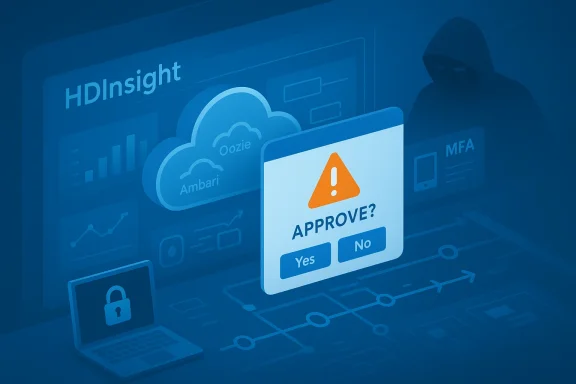
Azure HDInsight is Microsoft’s managed Hadoop and big-data platform in Azure, hosting well-known components such as Apache Hadoop, Apache Spark, Apache Ambari, and Apache Oozie across customer clusters. These management and orchestration components run both control-plane logic and web-facing management consoles; they are therefore high-value targets when a vulnerability allows impersonation of UI elements, service endpoints, or administrative flows.
A spoofing vulnerability is not a memory-safety bug — it targets trust and provenance. Rather than crashing a process, a spoof is powerful because it lets an attacker make a malicious action appear legitimate, tricking humans or automated workflows into granting credentials, approvals, or configuration changes. Microsoft’s Security Response Guide (MSRC) entries sometimes expose only the CVE identifier and a short description; the company also publishes a confidence metric that signals how certain the vendor is about the vulnerability’s existence and how complete the technical disclosure is. That metric matters for triage: a high-confidence entry with mapped KBs means immediate patching; a low-confidence/identifier-only entry means the vulnerability exists but key exploit mechanics or scope may still be under investigation.
Treat this advisory as a high-priority operational item for HDInsight administrators: the exploit model for spoofing iers who already have a foothold or social engineering vector, and the consequences can include token theft, unauthorized approvals, and downstream data exfiltration. Apply the mitigation checklist above, maintain elevated monitoring, and verify patch installation and behavior after any update is applied.
If you need a concise action summary to bring into an incident call:
Acknowledgement: This article synthesizes Microsoft’s Update Guide acknowledgement of CVE-2026-21529 with community and defensive analysis of spoofing-cla HDInsight and related management stacks; where vendor technical details are absent, reasonable defensive models and historical patterns are used to guide mitigation. ([cybermaterial.com](https://cybermaterial.com/azure-hdinsight-security-risks/?utm_source=o
Source: MSRC Security Update Guide - Microsoft Security Response Center
Azure HDInsight is Microsoft’s managed Hadoop and big-data platform in Azure, hosting well-known components such as Apache Hadoop, Apache Spark, Apache Ambari, and Apache Oozie across customer clusters. These management and orchestration components run both control-plane logic and web-facing management consoles; they are therefore high-value targets when a vulnerability allows impersonation of UI elements, service endpoints, or administrative flows.
A spoofing vulnerability is not a memory-safety bug — it targets trust and provenance. Rather than crashing a process, a spoof is powerful because it lets an attacker make a malicious action appear legitimate, tricking humans or automated workflows into granting credentials, approvals, or configuration changes. Microsoft’s Security Response Guide (MSRC) entries sometimes expose only the CVE identifier and a short description; the company also publishes a confidence metric that signals how certain the vendor is about the vulnerability’s existence and how complete the technical disclosure is. That metric matters for triage: a high-confidence entry with mapped KBs means immediate patching; a low-confidence/identifier-only entry means the vulnerability exists but key exploit mechanics or scope may still be under investigation.
 What we kn2Microsoft has recorded CVE-2026-21529 in its Update Guide and mapped it to Azure HDInsight as a spoofing class vulnerability. The presence of the CVE in MSRC’s Update Guide is vendor acknowledgement: the issue exists and is being tracked by Microsoft.
- Public technical detail is currently sparse. The Update Gui and does not include a full technical write‑up, line-level root cause, or a public proof-of-concept at the time of this writing. That brevity is a pattern Microsoft sometimes follows when initial disclosure is limited while patches and remediation mapping are prepared.
- Historically, Azure HDInsight components such as Ambari, Oozie, and ors have been the subject of spoofing and presentation-layer findings — a pattern repeated across several HDInsight advisories over the past years. Independent advisories and community trackers have repeatedly highlighted spoofing-style weaknesses in the HDInsight stack, which is consistent with the class assigned to CVE-2026-21529.
Why a spoofing CVE in HDInsight matters (operational impact)
Spoofing vulnerabilities are deceptively consequential in cloud-managed data platforms because they attack the human and automation trust surfaces that unlock broader power.- Human factor leverage: Cluster operators, platform engineers, and helpdesk staff routinely respond to management dialogs, consent prompts, or OAuth approval flows. A convincing spoof of any such prompt can yield privileged tokens or credentials instantly.
- Automation and connectors: Modern cloud orchestration accepts operator approvals as triggers. A spoofed console can cause an operator to approve a connector, runbook, or resource deployment that automates actions with privileged service identities.
- Management plane pivoting: In HDInsight, an attacker who convinces an operator or service to accept a spoofed management action may obtain keys or configure persistent compute that enables data exfiltration, job submission as an admin, or lateral access to other Azure resources.
- Low attacker bar in many scenarios: Spoofing attacks may be executed by a local foothold (compromised admin workstation, malicious browser extension) or via social engineering (phishing to induce a click). The attack complexity is often lown-layer control exists.
Plausible technical roots and attacker models
Because Microsoft’s public entry is terse, reasonable defensive modeling relies on prior spoofing advisories across cloud consoles and HDInsight-adjacent components. The following are defendable, plausible classes of root causes and attacker prerequisites:Likely root cause classes
- UI provenance / origin confusion — management consoles or embedded sign-in frames may display attacker-controlled text or icons without validating provenance, allowing dialogs to appear to come e.
- Improper caller validation / privilege inheritance — a management API or automation trigger may accept a UI-driven approval and act on it without verifying the initiating context, enabling a lower-privileged actor to request privileged action misbound authentication tokens** — if certificate, OAuth, or JWT tokens are misapplied or incorrectly accepted from proxied sources, request origin can be forged or proxied with valid-looking credentials.
Typical attacker prerequisites
- Local foothold or compromised operator device — many spoofing exploits require an attacker to run code or inject content on a device used by the operator, or to trick an operator into opening a crafted page or document.
- Social engineering — a convincing phish or phone call to an operator that leads them to a crafted admin console or approval prompt.
- Knowledge of tenant specifics — understanding the tenant’s naming, branding, and typical console flows helps attackers craft convincing spoofs.
Immediatht administrators (0–72 hours)
Treat CVE-2026-21529 as a vendor-confirmed condition and move through this prioritized checklist immediately:- Inventory priority (first hour)
- Identify all active HDInsight clusters and the owners/operators for each cluster.
- Enumerate administrative consoles: Ambari, Oozie, custom portals, and any self-hosted management front-ends.
- Gather the OS and component versions for Ambari/Oozie/Edge gateways and any management agents.
- Consult Microsoft’s Update Guide / KB mapping (first 1–12 hours)
- Use the Microsoft Update Guide entry for CVE-2026-21529 to extract any KB numbers or patch identifiers that Microsoft publishes for affected components. Vendor KBs are the canonical patch mapping.
- Short-term compensating controls (Restrict administrative console access to a management network or jump-host; require that admins use a hardened, dedicated workstation for management tasks.
- Where possible, disable automatic or unattended approvals in orchestration flows until the risk is fully understood.
- Enforce multi-factor authentication (MFA) for all admin and operator accounts; require device-based signals for any approval workflows.
- Monitoring and detection (first 24–72 hours)
- Increase logging levels on Ambari/Oozie and any orchestration components.
- Watch for anomalous approval events, unexpected connector activations, or management actions that were not part of scheduled maintenance.
- Hunt for suspicious sign‑in patterns and new API tokens issued around access or approval events.
- Patch and validate (as soon as patches are available)
- Apply vendor patches and KBs to HDInsight clusters and management components.
- Validate remediation in a staging cluster before broad rollout.
- Re-run configuration audits and confirm that patched machines or agents reflect the new builds.
Hardening and medium-term mitigations (2–14 days)
- Limit trustable automation triggers: review all runbooks, connectors, and delegated automation that accept human approvals and ensure explicit secondary validation (for example, verifying requestor identity via a separate channel).
- Harden operator workstations: require disk encryption, enforce application allow‑listing, apply EDR and exploit mitigation policies, and restrict browser extensions to a whitelisted set.
- Audit role mappings and least privilege: reduce the number of users who can perform high-impact approval flows and partition duties so that a single click cannot grant cluster-wide changes.
- Certificate and token lifecycle management: tighten accepted Certificate Authorities (CAs) and ensure client-certificate mapping rules are precise; enforce short-lived token lifetimes and strong revocation checking.
Detection and hunting recipes (practical signals)
- Unexpected approval events: look for API calls or console approvals outside scheduled maintenance windows or by accounts that do not normally act as approvers.
- Orchestration anomalies: sudden enabling of connectors, runbooks, or job submissions that were not part of a known deployment pipeline.
- Token issuance spikes: unusual creation of service principals, client secrets, or OAuth refresh tokens associated with operator actions.
- UX-based artifacts: review web server logs (reference headers, referrers, user-agents) for atypical requests preceding approval actions; a spoof often requires an orchestration of web requests that will leave a subtle trace.
- Telemetry correlation: connect console logs to identity and network telemetry — e.g., an approval event without an authenticated console session or with mismatched source IPs.
Risk analysis and confidence: how to read Microsofsoft’s Update Guide includes metadata elements beyond the CVE identifier — notably a confidence metric that conveys how complete and credible the public technical detail is. The vendor’s internal triage process typically moves through these stages:
- Identifier-only (low public technical detail): CVE assigned, general classification (such as spoofing), but no mapped KBs or PoC. Vendors use this stage to signal existence while technical verification and patching are underway.
- Independent corroboration (medium): third-party researchers publish analysis,iteups that align with vendor descriptions.
- Vendor confirmation and KB mapping (high): Microsoft publishes KBs, mapped SKUs, CVSS scoring, and step‑by‑step remediation guidance.
Cross-referencing and corroboration
Where possible, effective triage uses multiple independcase:- Microsoft’s Update Guide entry (vendor acknowledgement) is the authoritative confirmation that the CVE exists and is tracked. The Update Guide is the canonical mapping point for KB and SKU applicability, even when terse.
- Historical HDInsight advisories and community trackers show that Ambari/Oozie/management console spoofing and UX-originecurring themes and represent a realistic attacker path. Independent analyses of prior HDInsight spoofing bugs reinforce the operational plausibility of the classification assigned to CVE-2026-21529.
- Community and internal security analyses of MSRC entries underscore the value of the confidence metric — it explains why the vendor sometimes initially publishes a terse CVE and only later provides full technical details and KBs. This pattern has been observed across multiple recent Azure and Windows advisoublic record for CVE-2026-21529 is incomplete, treat any speculative exploit narratives as unverified until third-party research or an explicit Microsoft KB fills the gap.
Notable strengths and remaining risks (critical analysis)
Strengths
- Vendor acknowledgement is present: Microsoft’s listing of CVE-2026-21529 in the Update Guide is the decisive signal that the issue exists and is being tracked; this gives administrators the necessary authority to act.
- The categortionally meaningful: defenders can apply concrete mitigations (restrict administrative consoles, harden operator endpoints, tighten automation approvals) that materially reduce exploitation likelihood even before a patch is available.
Risks and limitations
- Lack otail increases uncertainty: without a described root cause, defenders cannot definitively say whether the vulnerability is remotely exploitable, requires local access, or depends on specific configuration patterns. This uncertainty complicates precise prioritization.
- Potential for rapid weaponization once patches are pu, limited vendor disclosures followed by a patch can allow skilled attackers to reverse-engineer fixes and develop exploits with short lead time. That risk argues for proactive, conservative hardening now.
- Wide deployment variability in HDInsight: HDInsight clusters can be config integrate with other Azure services; unpatched or misconfigured integrations (for example, overly broad service principals or delegated automation) can amplify impact if an attacker succeeds.
Practical checklist — prioritized playbook
- Immediate (hours)
- Confirm which clusters and management consoles in your estate are HDInsight-managed.
- Isolate admin consoles to a management network; require MFA + dedicated admin workstations.
- Review the MSRC Update Guide entry for CVE-2026-21529 and extract any KB or patched-package references once they appear.
- Short term (1–3 days)
- Harden operator endpoints with application allow‑listing and minimize - Temporarily disable or require higher-assurance validation for automation approval flows.
- Increase logging of approval-related events and correlate with identity telemetry.
- Medium term (3–14 days)
- Apply vendor KB patches to HDInsight clusters and management agents; validate in a test cluster.
- Audit and tighten role-based access control (RBAC) and service principal scopes.
- Implement detection rules for anomalous approval events and token issuance.
- Longer term (ongoing)
- Build a playbook for any future presentation-layer advisories that includes jump-host hardening, approval controls, and a detection kit keyed to UI-origin anomalies.
- Perform red-team exercises simulating spoofing attacks to validate operator procedures and detection efficacy.
Final assessment and recommended posture
CVE-2026-21529 is a vendor‑acknowledged spoofing vulnerability affecting Azure HDInsight. The presence of the CVE in Microsoft’s Update Guide means the issue is real and operationally relevant; however, the public technical detail is limited at the moment, and independent PoCs or extended analyses have not yet been published. That combination — confirmed existence plus limited disclosure — demands a conservative defensive posture: prioritize immediate inventory, isolate and harden administrative consoles and operator workstations, tighten automation approval flows, and prepare to apply vendor patches as soon as Microsoft publishes KB mappings and fixed builds.Treat this advisory as a high-priority operational item for HDInsight administrators: the exploit model for spoofing iers who already have a foothold or social engineering vector, and the consequences can include token theft, unauthorized approvals, and downstream data exfiltration. Apply the mitigation checklist above, maintain elevated monitoring, and verify patch installation and behavior after any update is applied.
If you need a concise action summary to bring into an incident call:
- Inventory HDInsight clusters and mapping owners now.
- Restrict conse admin jump-hosts + MFA.
- Increase logging and hunt for anomalous approval/token events.
- Watch Microsoft’s Update Guide for KB/patch mapping and apply patches immediately when available.
Acknowledgement: This article synthesizes Microsoft’s Update Guide acknowledgement of CVE-2026-21529 with community and defensive analysis of spoofing-cla HDInsight and related management stacks; where vendor technical details are absent, reasonable defensive models and historical patterns are used to guide mitigation. ([cybermaterial.com](https://cybermaterial.com/azure-hdinsight-security-risks/?utm_source=o
Source: MSRC Security Update Guide - Microsoft Security Response Center
