
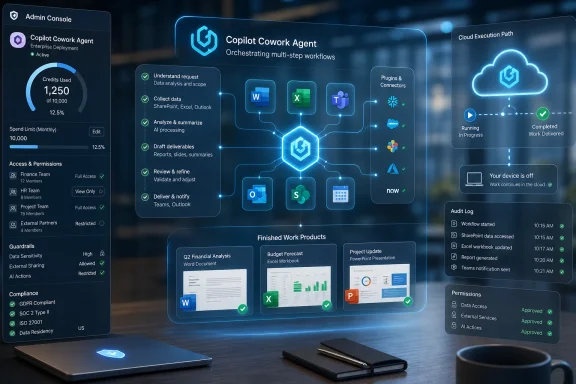
Microsoft made Copilot Cowork generally available worldwide in June 2026 as a Microsoft 365 Copilot feature that can execute multi-step business tasks across enterprise apps, files, calendars, browsers, and plugins rather than merely returning chat-style recommendations. That makes this launch less a feature update than a boundary change: Copilot is no longer just the assistant beside the document. Microsoft is asking enterprises to let an AI system do the work, meter the work, and leave behind auditable artifacts inside Microsoft 365. The bet is that the next productivity war will be fought not over who writes the best paragraph, but over who owns the workflow after the paragraph is written.
The most important word in Microsoft’s Copilot Cowork pitch is not agentic, though that is the one the company will use most often. The important word is outcome. Copilot Cowork is being sold as a system that takes a user’s intent, breaks it into steps, calls tools, pulls context from Microsoft 365, and returns finished work products.
That is a meaningful shift from the first generation of workplace AI. Early Copilot demos were built around suggestion: summarize this meeting, draft this email, turn this outline into slides, explain this spreadsheet. Those features were useful when they worked, but they still left the human as the actual process engine.
Cowork changes the implied contract. A user is no longer asking for help with a task so much as delegating the task itself. Microsoft’s examples are deliberately operational: modify batch-processing spreadsheets when upstream changes occur, generate dependency diagrams, compare roughly 4,000 files between two product versions, or assess sales opportunities across multiple data sources.
That framing matters because it pushes Copilot into the territory where WindowsForum readers live every day: permissions, compliance, billing, logs, data residency, browser behavior, endpoint policy, and the awkward gap between a demo that dazzles and a rollout that survives contact with enterprise reality.
Still, the customer names Microsoft has cited — including Accenture, Avanade, Capital Group, and Zurich Insurance — reveal the audience. This is not a consumer Copilot moment. It is a boardroom and IT governance moment, aimed at organizations that already pay for Microsoft 365 Copilot and are looking for measurable productivity gains to justify the spend.
The preview also appears to have served a second purpose: teaching Microsoft how to price and package agentic work. The company says Frontier usage helped it classify tasks into lightweight, medium, and advanced categories. That taxonomy is not just an adoption story; it is a billing story.
Lightweight tasks involve limited reasoning, fewer sources, and usually one output. Medium tasks pull from multiple sources and produce more structured outputs. Advanced tasks require broader synthesis, deeper reasoning, and multiple deliverables. In other words, Microsoft is building a cost model around the shape of work itself.
That is the quiet revolution here. The traditional Microsoft 365 license charges for access. Copilot Cowork charges, at least in part, for execution.
That may be rational. An AI agent that reads thousands of files, queries business systems, invokes tools, runs for a long time, and generates several deliverables is not the same cost burden as a chatbot answering a two-sentence question. If Microsoft absorbs that cost inside a flat license, heavy users become expensive quickly. If Microsoft meters the work, customers get precision and Microsoft gets margin protection.
But for IT departments, this is also a new class of budget risk. Traditional SaaS overruns usually come from seat sprawl. Agentic AI overruns may come from task sprawl: one well-meaning team automates a weekly reporting workflow, another starts comparing large document sets, a third lets an agent run browser-heavy research jobs, and suddenly the monthly bill reflects not just who has access, but what they asked the AI to do.
Microsoft seems aware of this anxiety. Cowork is disabled by default, and administrators can control activation timing, user access, tenant-level limits, group-level limits, individual limits, and usage alerts. That default-off posture is not merely caution; it is a signal that Microsoft knows Copilot Cowork is more infrastructure than app.
The P3 commitment plan adds another familiar cloud wrinkle. Customers can choose predictable usage commitments in exchange for discounts, or stay with pay-as-you-go. Anyone who has managed Azure spend will recognize the tradeoff: flexibility costs more, commitments require forecasting, and forecasting a new category of AI work is almost certainly going to be wrong at first.
The presence of Anthropic models inside Microsoft 365 is notable because it complicates the old mental map of Copilot. Copilot began as the visible enterprise face of Microsoft’s OpenAI partnership. Cowork makes Copilot look more like a model router, orchestration layer, governance boundary, and billing surface.
That may be the future of enterprise AI. The winning platform may not be the company with one best model, but the company that can select the appropriate model for a given task, surround it with identity and compliance controls, connect it to business data, and bill the result in a way finance teams can understand.
It also raises uncomfortable questions for customers. If different models are used for different jobs, administrators will want to know which model handled which task, what data was retrieved, which tools were invoked, and whether certain workloads can be restricted to certain providers or environments. In heavily regulated sectors, “multi-model” is not a marketing bullet. It is a governance requirement waiting to become a policy screen.
Microsoft’s cost comparison with Anthropic’s Claude Cowork through Microsoft 365 connectors is similarly strategic. The company says internal testing found average costs per prompt were 30% to 40% lower. That is a strong claim, but it should be understood as a vendor benchmark, not a universal law. Real-world costs will depend on prompts, data architecture, permissions hygiene, file sizes, plugin use, and how often users ask the agent to keep working.
That context is Microsoft’s advantage. Most companies do not have clean, unified knowledge systems. They have Teams chats, half-maintained SharePoint sites, old PowerPoints, attachments in Outlook, Excel files with tribal knowledge embedded in cell comments, and documents with names like “Final_v7_revised_REALFINAL.” Microsoft 365 is messy because work is messy.
If Cowork can navigate that mess well enough to produce dependable outputs, Microsoft gains a powerful lock-in mechanism. The more an organization’s work lives inside Microsoft 365, the more useful Cowork becomes. The more Cowork becomes useful, the harder it is to move the work elsewhere.
But this is also where the risks concentrate. Work IQ can only be as safe as the permissions and data governance beneath it. Many enterprises already have overshared SharePoint sites, stale Teams memberships, permissive OneDrive links, and historical data that was never meant to be machine-combed across contexts. A human employee may never find the wrong file. An agent asked to synthesize everything relevant just might.
That does not make Cowork uniquely dangerous. It makes it revealing. AI agents expose the real state of enterprise information governance, and the picture is often less tidy than the compliance deck suggests.
The classic Windows management model assumes a user, a device, a session, and a set of controls around that endpoint. Cowork shifts some activity into Microsoft’s cloud, where the agent continues operating under enterprise identity and policy. That may reduce local data leakage, but it also demands confidence in logging, conditional access, retention, and administrative visibility.
The browser detail is especially interesting. Microsoft says Cowork in the Frontier environment can browse the web through a local Microsoft Edge browser while continuing to comply with enterprise policies. That sounds designed to reassure organizations that web access is not a shadow channel outside corporate controls.
Still, browser-capable agents are a new operational category. They can click, read, extract, compare, and potentially interact with web systems in ways that resemble a user but scale beyond normal user behavior. Security teams will want to understand what counts as user action, what counts as agent action, and how those events appear in audit logs.
The old question was whether an AI assistant could see sensitive data. The new question is whether an AI coworker can act on sensitive data, across tools, while the user is asleep, traveling, or unaware of a downstream effect.
Drafts are easy to mentally sandbox. A user reads the draft, edits it, and sends it. Finished outputs blur responsibility. If an agent compares product versions and generates a dependency diagram, who verifies that diagram? If it updates batch-processing spreadsheets after a change, who owns the resulting operational risk? If it evaluates sales opportunities, who checks whether the underlying data was current, complete, and appropriate to use?
The answer, of course, is that humans still own the decision. Microsoft will say that. Every AI vendor says that. But the whole point of Cowork is to reduce the amount of human labor between request and outcome, and reduced friction has consequences.
The most likely enterprise pattern will be staged trust. Cowork will first be used for low-risk internal research, document comparison, meeting preparation, reporting, and repetitive analysis. Then it will move into semi-operational work with review checkpoints. Only later will organizations let it touch workflows where mistakes trigger financial, legal, or customer-facing consequences.
That adoption curve is sensible, but it is not automatic. It requires policies, training, and a clear distinction between “the agent generated this” and “the organization approved this.” In many companies, that distinction will be learned the hard way.
Microsoft is adding spending limits, usage alerts, reporting by user, group, and feature, and future user-level pricing visibility that shows the credit cost of individual tasks. These controls will determine whether Cowork feels like a manageable productivity system or another runaway SaaS experiment.
The default-disabled setting is important. It gives IT a chance to decide who gets access, which departments are mature enough to pilot it, and whether budget owners have agreed to the consumption model. In well-run organizations, Cowork rollout will look less like enabling a feature and more like launching a new internal platform.
Expect early policies to be conservative. Legal, finance, engineering, and sales operations may all want access, but their risk profiles differ. A marketing team asking Cowork to assemble competitive research is not the same as an engineering team asking it to compare thousands of files between product builds.
The admin challenge is that the same underlying feature can be harmless or high-risk depending on context. That makes blunt enable-or-disable controls insufficient over time. Enterprises will want task categories, data-boundary rules, model restrictions, plugin governance, and approval workflows for certain actions.
Fabric integration gives Cowork a path into analytics and data workflows. Dynamics integration gives it a path into sales, service, and enterprise resource planning. Partner plugins extend the surface further. Each integration increases usefulness, and each integration increases the blast radius of mistakes.
This is the paradox of agentic AI in enterprise software. The system becomes valuable when it can act across boundaries. The system becomes risky for the same reason.
Microsoft’s advantage is that many of these boundaries already sit inside its ecosystem. An organization that uses Microsoft 365, Teams, SharePoint, Fabric, Power Platform, Entra, Purview, Defender, and Dynamics may prefer one governed agentic layer over a patchwork of standalone AI tools and browser extensions. That is a rational choice.
It is also exactly the kind of bundling force regulators and competitors will watch. If Microsoft can make Copilot Cowork the default agentic interface for enterprise work, the company will have extended Microsoft 365 from productivity suite to execution substrate.
For smaller businesses, the calculus is different. Copilot Cowork requires a Microsoft 365 Copilot user subscription license, and then adds consumption-based credits on top. That means the entry point is not casual experimentation. It is a paid, managed commitment.
The practical question for many companies will be whether Cowork saves expensive human time reliably enough to justify variable AI spend. A system that reduces a multi-week file comparison job to half a day is easy to defend. A system that generates mediocre drafts of routine documents while burning credits is not.
This is why Microsoft’s task categories matter. Organizations will need to build their own internal menu of approved Cowork jobs: tasks where the value is clear, the risk is bounded, and the expected credit consumption is acceptable. Without that discipline, Cowork could become either underused because employees fear the meter, or overused because nobody sees the bill until month-end.
The best early deployments will probably come from teams that already understand process automation. They will treat Cowork less like magic and more like an unpredictable but useful worker that needs scope, inputs, review, and cost controls.
Security-minded readers should separate architecture from behavior. A system can honor Microsoft 365 permissions and still retrieve information a user technically has access to but should not use for a particular purpose. A system can retain outputs properly and still produce a flawed synthesis. A system can run under policy and still encourage users to delegate work they do not understand well enough to validate.
The hardest risks are not always technical. They are procedural. Employees may overtrust polished outputs. Managers may pressure teams to automate before controls are ready. Departments may use Cowork to accelerate work that was slow partly because review mattered.
That is why auditability will become central. Enterprises will need to know what Cowork saw, what it did, which tools it called, what model it used, what files it created or modified, and how much it cost. If those records are incomplete or hard to interpret, trust will erode quickly after the first serious mistake.
Microsoft has the pieces to make this work. Entra, Purview, Defender, Microsoft 365 audit logs, and admin reporting give it a stronger governance story than most standalone AI vendors. But integration is not the same as clarity, and clarity is what administrators will demand.
For years, Microsoft has been trying to make Windows less of a static operating system and more of an endpoint in a cloud-managed productivity fabric. Copilot Cowork accelerates that shift. The PC becomes the place where a user initiates, supervises, and reviews work that may continue elsewhere.
That future makes endpoint management more important, not less. If agents can browse, retrieve, generate, and invoke tools under user identity, then device compliance, identity protection, browser policy, data loss prevention, and conditional access become part of the agent governance stack.
It also changes how users think about productivity. The worker is no longer only operating apps. The worker is supervising processes. That sounds grand until a user has five Cowork tasks running, three alerts from budget controls, two generated documents awaiting review, and one manager asking why the agent’s spreadsheet update broke a downstream assumption.
The winners will be organizations that teach employees how to delegate precisely. The losers will be organizations that assume the AI understands the business because it can access the files.
That is why this launch matters even if many companies move slowly. Microsoft is not waiting for users to decide whether AI belongs in office work. It is redesigning office work around the assumption that some tasks will be delegated to agents, governed by IT, and billed by consumption.
The best version of that future is compelling. Repetitive analysis shrinks. Cross-file comparisons stop consuming weeks. Reports assemble themselves from governed sources. Busy professionals spend more time judging outputs and less time hunting for inputs.
The worse version is equally plausible. Costs become opaque, permissions mistakes become automated, users trust confident artifacts too quickly, and IT inherits yet another platform that executives bought before the operating model was ready. Copilot Cowork contains both futures because agentic AI always contains both futures.
Microsoft has launched the product with enough controls to suggest it understands the stakes. Now customers have to prove they do too. The companies that treat Cowork as a disciplined execution platform may extract real value from it; the ones that treat it as a smarter chatbot with a bigger button will discover that once software starts doing the work, governance is no longer an afterthought — it is the work.
 Microsoft Wants Copilot to Stop Talking and Start Shipping
The most important word in Microsoft’s Copilot Cowork pitch is not agentic, though that is the one the company will use most often. The important word is outcome. Copilot Cowork is being sold as a system that takes a user’s intent, breaks it into steps, calls tools, pulls context from Microsoft 365, and returns finished work products.That is a meaningful shift from the first generation of workplace AI. Early Copilot demos were built around suggestion: summarize this meeting, draft this email, turn this outline into slides, explain this spreadsheet. Those features were useful when they worked, but they still left the human as the actual process engine.
Cowork changes the implied contract. A user is no longer asking for help with a task so much as delegating the task itself. Microsoft’s examples are deliberately operational: modify batch-processing spreadsheets when upstream changes occur, generate dependency diagrams, compare roughly 4,000 files between two product versions, or assess sales opportunities across multiple data sources.
That framing matters because it pushes Copilot into the territory where WindowsForum readers live every day: permissions, compliance, billing, logs, data residency, browser behavior, endpoint policy, and the awkward gap between a demo that dazzles and a rollout that survives contact with enterprise reality.
The Three-Month Preview Was Microsoft’s Real Sales Pitch
Microsoft previewed Copilot Cowork through its Frontier program before opening it more broadly, and the company is already claiming traction from more than half of the Fortune 500. That figure should be read carefully. “Using” a preview feature can mean anything from a few pilot seats to serious workflow adoption, and Microsoft has every incentive to frame enterprise curiosity as enterprise momentum.Still, the customer names Microsoft has cited — including Accenture, Avanade, Capital Group, and Zurich Insurance — reveal the audience. This is not a consumer Copilot moment. It is a boardroom and IT governance moment, aimed at organizations that already pay for Microsoft 365 Copilot and are looking for measurable productivity gains to justify the spend.
The preview also appears to have served a second purpose: teaching Microsoft how to price and package agentic work. The company says Frontier usage helped it classify tasks into lightweight, medium, and advanced categories. That taxonomy is not just an adoption story; it is a billing story.
Lightweight tasks involve limited reasoning, fewer sources, and usually one output. Medium tasks pull from multiple sources and produce more structured outputs. Advanced tasks require broader synthesis, deeper reasoning, and multiple deliverables. In other words, Microsoft is building a cost model around the shape of work itself.
That is the quiet revolution here. The traditional Microsoft 365 license charges for access. Copilot Cowork charges, at least in part, for execution.
Copilot Credits Turn Productivity Into a Metered Utility
Copilot Cowork uses consumption-based pricing built around Copilot Credits, with a pay-as-you-go rate of $0.01 per credit. Microsoft says pricing depends on four factors: model utilization, context retrieval, tool invocation, and runtime resources. This is the cloud economics playbook applied to knowledge work.That may be rational. An AI agent that reads thousands of files, queries business systems, invokes tools, runs for a long time, and generates several deliverables is not the same cost burden as a chatbot answering a two-sentence question. If Microsoft absorbs that cost inside a flat license, heavy users become expensive quickly. If Microsoft meters the work, customers get precision and Microsoft gets margin protection.
But for IT departments, this is also a new class of budget risk. Traditional SaaS overruns usually come from seat sprawl. Agentic AI overruns may come from task sprawl: one well-meaning team automates a weekly reporting workflow, another starts comparing large document sets, a third lets an agent run browser-heavy research jobs, and suddenly the monthly bill reflects not just who has access, but what they asked the AI to do.
Microsoft seems aware of this anxiety. Cowork is disabled by default, and administrators can control activation timing, user access, tenant-level limits, group-level limits, individual limits, and usage alerts. That default-off posture is not merely caution; it is a signal that Microsoft knows Copilot Cowork is more infrastructure than app.
The P3 commitment plan adds another familiar cloud wrinkle. Customers can choose predictable usage commitments in exchange for discounts, or stay with pay-as-you-go. Anyone who has managed Azure spend will recognize the tradeoff: flexibility costs more, commitments require forecasting, and forecasting a new category of AI work is almost certainly going to be wrong at first.
Anthropic Inside Microsoft 365 Is the Most Interesting Dependency
Copilot Cowork currently runs on Anthropic’s Opus 4.8 and Sonnet 4.6 models, while GPT-5.5 is available in the Frontier environment. Microsoft also says a cost-efficient fine-tuned model, Cowork 1, is expected later. That multi-model architecture is being presented as customer choice, but it is also Microsoft hedging the economics and performance of agentic work.The presence of Anthropic models inside Microsoft 365 is notable because it complicates the old mental map of Copilot. Copilot began as the visible enterprise face of Microsoft’s OpenAI partnership. Cowork makes Copilot look more like a model router, orchestration layer, governance boundary, and billing surface.
That may be the future of enterprise AI. The winning platform may not be the company with one best model, but the company that can select the appropriate model for a given task, surround it with identity and compliance controls, connect it to business data, and bill the result in a way finance teams can understand.
It also raises uncomfortable questions for customers. If different models are used for different jobs, administrators will want to know which model handled which task, what data was retrieved, which tools were invoked, and whether certain workloads can be restricted to certain providers or environments. In heavily regulated sectors, “multi-model” is not a marketing bullet. It is a governance requirement waiting to become a policy screen.
Microsoft’s cost comparison with Anthropic’s Claude Cowork through Microsoft 365 connectors is similarly strategic. The company says internal testing found average costs per prompt were 30% to 40% lower. That is a strong claim, but it should be understood as a vendor benchmark, not a universal law. Real-world costs will depend on prompts, data architecture, permissions hygiene, file sizes, plugin use, and how often users ask the agent to keep working.
Work IQ Is Where the Moat Lives
Microsoft’s Work IQ branding is easy to dismiss as another AI-era label, but the underlying idea is central to Cowork’s value. An agent that cannot understand organizational context is just a clever macro with a chat box. An agent that can draw on mail, meetings, documents, SharePoint, OneDrive, Teams, and connected business systems becomes something closer to a workflow participant.That context is Microsoft’s advantage. Most companies do not have clean, unified knowledge systems. They have Teams chats, half-maintained SharePoint sites, old PowerPoints, attachments in Outlook, Excel files with tribal knowledge embedded in cell comments, and documents with names like “Final_v7_revised_REALFINAL.” Microsoft 365 is messy because work is messy.
If Cowork can navigate that mess well enough to produce dependable outputs, Microsoft gains a powerful lock-in mechanism. The more an organization’s work lives inside Microsoft 365, the more useful Cowork becomes. The more Cowork becomes useful, the harder it is to move the work elsewhere.
But this is also where the risks concentrate. Work IQ can only be as safe as the permissions and data governance beneath it. Many enterprises already have overshared SharePoint sites, stale Teams memberships, permissive OneDrive links, and historical data that was never meant to be machine-combed across contexts. A human employee may never find the wrong file. An agent asked to synthesize everything relevant just might.
That does not make Cowork uniquely dangerous. It makes it revealing. AI agents expose the real state of enterprise information governance, and the picture is often less tidy than the compliance deck suggests.
Cloud Execution Changes the Endpoint Story
One of Cowork’s more practical capabilities is cloud-hosted execution. Microsoft says tasks can keep running even when a user’s device is powered off, and files do not need to be stored locally. For road warriors and distributed teams, that is convenient. For IT departments, it changes where work actually happens.The classic Windows management model assumes a user, a device, a session, and a set of controls around that endpoint. Cowork shifts some activity into Microsoft’s cloud, where the agent continues operating under enterprise identity and policy. That may reduce local data leakage, but it also demands confidence in logging, conditional access, retention, and administrative visibility.
The browser detail is especially interesting. Microsoft says Cowork in the Frontier environment can browse the web through a local Microsoft Edge browser while continuing to comply with enterprise policies. That sounds designed to reassure organizations that web access is not a shadow channel outside corporate controls.
Still, browser-capable agents are a new operational category. They can click, read, extract, compare, and potentially interact with web systems in ways that resemble a user but scale beyond normal user behavior. Security teams will want to understand what counts as user action, what counts as agent action, and how those events appear in audit logs.
The old question was whether an AI assistant could see sensitive data. The new question is whether an AI coworker can act on sensitive data, across tools, while the user is asleep, traveling, or unaware of a downstream effect.
Finished Work Products Are a Governance Problem Disguised as a Feature
Microsoft is emphasizing that Cowork produces completed work products rather than drafts or suggestions. That is the commercial appeal, but it is also the line that should make administrators pause.Drafts are easy to mentally sandbox. A user reads the draft, edits it, and sends it. Finished outputs blur responsibility. If an agent compares product versions and generates a dependency diagram, who verifies that diagram? If it updates batch-processing spreadsheets after a change, who owns the resulting operational risk? If it evaluates sales opportunities, who checks whether the underlying data was current, complete, and appropriate to use?
The answer, of course, is that humans still own the decision. Microsoft will say that. Every AI vendor says that. But the whole point of Cowork is to reduce the amount of human labor between request and outcome, and reduced friction has consequences.
The most likely enterprise pattern will be staged trust. Cowork will first be used for low-risk internal research, document comparison, meeting preparation, reporting, and repetitive analysis. Then it will move into semi-operational work with review checkpoints. Only later will organizations let it touch workflows where mistakes trigger financial, legal, or customer-facing consequences.
That adoption curve is sensible, but it is not automatic. It requires policies, training, and a clear distinction between “the agent generated this” and “the organization approved this.” In many companies, that distinction will be learned the hard way.
The Admin Console Becomes the Real Product
For end users, the appeal of Cowork is the button inside Microsoft 365 Copilot that lets them move from chat to execution. For administrators, the real product is the control plane around that button.Microsoft is adding spending limits, usage alerts, reporting by user, group, and feature, and future user-level pricing visibility that shows the credit cost of individual tasks. These controls will determine whether Cowork feels like a manageable productivity system or another runaway SaaS experiment.
The default-disabled setting is important. It gives IT a chance to decide who gets access, which departments are mature enough to pilot it, and whether budget owners have agreed to the consumption model. In well-run organizations, Cowork rollout will look less like enabling a feature and more like launching a new internal platform.
Expect early policies to be conservative. Legal, finance, engineering, and sales operations may all want access, but their risk profiles differ. A marketing team asking Cowork to assemble competitive research is not the same as an engineering team asking it to compare thousands of files between product builds.
The admin challenge is that the same underlying feature can be harmless or high-risk depending on context. That makes blunt enable-or-disable controls insufficient over time. Enterprises will want task categories, data-boundary rules, model restrictions, plugin governance, and approval workflows for certain actions.
Plugins Move Cowork Beyond Office Automation
Microsoft is expanding plugin support with nine new partner plugins available and more planned, while native integrations with Fabric, Dynamics 365 Sales, Dynamics 365 Customer Service, and Dynamics 365 ERP are now generally available. This is where Cowork stops being an Office assistant and starts looking like a business process layer.Fabric integration gives Cowork a path into analytics and data workflows. Dynamics integration gives it a path into sales, service, and enterprise resource planning. Partner plugins extend the surface further. Each integration increases usefulness, and each integration increases the blast radius of mistakes.
This is the paradox of agentic AI in enterprise software. The system becomes valuable when it can act across boundaries. The system becomes risky for the same reason.
Microsoft’s advantage is that many of these boundaries already sit inside its ecosystem. An organization that uses Microsoft 365, Teams, SharePoint, Fabric, Power Platform, Entra, Purview, Defender, and Dynamics may prefer one governed agentic layer over a patchwork of standalone AI tools and browser extensions. That is a rational choice.
It is also exactly the kind of bundling force regulators and competitors will watch. If Microsoft can make Copilot Cowork the default agentic interface for enterprise work, the company will have extended Microsoft 365 from productivity suite to execution substrate.
Fortune 500 Adoption Does Not Mean Everyday Readiness
Microsoft’s Fortune 500 claim will make headlines, but enterprise pilots are not the same as durable adoption. Large organizations often test everything because they can afford to, because vendors give them early access, and because nobody wants to be the executive who missed the next platform shift.For smaller businesses, the calculus is different. Copilot Cowork requires a Microsoft 365 Copilot user subscription license, and then adds consumption-based credits on top. That means the entry point is not casual experimentation. It is a paid, managed commitment.
The practical question for many companies will be whether Cowork saves expensive human time reliably enough to justify variable AI spend. A system that reduces a multi-week file comparison job to half a day is easy to defend. A system that generates mediocre drafts of routine documents while burning credits is not.
This is why Microsoft’s task categories matter. Organizations will need to build their own internal menu of approved Cowork jobs: tasks where the value is clear, the risk is bounded, and the expected credit consumption is acceptable. Without that discipline, Cowork could become either underused because employees fear the meter, or overused because nobody sees the bill until month-end.
The best early deployments will probably come from teams that already understand process automation. They will treat Cowork less like magic and more like an unpredictable but useful worker that needs scope, inputs, review, and cost controls.
The Security Promise Is Strong, but the Human Layer Is Weak
Microsoft says Cowork prompts, responses, and outputs remain governed by Microsoft 365 security controls and can be searched, retained, and managed through existing compliance frameworks. That is exactly what enterprise buyers need to hear. It is also the minimum requirement for this product to be taken seriously.Security-minded readers should separate architecture from behavior. A system can honor Microsoft 365 permissions and still retrieve information a user technically has access to but should not use for a particular purpose. A system can retain outputs properly and still produce a flawed synthesis. A system can run under policy and still encourage users to delegate work they do not understand well enough to validate.
The hardest risks are not always technical. They are procedural. Employees may overtrust polished outputs. Managers may pressure teams to automate before controls are ready. Departments may use Cowork to accelerate work that was slow partly because review mattered.
That is why auditability will become central. Enterprises will need to know what Cowork saw, what it did, which tools it called, what model it used, what files it created or modified, and how much it cost. If those records are incomplete or hard to interpret, trust will erode quickly after the first serious mistake.
Microsoft has the pieces to make this work. Entra, Purview, Defender, Microsoft 365 audit logs, and admin reporting give it a stronger governance story than most standalone AI vendors. But integration is not the same as clarity, and clarity is what administrators will demand.
The Windows Angle Is Really the Work Angle
Copilot Cowork is not a Windows feature in the narrow sense. It lives in Microsoft 365 Copilot, runs heavily in the cloud, and is aimed at business workflows rather than desktop personalization. Yet it matters deeply to the Windows ecosystem because Windows remains the front door for much enterprise work.For years, Microsoft has been trying to make Windows less of a static operating system and more of an endpoint in a cloud-managed productivity fabric. Copilot Cowork accelerates that shift. The PC becomes the place where a user initiates, supervises, and reviews work that may continue elsewhere.
That future makes endpoint management more important, not less. If agents can browse, retrieve, generate, and invoke tools under user identity, then device compliance, identity protection, browser policy, data loss prevention, and conditional access become part of the agent governance stack.
It also changes how users think about productivity. The worker is no longer only operating apps. The worker is supervising processes. That sounds grand until a user has five Cowork tasks running, three alerts from budget controls, two generated documents awaiting review, and one manager asking why the agent’s spreadsheet update broke a downstream assumption.
The winners will be organizations that teach employees how to delegate precisely. The losers will be organizations that assume the AI understands the business because it can access the files.
Microsoft’s Agentic Future Arrives With a Meter Attached
The most concrete lesson from Copilot Cowork is that agentic AI is arriving as both a capability and a billing model. Microsoft is not simply giving Copilot more autonomy; it is attaching that autonomy to credits, commitments, model selection, runtime resources, and administrative guardrails.- Copilot Cowork is generally available as a Microsoft 365 Copilot capability for organizations that already have the required user subscription licensing.
- The product is designed to complete multi-step work across Microsoft 365 and connected systems, not merely generate drafts or recommendations.
- Pricing is based on Copilot Credits, with cost shaped by model use, context retrieval, tool calls, and runtime resources.
- Administrators get default-off deployment, access controls, spend limits, alerts, and reporting, which will be essential for any serious rollout.
- The system’s real value depends on enterprise data hygiene, permissions discipline, plugin governance, and review practices.
- Microsoft’s multi-model approach makes Copilot less a single AI assistant and more an orchestration layer for paid digital labor.
The Next Productivity Suite Is an Execution Layer
Copilot Cowork should be understood as Microsoft’s clearest statement yet that the productivity suite is no longer enough. Word, Excel, PowerPoint, Outlook, and Teams remain the familiar surfaces, but the strategic layer is moving above them: an agent that can decide which surface, file, model, and tool a job requires.That is why this launch matters even if many companies move slowly. Microsoft is not waiting for users to decide whether AI belongs in office work. It is redesigning office work around the assumption that some tasks will be delegated to agents, governed by IT, and billed by consumption.
The best version of that future is compelling. Repetitive analysis shrinks. Cross-file comparisons stop consuming weeks. Reports assemble themselves from governed sources. Busy professionals spend more time judging outputs and less time hunting for inputs.
The worse version is equally plausible. Costs become opaque, permissions mistakes become automated, users trust confident artifacts too quickly, and IT inherits yet another platform that executives bought before the operating model was ready. Copilot Cowork contains both futures because agentic AI always contains both futures.
Microsoft has launched the product with enough controls to suggest it understands the stakes. Now customers have to prove they do too. The companies that treat Cowork as a disciplined execution platform may extract real value from it; the ones that treat it as a smarter chatbot with a bigger button will discover that once software starts doing the work, governance is no longer an afterthought — it is the work.
References
- Primary source: thelec.net
Published: Thu, 18 Jun 2026 23:44:14 GMT
Microsoft Launches Agentic AI System Copilot Cowork - The Elec Inc.
Microsoft has officially launched Copilot Cowork, an agentic AI system designed to completwww.thelec.net - Related coverage: techradar.com
Microsoft makes Copilot Cowork open to everyone, and wants to help you tackle even the trickiest work tasks | TechRadar
Copilot Cowork gets an upgrade as it opens to all userswww.techradar.com - Related coverage: axios.com
Microsoft explores DeepSeek for Copilot Cowork
Microsoft will also shift to usage-based pricing for the enterprise agent.www.axios.com
- Official source: learn.microsoft.com
Copilot Cowork overview | Microsoft Learn
Learn about Microsoft 365 Copilot Cowork, which takes action on your behalf.learn.microsoft.com - Official source: microsoft.com
Copilot Cowork: A new way of getting work done | Microsoft 365 Blog
Copilot Cowork turns intent into action across Microsoft 365—automating tasks, coordinating workflows, and keeping you in control. See how.www.microsoft.com - Official source: support.microsoft.com
- Official source: news.microsoft.com
Copilot Cowork ya está disponible de forma general - Source EMEA
 news.microsoft.com
- Related coverage: computerworld.com
Microsoft launches Copilot Cowork with usage-based pricing – Computerworld
Copilot Cowork customers can choose from Anthropic and OpenAI models to run the AI agent, while Microsoft reportedly plans to offer an open source model from DeepSeek to lower costs. www.computerworld.com
- Related coverage: windowscentral.com
This is Microsoft's new "Copilot Cowork": An experiment with Anthropic's Claude AI models that plans and delegates your work | Windows Central
Microsoft ships Copilot Cowork to its Frontier program.www.windowscentral.com - Related coverage: itpro.com
Anthropic's Cowork tool is coming to Microsoft Copilot | IT Pro
The new Copilot Cowork tool will be made available through a new Microsoft 365 tier at the end of March.www.itpro.com - Related coverage: tomsguide.com
Biggest Microsoft Build 2026 announcements — agentic AI, RTX Spark Dev Box, GitHub Copilot app, new MAI models, and more | Tom's Guide
All the big news from Microsoft's AI-focused eventwww.tomsguide.com - Official source: adoption.microsoft.com
- Related coverage: thorstenmeyerai.com
- Related coverage: avantiico.com
