
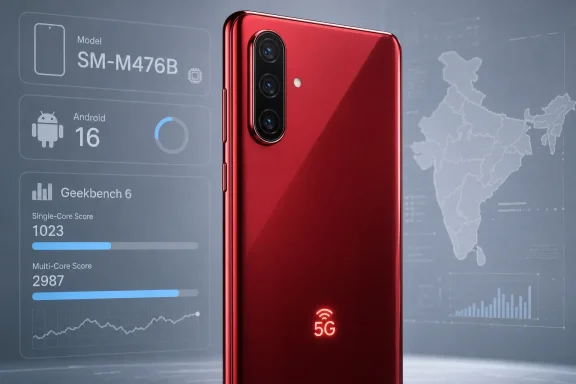
Samsung has officially teased the Galaxy M47 5G for India in June 2026, showing a red handset with a triple rear camera array, while benchmark listings tied to model SM-M476B point to a Snapdragon 6 Gen 3 chip and 8GB of RAM. That combination makes the phone less interesting as a one-off mid-ranger than as a signal of Samsung’s broader India play. The company appears to be reviving the M4x tier at the precise moment when affordable Android phones are being asked to do more: last longer, run heavier software, and look less like compromise devices. The Galaxy M47 5G is not yet fully announced, but the outline is already clear enough to matter.
The Galaxy M series has always lived in a slightly different Samsung universe. It is not the polished global showroom occupied by the Galaxy S line, nor the carrier-friendly mainstream of the Galaxy A family. In India especially, M-series phones have been Samsung’s answer to a market that punishes weak batteries, timid pricing, and vague value propositions.
That is why the Galaxy M47 5G teaser matters even before Samsung publishes the spec sheet. A “coming soon” page with a red finish and triple rear cameras is not a launch, but it is an official marker: Samsung is preparing to put another M-series device into a brutally competitive Indian mid-range segment. This is the same battlefield where Xiaomi, Realme, iQOO, Vivo, Motorola, and OnePlus spin performance, charging speeds, display brightness, and camera megapixels into weekly combat.
The M47 name also suggests Samsung is not merely refreshing its lowest-cost M phones. The M4x line has been quieter than the M1x and M3x tiers, and that gives this handset a faint sense of resurrection. If the M47 follows the pattern implied by recent leaks and benchmark entries, it may sit in the awkward but important space between mass-market budget 5G phones and more expensive A-series models.
That middle ground is where Samsung’s brand strength helps, but only up to a point. Buyers may trust the Galaxy name, but they also compare charging wattage, storage tiers, chipset names, and software promises with ruthless efficiency. A mid-range Samsung phone cannot simply be “good enough” anymore; it has to justify why it exists alongside Samsung’s own Galaxy A devices.
That matters because Samsung’s mid-range silicon choices carry baggage. Exynos chips are not automatically bad, and some have aged better than their online reputation suggests. But in enthusiast circles, especially in markets where Qualcomm-powered rivals are plentiful, Snapdragon still carries an aura of safer performance, better modem confidence, and more predictable thermals.
The alleged Geekbench scores — roughly 1,000 in single-core and just over 3,000 in multi-core testing — do not make the M47 a gaming monster. They place it in the competent modern mid-range. For everyday use, that is arguably more important than synthetic bragging rights: scrolling, camera processing, navigation, social apps, messaging, video calls, and the occasional heavy game are where this phone will be judged.
The Snapdragon 6 Gen 3 also gives Samsung a cleaner marketing story. It can sell the device as a practical 5G phone with a recognizable chipset instead of leaning too heavily on camera count or display size. In a market where spec sheets are shopping lists, the processor line still has unusual symbolic weight.
That caveat is especially important with M-series devices. Samsung has historically used these phones to push battery capacity and online-channel value, but not every M phone gets the same level of polish as its A-series cousins. The difference between a good M47 and a forgettable one will be in the invisible parts: update policy, storage speed, display quality, haptics, camera processing, thermal control, and how aggressively Samsung manages background apps.
There is also the old Android mid-range trap: a phone can benchmark well and still feel ordinary after a year of app updates, WhatsApp media buildup, background services, and OS patches. Eight gigabytes of RAM is a sensible baseline in 2026, but RAM alone does not guarantee long-term smoothness. Samsung’s software stack is feature-rich, and feature-rich software has a cost.
Still, the benchmark trail gives us enough to infer intent. Samsung is not positioning the M47 as an ultra-basic 5G handset. It appears to be building something with enough headroom to sit above the entry-level M models and below the more premium Galaxy A options.
Samsung’s choice of a red finish is also not accidental. The company could have teased the device in black or gray and let the spec sheet do the work. Instead, it is showing a phone that looks designed to be noticed, which implies the M47 is not being pitched solely as a utilitarian battery slab.
The camera count, however, deserves skepticism. Triple rear cameras in mid-range phones often hide an uneven system: one useful main sensor, one serviceable ultrawide if buyers are lucky, and a third module that exists largely to complete the marketing geometry. Until Samsung confirms sensor sizes, optical stabilization, ultrawide availability, macro or depth roles, and video capabilities, the camera island is a promise without proof.
That is not a criticism unique to Samsung. It is an industry habit. But Samsung’s image processing is one of the reasons many buyers choose Galaxy phones over spec-heavy rivals, so the M47’s camera story will be judged by output, not by the number of circles on the back.
India also rewards phones that feel durable in both senses of the word. Buyers care about physical endurance, battery life, network reliability, and after-sales support. They also care about whether a phone will remain usable through several years of software updates, family hand-me-downs, resale, or secondary use.
That is where Samsung has an opportunity. If it gives the M47 a credible update promise, sane storage options, a bright AMOLED display, a large battery, and sensible pricing, the phone could be more than another SKU. It could become a default recommendation for buyers who want a Samsung but do not want to stretch into higher A-series territory.
The risk is cannibalization. Samsung’s lineup is already dense: Galaxy A, M, F, and regional variants often overlap in ways that confuse even close observers. The M47 has to thread the needle between being attractive enough to matter and restrained enough not to undercut Samsung’s more profitable devices.
Samsung can answer that question with materials, cameras, water resistance, display tuning, software support, retail availability, and design. The A series typically carries the more mainstream global identity, while the M series often leans harder into price-to-spec value. But if the M47 gets too close to the A36 experience, it may expose how much of the A-series premium is branding and channel strategy.
On the other hand, if Samsung strips too much from the M47, the Snapdragon chip becomes a fig leaf. A good processor inside a dim display, weak camera system, slow storage configuration, or short update window would not be enough. Mid-range buyers have grown more sophisticated, and reviewers in India are particularly good at finding the corners manufacturers cut.
This is the central tension of the M47. The phone looks like a value play, but value in 2026 is no longer just a price divided by a chipset. It is the total package over three or four years.
For WindowsForum readers, the software angle may matter more than the camera teaser. Phones are endpoints now. They are authentication devices, password vault companions, work profile hosts, Teams and Outlook terminals, hotspot routers, and sometimes the only computing device a user owns outside the office.
A mid-range Android phone with a long update policy is a security asset. A mid-range Android phone abandoned too quickly becomes an unmanaged liability. Samsung understands this better than most Android vendors, but its update commitments can still vary by model, market, and tier.
If the M47 launches with a strong patch promise, it could appeal beyond ordinary consumer buyers. Small businesses, field staff, students, and budget-conscious professionals all benefit from predictable security updates. If Samsung keeps the promise vague, the M47 becomes just another phone racing depreciation.
That skepticism is healthy. The M series has produced some strong value devices, but it has also lived with compromises that did not always show up on launch banners. Build quality, camera secondary sensors, charging speed, speaker quality, and software feature omissions can separate a good buy from a frustrating one.
The Snapdragon 6 Gen 3 and 8GB RAM combination gives Samsung a decent foundation. It implies enough horsepower for mainstream users and enough breathing room for One UI. But the floor is not the ceiling. The final verdict will depend on how Samsung fills in the rest of the phone.
There is also the matter of price. A mid-range phone can be excellent at one price and absurd at another. Samsung has room to charge for brand, service, and software, but not unlimited room. India’s online buyers will compare launch offers, bank discounts, exchange bonuses, and rival flash-sale pricing within minutes.
A 6.7-inch AMOLED panel with a high refresh rate would put the M47 on stronger footing. A large battery would align with M-series expectations. Faster charging would help Samsung counter rivals that have made 45W, 67W, and higher figures part of mid-range theater.
But Samsung does not always play the charging-speed game aggressively. The company tends to prize battery longevity, thermal caution, and ecosystem consistency over headline wattage. That may be defensible, but in India it also gives competitors an easy attack line.
Storage is another quiet battleground. In 2026, a 128GB base model can feel tight for users who shoot video, hoard WhatsApp media, and install large games. If Samsung pairs 8GB RAM with modern storage and reasonable higher-capacity options, the M47 will age better. If it treats storage as an upsell trap, buyers will notice.
A buyer who has a good experience with a Galaxy M47 might later buy a Galaxy Watch, Galaxy Buds, a tablet, or an A-series or S-series phone. A buyer who feels shortchanged may leave the ecosystem entirely. Samsung’s mid-range phones are not just sales units; they are recruitment tools.
That is why the M47’s apparent positioning is strategically useful. It gives Samsung another chance to make the Galaxy ecosystem feel accessible without making it feel second-rate. The red design, Snapdragon chip, and 8GB RAM all point toward a phone that wants to look confident rather than apologetic.
The danger is that Samsung’s portfolio becomes too crowded for its own good. If buyers cannot understand why the M47 exists beside the M37, A36, F-series variants, and discounted older Galaxy models, the lineup itself becomes friction. Choice is good; overlap is exhausting.
The most concrete read is simple: Samsung appears to be bringing back a stronger M4x-class device for India with a modern Qualcomm mid-range platform, a bolder design, and enough RAM to avoid the entry-level label. That is a sensible move. It is also not, by itself, a guaranteed win.
The practical takeaways are narrower than the hype cycle will suggest:
 Samsung’s Mid-Range Strategy Is Getting Less Accidental
The Galaxy M series has always lived in a slightly different Samsung universe. It is not the polished global showroom occupied by the Galaxy S line, nor the carrier-friendly mainstream of the Galaxy A family. In India especially, M-series phones have been Samsung’s answer to a market that punishes weak batteries, timid pricing, and vague value propositions.That is why the Galaxy M47 5G teaser matters even before Samsung publishes the spec sheet. A “coming soon” page with a red finish and triple rear cameras is not a launch, but it is an official marker: Samsung is preparing to put another M-series device into a brutally competitive Indian mid-range segment. This is the same battlefield where Xiaomi, Realme, iQOO, Vivo, Motorola, and OnePlus spin performance, charging speeds, display brightness, and camera megapixels into weekly combat.
The M47 name also suggests Samsung is not merely refreshing its lowest-cost M phones. The M4x line has been quieter than the M1x and M3x tiers, and that gives this handset a faint sense of resurrection. If the M47 follows the pattern implied by recent leaks and benchmark entries, it may sit in the awkward but important space between mass-market budget 5G phones and more expensive A-series models.
That middle ground is where Samsung’s brand strength helps, but only up to a point. Buyers may trust the Galaxy name, but they also compare charging wattage, storage tiers, chipset names, and software promises with ruthless efficiency. A mid-range Samsung phone cannot simply be “good enough” anymore; it has to justify why it exists alongside Samsung’s own Galaxy A devices.
The Snapdragon Detail Is the Real Headline
The most consequential reported detail is not the red color, the camera island, or even the “5G” suffix. It is the Snapdragon 6 Gen 3. If the Geekbench listing is indeed the Galaxy M47 5G, Samsung is placing a Qualcomm chip at the center of a phone that could have easily stayed in the company’s Exynos orbit.That matters because Samsung’s mid-range silicon choices carry baggage. Exynos chips are not automatically bad, and some have aged better than their online reputation suggests. But in enthusiast circles, especially in markets where Qualcomm-powered rivals are plentiful, Snapdragon still carries an aura of safer performance, better modem confidence, and more predictable thermals.
The alleged Geekbench scores — roughly 1,000 in single-core and just over 3,000 in multi-core testing — do not make the M47 a gaming monster. They place it in the competent modern mid-range. For everyday use, that is arguably more important than synthetic bragging rights: scrolling, camera processing, navigation, social apps, messaging, video calls, and the occasional heavy game are where this phone will be judged.
The Snapdragon 6 Gen 3 also gives Samsung a cleaner marketing story. It can sell the device as a practical 5G phone with a recognizable chipset instead of leaning too heavily on camera count or display size. In a market where spec sheets are shopping lists, the processor line still has unusual symbolic weight.
Benchmarks Tell Us the Tier, Not the Phone
Geekbench leaks are useful, but they are not product reviews. A benchmark entry can reveal a model number, CPU configuration, RAM amount, Android version, and a rough performance class. It cannot tell us whether Samsung tuned the phone aggressively, whether the cooling solution is adequate, whether the battery life is excellent, or whether the camera stack is more than decorative symmetry.That caveat is especially important with M-series devices. Samsung has historically used these phones to push battery capacity and online-channel value, but not every M phone gets the same level of polish as its A-series cousins. The difference between a good M47 and a forgettable one will be in the invisible parts: update policy, storage speed, display quality, haptics, camera processing, thermal control, and how aggressively Samsung manages background apps.
There is also the old Android mid-range trap: a phone can benchmark well and still feel ordinary after a year of app updates, WhatsApp media buildup, background services, and OS patches. Eight gigabytes of RAM is a sensible baseline in 2026, but RAM alone does not guarantee long-term smoothness. Samsung’s software stack is feature-rich, and feature-rich software has a cost.
Still, the benchmark trail gives us enough to infer intent. Samsung is not positioning the M47 as an ultra-basic 5G handset. It appears to be building something with enough headroom to sit above the entry-level M models and below the more premium Galaxy A options.
The Camera Island Says Samsung Wants the M Series to Look Less Cheap
The official teaser shows a triple rear camera setup in a pill-shaped housing. That sentence sounds mundane because triple-camera islands are now nearly as common as USB-C ports. But design matters in the Indian mid-range because phones in this category are not only tools; they are status objects bought with careful money.Samsung’s choice of a red finish is also not accidental. The company could have teased the device in black or gray and let the spec sheet do the work. Instead, it is showing a phone that looks designed to be noticed, which implies the M47 is not being pitched solely as a utilitarian battery slab.
The camera count, however, deserves skepticism. Triple rear cameras in mid-range phones often hide an uneven system: one useful main sensor, one serviceable ultrawide if buyers are lucky, and a third module that exists largely to complete the marketing geometry. Until Samsung confirms sensor sizes, optical stabilization, ultrawide availability, macro or depth roles, and video capabilities, the camera island is a promise without proof.
That is not a criticism unique to Samsung. It is an industry habit. But Samsung’s image processing is one of the reasons many buyers choose Galaxy phones over spec-heavy rivals, so the M47’s camera story will be judged by output, not by the number of circles on the back.
India Is Not Just Another Launch Market
The Galaxy M47 5G being confirmed for India first is the least surprising and most important part of the story. India is one of the world’s most demanding smartphone markets, and Samsung’s position there depends on fighting across price bands rather than winning only at the premium end. The M series exists because Samsung needed a sharper online-market weapon against Chinese brands that understood value marketing earlier and better.India also rewards phones that feel durable in both senses of the word. Buyers care about physical endurance, battery life, network reliability, and after-sales support. They also care about whether a phone will remain usable through several years of software updates, family hand-me-downs, resale, or secondary use.
That is where Samsung has an opportunity. If it gives the M47 a credible update promise, sane storage options, a bright AMOLED display, a large battery, and sensible pricing, the phone could be more than another SKU. It could become a default recommendation for buyers who want a Samsung but do not want to stretch into higher A-series territory.
The risk is cannibalization. Samsung’s lineup is already dense: Galaxy A, M, F, and regional variants often overlap in ways that confuse even close observers. The M47 has to thread the needle between being attractive enough to matter and restrained enough not to undercut Samsung’s more profitable devices.
The Galaxy A Shadow Will Be Hard to Escape
The reported use of the Snapdragon 6 Gen 3 immediately invites comparison with the Galaxy A36 5G, which has also used that chip. That is the dilemma Samsung created for itself. When the same processor appears across different families, buyers start asking why one phone costs more than another.Samsung can answer that question with materials, cameras, water resistance, display tuning, software support, retail availability, and design. The A series typically carries the more mainstream global identity, while the M series often leans harder into price-to-spec value. But if the M47 gets too close to the A36 experience, it may expose how much of the A-series premium is branding and channel strategy.
On the other hand, if Samsung strips too much from the M47, the Snapdragon chip becomes a fig leaf. A good processor inside a dim display, weak camera system, slow storage configuration, or short update window would not be enough. Mid-range buyers have grown more sophisticated, and reviewers in India are particularly good at finding the corners manufacturers cut.
This is the central tension of the M47. The phone looks like a value play, but value in 2026 is no longer just a price divided by a chipset. It is the total package over three or four years.
Software Support Could Decide the Phone’s Real Value
The benchmark listing reportedly shows Android 16, which would make sense for a 2026 Samsung launch. The bigger question is not the launch version; it is the support runway. Samsung has made software updates a major competitive weapon in recent years, and that pressure now trickles down into the mid-range.For WindowsForum readers, the software angle may matter more than the camera teaser. Phones are endpoints now. They are authentication devices, password vault companions, work profile hosts, Teams and Outlook terminals, hotspot routers, and sometimes the only computing device a user owns outside the office.
A mid-range Android phone with a long update policy is a security asset. A mid-range Android phone abandoned too quickly becomes an unmanaged liability. Samsung understands this better than most Android vendors, but its update commitments can still vary by model, market, and tier.
If the M47 launches with a strong patch promise, it could appeal beyond ordinary consumer buyers. Small businesses, field staff, students, and budget-conscious professionals all benefit from predictable security updates. If Samsung keeps the promise vague, the M47 becomes just another phone racing depreciation.
The M Series Still Has to Earn Enthusiast Respect
Samsung’s challenge with the M47 is not awareness. The Galaxy brand has awareness. The challenge is credibility among people who read beyond the advertisement. Enthusiasts and IT-minded buyers will want to know whether this is a genuinely balanced phone or another Samsung model designed to look compelling in three headline specs.That skepticism is healthy. The M series has produced some strong value devices, but it has also lived with compromises that did not always show up on launch banners. Build quality, camera secondary sensors, charging speed, speaker quality, and software feature omissions can separate a good buy from a frustrating one.
The Snapdragon 6 Gen 3 and 8GB RAM combination gives Samsung a decent foundation. It implies enough horsepower for mainstream users and enough breathing room for One UI. But the floor is not the ceiling. The final verdict will depend on how Samsung fills in the rest of the phone.
There is also the matter of price. A mid-range phone can be excellent at one price and absurd at another. Samsung has room to charge for brand, service, and software, but not unlimited room. India’s online buyers will compare launch offers, bank discounts, exchange bonuses, and rival flash-sale pricing within minutes.
The Unannounced Specs Are Where the Story Still Lives
Several critical details remain unknown. Samsung has not confirmed the display type, refresh rate, battery capacity, charging speed, storage variants, main camera sensor, ultrawide presence, IP rating, fingerprint placement, or exact launch date. Those omissions are not minor; they are the difference between a promising teaser and a recommendation.A 6.7-inch AMOLED panel with a high refresh rate would put the M47 on stronger footing. A large battery would align with M-series expectations. Faster charging would help Samsung counter rivals that have made 45W, 67W, and higher figures part of mid-range theater.
But Samsung does not always play the charging-speed game aggressively. The company tends to prize battery longevity, thermal caution, and ecosystem consistency over headline wattage. That may be defensible, but in India it also gives competitors an easy attack line.
Storage is another quiet battleground. In 2026, a 128GB base model can feel tight for users who shoot video, hoard WhatsApp media, and install large games. If Samsung pairs 8GB RAM with modern storage and reasonable higher-capacity options, the M47 will age better. If it treats storage as an upsell trap, buyers will notice.
Samsung Is Rebuilding the Middle While Everyone Watches the Flagships
The smartphone industry loves its extremes. Foldables get the stagecraft, Ultra phones get the camera comparisons, and budget phones get the volume headlines. But the mid-range is where brand loyalty is often formed or broken.A buyer who has a good experience with a Galaxy M47 might later buy a Galaxy Watch, Galaxy Buds, a tablet, or an A-series or S-series phone. A buyer who feels shortchanged may leave the ecosystem entirely. Samsung’s mid-range phones are not just sales units; they are recruitment tools.
That is why the M47’s apparent positioning is strategically useful. It gives Samsung another chance to make the Galaxy ecosystem feel accessible without making it feel second-rate. The red design, Snapdragon chip, and 8GB RAM all point toward a phone that wants to look confident rather than apologetic.
The danger is that Samsung’s portfolio becomes too crowded for its own good. If buyers cannot understand why the M47 exists beside the M37, A36, F-series variants, and discounted older Galaxy models, the lineup itself becomes friction. Choice is good; overlap is exhausting.
The Small Print Will Decide Whether This Is a Revival or Just Another SKU
Samsung has confirmed enough to create anticipation, and the leaks have supplied enough to create expectations. That is a precarious place for a mid-range phone. The Galaxy M47 5G now has to arrive without disappointing the audience that has already built a spec sheet in its head.The most concrete read is simple: Samsung appears to be bringing back a stronger M4x-class device for India with a modern Qualcomm mid-range platform, a bolder design, and enough RAM to avoid the entry-level label. That is a sensible move. It is also not, by itself, a guaranteed win.
The practical takeaways are narrower than the hype cycle will suggest:
- Samsung has officially teased the Galaxy M47 5G for India, but it has not yet confirmed the full specification sheet or launch date.
- The device shown in the teaser has a red finish and a triple rear camera layout in a pill-shaped housing.
- Benchmark listings associated with model SM-M476B point to a Snapdragon 6 Gen 3 chip, 8GB of RAM, and Android 16.
- Reported Geekbench CPU scores place the phone in the competent mid-range rather than flagship-adjacent territory.
- The phone’s real value will depend on pricing, display quality, battery and charging choices, camera hardware, storage tiers, and Samsung’s update commitment.
- The M47 5G could strengthen Samsung’s India portfolio, but it also risks adding more overlap to an already crowded Galaxy mid-range lineup.
References
- Primary source: Notebookcheck
Published: Sat, 20 Jun 2026 00:51:00 GMT
Samsung officially confirms new M series phone - Notebookcheck News
Samsung has confirmed the Galaxy M47 5G for India. The phone has appeared in an official teaser with a triple rear camera setup. Meanwhile, a Geekbench listing of the phone reveals a Snapdragon chipset with 8GB of RAM. www.notebookcheck.net
- Related coverage: gadgets360.com
- Related coverage: sammyguru.com
Galaxy M47 Spotted on Geekbench With Snapdragon 6 Gen 3 - SammyGuru
SammyGuru spotted the Galaxy M47 on Geekbench CPU, with scores of 1,000 in the single-core test and 3,036 in the multi-core test.sammyguru.com - Related coverage: comparos.in
- Related coverage: bangsaonline.com
Samsung Galaxy M47 Muncul di Geekbench dengan Snapdragon 6 Gen 3
Dengan kemunculan Galaxy M47 di Geekbench, detail lebih lanjut mengenai ponsel kelas menengah terbaru Samsung diperkirakan akan terungkap dalam beberapa minggu mendatang.www.bangsaonline.com - Related coverage: cashkr.com
Samsung Galaxy M47 Spotted on Geekbench Launch Date & Specs
Samsung Galaxy M47 spotted on Geekbench with Snapdragon 6 Gen 3, 8GB RAM, and Android 16. India launch expected soon. Price yet to be confirmed.www.cashkr.com

- Related coverage: mymobileindia.com
Samsung Galaxy M47 Spotted on Geekbench GPU Listing With Snapdragon 6 Gen 3 and Android 16 ~ My Mobile India
Samsung Galaxy M47 spotted on Geekbench GPU with Snapdragon 6 Gen 3, Adreno 710 GPU, 8GB RAM and Android 16. Tipped to feature 120Hz AMOLED and 5000mAh battery. www.mymobileindia.com
- Related coverage: thethrive.in
- Related coverage: images.samsung.com


