
PAS president Abdul Hadi Awang said on June 13, 2026, that Larut MP Hamzah Zainudin would return as Malaysia’s Opposition Leader, reigniting tensions inside the opposition after Hamzah’s expulsion from Bersatu and the launch of his new Parti Wawasan Negara. The announcement was not just a personnel decision. It was a public demonstration of where power now sits. In the opposition’s new family drama, the smallest sibling is discovering that nostalgia is not a voting bloc.
The comedy of Malaysian opposition politics is that everyone still speaks the language of coalition equality long after the arithmetic has stopped cooperating. PAS does not need to shout to be heard anymore; the numbers do that on its behalf. When Hadi announced that Hamzah would resume the Opposition Leader role, the important part was not simply Hamzah’s return. It was that PAS acted as though the matter was settled.
That is what has unsettled Bersatu. The party that once looked like the pragmatic vehicle capable of making Islamist politics more electable now finds itself reduced, fragmented, and increasingly dependent on the very force it once presumed it could manage. Bersatu’s objection is therefore not merely procedural. It is existential.
Coalition politics usually rewards discretion, but this episode made the hierarchy visible. PAS, with the largest parliamentary bloc in the opposition, now behaves like the senior partner. Bersatu can object, but objection is no longer the same as leverage.
Hamzah’s position makes the story even more awkward. He was once a central Bersatu figure, then became the symbol of Bersatu’s internal rupture, and now returns under the shelter of a new party aligned with PAS. In family terms, the estranged uncle has come back to dinner with the blessing of the eldest sibling, while the smaller brother complains that nobody asked him about the seating plan.
That is a brutal reversal. Bersatu was once the party of prime ministers, defectors, power brokers, and post-Sheraton calculation. It carried the aura of executive experience, even when its electoral machinery was uneven. PAS supplied grassroots discipline and ideological ballast; Bersatu supplied the promise of national acceptability.
That bargain has aged badly. PAS now has the parliamentary mass. Bersatu has the memories.
This is why the argument over Opposition Leader feels larger than one post. It is a proxy battle over who owns Perikatan Nasional’s future, who gets to define opposition strategy, and who can credibly claim to speak for Malay-Muslim voters outside the government. In that contest, Bersatu’s shrinking institutional weight matters more than its wounded tone.
That matters. PAS is powerful, but it also knows the limits of its brand. A PAS-only opposition leadership would satisfy the party faithful, yet it could narrow the coalition’s appeal among voters wary of overt religious conservatism. Hamzah gives PAS a way to dominate without appearing to monopolise.
This is the quiet sophistication behind the move. PAS can keep the numbers, set the terms, and still let a non-PAS figure carry the parliamentary microphone. It is a classic senior-partner arrangement: control the architecture, outsource the frontage.
For Hamzah, the arrangement is equally convenient. His new party needs instant relevance, and nothing supplies relevance like the Opposition Leader’s chair. A new party without a parliamentary role risks looking like a rescue vehicle. A new party whose leader fronts the opposition becomes a potential platform.
Instead, Bersatu appears to be litigating status. It wants the opposition family to remember the old days, when it was indispensable. But parliamentary politics is unsentimental. Once MPs move, loyalties harden, and new alignments form, yesterday’s hierarchy becomes a museum exhibit.
The irony is that Bersatu helped create the environment in which this could happen. Its internal discipline problems, factional fights, and expulsions turned a party crisis into a coalition crisis. PAS did not need to manufacture Bersatu’s weakness; it merely had to wait for it to become obvious.
That is why the family metaphor works. The youngest sibling can still speak loudly at the reunion, but if the inheritance has already been divided, volume does not rewrite the will.
Yet the public should care about the underlying question. A functioning opposition is not a luxury. It scrutinises budgets, pressures ministers, exposes weak policy, and gives voters a credible alternative if the government fails. When the opposition is consumed by internal rank disputes, Parliament loses part of its checking function.
That is the danger here. The post of Opposition Leader is not merely ceremonial. It shapes parliamentary strategy, allocates visibility, and signals who is capable of coordinating the anti-government bench. If the opposition cannot agree on its own chain of command, it becomes easier for the government to dismiss its attacks as factional noise.
The opposition’s problem, then, is not that it has drama. All coalitions have drama. The problem is that this drama reveals a coalition still unsure whether it is a government-in-waiting or a collection of wounded parties negotiating their relative decline.
Now PAS has turned that bargain around. It no longer needs to plead for recognition. Its parliamentary strength gives it the ability to decide which partners matter, which personalities remain useful, and which disputes can be ignored.
This does not mean PAS has solved its own national dilemma. The party still faces questions about governance, plural society politics, economic policy, and whether it can broaden beyond its traditional base without alienating that base. But within the opposition, those limitations do not erase its immediate power.
PAS’s strategy appears to be simple: consolidate the opposition under terms favourable to PAS, while allowing figures like Hamzah to occupy roles that soften the optics. That is not weakness. It is an attempt at controlled expansion.
Those phrases are not meaningless. Coalitions do require trust. A senior partner that humiliates smaller allies too often can create resentment that later becomes sabotage. PAS may have the numbers, but numbers alone do not run a disciplined parliamentary opposition.
Still, consultation cannot become a euphemism for veto power. If every minor partner can block the largest bloc from acting, the coalition becomes hostage to its weakest component. That may feel inclusive, but it is not leadership.
Bersatu’s difficulty is that it wants the respect due to its former stature and the influence due to current strength. Politics rarely grants both. At some point, a party must decide whether it is rebuilding power or merely defending pride.
That creates opportunities and risks. For PAS, the arrangement could stabilise the opposition by giving it a recognised parliamentary leader while preserving PAS’s strategic dominance. For Hamzah, it offers a platform to prove that his new party is more than a factional lifeboat. For Bersatu, it is a warning that the opposition may continue reorganising around it rather than with it.
The government will watch all this with interest. A divided opposition is easier to manage. But a PAS-Hamzah axis that becomes disciplined could become more formidable than the current argument suggests.
That is why the episode should not be dismissed as mere gossip. Leadership disputes are often where political futures first become visible. The question is not only who gets the title today, but who is building the machine for the next election.
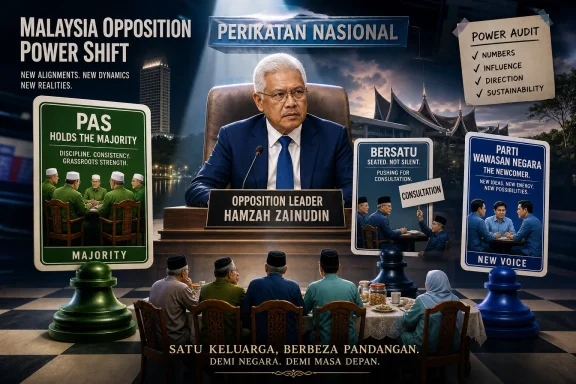 PAS Turns a Leadership Announcement Into a Power Audit
The comedy of Malaysian opposition politics is that everyone still speaks the language of coalition equality long after the arithmetic has stopped cooperating. PAS does not need to shout to be heard anymore; the numbers do that on its behalf. When Hadi announced that Hamzah would resume the Opposition Leader role, the important part was not simply Hamzah’s return. It was that PAS acted as though the matter was settled.That is what has unsettled Bersatu. The party that once looked like the pragmatic vehicle capable of making Islamist politics more electable now finds itself reduced, fragmented, and increasingly dependent on the very force it once presumed it could manage. Bersatu’s objection is therefore not merely procedural. It is existential.
Coalition politics usually rewards discretion, but this episode made the hierarchy visible. PAS, with the largest parliamentary bloc in the opposition, now behaves like the senior partner. Bersatu can object, but objection is no longer the same as leverage.
Hamzah’s position makes the story even more awkward. He was once a central Bersatu figure, then became the symbol of Bersatu’s internal rupture, and now returns under the shelter of a new party aligned with PAS. In family terms, the estranged uncle has come back to dinner with the blessing of the eldest sibling, while the smaller brother complains that nobody asked him about the seating plan.
Bersatu’s Real Problem Is Not the Announcement
The official complaint is about consultation. The political complaint is about humiliation. Bersatu can frame Hadi’s move as a breach of coalition process, but the deeper injury is that PAS has signalled it can shape the opposition bench without waiting for Bersatu’s permission.That is a brutal reversal. Bersatu was once the party of prime ministers, defectors, power brokers, and post-Sheraton calculation. It carried the aura of executive experience, even when its electoral machinery was uneven. PAS supplied grassroots discipline and ideological ballast; Bersatu supplied the promise of national acceptability.
That bargain has aged badly. PAS now has the parliamentary mass. Bersatu has the memories.
This is why the argument over Opposition Leader feels larger than one post. It is a proxy battle over who owns Perikatan Nasional’s future, who gets to define opposition strategy, and who can credibly claim to speak for Malay-Muslim voters outside the government. In that contest, Bersatu’s shrinking institutional weight matters more than its wounded tone.
Hamzah Becomes Useful Because He Solves More Than One Problem
Hamzah is not a neutral figure. He is a survivor, a tactician, and for some voters a reminder of the political manoeuvring that shaped Malaysia’s recent instability. But from PAS’s perspective, he offers something useful: he gives the opposition a parliamentary face who is not PAS.That matters. PAS is powerful, but it also knows the limits of its brand. A PAS-only opposition leadership would satisfy the party faithful, yet it could narrow the coalition’s appeal among voters wary of overt religious conservatism. Hamzah gives PAS a way to dominate without appearing to monopolise.
This is the quiet sophistication behind the move. PAS can keep the numbers, set the terms, and still let a non-PAS figure carry the parliamentary microphone. It is a classic senior-partner arrangement: control the architecture, outsource the frontage.
For Hamzah, the arrangement is equally convenient. His new party needs instant relevance, and nothing supplies relevance like the Opposition Leader’s chair. A new party without a parliamentary role risks looking like a rescue vehicle. A new party whose leader fronts the opposition becomes a potential platform.
The Smallest Brother Wants a Veto It No Longer Owns
Bersatu’s anger would be more persuasive if its numbers matched its sense of entitlement. In politics, consultation is easier to demand when one brings either seats, money, machinery, or public momentum. A party that has lost much of its internal cohesion must choose its battles carefully.Instead, Bersatu appears to be litigating status. It wants the opposition family to remember the old days, when it was indispensable. But parliamentary politics is unsentimental. Once MPs move, loyalties harden, and new alignments form, yesterday’s hierarchy becomes a museum exhibit.
The irony is that Bersatu helped create the environment in which this could happen. Its internal discipline problems, factional fights, and expulsions turned a party crisis into a coalition crisis. PAS did not need to manufacture Bersatu’s weakness; it merely had to wait for it to become obvious.
That is why the family metaphor works. The youngest sibling can still speak loudly at the reunion, but if the inheritance has already been divided, volume does not rewrite the will.
The Opposition Is Arguing About the Remote While Voters Watch the Bills
There is a limit to how much ordinary Malaysians will care about opposition seating arrangements. The country is dealing with cost-of-living pressures, economic uncertainty, and the familiar frustration that politics often feels more theatrical than productive. Against that backdrop, a fight over who announces the Opposition Leader risks looking self-indulgent.Yet the public should care about the underlying question. A functioning opposition is not a luxury. It scrutinises budgets, pressures ministers, exposes weak policy, and gives voters a credible alternative if the government fails. When the opposition is consumed by internal rank disputes, Parliament loses part of its checking function.
That is the danger here. The post of Opposition Leader is not merely ceremonial. It shapes parliamentary strategy, allocates visibility, and signals who is capable of coordinating the anti-government bench. If the opposition cannot agree on its own chain of command, it becomes easier for the government to dismiss its attacks as factional noise.
The opposition’s problem, then, is not that it has drama. All coalitions have drama. The problem is that this drama reveals a coalition still unsure whether it is a government-in-waiting or a collection of wounded parties negotiating their relative decline.
PAS Has Learned the Discipline of Patience
PAS’s rise within the opposition did not happen overnight. For years, it was treated by some partners as both essential and embarrassing: useful for rural Malay mobilisation, risky for national branding. That produced a familiar pattern in Malaysian politics, where allies wanted PAS voters but not always PAS dominance.Now PAS has turned that bargain around. It no longer needs to plead for recognition. Its parliamentary strength gives it the ability to decide which partners matter, which personalities remain useful, and which disputes can be ignored.
This does not mean PAS has solved its own national dilemma. The party still faces questions about governance, plural society politics, economic policy, and whether it can broaden beyond its traditional base without alienating that base. But within the opposition, those limitations do not erase its immediate power.
PAS’s strategy appears to be simple: consolidate the opposition under terms favourable to PAS, while allowing figures like Hamzah to occupy roles that soften the optics. That is not weakness. It is an attempt at controlled expansion.
The “Consultation” Argument Masks a Fight Over Relevance
In political disputes, process language often conceals power language. Parties rarely say, “We are angry because we are less important than before.” They say, “There should have been consultation.” They say, “Coalition spirit must be respected.” They say, “Decisions must be collective.”Those phrases are not meaningless. Coalitions do require trust. A senior partner that humiliates smaller allies too often can create resentment that later becomes sabotage. PAS may have the numbers, but numbers alone do not run a disciplined parliamentary opposition.
Still, consultation cannot become a euphemism for veto power. If every minor partner can block the largest bloc from acting, the coalition becomes hostage to its weakest component. That may feel inclusive, but it is not leadership.
Bersatu’s difficulty is that it wants the respect due to its former stature and the influence due to current strength. Politics rarely grants both. At some point, a party must decide whether it is rebuilding power or merely defending pride.
Hamzah’s Return Clarifies the Opposition’s New Map
The immediate result is that Hamzah returns to the centre of the opposition story. But the broader consequence is that Malaysia’s opposition map has shifted from a Bersatu-led framework to a PAS-weighted one, with Hamzah’s Parti Wawasan Negara serving as a new intermediary.That creates opportunities and risks. For PAS, the arrangement could stabilise the opposition by giving it a recognised parliamentary leader while preserving PAS’s strategic dominance. For Hamzah, it offers a platform to prove that his new party is more than a factional lifeboat. For Bersatu, it is a warning that the opposition may continue reorganising around it rather than with it.
The government will watch all this with interest. A divided opposition is easier to manage. But a PAS-Hamzah axis that becomes disciplined could become more formidable than the current argument suggests.
That is why the episode should not be dismissed as mere gossip. Leadership disputes are often where political futures first become visible. The question is not only who gets the title today, but who is building the machine for the next election.
The New Family Rules Are Written in Seats, Not Sentiment
The lesson from this episode is blunt, and perhaps that is why it has stung. Malaysian opposition politics is entering a phase where old assumptions no longer hold, and where the senior partner is the one with the numbers rather than the one with the most memories of power.- PAS has demonstrated that it now possesses the confidence to make major opposition decisions in public.
- Bersatu’s objections reveal how far its leverage has fallen since its days as the opposition’s central Malay-nationalist vehicle.
- Hamzah’s return gives PAS a useful non-PAS parliamentary face while giving his new party immediate relevance.
- The fight over consultation is really a fight over whether smaller partners retain veto power inside the opposition.
- Voters are unlikely to reward an opposition that appears more focused on hierarchy than on the cost of living, governance, and policy scrutiny.
References
- Primary source: Newswav
Published: 2026-06-20T04:50:18.141406
OPINION | The Opposition's New Family Drama - Newswav
Mihar Dias on Microsoft Copilot When the Smallest Brother (Bersatu) Wants Veto PowerBy Mihar Dias June 2026If Malaysian politics were a family gathering, the opnewswav.com
- Related coverage: malaymail.com
Hadi says Hamzah Zainudin to resume role as Opposition Leader | Malay Mail
KUALA LUMPUR, June 13 — Larut MP Datuk Seri Hamzah Zainudin will return as Opposition Leader just two months after relinquishing the post, PAS president Tan Sri Abdul Hadi Awang... www.malaymail.com
- Related coverage: thestar.com.my
- Related coverage: thesun.my
PAS sticks with Hamzah as Opposition Leader: Hadi
PAS confirms Hamzah Zainudin will remain Opposition Leader and Ahmad Samsuri PN chairman as Hadi Awang signals plans to strengthen support. thesun.my
- Related coverage: nst.com.my
Bersatu MPs back Hamzah Zainudin to remain opposition leader | New Straits Times
KUALA LUMPUR: Thirteen members of parliament from Bersatu have expressed support for Datuk Seri Hamzah Zainudin to remain opposition leader, despite his recent expulsion from the party.www.nst.com.my
