

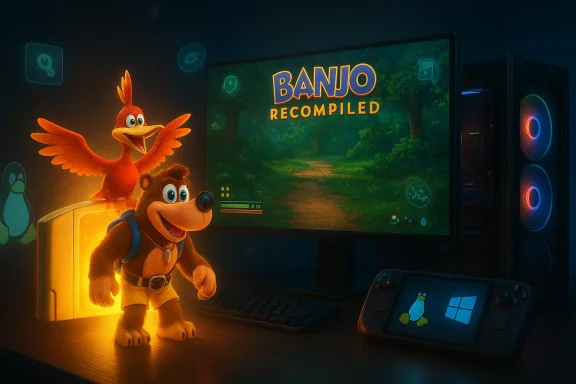
Banjo-Kazooie has been brought back to life by the community: a fan-led project called Banjo: Recompiled has released a native PC build that runs on Windows, macOS, Linux — and, yes, the Steam Deck — delivering widescreen support, uncapped framerates, modern controls, and out-of-the-box modability without relying on traditional emulation.
Banjo-Kazooie debuted on the Nintendo 64 in 1998 and quickly became one of the console’s most beloved 3D platformers, thanks to Rare’s distinctive character design, offbeat humor, and finely tuned platforming. Rare — the studio behind Banjo-Kazooie — was acquired by Microsoft in 2002, which put the IP squarely into Microsoft’s catalog. Since that acquisition, official entries and remasters of Rare’s N64-era franchises have arrived sporadically on modern platforms (notably via Rare Replay on Xbox and a later inclusion of Banjo-Kazooie on Nintendo Switch Online), but fans have long clamored for a native, modern-friendly version on PC.
That demand has now been answered — not by an official studio release, but by community developers using a technique called static recompilation to transform the original N64 binary into native code. The result is a PC port that preserves the original game logic while adding modern conveniences that players have expected for years.
This approach matters because:
Key legal and ethical points:
But there’s a tension:
Modders now have a stable native runtime to work with: replacing textures, tuning camera behavior, or producing full level‑swap mods is far easier when the game runs like a native PC title. Expect repositories of community mods, curated packs, and step‑by‑step modding guides to appear in the coming days and weeks.
For players, the experience promises smoother controls, widescreen support, and modability — all delivered in a way that feels modern while keeping the game’s original spirit intact. For preservationists and modders, this release demonstrates a realistic path forward for rescuing other N64 classics from obsolescence.
But the project also sits in a legal grey zone: it requires owners to supply ROMs and could draw attention from IP holders. Proceed with caution, obey copyright law, and expect the community and the project’s maintainers to iterate rapidly.
For now, the takeaway is simple: Banjo lives on in a new form, and the community has shown it can produce polished, modern experiences that respect the classic game — even without an official remaster. Whether this momentum leads to official engagement, wider preservation tools, or legal pushback remains to be seen.
Source: Windows Central Banjo-Kazooie fan-made PC version now playable on Steam Deck
 Background
Banjo-Kazooie debuted on the Nintendo 64 in 1998 and quickly became one of the console’s most beloved 3D platformers, thanks to Rare’s distinctive character design, offbeat humor, and finely tuned platforming. Rare — the studio behind Banjo-Kazooie — was acquired by Microsoft in 2002, which put the IP squarely into Microsoft’s catalog. Since that acquisition, official entries and remasters of Rare’s N64-era franchises have arrived sporadically on modern platforms (notably via Rare Replay on Xbox and a later inclusion of Banjo-Kazooie on Nintendo Switch Online), but fans have long clamored for a native, modern-friendly version on PC.That demand has now been answered — not by an official studio release, but by community developers using a technique called static recompilation to transform the original N64 binary into native code. The result is a PC port that preserves the original game logic while adding modern conveniences that players have expected for years.
Overview: What is Banjo: Recompiled?
- Banjo: Recompiled is a community-created native port of the original Banjo-Kazooie N64 binary.
- The project uses the static recompilation toolchain developed under the N64: Recompiled umbrella and pairs it with a modern renderer (RT64) to produce builds that run on Windows, Linux, and macOS.
- The release is distributed without the game’s original assets — players must supply their own legally obtained ROM — and ships with prebuilt binaries and source code for users who want to build from scratch.
- The initial public release landed as a v1.0.0 build and includes platform-specific guidance for Linux installs and Steam Deck usage.
How static recompilation works (and why it matters)
The technical idea in plain terms
Static recompilation reads a compiled binary (the N64 ROM) and translates machine instructions into equivalent C code. The recompiled C is then combined with a runtime that implements hardware-specific services (memory, peripheral interfaces, audio/video pipelines) and compiled on modern systems. The recompiled executable runs directly on your PC’s OS and hardware rather than running inside an emulator that reproduces N64 hardware behavior at runtime.This approach matters because:
- Performance: Native execution removes the interpreter or dynamic recompiler layer found in most emulators, which reduces runtime overhead and input latency.
- Extensibility: Once the game runs as native code, the community can inject modern renderers, widescreen fixes, and QoL patches more easily than trying to patch a black-box emulator.
- Preservation of logic: When done carefully, static recompilation preserves the game’s original logic and timing at a source-code-like level, which helps avoid behavior differences that can crop up when simply running at higher framerates in an emulator.
Trade-offs and caveats
Static recompilation is not a magic bullet. Translating machine code into C is an automated, literal process and is subject to:- Edge-case behavior: Certain low-level tricks or timing-dependent hardware behaviors can be difficult to reproduce exactly. For a small number of games or effects, inaccuracies may appear.
- Compatibility constraints: Recompiled builds are often tailored to a particular ROM revision (for example, the US 1.0 release), so mismatched ROMs or patched files may not work correctly.
- Maintenance burden: Native builds must be maintained across multiple OS and GPU stacks; the community must handle driver quirks and platform-specific fixes.
What’s new in this release: features and improvements
Banjo: Recompiled packages a number of tangible upgrades that target the biggest complaints of modern players trying to run N64-era titles today. Key highlights include:- Uncapped and high framerate support: The port can run well beyond the original N64 framerate, with many reported setups hitting 60 FPS, 120 FPS, and higher depending on hardware.
- Widescreen and ultrawide support: The renderer and game-layer changes allow arbitrary aspect ratios so 16:9 and ultrawide displays look correct without letterboxing or awkward pillarboxing.
- Lower input latency: Native execution and targeted buffering improvements reduce responsiveness compared with some emulator configurations.
- Modern control mapping: Dual-analog camera control and rebindable inputs bring the game in line with contemporary controller expectations.
- Faster load times and instant transitions: Desktop hardware and the port’s runtime yield much shorter wait times.
- Mod and texture pack support: The release is designed with mods in mind, including compatibility with texture replacements and other community-made “full conversion” mods showcased by the team.
- Steam Deck / Linux support: The project includes a Linux binary and Flatpak, plus explicit instructions for adding the Linux build to Steam on the Deck via Desktop Mode for handheld play.
The rendering stack: RT64 and why it’s important
A large part of the visual and performance upgrade comes via RT64 — a modern N64 renderer built for Vulkan, Direct3D 12, and Metal. RT64 is designed to be accurate to the original RDP/RSP behavior while enabling modern features such as:- Deferred and dual-renderer approaches: RT64 maintains a native-resolution renderer for correctness while running a separate high-resolution renderer for visual output so gameplay logic that reads framebuffers stays consistent.
- Ubershaders and minimized stuttering: Precompiled shader strategies reduce pipeline-generated stutter on modern GPUs.
- Framebuffer detection and reinterpretation: Preserves tricky N64 effects while enabling upscaling or reinterpretation at higher resolutions.
- Texture replacement and streaming: Support for HD texture packs without breaking the game’s internal indexing.
- Frame interpolation and motion-vector research: Experimental features can generate additional frames or reconstruct motion for smoother visuals in high-framerate modes.
Platform support and Steam Deck specifics
This release ships with binaries for multiple platforms and explicit directions for portable play:- Windows and macOS: Native builds are provided. On macOS, ARM/Apple Silicon support is available but certain full-conversion mods may only run under x86 compatibility (Rosetta) at present.
- Linux & Steam Deck: A Linux binary and a Flatpak are included. For Steam Deck, the recommended approach is:
- Switch the Deck to Desktop Mode.
- Place the Linux build or Flatpak on your device.
- Right‑click the executable and choose “Add to Steam” (or add the Flatpak through the app store).
- Return to Gaming Mode and launch Banjo via Steam as a non‑Steam game.
- When prompted by the in-game launcher, point the port to your legally obtained ROM file.
Legal and ethical checklist — what players need to know
This is the most important practical section for anyone considering trying Banjo: Recompiled. The project is a community-made transformation of Nintendo 64 game code; it does not include copyrighted game assets (graphics, music, levels). The developers distribute the runtime and tools only; running the port requires you to supply your own ROM.Key legal and ethical points:
- You must own the original game to stay on solid ground. The port expects the user to provide the N64 ROM, and the responsible, lawful method is to extract (rip) the ROM from a cartridge you own.
- Distribution of copyrighted assets is illegal. The project avoids distributing protected assets, but sharing or downloading ROM images from third‑party sites may infringe copyright and expose you to legal risk.
- IP holder actions are unpredictable. While some IP owners tolerate fan projects, others have historically issued DMCA takedowns on fan-made remakes and remasters. Fans should be aware of precedent and that hosting or distributing the port’s required ROMs is a separate legal matter from using the recompiled runtime.
- Antivirus false positives: Community reports indicate some builds can trigger antivirus detections. The developers warn these are false positives for authentic releases and recommend downloading only official GitHub releases and adding exclusions if necessary. Still, treat any executable you download carefully and verify checksums where provided.
Preservation vs. piracy — why the community is acting now
The rise of static recompilation tools has lowered the technical barrier for creating playable native ports of N64 classics. For preservation-minded gamers, this is a breakthrough: titles that are locked behind aging hardware or limited platform re-releases can be made playable on modern systems with preservation-focused enhancements.But there’s a tension:
- On one hand, community projects preserve playability and make otherwise hard-to-access games usable on modern devices.
- On the other hand, these projects exist in a grey legal space when they require or encourage users to extract or share copyrighted ROMs.
Risks, technical pitfalls, and what to watch for
- Timing-sensitive gameplay: Some small systems or minigames in N64 titles rely on precise timing. High-framerate operation or naive interpolation can introduce subtle differences in behavior. The project aims to preserve original logic, but players should expect edge-case bugs.
- Driver and GPU quirks: Reports around the release point to Intel integrated GPU driver caveats. Keep system drivers current and follow platform-specific instructions.
- Antivirus alerts and false positives: The portability of community builds means antivirus engines sometimes flag them. Use checksums provided by the project and trusted download channels.
- Legal takedowns: The IP owner could request takedowns or issue legal notices if they view the project as infringing. This risk is real and historically supported by prior fan project takedowns from major publishers.
- Compatibility with mods: Full conversion mods and texture packs may be platform-dependent or require specific mod managers. Expect iterative updates as the community stabilizes mod workflows across Windows, macOS, and Linux.
Installation and best-practice steps for PC and Steam Deck users
- Confirm you legally own the original N64 cartridge.
- Download the official Banjo: Recompiled v1.0.0 release from the project’s primary repository releases page.
- If you’re on Windows, extract and run the provided Windows binary; on macOS, use the build appropriate for your CPU architecture; on Linux/Steam Deck, use the Flatpak or Linux binary as instructed.
- Provide the required ROM file when prompted by the game’s launcher. Use the exact ROM revision the release expects (the project’s README typically specifies which version).
- Update GPU drivers to the latest vendor releases (especially Intel users).
- Add the executable to Steam (if you want to use Gaming Mode on Steam Deck) via Desktop Mode, and then launch from Gaming Mode.
- If antivirus flags the build, verify checksums and the release page notes; add an exclusion only after verifying authenticity.
- For mods, use the in-game mod menu or community-recommended mod managers and follow each mod’s installation instructions.
Community reaction and modding prospects
The fan community has responded enthusiastically. Within hours of the release, modders and texture artists began publishing widescreen-friendly textures, camera improvements, and larger “conversion” mods. The port’s explicit support for modding — coupled with RT64’s texture streaming and replacement capabilities — means we’re likely to see a rapid burst of content, from simple QoL patches to ambitious remakes.Modders now have a stable native runtime to work with: replacing textures, tuning camera behavior, or producing full level‑swap mods is far easier when the game runs like a native PC title. Expect repositories of community mods, curated packs, and step‑by‑step modding guides to appear in the coming days and weeks.
Critical analysis: strengths, limits, and long-term implications
Strengths
- Practical preservation: Banjo: Recompiled demonstrates a workable path for bringing N64-era classics to modern systems without waiting for official remasters.
- Quality-of-life modernization: Dual-analog support, widescreen, and reduced latency are genuine user-facing improvements that modernize the experience without fundamentally altering the game.
- Mod ecosystem potential: Native ports are a far better substrate for modding than emulator-level hacks; the community can build robust tooling around a native runtime.
- Platform reach: Linux and Steam Deck support is particularly noteworthy, since portable playability is a longtime ask among retro fans.
Limits and risks
- Legal uncertainty: The project depends on users supplying copyrighted ROMs. IP owners have historically acted against fan projects; that risk remains.
- Technical fidelity edge cases: Recompilation is powerful but not perfect; a sliver of gameplay or audiovisual behavior may differ from the original in edge cases.
- Maintenance burden: Cross-platform native builds require ongoing maintenance. The community will need to keep releases current with driver and OS changes, or users will run into issues over time.
Long-term implications
If community projects like this continue to succeed and produce stable, high-quality ports, the game industry may be forced to rethink how it addresses preservation and re-releases. Publishers could respond in several ways:- Embrace and collaborate: Some publishers might see fan efforts as a sign of interest and opt to cooperate, offering official remasters or licensing tools.
- Enforce IP: Others may continue to issue takedowns and push for stricter enforcement of existing copyrights.
- Open-source engagement: A third route would be to provide sanctioned tools or archive programs that enable preservation in partnership with fan communities.
Final verdict
Banjo: Recompiled is a technical and cultural milestone for N64 preservation and fan-driven ports. It blends a pragmatic engineering approach (static recompilation) with a modern rendering stack (RT64) to produce a playable, upgradeable native version of a cherished classic — and crucially, it runs on devices the original audience actually uses today, including the Steam Deck.For players, the experience promises smoother controls, widescreen support, and modability — all delivered in a way that feels modern while keeping the game’s original spirit intact. For preservationists and modders, this release demonstrates a realistic path forward for rescuing other N64 classics from obsolescence.
But the project also sits in a legal grey zone: it requires owners to supply ROMs and could draw attention from IP holders. Proceed with caution, obey copyright law, and expect the community and the project’s maintainers to iterate rapidly.
For now, the takeaway is simple: Banjo lives on in a new form, and the community has shown it can produce polished, modern experiences that respect the classic game — even without an official remaster. Whether this momentum leads to official engagement, wider preservation tools, or legal pushback remains to be seen.
Source: Windows Central Banjo-Kazooie fan-made PC version now playable on Steam Deck
