
Adobe announced Adobe Brand Visibility on June 17, 2026, positioning the new enterprise marketing product as a way for businesses to measure and improve how their brands appear across AI tools such as ChatGPT, Google AI Mode, Microsoft Copilot, and Perplexity AI. The product folds Semrush’s AI search capabilities into Adobe’s LLM Optimizer and places the combined system inside Adobe CX Enterprise. The pitch is simple, and deliberately ambitious: if customers are now asking an AI assistant before they ever visit a website, the old search playbook is no longer enough. For WindowsForum readers, the interesting part is not merely another Adobe product launch; it is the way AI discovery is becoming a managed enterprise surface, much like browsers, endpoints, email, identity, and analytics before it.
Adobe’s new Brand Visibility product is not being sold as a dashboard for curious marketers. It is being framed as infrastructure for a customer journey that increasingly begins outside a company’s owned website, outside its app, and often outside the familiar search-results page. That is a meaningful shift in Adobe’s language and, more importantly, in its assumed buyer.
The company says Brand Visibility combines Adobe LLM Optimizer with Semrush’s AI Optimization, giving brands a way to monitor prompts, competitive mentions, share of voice, content gaps, and downstream business impact. In practical terms, Adobe wants marketing teams to treat AI answers as a channel that can be audited, optimized, and tied back to revenue. This is not search engine optimization with a new acronym slapped on top; it is the attempt to operationalize generative engine optimization inside a larger enterprise software stack.
The Adobe claim that will get the most attention is the traffic growth. The company says AI traffic to U.S. retail sites rose 1,324 percent between October 2024 and May 2026, while AI traffic in travel rose 2,215 percent over the same period. Those are dramatic percentages, and they serve Adobe’s narrative well: AI referrals may still represent a small slice of overall web traffic, but they are growing quickly enough that large brands cannot ignore them.
The more strategic point is where Adobe places this product. Brand Visibility is part of Adobe CX Enterprise, the company’s broader push to turn customer acquisition, engagement, conversion, and loyalty into an AI-assisted workflow. That means the new product is not just about seeing whether a brand appears in an AI answer. It is about connecting that appearance to web analytics, content management, commerce systems, customer profiles, and agentic recommendations.
That is why this announcement matters beyond the marketing department. Adobe is betting that AI discovery will become another enterprise system of record. Once that happens, CIOs, security teams, data-governance leads, and platform owners will be pulled into a conversation that once belonged mostly to SEO specialists and campaign managers.
Semrush gives Adobe something it did not have at comparable scale: a long history of measuring how brands appear across the open web. Adobe brings the enterprise plumbing around content, analytics, identity, commerce, and campaign execution. The combined pitch is that brands can not only diagnose where they are invisible to AI systems, but also change their content and measure the business result.
That last part is what separates Adobe’s enterprise story from the emerging market of smaller AI visibility tools. A standalone product can tell a company that ChatGPT recommends a competitor more often for “best family resorts in Florida” or “best endpoint protection for small business.” Adobe wants to tell the same company which content to change, push that change through Adobe Experience Manager, measure the impact in Adobe Analytics, and eventually connect the result to bookings, pipeline, or revenue.
This is classic Adobe strategy. The company rarely wants to be a tool in isolation if it can instead become a workflow hub. Creative Cloud did this for content creation, Experience Cloud did it for digital marketing, and CX Enterprise is the current attempt to do it for AI-assisted customer operations.
There is a risk in that strategy, however. The more Adobe integrates Semrush into an enterprise bundle, the more it may alienate some of the practitioners who made Semrush valuable in the first place. SEO teams, agencies, and independent consultants have long used Semrush because it was a practical research tool, not because it was part of a sprawling customer-experience platform. If Adobe steers too aggressively toward top-down enterprise packaging, it may strengthen the product for Fortune 500 buyers while making it less accessible to smaller teams.
Still, the logic is unmistakable. Adobe did not buy Semrush merely to own a conventional SEO company. It bought a data and visibility layer for a world in which discovery is mediated by models, agents, and answer engines.
AI search blurs that chain. A user may ask a chatbot for a shortlist, refine the request conversationally, compare products inside the same interface, and click through only after the field has already narrowed. By the time the user reaches a brand’s website, the most important persuasion may have already happened elsewhere.
That is why Adobe’s example of a travel brand being recommended—or not recommended—by ChatGPT is more than marketing copy. Travel is one of the most natural use cases for AI-assisted discovery because it involves vague intent, many constraints, subjective preferences, and a high cost of comparison. A user does not want ten blue links for “three-day family trip in Lisbon with kids and no car.” The user wants an answer.
Retail is similar, though the mechanics differ. Product discovery increasingly happens in a messy blend of marketplace search, social recommendations, short-form video, AI summaries, browser assistants, review aggregators, and chat interfaces. The website remains important, but it is no longer guaranteed to be the first meaningful brand encounter.
For IT pros, this should sound familiar. Enterprise software has spent years moving from visible interfaces to brokered experiences. Users do not always open a dedicated app; they interact through Teams, Slack, Copilot, a browser sidebar, a mobile notification, or a workflow automation. Marketing is now facing a comparable abstraction layer, except the broker is an AI system that may summarize, rank, omit, or recommend without exposing the full logic behind the answer.
That opacity is the heart of the problem Adobe wants to monetize. If a brand does not know when it appears in AI answers, which prompts trigger it, why competitors appear instead, or whether the answer is accurate, then it cannot manage the channel. Adobe’s answer is to instrument the channel as much as possible and tie the results back to enterprise workflows.
In the consumer context, Copilot and AI-enabled browsers can shape product discovery much like ChatGPT or Perplexity. In the enterprise context, the stakes become more complicated. Employees may ask AI assistants for vendor comparisons, procurement research, software recommendations, troubleshooting paths, compliance summaries, or competitive intelligence. The answer may draw from the public web, internal tenant data, licensed content, or a mix of sources depending on the tool and configuration.
That means brand visibility is not just about convincing shoppers. It is also about how organizations are represented to employees, partners, procurement teams, and customers using AI assistants at work. A software vendor that is poorly described by AI systems may lose consideration before it ever reaches a formal RFP. A security vendor whose documentation is hard for AI crawlers to interpret may appear weaker than a competitor with clearer, better-structured content.
Windows administrators should also recognize the governance angle. AI discovery touches browser policy, data leakage, identity boundaries, endpoint controls, and approved toolchains. If employees use consumer AI services for product research, the organization may have little control over what data is entered, what answers are returned, or how those answers influence buying decisions. If employees use managed Microsoft 365 Copilot or Edge for Business experiences, IT has more levers, but also more responsibility.
Adobe’s announcement does not solve those governance issues. It does, however, reinforce that AI surfaces are becoming business-critical channels. Once marketing leaders start asking why the company is underrepresented in Copilot answers, IT teams may find themselves in discussions about crawlability, browser defaults, content access, AI tool approval, and telemetry.
The boundary between marketing technology and workplace technology is getting thinner. Adobe is approaching the problem from the customer-experience side. Microsoft is approaching it from productivity, search, and operating-system integration. Enterprises will live in the overlap.
Adobe’s product framing suggests a more sober version of the discipline. Brand Visibility is supposed to show marketers which prompts they win or lose, how often they are mentioned, where competitors are ahead, and which content gaps matter. That resembles traditional SEO in spirit, but the object of optimization is different. Instead of ranking for a keyword on a results page, the brand is trying to be accurately represented in a generated answer.
That distinction is important. Traditional SEO often focused on visible ranking positions, snippets, backlinks, technical performance, and content relevance. GEO has to care about whether a model can understand the entity, trust the source, reconcile conflicting information, and use the brand appropriately in a synthesized response. The model may not show ten results. It may show three recommendations, one paragraph, or no citation at all.
This does not make old SEO obsolete. Quite the opposite: clean site architecture, structured data, authoritative content, fast pages, consistent naming, and well-maintained documentation become more important when AI systems are trying to interpret the web at scale. A messy website that was merely annoying for human visitors can become invisible or misleading to AI systems.
The same logic applies to enterprise documentation. Product pages, support articles, changelogs, pricing explanations, compatibility matrices, API documentation, and security whitepapers are not just human collateral anymore. They are training, retrieval, and summarization inputs for systems that may influence buying decisions. Companies that treat documentation as an afterthought will be punished twice: first by users, then by the AI systems those users increasingly consult.
Adobe is therefore selling a management layer on top of a broader operational truth. Visibility in AI answers begins with content discipline. No dashboard can permanently compensate for stale, contradictory, thin, or inaccessible information.
In classic search, keyword data was the strategic raw material. Marketers wanted to know what users typed, how often they typed it, how competitive the query was, and which pages ranked. In AI discovery, prompts are longer, more contextual, and more revealing. A prompt may include intent, constraints, preferences, budget, location, and comparison criteria in a single request.
That makes prompt data more valuable and harder to normalize. “Best laptop for college” is a keyword. “I need a lightweight Windows laptop for engineering classes, good battery life, under $1,200, not too flashy, available before August” is closer to a buying brief. If Adobe can help brands understand those longer patterns at scale, it gives marketers a new map of demand.
The privacy and provenance questions are inevitable. Adobe says the system draws on real-world AI search prompts, but enterprise buyers will want clarity about how those prompts are collected, anonymized, licensed, filtered, and geographically segmented. In a world where prompts can contain sensitive personal or business context, the data supply chain matters.
There is also the question of representativeness. AI users are not a perfect proxy for all customers. Early adopters, younger consumers, professionals, researchers, and high-intent buyers may be overrepresented depending on the surface and sector. If a brand over-optimizes for AI prompt data without comparing it against broader analytics, it may mistake a fast-growing channel for the whole market.
Adobe’s advantage is that it can position Brand Visibility alongside first-party data from owned channels. That is the right answer conceptually. AI prompt intelligence becomes more useful when compared with website behavior, campaign performance, conversion paths, and customer profiles. The risk is that the resulting stack becomes so powerful and so complex that only the largest enterprises can operationalize it.
For marketing teams under pressure to move faster, this is appealing. AI discovery is volatile, and manual analysis will not scale if companies are trying to monitor thousands or millions of prompt variations across multiple AI surfaces. A recommendation engine that identifies content gaps and prioritizes fixes could save real time.
But “deploy updates in minutes” is also where governance enters. Content changes affect brand voice, legal claims, regulated disclosures, accessibility, localization, SEO, security, and customer expectations. A hotel chain can adjust destination content quickly; a financial services company cannot casually rewrite product claims without compliance review. A healthcare provider has even less room for improvisation.
Adobe will almost certainly argue that enterprise workflows, permissions, approvals, and analytics can manage those risks. That may be true for disciplined organizations. But the temptation will be to turn the system into a content treadmill: identify prompt gaps, generate updates, publish rapidly, measure movement, repeat. The web is already full of low-value SEO content created to satisfy search algorithms. GEO could repeat that mistake at AI scale.
The better use of agentic recommendations is not to flood the web with AI-shaped filler. It is to identify where the company’s real expertise is missing, unclear, inaccessible, or badly structured. A recommendation that says “create a clearer comparison page for this product category” can be valuable. A recommendation that says “rewrite every page to mention these prompt phrases” is a warning sign.
This is where enterprise buyers need to be blunt with vendors. The goal should be accurate representation, not answer-engine manipulation. Brands that try to pollute AI systems with synthetic relevance may win short-term mentions and lose long-term trust.
The optimization side is harder. AI answers are generated by systems whose rankings, retrieval methods, partnerships, model versions, and safety layers change constantly. A tactic that improves visibility in one surface may do nothing in another. A brand may appear in ChatGPT for a set of prompts but not in Google AI Mode, or may be cited by Perplexity but omitted by Copilot.
That fragmentation makes Adobe’s cross-surface pitch compelling. If the product can show differences across ChatGPT, Google AI Mode, Microsoft Copilot, and Perplexity AI, marketers can stop treating “AI search” as a single channel. Each surface has its own user base, interface, retrieval behavior, and commercial context.
Still, no vendor can fully control the last mile. Adobe can help brands produce clearer content, measure outcomes, and compare visibility. It cannot guarantee that an AI model will recommend a brand, cite a page, or preserve a message exactly as written. That uncertainty should be part of the buying conversation.
The better analogy is security posture management, not paid search. A company can reduce exposure, fix misconfigurations, improve controls, and monitor changes, but it cannot eliminate risk. Likewise, Brand Visibility can improve a company’s readiness for AI discovery, but it cannot make the AI ecosystem deterministic.
That distinction matters because marketing technology is often sold with the language of control. AI discovery will resist that language. Enterprises should buy tools that improve observability and operational discipline, not promises of guaranteed placement inside someone else’s model.
This problem is not new. Search engines have long rewarded technical clarity, semantic structure, and crawlable content. But AI raises the bar because it does not merely index a page; it may summarize relationships, compare entities, answer follow-up questions, and infer suitability. Ambiguity that once cost a ranking position can now distort a recommendation.
For Windows and enterprise software vendors, the issue is especially acute. Product pages are often full of naming complexity, licensing caveats, compatibility conditions, deployment models, and security claims. If those details are scattered across PDFs, gated portals, marketing pages, and old blog posts, AI systems may produce incomplete or outdated answers.
The same is true for support content. AI assistants are increasingly used for troubleshooting, which means documentation needs to be structured, current, and explicit. A support page that assumes context or hides critical information behind scripts can fail both users and AI retrieval systems. The cleaner the content, the better the chance that an assistant will summarize it correctly.
Adobe’s Brand Visibility does not directly fix a company’s information architecture. But by measuring where AI systems fail to recognize or recommend a brand, it may expose the cost of neglected content operations. That could be healthy. Many organizations need a business reason to fund documentation, structured data, taxonomy cleanup, and content governance.
If GEO has a constructive future, it is this: not tricking models, but making the public web more intelligible.
Data access will be the first issue. Which teams can see prompt intelligence? Which teams can connect it to conversion data? Can agencies access it? Does the system process customer data, campaign data, or proprietary content? How are permissions mapped to existing identity providers? These are not glamorous questions, but they decide whether the tool becomes a trusted platform or another shadow stack.
Security will be the second issue. Any platform that recommends content changes based on competitive and customer signals becomes a sensitive system. If compromised, it could reveal strategy, campaign priorities, market weaknesses, or future positioning. If misconfigured, it could expose data across teams or regions.
Compliance will be the third issue. Regulated industries cannot let AI-generated recommendations drift into unsupported claims. Even non-regulated companies must care about trademark use, comparative advertising, localization, accessibility, and records retention. The more automated the workflow, the more important the audit trail becomes.
The fourth issue is vendor lock-in. Adobe’s strongest argument is integration; its biggest risk is also integration. Once Brand Visibility is tied to Adobe Analytics, Adobe Experience Manager, Adobe Experience Platform, Adobe Commerce, and CX Enterprise workflows, leaving becomes harder. Enterprises may accept that tradeoff, but they should do so consciously.
This is not an argument against Adobe. It is an argument for treating AI visibility as enterprise architecture, not campaign decoration. The companies that manage it well will involve IT, legal, security, marketing, analytics, and content teams early. The companies that manage it poorly will discover that AI search optimization can create the same sprawl, duplication, and governance headaches that earlier waves of marketing technology already produced.
This is where the Semrush acquisition becomes delicate. Semrush has long served a wide market that includes agencies, freelancers, in-house SEO teams, and smaller companies. Adobe’s enterprise motion could make the combined technology more powerful, but also more expensive and more organizationally demanding. The fear among some practitioners is predictable: a useful independent tool becomes part of a larger suite optimized for bigger customers.
At the same time, smaller teams may benefit indirectly. When a company like Adobe legitimizes GEO, it pushes the broader market to build better tools, clearer practices, and more standardized metrics. Competing vendors will sharpen their own offerings. Agencies will develop services around AI visibility. Content management systems will add machine-readability checks. The discipline will not remain exclusive to Adobe customers.
The challenge is that small businesses are often the most vulnerable to shifts in discovery. A large brand can survive being underrepresented in AI answers for a while because it has advertising, distribution, partnerships, and recognition. A smaller brand may depend heavily on being discovered at the moment of intent. If AI assistants narrow recommendations to familiar incumbents, the web could become less open.
That is the uncomfortable competitive question behind the product category. Will AI discovery surface better niche answers, or will it reinforce the brands that already have the most content, citations, and enterprise optimization budgets? Adobe’s product helps paying customers compete in that system. It does not answer whether the system itself will be fair.
They will also separate measurement from panic. A brand that loses a set of prompts to a competitor should not immediately flood its site with reactive content. It should ask whether the competitor has better information, stronger authority, clearer comparisons, more recent documentation, or simply more machine-readable pages. Sometimes the answer will be a tactical content fix. Sometimes it will reveal a real product or positioning weakness.
This is where Adobe’s analytics integration could be valuable. AI visibility without business context can become vanity measurement. A brand may appear often in AI answers that do not convert, or lose prompts that have little commercial value. Conversely, a small cluster of high-intent prompts may matter more than broad mention frequency.
The hard part will be attribution. If a user asks an AI assistant for research, visits several websites, returns through search, and converts days later, which channel gets credit? Adobe has spent years selling tools for exactly that kind of messy customer journey. AI makes the journey messier still.
That messiness does not invalidate the effort. It simply means companies should be skeptical of clean dashboards that imply more certainty than the ecosystem allows. The future of AI visibility measurement will be probabilistic, comparative, and directional. That is still better than flying blind.
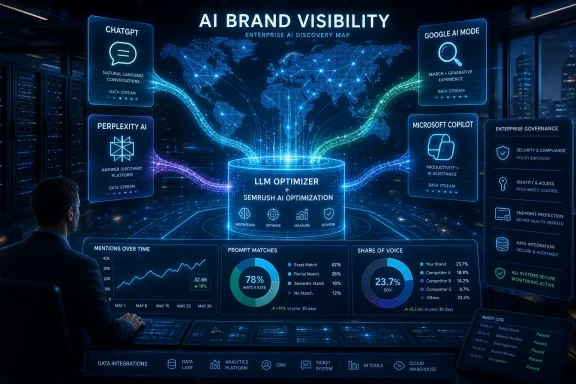 Adobe Is Turning AI Search Into an Enterprise Control Plane
Adobe’s new Brand Visibility product is not being sold as a dashboard for curious marketers. It is being framed as infrastructure for a customer journey that increasingly begins outside a company’s owned website, outside its app, and often outside the familiar search-results page. That is a meaningful shift in Adobe’s language and, more importantly, in its assumed buyer.The company says Brand Visibility combines Adobe LLM Optimizer with Semrush’s AI Optimization, giving brands a way to monitor prompts, competitive mentions, share of voice, content gaps, and downstream business impact. In practical terms, Adobe wants marketing teams to treat AI answers as a channel that can be audited, optimized, and tied back to revenue. This is not search engine optimization with a new acronym slapped on top; it is the attempt to operationalize generative engine optimization inside a larger enterprise software stack.
The Adobe claim that will get the most attention is the traffic growth. The company says AI traffic to U.S. retail sites rose 1,324 percent between October 2024 and May 2026, while AI traffic in travel rose 2,215 percent over the same period. Those are dramatic percentages, and they serve Adobe’s narrative well: AI referrals may still represent a small slice of overall web traffic, but they are growing quickly enough that large brands cannot ignore them.
The more strategic point is where Adobe places this product. Brand Visibility is part of Adobe CX Enterprise, the company’s broader push to turn customer acquisition, engagement, conversion, and loyalty into an AI-assisted workflow. That means the new product is not just about seeing whether a brand appears in an AI answer. It is about connecting that appearance to web analytics, content management, commerce systems, customer profiles, and agentic recommendations.
That is why this announcement matters beyond the marketing department. Adobe is betting that AI discovery will become another enterprise system of record. Once that happens, CIOs, security teams, data-governance leads, and platform owners will be pulled into a conversation that once belonged mostly to SEO specialists and campaign managers.
The Semrush Deal Was the Setup, Not the Side Story
Adobe completed its acquisition of Semrush in April 2026, after announcing the deal in late 2025. At the time, the rationale was easy to summarize: Adobe had a large enterprise customer experience stack, while Semrush had a large footprint in search visibility, competitive intelligence, and marketing analytics. Brand Visibility is the first clear sign of how Adobe intends to turn that acquisition into product gravity.Semrush gives Adobe something it did not have at comparable scale: a long history of measuring how brands appear across the open web. Adobe brings the enterprise plumbing around content, analytics, identity, commerce, and campaign execution. The combined pitch is that brands can not only diagnose where they are invisible to AI systems, but also change their content and measure the business result.
That last part is what separates Adobe’s enterprise story from the emerging market of smaller AI visibility tools. A standalone product can tell a company that ChatGPT recommends a competitor more often for “best family resorts in Florida” or “best endpoint protection for small business.” Adobe wants to tell the same company which content to change, push that change through Adobe Experience Manager, measure the impact in Adobe Analytics, and eventually connect the result to bookings, pipeline, or revenue.
This is classic Adobe strategy. The company rarely wants to be a tool in isolation if it can instead become a workflow hub. Creative Cloud did this for content creation, Experience Cloud did it for digital marketing, and CX Enterprise is the current attempt to do it for AI-assisted customer operations.
There is a risk in that strategy, however. The more Adobe integrates Semrush into an enterprise bundle, the more it may alienate some of the practitioners who made Semrush valuable in the first place. SEO teams, agencies, and independent consultants have long used Semrush because it was a practical research tool, not because it was part of a sprawling customer-experience platform. If Adobe steers too aggressively toward top-down enterprise packaging, it may strengthen the product for Fortune 500 buyers while making it less accessible to smaller teams.
Still, the logic is unmistakable. Adobe did not buy Semrush merely to own a conventional SEO company. It bought a data and visibility layer for a world in which discovery is mediated by models, agents, and answer engines.
Search Is No Longer Just a Page of Links
The old search bargain was imperfect but legible. A user typed a query, a search engine ranked pages, and a brand fought for placement through content quality, authority, technical structure, and sometimes paid ads. The browser, the search engine, the website, and the analytics stack each had recognizable roles.AI search blurs that chain. A user may ask a chatbot for a shortlist, refine the request conversationally, compare products inside the same interface, and click through only after the field has already narrowed. By the time the user reaches a brand’s website, the most important persuasion may have already happened elsewhere.
That is why Adobe’s example of a travel brand being recommended—or not recommended—by ChatGPT is more than marketing copy. Travel is one of the most natural use cases for AI-assisted discovery because it involves vague intent, many constraints, subjective preferences, and a high cost of comparison. A user does not want ten blue links for “three-day family trip in Lisbon with kids and no car.” The user wants an answer.
Retail is similar, though the mechanics differ. Product discovery increasingly happens in a messy blend of marketplace search, social recommendations, short-form video, AI summaries, browser assistants, review aggregators, and chat interfaces. The website remains important, but it is no longer guaranteed to be the first meaningful brand encounter.
For IT pros, this should sound familiar. Enterprise software has spent years moving from visible interfaces to brokered experiences. Users do not always open a dedicated app; they interact through Teams, Slack, Copilot, a browser sidebar, a mobile notification, or a workflow automation. Marketing is now facing a comparable abstraction layer, except the broker is an AI system that may summarize, rank, omit, or recommend without exposing the full logic behind the answer.
That opacity is the heart of the problem Adobe wants to monetize. If a brand does not know when it appears in AI answers, which prompts trigger it, why competitors appear instead, or whether the answer is accurate, then it cannot manage the channel. Adobe’s answer is to instrument the channel as much as possible and tie the results back to enterprise workflows.
Microsoft Copilot Makes This a Windows Story
At first glance, Adobe Brand Visibility looks like a marketing-cloud story, not a Windows story. But Microsoft Copilot is one of the AI surfaces Adobe specifically names, and that matters. Microsoft has spent the last several years embedding Copilot into Windows, Edge, Microsoft 365, Bing, and enterprise productivity workflows. That makes AI-mediated discovery part of the environment many Windows users and administrators already manage.In the consumer context, Copilot and AI-enabled browsers can shape product discovery much like ChatGPT or Perplexity. In the enterprise context, the stakes become more complicated. Employees may ask AI assistants for vendor comparisons, procurement research, software recommendations, troubleshooting paths, compliance summaries, or competitive intelligence. The answer may draw from the public web, internal tenant data, licensed content, or a mix of sources depending on the tool and configuration.
That means brand visibility is not just about convincing shoppers. It is also about how organizations are represented to employees, partners, procurement teams, and customers using AI assistants at work. A software vendor that is poorly described by AI systems may lose consideration before it ever reaches a formal RFP. A security vendor whose documentation is hard for AI crawlers to interpret may appear weaker than a competitor with clearer, better-structured content.
Windows administrators should also recognize the governance angle. AI discovery touches browser policy, data leakage, identity boundaries, endpoint controls, and approved toolchains. If employees use consumer AI services for product research, the organization may have little control over what data is entered, what answers are returned, or how those answers influence buying decisions. If employees use managed Microsoft 365 Copilot or Edge for Business experiences, IT has more levers, but also more responsibility.
Adobe’s announcement does not solve those governance issues. It does, however, reinforce that AI surfaces are becoming business-critical channels. Once marketing leaders start asking why the company is underrepresented in Copilot answers, IT teams may find themselves in discussions about crawlability, browser defaults, content access, AI tool approval, and telemetry.
The boundary between marketing technology and workplace technology is getting thinner. Adobe is approaching the problem from the customer-experience side. Microsoft is approaching it from productivity, search, and operating-system integration. Enterprises will live in the overlap.
The New Acronym Is GEO, but the Old Discipline Still Matters
Generative engine optimization is a useful phrase because it names a real change. But like many useful phrases, it will quickly attract hype, vendors, dubious playbooks, and magical thinking. The danger is that companies will treat GEO as a way to game AI systems rather than as a forcing function to make their content clearer, more authoritative, and more machine-readable.Adobe’s product framing suggests a more sober version of the discipline. Brand Visibility is supposed to show marketers which prompts they win or lose, how often they are mentioned, where competitors are ahead, and which content gaps matter. That resembles traditional SEO in spirit, but the object of optimization is different. Instead of ranking for a keyword on a results page, the brand is trying to be accurately represented in a generated answer.
That distinction is important. Traditional SEO often focused on visible ranking positions, snippets, backlinks, technical performance, and content relevance. GEO has to care about whether a model can understand the entity, trust the source, reconcile conflicting information, and use the brand appropriately in a synthesized response. The model may not show ten results. It may show three recommendations, one paragraph, or no citation at all.
This does not make old SEO obsolete. Quite the opposite: clean site architecture, structured data, authoritative content, fast pages, consistent naming, and well-maintained documentation become more important when AI systems are trying to interpret the web at scale. A messy website that was merely annoying for human visitors can become invisible or misleading to AI systems.
The same logic applies to enterprise documentation. Product pages, support articles, changelogs, pricing explanations, compatibility matrices, API documentation, and security whitepapers are not just human collateral anymore. They are training, retrieval, and summarization inputs for systems that may influence buying decisions. Companies that treat documentation as an afterthought will be punished twice: first by users, then by the AI systems those users increasingly consult.
Adobe is therefore selling a management layer on top of a broader operational truth. Visibility in AI answers begins with content discipline. No dashboard can permanently compensate for stale, contradictory, thin, or inaccessible information.
The Prompt Database Is the Moat Adobe Wants Buyers to Notice
One of the more striking claims in Adobe’s announcement is that Brand Visibility draws on nearly 300 million real-world AI search prompts. Adobe calls it the largest global database of its kind. Whether rivals challenge that framing or not, the claim points to the emerging battleground: prompt intelligence.In classic search, keyword data was the strategic raw material. Marketers wanted to know what users typed, how often they typed it, how competitive the query was, and which pages ranked. In AI discovery, prompts are longer, more contextual, and more revealing. A prompt may include intent, constraints, preferences, budget, location, and comparison criteria in a single request.
That makes prompt data more valuable and harder to normalize. “Best laptop for college” is a keyword. “I need a lightweight Windows laptop for engineering classes, good battery life, under $1,200, not too flashy, available before August” is closer to a buying brief. If Adobe can help brands understand those longer patterns at scale, it gives marketers a new map of demand.
The privacy and provenance questions are inevitable. Adobe says the system draws on real-world AI search prompts, but enterprise buyers will want clarity about how those prompts are collected, anonymized, licensed, filtered, and geographically segmented. In a world where prompts can contain sensitive personal or business context, the data supply chain matters.
There is also the question of representativeness. AI users are not a perfect proxy for all customers. Early adopters, younger consumers, professionals, researchers, and high-intent buyers may be overrepresented depending on the surface and sector. If a brand over-optimizes for AI prompt data without comparing it against broader analytics, it may mistake a fast-growing channel for the whole market.
Adobe’s advantage is that it can position Brand Visibility alongside first-party data from owned channels. That is the right answer conceptually. AI prompt intelligence becomes more useful when compared with website behavior, campaign performance, conversion paths, and customer profiles. The risk is that the resulting stack becomes so powerful and so complex that only the largest enterprises can operationalize it.
Agentic Recommendations Are Where the Product Becomes Politically Sensitive
Adobe says AI agents in Brand Visibility can surface prioritized recommendations and let teams deploy updates quickly, with impact measured in the same workflow. That is the part of the announcement that will thrill executives and worry practitioners. The dashboard tells you what is wrong; the agent suggests what to do; the platform helps you change it.For marketing teams under pressure to move faster, this is appealing. AI discovery is volatile, and manual analysis will not scale if companies are trying to monitor thousands or millions of prompt variations across multiple AI surfaces. A recommendation engine that identifies content gaps and prioritizes fixes could save real time.
But “deploy updates in minutes” is also where governance enters. Content changes affect brand voice, legal claims, regulated disclosures, accessibility, localization, SEO, security, and customer expectations. A hotel chain can adjust destination content quickly; a financial services company cannot casually rewrite product claims without compliance review. A healthcare provider has even less room for improvisation.
Adobe will almost certainly argue that enterprise workflows, permissions, approvals, and analytics can manage those risks. That may be true for disciplined organizations. But the temptation will be to turn the system into a content treadmill: identify prompt gaps, generate updates, publish rapidly, measure movement, repeat. The web is already full of low-value SEO content created to satisfy search algorithms. GEO could repeat that mistake at AI scale.
The better use of agentic recommendations is not to flood the web with AI-shaped filler. It is to identify where the company’s real expertise is missing, unclear, inaccessible, or badly structured. A recommendation that says “create a clearer comparison page for this product category” can be valuable. A recommendation that says “rewrite every page to mention these prompt phrases” is a warning sign.
This is where enterprise buyers need to be blunt with vendors. The goal should be accurate representation, not answer-engine manipulation. Brands that try to pollute AI systems with synthetic relevance may win short-term mentions and lose long-term trust.
The Analytics Promise Is Stronger Than the Optimization Promise
The most credible part of Adobe Brand Visibility is measurement. Enterprises genuinely need to know how AI systems describe them, whether competitors are being recommended more often, and whether AI-referred users behave differently when they arrive. Without measurement, strategy becomes guesswork.The optimization side is harder. AI answers are generated by systems whose rankings, retrieval methods, partnerships, model versions, and safety layers change constantly. A tactic that improves visibility in one surface may do nothing in another. A brand may appear in ChatGPT for a set of prompts but not in Google AI Mode, or may be cited by Perplexity but omitted by Copilot.
That fragmentation makes Adobe’s cross-surface pitch compelling. If the product can show differences across ChatGPT, Google AI Mode, Microsoft Copilot, and Perplexity AI, marketers can stop treating “AI search” as a single channel. Each surface has its own user base, interface, retrieval behavior, and commercial context.
Still, no vendor can fully control the last mile. Adobe can help brands produce clearer content, measure outcomes, and compare visibility. It cannot guarantee that an AI model will recommend a brand, cite a page, or preserve a message exactly as written. That uncertainty should be part of the buying conversation.
The better analogy is security posture management, not paid search. A company can reduce exposure, fix misconfigurations, improve controls, and monitor changes, but it cannot eliminate risk. Likewise, Brand Visibility can improve a company’s readiness for AI discovery, but it cannot make the AI ecosystem deterministic.
That distinction matters because marketing technology is often sold with the language of control. AI discovery will resist that language. Enterprises should buy tools that improve observability and operational discipline, not promises of guaranteed placement inside someone else’s model.
The Website Is Becoming an API for Humans and Machines
Adobe’s announcement quietly reinforces an uncomfortable truth: many websites were designed for human persuasion, not machine interpretation. Beautiful pages, clever copy, interactive components, and fragmented campaign microsites can work for human visitors while confusing crawlers, retrieval systems, and AI agents. The result is a brand that looks polished but reads poorly to machines.This problem is not new. Search engines have long rewarded technical clarity, semantic structure, and crawlable content. But AI raises the bar because it does not merely index a page; it may summarize relationships, compare entities, answer follow-up questions, and infer suitability. Ambiguity that once cost a ranking position can now distort a recommendation.
For Windows and enterprise software vendors, the issue is especially acute. Product pages are often full of naming complexity, licensing caveats, compatibility conditions, deployment models, and security claims. If those details are scattered across PDFs, gated portals, marketing pages, and old blog posts, AI systems may produce incomplete or outdated answers.
The same is true for support content. AI assistants are increasingly used for troubleshooting, which means documentation needs to be structured, current, and explicit. A support page that assumes context or hides critical information behind scripts can fail both users and AI retrieval systems. The cleaner the content, the better the chance that an assistant will summarize it correctly.
Adobe’s Brand Visibility does not directly fix a company’s information architecture. But by measuring where AI systems fail to recognize or recommend a brand, it may expose the cost of neglected content operations. That could be healthy. Many organizations need a business reason to fund documentation, structured data, taxonomy cleanup, and content governance.
If GEO has a constructive future, it is this: not tricking models, but making the public web more intelligible.
Enterprise IT Will Inherit the Mess Marketing Creates
Marketing teams may own the budget for Brand Visibility, but IT will inherit many of the integration and governance questions. Adobe’s pitch depends on connecting AI visibility data with owned-channel analytics, content systems, customer data, and possibly commerce or CRM workflows. Those systems are rarely clean, simple, or politically neutral.Data access will be the first issue. Which teams can see prompt intelligence? Which teams can connect it to conversion data? Can agencies access it? Does the system process customer data, campaign data, or proprietary content? How are permissions mapped to existing identity providers? These are not glamorous questions, but they decide whether the tool becomes a trusted platform or another shadow stack.
Security will be the second issue. Any platform that recommends content changes based on competitive and customer signals becomes a sensitive system. If compromised, it could reveal strategy, campaign priorities, market weaknesses, or future positioning. If misconfigured, it could expose data across teams or regions.
Compliance will be the third issue. Regulated industries cannot let AI-generated recommendations drift into unsupported claims. Even non-regulated companies must care about trademark use, comparative advertising, localization, accessibility, and records retention. The more automated the workflow, the more important the audit trail becomes.
The fourth issue is vendor lock-in. Adobe’s strongest argument is integration; its biggest risk is also integration. Once Brand Visibility is tied to Adobe Analytics, Adobe Experience Manager, Adobe Experience Platform, Adobe Commerce, and CX Enterprise workflows, leaving becomes harder. Enterprises may accept that tradeoff, but they should do so consciously.
This is not an argument against Adobe. It is an argument for treating AI visibility as enterprise architecture, not campaign decoration. The companies that manage it well will involve IT, legal, security, marketing, analytics, and content teams early. The companies that manage it poorly will discover that AI search optimization can create the same sprawl, duplication, and governance headaches that earlier waves of marketing technology already produced.
Smaller Teams May Watch the Enterprise Stack Pull Away
Adobe Brand Visibility is clearly aimed at enterprise buyers. That does not make it irrelevant to smaller businesses, but it does mean the economics and workflow assumptions may not fit them. A midmarket retailer or regional travel company may need AI visibility just as badly as a global brand, but it may not have Adobe’s full customer-experience stack or the staff to operate it.This is where the Semrush acquisition becomes delicate. Semrush has long served a wide market that includes agencies, freelancers, in-house SEO teams, and smaller companies. Adobe’s enterprise motion could make the combined technology more powerful, but also more expensive and more organizationally demanding. The fear among some practitioners is predictable: a useful independent tool becomes part of a larger suite optimized for bigger customers.
At the same time, smaller teams may benefit indirectly. When a company like Adobe legitimizes GEO, it pushes the broader market to build better tools, clearer practices, and more standardized metrics. Competing vendors will sharpen their own offerings. Agencies will develop services around AI visibility. Content management systems will add machine-readability checks. The discipline will not remain exclusive to Adobe customers.
The challenge is that small businesses are often the most vulnerable to shifts in discovery. A large brand can survive being underrepresented in AI answers for a while because it has advertising, distribution, partnerships, and recognition. A smaller brand may depend heavily on being discovered at the moment of intent. If AI assistants narrow recommendations to familiar incumbents, the web could become less open.
That is the uncomfortable competitive question behind the product category. Will AI discovery surface better niche answers, or will it reinforce the brands that already have the most content, citations, and enterprise optimization budgets? Adobe’s product helps paying customers compete in that system. It does not answer whether the system itself will be fair.
AI Visibility Will Reward the Boring Work First
The hype around Brand Visibility will focus on AI agents, prompt databases, and cross-surface measurement. But the organizations that benefit most will probably be the ones willing to do the boring work. They will clean up product pages, consolidate contradictory messaging, maintain documentation, implement structured data, improve accessibility, and make content useful before making it clever.They will also separate measurement from panic. A brand that loses a set of prompts to a competitor should not immediately flood its site with reactive content. It should ask whether the competitor has better information, stronger authority, clearer comparisons, more recent documentation, or simply more machine-readable pages. Sometimes the answer will be a tactical content fix. Sometimes it will reveal a real product or positioning weakness.
This is where Adobe’s analytics integration could be valuable. AI visibility without business context can become vanity measurement. A brand may appear often in AI answers that do not convert, or lose prompts that have little commercial value. Conversely, a small cluster of high-intent prompts may matter more than broad mention frequency.
The hard part will be attribution. If a user asks an AI assistant for research, visits several websites, returns through search, and converts days later, which channel gets credit? Adobe has spent years selling tools for exactly that kind of messy customer journey. AI makes the journey messier still.
That messiness does not invalidate the effort. It simply means companies should be skeptical of clean dashboards that imply more certainty than the ecosystem allows. The future of AI visibility measurement will be probabilistic, comparative, and directional. That is still better than flying blind.
The Practical Reading of Adobe’s AI Search Bet
Adobe’s launch is best understood as an early enterprise land grab in a channel that is growing quickly but still settling its rules. Brand Visibility may become a major product category, or it may be folded into broader analytics and content workflows over time. Either way, the underlying shift is real enough that WindowsForum readers should pay attention.- Adobe Brand Visibility combines Adobe LLM Optimizer with Semrush’s AI Optimization and is positioned inside Adobe CX Enterprise.
- Adobe says AI-referred traffic to U.S. retail and travel sites has grown sharply since October 2024, giving the company a strong commercial argument for treating AI discovery as a managed channel.
- The product focuses on how brands appear across AI surfaces including ChatGPT, Google AI Mode, Microsoft Copilot, and Perplexity AI.
- The most credible near-term value is observability: knowing where a brand appears, where competitors win, and which content gaps may affect AI-generated answers.
- The biggest operational risks are governance, compliance, over-automation, and the temptation to generate low-value content designed to manipulate answer engines.
- For IT teams, AI visibility will increasingly intersect with browser strategy, identity, data access, content systems, analytics, and enterprise AI policy.
References
- Primary source: varindia.com
Published: 2026-06-20T11:50:08.082176
Loading…
www.varindia.com - Independent coverage: MarTech Cube
Published: 2026-06-19T16:50:08.079313
Loading…
www.martechcube.com - Related coverage: news.adobe.com
Loading…
news.adobe.com - Related coverage: semrush.com
Loading…
www.semrush.com - Related coverage: techtarget.com
Loading…
www.techtarget.com - Related coverage: blog.adobe.com
Loading…
blog.adobe.com
- Related coverage: business.adobe.com
Loading…
business.adobe.com - Related coverage: shashi.co
Loading…
www.shashi.co - Related coverage: shopifreaks.com
Loading…
www.shopifreaks.com - Related coverage: industry-lens.com
Loading…
industry-lens.com - Related coverage: techradar.com
Loading…
www.techradar.com