
Signal president Meredith Whittaker argued at SXSW 2025 in Austin that AI agents threaten privacy because useful assistants require access to browsers, calendars, payments, files and private messages, turning productivity software into a new layer of surveillance and control over personal and business life. She is right, and the industry’s rush to make agents feel friendly is making the problem harder to see. The privacy debate around AI is no longer just about training data or chatbot logs. It is about whether the operating system, the cloud suite and the assistant become the place where all other permissions quietly converge.
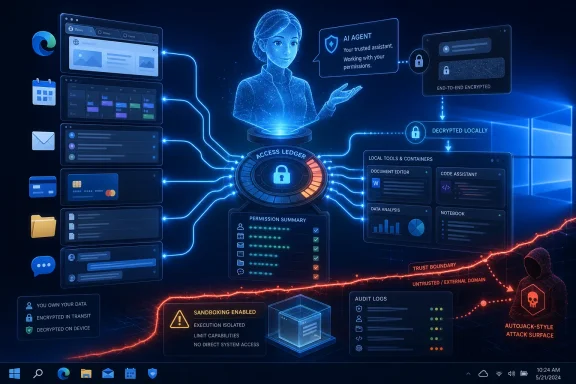
The modern AI agent is sold as a breakthrough in convenience. It will book the trip, summarize the meeting, chase the invoice, update the CRM, draft the email and message the team. The demo always looks like delegation, but underneath it is permission aggregation.
That distinction matters. A chatbot that answers a question can be judged by output. An agent that completes a task must be judged by reach. If it cannot see enough, it cannot act; if it can see enough, it becomes one of the most privileged pieces of software in your life.
Whittaker’s concert-ticket example works because it is ordinary. An agent that finds a show, buys tickets and coordinates with friends needs browser access, payment access, calendar access and messaging access. None of that is exotic. That is precisely why it is dangerous.
The industry wants users to understand agents as digital assistants. A better analogy is a roaming automation account with a conversational interface. Once the system can observe, decide and act across apps, the question is no longer whether the assistant is clever. The question is who controls the assistant, who audits it and who benefits from its memory.
That is where the old privacy model gets uncomfortable. If an operating-system-level agent can read the screen, automate the app, index local content or infer context from notifications, encryption has not technically failed. It has simply been bypassed by software operating in the same trusted environment as the user.
This is the distinction vendors often blur. They can truthfully say a message remains end-to-end encrypted while also building systems that make decrypted content available to local or cloud-connected assistants. Both statements can be true. That is why the policy language needs to be sharper than the marketing language.
For Windows users, this is not an abstract debate. Microsoft is trying to make Windows a serious runtime for local and cloud-connected agents. That means the desktop is becoming less like a passive workspace and more like a programmable control plane. The more powerful that control plane becomes, the more every privacy promise depends on boundaries that ordinary users cannot see.
That is not automatically malicious. Enterprise software has always been about access to shared information. The difference is that agents compress access, inference and action into a single layer. A traditional app may display the calendar. An agent may read the calendar, infer intent, draft a message, update a record and trigger another workflow.
Microsoft’s sandboxing language is therefore both reassuring and revealing. Sandboxes exist because the company knows agentic systems need containment. Runtime boundaries, policy enforcement and visibility are not optional extras; they are the minimum viable architecture for software that can act across sensitive systems.
The Windows angle is especially important. If agents become a first-class part of the operating system, Microsoft is not merely adding another productivity feature. It is creating a new permissions economy inside Windows itself. That economy will decide what software can see, what it can touch and how much autonomy it can exercise before a human notices.
That responsible outcome should not make anyone relax. The interesting part is not that one flaw existed in one research-adjacent tool. The interesting part is the shape of the failure. A web-facing agent interacted with local services in a way that challenged assumptions developers have relied on for years.
Traditional security models often separate the browser, local services, user input and application logic into familiar compartments. Agents blur those compartments. They read instructions from untrusted pages, interpret them as goals, use tools on the user’s behalf and may have access to local resources that were never designed for autonomous intermediaries.
This is why prompt injection is not just a weird chatbot problem. When an AI system can act, hostile text becomes an input to behavior. A malicious page does not need to exploit a memory corruption bug if it can persuade the agent to misuse its tools, leak context or cross a boundary the user never knew existed.
That is why the anthropomorphic language matters. Calling an agent a teammate, coworker or assistant changes the user’s posture. People disclose differently to entities they perceive as helpful social actors. They also become less precise about what they are authorizing.
A file picker is concrete. A permission prompt that grants an agent access to “work context” is foggy. A human assistant may need broad trust because humans operate inside social, legal and organizational constraints. Software agents operate inside business models, telemetry systems, model pipelines and platform incentives.
This is where Whittaker’s critique cuts deepest. The intimacy is not an accidental side effect of the agent model. It is part of the product. The more the system knows about your habits, relationships, documents, routines and obligations, the more useful it becomes — and the harder it becomes to remove.
Agentic AI makes those questions central again. A generative model that drafts text is one kind of risk. An agent that can retrieve documents, call APIs and change business records is another. The former may leak information; the latter may also act on bad information.
Banks, hospitals, law firms, defense contractors and regulated manufacturers already understand this. They have spent years treating access control as infrastructure, not paperwork. The broader market is about to learn the same lesson under less forgiving conditions.
The practical dividing line will not be “AI or no AI.” That fight is already over in most organizations. The real dividing line will be between agents that operate under narrow, auditable, revocable permissions and agents that ask for broad contextual access in exchange for smoother demos.
Many will try to square that circle with branding. They will promise responsible AI, secure workflows and enterprise-grade privacy while building on platforms whose long-term strategy is to make everything more context-aware. That may satisfy a pitch deck. It will not satisfy a serious security review.
If a startup’s agent depends on a cloud suite it does not control, then part of its privacy posture is borrowed. The startup may handle its own data carefully, but the platform beneath it still defines what is technically possible, what telemetry exists and how permissions evolve over time. Customers should evaluate the whole chain, not just the newest layer with the nicest interface.
This does not mean every agent startup is doomed or every platform integration is reckless. It means the architecture must match the promise. Minimal access, local processing, task-specific permissions and clear audit trails should be treated as product features, not compliance decorations.
Agents require a new step. Users and administrators need to understand not merely whether an app is installed or elevated, but what an agent can perceive and what it can do. That means permissions must become more granular, more legible and more temporary.
A good Windows agent permission model would not ask users to approve a vague bundle of “context.” It would expose meaningful boundaries: this agent can read these folders, access this mailbox, use this browser profile, call these local tools and perform these actions only after confirmation. Anything less turns consent into theater.
Administrators will need even more. They will need policy controls that restrict agents by data classification, identity, network zone, application, action type and time. They will need logs that explain not just what happened, but why the agent believed it was allowed to happen. The operating system cannot become an agent platform without also becoming an accountability platform.
But local does not automatically mean safe. A local agent can still read too much, act too broadly or be manipulated by hostile content. If anything, local execution can increase the stakes because the agent may sit closer to files, credentials, development tools and internal services.
The better principle is not “local good, cloud bad.” It is least privilege by design. A cloud service with narrow, audited access may be safer than a local agent with sprawling permissions. A local model that never sees sensitive files may be safer than both.
The privacy debate should therefore focus on boundaries rather than geography alone. Where does data go? What can inspect it? What actions are allowed? What happens by default? What can be revoked? What is logged? These are the questions that separate architecture from vibes.
Memory is also surveillance with a product manager. It converts fleeting interactions into durable context. It lets systems infer patterns from behavior and carry those patterns into future decisions.
For individuals, that creates obvious risks around private life. For organizations, it creates risks around confidentiality, privilege and internal politics. An agent that remembers too much may become an unofficial record system, one that captures sensitive context without the governance applied to email archives, document repositories or ticketing systems.
This is where enterprise IT should push back early. Agent memory should be inspectable, editable, exportable and deletable. It should be scoped by role and purpose. It should never become a shadow profile that users cannot understand and administrators cannot govern.
This is one of the least discussed problems in the agent boom. Vendors like to talk about access controls at the front door. They talk less about downstream artifacts. Once sensitive information is transformed into summaries, vector indexes, memories or workflow state, it may escape the governance rules attached to the original file or message.
Security teams should treat derived data as data. A meeting transcript summarized by an agent may be as sensitive as the transcript itself. A CRM note generated from private email may inherit the confidentiality of the email. An agent memory about a legal matter may be discoverable, regulated or simply dangerous.
Revocation, then, must include more than disconnecting an integration. It must include deletion of cached content, invalidation of derived memory and auditability of where the information moved. Without that, the user’s “no” arrives too late.
But the durable market may reward vendors that refuse certain kinds of access. A product that says it cannot read private messages by design may look less magical in a demo and more credible in procurement. A tool that runs a narrow task with explicit approval may lose to a flashy assistant in a keynote and win inside a bank.
This is not anti-innovation. It is the same pattern that eventually shaped cloud security, mobile permissions and browser sandboxing. The first wave maximizes capability. The second wave survives by controlling it.
For WindowsForum readers, the practical advice is to be skeptical of any agent that requires broad access before proving narrow value. If the assistant needs the keys to the house to turn on one light, the design is wrong. If the vendor cannot explain what the agent can see, where the data goes and how actions are constrained, the product is not ready for sensitive work.
Agents shift the fight upward. The channel may remain protected while the endpoint becomes saturated with observation. The privacy boundary moves from the network to the operating environment, from cryptographic protocol to user interface, local automation and cloud identity.
That is harder to explain and harder to defend. Most users can understand a locked message. Fewer can reason about an AI agent with screen visibility, tool access, memory and cloud grounding. Even IT professionals will struggle if vendors collapse too many permissions into a single friendly switch.
This is why Whittaker’s framing matters. Calling agents surveillance infrastructure sounds severe, but it captures the architecture more honestly than “assistant.” A system that must observe many parts of your life to be useful is a surveillance system, even if the user experience is cheerful and the stated purpose is productivity.
The demo layer will be impressive. The plumbing layer will matter more.
For enthusiasts, sysadmins and IT pros, the right question is not whether the agent can complete the task on stage. It is whether the system can be constrained in production. Can it run with a disposable identity? Can it be blocked from sensitive folders? Can it be prevented from reading private chats? Can it be forced to ask before spending money, sending messages or changing records?
The answer must be visible in the product, not buried in a white paper. Agent security cannot depend on trust language alone. It needs controls that ordinary administrators can deploy and ordinary users can understand.
 The Agent Pitch Depends on Access, Not Intelligence
The modern AI agent is sold as a breakthrough in convenience. It will book the trip, summarize the meeting, chase the invoice, update the CRM, draft the email and message the team. The demo always looks like delegation, but underneath it is permission aggregation.That distinction matters. A chatbot that answers a question can be judged by output. An agent that completes a task must be judged by reach. If it cannot see enough, it cannot act; if it can see enough, it becomes one of the most privileged pieces of software in your life.
Whittaker’s concert-ticket example works because it is ordinary. An agent that finds a show, buys tickets and coordinates with friends needs browser access, payment access, calendar access and messaging access. None of that is exotic. That is precisely why it is dangerous.
The industry wants users to understand agents as digital assistants. A better analogy is a roaming automation account with a conversational interface. Once the system can observe, decide and act across apps, the question is no longer whether the assistant is clever. The question is who controls the assistant, who audits it and who benefits from its memory.
Encryption Survives While the Room Around It Changes
Whittaker’s warning is not that Signal’s encryption has been cracked. End-to-end encryption still protects messages in transit and at rest from parties outside the conversation. The problem begins after the message is legitimately decrypted on a user’s device.That is where the old privacy model gets uncomfortable. If an operating-system-level agent can read the screen, automate the app, index local content or infer context from notifications, encryption has not technically failed. It has simply been bypassed by software operating in the same trusted environment as the user.
This is the distinction vendors often blur. They can truthfully say a message remains end-to-end encrypted while also building systems that make decrypted content available to local or cloud-connected assistants. Both statements can be true. That is why the policy language needs to be sharper than the marketing language.
For Windows users, this is not an abstract debate. Microsoft is trying to make Windows a serious runtime for local and cloud-connected agents. That means the desktop is becoming less like a passive workspace and more like a programmable control plane. The more powerful that control plane becomes, the more every privacy promise depends on boundaries that ordinary users cannot see.
Microsoft’s Agent Strategy Proves Whittaker’s Point
Microsoft is not hiding the direction of travel. At Build 2026, the company framed Windows, Microsoft 365 and its developer platform around agents that can use workplace knowledge, web information and local execution environments. Microsoft IQ, Microsoft Execution Containers and the broader Copilot ecosystem all point toward the same destination: agents grounded in more context and allowed to do more work.That is not automatically malicious. Enterprise software has always been about access to shared information. The difference is that agents compress access, inference and action into a single layer. A traditional app may display the calendar. An agent may read the calendar, infer intent, draft a message, update a record and trigger another workflow.
Microsoft’s sandboxing language is therefore both reassuring and revealing. Sandboxes exist because the company knows agentic systems need containment. Runtime boundaries, policy enforcement and visibility are not optional extras; they are the minimum viable architecture for software that can act across sensitive systems.
The Windows angle is especially important. If agents become a first-class part of the operating system, Microsoft is not merely adding another productivity feature. It is creating a new permissions economy inside Windows itself. That economy will decide what software can see, what it can touch and how much autonomy it can exercise before a human notices.
AutoJack Shows the Attack Surface Is Already Moving
The AutoJack vulnerability chain disclosed by Microsoft’s Defender Security Research Team is a useful warning because it does not require science fiction. The reported issue involved an AutoGen Studio agent browsing an untrusted website, crossing a local trust boundary and reaching a privileged service in a way that could enable code execution. Microsoft fixed the issue before it affected regular users, and the official downloadable version was reportedly not affected.That responsible outcome should not make anyone relax. The interesting part is not that one flaw existed in one research-adjacent tool. The interesting part is the shape of the failure. A web-facing agent interacted with local services in a way that challenged assumptions developers have relied on for years.
Traditional security models often separate the browser, local services, user input and application logic into familiar compartments. Agents blur those compartments. They read instructions from untrusted pages, interpret them as goals, use tools on the user’s behalf and may have access to local resources that were never designed for autonomous intermediaries.
This is why prompt injection is not just a weird chatbot problem. When an AI system can act, hostile text becomes an input to behavior. A malicious page does not need to exploit a memory corruption bug if it can persuade the agent to misuse its tools, leak context or cross a boundary the user never knew existed.
The Friendlier the Assistant, the More Dangerous the Permission Grant
The most effective privacy threat is rarely the one that looks like a threat. It looks like convenience. It looks like a helpful summary at the top of an inbox or a button that says the assistant can “use your context” to improve results.That is why the anthropomorphic language matters. Calling an agent a teammate, coworker or assistant changes the user’s posture. People disclose differently to entities they perceive as helpful social actors. They also become less precise about what they are authorizing.
A file picker is concrete. A permission prompt that grants an agent access to “work context” is foggy. A human assistant may need broad trust because humans operate inside social, legal and organizational constraints. Software agents operate inside business models, telemetry systems, model pipelines and platform incentives.
This is where Whittaker’s critique cuts deepest. The intimacy is not an accidental side effect of the agent model. It is part of the product. The more the system knows about your habits, relationships, documents, routines and obligations, the more useful it becomes — and the harder it becomes to remove.
Enterprise Buyers Will Rediscover Boring Questions
For years, security teams have asked tedious procurement questions that product teams would rather skip. Where is the data stored? Who can access it? How long is it retained? Can logs be disabled? Can permissions be scoped? Can actions be reviewed? Can the system run locally? Can the vendor prove any of this?Agentic AI makes those questions central again. A generative model that drafts text is one kind of risk. An agent that can retrieve documents, call APIs and change business records is another. The former may leak information; the latter may also act on bad information.
Banks, hospitals, law firms, defense contractors and regulated manufacturers already understand this. They have spent years treating access control as infrastructure, not paperwork. The broader market is about to learn the same lesson under less forgiving conditions.
The practical dividing line will not be “AI or no AI.” That fight is already over in most organizations. The real dividing line will be between agents that operate under narrow, auditable, revocable permissions and agents that ask for broad contextual access in exchange for smoother demos.
Startups Cannot Privacy-Policy Their Way Out of Platform Dependence
Startups building agentic workflows face a brutal tradeoff. The fastest path to usefulness is to integrate with Microsoft 365, Google Workspace, Slack, Salesforce, GitHub, browsers and payment systems. The fastest path to trust is to ask for less.Many will try to square that circle with branding. They will promise responsible AI, secure workflows and enterprise-grade privacy while building on platforms whose long-term strategy is to make everything more context-aware. That may satisfy a pitch deck. It will not satisfy a serious security review.
If a startup’s agent depends on a cloud suite it does not control, then part of its privacy posture is borrowed. The startup may handle its own data carefully, but the platform beneath it still defines what is technically possible, what telemetry exists and how permissions evolve over time. Customers should evaluate the whole chain, not just the newest layer with the nicest interface.
This does not mean every agent startup is doomed or every platform integration is reckless. It means the architecture must match the promise. Minimal access, local processing, task-specific permissions and clear audit trails should be treated as product features, not compliance decorations.
Windows Needs a Permission Model Users Can Actually Understand
Windows has lived through several eras of trust. There was the era when desktop software could do almost anything once installed. There was the UAC era, when elevation became visible but often annoying. There is now the Microsoft account, cloud sync and Copilot era, where identity, files, settings and assistant features increasingly overlap.Agents require a new step. Users and administrators need to understand not merely whether an app is installed or elevated, but what an agent can perceive and what it can do. That means permissions must become more granular, more legible and more temporary.
A good Windows agent permission model would not ask users to approve a vague bundle of “context.” It would expose meaningful boundaries: this agent can read these folders, access this mailbox, use this browser profile, call these local tools and perform these actions only after confirmation. Anything less turns consent into theater.
Administrators will need even more. They will need policy controls that restrict agents by data classification, identity, network zone, application, action type and time. They will need logs that explain not just what happened, but why the agent believed it was allowed to happen. The operating system cannot become an agent platform without also becoming an accountability platform.
Local AI Is Not a Magic Privacy Cure
One tempting answer is to keep agents local. Run the model on the PC, keep the data on the device and avoid sending private context to a cloud service. For some workloads, that is the right direction.But local does not automatically mean safe. A local agent can still read too much, act too broadly or be manipulated by hostile content. If anything, local execution can increase the stakes because the agent may sit closer to files, credentials, development tools and internal services.
The better principle is not “local good, cloud bad.” It is least privilege by design. A cloud service with narrow, audited access may be safer than a local agent with sprawling permissions. A local model that never sees sensitive files may be safer than both.
The privacy debate should therefore focus on boundaries rather than geography alone. Where does data go? What can inspect it? What actions are allowed? What happens by default? What can be revoked? What is logged? These are the questions that separate architecture from vibes.
The Agent Economy Wants Memory, and Memory Wants Governance
The next commercial battle will be over memory. Assistants that remember preferences, relationships, documents and past decisions will feel more useful than assistants that start from scratch. Vendors will market that memory as personalization.Memory is also surveillance with a product manager. It converts fleeting interactions into durable context. It lets systems infer patterns from behavior and carry those patterns into future decisions.
For individuals, that creates obvious risks around private life. For organizations, it creates risks around confidentiality, privilege and internal politics. An agent that remembers too much may become an unofficial record system, one that captures sensitive context without the governance applied to email archives, document repositories or ticketing systems.
This is where enterprise IT should push back early. Agent memory should be inspectable, editable, exportable and deletable. It should be scoped by role and purpose. It should never become a shadow profile that users cannot understand and administrators cannot govern.
The Real Test Is Revocation
A permission grant is only meaningful if it can be withdrawn. That sounds simple, but agentic systems make revocation complicated. If an agent has already summarized documents, cached embeddings, written logs, updated records and generated derived context, cutting off the original data source may not remove what the system has learned.This is one of the least discussed problems in the agent boom. Vendors like to talk about access controls at the front door. They talk less about downstream artifacts. Once sensitive information is transformed into summaries, vector indexes, memories or workflow state, it may escape the governance rules attached to the original file or message.
Security teams should treat derived data as data. A meeting transcript summarized by an agent may be as sensitive as the transcript itself. A CRM note generated from private email may inherit the confidentiality of the email. An agent memory about a legal matter may be discoverable, regulated or simply dangerous.
Revocation, then, must include more than disconnecting an integration. It must include deletion of cached content, invalidation of derived memory and auditability of where the information moved. Without that, the user’s “no” arrives too late.
The Agent Boom Will Reward Vendors That Say No
The market currently rewards agents that do more. More integrations, more autonomy, more context, more workflows. That is understandable in the early phase, when demos drive funding and adoption.But the durable market may reward vendors that refuse certain kinds of access. A product that says it cannot read private messages by design may look less magical in a demo and more credible in procurement. A tool that runs a narrow task with explicit approval may lose to a flashy assistant in a keynote and win inside a bank.
This is not anti-innovation. It is the same pattern that eventually shaped cloud security, mobile permissions and browser sandboxing. The first wave maximizes capability. The second wave survives by controlling it.
For WindowsForum readers, the practical advice is to be skeptical of any agent that requires broad access before proving narrow value. If the assistant needs the keys to the house to turn on one light, the design is wrong. If the vendor cannot explain what the agent can see, where the data goes and how actions are constrained, the product is not ready for sensitive work.
The Privacy Fight Moves From Messages to Operating Systems
Signal’s role in this debate is important because it reminds us what privacy engineering used to mean in the consumer imagination. Encrypt the message. Minimize metadata. Keep the server blind. Protect the channel.Agents shift the fight upward. The channel may remain protected while the endpoint becomes saturated with observation. The privacy boundary moves from the network to the operating environment, from cryptographic protocol to user interface, local automation and cloud identity.
That is harder to explain and harder to defend. Most users can understand a locked message. Fewer can reason about an AI agent with screen visibility, tool access, memory and cloud grounding. Even IT professionals will struggle if vendors collapse too many permissions into a single friendly switch.
This is why Whittaker’s framing matters. Calling agents surveillance infrastructure sounds severe, but it captures the architecture more honestly than “assistant.” A system that must observe many parts of your life to be useful is a surveillance system, even if the user experience is cheerful and the stated purpose is productivity.
The Windows Crowd Should Watch the Plumbing, Not the Demo
The next year of agent announcements will be full of polished scenarios. Copilot will understand the meeting. Gemini will understand the workspace. Salesforce agents will understand the customer. Windows will understand more about what developers and users are trying to do locally.The demo layer will be impressive. The plumbing layer will matter more.
For enthusiasts, sysadmins and IT pros, the right question is not whether the agent can complete the task on stage. It is whether the system can be constrained in production. Can it run with a disposable identity? Can it be blocked from sensitive folders? Can it be prevented from reading private chats? Can it be forced to ask before spending money, sending messages or changing records?
The answer must be visible in the product, not buried in a white paper. Agent security cannot depend on trust language alone. It needs controls that ordinary administrators can deploy and ordinary users can understand.
The Access Ledger Comes Due
The agent debate is not going away, and the most concrete lessons are already visible. Whittaker’s warning is useful because it forces the industry to describe the tradeoff plainly: autonomy requires access, and access requires governance.- AI agents should be evaluated by what they can see and do, not by how natural their conversational interface feels.
- End-to-end encryption can remain intact while endpoint agents still create serious privacy risks after content is decrypted.
- Microsoft’s push to make Windows an agent platform makes sandboxing, policy enforcement and audit logs central security features rather than developer niceties.
- The AutoJack disclosure shows that agents connected to browsers and local services can disturb old trust boundaries in practical, exploitable ways.
- Startups that build around minimal access, local options and narrow permissions will have a stronger long-term trust story than rivals that ask for everything.
- Enterprise buyers should treat agent memory, derived summaries and cached context as sensitive data that needs governance and revocation.
References
- Primary source: Startup Fortune
Published: 2026-06-21T12:50:32.919228
Loading…
startupfortune.com - Related coverage: techradar.com
Loading…
www.techradar.com - Related coverage: windowscentral.com
"Agents are only as good as the context we give them": Microsoft IQ connects AI agents to your workspace data and the web | Windows Central
The newly unveiled Microsoft IQ data stack and Scout assistant turn generic AI into a personalized workplace tool.www.windowscentral.com - Related coverage: csoonline.com
Loading…
www.csoonline.com - Related coverage: tomshardware.com
Microsoft unveils Project Solara AI, a chip-to-cloud platform built to power a new generation of 'agent-first' enterprise devices — hardware designed to run AI agents instead of traditional apps | Tom's Hardware
Microsoft ditches Windows to build OS on Androidwww.tomshardware.com - Related coverage: redmondmag.com
Microsoft Uses Build 2026 To Put AI Agents at the Center of Windows -- Redmondmag.com
Microsoft used Build 2026 to position Windows as a platform for building and running AI agents, expanding its developer focus beyond AI-assisted apps and into agents that can act across local devices, cloud environments and enterprise systems.redmondmag.com