
NHS England said in June 2026 that 505,000 clinicians and support staff across England will receive Microsoft 365 Copilot by October 2026, after a 30,000-person trial across 90 NHS organisations reported average administrative time savings of 43 minutes per user per day. The announcement is not just another enterprise AI rollout; it is a stress test of whether generative AI can survive contact with one of the world’s most politically scrutinised workplaces. Microsoft gets a marquee public-sector deployment, the NHS gets a productivity story, and staff get a new layer of software inserted into already complicated workdays. The real question is whether Copilot becomes a useful administrative prosthetic or another centrally purchased tool whose benefits are easiest to see from a ministerial podium.
For Microsoft, the NHS deployment is almost too perfect a showcase. Copilot has been sold as the product that turns Microsoft 365 from a bundle of office applications into a knowledge-work operating system: emails summarised, meetings distilled, documents drafted, spreadsheets queried, and organisational memory surfaced through Microsoft Graph. A half-million-seat public healthcare rollout gives that pitch institutional heft.
It also arrives at a useful moment. Microsoft has spent heavily to make AI inseparable from Windows, Office, Azure, Teams, Edge, and security tooling, but the economics of paid Copilot adoption have remained under close scrutiny. Enterprise buyers like the idea of generative AI, but they often move slowly once licensing, training, data governance, measurable return, and employee trust enter the room.
The NHS is therefore more than a customer. It is a public demonstration that Copilot can be framed not as a gadget for executives but as a relief valve for overloaded systems. If Microsoft can point to nurses, ward clerks, medical secretaries, finance teams, and managers saving measurable time, it has a better story than “AI will transform productivity someday.”
That does not make the story false. Anyone who has spent time around healthcare administration knows that paperwork, rota coordination, discharge planning, minutes, board packs, forms, letters, and inbox triage consume an absurd amount of human attention. The NHS is betting that enough of this work is repetitive, structured, and language-heavy to be attacked by a general-purpose assistant rather than a bespoke clinical system.
But averages are blunt instruments. A medical secretary drafting routine letters may see obvious benefit from first-pass text generation and template consistency. A clinician may find value in summarising meetings or drafting administrative correspondence, while still needing to review every sentence because a bad sentence in healthcare is not merely embarrassing. A ward clerk juggling bed management and discharge processes may gain time from structured summaries, but only if the underlying data is accurate, accessible, and already well maintained.
The danger is that the 43-minute figure becomes a political abstraction. Time saved in a trial is not the same as capacity created across a live health system. A staff member who saves time on correspondence may spend that time checking AI output, correcting records, chasing missing information, or absorbing new compliance tasks created by the tool itself.
This is not an argument against the rollout. It is an argument against treating the rollout as self-validating. The NHS has not bought 505,000 units of productivity; it has bought the possibility of productivity, contingent on training, workflow redesign, data hygiene, and local management discipline.
This is the work around the work. It is the connective tissue that keeps hospitals and trusts functioning but rarely appears in political speeches about frontline care. It is also exactly the kind of work Microsoft 365 already mediates through Outlook, Word, Excel, Teams, SharePoint, OneDrive, and PowerPoint.
That is why Copilot has an advantage over many healthcare AI systems. It does not need to replace a clinical pathway to matter. It can live inside the applications staff already use and remove friction from the low-glamour tasks that accumulate into exhaustion.
Yet that same advantage creates risk. Copilot’s usefulness depends on what the Microsoft 365 environment already knows and what the user is allowed to access. If permissions are sloppy, if document libraries are chaotic, if old files are mislabelled, or if Teams channels have become informal data dumps, an AI assistant can surface mess faster than a human can stumble across it.
The product is not magic; it is an amplifier. In a clean, well-governed tenant, it can amplify order. In a sprawling organisation with uneven digital maturity, it can amplify confusion, inconsistency, and accidental visibility.
Rota management is an obvious example. The administrative burden is not just writing the rota; it is reconciling staffing needs, leave, sickness, training, shift rules, local constraints, and last-minute disruption. A generic assistant can help produce a draft or summarise conflicts, but a useful agent would need to understand the rules and systems around the process.
Meeting minutes are similar. Summarisation is a commodity AI feature. The valuable version knows which actions matter, who owns them, what deadline was agreed, which previous action is still open, and where the decision should be recorded. That is not simply language generation; it is workflow governance.
This is where Microsoft’s platform strategy becomes visible. Copilot is the friendly interface, but the larger prize is deeper dependency on Microsoft’s productivity stack, identity layer, compliance tooling, data estate, and low-code automation environment. For WindowsForum readers, the lesson is familiar: the assistant is the visible feature; the ecosystem lock-in is the architecture.
But administrative work in healthcare is still safety-critical. A discharge letter can shape medication adherence, follow-up appointments, patient understanding, and GP handover. A poorly summarised meeting can distort accountability. A misread policy document can lead staff down the wrong path.
This means the “human in the loop” cannot be a decorative phrase. It has to be a real operational requirement, with clear expectations about when AI output may be used, when it must be checked, how corrections are made, and who remains accountable. The NHS will need to resist the temptation to count generated drafts as completed work before the review burden is understood.
The risk is not that Copilot suddenly becomes a rogue doctor. The more mundane risk is that hurried staff, under pressure, begin to trust fluent output because it looks plausible and saves time. In healthcare, plausible is not good enough.
But the harder governance problem is not simply whether Microsoft trains models on NHS prompts. It is whether Copilot can access, summarise, infer from, or expose information that a user technically has permission to see but should not encounter in that context. AI does not need to breach a system to create a privacy incident; it can make existing over-permissioning newly visible.
This is one of the uncomfortable truths of enterprise AI. Many organisations have tolerated messy permissions because humans are inefficient search engines. Copilot changes the economics of discovery. A user who would never manually browse through years of SharePoint folders may ask a broad question and receive a synthesis from documents they forgot they could access.
For NHS trusts, the preparation work is therefore as important as the licence allocation. Sensitivity labels, data loss prevention policies, retention rules, access reviews, audit logging, and information architecture move from background compliance chores to front-line AI controls. If those controls are uneven, Copilot will expose the unevenness.
The NHS announcement says trusts will receive central allocations based on organisational headcount, typically starting around 2,000 Microsoft 365 Copilot licences, with rollout expected by October. That is a massive deployment timetable for any enterprise, let alone a federated healthcare system with different local pressures, cultures, and levels of digital readiness.
The successful trusts will likely be the ones that treat Copilot adoption as service redesign, not software distribution. They will identify specific workflows, train staff around real tasks, create local champions, measure before-and-after effects, and retire bad use cases quickly. The unsuccessful ones will turn on licences, circulate guidance documents, and wonder why usage trails off after the novelty fades.
This is especially true because Copilot’s best uses are often personal and situational. One manager may use it to draft board papers from existing notes. A secretary may use it to standardise letters. A clinician may use it to summarise a long Teams thread before a meeting. A finance team may use it to turn messy discussion into a cleaner procurement brief.
That diversity is useful, but it complicates measurement. The NHS will need to distinguish between genuine time returned to care and a haze of small conveniences that feel helpful but do not change throughput, waiting lists, staff stress, or patient experience.
For staff, the first question may not be “Will this help patients?” It may be “Is this another tool being imposed on me?” That distinction matters. AI adoption in frontline settings depends on whether workers feel assisted or monitored, empowered or optimised, trusted or replaced.
Microsoft 365 Copilot can be useful precisely because it works in the grain of existing office work. But if managers use it to demand more output without acknowledging review time and cognitive load, the tool will become part of the productivity treadmill. A draft letter still has to be clinically and contextually right. A meeting summary still has to reflect what actually happened. A rota still has to survive reality.
The NHS also needs to be honest about digital inequality among staff. Some users will become power users quickly. Others will need careful support, not because they are resistant to change but because healthcare already asks them to master too many systems with too little slack. Training cannot be a webinar and a PDF.
That shift has practical consequences for administrators. Endpoint readiness still matters, but the decisive questions are tenant configuration, Entra ID, licensing, data classification, conditional access, Purview, SharePoint governance, Teams sprawl, and user training. The PC is no longer the main container of work; it is the access point to a cloud-mediated organisational memory.
This is why public-sector Copilot rollouts deserve attention from sysadmins outside healthcare. The same pattern is coming to local government, education, legal services, finance, and enterprise back offices. Microsoft is turning AI adoption into a Microsoft 365 governance exam.
The NHS may be the most visible test case, but the lesson generalises. Organisations that have treated Microsoft 365 as “Office plus email” are about to discover that Copilot forces them to understand their own data estate. That may be painful, but it is not optional.
But a productivity story is not automatically a patient story. Saving 43 minutes a day matters only if that time turns into better care, safer handovers, faster discharge, clearer communication, shorter waits, or less exhausted staff. Otherwise the savings will dissolve into the system’s permanent backlog of unmet demand.
This is where the rollout should be judged over time. Not by the number of active licences. Not by the number of prompts. Not by the number of AI-generated documents. The meaningful measures are whether staff report less administrative drag, whether patients experience fewer communication failures, whether managers make better decisions faster, and whether trusts can demonstrate service improvements without hiding the costs.
The NHS should publish sober evidence as the rollout progresses. That means sharing not only success stories but also abandoned use cases, safety incidents, training lessons, and governance changes. Public trust in healthcare AI will not be built through launch announcements; it will be built through transparency after the launch.
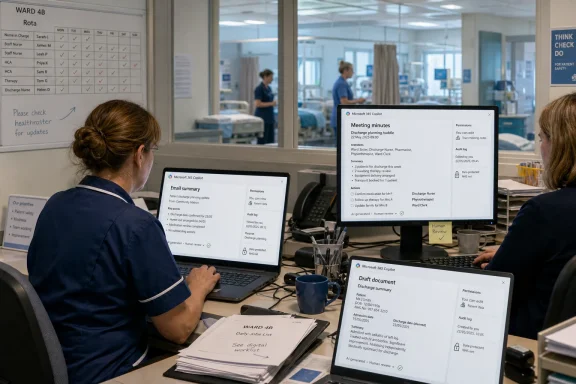 Microsoft Finds Its Biggest Copilot Case Study in the NHS
For Microsoft, the NHS deployment is almost too perfect a showcase. Copilot has been sold as the product that turns Microsoft 365 from a bundle of office applications into a knowledge-work operating system: emails summarised, meetings distilled, documents drafted, spreadsheets queried, and organisational memory surfaced through Microsoft Graph. A half-million-seat public healthcare rollout gives that pitch institutional heft.It also arrives at a useful moment. Microsoft has spent heavily to make AI inseparable from Windows, Office, Azure, Teams, Edge, and security tooling, but the economics of paid Copilot adoption have remained under close scrutiny. Enterprise buyers like the idea of generative AI, but they often move slowly once licensing, training, data governance, measurable return, and employee trust enter the room.
The NHS is therefore more than a customer. It is a public demonstration that Copilot can be framed not as a gadget for executives but as a relief valve for overloaded systems. If Microsoft can point to nurses, ward clerks, medical secretaries, finance teams, and managers saving measurable time, it has a better story than “AI will transform productivity someday.”
That does not make the story false. Anyone who has spent time around healthcare administration knows that paperwork, rota coordination, discharge planning, minutes, board packs, forms, letters, and inbox triage consume an absurd amount of human attention. The NHS is betting that enough of this work is repetitive, structured, and language-heavy to be attacked by a general-purpose assistant rather than a bespoke clinical system.
The 43-Minute Number Is Powerful Because It Is Also Dangerous
The headline figure is irresistible: 43 minutes saved per staff member per day, or roughly five weeks per person per year. At 505,000 staff, that scales into a productivity claim so large that it begins to sound like fantasy. This is the seduction of AI procurement in one number.But averages are blunt instruments. A medical secretary drafting routine letters may see obvious benefit from first-pass text generation and template consistency. A clinician may find value in summarising meetings or drafting administrative correspondence, while still needing to review every sentence because a bad sentence in healthcare is not merely embarrassing. A ward clerk juggling bed management and discharge processes may gain time from structured summaries, but only if the underlying data is accurate, accessible, and already well maintained.
The danger is that the 43-minute figure becomes a political abstraction. Time saved in a trial is not the same as capacity created across a live health system. A staff member who saves time on correspondence may spend that time checking AI output, correcting records, chasing missing information, or absorbing new compliance tasks created by the tool itself.
This is not an argument against the rollout. It is an argument against treating the rollout as self-validating. The NHS has not bought 505,000 units of productivity; it has bought the possibility of productivity, contingent on training, workflow redesign, data hygiene, and local management discipline.
Copilot Is Being Asked to Fix the Work Around the Work
The most revealing part of the announcement is not that clinicians will get AI assistance. It is the list of use cases: drafting letters, registrar training support, patient discharge administration, service data analysis, rota building, bed management, meeting minutes, templates, HR, finance, procurement, board papers, briefings, and analysis.This is the work around the work. It is the connective tissue that keeps hospitals and trusts functioning but rarely appears in political speeches about frontline care. It is also exactly the kind of work Microsoft 365 already mediates through Outlook, Word, Excel, Teams, SharePoint, OneDrive, and PowerPoint.
That is why Copilot has an advantage over many healthcare AI systems. It does not need to replace a clinical pathway to matter. It can live inside the applications staff already use and remove friction from the low-glamour tasks that accumulate into exhaustion.
Yet that same advantage creates risk. Copilot’s usefulness depends on what the Microsoft 365 environment already knows and what the user is allowed to access. If permissions are sloppy, if document libraries are chaotic, if old files are mislabelled, or if Teams channels have become informal data dumps, an AI assistant can surface mess faster than a human can stumble across it.
The product is not magic; it is an amplifier. In a clean, well-governed tenant, it can amplify order. In a sprawling organisation with uneven digital maturity, it can amplify confusion, inconsistency, and accidental visibility.
The NHS Is Buying a Platform, Not a Chatbot
The inclusion of Copilot Studio matters. Microsoft is not merely handing NHS staff a conversational sidebar; it is giving organisations a way to build specialised agents for recurring processes. That points toward a second phase of the rollout, where the real work shifts from asking Copilot to draft text to embedding AI into operational workflows.Rota management is an obvious example. The administrative burden is not just writing the rota; it is reconciling staffing needs, leave, sickness, training, shift rules, local constraints, and last-minute disruption. A generic assistant can help produce a draft or summarise conflicts, but a useful agent would need to understand the rules and systems around the process.
Meeting minutes are similar. Summarisation is a commodity AI feature. The valuable version knows which actions matter, who owns them, what deadline was agreed, which previous action is still open, and where the decision should be recorded. That is not simply language generation; it is workflow governance.
This is where Microsoft’s platform strategy becomes visible. Copilot is the friendly interface, but the larger prize is deeper dependency on Microsoft’s productivity stack, identity layer, compliance tooling, data estate, and low-code automation environment. For WindowsForum readers, the lesson is familiar: the assistant is the visible feature; the ecosystem lock-in is the architecture.
Clinical Safety Begins Before the Model Answers
Microsoft and NHS England are presenting the rollout as administrative support, not autonomous diagnosis or treatment. That distinction is important. Drafting a patient letter is not the same as choosing a cancer therapy, and summarising a meeting is not the same as interpreting a scan.But administrative work in healthcare is still safety-critical. A discharge letter can shape medication adherence, follow-up appointments, patient understanding, and GP handover. A poorly summarised meeting can distort accountability. A misread policy document can lead staff down the wrong path.
This means the “human in the loop” cannot be a decorative phrase. It has to be a real operational requirement, with clear expectations about when AI output may be used, when it must be checked, how corrections are made, and who remains accountable. The NHS will need to resist the temptation to count generated drafts as completed work before the review burden is understood.
The risk is not that Copilot suddenly becomes a rogue doctor. The more mundane risk is that hurried staff, under pressure, begin to trust fluent output because it looks plausible and saves time. In healthcare, plausible is not good enough.
Data Protection Is a Promise, but Permissions Are the Battlefield
Microsoft’s enterprise pitch is built around assurances that commercial Microsoft 365 Copilot data is handled within enterprise protections and is not used to train foundation models. That matters, particularly in a health system where public trust is fragile and patient information is among the most sensitive categories of data government handles.But the harder governance problem is not simply whether Microsoft trains models on NHS prompts. It is whether Copilot can access, summarise, infer from, or expose information that a user technically has permission to see but should not encounter in that context. AI does not need to breach a system to create a privacy incident; it can make existing over-permissioning newly visible.
This is one of the uncomfortable truths of enterprise AI. Many organisations have tolerated messy permissions because humans are inefficient search engines. Copilot changes the economics of discovery. A user who would never manually browse through years of SharePoint folders may ask a broad question and receive a synthesis from documents they forgot they could access.
For NHS trusts, the preparation work is therefore as important as the licence allocation. Sensitivity labels, data loss prevention policies, retention rules, access reviews, audit logging, and information architecture move from background compliance chores to front-line AI controls. If those controls are uneven, Copilot will expose the unevenness.
The Rollout Will Be Won or Lost by Local Adoption
Central procurement can buy licences. It cannot buy habits.The NHS announcement says trusts will receive central allocations based on organisational headcount, typically starting around 2,000 Microsoft 365 Copilot licences, with rollout expected by October. That is a massive deployment timetable for any enterprise, let alone a federated healthcare system with different local pressures, cultures, and levels of digital readiness.
The successful trusts will likely be the ones that treat Copilot adoption as service redesign, not software distribution. They will identify specific workflows, train staff around real tasks, create local champions, measure before-and-after effects, and retire bad use cases quickly. The unsuccessful ones will turn on licences, circulate guidance documents, and wonder why usage trails off after the novelty fades.
This is especially true because Copilot’s best uses are often personal and situational. One manager may use it to draft board papers from existing notes. A secretary may use it to standardise letters. A clinician may use it to summarise a long Teams thread before a meeting. A finance team may use it to turn messy discussion into a cleaner procurement brief.
That diversity is useful, but it complicates measurement. The NHS will need to distinguish between genuine time returned to care and a haze of small conveniences that feel helpful but do not change throughput, waiting lists, staff stress, or patient experience.
Staff Trust Cannot Be Announced Into Existence
The political language around the rollout is predictable: innovation, productivity, taxpayer value, better care, faster access. Those are legitimate goals. They are also words that can grate when they land on staff who have lived through years of pressure, workforce shortages, industrial disputes, legacy IT headaches, and repeated transformation programmes.For staff, the first question may not be “Will this help patients?” It may be “Is this another tool being imposed on me?” That distinction matters. AI adoption in frontline settings depends on whether workers feel assisted or monitored, empowered or optimised, trusted or replaced.
Microsoft 365 Copilot can be useful precisely because it works in the grain of existing office work. But if managers use it to demand more output without acknowledging review time and cognitive load, the tool will become part of the productivity treadmill. A draft letter still has to be clinically and contextually right. A meeting summary still has to reflect what actually happened. A rota still has to survive reality.
The NHS also needs to be honest about digital inequality among staff. Some users will become power users quickly. Others will need careful support, not because they are resistant to change but because healthcare already asks them to master too many systems with too little slack. Training cannot be a webinar and a PDF.
The Windows Angle Is Really the Microsoft 365 Angle
For Windows enthusiasts, the NHS Copilot rollout is another marker of where Microsoft has moved the centre of gravity. Windows remains the endpoint, but the strategic action is in Microsoft 365, identity, cloud services, compliance, and AI orchestration. Copilot is less a Windows feature than a Microsoft-account-and-tenant feature that happens to surface across Windows PCs.That shift has practical consequences for administrators. Endpoint readiness still matters, but the decisive questions are tenant configuration, Entra ID, licensing, data classification, conditional access, Purview, SharePoint governance, Teams sprawl, and user training. The PC is no longer the main container of work; it is the access point to a cloud-mediated organisational memory.
This is why public-sector Copilot rollouts deserve attention from sysadmins outside healthcare. The same pattern is coming to local government, education, legal services, finance, and enterprise back offices. Microsoft is turning AI adoption into a Microsoft 365 governance exam.
The NHS may be the most visible test case, but the lesson generalises. Organisations that have treated Microsoft 365 as “Office plus email” are about to discover that Copilot forces them to understand their own data estate. That may be painful, but it is not optional.
The Productivity Story Needs a Patient Story
The NHS is right to target administration. Waiting lists, discharge delays, appointment backlogs, and staff burnout are not solved only in operating theatres and consulting rooms. They are also shaped by the speed and reliability of paperwork, coordination, and communication.But a productivity story is not automatically a patient story. Saving 43 minutes a day matters only if that time turns into better care, safer handovers, faster discharge, clearer communication, shorter waits, or less exhausted staff. Otherwise the savings will dissolve into the system’s permanent backlog of unmet demand.
This is where the rollout should be judged over time. Not by the number of active licences. Not by the number of prompts. Not by the number of AI-generated documents. The meaningful measures are whether staff report less administrative drag, whether patients experience fewer communication failures, whether managers make better decisions faster, and whether trusts can demonstrate service improvements without hiding the costs.
The NHS should publish sober evidence as the rollout progresses. That means sharing not only success stories but also abandoned use cases, safety incidents, training lessons, and governance changes. Public trust in healthcare AI will not be built through launch announcements; it will be built through transparency after the launch.
The Half-Million-Seat Bet Comes With Hard Edges
The shape of the NHS Copilot deal is now clear enough to draw some practical conclusions. The uncertainty lies not in whether AI will enter healthcare administration, but in whether the implementation will be disciplined enough to make the benefits real.- NHS England is moving from trial to mass deployment, with 505,000 clinicians and support staff expected to receive Microsoft 365 Copilot access by October 2026.
- The reported trial result of 43 minutes saved per user per day is promising, but it should be treated as a hypothesis to validate at scale rather than a guaranteed system-wide saving.
- The most credible early benefits are likely to come from administrative drafting, summarisation, meeting support, templates, rota work, analysis, and other Microsoft 365-native tasks.
- The largest governance risks sit in permissions, data classification, sensitivity labels, auditability, and staff overreliance on fluent but imperfect AI output.
- Copilot Studio points toward a future in which NHS organisations build specialised agents, making local workflow design and safety oversight more important than the chatbot itself.
- The deployment will be judged fairly only if the NHS measures patient-facing outcomes and staff workload effects, not just licence counts and optimistic productivity arithmetic.
References
- Primary source: Healthcare Today
Published: 2026-06-22T05:06:07.451006
Loading…
healthcaretoday.com - Related coverage: enterprisedna.co
NHS Rolls Out AI to 505,000 Staff, Saving 43 Minutes Daily — Enterprise DNA
NHS England's £120m Microsoft 365 Copilot rollout to 505,000 staff saves 43 minutes daily per person after the largest AI trial in global healthcare.enterprisedna.co - Related coverage: resultsense.com
505,000 NHS staff to get Microsoft Copilot to cut admin
NHS England will roll out Microsoft 365 Copilot to 505,000 staff after a trial saved 43 minutes a day, freeing clinicians for patient care by October 2026.www.resultsense.com
- Related coverage: thenextweb.com
NHS England rolls out Microsoft 365 Copilot to 505,000 staff in largest healthcare AI deployment
NHS England is giving 505,000 clinicians and staff access to Microsoft 365 Copilot after a 30,000-person trial reported 43 minutes saved per day.thenextweb.com - Related coverage: techtimes.com
Loading…
www.techtimes.com - Related coverage: technologyrecord.com
NHS to roll out Microsoft Copilot to 505,000 staff -...
NHS England is to give 505,000 clinicians and support staff access to Microsoft 365 Copilot, following a trial that found the AI tool could save...www.technologyrecord.com
- Related coverage: htn.co.uk
- Related coverage: prioritypixels.co.uk
NHS England Deploys Microsoft 365 Copilot to 505,000 Staff
NHS England rolls out Microsoft 365 Copilot to over half a million clinicians and support staff, saving 43 minutes per day on admin tasks.prioritypixels.co.uk - Related coverage: england.nhs.uk
NHS England » 500,000 NHS staff to get new artificial intelligence tools to help free up more time for patients
NHS England » 500,000 NHS staff to get new artificial intelligence tools to help free up more time for patientswww.england.nhs.uk - Related coverage: techradar.com
Microsoft rolls out Copilot AI tools to over half a million NHS England staff, promises 'to improve service delivery, reduce costs and create more time for care' | TechRadar
NHS England to deploy Copilot to half a million staffwww.techradar.com - Related coverage: medcloudinsider.com
NHS England to Expand Microsoft Copilot Access to 505k Staff -- MedCloudInsider
NHS England plans to give 505,000 clinicians and support staff access to Microsoft 365 Copilot by October 2026, expanding the use of generative AI across one of the world’s largest public healthcare systems.medcloudinsider.com - Official source: cdn-dynmedia-1.microsoft.com
Loading…
cdn-dynmedia-1.microsoft.com

