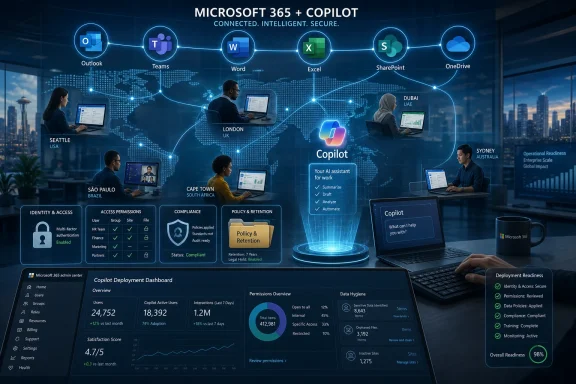
On April 27 and 28, 2026, Microsoft and Accenture said Microsoft 365 Copilot was being rolled out to roughly 743,000 Accenture workers worldwide, making it Microsoft’s largest publicly announced enterprise Copilot deployment to date. The number is the headline, but it is not the story by itself. The story is that Microsoft has found the kind of reference customer every enterprise software platform needs when a new category is still suspected of being mostly demos, pilots, and executive theater. Accenture is not just buying Copilot; it is turning itself into the proof-of-scale case study it can now sell to everyone else.
That matters because the first phase of generative AI in the workplace was powered by curiosity, fear, and discretionary budget. The next phase will be governed by procurement, governance, identity systems, data permissions, and the old-fashioned question of whether employees keep using the tool after the launch email. Accenture’s bet is that Copilot is ready to become part of the daily machinery of consulting work. Microsoft’s bet is larger: that AI adoption in the enterprise will be won less by the model with the flashiest benchmark and more by the assistant already sitting inside Outlook, Teams, Word, Excel, PowerPoint, SharePoint, OneDrive, and Microsoft Graph.
Microsoft has spent the last several years trying to make Copilot feel inevitable. It has put the brand across Windows, GitHub, Microsoft 365, Dynamics, Power Platform, Security, Edge, and a growing family of agentic workflows. The branding has sometimes run ahead of the product clarity, but the strategic intent has been consistent: Microsoft wants AI to become an add-on layer to the software estate enterprises already rent from Redmond.
The Accenture deployment gives that strategy a different kind of weight. A few thousand seats can be dismissed as experimentation. Tens of thousands can be treated as a large pilot. A rollout to roughly 743,000 people is not a pilot in any meaningful sense, even if adoption and value will still vary wildly by role.
That is why the size of the deployment has become its own argument. Enterprise software buyers are herd animals for good reasons: nobody wants to be the first CIO to discover that a hyped platform breaks compliance assumptions, exposes sensitive files, or produces no measurable return. When an organization as large and process-heavy as Accenture moves toward near-total workforce coverage, it gives risk-averse buyers a reference point.
Microsoft still has plenty to prove. A license assigned is not the same thing as a workflow transformed, and a glowing internal case study is not the same thing as audited productivity data. But the company now has a marquee answer when customers ask whether Microsoft 365 Copilot can be deployed beyond the early-adopter class.
That makes the rollout unusually self-referential. Accenture needs Copilot to help its own employees work faster, but it also needs to demonstrate that it knows how to deploy workplace AI at frightening scale. Every internal adoption metric becomes a sales asset. Every governance lesson becomes a consulting slide. Every training module can be converted into a client workshop.
This does not make the rollout cynical. It makes it strategically rational. Accenture’s clients have been asking the obvious question since the generative AI boom accelerated: if the world’s largest consultancies are telling everyone else to transform, what exactly have they transformed internally?
The Copilot deployment is Accenture’s answer. The firm is effectively saying that enterprise AI is no longer something its consultants merely advise on from the outside. It is now a tool embedded in the same email threads, Teams meetings, project plans, knowledge repositories, sales pursuits, and client deliverables that define Accenture’s own operating model.
That sequencing matters. The early cohort was not merely a technology test; it was a political and organizational test. Senior leaders had to understand the product well enough to defend it, model its use, and avoid the familiar enterprise failure mode where executives sponsor a tool they do not personally use.
The 20,000-user phase was where the deployment became operationally serious. At that size, organizations start seeing the real problems: inconsistent data access, uneven training, unclear usage norms, employee skepticism, and the gap between a good demo and a repeatable work habit. Accenture also had to understand how Copilot behaved across Microsoft 365’s existing surfaces rather than as a standalone chatbot.
Only after that did the rollout move toward the full workforce. That is the part other CIOs should notice. The lesson is not “buy 743,000 licenses.” The lesson is that the license event comes after identity, governance, training, telemetry, executive sponsorship, and a decision about what kinds of work the company actually wants AI to change.
The phrase routine tasks is doing a lot of work. Drafting a first-pass email, summarizing a meeting, producing a status update, finding a document, or generating a starting outline can absolutely become much faster with a good AI assistant. If the baseline is “start from a blank page,” a 15x improvement on a narrow task is plausible.
But narrow task acceleration is not the same thing as whole-job productivity. Consulting work includes client judgment, relationship management, synthesis, accountability, negotiation, domain expertise, and the painful ambiguity of real projects. Copilot can reduce friction around the edges of those workflows, and sometimes more than the edges, but it does not magically convert every saved minute into billable output.
The stronger data points are less theatrical. Microsoft’s account said monthly active usage in the large Accenture cohort reached 89 percent, and that 84 percent of surveyed employees said they would deeply miss Copilot if it were removed. Those numbers matter because enterprise software value usually dies in the valley between assigned seats and repeated use.
That is why Accenture’s change-management approach may be more important than the model itself. Microsoft described one-on-one leader training, group sessions, regular communication, and ongoing support channels. That sounds mundane, but it is the difference between a product launch and an operating change.
Enterprise AI adoption is unusually vulnerable to disappointment because the first experience can vary dramatically. One employee asks Copilot to summarize a well-structured meeting and gets magic. Another asks it to reason across a chaotic SharePoint estate and gets mush. A third discovers that the tool can see documents whose permissions should have been cleaned up years ago.
Accenture appears to have treated those realities as part of the deployment rather than as aftercare. That is the right instinct. AI assistants do not arrive in a vacuum; they inherit the messiness of the organization that deploys them.
If a user has access to a file, Copilot can potentially use that accessible information in responses. In theory, this respects existing permissions. In practice, many organizations have years of overshared SharePoint sites, stale groups, inherited access, abandoned Teams, and OneDrive folders that were never designed for AI-mediated discovery.
Copilot does not create that permissions debt. It exposes it. The difference is that a human employee might never manually browse into an obscure folder, while an AI assistant can surface relevant information from across the estate in response to a natural-language prompt.
That is why Accenture’s size should not lull smaller organizations into complacency. A 5,000-person company with poor information governance may face more practical risk than a 743,000-person company with disciplined access controls and a dedicated deployment team. Before Copilot becomes a productivity story, it is a data hygiene story.
The first-order effect is productivity. Consultants spend less time on administrative scaffolding and more time on analysis, client interaction, and delivery. That is the version everyone is comfortable saying out loud.
The second-order effect is more complicated. If AI raises output per employee, firms can grow revenue without growing headcount at the same historical rate. That has implications for hiring, training, margins, pyramid models, and the way junior staff learn by doing the grunt work AI is now being asked to accelerate.
Accenture will not be alone in confronting that tension. Every large services firm is trying to tell a story in which AI improves work without hollowing out the apprenticeship path that creates future experts. Copilot can help produce a better first draft, but professional judgment still has to come from somewhere.
That is Microsoft’s opening. Copilot does not need every employee to believe it is the world’s most powerful AI system. It needs to be useful enough inside the tools employees already open every morning.
Google has a strong counterargument with Gemini inside Workspace, especially for organizations already standardized on Gmail, Docs, Meet, and Drive. OpenAI has a different advantage with ChatGPT Enterprise as a broadly capable standalone assistant that many users already understand from consumer experience. Anthropic, too, remains influential where organizations prize long-context reasoning and safety positioning.
But Microsoft’s enterprise muscle is hard to overstate. If a company already runs on Microsoft 365, Entra ID, Teams, SharePoint, OneDrive, Defender, Purview, and Azure, Copilot arrives with fewer architectural debates than a tool that must be integrated from the outside. That does not make it automatically superior. It makes it easier to buy, easier to justify, and easier to deploy at scale.
Google and OpenAI will almost certainly counter with their own customer narratives. Google can point to the increasing integration of Gemini across Workspace and its strength in cloud-native collaboration. OpenAI can point to ChatGPT Enterprise adoption across large companies and the cultural familiarity of ChatGPT as the product that taught many knowledge workers what generative AI could do.
Still, the Accenture announcement gives Microsoft a blunt sales line. If a customer asks whether Copilot can operate across a global enterprise, Microsoft can now point to a professional services firm with operations in more than 120 countries and a workforce larger than many cities.
That does not end the race. It changes the terrain. The competition is shifting from “whose chatbot is cleverest?” to “whose assistant can survive procurement, compliance, training, governance, and daily use across the whole company?”
That makes back-of-the-envelope revenue calculations dangerous. A 743,000-seat announcement does not mean 743,000 seats multiplied cleanly by a public website price. Enterprise software economics are full of discounts, bundles, credits, ramp periods, and broader commercial agreements.
But the financial importance does not disappear just because the exact price is unknown. For Microsoft, Copilot must become a meaningful recurring revenue layer on top of Microsoft 365. For Accenture, Copilot must justify itself both through internal efficiency and through the external consulting revenue that comes from helping clients follow the same path.
The announcement is therefore less about one purchase order than about a flywheel. Microsoft gets a proof point that helps sell more Copilot. Accenture gets internal experience that helps sell more AI transformation work. Each company’s marketing supports the other’s revenue model.
Organizations considering broad deployment should start with a sober inventory of their Microsoft 365 environment. Are SharePoint permissions comprehensible? Are Teams and groups governed? Is sensitive data labeled? Are retention policies current? Does Purview exist as a real operating capability or merely as a licensed feature nobody has configured properly?
They should also define what success means. “Productivity” is too vague to manage. A useful deployment plan identifies the workflows where Copilot is expected to help: meeting summarization, email triage, proposal drafting, internal knowledge search, code assistance, sales preparation, HR operations, or finance analysis.
Finally, companies need to prepare managers. AI tools change how work is produced, reviewed, and evaluated. If managers do not understand the tool, they cannot tell the difference between useful acceleration and polished nonsense.
That unevenness is not a failure. It is a normal feature of horizontal enterprise platforms. Microsoft Office itself has never meant the same thing to every worker. Excel is a primary work environment for some employees and an occasional viewer for others.
The risk is that executives average the experience into a single productivity narrative. AI adoption is better understood as a portfolio of use cases. Some will pay back quickly, some will become background convenience, and some will never justify the attention they receive.
Accenture’s own reported metrics suggest high engagement, but engagement is only the first layer. The harder question is whether Copilot changes the quality, speed, cost, or scalability of client delivery. That answer will emerge over quarters and years, not in the launch window.
Accenture’s rollout is important because it represents a move from experimentation to normalization. Copilot becomes part of the default software environment rather than a special tool for an innovation cohort. That is a psychological shift as much as a technical one.
But the end of the pilot era will not arrive evenly. Some organizations are ready for broad AI deployment because their identity, data governance, compliance, and training capabilities are mature. Others are still trying to untangle years of file sprawl and shadow IT.
The market will punish companies that confuse buying with adopting. Microsoft can assign the licenses. Accenture can build the deployment machine. But each organization still has to decide whether its culture, data estate, and management practices can absorb AI without turning it into either shelfware or riskware.
That matters because the first phase of generative AI in the workplace was powered by curiosity, fear, and discretionary budget. The next phase will be governed by procurement, governance, identity systems, data permissions, and the old-fashioned question of whether employees keep using the tool after the launch email. Accenture’s bet is that Copilot is ready to become part of the daily machinery of consulting work. Microsoft’s bet is larger: that AI adoption in the enterprise will be won less by the model with the flashiest benchmark and more by the assistant already sitting inside Outlook, Teams, Word, Excel, PowerPoint, SharePoint, OneDrive, and Microsoft Graph.
 Microsoft Finally Gets the Enterprise AI Logo It Needed
Microsoft has spent the last several years trying to make Copilot feel inevitable. It has put the brand across Windows, GitHub, Microsoft 365, Dynamics, Power Platform, Security, Edge, and a growing family of agentic workflows. The branding has sometimes run ahead of the product clarity, but the strategic intent has been consistent: Microsoft wants AI to become an add-on layer to the software estate enterprises already rent from Redmond.The Accenture deployment gives that strategy a different kind of weight. A few thousand seats can be dismissed as experimentation. Tens of thousands can be treated as a large pilot. A rollout to roughly 743,000 people is not a pilot in any meaningful sense, even if adoption and value will still vary wildly by role.
That is why the size of the deployment has become its own argument. Enterprise software buyers are herd animals for good reasons: nobody wants to be the first CIO to discover that a hyped platform breaks compliance assumptions, exposes sensitive files, or produces no measurable return. When an organization as large and process-heavy as Accenture moves toward near-total workforce coverage, it gives risk-averse buyers a reference point.
Microsoft still has plenty to prove. A license assigned is not the same thing as a workflow transformed, and a glowing internal case study is not the same thing as audited productivity data. But the company now has a marquee answer when customers ask whether Microsoft 365 Copilot can be deployed beyond the early-adopter class.
Accenture Is Not a Normal Customer
The most important fact about Accenture is that it is both the buyer and the reseller of the story. This is not a hospital, a retailer, or a manufacturer quietly adopting AI to shave time from back-office tasks. Accenture is one of the world’s largest professional services firms, and a major part of its future revenue depends on convincing other companies to reorganize around AI.That makes the rollout unusually self-referential. Accenture needs Copilot to help its own employees work faster, but it also needs to demonstrate that it knows how to deploy workplace AI at frightening scale. Every internal adoption metric becomes a sales asset. Every governance lesson becomes a consulting slide. Every training module can be converted into a client workshop.
This does not make the rollout cynical. It makes it strategically rational. Accenture’s clients have been asking the obvious question since the generative AI boom accelerated: if the world’s largest consultancies are telling everyone else to transform, what exactly have they transformed internally?
The Copilot deployment is Accenture’s answer. The firm is effectively saying that enterprise AI is no longer something its consultants merely advise on from the outside. It is now a tool embedded in the same email threads, Teams meetings, project plans, knowledge repositories, sales pursuits, and client deliverables that define Accenture’s own operating model.
The Rollout Was a Long March, Not a Big Bang
The April 2026 announcement can sound like a switch was flipped for nearly three quarters of a million workers. That is not what happened. Accenture began working with Microsoft 365 Copilot in 2023, starting with a small group of senior leaders and selected employees before expanding to a larger group of about 20,000 users.That sequencing matters. The early cohort was not merely a technology test; it was a political and organizational test. Senior leaders had to understand the product well enough to defend it, model its use, and avoid the familiar enterprise failure mode where executives sponsor a tool they do not personally use.
The 20,000-user phase was where the deployment became operationally serious. At that size, organizations start seeing the real problems: inconsistent data access, uneven training, unclear usage norms, employee skepticism, and the gap between a good demo and a repeatable work habit. Accenture also had to understand how Copilot behaved across Microsoft 365’s existing surfaces rather than as a standalone chatbot.
Only after that did the rollout move toward the full workforce. That is the part other CIOs should notice. The lesson is not “buy 743,000 licenses.” The lesson is that the license event comes after identity, governance, training, telemetry, executive sponsorship, and a decision about what kinds of work the company actually wants AI to change.
The Productivity Claims Are Big Enough to Need a Seatbelt
Microsoft’s feature coverage highlighted Accenture data saying 97 percent of employees in a 200,000-user study reported completing routine tasks 15 times faster with Copilot, while 53 percent reported significant productivity and efficiency improvements. Those are spectacular numbers. They are also the kind of numbers that should make experienced IT leaders slow down rather than speed up.The phrase routine tasks is doing a lot of work. Drafting a first-pass email, summarizing a meeting, producing a status update, finding a document, or generating a starting outline can absolutely become much faster with a good AI assistant. If the baseline is “start from a blank page,” a 15x improvement on a narrow task is plausible.
But narrow task acceleration is not the same thing as whole-job productivity. Consulting work includes client judgment, relationship management, synthesis, accountability, negotiation, domain expertise, and the painful ambiguity of real projects. Copilot can reduce friction around the edges of those workflows, and sometimes more than the edges, but it does not magically convert every saved minute into billable output.
The stronger data points are less theatrical. Microsoft’s account said monthly active usage in the large Accenture cohort reached 89 percent, and that 84 percent of surveyed employees said they would deeply miss Copilot if it were removed. Those numbers matter because enterprise software value usually dies in the valley between assigned seats and repeated use.
The Real Product Is Habit Formation
The central challenge for Microsoft 365 Copilot has never been whether it can produce a useful summary or draft a plausible document. It can. The harder challenge is whether workers remember to use it, trust it enough to keep it in the loop, and understand when the output is good enough, wrong, risky, or merely bland.That is why Accenture’s change-management approach may be more important than the model itself. Microsoft described one-on-one leader training, group sessions, regular communication, and ongoing support channels. That sounds mundane, but it is the difference between a product launch and an operating change.
Enterprise AI adoption is unusually vulnerable to disappointment because the first experience can vary dramatically. One employee asks Copilot to summarize a well-structured meeting and gets magic. Another asks it to reason across a chaotic SharePoint estate and gets mush. A third discovers that the tool can see documents whose permissions should have been cleaned up years ago.
Accenture appears to have treated those realities as part of the deployment rather than as aftercare. That is the right instinct. AI assistants do not arrive in a vacuum; they inherit the messiness of the organization that deploys them.
Microsoft Graph Turns Old Permissions Debt Into New AI Risk
For WindowsForum readers who administer Microsoft 365 tenants, the governance issue is not abstract. Microsoft 365 Copilot is valuable because it is grounded in enterprise context through Microsoft Graph. That is also why it can make old mistakes visible at unsettling speed.If a user has access to a file, Copilot can potentially use that accessible information in responses. In theory, this respects existing permissions. In practice, many organizations have years of overshared SharePoint sites, stale groups, inherited access, abandoned Teams, and OneDrive folders that were never designed for AI-mediated discovery.
Copilot does not create that permissions debt. It exposes it. The difference is that a human employee might never manually browse into an obscure folder, while an AI assistant can surface relevant information from across the estate in response to a natural-language prompt.
That is why Accenture’s size should not lull smaller organizations into complacency. A 5,000-person company with poor information governance may face more practical risk than a 743,000-person company with disciplined access controls and a dedicated deployment team. Before Copilot becomes a productivity story, it is a data hygiene story.
The Consulting Economics Explain the Urgency
Accenture has a direct financial incentive to make Copilot work internally. Professional services firms sell time, expertise, and repeatable methods. If AI reduces the time required to prepare proposals, summarize discovery sessions, draft deliverables, search internal knowledge, and coordinate teams, it changes the economics of consulting work.The first-order effect is productivity. Consultants spend less time on administrative scaffolding and more time on analysis, client interaction, and delivery. That is the version everyone is comfortable saying out loud.
The second-order effect is more complicated. If AI raises output per employee, firms can grow revenue without growing headcount at the same historical rate. That has implications for hiring, training, margins, pyramid models, and the way junior staff learn by doing the grunt work AI is now being asked to accelerate.
Accenture will not be alone in confronting that tension. Every large services firm is trying to tell a story in which AI improves work without hollowing out the apprenticeship path that creates future experts. Copilot can help produce a better first draft, but professional judgment still has to come from somewhere.
Microsoft’s Advantage Is Distribution, Not Purity
The workplace AI market is often discussed as if it were a clean contest among model capabilities. That framing flatters the model labs but misses how enterprises actually buy software. In corporate IT, the best product does not always win; the product that fits identity, compliance, procurement, support, data residency, workflow, and existing contracts often has the advantage.That is Microsoft’s opening. Copilot does not need every employee to believe it is the world’s most powerful AI system. It needs to be useful enough inside the tools employees already open every morning.
Google has a strong counterargument with Gemini inside Workspace, especially for organizations already standardized on Gmail, Docs, Meet, and Drive. OpenAI has a different advantage with ChatGPT Enterprise as a broadly capable standalone assistant that many users already understand from consumer experience. Anthropic, too, remains influential where organizations prize long-context reasoning and safety positioning.
But Microsoft’s enterprise muscle is hard to overstate. If a company already runs on Microsoft 365, Entra ID, Teams, SharePoint, OneDrive, Defender, Purview, and Azure, Copilot arrives with fewer architectural debates than a tool that must be integrated from the outside. That does not make it automatically superior. It makes it easier to buy, easier to justify, and easier to deploy at scale.
The Accenture Deal Raises the Bar for Google and OpenAI
The public significance of the Accenture rollout is competitive as much as operational. Microsoft now has a single deployment figure that is larger than many vendors’ entire disclosed enterprise footprints for comparable AI products. That matters in boardrooms, even if the true measure of success will be usage and value rather than seat count.Google and OpenAI will almost certainly counter with their own customer narratives. Google can point to the increasing integration of Gemini across Workspace and its strength in cloud-native collaboration. OpenAI can point to ChatGPT Enterprise adoption across large companies and the cultural familiarity of ChatGPT as the product that taught many knowledge workers what generative AI could do.
Still, the Accenture announcement gives Microsoft a blunt sales line. If a customer asks whether Copilot can operate across a global enterprise, Microsoft can now point to a professional services firm with operations in more than 120 countries and a workforce larger than many cities.
That does not end the race. It changes the terrain. The competition is shifting from “whose chatbot is cleverest?” to “whose assistant can survive procurement, compliance, training, governance, and daily use across the whole company?”
The Missing Number Is the One Microsoft Did Not Publish
The contract value remains undisclosed, and that omission is not incidental. At public list prices, a deployment of this size would imply a very large annualized software commitment. In reality, a customer like Accenture would almost certainly negotiate terms that reflect its scale, strategic importance, existing Microsoft relationship, and value as a public reference.That makes back-of-the-envelope revenue calculations dangerous. A 743,000-seat announcement does not mean 743,000 seats multiplied cleanly by a public website price. Enterprise software economics are full of discounts, bundles, credits, ramp periods, and broader commercial agreements.
But the financial importance does not disappear just because the exact price is unknown. For Microsoft, Copilot must become a meaningful recurring revenue layer on top of Microsoft 365. For Accenture, Copilot must justify itself both through internal efficiency and through the external consulting revenue that comes from helping clients follow the same path.
The announcement is therefore less about one purchase order than about a flywheel. Microsoft gets a proof point that helps sell more Copilot. Accenture gets internal experience that helps sell more AI transformation work. Each company’s marketing supports the other’s revenue model.
The Announcement Is Also a Warning to CIOs
The easiest mistake for CIOs is to read the Accenture rollout as permission to move faster without doing the unglamorous work. That would be the wrong lesson. Accenture’s scale is impressive precisely because deploying Copilot to that many people requires more than enthusiasm.Organizations considering broad deployment should start with a sober inventory of their Microsoft 365 environment. Are SharePoint permissions comprehensible? Are Teams and groups governed? Is sensitive data labeled? Are retention policies current? Does Purview exist as a real operating capability or merely as a licensed feature nobody has configured properly?
They should also define what success means. “Productivity” is too vague to manage. A useful deployment plan identifies the workflows where Copilot is expected to help: meeting summarization, email triage, proposal drafting, internal knowledge search, code assistance, sales preparation, HR operations, or finance analysis.
Finally, companies need to prepare managers. AI tools change how work is produced, reviewed, and evaluated. If managers do not understand the tool, they cannot tell the difference between useful acceleration and polished nonsense.
The Worker Experience Will Be Uneven by Design
A 743,000-person rollout does not mean 743,000 people will experience the same product. Copilot’s usefulness depends heavily on job role, data availability, meeting culture, writing load, and the quality of the underlying Microsoft 365 environment. A consultant drowning in Teams meetings and client documents may find immediate value. A field worker or specialized technical employee may see less benefit.That unevenness is not a failure. It is a normal feature of horizontal enterprise platforms. Microsoft Office itself has never meant the same thing to every worker. Excel is a primary work environment for some employees and an occasional viewer for others.
The risk is that executives average the experience into a single productivity narrative. AI adoption is better understood as a portfolio of use cases. Some will pay back quickly, some will become background convenience, and some will never justify the attention they receive.
Accenture’s own reported metrics suggest high engagement, but engagement is only the first layer. The harder question is whether Copilot changes the quality, speed, cost, or scalability of client delivery. That answer will emerge over quarters and years, not in the launch window.
The AI Pilot Era Is Ending Unevenly
For two years, enterprise generative AI has been stuck in pilot purgatory. Companies launched experiments, created innovation teams, wrote internal guidance, and gave executives demos that looked impressive under controlled conditions. Many then struggled to turn those experiments into durable deployment.Accenture’s rollout is important because it represents a move from experimentation to normalization. Copilot becomes part of the default software environment rather than a special tool for an innovation cohort. That is a psychological shift as much as a technical one.
But the end of the pilot era will not arrive evenly. Some organizations are ready for broad AI deployment because their identity, data governance, compliance, and training capabilities are mature. Others are still trying to untangle years of file sprawl and shadow IT.
The market will punish companies that confuse buying with adopting. Microsoft can assign the licenses. Accenture can build the deployment machine. But each organization still has to decide whether its culture, data estate, and management practices can absorb AI without turning it into either shelfware or riskware.
The Denver-Sized Rollout Leaves Five Practical Lessons
The Accenture deployment is best understood as a case study with caveats, not a universal template. Its scale is unusual, its relationship with Microsoft is unusually deep, and its commercial incentive to publicize success is unusually strong. Still, the announcement gives IT leaders a clearer view of what enterprise AI deployment now demands.- A full-workforce Copilot rollout is operationally possible in 2026, but it requires phased deployment, executive use, training, telemetry, and sustained support rather than a license-first launch.
- The most credible adoption signals are repeated usage and employee dependence, not the most dramatic self-reported productivity multiplier.
- Microsoft Graph grounding makes Copilot powerful, but it also turns stale permissions, overshared files, and weak information governance into front-line deployment risks.
- Accenture’s rollout is both an internal productivity program and an external consulting asset, which makes its incentives different from those of ordinary enterprise customers.
- The competitive battle among Microsoft, Google, OpenAI, and others is moving from model benchmarks toward distribution, governance, workflow integration, and proof that employees keep using the tools.
References
- Primary source: tech-insider.org
Published: 2026-05-31T08:09:17.695865
Accenture Copilot Rollout: 743K Seats Largest [2026]
Microsoft confirmed Accenture is rolling out Microsoft 365 Copilot to 743,000 employees across 120+ countries — the largest enterprise AI deployment ever.tech-insider.org - Official source: news.microsoft.com
Accenture is rolling out Copilot to a workforce the size of Denver. Here’s how they're doing it. - Source
The global professional services firm is rolling out Copilot across its workforce to around 743,000 people – the largest enterprise Copilot deployment to date.news.microsoft.com - Related coverage: resultsense.com
Accenture rolls Microsoft Copilot out to all 743,000 employees
Accenture is deploying Microsoft 365 Copilot to its entire 743,000-strong workforce in the largest enterprise rollout to date — a major reference for Microsoft.www.resultsense.com
- Related coverage: technologyrecord.com
Accenture expands use of Microsoft 365 Copilot to...
Professional services company Accenture is rolling out Microsoft 365 Copilot to around 743,000 employees, nearly its entire workforce. Avanade,...www.technologyrecord.com
- Related coverage: timesofindia.indiatimes.com
Microsoft 365 Copilot: Microsoft rolls out Copilot to Accenture’s 743,000 employees, its largest deployment to date | - The Times of India
Microsoft is rolling out its Copilot 365 AI assistant to all of Accenture’s roughly 743,000 employees, marking one of the largest enterprise deploymen.timesofindia.indiatimes.com - Related coverage: americanbazaaronline.com
Accenture rolls out Microsoft Copilot to all 743,000 employees
Microsoft is rolling out its Copilot 365 AI assistant to all of Accenture's roughly 743,000 employees in the biggest enterprise deal for the chatbot.americanbazaaronline.com
- Related coverage: ciotechoutlook.com
Accenture to Roll Out Copilot to 743,000 Employees
Accenture will roll out Microsoft Copilot to 743,000 employees, accelerating enterprise AI adoption and enhancing productivity across global operations.www.ciotechoutlook.com
- Related coverage: thenextweb.com
Accenture deploys Microsoft 365 Copilot to all 743,000 employees
Accenture has deployed Copilot to all 743,000 employees, the largest enterprise AI rollout ever. 89% monthly active usage, 97% report faster tasks.thenextweb.com - Related coverage: itpro.com
Accenture has been trialling Microsoft Copilot since 2023 – now it’s rolling out the AI tool to all 743,000 staff | IT Pro
Accenture will roll out Microsoft Copilot to 743,000 employees after years of testing.www.itpro.com - Related coverage: inspirepreneurmagazine.com
Accenture to Roll Out Microsoft Copilot to All 743,000 Employees
Accenture rolls out Microsoft Copilot to all 743,000 employees in the largest enterprise AI deal ever. Read more. inspirepreneurmagazine.com
- Related coverage: datagrom.com
Accenture Deploys Microsoft Copilot to 743,000 Employees — Datagrom AI News
Microsoft and Accenture have completed the largest-ever deployment of Microsoft 365 Copilot, rolling it out to over 743,000 employees across 120 countries. Thewww.datagrom.com - Related coverage: aimagazine.com
Accenture Scales Copilot to 743,000 Employees in Record Move | AI Magazine
Global professional services firm Accenture is rolling out Microsoft 365 Copilot to 743,000 people, expanding from a few hundred select employees in 2023 aimagazine.com
- Related coverage: windowscentral.com
CEO Satya Nadella insists Microsoft Copilot AI is widely used | Windows Central
Satya Nadella says Microsoft’s Copilot AI is seeing strong adoption, even as investors question the growth of Azure and Microsoft 365.www.windowscentral.com - Official source: microsoft.com
</rdf:Alt> </dc:title> <dc:description> <rdf:Alt> <rdf:li xml:lang="x-default"/> </rdf:Alt> </dc:description> <dc:creator> <rdf:Seq> <rdf:li>Lukas V
</rdf:Alt> </dc:description> <dc:creator> <rdf:Seq> <rdf:li>Lukas Velushwww.microsoft.com
- Official source: adoption.microsoft.com
- Related coverage: newsroom.ibm.com
IBM Introduces New Microsoft Copilot Capabilities to Fuel AI-Powered Business Transformation
PDF documentnewsroom.ibm.com