
Exaba, a Waikato-founded data storage software company, is using a NZ$12 million seed round to expand into the United States in 2026, pitching its LocalScaler platform to managed service providers that want higher-margin storage without relying entirely on AWS or Microsoft Azure. The company’s wager is simple: cloud storage has become too important, too expensive, and too margin-hostile for MSPs to treat it as someone else’s commodity. If Exaba is right, the next profitable cloud business for many providers will look less like renting hyperscaler capacity and more like running local infrastructure under their own brand.
The most important thing about Exaba’s US expansion is not that another storage vendor wants a slice of the American market. That happens every week. The interesting part is that Exaba is framing storage as a profit engine for MSPs at a time when many service providers have learned to treat storage as an unavoidable pass-through cost.
That pitch lands because MSPs live in a world of margin compression. Security tooling gets more expensive. Labor gets harder to scale. Customers want more predictable monthly bills while their data footprints grow in every direction. Hyperscale cloud solved the deployment problem, but it did not always solve the business-model problem for the companies reselling and managing those services.
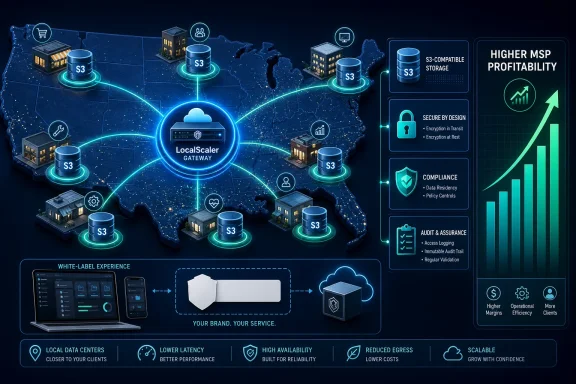
Exaba’s LocalScaler platform is designed to let MSPs build locally hosted, S3-compatible storage clouds on standard hardware, often in independent data centers. The company says the result is enterprise-grade storage with local jurisdiction controls, encryption, immutability, backup integrations, multi-tenant billing, and white-label branding. That is not merely a feature list. It is a claim that MSPs can stop being brokers of someone else’s storage and start being owners of their own storage economics.
The company’s most aggressive numbers are also its most provocative. Exaba says its model can support margins as high as 80 percent while pricing storage at a fraction of comparable hyperscaler services. Those figures should be treated as vendor claims until validated across a broad base of production deployments, but they explain why the company is drawing attention. In a market where a few percentage points of gross margin can change the health of a services business, a storage platform promising a step-change in profitability is not selling infrastructure. It is selling relief.
But the second-order effects are now harder to ignore. Storage bills grow quietly. Egress charges punish movement. Backup retention requirements keep expanding. Compliance and sovereignty concerns push customers to ask where their data actually lives. MSPs are then left trying to explain a monthly bill whose logic is perfectly rational to a cloud pricing spreadsheet and maddening to a small business owner.
Exaba is entering the US with a counter-narrative that is almost deliberately unfashionable: put storage close to customers, make pricing predictable, and let the MSP own the customer relationship. That does not mean the hyperscalers disappear. It means the default assumption that all durable storage belongs in hyperscale object stores is becoming more contestable.
This is where LocalScaler’s timing matters. The industry has spent the past few years rediscovering the old truth that cloud is a consumption model, not a moral destination. Some workloads belong in hyperscale regions. Some belong at the edge. Some belong in local data centers with known cost curves and direct operational control. Exaba’s bet is that backup-heavy MSP storage is one of the categories where locality and predictability can beat global scale.
That argument will resonate with providers that have watched storage become a low-margin necessity rather than a defensible service line. It will also unsettle vendors whose channel programs depend on MSPs continuing to move customer data into hyperscale platforms while accepting thin resale economics. Exaba is not trying to out-AWS AWS. It is trying to convince MSPs that AWS was never the right economic template for a large chunk of their storage business.
That makes Exaba’s go-to-market challenge more complex than its headline margin pitch suggests. MSPs may hate unpredictable cloud costs, but they hate operational risk even more. A storage platform that underpins backup and recovery is not a casual add-on. It sits close to the nerve center of customer trust.
The company appears to understand this, at least in its messaging. Exaba says it spent two years working with MSPs before building to specification, rather than building first and asking the market to adapt. That is the sort of founder story every enterprise startup tells, but in this category it matters more than usual. Storage products fail not only when disks fail, but when billing, tenancy, restores, compliance, and support workflows fail to match how providers actually operate.
The appointment of AJ Tills to lead US operations from Austin is also a signal that Exaba sees this as a channel execution problem, not just a product launch. Tills’ background includes launching Uber in Australia and New Zealand, which is not the same as selling infrastructure software to American MSPs, but it does suggest experience with market entry, local operations, and high-friction adoption. The company will need all of that.
The US MSP market rewards vendors that show up in person, support the channel, fund demand generation, and make migration feel safer than inertia. Exaba’s product may promise better economics, but its expansion will be judged on whether it can turn a financially attractive thesis into a repeatable partner motion.
Exaba’s LocalScaler architecture is built around that distinction. The platform is described as S3-compatible, which is table stakes for integrating with modern backup and data workflows. It also emphasizes immutability, encryption, local jurisdiction controls, and compatibility with backup tools such as Veeam and Commvault. Those are the practical features that make a storage target usable inside an MSP stack.
The business features may be just as important. Multi-tenancy, customer isolation, transparent billing, and white-label service delivery are not glamorous engineering achievements, but they are the difference between a storage system and a managed service product. If an MSP cannot package, bill, monitor, and support the service cleanly, the technical merits become secondary.
That is why Exaba’s “local cloud” language is not merely branding. It is an attempt to give MSPs a cloud-like product they can own without asking them to assemble a large specialist engineering team. The company’s co-founder Dr. Stuart Inglis has described the goal as building a cloud for the individual MSP — something that would traditionally be difficult without deep Linux and Windows technical talent.
The risk is that simplicity is always relative in storage. Commodity hardware still has to be procured, deployed, maintained, monitored, and replaced. Data centers still need power, cooling, connectivity, and physical security. Software can abstract complexity, but it cannot abolish the operational responsibilities that come with owning infrastructure.
The appeal is obvious. Cloud resale has often become a low-margin business where the provider owns the relationship risk but not much of the upside. Customers expect the MSP to manage performance, backup, security, and cost surprises, but the hyperscaler captures much of the infrastructure value. Exaba is arguing that storage is too central to leave in that arrangement.
This is particularly relevant as AI enters the MSP conversation. AI workloads create more data, more backup requirements, more compliance questions, and more customer anxiety about cost. If MSPs are expected to deliver AI-related services while absorbing higher platform costs, they need durable profit centers elsewhere in the stack.
Exaba’s own research, as described in the supplied material, suggests that many MSPs see agentic AI as a major revenue opportunity and also a major margin threat. That sounds contradictory only if one assumes revenue growth and profitability move together. MSPs know they often do not.
A provider can win a customer’s AI project and still lose money if the supporting infrastructure, storage, governance, and support obligations are mispriced. In that context, profitable storage is not a nostalgic return to hardware. It is a financial stabilizer for a services business being pulled into more complex workloads.
Local hosting gives MSPs a clearer story to tell. Data can be kept in a known jurisdiction. Customers can ask more concrete questions about location, retention, and access. Providers can align storage with regional compliance expectations without routing every discussion through the abstractions of global cloud regions and contractual fine print.
This is not to say hyperscalers lack sovereignty tools. Microsoft, AWS, and others have invested heavily in regional cloud offerings, compliance certifications, customer-managed keys, and hybrid architectures. They are not blind to the issue. But the hyperscaler approach still tends to begin with global platforms and then carve out controls.
Exaba begins from the opposite direction. It argues that proximity, local control, and provider ownership should be the default. For MSPs serving customers that want a human account team, local accountability, and predictable pricing, that inversion may be compelling.
There is also a trust dynamic at work. Many small and midsize customers do not want to become cloud pricing experts. They want their MSP to recommend a service that is safe, recoverable, compliant, and affordable. If the MSP can supply that under its own brand, with clearer economics and local accountability, the value proposition becomes easier to explain.
The company will need to show evidence of durability, recoverability, support responsiveness, and operational maturity. It will need reference customers willing to talk about restores, not just deployments. It will need to survive the first wave of edge cases that appear only when many MSPs run many different customer environments across many different hardware and data center configurations.
American MSPs will also ask uncomfortable questions. Who is responsible when hardware fails? How are upgrades handled? What does ransomware recovery look like under pressure? How does the platform behave when a tenant grows unexpectedly? What happens when a provider wants to migrate away? How are support escalations handled across time zones?
These are not objections to the model. They are the buying process. The more important a product is to an MSP’s recurring revenue, the more skeptical the MSP should be.
Exaba’s advantage is that it is not asking providers to abandon every hyperscale service. It is targeting a defined pain point: backup and storage economics. That narrower wedge may make adoption easier. An MSP can test local object storage for specific workloads before making it a default platform.
Still, the company must avoid sounding as though it has discovered private cloud for the first time. Many MSPs have already built, bought, or abandoned their own infrastructure platforms. They have scars from SAN upgrades, replication failures, licensing traps, and midnight restore calls. Exaba’s argument must be not merely that local storage is profitable, but that its software changes the operational equation enough to make that profitability sustainable.
That is why Exaba’s opportunity is not universal displacement. It is selective repatriation and channel-owned storage for workloads where hyperscaler value is weaker than hyperscaler cost. Backup repositories, archival data, compliance-driven local copies, and MSP-branded storage services are more plausible targets than cloud-native applications built around platform-specific services.
The hyperscalers also have their own hybrid and edge stories. Microsoft has Azure Local and a broad ecosystem around Windows Server, Hyper-V, Azure Arc, and backup integrations. AWS has Outposts, Local Zones, and partner-led hybrid architectures. If customer demand moves toward local sovereignty and predictable pricing, the big platforms will keep adapting.
But hyperscaler adaptation does not automatically solve MSP margin. A cloud platform can make infrastructure technically elegant while leaving the channel with limited room to build recurring profit. Exaba’s wedge is economic, not merely architectural.
That is why incumbents should take the company seriously even if its current footprint is small. The best startup attacks often begin where the incumbent’s product is strong but the business model frustrates a specific buyer. MSPs are precisely that kind of buyer: sophisticated enough to understand the trade-offs, close enough to customers to feel the pain, and motivated enough by recurring margin to experiment.
That creates discipline. A New Zealand company targeting the US has to learn quickly that product quality is only one part of the problem. Distribution, credibility, local leadership, investor networks, and customer proximity matter just as much. The US market is not merely larger; it is louder, faster, and less forgiving.
Guy Haddleton’s involvement gives Exaba useful credibility here. Haddleton’s track record includes Adaytum, Anaplan, and a role in the broader Xero story. That does not guarantee Exaba’s success, but it provides a strategic pattern: build from a small market, find a global pain point, and scale through a focused category narrative.
The company’s founders, Peter Boyle and Stuart Inglis, are also positioning Exaba as a product shaped by MSP conversations rather than a laboratory invention. That is the right posture for this market. MSPs do not want elegant abstractions that make sense only to venture investors. They want products that reduce tickets, improve margins, and do not embarrass them in front of customers.
Relocating US leadership to Austin is similarly practical. Austin gives Exaba access to a dense technology ecosystem, strong transport links, and a business culture comfortable with infrastructure software. More importantly, it signals that the company is not trying to run a US channel push entirely from the other side of the Pacific.
That claim is plausible. AI projects generate more data, require more governance, and often come with unclear cost structures. Customers may ask MSPs to deploy AI tools, manage access, secure outputs, archive prompts or documents, and support new workflows. Much of that work is service-heavy and risk-heavy.
But Exaba’s stronger argument does not depend on AI hype. Even without agentic AI, the world is producing more backup data, retaining it for longer, and demanding faster recovery. Ransomware has made immutability and restore confidence board-level concerns. Compliance has made data location more visible. Cloud cost management has become a permanent discipline rather than a one-time optimization.
AI may accelerate those trends, but it did not create them. Exaba’s product is therefore better understood as a response to structural storage pressure than as an AI-adjacent startup. That is a healthier position. Companies that tie themselves too tightly to the AI news cycle risk looking dated when the vocabulary changes.
For MSPs, the question is not whether AI will transform everything. The question is whether their basic infrastructure economics can survive the next wave of data growth. Exaba is arguing that they cannot if storage remains a hyperscaler pass-through with thin margins and unpredictable costs.
But control comes with obligations. If an MSP sells its own storage cloud, customers will expect the MSP to stand behind it. The provider cannot point to a global cloud status page and say the problem is upstream. The brand on the invoice becomes the brand in the incident report.
This is where Exaba’s software layer has to earn its keep. The platform must make local ownership feel less like running a bespoke storage science project and more like operating a managed service product. Deployment, monitoring, billing, isolation, upgrades, and support all have to be boring in the best sense of the word.
The company’s use of standard hardware is a double-edged sword. It can reduce costs and avoid proprietary appliance lock-in. It can also widen the range of configurations that must be supported. Standard hardware is only simple when procurement, certification, monitoring, and failure handling are disciplined.
For WindowsForum readers, especially sysadmins and IT pros, this is the part to watch. The business case may be written in margin percentages, but the success or failure will show up in operational details: restore speed, alert fidelity, tenant isolation, upgrade safety, and how well the product behaves during the ugly moments.
Exaba’s LocalScaler concept fits that more mature version of the trend. It is not telling MSPs to abandon cloud principles. It is telling them to stop assuming hyperscale geography and hyperscale pricing are required for every storage workload.
The danger is regression. If local storage means manual operations, fragile scaling, poor observability, or painful migrations, the savings will be eaten by labor and risk. MSPs have been down that road before. Cheap infrastructure that demands expensive humans is not cheap.
That is why API compatibility matters. If backup software and customer workflows can treat LocalScaler as an object storage target without exotic integration work, the adoption barrier falls. If MSP billing and tenant management are built in rather than bolted on, the service becomes easier to monetize.
The market will not reward Exaba for being merely cheaper. It will reward the company only if cheaper also means manageable, resilient, and commercially clean. In storage, good enough is not a compliment unless it includes recovery under pressure.
But markets evolve. Once customers become comfortable with cloud, they start asking harder questions about the bill. Once MSPs become responsible for managing cloud estates, they start calculating which parts of the stack actually create margin. Once data sovereignty and ransomware recovery become everyday concerns, local control stops sounding parochial.
Exaba’s US expansion is therefore part of a broader industry correction. The cloud era is not ending. It is fragmenting. Workloads are being sorted more carefully by performance, cost, risk, compliance, and ownership. That sorting creates room for companies that can deliver cloud-like operations without hyperscale dependency.
This does not make Exaba a guaranteed winner. The storage market is crowded, and American MSPs are famously pragmatic. They will test the numbers, demand references, compare alternatives, and push hard on support. They will also listen if a vendor can show them a credible path to millions of dollars in additional margin.
The most interesting outcome would not be Exaba replacing AWS or Azure. It would be Exaba forcing MSPs to renegotiate their mental model of storage: not as a commodity they resell, but as a strategic service they can own.
 Exaba Is Selling Margin, Not Just Storage
The most important thing about Exaba’s US expansion is not that another storage vendor wants a slice of the American market. That happens every week. The interesting part is that Exaba is framing storage as a profit engine for MSPs at a time when many service providers have learned to treat storage as an unavoidable pass-through cost.That pitch lands because MSPs live in a world of margin compression. Security tooling gets more expensive. Labor gets harder to scale. Customers want more predictable monthly bills while their data footprints grow in every direction. Hyperscale cloud solved the deployment problem, but it did not always solve the business-model problem for the companies reselling and managing those services.
Exaba’s LocalScaler platform is designed to let MSPs build locally hosted, S3-compatible storage clouds on standard hardware, often in independent data centers. The company says the result is enterprise-grade storage with local jurisdiction controls, encryption, immutability, backup integrations, multi-tenant billing, and white-label branding. That is not merely a feature list. It is a claim that MSPs can stop being brokers of someone else’s storage and start being owners of their own storage economics.
The company’s most aggressive numbers are also its most provocative. Exaba says its model can support margins as high as 80 percent while pricing storage at a fraction of comparable hyperscaler services. Those figures should be treated as vendor claims until validated across a broad base of production deployments, but they explain why the company is drawing attention. In a market where a few percentage points of gross margin can change the health of a services business, a storage platform promising a step-change in profitability is not selling infrastructure. It is selling relief.
The Hyperscaler Backlash Has Found Its MSP Story
For years, the public cloud narrative was dominated by speed, elasticity, and the freedom to avoid capital expenditure. Those arguments were not wrong. AWS, Azure, and Google Cloud changed the economics of infrastructure by making capacity programmable, global, and instantly available.But the second-order effects are now harder to ignore. Storage bills grow quietly. Egress charges punish movement. Backup retention requirements keep expanding. Compliance and sovereignty concerns push customers to ask where their data actually lives. MSPs are then left trying to explain a monthly bill whose logic is perfectly rational to a cloud pricing spreadsheet and maddening to a small business owner.
Exaba is entering the US with a counter-narrative that is almost deliberately unfashionable: put storage close to customers, make pricing predictable, and let the MSP own the customer relationship. That does not mean the hyperscalers disappear. It means the default assumption that all durable storage belongs in hyperscale object stores is becoming more contestable.
This is where LocalScaler’s timing matters. The industry has spent the past few years rediscovering the old truth that cloud is a consumption model, not a moral destination. Some workloads belong in hyperscale regions. Some belong at the edge. Some belong in local data centers with known cost curves and direct operational control. Exaba’s bet is that backup-heavy MSP storage is one of the categories where locality and predictability can beat global scale.
That argument will resonate with providers that have watched storage become a low-margin necessity rather than a defensible service line. It will also unsettle vendors whose channel programs depend on MSPs continuing to move customer data into hyperscale platforms while accepting thin resale economics. Exaba is not trying to out-AWS AWS. It is trying to convince MSPs that AWS was never the right economic template for a large chunk of their storage business.
The US Market Is the Prize and the Trap
The United States is an obvious target because it has a vast MSP ecosystem, deep customer demand, and a mature channel culture. It is also a brutal market to enter. American MSPs are not waiting around for a New Zealand startup to explain storage to them; most already have vendor relationships, backup stacks, purchasing contracts, and strong opinions formed by painful incidents.That makes Exaba’s go-to-market challenge more complex than its headline margin pitch suggests. MSPs may hate unpredictable cloud costs, but they hate operational risk even more. A storage platform that underpins backup and recovery is not a casual add-on. It sits close to the nerve center of customer trust.
The company appears to understand this, at least in its messaging. Exaba says it spent two years working with MSPs before building to specification, rather than building first and asking the market to adapt. That is the sort of founder story every enterprise startup tells, but in this category it matters more than usual. Storage products fail not only when disks fail, but when billing, tenancy, restores, compliance, and support workflows fail to match how providers actually operate.
The appointment of AJ Tills to lead US operations from Austin is also a signal that Exaba sees this as a channel execution problem, not just a product launch. Tills’ background includes launching Uber in Australia and New Zealand, which is not the same as selling infrastructure software to American MSPs, but it does suggest experience with market entry, local operations, and high-friction adoption. The company will need all of that.
The US MSP market rewards vendors that show up in person, support the channel, fund demand generation, and make migration feel safer than inertia. Exaba’s product may promise better economics, but its expansion will be judged on whether it can turn a financially attractive thesis into a repeatable partner motion.
LocalScaler Is a Bet Against Storage as a Commodity
Storage is often described as a commodity, but that word hides more than it reveals. A terabyte is a unit of capacity; a customer’s recoverable, compliant, isolated, auditable, ransomware-resistant backup estate is not a commodity. MSPs know the difference because they get the phone call when something breaks.Exaba’s LocalScaler architecture is built around that distinction. The platform is described as S3-compatible, which is table stakes for integrating with modern backup and data workflows. It also emphasizes immutability, encryption, local jurisdiction controls, and compatibility with backup tools such as Veeam and Commvault. Those are the practical features that make a storage target usable inside an MSP stack.
The business features may be just as important. Multi-tenancy, customer isolation, transparent billing, and white-label service delivery are not glamorous engineering achievements, but they are the difference between a storage system and a managed service product. If an MSP cannot package, bill, monitor, and support the service cleanly, the technical merits become secondary.
That is why Exaba’s “local cloud” language is not merely branding. It is an attempt to give MSPs a cloud-like product they can own without asking them to assemble a large specialist engineering team. The company’s co-founder Dr. Stuart Inglis has described the goal as building a cloud for the individual MSP — something that would traditionally be difficult without deep Linux and Windows technical talent.
The risk is that simplicity is always relative in storage. Commodity hardware still has to be procured, deployed, maintained, monitored, and replaced. Data centers still need power, cooling, connectivity, and physical security. Software can abstract complexity, but it cannot abolish the operational responsibilities that come with owning infrastructure.
The Margin Claim Is Powerful Because MSPs Know the Pain
Exaba’s pitch includes a striking example: a $20 million MSP with $5 million in storage revenue at a 10 percent margin could reportedly improve margin by more than $3 million by switching to the Exaba model. That is the kind of math that gets attention in boardrooms because it does not require a new customer segment or a speculative AI product. It proposes extracting more profit from a service line MSPs already sell.The appeal is obvious. Cloud resale has often become a low-margin business where the provider owns the relationship risk but not much of the upside. Customers expect the MSP to manage performance, backup, security, and cost surprises, but the hyperscaler captures much of the infrastructure value. Exaba is arguing that storage is too central to leave in that arrangement.
This is particularly relevant as AI enters the MSP conversation. AI workloads create more data, more backup requirements, more compliance questions, and more customer anxiety about cost. If MSPs are expected to deliver AI-related services while absorbing higher platform costs, they need durable profit centers elsewhere in the stack.
Exaba’s own research, as described in the supplied material, suggests that many MSPs see agentic AI as a major revenue opportunity and also a major margin threat. That sounds contradictory only if one assumes revenue growth and profitability move together. MSPs know they often do not.
A provider can win a customer’s AI project and still lose money if the supporting infrastructure, storage, governance, and support obligations are mispriced. In that context, profitable storage is not a nostalgic return to hardware. It is a financial stabilizer for a services business being pulled into more complex workloads.
Sovereignty Gives the Pitch a Second Engine
The cost argument is the loudest part of Exaba’s story, but sovereignty may prove to be the more durable one. Customers increasingly care about where data resides, who controls it, and which legal regimes apply to it. That concern is not limited to government agencies or heavily regulated industries; it is spreading through ordinary business procurement.Local hosting gives MSPs a clearer story to tell. Data can be kept in a known jurisdiction. Customers can ask more concrete questions about location, retention, and access. Providers can align storage with regional compliance expectations without routing every discussion through the abstractions of global cloud regions and contractual fine print.
This is not to say hyperscalers lack sovereignty tools. Microsoft, AWS, and others have invested heavily in regional cloud offerings, compliance certifications, customer-managed keys, and hybrid architectures. They are not blind to the issue. But the hyperscaler approach still tends to begin with global platforms and then carve out controls.
Exaba begins from the opposite direction. It argues that proximity, local control, and provider ownership should be the default. For MSPs serving customers that want a human account team, local accountability, and predictable pricing, that inversion may be compelling.
There is also a trust dynamic at work. Many small and midsize customers do not want to become cloud pricing experts. They want their MSP to recommend a service that is safe, recoverable, compliant, and affordable. If the MSP can supply that under its own brand, with clearer economics and local accountability, the value proposition becomes easier to explain.
The Hard Part Is Proving Reliability at American Scale
Storage startups do not get many second chances. If a collaboration tool has an outage, customers complain. If a storage platform mishandles backup integrity or recovery, customers may face existential damage. That is why Exaba’s US expansion will require more than persuasive margin models.The company will need to show evidence of durability, recoverability, support responsiveness, and operational maturity. It will need reference customers willing to talk about restores, not just deployments. It will need to survive the first wave of edge cases that appear only when many MSPs run many different customer environments across many different hardware and data center configurations.
American MSPs will also ask uncomfortable questions. Who is responsible when hardware fails? How are upgrades handled? What does ransomware recovery look like under pressure? How does the platform behave when a tenant grows unexpectedly? What happens when a provider wants to migrate away? How are support escalations handled across time zones?
These are not objections to the model. They are the buying process. The more important a product is to an MSP’s recurring revenue, the more skeptical the MSP should be.
Exaba’s advantage is that it is not asking providers to abandon every hyperscale service. It is targeting a defined pain point: backup and storage economics. That narrower wedge may make adoption easier. An MSP can test local object storage for specific workloads before making it a default platform.
Still, the company must avoid sounding as though it has discovered private cloud for the first time. Many MSPs have already built, bought, or abandoned their own infrastructure platforms. They have scars from SAN upgrades, replication failures, licensing traps, and midnight restore calls. Exaba’s argument must be not merely that local storage is profitable, but that its software changes the operational equation enough to make that profitability sustainable.
Hyperscalers Will Not Stand Still
AWS and Microsoft Azure remain dominant because they are extraordinarily capable platforms. Their storage services are deeply integrated with compute, analytics, identity, security tooling, global networking, and partner ecosystems. For many workloads, leaving hyperscale storage would be irrational.That is why Exaba’s opportunity is not universal displacement. It is selective repatriation and channel-owned storage for workloads where hyperscaler value is weaker than hyperscaler cost. Backup repositories, archival data, compliance-driven local copies, and MSP-branded storage services are more plausible targets than cloud-native applications built around platform-specific services.
The hyperscalers also have their own hybrid and edge stories. Microsoft has Azure Local and a broad ecosystem around Windows Server, Hyper-V, Azure Arc, and backup integrations. AWS has Outposts, Local Zones, and partner-led hybrid architectures. If customer demand moves toward local sovereignty and predictable pricing, the big platforms will keep adapting.
But hyperscaler adaptation does not automatically solve MSP margin. A cloud platform can make infrastructure technically elegant while leaving the channel with limited room to build recurring profit. Exaba’s wedge is economic, not merely architectural.
That is why incumbents should take the company seriously even if its current footprint is small. The best startup attacks often begin where the incumbent’s product is strong but the business model frustrates a specific buyer. MSPs are precisely that kind of buyer: sophisticated enough to understand the trade-offs, close enough to customers to feel the pain, and motivated enough by recurring margin to experiment.
New Zealand Startups Know the Distance Problem
Exaba’s origin story matters because New Zealand technology companies have a particular relationship with global expansion. The domestic market is too small to support the scale ambitions of most serious software companies, so internationalization is not a late-stage luxury. It is built into the plan.That creates discipline. A New Zealand company targeting the US has to learn quickly that product quality is only one part of the problem. Distribution, credibility, local leadership, investor networks, and customer proximity matter just as much. The US market is not merely larger; it is louder, faster, and less forgiving.
Guy Haddleton’s involvement gives Exaba useful credibility here. Haddleton’s track record includes Adaytum, Anaplan, and a role in the broader Xero story. That does not guarantee Exaba’s success, but it provides a strategic pattern: build from a small market, find a global pain point, and scale through a focused category narrative.
The company’s founders, Peter Boyle and Stuart Inglis, are also positioning Exaba as a product shaped by MSP conversations rather than a laboratory invention. That is the right posture for this market. MSPs do not want elegant abstractions that make sense only to venture investors. They want products that reduce tickets, improve margins, and do not embarrass them in front of customers.
Relocating US leadership to Austin is similarly practical. Austin gives Exaba access to a dense technology ecosystem, strong transport links, and a business culture comfortable with infrastructure software. More importantly, it signals that the company is not trying to run a US channel push entirely from the other side of the Pacific.
The AI Angle Is Real, but Storage Is the Substance
Every infrastructure story now gets pulled toward AI, often with more heat than light. Exaba is no exception. The company’s US messaging includes the idea that AI will create new revenue opportunities for MSPs while also threatening margins.That claim is plausible. AI projects generate more data, require more governance, and often come with unclear cost structures. Customers may ask MSPs to deploy AI tools, manage access, secure outputs, archive prompts or documents, and support new workflows. Much of that work is service-heavy and risk-heavy.
But Exaba’s stronger argument does not depend on AI hype. Even without agentic AI, the world is producing more backup data, retaining it for longer, and demanding faster recovery. Ransomware has made immutability and restore confidence board-level concerns. Compliance has made data location more visible. Cloud cost management has become a permanent discipline rather than a one-time optimization.
AI may accelerate those trends, but it did not create them. Exaba’s product is therefore better understood as a response to structural storage pressure than as an AI-adjacent startup. That is a healthier position. Companies that tie themselves too tightly to the AI news cycle risk looking dated when the vocabulary changes.
For MSPs, the question is not whether AI will transform everything. The question is whether their basic infrastructure economics can survive the next wave of data growth. Exaba is arguing that they cannot if storage remains a hyperscaler pass-through with thin margins and unpredictable costs.
The MSP Channel Wants Control, but It Also Wants Sleep
The central tension in Exaba’s pitch is control versus responsibility. MSPs like the idea of owning infrastructure economics. They like white-label services, local branding, predictable pricing, and customer stickiness. They like recurring revenue that does not evaporate into a hyperscaler bill.But control comes with obligations. If an MSP sells its own storage cloud, customers will expect the MSP to stand behind it. The provider cannot point to a global cloud status page and say the problem is upstream. The brand on the invoice becomes the brand in the incident report.
This is where Exaba’s software layer has to earn its keep. The platform must make local ownership feel less like running a bespoke storage science project and more like operating a managed service product. Deployment, monitoring, billing, isolation, upgrades, and support all have to be boring in the best sense of the word.
The company’s use of standard hardware is a double-edged sword. It can reduce costs and avoid proprietary appliance lock-in. It can also widen the range of configurations that must be supported. Standard hardware is only simple when procurement, certification, monitoring, and failure handling are disciplined.
For WindowsForum readers, especially sysadmins and IT pros, this is the part to watch. The business case may be written in margin percentages, but the success or failure will show up in operational details: restore speed, alert fidelity, tenant isolation, upgrade safety, and how well the product behaves during the ugly moments.
The Real Test Will Be Repatriation Without Regression
Cloud repatriation is often discussed as if it were a backlash against modern infrastructure. That misses the point. The best repatriation stories are not nostalgic returns to the server closet. They are attempts to apply cloud lessons — automation, API compatibility, usage-based thinking, resilience patterns — to infrastructure that lives closer to the customer and has a better cost profile.Exaba’s LocalScaler concept fits that more mature version of the trend. It is not telling MSPs to abandon cloud principles. It is telling them to stop assuming hyperscale geography and hyperscale pricing are required for every storage workload.
The danger is regression. If local storage means manual operations, fragile scaling, poor observability, or painful migrations, the savings will be eaten by labor and risk. MSPs have been down that road before. Cheap infrastructure that demands expensive humans is not cheap.
That is why API compatibility matters. If backup software and customer workflows can treat LocalScaler as an object storage target without exotic integration work, the adoption barrier falls. If MSP billing and tenant management are built in rather than bolted on, the service becomes easier to monetize.
The market will not reward Exaba for being merely cheaper. It will reward the company only if cheaper also means manageable, resilient, and commercially clean. In storage, good enough is not a compliment unless it includes recovery under pressure.
A Small Company Is Poking a Very Large Assumption
The biggest assumption Exaba challenges is that hyperscale cloud is the natural endpoint for storage growth. That assumption became powerful because it was often true. When organizations needed fast capacity, global reach, and minimal upfront investment, hyperscalers were the obvious answer.But markets evolve. Once customers become comfortable with cloud, they start asking harder questions about the bill. Once MSPs become responsible for managing cloud estates, they start calculating which parts of the stack actually create margin. Once data sovereignty and ransomware recovery become everyday concerns, local control stops sounding parochial.
Exaba’s US expansion is therefore part of a broader industry correction. The cloud era is not ending. It is fragmenting. Workloads are being sorted more carefully by performance, cost, risk, compliance, and ownership. That sorting creates room for companies that can deliver cloud-like operations without hyperscale dependency.
This does not make Exaba a guaranteed winner. The storage market is crowded, and American MSPs are famously pragmatic. They will test the numbers, demand references, compare alternatives, and push hard on support. They will also listen if a vendor can show them a credible path to millions of dollars in additional margin.
The most interesting outcome would not be Exaba replacing AWS or Azure. It would be Exaba forcing MSPs to renegotiate their mental model of storage: not as a commodity they resell, but as a strategic service they can own.
The Numbers That Will Decide Exaba’s American Bet
Exaba’s US story is compelling because it connects a technical architecture to a business problem MSPs already recognize. The details still matter, and the company’s next phase will be judged less by launch rhetoric than by repeatable evidence in the field.- Exaba has raised NZ$12 million in seed funding and is using that capital to expand from New Zealand and Australia into North America.
- LocalScaler is positioned as an MSP-first, locally hosted, S3-compatible storage platform that runs on standard hardware and supports white-label service delivery.
- The company claims its model can deliver substantially higher storage margins than hyperscaler resale while avoiding egress, API, and hidden-fee surprises.
- The US opportunity is large, but MSP adoption will depend on reliability, support, migration safety, and proof that local ownership does not recreate old private-cloud burdens.
- The strongest competitive pressure on AWS and Azure is not that Exaba can match their global platforms, but that some MSP storage workloads may not need global platforms in the first place.
- The AI boom may strengthen Exaba’s pitch, but the deeper driver is simpler: customers are storing more data, retaining it longer, and asking MSPs to make the economics work.
References
- Primary source: IT Brief Australia
Published: 2026-06-22T21:30:43.109674
Loading…
itbrief.com.au - Related coverage: exaba.com
Loading…
exaba.com - Related coverage: app.dealroom.co
Loading…
app.dealroom.co - Related coverage: nbr.co.nz
Loading…
www.nbr.co.nz - Related coverage: s3.eu-central-1.amazonaws.com
Loading…
s3.eu-central-1.amazonaws.com