
Farseer expanded into the UK and North America on June 23, 2026, while launching AI Analyst, a conversational finance tool that lets teams query live financial models without allowing the AI layer to invent or recalculate the underlying numbers. The move is not just another regional SaaS launch dressed in AI clothing. It is a bet that finance departments will accept generative interfaces only when the arithmetic remains locked inside a governed model. In a market flooded with copilots, Farseer is trying to sell something more conservative: AI that talks, but does not get to touch the books.
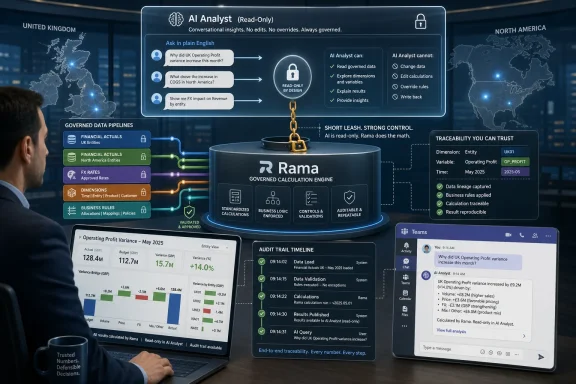
The most interesting part of Farseer’s AI Analyst is not that finance users can ask questions in plain English. That is now table stakes for almost every enterprise software vendor with a roadmap, a marketing team, and access to a large language model. The more consequential design choice is that Farseer says the tool is read-only and that the calculations stay inside Rama, its existing financial model and calculation engine.
That distinction matters because finance is one of the worst places to discover that an AI assistant has been improvising. A hallucinated sales trend is not just an embarrassing demo failure when it lands in a board pack, a lender covenant discussion, or an auditor’s review sample. In corporate finance, the problem is not merely whether a model sounds plausible; it is whether the number can be traced back to an agreed definition, a source system, and a repeatable calculation.
Farseer is pitching AI Analyst as a layer of interpretation rather than a second brain for finance. Users can ask for tables, rankings, variance breakdowns, and commentary from live model data, but the company says the product does not generate financial numbers on its own. In other words, the AI is there to explain and retrieve, not to become the system of record.
That is a sober message in a hype cycle that often rewards vendors for promising the opposite. The agentic dream says software should do more on the user’s behalf. Farseer’s early message says finance AI should do less, at least when the job involves numbers that executives, auditors, and boards must defend.
Farseer’s new UK footprint includes implementation consultants Maksim Grigorjev, Rajvinder Dhesi, and Velislav Asenov. That detail is easy to skip, but it is strategically important. Planning software rarely wins because a vendor has the most elegant demo; it wins when consultants can map a company’s messy chart of accounts, departmental logic, revenue drivers, and reporting cadence into a model people actually trust.
North America is the more ambitious part of the push. Farseer has said its Series A funding is intended to help scale the company beyond its European base, and North America is where the competitive set becomes especially crowded. Adaptive Planning, Anaplan, Pigment, Oracle, SAP, Workday, OneStream, and a long tail of younger FP&A vendors are all fighting for budget from CFOs who have heard the “replace spreadsheets” pitch for years.
That history is a problem for every new entrant. Finance teams do not cling to spreadsheets because they are unaware of modern software. They cling to them because spreadsheets are flexible, local, inspectable, and politically useful. Replacing them requires more than a better interface; it requires trust that the new model can absorb the exceptions, edge cases, and late-night workarounds that spreadsheets have been quietly carrying for decades.
Farseer’s challenge in the UK and North America is therefore not only to sell AI Analyst. It must prove that the underlying platform can become the place where finance logic lives. If Rama is the trusted model, AI Analyst becomes a useful interface. If Rama is just another layer beside Excel, ERP, and BI, the AI risks becoming another window into an already fragmented truth.
The spreadsheet problem is often misdescribed as a productivity problem. It is partly that, of course. Manual consolidations, broken links, copied formulas, and versioned files are expensive forms of friction. But the deeper issue is institutional ambiguity.
A spreadsheet can encode a business definition without documenting why that definition exists. It can produce a number without making lineage obvious. It can allow two departments to use similar-looking metrics that diverge in subtle ways. Over time, the spreadsheet estate becomes not just a toolset but a shadow constitution for the business.
That is why finance software vendors keep talking about governance, traceability, and explainability. The language may be dull, but the stakes are real. If the revenue forecast changes, the CFO needs to know whether demand shifted, pricing changed, volume assumptions moved, a region reclassified something, or a formula broke.
Generative AI intensifies this old problem. A chatbot can make fragmented finance systems feel deceptively unified by wrapping them in a single conversational interface. But if the underlying definitions are inconsistent, the chatbot does not solve the problem. It simply makes the inconsistency faster, smoother, and potentially harder to notice.
Farseer is trying to place AI Analyst near the safer end of that spectrum. The product works against live model data, supports requests for analysis and commentary, and displays the variables and dimensions used in its responses. That last feature is not glamorous, but it is central to the pitch: finance users need to see how the answer was framed.
The company says AI Analyst supports performance and positioning analysis, price-volume-mix work, trend and seasonality views, multi-dimensional profitability, and variance across actuals, budgets, forecasts, and plans. Those are exactly the kinds of tasks where finance teams spend hours slicing data, rebuilding tables, and explaining deltas to operational leaders. If the tool can reliably accelerate that work without losing lineage, it has practical value even if it never becomes a fully autonomous agent.
The integration story is similarly pragmatic. Farseer says AI Analyst can work inside Slack, Microsoft Teams, and WhatsApp, which reflects how finance work actually happens: in chats, side channels, review loops, and recurring requests from executives who do not want another dashboard login. The risk, of course, is that chat-based finance analysis can spread sensitive information into collaboration tools that were not originally designed as financial control environments.
That risk is manageable, but not trivial. Permissions, audit trails, data retention policies, and identity controls become part of the product story whether vendors want them there or not. If finance users can ask sensitive questions from Teams or WhatsApp, IT and security teams will want to know who can ask, what can be returned, where responses are stored, and how those responses are governed.
But the limitation is also the sales argument. A read-only analyst is easier to approve than an AI agent that can alter forecasts or change drivers. It creates a cleaner boundary between human accountability and machine assistance. It also gives finance leaders a way to experiment with AI without handing it the keys to the planning process.
This matters because the first wave of enterprise AI adoption has often been more cautious than the marketing suggested. Companies are willing to use AI for summarization, drafting, coding assistance, support triage, and knowledge retrieval. They become more careful when AI begins influencing financial reporting, hiring decisions, legal review, regulated operations, or material business forecasts.
Farseer’s approach reflects that tension. The company is not saying AI should be absent from finance; it is saying the model must remain governed. That is a narrower claim than the full agentic vision, but it may be more credible to CFOs who have to defend results rather than merely consume them.
The eventual question is whether read-only remains a permanent guardrail or an adoption wedge. If customers come to trust the answers, they may ask for controlled write-back capabilities: update a scenario, change a driver, prepare a forecast version, route a task, or generate commentary for review. Farseer will then face the same product dilemma as every AI vendor in a controlled environment: how to make the assistant more useful without making it unacceptably powerful.
Still, certification should not be mistaken for a competitive moat. Many buyers will view it as reassurance rather than a reason to switch platforms. The harder question is whether Farseer can deliver repeatable implementations across industries, geographies, accounting structures, and planning cultures.
That is where FP&A platforms live or die. A tool that works beautifully for a hotel group may need very different logic for telecom infrastructure, manufacturing, retail, or software revenue recognition. Customer references such as TT Hotels and EuroTeleSites help Farseer show that AI Analyst is already in live use, but expansion into the UK and North America will test whether those early deployments generalize.
The certification story also intersects with AI governance. If AI Analyst is generating commentary from governed data, then the quality of the report is partly a function of both the data model and the presentation layer. It is not enough for the numbers to be correct if the explanation misleads, overstates causality, or hides uncertainty.
This is one of the underappreciated challenges in finance AI. Variance commentary can sound authoritative while being analytically thin. A tool may correctly identify that revenue fell in a region while offering a weak explanation of why. Finance teams will need to distinguish between accurate retrieval, useful interpretation, and speculative narrative.
The funding round was led by Aymo Ventures, with participation from SQ Capital and Apertu Capital. Farseer has described the money as fuel for product development, AI investment, and expansion beyond its regional base. That is the right story for a Series A company, but the next phase is where the market becomes less forgiving.
The company’s apparent strength is focus. Farseer is not trying to be a general enterprise AI platform. It is building around finance data, planning, reporting, and forecasting. That domain specificity gives it a clearer product narrative than generic copilots that promise to help everyone do everything.
The weakness is that domain specificity also raises the bar. Finance teams will not tolerate a system that is merely clever. They will expect integrations with ERP and CRM systems, reconciliation workflows, permissions, auditability, performance at scale, and enough flexibility to model how the business actually operates rather than how a vendor thinks it should operate.
This is why Farseer’s Rama architecture is central to the company’s story. If the engine can standardize data, run multidimensional models quickly, and keep definitions consistent, then AI Analyst becomes more than a chatbot. If the engine cannot handle enterprise messiness, the AI layer will be judged harshly no matter how polished the interface looks.
The appeal is obvious. A CFO, controller, or regional manager can ask for a variance breakdown without opening a separate FP&A workspace. A finance analyst can retrieve live model data in the same environment where budget owners are already debating assumptions. A planning cycle that once depended on emailed spreadsheets and static decks can become more conversational.
But Teams integration also brings familiar administrative questions. Microsoft 365 tenants are governed through identity, conditional access, retention, eDiscovery, sensitivity labels, and data loss prevention policies. If AI Analyst surfaces financial model data in Teams, organizations need to understand how those controls interact with Farseer’s own permissions and logging.
That is where IT will be dragged into what might otherwise look like a finance-led purchase. The CFO may buy the platform, but the CIO and security team will be asked to bless the integration. They will want to know whether prompts and responses are stored, whether sensitive financial information can be exported, whether access follows least-privilege principles, and how user activity is audited.
The broader lesson is that enterprise AI increasingly collapses the boundaries between business applications and collaboration platforms. A finance chatbot in Teams is not just a feature; it is a new route by which controlled business data moves through the organization. That is useful, but it must be designed with the same seriousness as any other path into financial systems.
Conversational analytics is an attempt to solve that last-mile problem. Instead of forcing users to navigate filters, dimensions, and visualizations, the system lets them ask the question directly. For finance, the promise is not simply convenience; it is faster iteration between question, answer, and decision.
The danger is that dialogue can hide structure. A dashboard exposes, however imperfectly, some of the dimensions and filters behind the view. A chat response may compress those choices into a paragraph. Unless the system shows variables, dimensions, and assumptions clearly, users may accept answers without understanding the frame.
Farseer appears aware of that risk. Its emphasis on displaying variables and dimensions is a small but important concession to the way finance professionals work. They do not just need an answer; they need to inspect the basis of the answer.
This is also why generic AI tools remain awkward in financial planning. They can summarize a spreadsheet or draft commentary, but they usually sit outside the governed model. Farseer’s wager is that the winning interface is conversational, but the winning architecture is disciplined.
That tension makes finance software a battleground for the next phase of enterprise AI. Vendors cannot simply bolt on a chatbot and declare victory. They must prove that AI outputs are grounded in controlled data, shaped by consistent definitions, and reviewable by humans who remain accountable for the result.
Farseer’s message fits the moment because it separates arithmetic from reasoning. The governed model does the maths; the AI explains, ranks, summarizes, and contextualizes. That division will not eliminate every risk, but it is a cleaner starting point than letting a language model become a financial calculator of last resort.
The phrase “AI you can defend” may become the real enterprise slogan of this cycle. Not AI that amazes in a demo. Not AI that writes a plausible memo. AI that a CFO can take into an audit committee meeting without hoping nobody asks how the number was produced.
There is a subtle but important shift here. Early AI marketing centered on productivity. The next enterprise wave is about accountability. In finance, the winner will not be the tool that gives the fastest answer; it will be the tool whose answer survives review.
The UK market gives Farseer a plausible foothold. It is large enough to matter, close enough to European business norms to be familiar, and full of companies balancing modernization with regulatory and reporting discipline. A local implementation presence should help the company move beyond remote sales and into the practical work of model adoption.
North America is a different beast. The market is bigger, louder, and more saturated. Buyers may be receptive to AI-enabled FP&A, but they will also compare Farseer against better-known names and platform vendors already embedded in their stack.
That comparison may work in Farseer’s favor if customers are tired of sprawling implementations and spreadsheet-dependent workarounds. It may work against the company if procurement teams prefer vendors with larger ecosystems, broader partner networks, and longer track records. Series A companies often win because they are focused and responsive; they lose when buyers decide that finance infrastructure is too important for a smaller vendor.
The company’s best chance is to sell into pain that incumbents have not fully solved. Fragmented planning, slow forecasting, inconsistent definitions, and manual variance analysis are not niche problems. They are the daily grind of finance departments that have modernized everything except the connective tissue.
A good finance analyst does more than retrieve numbers. They know which variance matters, which driver is suspect, which assumption is politically sensitive, and which operational explanation is convenient but incomplete. AI can accelerate the search for patterns, but it cannot own the business context.
This is why Farseer’s read-only design is philosophically coherent. It keeps responsibility with the finance team while giving them a faster way to interrogate the model. The user still has to decide whether the answer is meaningful, whether the commentary is fair, and whether the result should influence a forecast or management decision.
That may sound modest, but modesty is underrated in enterprise AI. The most successful tools may be the ones that fit into existing accountability structures rather than trying to replace them. Finance departments do not need a theatrical oracle; they need a faster route to defensible analysis.
The real operational question is training. Users must learn not only how to ask AI Analyst questions, but how to challenge its framing. If the system returns a variance explanation, finance teams should still inspect the dimensions, assumptions, and source data. AI fluency in finance will be less about prompt artistry and more about disciplined skepticism.
That contradiction creates the opening for products like AI Analyst. The promise is speed without surrendering governance. The risk is that the promise becomes another layer of software complexity if the underlying model is not adopted as the common source of truth.
The most credible part of Farseer’s pitch is its refusal to pretend that AI alone fixes fragmented finance. Trbara’s point that AI exposes weak foundations rather than curing them is exactly right. If a business has inconsistent definitions, disconnected systems, and spreadsheet politics, a chatbot may simply make the confusion conversational.
The hardest part of Farseer’s journey will be proving that its model-first approach can survive outside early adopters and regional success stories. UK and North American finance teams will judge the company not by its AI vocabulary, but by implementation reality: how quickly it connects to source systems, how well it handles exceptions, and how confidently users can trace answers back to agreed logic.
 Farseer Sells AI by Putting It on a Short Leash
The most interesting part of Farseer’s AI Analyst is not that finance users can ask questions in plain English. That is now table stakes for almost every enterprise software vendor with a roadmap, a marketing team, and access to a large language model. The more consequential design choice is that Farseer says the tool is read-only and that the calculations stay inside Rama, its existing financial model and calculation engine.That distinction matters because finance is one of the worst places to discover that an AI assistant has been improvising. A hallucinated sales trend is not just an embarrassing demo failure when it lands in a board pack, a lender covenant discussion, or an auditor’s review sample. In corporate finance, the problem is not merely whether a model sounds plausible; it is whether the number can be traced back to an agreed definition, a source system, and a repeatable calculation.
Farseer is pitching AI Analyst as a layer of interpretation rather than a second brain for finance. Users can ask for tables, rankings, variance breakdowns, and commentary from live model data, but the company says the product does not generate financial numbers on its own. In other words, the AI is there to explain and retrieve, not to become the system of record.
That is a sober message in a hype cycle that often rewards vendors for promising the opposite. The agentic dream says software should do more on the user’s behalf. Farseer’s early message says finance AI should do less, at least when the job involves numbers that executives, auditors, and boards must defend.
The Expansion Is Really a Credibility Test
The UK and North America are obvious targets for any European finance software company with global ambitions. They are large markets, rich in mid-market and enterprise buyers, and full of finance teams still living in the awkward middle ground between ERP, spreadsheets, BI dashboards, and specialist planning tools. They are also unforgiving markets where FP&A software is not purchased on novelty alone.Farseer’s new UK footprint includes implementation consultants Maksim Grigorjev, Rajvinder Dhesi, and Velislav Asenov. That detail is easy to skip, but it is strategically important. Planning software rarely wins because a vendor has the most elegant demo; it wins when consultants can map a company’s messy chart of accounts, departmental logic, revenue drivers, and reporting cadence into a model people actually trust.
North America is the more ambitious part of the push. Farseer has said its Series A funding is intended to help scale the company beyond its European base, and North America is where the competitive set becomes especially crowded. Adaptive Planning, Anaplan, Pigment, Oracle, SAP, Workday, OneStream, and a long tail of younger FP&A vendors are all fighting for budget from CFOs who have heard the “replace spreadsheets” pitch for years.
That history is a problem for every new entrant. Finance teams do not cling to spreadsheets because they are unaware of modern software. They cling to them because spreadsheets are flexible, local, inspectable, and politically useful. Replacing them requires more than a better interface; it requires trust that the new model can absorb the exceptions, edge cases, and late-night workarounds that spreadsheets have been quietly carrying for decades.
Farseer’s challenge in the UK and North America is therefore not only to sell AI Analyst. It must prove that the underlying platform can become the place where finance logic lives. If Rama is the trusted model, AI Analyst becomes a useful interface. If Rama is just another layer beside Excel, ERP, and BI, the AI risks becoming another window into an already fragmented truth.
The Spreadsheet Problem Was Never About Cells
Farseer’s co-founder Matej Trbara framed the issue bluntly: finance leaders can ask the same question in two places and receive different answers depending on which spreadsheet, definition, or system is being used. That diagnosis will sound familiar to anyone who has watched a management meeting derail over whether “revenue” means booked revenue, billed revenue, recognized revenue, adjusted revenue, or whatever definition was used in last month’s deck.The spreadsheet problem is often misdescribed as a productivity problem. It is partly that, of course. Manual consolidations, broken links, copied formulas, and versioned files are expensive forms of friction. But the deeper issue is institutional ambiguity.
A spreadsheet can encode a business definition without documenting why that definition exists. It can produce a number without making lineage obvious. It can allow two departments to use similar-looking metrics that diverge in subtle ways. Over time, the spreadsheet estate becomes not just a toolset but a shadow constitution for the business.
That is why finance software vendors keep talking about governance, traceability, and explainability. The language may be dull, but the stakes are real. If the revenue forecast changes, the CFO needs to know whether demand shifted, pricing changed, volume assumptions moved, a region reclassified something, or a formula broke.
Generative AI intensifies this old problem. A chatbot can make fragmented finance systems feel deceptively unified by wrapping them in a single conversational interface. But if the underlying definitions are inconsistent, the chatbot does not solve the problem. It simply makes the inconsistency faster, smoother, and potentially harder to notice.
AI Analyst Tries to Make the Chatbot Boring Enough for Finance
Enterprise software vendors have spent the past two years teaching customers to expect a chat box inside every product. The trouble is that a chat interface can mean wildly different things. It might be a search tool, a report generator, a workflow assistant, a code interpreter, a summarizer, or an autonomous agent with permission to change data.Farseer is trying to place AI Analyst near the safer end of that spectrum. The product works against live model data, supports requests for analysis and commentary, and displays the variables and dimensions used in its responses. That last feature is not glamorous, but it is central to the pitch: finance users need to see how the answer was framed.
The company says AI Analyst supports performance and positioning analysis, price-volume-mix work, trend and seasonality views, multi-dimensional profitability, and variance across actuals, budgets, forecasts, and plans. Those are exactly the kinds of tasks where finance teams spend hours slicing data, rebuilding tables, and explaining deltas to operational leaders. If the tool can reliably accelerate that work without losing lineage, it has practical value even if it never becomes a fully autonomous agent.
The integration story is similarly pragmatic. Farseer says AI Analyst can work inside Slack, Microsoft Teams, and WhatsApp, which reflects how finance work actually happens: in chats, side channels, review loops, and recurring requests from executives who do not want another dashboard login. The risk, of course, is that chat-based finance analysis can spread sensitive information into collaboration tools that were not originally designed as financial control environments.
That risk is manageable, but not trivial. Permissions, audit trails, data retention policies, and identity controls become part of the product story whether vendors want them there or not. If finance users can ask sensitive questions from Teams or WhatsApp, IT and security teams will want to know who can ask, what can be returned, where responses are stored, and how those responses are governed.
The Read-Only Design Is a Product Choice and a Sales Argument
Farseer’s read-only positioning is likely to frustrate some buyers who want AI to do more than answer questions. The broader market is moving toward agents that can update records, trigger workflows, draft plans, and execute tasks across systems. A finance assistant that refuses to write back to the model may sound limited by comparison.But the limitation is also the sales argument. A read-only analyst is easier to approve than an AI agent that can alter forecasts or change drivers. It creates a cleaner boundary between human accountability and machine assistance. It also gives finance leaders a way to experiment with AI without handing it the keys to the planning process.
This matters because the first wave of enterprise AI adoption has often been more cautious than the marketing suggested. Companies are willing to use AI for summarization, drafting, coding assistance, support triage, and knowledge retrieval. They become more careful when AI begins influencing financial reporting, hiring decisions, legal review, regulated operations, or material business forecasts.
Farseer’s approach reflects that tension. The company is not saying AI should be absent from finance; it is saying the model must remain governed. That is a narrower claim than the full agentic vision, but it may be more credible to CFOs who have to defend results rather than merely consume them.
The eventual question is whether read-only remains a permanent guardrail or an adoption wedge. If customers come to trust the answers, they may ask for controlled write-back capabilities: update a scenario, change a driver, prepare a forecast version, route a task, or generate commentary for review. Farseer will then face the same product dilemma as every AI vendor in a controlled environment: how to make the assistant more useful without making it unacceptably powerful.
Certification Is a Signal, Not a Moat
Farseer says its reporting has received certification from the International Business Communication Standards, aligned with ISO 24896. That is a useful credibility signal because financial reporting is not just about whether numbers are correct; it is also about whether information is presented consistently and intelligibly. Standards matter when reports move between finance, executives, boards, and external reviewers.Still, certification should not be mistaken for a competitive moat. Many buyers will view it as reassurance rather than a reason to switch platforms. The harder question is whether Farseer can deliver repeatable implementations across industries, geographies, accounting structures, and planning cultures.
That is where FP&A platforms live or die. A tool that works beautifully for a hotel group may need very different logic for telecom infrastructure, manufacturing, retail, or software revenue recognition. Customer references such as TT Hotels and EuroTeleSites help Farseer show that AI Analyst is already in live use, but expansion into the UK and North America will test whether those early deployments generalize.
The certification story also intersects with AI governance. If AI Analyst is generating commentary from governed data, then the quality of the report is partly a function of both the data model and the presentation layer. It is not enough for the numbers to be correct if the explanation misleads, overstates causality, or hides uncertainty.
This is one of the underappreciated challenges in finance AI. Variance commentary can sound authoritative while being analytically thin. A tool may correctly identify that revenue fell in a region while offering a weak explanation of why. Finance teams will need to distinguish between accurate retrieval, useful interpretation, and speculative narrative.
The Series A Buys Time, Not Inevitability
Farseer’s $7.2 million Series A gives the company resources to expand, but it does not put the company in the same financial weight class as the giants it will meet in the UK and North America. In enterprise finance software, sales cycles can be long, implementations can be demanding, and switching costs cut both ways. A vendor needs enough capital not only to build product but also to survive procurement, security review, consulting demands, and customer success load.The funding round was led by Aymo Ventures, with participation from SQ Capital and Apertu Capital. Farseer has described the money as fuel for product development, AI investment, and expansion beyond its regional base. That is the right story for a Series A company, but the next phase is where the market becomes less forgiving.
The company’s apparent strength is focus. Farseer is not trying to be a general enterprise AI platform. It is building around finance data, planning, reporting, and forecasting. That domain specificity gives it a clearer product narrative than generic copilots that promise to help everyone do everything.
The weakness is that domain specificity also raises the bar. Finance teams will not tolerate a system that is merely clever. They will expect integrations with ERP and CRM systems, reconciliation workflows, permissions, auditability, performance at scale, and enough flexibility to model how the business actually operates rather than how a vendor thinks it should operate.
This is why Farseer’s Rama architecture is central to the company’s story. If the engine can standardize data, run multidimensional models quickly, and keep definitions consistent, then AI Analyst becomes more than a chatbot. If the engine cannot handle enterprise messiness, the AI layer will be judged harshly no matter how polished the interface looks.
Microsoft Teams Is Where the Windows Crowd Should Pay Attention
For WindowsForum readers, the Microsoft Teams integration is more than a passing product detail. Teams has become the default collaboration surface for many Microsoft 365 organizations, and vendors increasingly treat it as a place where business processes should happen rather than merely be discussed. Finance analysis inside Teams fits that larger shift.The appeal is obvious. A CFO, controller, or regional manager can ask for a variance breakdown without opening a separate FP&A workspace. A finance analyst can retrieve live model data in the same environment where budget owners are already debating assumptions. A planning cycle that once depended on emailed spreadsheets and static decks can become more conversational.
But Teams integration also brings familiar administrative questions. Microsoft 365 tenants are governed through identity, conditional access, retention, eDiscovery, sensitivity labels, and data loss prevention policies. If AI Analyst surfaces financial model data in Teams, organizations need to understand how those controls interact with Farseer’s own permissions and logging.
That is where IT will be dragged into what might otherwise look like a finance-led purchase. The CFO may buy the platform, but the CIO and security team will be asked to bless the integration. They will want to know whether prompts and responses are stored, whether sensitive financial information can be exported, whether access follows least-privilege principles, and how user activity is audited.
The broader lesson is that enterprise AI increasingly collapses the boundaries between business applications and collaboration platforms. A finance chatbot in Teams is not just a feature; it is a new route by which controlled business data moves through the organization. That is useful, but it must be designed with the same seriousness as any other path into financial systems.
The Market Is Moving From Dashboards to Dialogue
Business intelligence was supposed to reduce the reporting burden by giving leaders self-service dashboards. In practice, dashboards often created a second layer of work. Executives still asked follow-up questions, definitions still drifted, and finance teams still exported data into spreadsheets to answer the question that was not anticipated when the dashboard was built.Conversational analytics is an attempt to solve that last-mile problem. Instead of forcing users to navigate filters, dimensions, and visualizations, the system lets them ask the question directly. For finance, the promise is not simply convenience; it is faster iteration between question, answer, and decision.
The danger is that dialogue can hide structure. A dashboard exposes, however imperfectly, some of the dimensions and filters behind the view. A chat response may compress those choices into a paragraph. Unless the system shows variables, dimensions, and assumptions clearly, users may accept answers without understanding the frame.
Farseer appears aware of that risk. Its emphasis on displaying variables and dimensions is a small but important concession to the way finance professionals work. They do not just need an answer; they need to inspect the basis of the answer.
This is also why generic AI tools remain awkward in financial planning. They can summarize a spreadsheet or draft commentary, but they usually sit outside the governed model. Farseer’s wager is that the winning interface is conversational, but the winning architecture is disciplined.
CFO Software Is Becoming an AI Governance Battleground
The finance function is a natural proving ground for governed AI because it combines structured data, recurring workflows, high executive visibility, and low tolerance for error. Every month-end close, forecast cycle, and board pack creates demand for faster explanation. Every audit trail, approval chain, and metric definition creates resistance to black-box automation.That tension makes finance software a battleground for the next phase of enterprise AI. Vendors cannot simply bolt on a chatbot and declare victory. They must prove that AI outputs are grounded in controlled data, shaped by consistent definitions, and reviewable by humans who remain accountable for the result.
Farseer’s message fits the moment because it separates arithmetic from reasoning. The governed model does the maths; the AI explains, ranks, summarizes, and contextualizes. That division will not eliminate every risk, but it is a cleaner starting point than letting a language model become a financial calculator of last resort.
The phrase “AI you can defend” may become the real enterprise slogan of this cycle. Not AI that amazes in a demo. Not AI that writes a plausible memo. AI that a CFO can take into an audit committee meeting without hoping nobody asks how the number was produced.
There is a subtle but important shift here. Early AI marketing centered on productivity. The next enterprise wave is about accountability. In finance, the winner will not be the tool that gives the fastest answer; it will be the tool whose answer survives review.
The UK and North America Will Test Whether Governance Can Sell
Governance is easy to praise and hard to monetize. Every enterprise buyer says they want controls, traceability, and explainability. But purchasing decisions often reward speed, interface polish, integration breadth, and incumbent relationships. Farseer now has to prove that its governed model is not just a compliance comfort blanket but a better way to run finance.The UK market gives Farseer a plausible foothold. It is large enough to matter, close enough to European business norms to be familiar, and full of companies balancing modernization with regulatory and reporting discipline. A local implementation presence should help the company move beyond remote sales and into the practical work of model adoption.
North America is a different beast. The market is bigger, louder, and more saturated. Buyers may be receptive to AI-enabled FP&A, but they will also compare Farseer against better-known names and platform vendors already embedded in their stack.
That comparison may work in Farseer’s favor if customers are tired of sprawling implementations and spreadsheet-dependent workarounds. It may work against the company if procurement teams prefer vendors with larger ecosystems, broader partner networks, and longer track records. Series A companies often win because they are focused and responsive; they lose when buyers decide that finance infrastructure is too important for a smaller vendor.
The company’s best chance is to sell into pain that incumbents have not fully solved. Fragmented planning, slow forecasting, inconsistent definitions, and manual variance analysis are not niche problems. They are the daily grind of finance departments that have modernized everything except the connective tissue.
The Numbers Still Need Human Owners
There is a temptation to frame finance AI as a battle between humans and automation. That framing misses what is actually happening. Tools like AI Analyst are not replacing the judgment of finance teams; they are trying to reduce the clerical and interpretive load between data and judgment.A good finance analyst does more than retrieve numbers. They know which variance matters, which driver is suspect, which assumption is politically sensitive, and which operational explanation is convenient but incomplete. AI can accelerate the search for patterns, but it cannot own the business context.
This is why Farseer’s read-only design is philosophically coherent. It keeps responsibility with the finance team while giving them a faster way to interrogate the model. The user still has to decide whether the answer is meaningful, whether the commentary is fair, and whether the result should influence a forecast or management decision.
That may sound modest, but modesty is underrated in enterprise AI. The most successful tools may be the ones that fit into existing accountability structures rather than trying to replace them. Finance departments do not need a theatrical oracle; they need a faster route to defensible analysis.
The real operational question is training. Users must learn not only how to ask AI Analyst questions, but how to challenge its framing. If the system returns a variance explanation, finance teams should still inspect the dimensions, assumptions, and source data. AI fluency in finance will be less about prompt artistry and more about disciplined skepticism.
Farseer’s Bet Comes Down to Trust at Scale
Farseer’s expansion and AI Analyst launch arrive at a moment when finance leaders are being pushed in two directions at once. They are expected to move faster, forecast more often, and provide sharper commentary. At the same time, they are expected to maintain controls, satisfy auditors, and avoid turning business reporting into a generative AI experiment.That contradiction creates the opening for products like AI Analyst. The promise is speed without surrendering governance. The risk is that the promise becomes another layer of software complexity if the underlying model is not adopted as the common source of truth.
The most credible part of Farseer’s pitch is its refusal to pretend that AI alone fixes fragmented finance. Trbara’s point that AI exposes weak foundations rather than curing them is exactly right. If a business has inconsistent definitions, disconnected systems, and spreadsheet politics, a chatbot may simply make the confusion conversational.
The hardest part of Farseer’s journey will be proving that its model-first approach can survive outside early adopters and regional success stories. UK and North American finance teams will judge the company not by its AI vocabulary, but by implementation reality: how quickly it connects to source systems, how well it handles exceptions, and how confidently users can trace answers back to agreed logic.
The Defensible-AI Pitch Gives Farseer Its Opening
Farseer’s announcement is a compact example of where enterprise AI is heading: less magic, more control, and a growing insistence that software explain itself before it asks for trust. The company is entering bigger markets with a product that looks conversational on the surface but conservative underneath. That combination may be exactly what finance buyers want.- Farseer has expanded into the UK and North America as part of a post-Series A push beyond its European base.
- AI Analyst lets finance teams query live financial models in plain language, but Farseer says the tool is read-only and does not generate the underlying financial numbers.
- Rama remains the calculation layer, which is central to Farseer’s argument that AI outputs must be grounded in governed finance logic.
- The product is designed to work in collaboration tools including Slack, Microsoft Teams, and WhatsApp, which makes identity, permissions, retention, and audit controls important implementation questions.
- Early named users include TT Hotels and EuroTeleSites, but the broader test will be whether Farseer can scale repeatable implementations in crowded UK and North American FP&A markets.
- The launch reflects a wider shift from generic AI enthusiasm toward finance tools that can show definitions, dimensions, lineage, and accountability.
References
- Primary source: IT Brief UK
Published: 2026-06-23T07:30:11.602183
Farseer expands to UK & North America with AI Analyst
Finance teams in two major markets can now query live models in plain language, as Farseer widens its reach beyond Europe. itbrief.co.uk
- Related coverage: farseer.com
Farseer raises $7.2M Series A to build the Enterprise Operating System for Finance | Farseer
Farseer raises $7.2M Series A to build the operating system for corporate finance, replacing spreadsheets with a governed, AI powered platform.www.farseer.com - Related coverage: en.lider.media
Croatian Farseer Secures $7.2 Million Investment – Lider Media
Farseer, a domestic financial planning platform that has been experiencing double-digit growth for years, has concluded a Series A investment round worth 7.2 million dollars. The round is led by AYMO Ventures, with continued participation from SQ Capital, which has supported the company since...en.lider.media - Related coverage: founderland.ai
Farseer Raises $7.2M Series A to Scale AI-Powered FP&A Platform | Founderland | Founderland
Croatian enterprise planning startup secures funding from AYMO Ventures to expand its proprietary Rama database across Western Europe and North America...www.founderland.ai - Related coverage: seenews.com
Croatia's Farseer raises $7.2 mln in Series A funding | Croatia Startups News | SeeNews
Croatian software developer Farseer said on Monday it has raised $7.2 million (6.1 million euro) in Series A funding to speed up its global expansion. seenews.com
- Related coverage: gaebler.com
Farseer - Tech Company Profile - Gaebler.com Venture Capital Database
Farseer, operating out of Zagreb, received equity investments from private investors.www.gaebler.com
- Related coverage: serbia-business.eu
Tech platform Farseer to hire developers in Serbia after raising $7.2 million - Doing Business in Serbia - Serbia business country gateway, companies industry sectors
Farseer, a platform focused on financial planning tools for mid-sized and large enterprises, has closed a Series A funding round of $7.2 million. serbia-business.eu
- Related coverage: poslovnipuls.com
- Related coverage: therecursive.com
Farseer Series A: $7.2M Secured to Revolutionize Enterprise FP&A
Farseer has secured a $7.2 million Series A led by AYMO Ventures to accelerate its mission of replacing manual spreadsheets with an AI-driven, automated financial planning platform for global enterprises. therecursive.com
- Related coverage: cbinsights.com
Farseer - Products, Competitors, Financials, Employees, Headquarters Locations
Farseer is a financial planning and performance management platform for the finance sector, enabling organizations to plan, forecast, and collaborate. Use the CB Insights Platform to explore Farseer's full profile.www.cbinsights.com - Related coverage: likemagicai.com
Big News from Croatia’s Startup Scene — Farseer Raises €6M Series A - Like Magic AI NEWS
Croatian FP&A scale-up Farseer has just closed a €6.07 million (~$7.2 million) Series A round, led by AYMO Ventures with follow-on participation from SQ Capital — a major vote of confidence in the team and product.Founded in Zagreb and focused on modernizing financial planning and analysis...likemagicai.com - Related coverage: naslovi.net
Farseer primio 7,2 milijuna dolara investicije i ubrzava globalno širenje - Naslovi.net
Rundu predvodi AYMO Ventures, uz ponovno sudjelovanje SQ Capitala, koji je tvrtku podržao od samih početaka u pre-seed i seed investicijskoj rundi. No, uz veliku kapitalnu injekciju i širenje na strana tržišta, ključna poruka ove runde je jasna: šire organizaciju i grade timove za sljedeću fazu... naslovi.net