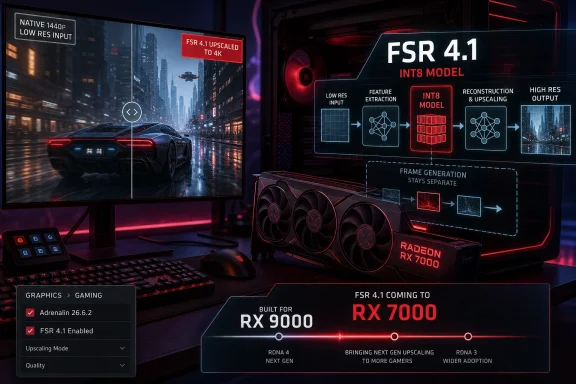
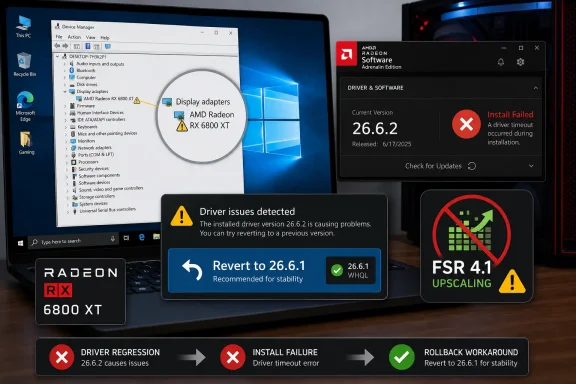
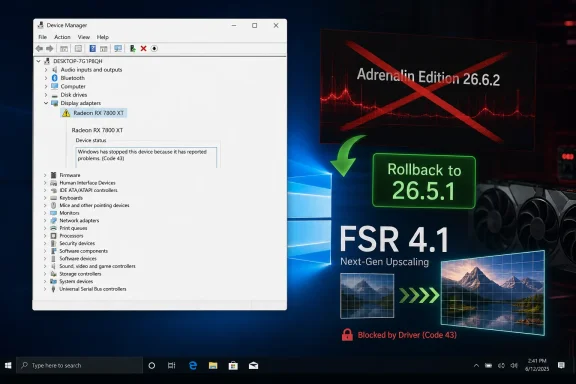
AMD released AMD Software: Adrenalin Edition 26.6.2 WHQL on June 22, 2026, adding FSR Upscaling 4.1 support for Radeon RX 7000 graphics cards while bundling game support, bug fixes, and a familiar roster of unresolved issues for Windows gamers and creators. The headline is not merely that RDNA 3 owners get a new toggle. It is that AMD is using the driver stack to redraw the line between current, recent, and legacy Radeon hardware in a way that gamers will feel immediately. For Windows users, this is less a routine package than another reminder that modern GPU value now arrives in waves, long after the card leaves the box.
There was a time when a graphics driver update meant better frame pacing in a couple of new games, a fixed crash in a niche workload, and perhaps a new control-panel checkbox for the curious. Adrenalin 26.6.2 still contains all of that, but the center of gravity has moved. FSR Upscaling 4.1 arriving for Radeon RX 7000 cards gives RDNA 3 owners a feature that feels closer to a mid-cycle product refresh than a maintenance release.
That matters because Radeon RX 7000 owners have spent the last year watching AMD’s newer GPU families become the natural home for the company’s most visible gaming features. The RX 7000 generation is not old in any practical sense, and many of these cards are still perfectly capable at 1440p and 4K. But in the AI-upscaling era, capability is increasingly defined not only by shader throughput and memory bandwidth, but by which software paths the vendor chooses to enable.
AMD’s move gives RX 7000 users a cleaner answer to a nagging question: will RDNA 3 remain part of the forward feature conversation, or will it become merely “supported” in the thin, security-and-compatibility sense? With 26.6.2, AMD is signaling that RDNA 3 still matters. The company is not pretending every Radeon generation can receive every feature at the same time, but it is also not cutting RX 7000 cards loose from the FSR roadmap.
The Windows angle is obvious. On the PC, a GPU is not a fixed appliance; it is a moving target governed by firmware, driver branches, game profiles, OS scheduling, and engine-specific workarounds. Adrenalin 26.6.2 is a reminder that buying a graphics card today means buying into an update cadence as much as a silicon spec sheet.
FSR 4.1 support on Radeon RX 7000 does not erase that history, but it changes the current conversation for one important audience. RDNA 3 buyers who invested in cards like the Radeon RX 7900 XTX, RX 7900 XT, RX 7800 XT, RX 7700 XT, and RX 7600-class products now get access to AMD’s newer upscaling path without needing to move to a newer GPU family. That gives the installed base more runway and gives AMD a better story in games where upscaling is no longer optional window dressing.
The word upscaling undersells the practical stakes. In modern PC games, especially those built around heavy ray tracing, dense worlds, or ambitious post-processing, upscaling is often the difference between tolerable and smooth. It also shapes how users perceive a card’s longevity. A GPU that can render a game natively at acceptable settings is valuable, but a GPU that can use newer reconstruction techniques convincingly may remain viable for much longer.
That is why the 26.6.2 release lands as more than a checkbox. AMD is trying to keep RX 7000 in the performance conversation without pretending the underlying silicon has changed. For owners who bought RDNA 3 expecting a multi-year gaming platform, that distinction matters.
AMD has learned, as Nvidia and Intel have, that day-one compatibility is no longer a luxury. Major PC releases now arrive with complex rendering stacks, shader compilation behavior, anti-cheat integrations, frame generation options, and overlay interactions. A driver update timed to those launches is partly about performance and partly about avoiding the first-week support disaster that hardens into folklore.
The two supported games also tell us something about where Radeon optimization pressure sits. DOOM titles have historically been associated with efficient engines and strong low-level API work, while Ubisoft’s open-world catalog tends to stress a different mix of CPU scheduling, streaming, and GPU throughput. A single driver that supports both is not just carrying profiles; it is carrying AMD’s promise that the Radeon stack will behave predictably across very different engine assumptions.
For Windows gamers, this is the hidden bargain of staying current. The driver that adds a feature you want may also be the driver that changes behavior in a game you already play. That is why WHQL status still carries psychological weight, even if experienced users know certification is not a guarantee of perfection.
Adrenalin 26.6.2 illustrates the distinction neatly. AMD is confident enough to ship this as a WHQL package, but the release notes still include known issues that will make some users pause. That is not hypocrisy; it is modern GPU software reality. The Windows graphics stack has too many permutations for a clean bill of health to mean universal safety.
For enthusiasts, the practical reading is simple: WHQL should reduce baseline risk, not eliminate judgment. If you are chasing FSR 4.1 on an RX 7000 card or preparing for one of the newly supported games, 26.6.2 is the obvious update to test. If your machine is primarily a workstation running Blender or Cinema 4D, the calculus looks very different.
That split is where AMD’s release notes become more than boilerplate. They are a map of who should update quickly and who should wait.
Driver timeouts are among the most frustrating failures in PC gaming because they blur the line between software instability and hardware suspicion. A user who sees the display reset or the game crash may start questioning temperatures, undervolts, power supplies, Windows updates, and game files before discovering the issue is driver-side. Fixes like this rarely dominate headlines, but they quietly restore trust.
The HP Reverb G2 fix is just as revealing. AMD notes that a purple screen may be displayed when using the headset with SteamVR on Radeon RX 6000 graphics products, and 26.6.2 includes a correction for that class of problem. That is notable because the RX 6000 series is not the star of this release, yet AMD is still addressing a real user-facing VR issue on RDNA 2.
VR remains one of the least forgiving PC workloads. Latency, display output behavior, compositor timing, USB quirks, and SteamVR interactions can turn a small graphics bug into a headset-breaking experience. A purple screen in a monitor game is annoying; a purple screen in a headset is an immersion-destroying failure that can make the platform feel unreliable.
These fixes do not transform the driver into a universal upgrade. They do, however, show AMD doing the unglamorous work that keeps older Radeon owners from feeling abandoned. That matters at a time when GPU vendors increasingly reserve the most marketable features for newer hardware.
The Ryzen AI 9 HX 370 is not a desktop graphics card; it is a modern mobile APU platform where CPU, integrated graphics, power management, firmware, and Windows scheduling all meet in a tighter thermal envelope. A crash there can be harder to isolate than a discrete GPU issue in a tower. It also matters because mobile Windows gaming is no longer a sideshow. Handhelds, thin gaming laptops, and creator notebooks have made integrated and semi-integrated graphics behavior far more visible.
AMD also lists texture flickering or corruption while playing Battlefield 6 with AMD Record and Stream on some AMD graphics products. This is exactly the sort of bug that reflects how complicated the modern driver package has become. The graphics driver is not just drawing frames; it is recording, encoding, overlaying, capturing, optimizing, and presenting a software dashboard that users expect to coexist with the game engine.
Then there is the FSR-specific known issue. AMD says FSR Upscaling and FSR Frame Generation may show as inactive in AMD Software: Adrenalin Edition while playing Battlefield 6 when enabled on Radeon RX 9000 series graphics products. That is a particularly awkward bug because it touches the very category of feature AMD wants users to care about. If the software cannot reliably communicate whether FSR features are active, users lose confidence in the stack even when the game itself may be rendering correctly.
This is the paradox of the AI-assisted gaming era. Upscaling and frame generation are marketed as simple switches, but under the hood they depend on game integration, driver recognition, overlay reporting, motion vectors, frame pacing, and presentation logic. When any one layer misreports state, the user’s trust in the entire feature chain takes a hit.
That is a striking recommendation. AMD is effectively telling some creator users that the newest WHQL driver is not necessarily the best driver for their work. This is not unusual in professional graphics workflows, but it is important because many enthusiast PCs now straddle gaming and production. The same RX 7900 XT that plays DOOM at night may render Blender scenes during the day.
For creators, reliability often outranks feature freshness. A driver that adds FSR 4.1 for games but introduces rendering instability in a production app is not an upgrade; it is a risk. AMD’s recommendation to fall back to 26.3.1 gives users a concrete escape route, but it also underscores the fragmentation problem built into unified consumer driver packages.
This is where Windows administrators and power users should be especially cautious. A home gaming rig can tolerate experimentation. A lab machine, a student workstation, a freelance artist’s PC, or a small studio render node cannot treat every driver as disposable. The correct driver is the one that supports the workload, not necessarily the one with the newest version number.
This is a new kind of fragility for Windows users. Traditional driver installation problems were local: corrupted packages, old remnants, permissions, antivirus interference, or Windows Update conflicts. The AI Bundle issue introduces a wider dependency chain. If regional access to developer platforms is constrained, a feature bundle can fail even if the GPU, operating system, and installer are otherwise functioning normally.
That may be acceptable for optional extras, but it complicates the user experience. AMD wants Radeon hardware to participate in local AI workflows, and that means software distribution has to become more resilient. Users should not need to understand the global availability of GitHub or Hugging Face to know why an installer failed.
For IT pros, the lesson is familiar. Any driver package that reaches outside itself during installation needs to be tested in the same network environment where it will be deployed. Proxies, regional restrictions, content filters, and firewall rules are not peripheral concerns anymore. They are part of whether a GPU feature can be installed at all.
AMD has to manage this carefully. If it pushes too many features only to the newest cards, it risks alienating users who bought powerful hardware recently. If it backports too aggressively, it may slow optimization for the newest silicon or enable features that do not perform well enough to satisfy users. Adrenalin 26.6.2 looks like an attempt to split the difference: give RX 7000 owners a substantial feature win, keep RX 6000 users in the bug-fix loop, and continue refining RX 9000 behavior.
The move is also competitive. Nvidia has trained the market to think of GPU value in terms of a feature ecosystem, not just raster performance. AMD has historically countered with openness, pricing pressure, and broad compatibility, but it still needs to prove that Radeon software will age well. Bringing FSR 4.1 to RDNA 3 is one way to argue that a Radeon purchase has a longer software tail than skeptics assume.
Still, the release does not answer every question. Users with RDNA 2 and older cards will reasonably ask which future features are impossible, which are merely deprioritized, and which might arrive later. AMD does not need to support every feature forever, but it does need clear communication. Silence is where resentment grows.
But manual updating carries its own burden. Users must decide whether to perform a standard in-place upgrade, use AMD’s cleanup tools, roll back after trouble, or wait for community feedback. That decision becomes harder when a driver contains both a desirable feature and a serious known issue for a different workload.
The cleanest approach is workload-based. A gaming-only RX 7000 system chasing FSR 4.1 should evaluate 26.6.2 quickly, especially if the user plays newly supported titles or has been affected by RoadCraft instability. A Blender-heavy workstation on RX 7000 or newer should treat AMD’s 26.3.1 recommendation as a red flag. A VR user with an HP Reverb G2 on RX 6000 has a stronger reason to update than another RX 6000 owner who is otherwise stable.
This is not the simple world of “always install the latest driver.” It is the more mature, more annoying world of driver selection as systems management. WindowsForum readers know that world well.
That makes bugs in the control layer more consequential. If Record and Stream can trigger texture corruption in Battlefield 6, the overlay is not merely cosmetic. If AMD Software reports FSR features as inactive when enabled, the dashboard becomes a source of confusion rather than clarity. If AI Bundle components fail to install because of external access limitations, the package’s ambitions exceed the reliability of its delivery path.
This is not unique to AMD. Nvidia App, Intel Graphics Software, Steam overlays, Discord overlays, Xbox Game Bar, capture utilities, and RGB tools all compete for space in the same fragile ecosystem. But AMD’s challenge is acute because Radeon’s reputation has long been tied to driver perception. Every visible software hiccup can revive old stereotypes, even when the underlying driver is technically sound.
The solution is not to strip Adrenalin down to nothing. Users genuinely want recording, tuning, metrics, game profiles, and feature visibility in one place. The solution is to make the control layer feel boringly dependable. In 2026, that may be as important as another few percentage points of performance.
For RX 7000 owners, FSR Upscaling 4.1 is the major draw. The update gives RDNA 3 a more current footing in supported games and helps protect the value of cards that still have plenty of life left. If gaming is the priority, this is the kind of driver release that deserves attention.
For users on RX 6000, the calculus is narrower. The HP Reverb G2 and SteamVR fix may be important, but this is not a broad feature upgrade for RDNA 2. That does not make it irrelevant. It simply means RX 6000 users should update for a reason, not because the version number changed.
For creators, the warnings are strong enough to override the marketing. If Blender or Cinema 4D stability matters, AMD’s own guidance points affected users back to 26.3.1. That is the line in the release notes that should stop workstation owners from treating WHQL as a blanket endorsement.
AMD’s 26.6.2 WHQL driver is a welcome release for Radeon RX 7000 gamers because it brings FSR 4.1 to hardware that deserves a longer feature life, but it is also a reminder that the modern Windows graphics stack has become too sprawling for one update to be good news for everyone. The future of Radeon will not be judged only by launch-day benchmarks or raw frame rates; it will be judged by how consistently AMD can extend features backward, fix regressions forward, and tell users plainly when the newest driver is not the right driver for their machine.
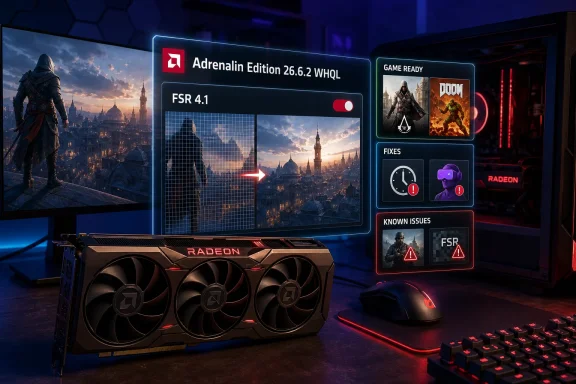 AMD Turns a Driver Drop Into a Product-Life Extension
There was a time when a graphics driver update meant better frame pacing in a couple of new games, a fixed crash in a niche workload, and perhaps a new control-panel checkbox for the curious. Adrenalin 26.6.2 still contains all of that, but the center of gravity has moved. FSR Upscaling 4.1 arriving for Radeon RX 7000 cards gives RDNA 3 owners a feature that feels closer to a mid-cycle product refresh than a maintenance release.That matters because Radeon RX 7000 owners have spent the last year watching AMD’s newer GPU families become the natural home for the company’s most visible gaming features. The RX 7000 generation is not old in any practical sense, and many of these cards are still perfectly capable at 1440p and 4K. But in the AI-upscaling era, capability is increasingly defined not only by shader throughput and memory bandwidth, but by which software paths the vendor chooses to enable.
AMD’s move gives RX 7000 users a cleaner answer to a nagging question: will RDNA 3 remain part of the forward feature conversation, or will it become merely “supported” in the thin, security-and-compatibility sense? With 26.6.2, AMD is signaling that RDNA 3 still matters. The company is not pretending every Radeon generation can receive every feature at the same time, but it is also not cutting RX 7000 cards loose from the FSR roadmap.
The Windows angle is obvious. On the PC, a GPU is not a fixed appliance; it is a moving target governed by firmware, driver branches, game profiles, OS scheduling, and engine-specific workarounds. Adrenalin 26.6.2 is a reminder that buying a graphics card today means buying into an update cadence as much as a silicon spec sheet.
FSR 4.1 Is the Feature AMD Needed to Backport
FSR has always been AMD’s answer to a problem Nvidia helped define: how do you make expensive pixels cheaper without making the image look cheap? Early FidelityFX Super Resolution versions leaned heavily on broad hardware compatibility. That gave AMD a philosophical advantage, especially among users who disliked proprietary feature locks, but it also left Radeon owners comparing FSR’s image quality and temporal stability against more aggressively integrated alternatives.FSR 4.1 support on Radeon RX 7000 does not erase that history, but it changes the current conversation for one important audience. RDNA 3 buyers who invested in cards like the Radeon RX 7900 XTX, RX 7900 XT, RX 7800 XT, RX 7700 XT, and RX 7600-class products now get access to AMD’s newer upscaling path without needing to move to a newer GPU family. That gives the installed base more runway and gives AMD a better story in games where upscaling is no longer optional window dressing.
The word upscaling undersells the practical stakes. In modern PC games, especially those built around heavy ray tracing, dense worlds, or ambitious post-processing, upscaling is often the difference between tolerable and smooth. It also shapes how users perceive a card’s longevity. A GPU that can render a game natively at acceptable settings is valuable, but a GPU that can use newer reconstruction techniques convincingly may remain viable for much longer.
That is why the 26.6.2 release lands as more than a checkbox. AMD is trying to keep RX 7000 in the performance conversation without pretending the underlying silicon has changed. For owners who bought RDNA 3 expecting a multi-year gaming platform, that distinction matters.
Game-Ready Drivers Are Now Reputation Management
The release also adds support for Assassin’s Creed Black Flag Resynced and DOOM: The Dark Ages | Revelations, which is the traditional “game-ready” portion of the package. These entries are easy to skim past, but they are a core part of how GPU vendors defend their reputations. A new game that launches poorly on a given driver can quickly become a Reddit thread, a support ticket, and a brand narrative.AMD has learned, as Nvidia and Intel have, that day-one compatibility is no longer a luxury. Major PC releases now arrive with complex rendering stacks, shader compilation behavior, anti-cheat integrations, frame generation options, and overlay interactions. A driver update timed to those launches is partly about performance and partly about avoiding the first-week support disaster that hardens into folklore.
The two supported games also tell us something about where Radeon optimization pressure sits. DOOM titles have historically been associated with efficient engines and strong low-level API work, while Ubisoft’s open-world catalog tends to stress a different mix of CPU scheduling, streaming, and GPU throughput. A single driver that supports both is not just carrying profiles; it is carrying AMD’s promise that the Radeon stack will behave predictably across very different engine assumptions.
For Windows gamers, this is the hidden bargain of staying current. The driver that adds a feature you want may also be the driver that changes behavior in a game you already play. That is why WHQL status still carries psychological weight, even if experienced users know certification is not a guarantee of perfection.
WHQL Still Means Something, Just Not Everything
The WHQL label is useful, but it is often misunderstood. It tells users that the driver has passed Microsoft’s certification process for Windows compatibility. It does not mean every game, headset, creator application, overlay, and edge-case hardware combination has been fully cleared in the wild.Adrenalin 26.6.2 illustrates the distinction neatly. AMD is confident enough to ship this as a WHQL package, but the release notes still include known issues that will make some users pause. That is not hypocrisy; it is modern GPU software reality. The Windows graphics stack has too many permutations for a clean bill of health to mean universal safety.
For enthusiasts, the practical reading is simple: WHQL should reduce baseline risk, not eliminate judgment. If you are chasing FSR 4.1 on an RX 7000 card or preparing for one of the newly supported games, 26.6.2 is the obvious update to test. If your machine is primarily a workstation running Blender or Cinema 4D, the calculus looks very different.
That split is where AMD’s release notes become more than boilerplate. They are a map of who should update quickly and who should wait.
The Fixes Are Narrow, But They Matter to the People Hit by Them
AMD says 26.6.2 addresses an intermittent application crash or driver timeout while playing RoadCraft on Radeon RX 7000 series products. For the average user, that sounds like a small fix for a specific title on a specific generation. For the affected player, it is the difference between a playable game and a session-ending timeout.Driver timeouts are among the most frustrating failures in PC gaming because they blur the line between software instability and hardware suspicion. A user who sees the display reset or the game crash may start questioning temperatures, undervolts, power supplies, Windows updates, and game files before discovering the issue is driver-side. Fixes like this rarely dominate headlines, but they quietly restore trust.
The HP Reverb G2 fix is just as revealing. AMD notes that a purple screen may be displayed when using the headset with SteamVR on Radeon RX 6000 graphics products, and 26.6.2 includes a correction for that class of problem. That is notable because the RX 6000 series is not the star of this release, yet AMD is still addressing a real user-facing VR issue on RDNA 2.
VR remains one of the least forgiving PC workloads. Latency, display output behavior, compositor timing, USB quirks, and SteamVR interactions can turn a small graphics bug into a headset-breaking experience. A purple screen in a monitor game is annoying; a purple screen in a headset is an immersion-destroying failure that can make the platform feel unreliable.
These fixes do not transform the driver into a universal upgrade. They do, however, show AMD doing the unglamorous work that keeps older Radeon owners from feeling abandoned. That matters at a time when GPU vendors increasingly reserve the most marketable features for newer hardware.
Battlefield 6 Is the Driver’s Most Visible Caveat
The most interesting unresolved problems in 26.6.2 cluster around Battlefield 6. AMD lists an intermittent application crash or driver timeout while playing the game on AMD Ryzen AI 9 HX 370, with the company saying it is working with the developer on a resolution. That phrasing matters because it suggests the fault line may run through more than a single driver component.The Ryzen AI 9 HX 370 is not a desktop graphics card; it is a modern mobile APU platform where CPU, integrated graphics, power management, firmware, and Windows scheduling all meet in a tighter thermal envelope. A crash there can be harder to isolate than a discrete GPU issue in a tower. It also matters because mobile Windows gaming is no longer a sideshow. Handhelds, thin gaming laptops, and creator notebooks have made integrated and semi-integrated graphics behavior far more visible.
AMD also lists texture flickering or corruption while playing Battlefield 6 with AMD Record and Stream on some AMD graphics products. This is exactly the sort of bug that reflects how complicated the modern driver package has become. The graphics driver is not just drawing frames; it is recording, encoding, overlaying, capturing, optimizing, and presenting a software dashboard that users expect to coexist with the game engine.
Then there is the FSR-specific known issue. AMD says FSR Upscaling and FSR Frame Generation may show as inactive in AMD Software: Adrenalin Edition while playing Battlefield 6 when enabled on Radeon RX 9000 series graphics products. That is a particularly awkward bug because it touches the very category of feature AMD wants users to care about. If the software cannot reliably communicate whether FSR features are active, users lose confidence in the stack even when the game itself may be rendering correctly.
This is the paradox of the AI-assisted gaming era. Upscaling and frame generation are marketed as simple switches, but under the hood they depend on game integration, driver recognition, overlay reporting, motion vectors, frame pacing, and presentation logic. When any one layer misreports state, the user’s trust in the entire feature chain takes a hit.
Creators Get the Warning Label Gamers Often Ignore
The most consequential warning in AMD’s notes may not be for gamers at all. AMD says model flickering or rendering failure may appear in Maxon Cinema 4D and Blender on Radeon RX 7000 series and newer graphics products, and it recommends affected users install Adrenalin Edition 26.3.1. The company also flags intermittent application crashes on some models while running Blender on Radeon RX 7000 and newer products, again pointing users back to 26.3.1.That is a striking recommendation. AMD is effectively telling some creator users that the newest WHQL driver is not necessarily the best driver for their work. This is not unusual in professional graphics workflows, but it is important because many enthusiast PCs now straddle gaming and production. The same RX 7900 XT that plays DOOM at night may render Blender scenes during the day.
For creators, reliability often outranks feature freshness. A driver that adds FSR 4.1 for games but introduces rendering instability in a production app is not an upgrade; it is a risk. AMD’s recommendation to fall back to 26.3.1 gives users a concrete escape route, but it also underscores the fragmentation problem built into unified consumer driver packages.
This is where Windows administrators and power users should be especially cautious. A home gaming rig can tolerate experimentation. A lab machine, a student workstation, a freelance artist’s PC, or a small studio render node cannot treat every driver as disposable. The correct driver is the one that supports the workload, not necessarily the one with the newest version number.
The AI Bundle Problem Shows the Limits of a Global Installer
AMD also lists a failure to install AI Bundle components in some regions with limited access to Hugging Face and GitHub. That line reads almost mundane until you consider what it says about the direction of PC driver packages. GPU drivers are no longer self-contained slabs of display code; they increasingly act as gateways to AI tools, model downloads, SDK components, and cloud-hosted dependencies.This is a new kind of fragility for Windows users. Traditional driver installation problems were local: corrupted packages, old remnants, permissions, antivirus interference, or Windows Update conflicts. The AI Bundle issue introduces a wider dependency chain. If regional access to developer platforms is constrained, a feature bundle can fail even if the GPU, operating system, and installer are otherwise functioning normally.
That may be acceptable for optional extras, but it complicates the user experience. AMD wants Radeon hardware to participate in local AI workflows, and that means software distribution has to become more resilient. Users should not need to understand the global availability of GitHub or Hugging Face to know why an installer failed.
For IT pros, the lesson is familiar. Any driver package that reaches outside itself during installation needs to be tested in the same network environment where it will be deployed. Proxies, regional restrictions, content filters, and firewall rules are not peripheral concerns anymore. They are part of whether a GPU feature can be installed at all.
RDNA 3 Gains Ground While Older Cards Hold the Line
The release’s generational politics are subtle but important. Radeon RX 7000 cards receive the marquee FSR 4.1 support. Radeon RX 6000 cards receive a meaningful VR-related fix. Radeon RX 9000 cards show up in known issues involving FSR reporting in Battlefield 6. The result is not a clean hierarchy so much as a snapshot of a driver stack stretched across multiple architectures.AMD has to manage this carefully. If it pushes too many features only to the newest cards, it risks alienating users who bought powerful hardware recently. If it backports too aggressively, it may slow optimization for the newest silicon or enable features that do not perform well enough to satisfy users. Adrenalin 26.6.2 looks like an attempt to split the difference: give RX 7000 owners a substantial feature win, keep RX 6000 users in the bug-fix loop, and continue refining RX 9000 behavior.
The move is also competitive. Nvidia has trained the market to think of GPU value in terms of a feature ecosystem, not just raster performance. AMD has historically countered with openness, pricing pressure, and broad compatibility, but it still needs to prove that Radeon software will age well. Bringing FSR 4.1 to RDNA 3 is one way to argue that a Radeon purchase has a longer software tail than skeptics assume.
Still, the release does not answer every question. Users with RDNA 2 and older cards will reasonably ask which future features are impossible, which are merely deprioritized, and which might arrive later. AMD does not need to support every feature forever, but it does need clear communication. Silence is where resentment grows.
Windows Update Is Not the Strategy Enthusiasts Need
For casual users, the safest GPU driver may be the one Windows offers automatically. For enthusiasts, that is rarely enough. A release like 26.6.2 is exactly why many Radeon owners still download drivers directly from AMD: the timing, feature set, and game profiles matter too much to leave entirely to Windows Update’s slower and more conservative channel.But manual updating carries its own burden. Users must decide whether to perform a standard in-place upgrade, use AMD’s cleanup tools, roll back after trouble, or wait for community feedback. That decision becomes harder when a driver contains both a desirable feature and a serious known issue for a different workload.
The cleanest approach is workload-based. A gaming-only RX 7000 system chasing FSR 4.1 should evaluate 26.6.2 quickly, especially if the user plays newly supported titles or has been affected by RoadCraft instability. A Blender-heavy workstation on RX 7000 or newer should treat AMD’s 26.3.1 recommendation as a red flag. A VR user with an HP Reverb G2 on RX 6000 has a stronger reason to update than another RX 6000 owner who is otherwise stable.
This is not the simple world of “always install the latest driver.” It is the more mature, more annoying world of driver selection as systems management. WindowsForum readers know that world well.
The Control Panel Has Become Part of the Gaming Surface
One of the quiet threads running through the release notes is AMD Software itself. The Adrenalin application is no longer just a settings panel. It is a launcher-adjacent overlay, a recording suite, a performance monitor, an upscaling status surface, an update manager, and, increasingly, a bridge to AI features.That makes bugs in the control layer more consequential. If Record and Stream can trigger texture corruption in Battlefield 6, the overlay is not merely cosmetic. If AMD Software reports FSR features as inactive when enabled, the dashboard becomes a source of confusion rather than clarity. If AI Bundle components fail to install because of external access limitations, the package’s ambitions exceed the reliability of its delivery path.
This is not unique to AMD. Nvidia App, Intel Graphics Software, Steam overlays, Discord overlays, Xbox Game Bar, capture utilities, and RGB tools all compete for space in the same fragile ecosystem. But AMD’s challenge is acute because Radeon’s reputation has long been tied to driver perception. Every visible software hiccup can revive old stereotypes, even when the underlying driver is technically sound.
The solution is not to strip Adrenalin down to nothing. Users genuinely want recording, tuning, metrics, game profiles, and feature visibility in one place. The solution is to make the control layer feel boringly dependable. In 2026, that may be as important as another few percentage points of performance.
The Smart Upgrade Path Depends on the Machine, Not the Marketing
The right way to read Adrenalin 26.6.2 is not as a universal recommendation. It is a targeted release with one major feature expansion, a couple of meaningful fixes, and several warnings that should influence who installs it today. That is not a criticism; it is the reality of a driver package serving gamers, creators, VR users, laptop owners, streamers, and AI experimenters at once.For RX 7000 owners, FSR Upscaling 4.1 is the major draw. The update gives RDNA 3 a more current footing in supported games and helps protect the value of cards that still have plenty of life left. If gaming is the priority, this is the kind of driver release that deserves attention.
For users on RX 6000, the calculus is narrower. The HP Reverb G2 and SteamVR fix may be important, but this is not a broad feature upgrade for RDNA 2. That does not make it irrelevant. It simply means RX 6000 users should update for a reason, not because the version number changed.
For creators, the warnings are strong enough to override the marketing. If Blender or Cinema 4D stability matters, AMD’s own guidance points affected users back to 26.3.1. That is the line in the release notes that should stop workstation owners from treating WHQL as a blanket endorsement.
The Radeon 26.6.2 Upgrade Is a Test of Priorities
Adrenalin 26.6.2 is best understood as a fork in the road for different Radeon users. It rewards some systems, merely maintains others, and asks a few to stay behind for now.- Radeon RX 7000 owners gain FSR Upscaling 4.1 support, making this one of the more important RDNA 3 driver updates of the year.
- Players of Assassin’s Creed Black Flag Resynced and DOOM: The Dark Ages | Revelations have a clear reason to install the driver before launch-day or early-session troubleshooting begins.
- Users affected by RoadCraft driver timeouts on RX 7000 or HP Reverb G2 purple-screen behavior on RX 6000 have practical fixes to test.
- Battlefield 6 remains a trouble spot across multiple scenarios, including crashes on Ryzen AI 9 HX 370, capture-related texture problems, and FSR status reporting on RX 9000 cards.
- Blender and Cinema 4D users on RX 7000 and newer hardware should be cautious, because AMD points affected users back to Adrenalin 26.3.1 for stability.
- Anyone deploying AI Bundle components should remember that installer success may depend on access to external platforms such as Hugging Face and GitHub.
AMD’s 26.6.2 WHQL driver is a welcome release for Radeon RX 7000 gamers because it brings FSR 4.1 to hardware that deserves a longer feature life, but it is also a reminder that the modern Windows graphics stack has become too sprawling for one update to be good news for everyone. The future of Radeon will not be judged only by launch-day benchmarks or raw frame rates; it will be judged by how consistently AMD can extend features backward, fix regressions forward, and tell users plainly when the newest driver is not the right driver for their machine.
References
- Primary source: TechPowerUp
Published: 2026-06-22T17:20:42.589002
AMD Releases Adrenalin Edition 26.6.2 WHQL Drivers | TechPowerUp
AMD has released its latest Adrenalin Edition 26.6.2 WHQL Drivers today, bringing FSR Upscaling 4.1 to the RDNA 3 GPU family, commonly known as the Radeon RX 7000 series. This driver release is the second in June, specifically tailored for RDNA 3 gamers, with general improvements for everyone...www.techpowerup.com - Related coverage: technopat.net
RX 7000 serisine FSR 4.1 desteği getiren AMD Radeon 26.6.2 WHQL Sürücüsü Yayınlandı | Technopat Sosyal
Öne Çıkanlar Yeni Özellikler AMD Radeon™ RX 7000 Serisi ekran kartları için AMD FSR Upscaling 4.1 desteği. Yeni Oyun Desteği Assassin's Creed Black Flag...www.technopat.net - Related coverage: techspot.com
AMD Radeon Adrenalin Graphics Driver 26.6.2 Download | TechSpot
Download AMD Radeon Adrenalin Graphics Driver 26.6.2. OS support: Windows (all). Category: Graphics Cardswww.techspot.com - Related coverage: amd.com
AMD Radeon™ RX 6600 Drivers and Downloads | Previous Versions
Get drivers and downloads for the previous versions of AMD Radeon™ RX 6600www.amd.com - Related coverage: tomshardware.com
AMD confirms its Radeon RX 5000, 6000 series cards will still get some new features 'as required by market needs' — company also says RX 7900 USB-C change was a mistake (Updated) | Tom's Hardware
USB-C remains supported on the RX 7900www.tomshardware.com